‘The Refuge Plays,’ Nicole Ari Parker and Daniel J. Watts are Smashing

Nathan Alan Davis’ The Refuge Plays, directed by Patricia McGregor, chronicles a family’s survival with a play whose structure employs an interesting twist. The production, a world premiere, begins in the present and flashes backward in generational segments to 70 years prior, spanning four generations. Though the three plays or segments may stand alone, the characters repeat in each and the thread of the main character’s resilience is the principle linchpin around which the events revolve.
In its world premiere presented by the Roundabout Theatre Company in association with New York Theatre Workshop, The Refuge Plays unspools its epic saga during three hours and twenty minutes, and two intermissions. It runs until November 12th at the Laura Pels Theatre.
In Davis’ epic of family bonds happening away from any social construct after World War II, we note how the reigning matriarch and great, grandmother Early wields subtle power and presence despite her advanced years. The superb Nicole Ari Parker is a standout in the role as she evokes the elderly, middle aged and teenage Early.
Contrasted with her great grandson Ha, Ha (JJ Wynder), who expects others to do for him, Early takes it upon herself to chop wood for the stove which also provides heat, despite her granddaughter Joy’s protests that her seventeen-year old son Ha Ha should be doing the chopping, which he says he doesn’t know how to do.

From that action alone the clue is given that Early’s age belies her life force and vibrancy. Living in this cabin in the woods off the grid, which she and husband Crazy Eddie (the superb Daniel J. Watts), built with their own hands decades before, she makes the best of her roughly-hewn life, which she shares with family. Remaining isolated from culture, technological developments and progress, they have managed to find a measure of comfort and peace that society doesn’t offer. The inference is that is perhaps that is why they are still alive. Though not living in the lap of luxury, they want for nothing. What carries them onward are the the authentic community and relationships they forge with each other.
Davis symbolizes Early as the seminal earth mother who sustains her family’s survival, which we understand watching the characters in the present and their movement into the past. From the outset, we note the elderly Early is determined, feisty, funny and authentic no nonsense with family members.
Though she doesn’t get along with her son’s wife Gail (Jessica Frances Dukes), she allows her to stay with them for the sake of their daughter Joy, who once left then came back. Making cryptic comments at times, Early puts up with Gail, though it is obvious she approves of her granddaughter for what they share. Both mourn Walking Man (Jon Michael Hill), who we hear died in a freak accident when a cow crushed him with its weight as he slaughtered it.
In the first segment, “Protect the Beautiful Place,” Davis sets the tone and presents the four generations of family members living in a two room cabin, cramped together, not seeming to mind the lack of personal and private space. This cabin that they call home is a refuge from all that would destroy and divide them, we realize, by the play’s conclusion.
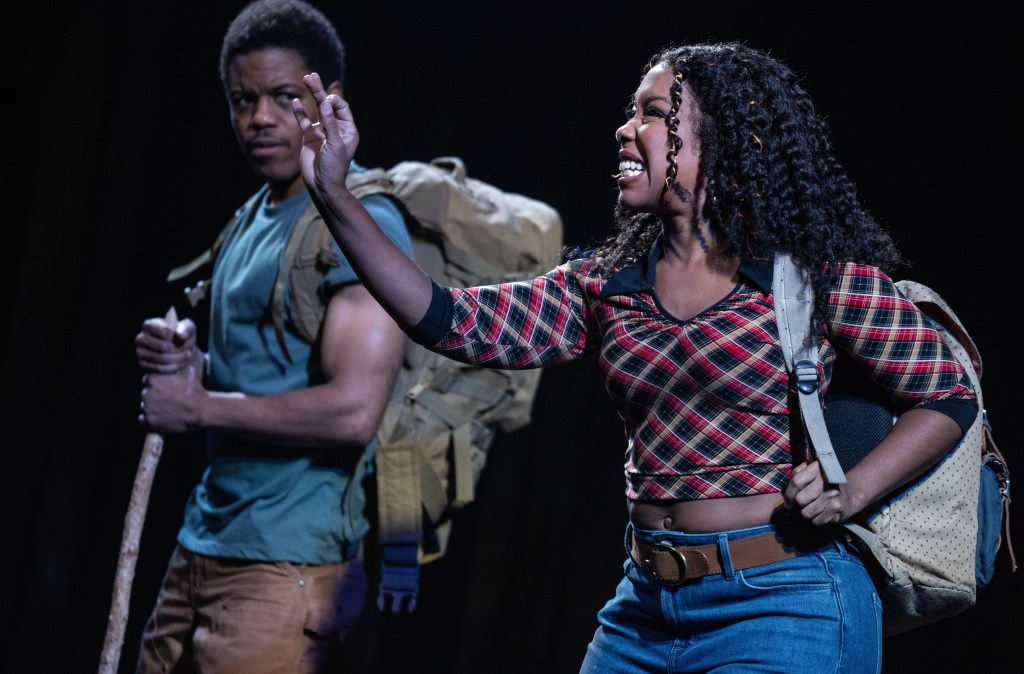
Arnulfo Maldonado’s set design reveals the rawness of their life that indicates economically that they are lower middle class. Only Gail has her own bedroom. Early, Joy and Ha ha sleep together in the living room in a chair, a sofa and the floor. In the same room they cook and eat with spare utilitarian minimalism. The outhouse is around the corner and in the distant past, a younger Early took the water in pails up from the river.
In “Protect the Beautiful Place,” the supernatural eerily wends its way into the family’s routine as they wake up and get ready for their day. The spirit of Gail’s husband Walking Man is a welcome visitor. He moves between the veil of life and the afterlife, and all know of his presence and communicate with him. Recently, he has appeared and announced to Early that Gail will pass on and join him. The family, even Ha ha, accepts this notion, though Gail resists it. During the course of the family interactions, we learn that the women hope that Ha Ha finds a woman to love and have children with to continue the family’s bloodline, though he is only seventeen. We also learn clues about the family history that Davis clarifies in subsequent segments.
When Walking Man visits Gail in a dream, he helps her to make up her mind about joining him. The eventual result occurs through an interesting sequence of events. Thus, we see that the family, encouraged by Early, has created its own myths and folklore which is as natural to them as breathing. Importantly, that one generation has exceeded another is striking and a testament to Early’s resilience and survival instincts. By the conclusion of The Refuge Plays, we understand how Early’s youthful struggles strengthened her, gave her courage and fostered the thriving of this family whose dominance will be taken up by the innocent, clever, book-smart Ha Ha with his new found girlfriend.
The second part, “Walking Man” features Early’s son after he leaves home, wanders to Alaska and other parts of the world, then returns home to his mother and father. Maldonado’s sets include the outdoor space in front of the cabin which is indicated by a front door. During the course of Walking Man’s return home, he talks to his father’s brother, uncle Dax (the humorous Lance Coadie Williams), and two spirits who are his grandparents Clydette (Lizan Mitchell) and Reginald (Jerome Preston Bates). Through them he discovers the truth of his legacy and why he has no birth certificate, why his mother raised him to be self-sufficient and why he is compelled to wander the earth, which he doesn’t understand.

After he learns this truth, Walking Man doesn’t have the heart to confront his mother with the specific details, though he confronts Crazy Eddie who he has accepted as his father. Angry, Walking Man intends to take revenge on the world and kill anyone he finds who exhibits the wickedness of his blood father. Early, stalwart, trusting in God, doesn’t insist with her son, but makes a suggestion and leaves him to his own decisions.
The segment ends with a new influence in Walking Man’s life, his future wife Gail, who the spirits have brought to him. We know this because of the lighter which Gail has been given by Clydette and Reginald and which she uses to light Walking Man’s pipe. The lighter, exhibited by Gail in the first segment which Ha Ha’s girlfriend Symphony (Mallori Taylor Johnson), picks up and uses, reveals the spiritual and ancestral influences that surround this family and guide it to peace and security.
The third segment, “Early’s House” flashes back to Early as a teenager living in the forest with her baby, Walking Man. Through her conversations with Watts’ Crazy Eddie who seeks her out and brings her food, we discover how she has survived through the winter after bearing her child alone. The relationship they develop over the course of the segment is powerfully drawn by Davis and acted with smashing resolve by Parker and Watts. As Crazy Eddie draws her out of herself so she trusts him, similar to how a feral animal is wooed by a well-meaning animal lover, Early reveals herself.
The place by the river she has chosen to be her sanctuary to receive respite and peace. Because she has been forbidden to return home, she determined to turn her back on society and her parents and make it in the woods. Nature has embraced her and with faith in God and the supernatural, she has received sustenance and wisdom to survive with Walking Man.
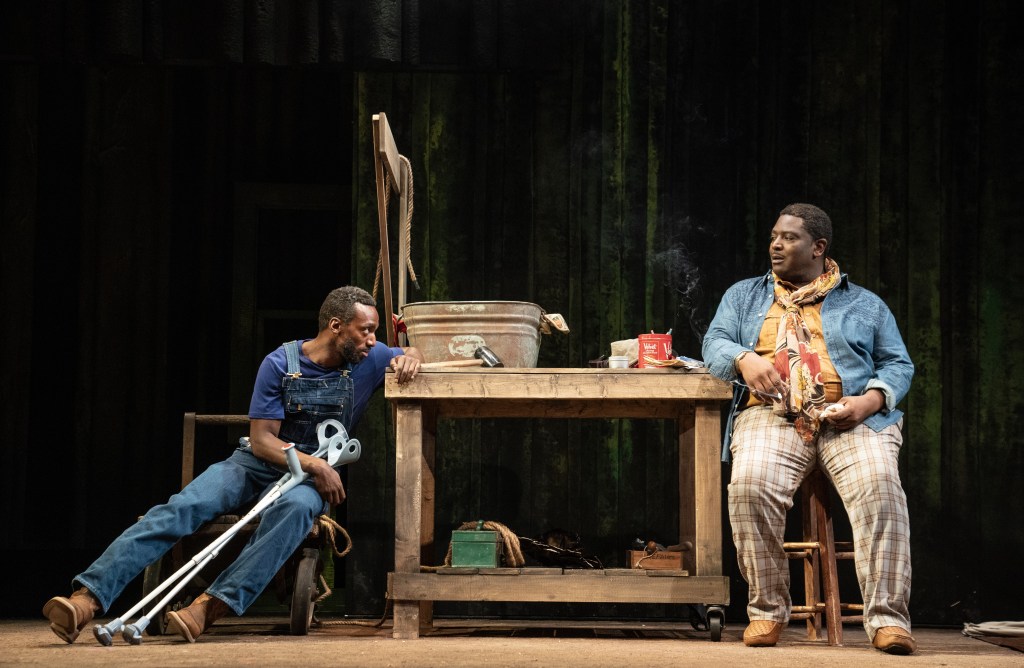
Parker’s amazing portrayal of the young Early reveals the depths of a woman who will fight against all odds to live and care for her child whom she loves. Ironically, there is more peace in nature than there could be found back in her home and former lifestyle which she has renounced to keep Walking Man with her.
The gentle Crazy Eddie is the only one who seeks her out and attempts to help her. Because he, too, has been wounded like Early, hobbled by extensive war injuries, she pities, accepts and trusts him. Both need one another and gradually they receive each other’s help and care. And it is in this place by the river that Eddie and Early sanctify their union and build a rudimentary cabin where they will live and raise Walking Man, whom Eddie unofficially adopts as his son.
“Early’s House” is poignantly written and acted with spot on authenticity. Davis brings together all of the character threads and elements so that we realize how Early compelled herself to forge a family which burgeons and will be sustained past the seventy years that we witness this saga. Excellently directed with fine performances all around, The Refuge Plays is fascinating especially in its structure and poetic, striking dialogue.
A fault at the outset was in the sound design which was corrected in the latter segment. Props go to Emilio Sosa’s costume design, Stacey Derosier’s lighting design, Earon Nealey’s superb hair and wig design and J. Jared Janas make-up design.
For tickets to the unique production, The Refuge Plays, go to their website https://www.roundabouttheatre.org/get-tickets/2023-2024-season/the-refuge-plays/performances

Posted on October 24, 2023, in NYC Theater Reviews, Off Broadway and tagged Nathan Alan Davis, Nicole Ari parker, Patricia McGregor, The Refuge Plays. Bookmark the permalink. Leave a comment.
 CAROLE DI TOSTI
Leave a comment
Comments 0