‘Sunset Blvd.’ A Thrilling, Edgy, Mega Spectacle, Starring Nicole Scherzinger

If you have seen A Doll’s House with Jessica Chastain, Cyrano de Bergerac with James McAvoy or Betrayal with Tom Hiddleston, you know that director Jamie Lloyd’s dramatic approach reimagining the classics is to present an unencumbered stage and few or no props. The reason is paramount. He focuses his vision on the actors’ characters, and their steely, maverick interpretation of the playwright’s dialogue. The actors and dialogue are the theatricality of the drama. Why include extraneous distractions? Using this elusively spare almost spiritual approach which is archetypal and happens in what appears to be pure, electrified consciousness, Lloyd is a throwback to ancient Greek theater, which used few if any sets. As such Lloyd’s reimagining of the magnificently performed, uncluttered, cinematically live spectacle, Sunset Blvd., currently at the St. James Theatre in its second Broadway revival, is a marvel to behold.
The original production, with music by Andrew Lloyd Webber and book and lyrics by Don Black and Christoper Hampton, opened in 1993. Lloyd’s reimagining configures the musical on a predominately black “box” stage that appears cavernous. Soutra Gilmour’s black costumes (with white accessories, belts, Joe’s T-shirt), are carried through to the black backdrop whose projection, at times, is white light against which the actors/dancers gyrate and dance as shadow figures. The white mists and clouds of fog ethereally appear white in contrast to the background. There is one stark exception of blinding color (no spoiler, sorry), toward the last scene of the musical.

As a result, David Cullen and Andrew Lloyd Webber’s orchestrations under Alan Williams’ music supervision/direction sonorously played by the 19 piece orchestra are a standout. The gorgeous, memorable music is a character in itself, one of the points of Lloyd’s stunning production. From the overture to the heightened conclusion, the music carries tragedy lushly, operatically in a fascinating accompaniment/contrast to Lloyd’s spare, highly stylized rendering. On stage there are just the actors, their figures, voices and looming faces, which shine or spook shadows, sinister in the dim light. The immense faces of the main four characters in black and white, like the silent film stars, gleam or horrify. The surreal, hallucinatory effect even abides when the actors/dancers stand in the spotlights, or the towers of LED lights, or huddle in a dance circle as the cinematographer films close-ups thanks to Nathan Amzi & Joe Ransom.
The symbolism of the staging and selection of colors is open to many interpretations, including a ghostly haunting of the of the Hollywood era, which still impacts us today, persisting with some of the most duplicitous values, memes, behaviors and abuses. These are connected to the billion dollar weight loss industry, the medical (surgery and big pharma) industry, the fashion and cosmetics industry, and more. The noxious values referenced include ageism, appearance fascism (unreal concepts of beauty and fashion for women that promote pain, chemical dependence and prejudice), voracious, self-annihilating ambitions, sexual youth exploitation, sexual predation and much more. Lloyd’s stark and austere iteration of Sunset Blvd. promotes such themes that the dazzling full bore set design, etc., drains of meaning via distraction and misdirection.
The narrative is the same. Down and out studio writer Joe Gillis (the exceptional, winsome, authentic Tom Francis), to avoid goons sent to repossess his car, escapes onto the grounds of a dilapidated mansion on the famed Sunset Boulevard in Hollywood. In the driveway, manservant Max (an incredible David Thaxton), mistakes him for someone else and invites him inside. There, Joe meets Norma Desmond (the divine hellion Nicole Scherzinger), a faded icon of the silent screen era in the throes of mania. Norma is “lovingly,” stoked by Max into the delusion that thousands of fans want her to return to her glory days in a new film.
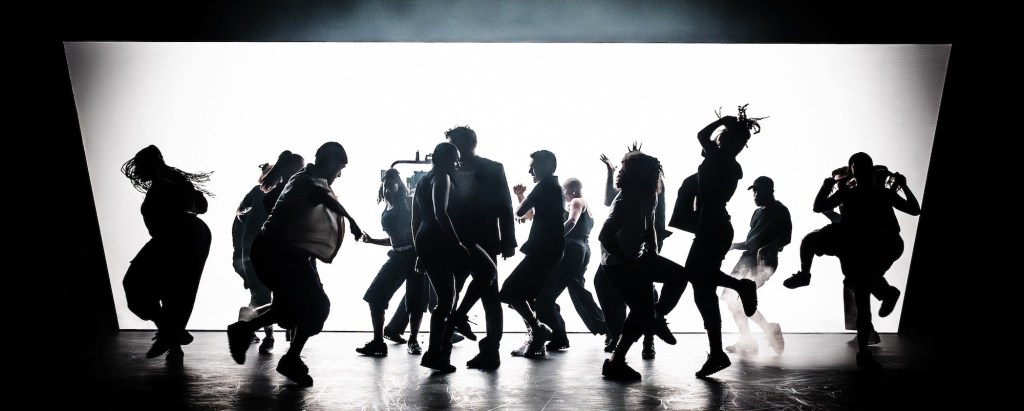
When Norma hears Joe is a screenwriter, like a spider with a fly, she traps him to finish her “come-back” film (she wrote the screenplay). Thus, for champagne, caviar and the thrill of it, he stays, lured by the promise of money, the glamour of old Hollywood and the avoidance of debt collectors. As Norma grows dependent on Joe as her gigolo, he ends up falling for the lovely, unadulterated Betty (the fine, sweet, Grace Hodgett Young). Behind Norma’s back, Joe and Betty collaborate on a script and fall in love. The lies and romance end with the tragic truth.
The seemingly empty stage, tower of lights, spotlights for Norma and live streaming camera closeups projected on the back wall screen, Lloyd is the antithesis of the average director, whose vision focuses on lustrous set design and elaborate costumes and props. In Lloyd’s consciousness-raising universe such gaudy commercialism gaslights away from revealing anything novel or intriguing in the meat of this play’s themes or characterizations, which ultimately excoriate the culture with social commentary.
Soutra Gilmour’s set design and related costumes unmistakenly lay bare the narcissism and twisted values the entertainment industry promotes so that we see the destructive results in the interplay between Max, the indulged Norma and the hapless victim Joe, who tries a scam of his own which fails. Ultimately, all is psychosis, illusions and broken dreams turned into black hallucinations. For a parallel, current example, think of an indulged politician who wears bad make-up that under hot lights makes his face melt like Silly Putty. Again, hallucinations, psychosis, narcissism, egotism that is dangerous and ravenous and never satisfied. Such is the stuff insufferable divas are made of.

In the portrayal of the former Hollywood icon who has faded from the public spotlight and become a recluse, in scene three, when Lloyd presents Gillis meeting Desmond, she is the schizoid goddess and Gorgon radiating her own sunlight via Jack Knowles’ powerful, gleaming spotlights and shimmering lighting design, the only “being” worth looking at against the black background. Throughout, Norma possesses the cavernous space of the stage in surround-view black with white mists jetting out from stage left or right, forming symbolic clouds and fog representing her imagined “divinity” and her confused, fogged-over, abject psychotic hallucinations.
Whenever she “brings forth” from her consciousness “on high,” and empowers her fantasies in song, Lloyd has Knowles bathe her lovingly in a vibrant spotlight. When she emerges from the depths of her bleak mansion of sorrows to sing, “Surrender,” “With One Look,” and later, “As if We Never Said Goodbye,” she brings down the house with a standing ovation. Indeed, Norma Desmond is an immortal. She worships her imagined self at her alter of tribute. Her mammoth consciousness and ethos which Max (Thaxton’s incredible, equally magnificent, hollow-eyed, ghoulish, former husband and current director/keeper of her flaming divinity), perpetuates is key in the tragedy that is her life.
Importantly, Lloyd’s maverick, spare, stripped down approach gives the actors free reign to dig out the core of their characters and materialize their truth. In this musical, the black “empty” stage allows Scherzinger’s Norma to be the primal, raging diva who “will not surrender” to oblivion and death. She is a a god. Like the Gorgon Medusa, she will kill you as soon as look at you. And don’t anyone tell her the truth that she is a “has been.”
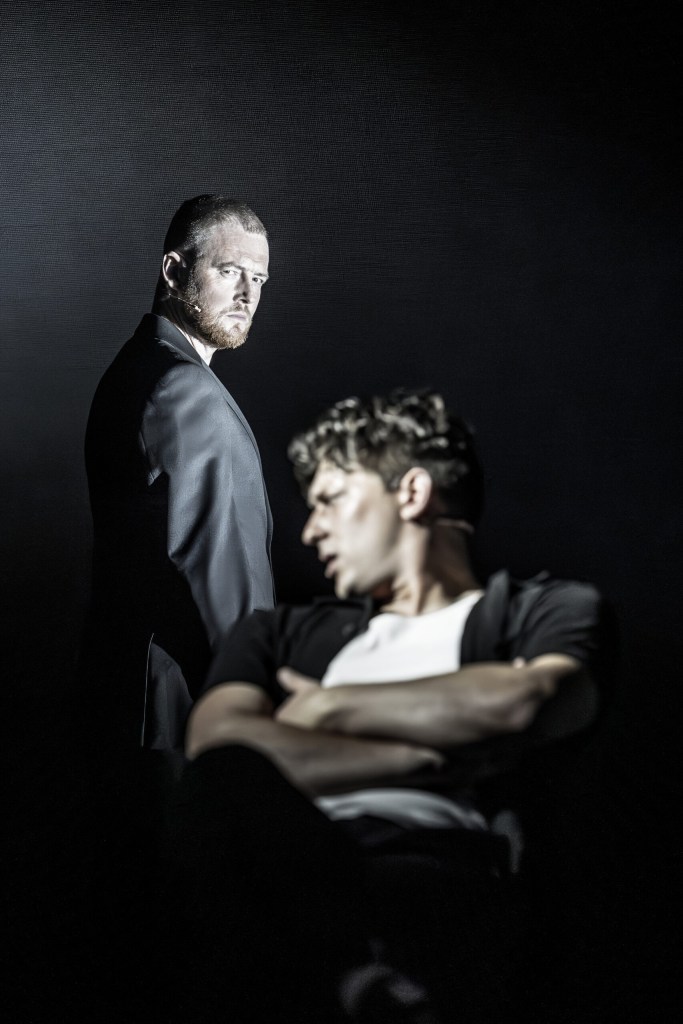
Of course, Joe does this out of a kindness that she refuses to accept. Without the black and white design, and cinematic streaming, a nod to the silent screen, which allows us to focus on faces, performances, magnified gestures and looks, the meanings become unremarkable. The theme-those who speak the truth must die/be killed because the deluded psychotic can’t hear truth-gains preeminence and Lloyd’s archetypal production gives witness to its timelessness. In her most unnuanced form, Norma is a dictator who must be obeyed and worshiped. Such narcissistic sociopaths must be pampered with lies.
Thus, in the last scene, Scherzinger’s Norma stands in bloody regalia as the spiritual devourer who has just annihilated reality and punished Joe. She is permissively allowed to do so by Max, who like a director, encourages her to star in her own tragedy, as he destroys her and himself. As Joe narrates in the flashback from beyond the grave, he expiates his soul’s mistakes with his cleansing confession, as he emphasizes a timeless object lesson.
From a theatrical perspective, the dramatic tension and forward momentum lies with Lloyd’s astute, profound shepherding of the actors in an illusory space. This becomes a fluid field which can shift flexibly each night, revealed when Joe, et. al run in circles and criss-cross the stage wildly. Expressionistic haunting, the foggy mists, the surrounding black stage walls, black costumes, the barefoot diva-hungrily filling up the spotlight-the shadowy figures, all suggest floating cultural nightmares. These the brainwashing “entertainment” industry for decades forces upon its fans to consume their waking moments with fear, the fear of aging, fear of failure, fear of destitution, fear of not being loved, fear of being alone. Many of these fears are conveyed in the songs, and dance numbers in Fabian Aloise’s choreography.

And yet, when the protagonist takes control of the black space of the stage around her, we understand how this happens. She is mesmerizing, hypnotic. Seduced by what we perceive is gorgeousness, we don’t see the terror, panic and mania beneath the shining surface. Instead, we are drawn as if she indomitably, courageously stands at the edge of the universe and asserts her being. In all of her growing insanity, we admire her persistence in driving toward her desire to be remembered and worshiped. Though it may not be in the medium she wishes, her provocations and Max’s love and loyalty help her achieve this dream, albeit, an infamous one, by the conclusion, as gory and macabre as Lloyd ironically makes it. Indeed, by the end her hallucination devours her.
Sunset Blvd is a sardonic send up of old Hollywood’s pernicious cruelty and savagery in how it ground up its employees (“Let’s Have Lunch,” Aloise’s brilliant factory town, conveyor belt choreography, referencing the cynical deadening of Joe’s dreams), and how it made its movie star icons into caricatures that bound their souls in cages of time and youth. Also, it is a drop down into tropes of cinema today in its penchant for horror, psychosis and the macabre, represented by Lloyd’s phenomenal creative team which elucidates this in the color scheme, mists, and starkly hyper-drive, electric atmosphere and movement.

Finally, in one of the most engaging, and exuberantly ironic segments filmed live, right before Act II, when Joe sings Sunset Blvd. with wry, humorous majesty, Tom Francis merges the character with himself as a Broadway/entertainment industry actor. During a live-recorded journey unveiling backstage “reality,” Francis/Joe moves downstairs, inside the bowels of the theater and in the actors’ spaces, so we see the actors’ view, from the stairwell to dressing rooms. Then Francis moves out onto 44th Street, joined by the chorus to eventually move back inside the theater and on stage where they finish singing “Sunset Blvd,” in a thematic parallel of Broadway and Hollywood. Broadway with its wicked inclination to sacrifice art for dollars, truth for commercialism with insane ticket prices, is the same if not worse than Hollywood, until now with AI fueling Amazon, Apple, Google, etc.
However, Broadway came first and spawned the movie industry, which poached actors from “the great white way.” Lloyd clearly makes the connection that the self-destructive dangers of the entertainment industry are the same, whether stage, screen, TV or Tik Tok. The competing themes are fascinating and the lightening strike into the “reality of backstage theater,” refreshes with funny split-second vignettes. For example, Francis peeks into Thaxton’s dressing room. Humorously merging with his character Max, Thaxton ogles a photo of the Pussycat Dolls taped to his mirror. Scherzinger was a former member of the global, best-selling music group (The Pussycat Dolls).

As Lloyd’s most expressionistic pared down, superbly technical extravaganza to date, every thrilling moment holds dynamic feeling, sharply illustrated for maximum impact. As an apotheosis of rage when her gigolo lover speaks the truth that dare not be spoken, Scherzinger’s Desmond becomes primal, a banshee, a Gorgon, a Medea who “refuses to surrender” to the idea that Hollywood, a treasured lover, like Jason, abandoned her for new goddesses.
With cosmic rage Scherzinger releases every, living, fiery nerve of vengeance to destroy the who and what that she can never believe. Meanwhile, Max, her evil twin, with clever prestidigitation, in one final act of loyalty to protect her febrile, mad, entangled imagination, has her get ready for the cameras and close-up, despite Joe’s tell-tale gore on her “black slip,” face and hands, which the media can feed off of like flies. No matter, she sucks up all the spotlight hungrily, clueless she will share a solitary room in a padded sell with no one in a prison for the mentally insane. Perhaps.
This revival should not be missed. Sunset Blvd. with one intermission, two hours 35 minutes is at the St. James Theatre until March 22, 2025 https://sunsetblvdbroadway.com/?gad_source=1

Posted on October 28, 2024, in Broadway and tagged Andrew Lloyd Webber, David Thaxton, Don Black & Christopher Hampton, Grace Hodgett Young, Jamie Lloyd, musical, Nicole Scherzinger, review, sunset-boulevard, theatre, Tom Francis. Bookmark the permalink. Leave a comment.
 CAROLE DI TOSTI
Leave a comment
Comments 0