‘The Blood Quilt,’ Threading an Ancestral Masterpiece of Hope
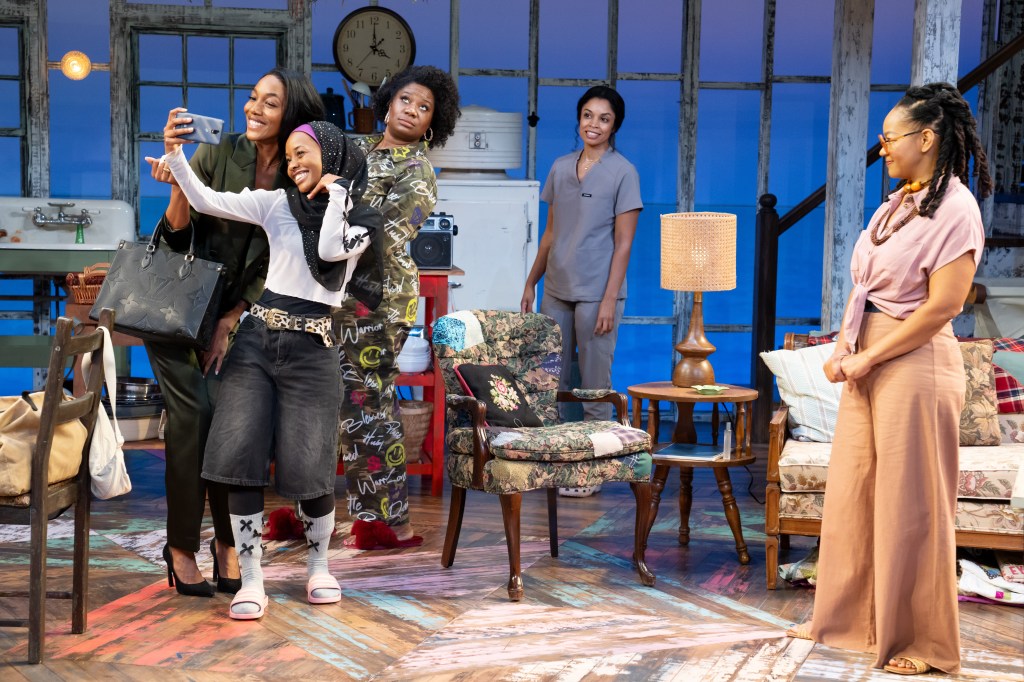
The Blood Quilt
In her ambitious layering of the story of four half-sisters who gather to finally lay to rest their recently deceased mother, Katori Hall, with astute direction by Lileana Blain-Cruz, focuses on complex family dynamics, jealousies, misunderstandings and secrets. The confluence of emotions roil the souls of each sister and a teenage niece, paralleling the stormy seas which crash waves onto the setting, Kwemera Island, Georgia. The culmination of fiery anger, pain and sadness releases in the rituals of quilting and the soul healing of family connections in mysticism, dance and song.
By the conclusion of the two-act drama, currently at LCT’s Mitzie E. Newhouse until December 29, we know the fabric of each of the sister’s lives. As a result we thrill with them when they are able to reconcile their inner wounds and cast them into the sea. It is in the waters fronting the small country cabin they call home, where ancestors have been buried in a symbolic tradition that the eldest sister Clementine speaks of with power, “We all came from the water and we all must return.”
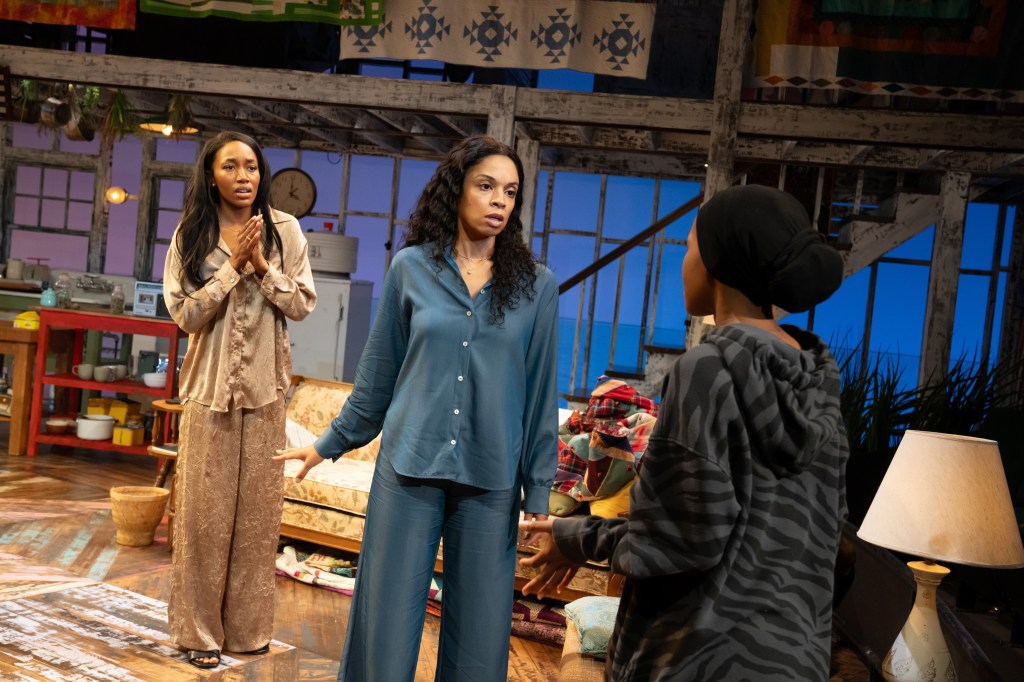
The characters are the patchworks that make up the family masterpiece
Much of the beauty of Hall’s drama, laced with comedic elements, comes from her precise characterizations of the disparate sisters who share the same mother but have different fathers. They are the patchworks that make up the last quilted masterpiece that their mother designed and they gather to finish.
Clementine, Gio, Amber
Clementine (Crystal Dickinson), is the eldest, who lives in the incredible ancestral home. Adam Rigg’s set design hums with authenticity, warmth and life. The cabin is decorated with generational family quilts that cover walls and the balcony railing, each colorful, individual, symbolic. Family ownership of the “chic” cabin with the sea in its front yard is in jeopardy because of unpaid taxes which their mother ignored, while keeping her delinquency a secret from her children.
Clementine, who lives there and became caretaker of their dying mother, best knows the rituals of their Jernigan ancestors. A root worker of potions and spells, she speaks Geechee (from their Gullah Geechee heritage), and emotionally archives their legacy, back to the first slave ancestors that lived and worked on the plantations in the area. She is a master of the rituals and celebration of their heritage through quilting which they practice yearly under her direction. This summer when the play opens, the sisters and their niece Zambia (Mirirai), gather together to complete the last quilt their dying mother/grandmother designed, as they symbolically release her to another plane of existence.
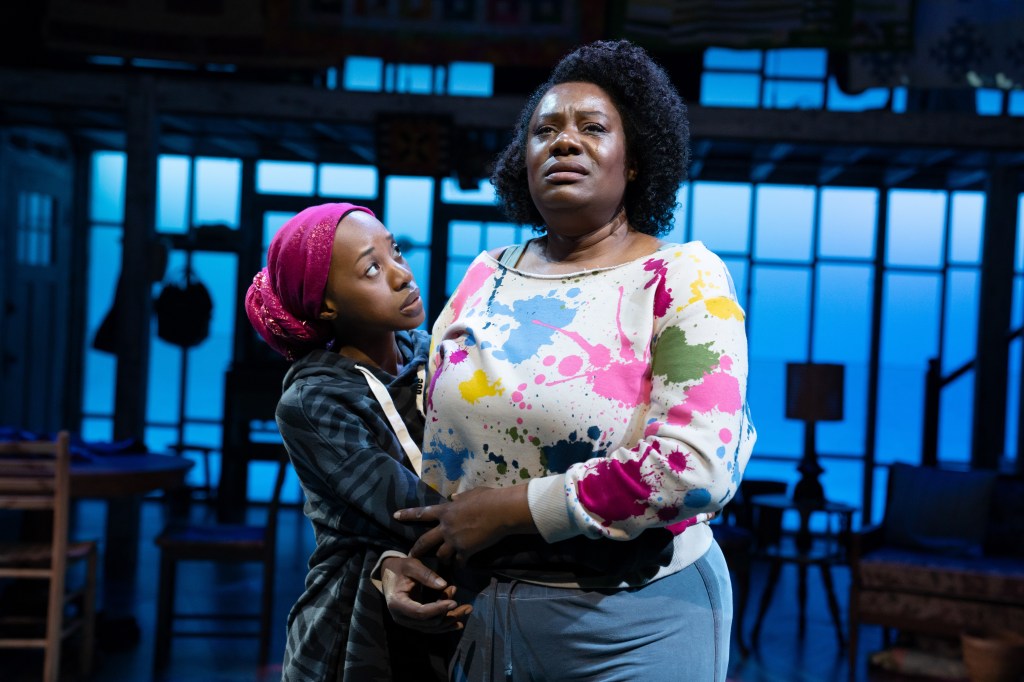
Gio (Adrienne C. Moore), is the second oldest, a roughly hewn, hard drinking, Mississippi cop, who is resentful and jealous of her youngest sister Amber (Lauren E. Banks). Gio’s rancor runs deep because of a traumatic, covert incident unbeknownst to Amber but related to Amber’s father that happened when Gio was a teenager. Sensitive to her own misery, burying hurts from her divisive relationship with their mother who abused her, Gio’s moods, aided by alcohol, swing widely as she peppers them with spicey swearing and insults directed mostly at youngest sister Amber.
Amber is the beauty and reputed favorite of their mother because of her accomplishments. She went to an Ivy league college and eventually becomes an entertainment lawyer of means. Because she missed the last three summers of their quilting ritual, and their mother’s funeral service, her estrangement from her sisters and the difference between her lifestyle and theirs is apparent.

Despite Gio and Clementine’s “guilting” her for not coming to the funeral, we discover Amber was emotionally the closest to her mother. She paid for her cancer treatments, phoned her often and even assisted the family after she left the homestead for California. In spite of their geographical and emotional separation, she paid for her sisters’ needs when they asked her, and especially pays for niece Zambia’s tuition in a private school.
Zambia and Cassan
It is Zambia who is the linchpin of the wayward, patchwork family that hangs together by a slender thread as each sister expels her angst and self-recrimination to each other. However, Hall uses Zambia and her mother, the quiet nurse Cassan (Susan Kelechi Watson), who is the closest to Amber, to round out the backstory with Zambia’s questions. Zambia and peacemaker Clementine move along the arc of development which settles upon two issues. How will they pay off the tax liens against the house, and who inherits the quilts, (pricey relics which are cultural artifacts of a rich historical past), the property and the cabin contents?
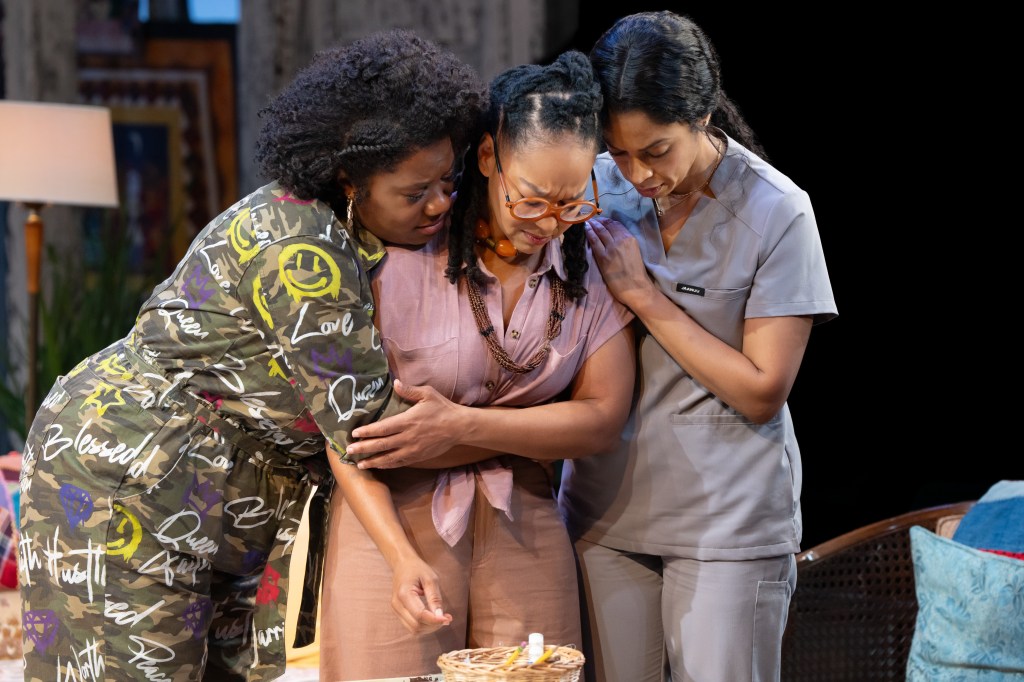
These questions are answered as Hall unspools each sister’s interior wounds via their relationships, revealing their individual portrait of their complicated, intriguing mother. All clarifies and we are brought to the edge of unresolved personal traumas that threaten to further destroy their lives emotionally, physically, spiritually. However, it is the act of quilting together that we view the whole with the sisters contributing to the corners of the ancestral masterpiece that unifies them with a familial love and redemption from past harm effected by their mother, each other and most importantly themselves.
Mystical elements
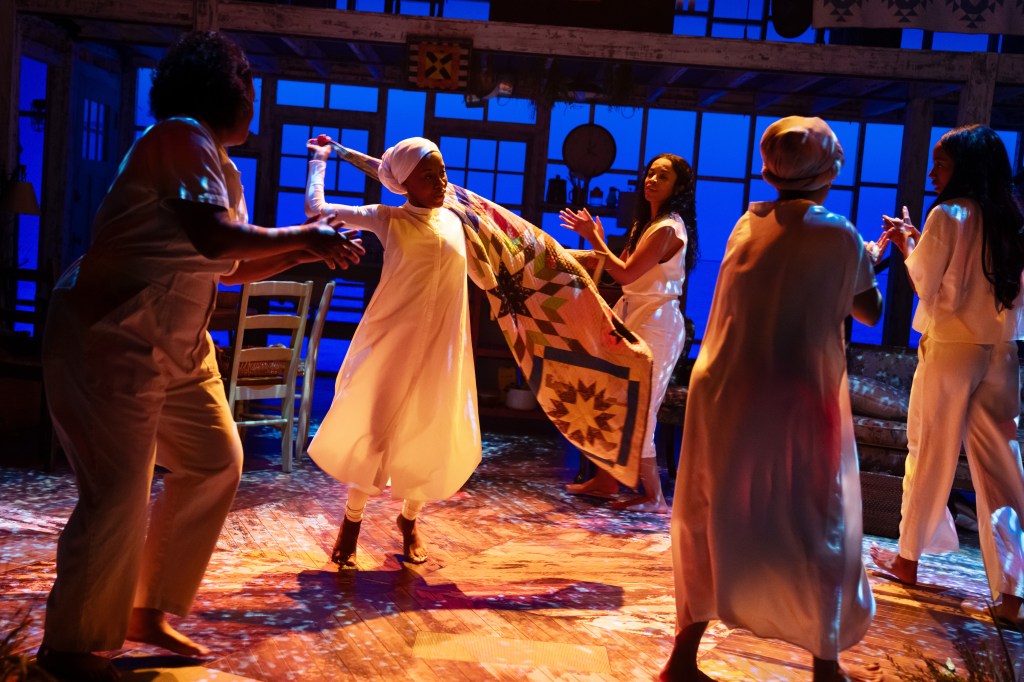
Hall’s first act languishes in exposition until the conflicts among the sisters erupt. The details of the quilting process fascinate and are well integrated into the dialogue. The symbolism and metaphor of the stormy souls aligned with the threatening hurricane’s thunder and lightening effected by Jiyoun Chang (lighting design), Palmer Hefferan (sound design), and Jeanette Oi-Suk Yew (projections), mirror how the natural world, material world and spiritual world often collide until there is a movement toward establishing peace and reconciliation.
Blain-Cruz does a smashing job referencing the impact the spiritual plane of existence has upon the material life of the sisters which is sensationally wrought in Act 2 toward the conclusion when they attempt to place the finished quilt on their mother’s bed and a mystical experience occurs. It is then when Zambia becomes the channel between the past spiritual legacy and the present and the pathway toward healing is realized.
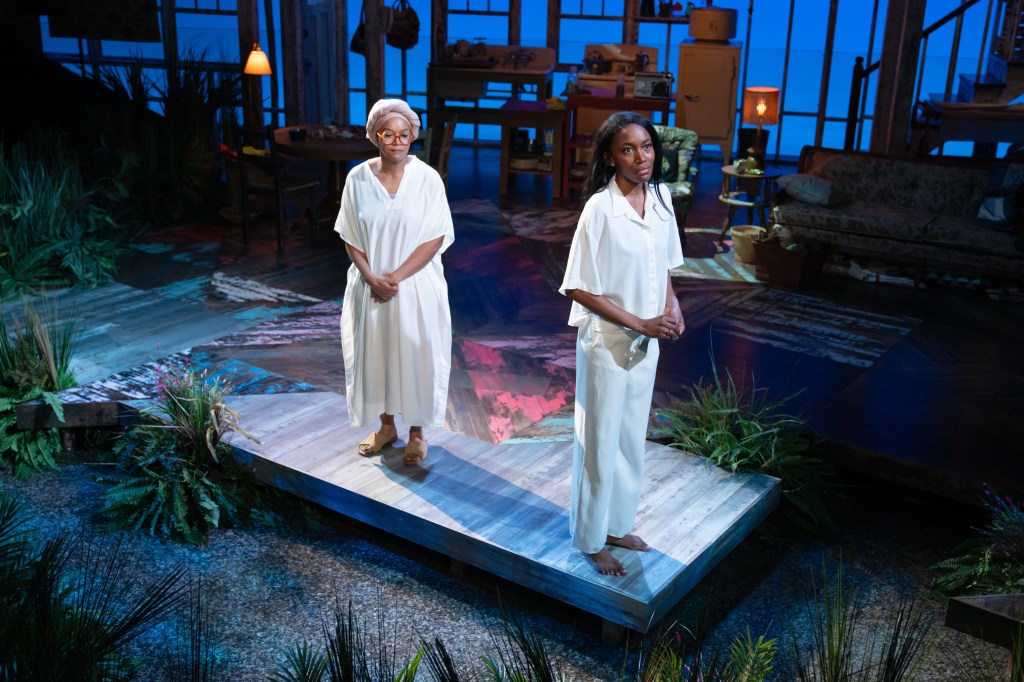
The costumes by Montana Lvi Blanco pointedly imbue each of the sisters and Zambia’s changing “trends,” enhancing Hall and Blain-Cruz’s vision of this family to precisely tie in their characters culturally and psychically. Importantly, the ensemble works together to create a family drama with which we can identify and empathize. Their acting is superb. Perhaps the Geechee deserves a translation either in the program or elsewhere. I was benefited by a copy of the script. Vitally, the different language serves to remind the audience of the African diaspora that beleaguered the Jernigan ancestors-slaves, and unified them as they prospered in a hostile, alien world.
The Blood Quilt
See The Blood Quilt, which runs two hours forty-five minutes with one intermission at LCT, the Mitzi E. Newhouse, until December 29th.
,

Posted on December 11, 2024, in Lincoln Center Theater and tagged Adrienne C. Moore, Crystal Dickinson, Katori Hall, Lauren E. Banks, Lileana Blain-Cruz, Mirirai, Susan Kelechi Watson, The Blood Quilt. Bookmark the permalink. Leave a comment.
 CAROLE DI TOSTI
Leave a comment
Comments 0