‘Glengarry Glen Ross’ Starring Kieran Culkin, Bob Odenkirk, Bill Burr

Glengarry Glen Ross
Glengarry Glen Ross, David Mamet’s Pulitzer-prize winning treatise on rapacious, capitalist indecency is currently in its third revival at the spacious Palace Theatre on Broadway. Because of audience enthusiasm for a celebrity bro-fest, starring Kieran Culkin (Succession), Bob Odenkirk (Better Call Saul), comedian Bill Burr, who is making his Broadway debut, and clever ironist Michael McKean of the cult hit This is Spinal Tap, Glengarry Glenn Ross has been extended two weeks until June 28th. Judging by the jeers and raucous laughter at the characters’ non-stop, insulting, verbal sword play, the production directed by Patrick Marber (Closer) is a success.
With scenic design by Scott Pask, Mamet’s timeless, horrifically current, two-act drama divides between an unbusy Chinese restaurant in the first act, and in the second act, the robbery-devastated, real estate office where the characters attempt unsuccessfully to make “a living” and deliver their finalized sales contracts. The brief, first act is the set up for the second act where the emotional explosion occurs and the revelations stun because of Mamet’s clever misdirection throughout.

The Chinese restaurant represents the off-site, safe place where furtive deals might be made between the real estate salesmen and others. The three two-hander scenes, taking place one after the other, reveal the salesmen who succeed or fail under the oppression of a “dog-eat-dog” system that values money and material wealth as the only measure of human success, a pathetic blind they’ve fallen for.
Thus, thematically, as these individuals get ground up, drained of their identity and humanity in a process that de-masculinizes them, we note they become more aggressive, desperate and verbally explosive, as they confront failure by the play’s conclusion.
First, we meet Shelley Levene (Bob Odenkirk), who gaslights his office manager boss John Williamson (Donald Webber, Jr.), about his poor sales performance. Shelley hopes to mitigate the inevitable, being canned. So, he persuades John to give him the great leads that sell themselves. Despite Shelley’s oily patter and insistence to be “heard,” as he recalls his past glory days as ‘The Machine,” John directly tells Shelley that he hasn’t had a recent successful sale. He is at the bottom and ripe for firing because he is nowhere near being put on the board to compete to win the Cadillac offered as a gift to incentivize the men’s sales productivity.
Failing to convince John to “have a heart” about his losing streak that he claims is ending, Odenkirk’s Shelley suggests a quid pro quo. In exchange for a few premium leads, he will cut in John on a kickback of his sales. Not only does John “take the bait,” he calls Shelley’s bluff. He demands more money and payment up front which Shelley, of course, can’t afford. Interestingly, we note the sliminess of the exchanges and the abuse each man takes from the other in a devaluation of their humanity and decency in their struggle for the “all mighty dollar,” whose pursuit enslaves them and destroys their souls.
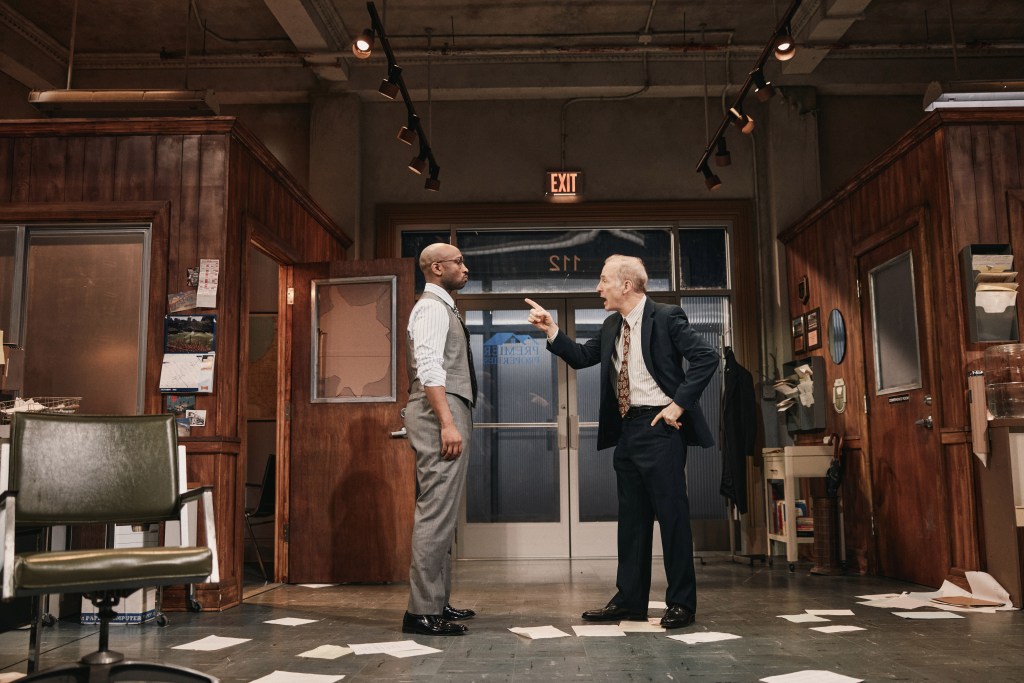
Webber, Jr. and Odenkirk are terrific in their focus, direction and pacing as they reveal these archetypes who are caught in a battle of wills where there is no ultimate winner.
The irony is that Williamson’s desk job is lower paying and requires little risk and a different skill set than Levene’s, who must sell worthless property to unsuspecting buyers. Both are on different levels entirely and they are blind to it. Without empathy for each other, they allow themselves to be overlorded by the unseen master entrepreneurs “Mitch and Murray,” who are the god-like downtown owners of the slime pit, real estate enterprise.
The overlords keep their charges in line through division, making sure all understand that performance is everything and competition against one another is the best way to shine. Those who can’t keep closing are fired, nothing personal. In spite of the vapid callousness his position requires, John makes sure the “operational daily grinding up of the men into mincemeat” continues smoothly. He is his owner’s loyal employee. Thus, he dead-ends Shelley’s kick-back offer and their conversation.
From this dead-end conversation between Levene and Williamson, Mamet moves to the next staccato dialogue between disgruntled, carping Dave Moss (Bill Burr), and laconic George Aaronow (Michael McKean). Both are terrific in humorous performances which reveal their mastery at their craft. Moss attempts to engage George to steal the premium leads that sell themselves which we’ve heard about in the previous scene. After their theft, Moss plans to sell them to a competitor of “Mitch and Murray” and give half the proceeds to George. Thus, on another level it’s “every man for himself” and the competition that Mitch and Murray stuff down their charges’ throats, Moss, who has had enough, plans to stuff down Mitch and Murray’s. Karma is a bitch in this world of anger, aggression and money.

Interestingly, with matter-of-fact irony, the “innocent” Moss anticipates that confiding in George about his gambit as a co-conspirator will be accepted by the laid back, stolid George. However, because the deal is a shady crime, Moss could be double crossing George about the amount of money he gets from the competitor. Not only would George not be able to countermand any cheating, he could end up “going up the river” if Moss decides to turn him over and disavow any participation in the theft. Moss’ proposition is a desperate one. Mamet indirectly suggests that the oppressive system, corrupt in itself, then provokes men to commit crimes to circumvent the inequitable set up rigged against them. If McKean’s George doesn’t pay attention to divine all the ramifications, he will trap himself, like Moss has been trapped.
When George realizes what Moss is after, none of the risk and half of the reward, which surely Moss will skim to his liking, McKean’s George avers. Moss, with dead seriousness that is also funny, implies that now, George is forced to steal the leads; he has no choice. By listening, he is an accomplice after the fact. Ironically, Moss uses his skills of persuasion to dupe a colleague in a contorted competitive strategem to get to the top.

With this sleight-of-hand, Mamet leaves the conversation “up in the air.” Will the exhausted, deadened George do what Moss wants him to, or will he assert his own will and avoid the trap, thus most probably losing his job, because he, too, hasn’t been on a winning streak and has no sales to stop the inevitable.
In the last exchange the dialogue shifts to the smooth, unadulterated, force and charm of the Ricky Roma (Kieran Culkin) sales pitch on his mark James Lingk (John Pirruccello). If the two previous scenes reveal desperate salesmen at the edge of the cliff of their humanity and identity, believing in the values of the system which cast them as suckers, failures and losers, Ricky Roma (Kiernan Culkin), proves to be the opposite.
In contrast Mamet shows why Roma succeeds as a salesman who the others resent. Additionally, he reveals why the premium leads that the others crave will only go to Roma as a closer and Cadillac winner. His approach with his mark is obvious. With Lingk he has identified a vulnerable, emasculated male who life has kicked around so furiously he wears as his cloak of apology and embarrassment as his outward demeanor. The real estate he sells, Roma cleverly converts to a concept, an experience of hope, a wonderful opportunity Lingk may have been waiting for his entire life. Roma presents the property as a salve that will soothe Lingk’s life humiliations.
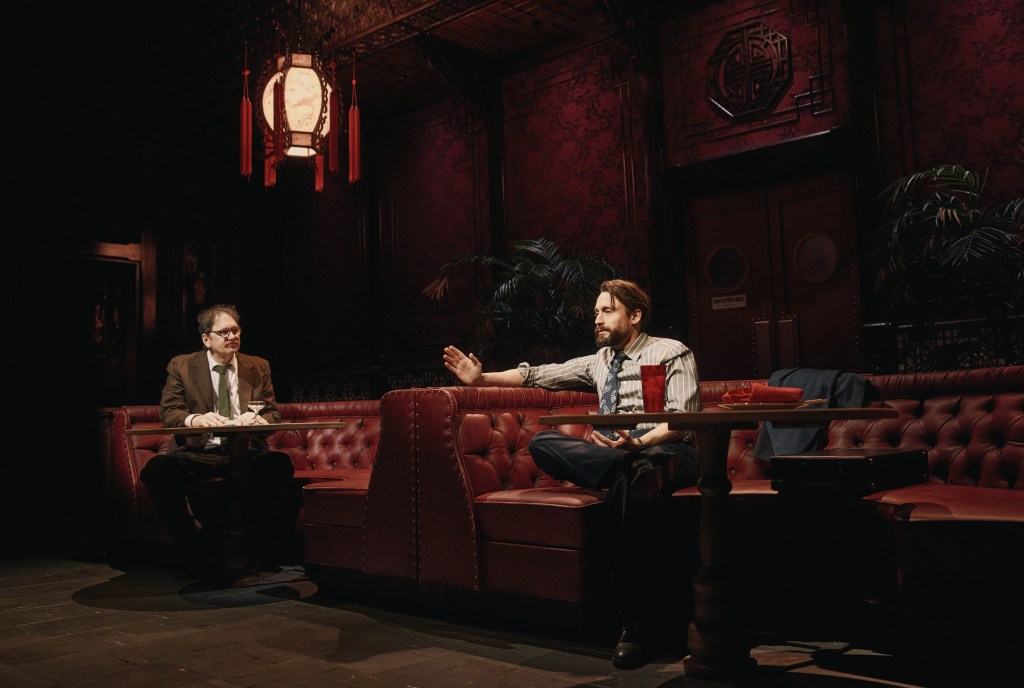
However, to prep Lingk to receive this life turning experience, Roma frees Pirruccello’s Lingk from the obvious middle class morality that appears to have held him in. He absolves him of his deepest, darkest amoral longings only known to him.
Roma’s approach is gobsmacking. Here’s a winner to be reckoned with whose skills are exceptional and admirable. We would easily, willingly be duped by him. Yes, unlike the other whiners and weak-willed complainers, Roma is a closer who deserves the Cadillac. Along with Lingk, Mamet’s Roma has hooked us. We normalize the perverse values of this indecent unholy enterprise that is the backbone of the real estate industry as well as any industry that introduces a fabulous product but falls short of its promises.
Roma’s monologue is brilliantly written and I found it difficult to get Al Pacino’s portrayal in the titular 1992 film out of my mind. There’s an intimate intensity that must be conveyed, a confessional nature that engages Lingk so that he finds Roma’s sincerity and the hope he sells irresistible. The intensity, intimacy and sly seduction necessary for the sale was missing in Caulkin’s Roma. I do think that Caulkin might have been better served if the director positioned him seated in the same banquette as Pirruccello’s Lingk from the outset. Instead, Calkin’s Roma leans over the banquette and the intimacy that should exist between them falters.
In the first act Mamet sets up the stakes. The second act presents the payoff settling this masterpiece into a tragicomedy. The results of what the system has wrought in promoting the misery, torment and criminal behavior upturns the office. John’s “perfectly seamless environment” explodes. There is mess everywhere, and everyone loses, most of all Mitch and Murray. The power dynamic heightens between Caulkin’s Roma and Webber, Jr.’s John, as well as the dynamic between Shelley and John. In these scenes the actors are superlative.

Criminality has run amuck, starting from the top of the system on down, and all are its victims, even the detective (Howard W. Overshown), who must find the perpetrator to make himself relevant. As the gloves come off, Mamet ties in the humanity behind the desperation in the life of the one who stole the leads. The horror is that money has become the arbiter of life and death in this system where to get ahead, one must dupe, deceive, harm, then be inured to one’s own egregious actions, as if they are justified because you need money to live and a ton of money to prosper and live well. (Think of the CEO Brian Thompson of UnitedHealthcare.) Roma goes off to the restaurant after telling John that he and Shelley are teaming up and he is taking a part of Shelley’s commissions. Of course, John says nothing, allowing Roma’s greed to trap him as Roma is ignorant of Shelley’s circumstances.
Glengarry Glenn Ross works in this revival because its overarching themes are timeless. The acting and direction superbly emphasizes the authenticity of the characters’ desperation, exhaustion, and zombie-rat state, running in their own wheels, unable to stop themselves. Yes, even the shining Roma by the conclusion has been done in by the situation and his overconfidence in his skills.
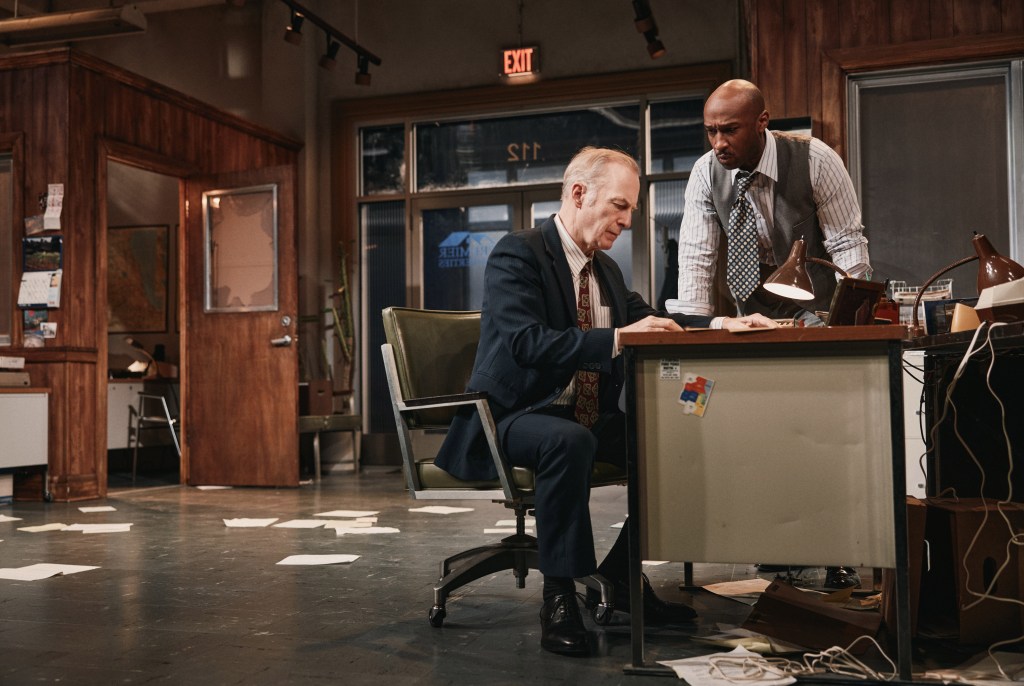
Mamet emphasizes that in the system, whether you project that it is capitalism or economic totalitarianism, pity is a weakness and empathy is for chumps, not for closers. This is the perfect world that has birthed the current miasma that Donald Trump as a symbolic Mitch and Murray embraces and would foster, making all into his slavish subjects.
Of course, such a world doesn’t work seamlessly nor successfully, and if anything, nothing works in it much of the time. That the play concludes with all the players wiping dreck off their faces, including Mitch and Murray, who have lost their profits in a breach of security to their competitor, should be a lesson all the characters learn. But they don’t because they don’t reflect on their lives. They are too busy whining, being oppressed and making money to recognize they are going nowhere having been nowhere valuable or worthwhile when all is said and done.
Kudos to lighting designer Jen Schriever and the creative team already mentioned. Glengarry Glenn Ross is a must-see for the performances and to appreciate this early Mamet work. Apparently, he has since come to embrace the Mitch and Murrays of the world in what may only be intimated as Stockholm Syndrome.
Glengarry Glenn Ross runs 1 hour 45 minutes with a 15-minute intermission at the Palace Theatre on 47th Street. https://www.glengarryonbroadway.com/?gclsrc=aw.ds&gad_source=1

Posted on April 9, 2025, in Broadway and tagged beach, Bill Burr, blogathon, Bob Odenkirk, crime-fiction, DAvid Mamet, Film Noir, Glengarry Glenn Ross, Kieran culkin, Michael McKean, noir. Bookmark the permalink. Leave a comment.
 CAROLE DI TOSTI
Leave a comment
Comments 0