‘Maybe Happy Ending,’ Breathtaking With Darren Criss, Helen J Shen
Maybe Happy Ending
“Memento Mori!” The Stoics created this phrase meaning “remember you must die.” Human beings can be incredibly oblivious to their own mortality, especially when they are young. Indeed, it gets worse as one ages in the attempt to forestall looking old to remain “forever young.” But what does that have to do with robots Oliver (Darren Criss) and Claire (Helen J Shen), simulated, digital human beings who run on technological parts and have operating systems, batteries, chargers, chips, etc.? As it turns out “memento mori” is the linchpin of Maybe Happy Ending, currently at the Belasco Theatre until January 2026.
As with all things, even with long-lived elements like tellurium-128, the second law of thermodynamics applies: all things move from order to chaos, entropy. Heat dissipates into cold. Things fall apart. Things come to an end. It’s irrevocable. And at this point there’s not a damn thing one can do but live life to the fullest, if memento mori..
It is Claire, an advanced Model 5 robot, who is sleek, beautiful, witty and programmed to understand most things, who essentially reminds Oliver that things come to an end.
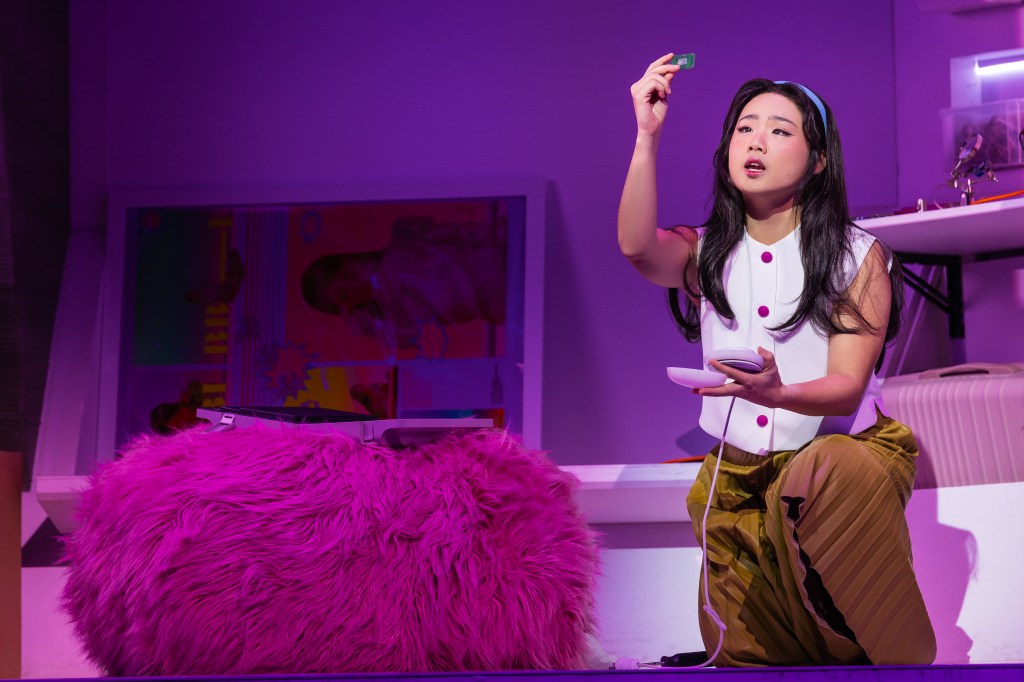
But Oliver doesn’t really get it. Oliver is a less smoothly functioning and quirky-kinky-glitchy robot Model 3. The earlier, older model is more simplistic and durable, programmed to be upbeat, decorous, sweet. He is the perfect companion, friend, son, but unaware about the deeper, more painful qualities and attributes of human beings and the natural order of the known world and his place in it. Innocent, and cheerful, he doesn’t seem to understand the cycles of wheel and woe, peaks and valleys and the end of things, for example humans, relationships, devices, himself. But by the conclusion of this incredible heart-rending musical, Oliver learns about himself. He learns what he is capable of, guided by Claire’s empathy, wisdom and heart.
The year is 2064 on the outskirts of Seoul, Korea when we meet Oliver and Claire, Helperbots (think android servants), once hired out by their manufacturer to assist their human owners with daily tasks. However, a blip has occurred for Oliver and Claire whose existence and purpose has changed. Their antiquated operating systems can no longer be upgraded. Replacement parts are scarce or discontinued. The company has with consideration allowed them to spend their purposeless, remaining days in a retirement home in the Helperbot Yards until they come to the end of themselves.
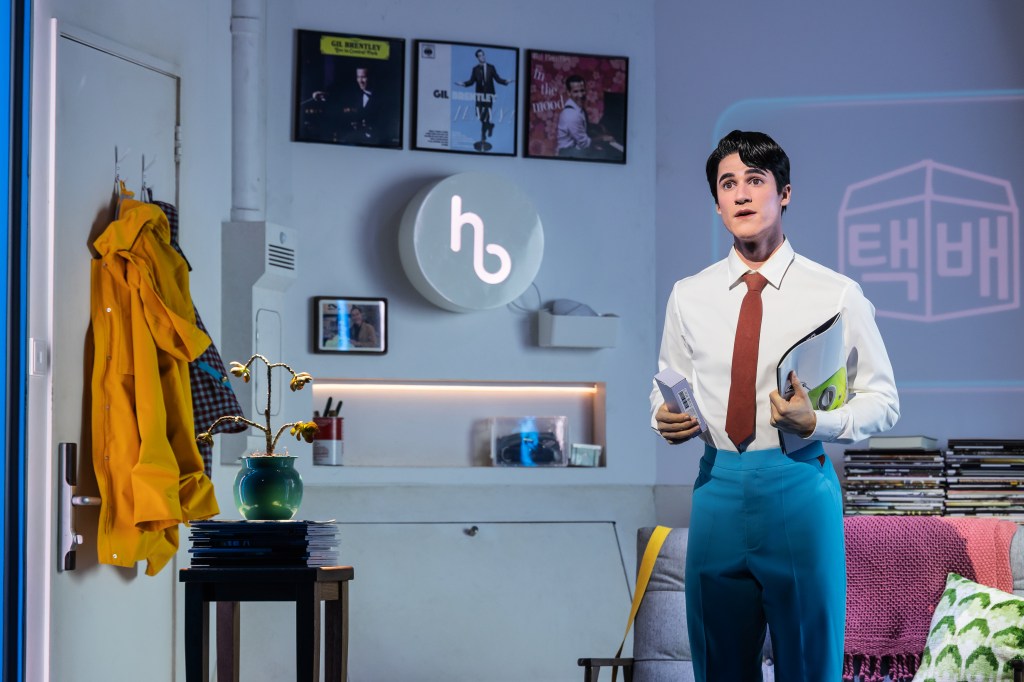
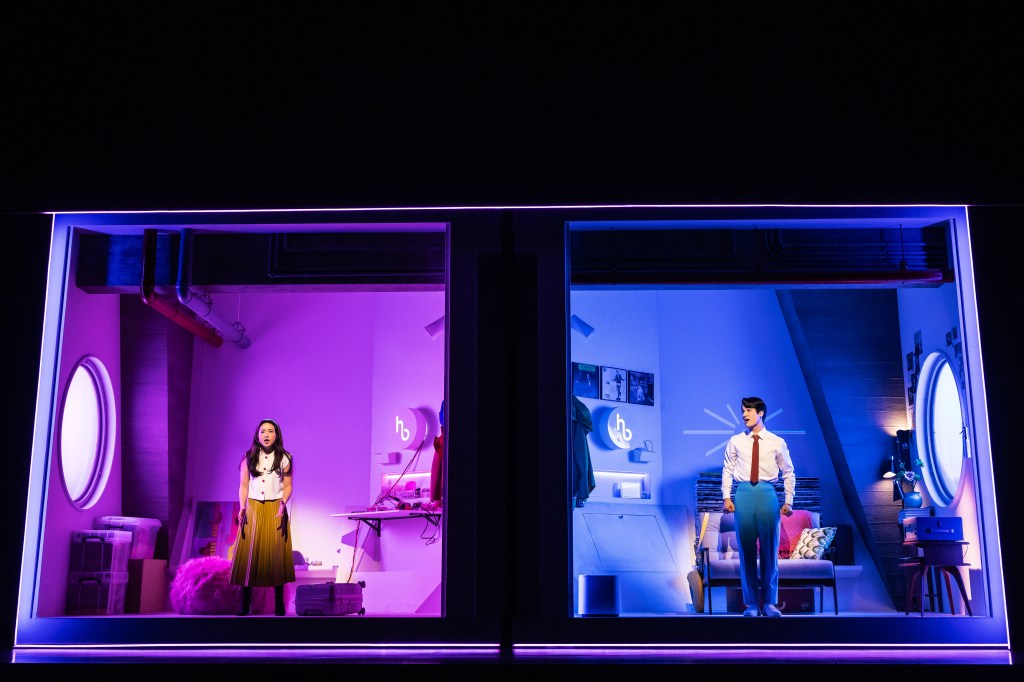
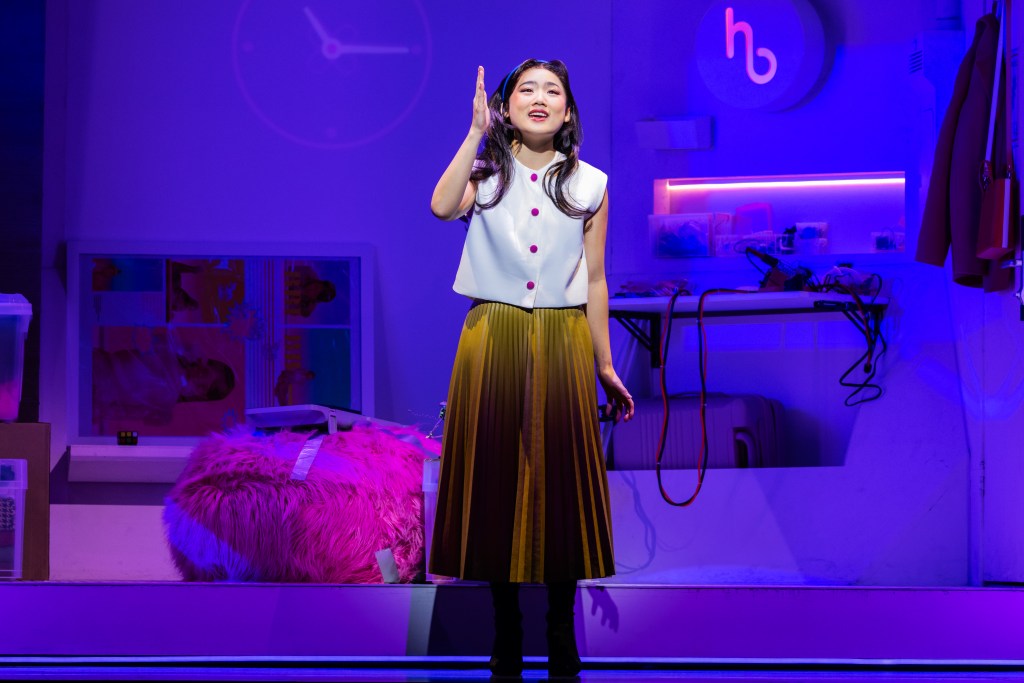
The set design of their rooms at the Helperbot Yards is imagined cleverly by Dane Laffrey via bright lighting in their rooms (Ben Stanton’s design), surrounded by darkness. Neon tube sliding panels separate and feature Claire’s and Oliver’s rooms side by side, or in movement, like a split screen effect. The rooms are color coordinated. Claire’s belongings are pink and lavender with saturated lighting effects. Oliver’s room appointments are mostly neutral influenced by his owner with blue lighting effects. The colors ironically signify their genders, recalling an innocence that belies their knowledge and Claire’s deeper understanding of human beings. As they grow closer, the saturated lighting effects sometimes alternate.
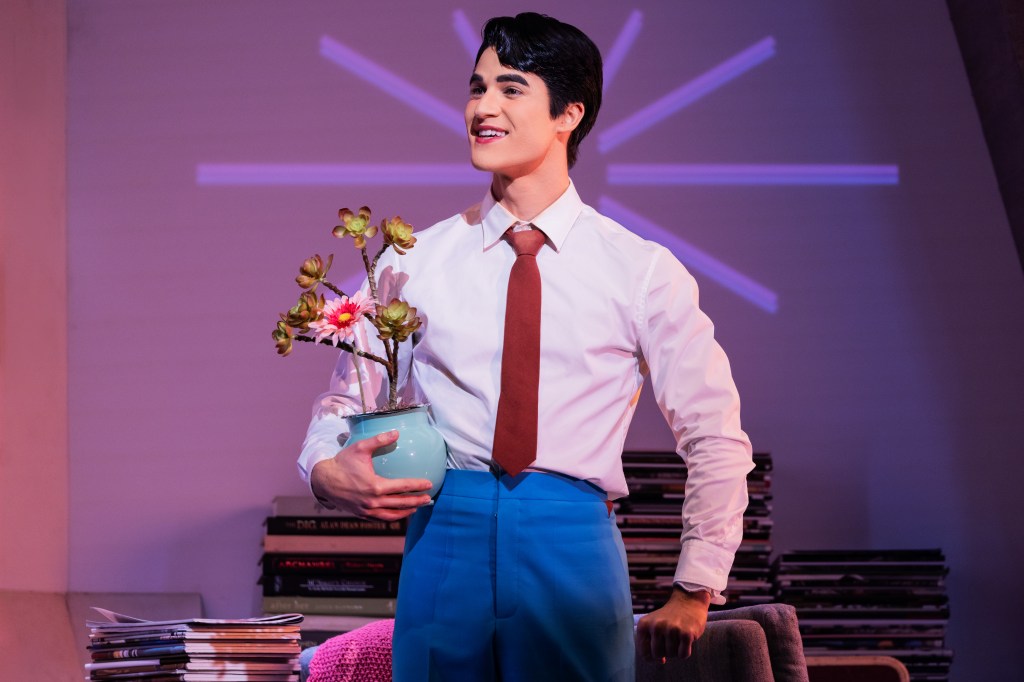
Laffrey’s scenic and additional video design, along with Ben Stanton’s lighting design and George Reeve’s video design cohere perfectly with director Michael Arden’s vision and tone, effected by Hue Park’s book and lyrics and Will Aronson’s book, lyrics and music, which is sonorous, mellifluous and lovely.
Oliver appears Model 3 robotic with slicked down helmet-headed hair, (Craig Franklin Miller’s hair & wig design), obvious reddish lips and paste skin tone (Suki Tsujimoto) and a perfectly tailored, boyish outfit by Clint Ramos. Claire’s pleated skirt and white blouse are simple, and flowing in more natural colors as the later models were designed to appear real; her hair and make-up coordinate and appear natural. The vibrant color and Ramos’ costumes cohere with the color schemes, save Claire’s initial outfit, though she wears a colorful jacket when they travel.
The design features represent the robotic and real worlds stylized appropriately. The real world is dimly lit and in shadow; the natural setting is somber, subdued and minimal. There is no sense of futuristic design consonant with James’ preference of retro mirrored in his acoustic music taste. James and his son (both played by Marcus Choi) naturally. Likewise, singer Gil Brentley appears in fall toned period clothing of the 50s. Sometimes with a microphone, perhaps in a club where he once performed, Brentley sings four songs solo in simple lighting. Finally, the forest scene is magically lit, captivatingly stylized, romantic and “to die for,” which is the point.
Peter Hylenski’s sound design is balanced for Deborah Abramson (music supervision), and the songs are lyrical, the harmonies in the duets gorgeous. Both Criss and Shen have voices that convey the tone of light, love and beauty. The cool jazz numbers sung by the excellent Dez Duron as singer Gil Brentley are seamlessly mixed into the action as a counterpoint to it and commentary on it.

Of the two robots, Shen’s astute, ironic Claire is the more aware, having experienced poignant and hurtful events with her beloved owner who gave her up. We get to see this via amazing digital projections and a hologram (George Reeve’s video design), as Claire revisits memories to fill in the puzzle pieces of a mystery Oliver needs to have solved. Claire is canny, smoothly sophisticated and not easily duped. There is little that she can’t figure out. On the other hand, Oliver is oblivious about why he is where he is. Oliver believes that his beloved owner and friend James will be coming to take him to wherever he has gone so they may resume their relationship which makes both of them happy.
With Oliver’s first song, “World Within my Room,” Will Aronson and Hue Park establish the situation of his isolated living arrangement which he doesn’t mind, convinced James will come for him. He is contented in his own confined world with his friend, the plant HwaBoon, his jazz records, an old-fashioned record player, all given to him by James, a jazz aficionado who converted Oliver to love jazz too. Indeed, Oliver gets to enjoy monthly jazz magazines James has sent to him which Oliver receives via a mail chute. His only interaction over the years is a remote bot (a voice over), that interacts with him if he requests something i.e. a replacement part that has not yet been discontinued.
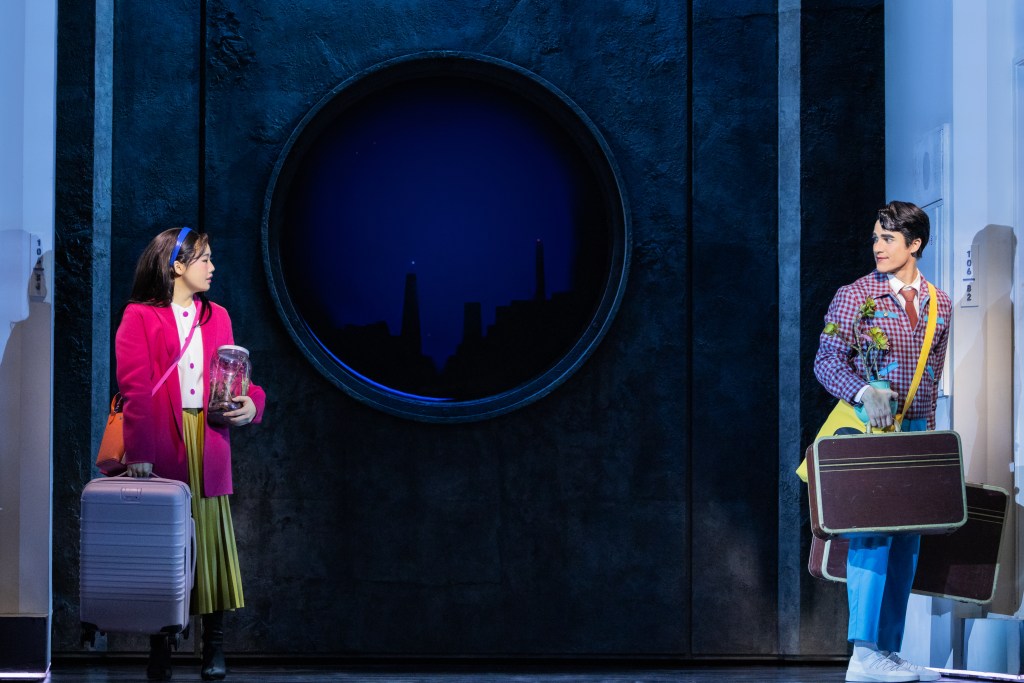
Twelve years go by, then there is an urgent knock that displaces Oliver and his contented isolation. Claire, who lives across the hall, needs a charge because the advanced Model 5s need charging more frequently or they freeze up, as Claire does, arm lifted in the midst of knocking. Oliver is too jarred by a live interaction intruding on his solipsistic existence to immediately answer the door. When he finally does relent, she is stationary, silent, frozen, and he must pick her up and carry her into his room to charge her up (literally and figuratively). Look for all of the double entendres, sly, winking humor, symbolism and metaphors about human existence, human love, human experience and forever love and happiness.
After Oliver “charges” Claire, she takes the lead, as the female model’s advanced assertiveness prompts her to. She queries him, and finding out about James, understands what has happened, but is empathetic enough to wisely counsel Oliver, sometimes with humorous snark about himself. Additionally, she dispels the competitiveness Oliver has about being the less sleek, smart and advanced model. However, she is less durable, a fault he continually throws in her face. Eventually, as Claire repeatedly returns to borrow his charger, one day she cleverly arranges to stop their routine, knowing the less flexible Oliver will freak out about it. Of course, she is correct, and when he begins to seek her out, their relationship faces a turning point and they are off and running to become more involved with each other’s wants, needs and hopes.
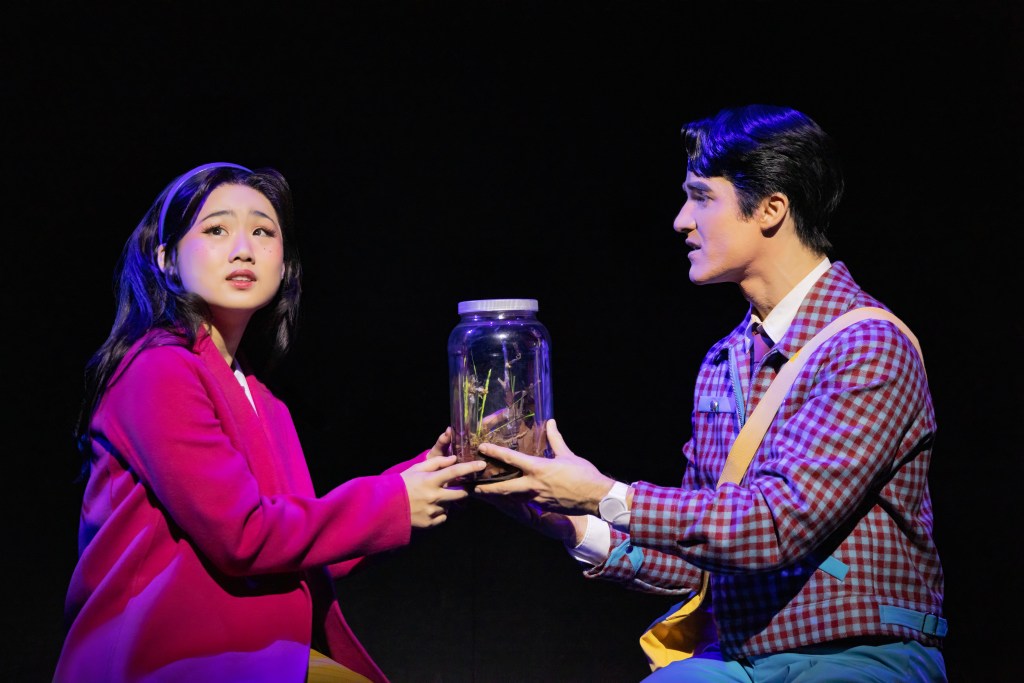
Claire and Oliver’s growing connection is a series of cataclysmic sequences that explode upon the audience’s consciousness. These are taken out of every romantic playbook of “boy meets girl” etc. However, it’s in reversal as Claire is the catalyst. Importantly, there is no equivalence because these robots can’t have emotions, can they? They’re weird, the situation is anomalous, but for the song (“Why Love?”) as a lyrical remembrance at the top of the musical, we don’t quite get it. We think, “OK, theirs is a peculiar and funny meet-up.” Importantly, though they look youthful, they are “discontinued,” seniors in a retirement home, useless, waiting to fall apart (think of “all the lonely people” whether in nursing homes or under sick-bed isolation).
Eventually, the realization hits the audience that they are looking at themselves. There will be an arrow strike into the heart and perhaps the tears or the discomfort will follow, if not at earlier junctures, yet, it will follow. The story and its incredibly coherent, metaphoric rendering in every technical and live-wired aspect (especially performances), by the creatives are designed to penetrate any cynical, hardened emotions and break your heart.
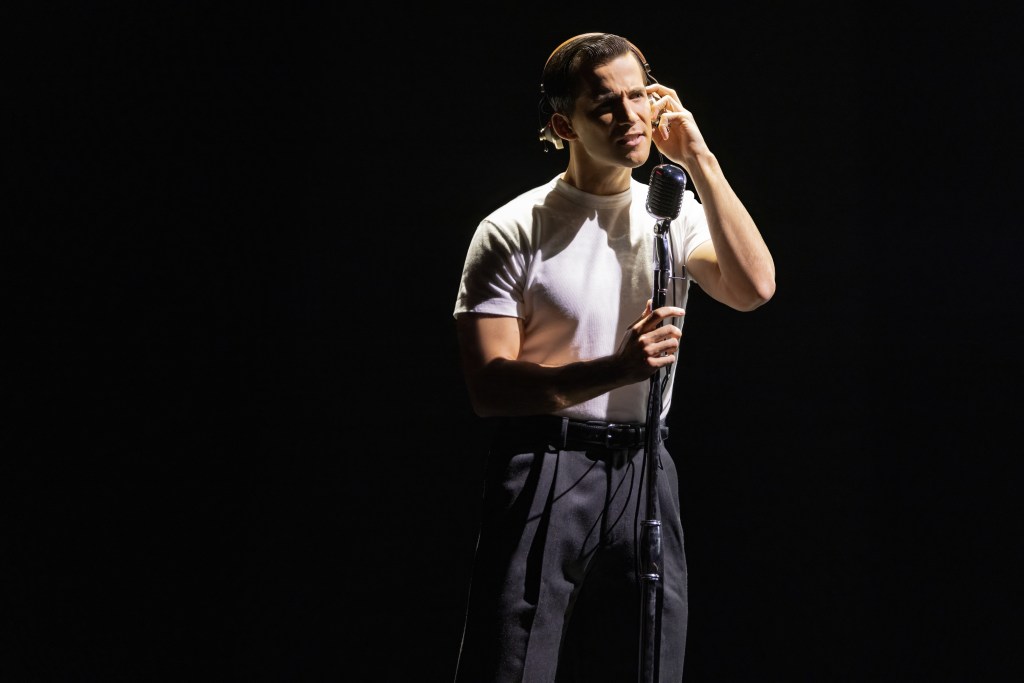
The parallel between Claire and Oliver’s story and variations of our own stings as does the song “Why Love?” sung gorgeously by Duron’s Gil Brantley. The song that James loved (he gave the Gil Brantley record to Oliver), opens the musical and concludes it, a question answering with the question. And we learn its meaning as we know it from our own lives and the journey of Claire and Oliver, as they get to know each other. The irony of these characters and their discoveries about themselves and each other is that we will more readily identify precisely because they are robots. By removing their “humanity,” the intensity of the parallels to human experience crystallizes. You “get it” in revelation, and by then, you are a goner.
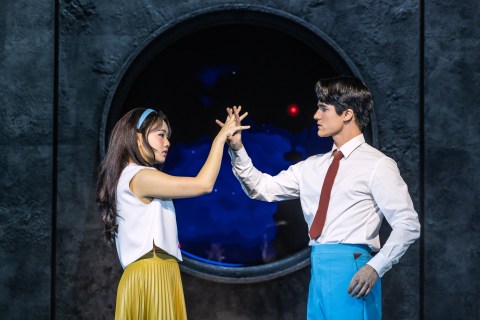
Michael Arden’s shepherding of Criss and Shen ingeniously unfolds and stages their relationship dynamic throughout, moving from their box-like, enclosed, limited existence to a forest field, in a nighttime sky of fireflies (an achingly beautiful sequence lit exquisitely by Ben Stanton). Enlightened from their adventurous “road trip,” they go back home with a new, expansive perspective and realization of their deep connection to each other, a duplication of human experience which they can laugh at as robots, yet sorrow over, for it, and they are perishable.
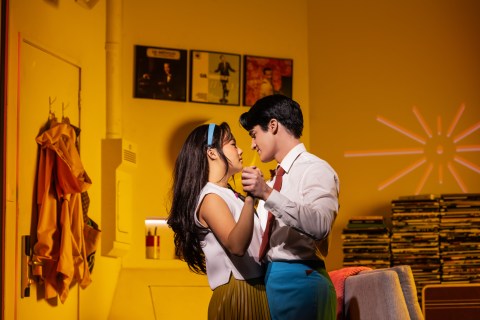
The characters and situation are counterintuitive as are the incredible performances of Criss as the more authentically robotic and Shen’s more progressively human. But by the conclusion both have evolved to decide whether to remember their love or not, knowing there is no way around the second law of thermodynamics. Even robots die. But in this instance, the more durable Oliver will be around with the memories of their love a lot longer than Claire. A decision must be made.
Maybe Happy Ending is not a story about robot love. It is a story about us. Our humanity. Our mortality. Our inability to comprehend loss, and love, and relationships, and other human beings, and emotional pain, and hurt, and tolerance of these experiences, not having the first clue about what they truly are, as we are forced to go through them, sometimes kicking and screaming
If you don’t see Maybe Happy Ending, you are missing an incredible, theatrical event, taking a deep dive into your own humanity through identification with “robots” who just kill it. They will delight, entertain and wreck you emotionally. If that doesn’t appeal, then see it to appreciate its splendiferousness as a gobsmacking, award winning, uniquely, amazing musical.
Maybe Happy Ending runs 1 hour, 45 minutes with no intermission at the Belasco Theatre (111 West 44th Street) until January 2026. https://www.maybehappyending.com/
ENCHANTING, SPELLBINDING, HEART-STOPPING, MOVING, TOUCHING, OVERWHELMING, INTENSE, HEART-RENDING
Maybe Happy Ending runs with no intermission 1 hours 45 minutes. at the Belasco Theatre (131 West 44th Street). https://www.maybehappyending.com/

Posted on May 8, 2025, in Broadway, NYC Theater Reviews and tagged Darren Criss, Dez Duron, Helen J.Shen, Hue Park, Marcus Choi, Maybe Happy Ending, Michael Arden, Will Aronson. Bookmark the permalink. Leave a comment.
 CAROLE DI TOSTI
Leave a comment
Comments 0