‘Duke & Roya’ Review, in Love and War
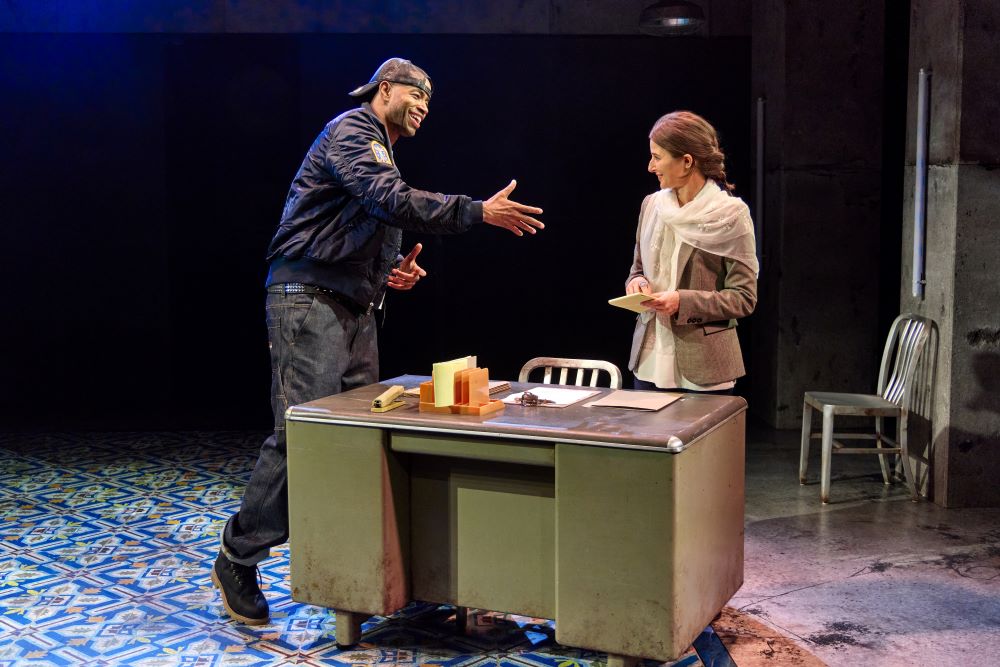
What does Hip Hop music have to do with a Muslim country whose strict religious practices frown on it? Nothing, unless an American base commander brings in a rapper to raise morale and entertain the troops stationed at Bagram Air Force base in Kabul, Afghanistan circa 2017. As unlikely as Hip Hop is to Afghanistan, so is the unlikelihood of the developing relationship between famous rapper Duke (Jay Ellis) and Afghan translator Roya (Stephanie Nur). The evolution of their love and respect for each other develops with humor and insight in Charles Randolph-Wright’s entertaining and meaningful play Duke & Roya. Currently, the hybrid comedy/drama runs at the Lucille Lortel Theatre until August 23rd.
Randolph-Wright unfolds his intriguing play through a series of flashbacks stirred by interviews and interrogations. The purpose of the interviews for the media, obviously is to entertain and titillate. On the other hand the interrogations yield information for investigators. Though we never see the questioners, the four principals, who answer the interrogators,’ questions do the heavy lifting. Through the nimble and talented actors, we form a perspective of the danger and the intrusion into their characters’ personal lives and identities. Randolph-Wright uses the “questioner” device so he can move immediately into the action and adventures between the titular characters in scenes between 2017 and 2025.
Initially, the media questions Duke about his music in the present. Then action transfers from the TV studio to his time in Kabul, Afghanistan. When Duke helicopters onto the base he meets Roya (Stephanie Nur) and her father Sayeed (Dariush Kashani), translators for the American military during the War in Afghanistan. Amiable Sayeed and cool Roya extend their hospitality as employees of the American government. Immediately, Duke shows interest and flirts with Roya, using his confident, “full-of-himself” attitude. Unsurprisingly, his approach, which most likely works on American women, falls flat with Roya.
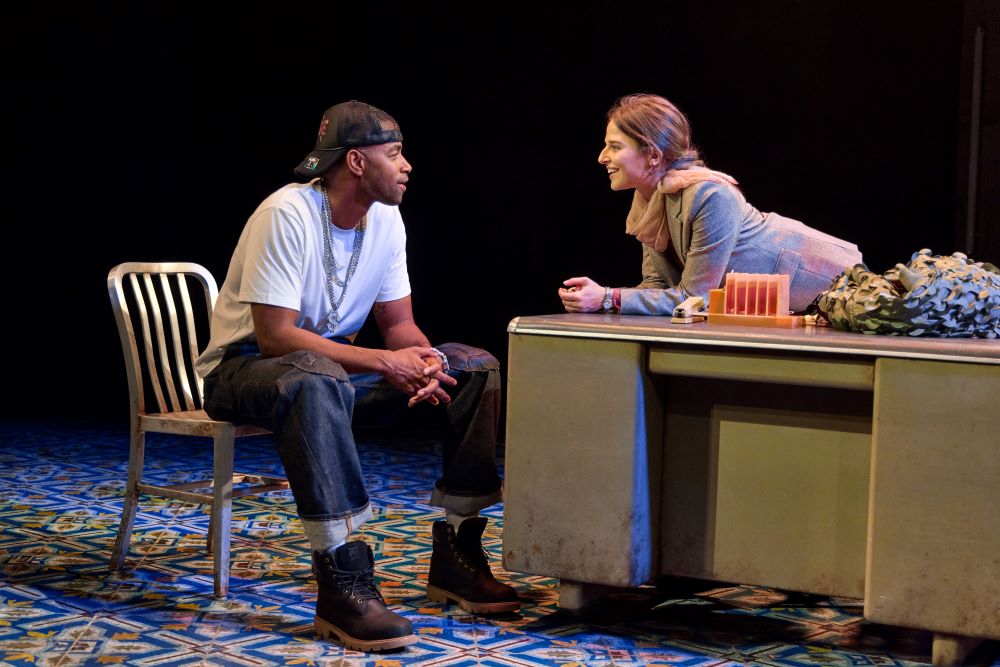
A product of her culture’s strict mores which Duke knows little about, Roya remains aloof. Because he interprets her reaction as “playing hard to get,” their acquaintance happens slowly. Influentially, Roya redirects him toward a new approach with women to encourage his respect. We recognize her brilliant balancing act. Cleverly, she resists his charms, yet lets him know he does appeal to her. So she teases and surprises him with ironic jokes. However, he eventually understands she must be her own woman.
Throughout their experiences together, this push-pull by Ellis’ Duke and Nur’s Roya plays believably. Acutely shepherded by director Warren Adams, the actors and Adams’ staging of them grounds the play in Wilson Chins’ minimal, stylistic set.
Vitally, the contrast between folkways of the west and east reflected in the lightheartedness, emotional drama and revelation of their personalities does capture our interest. For example we learn about the Afghan practice of bacha posh. Because Sayeed has many daughters, he chose the oldest Roya to live as a boy until puberty. Thus, as a boy she had the opportunity of an education. However, sometimes for purposes of safety she dons male clothing and practices bacha posh, which jeopardizes the situation for her later in the play.
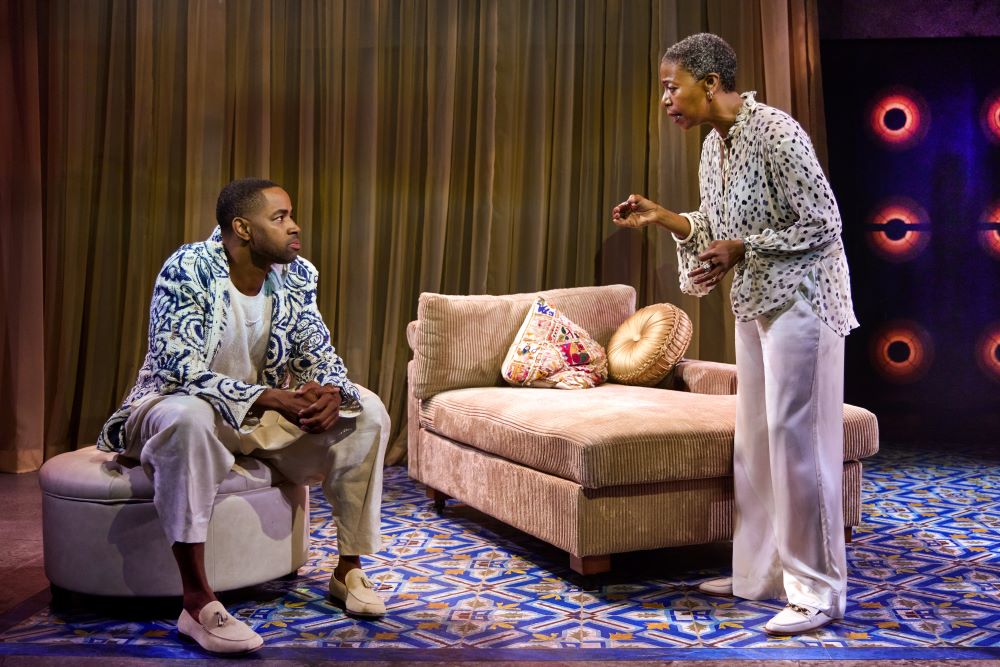
In addition to the standout performances by Ellis and Nur, Noma Dumezweni and Dariush Kashani keep us guessing as Duke’s mom and Roya’s dad. As Desiree, Dumezweni’s strong and forthright sister/mother figure, who chastises Duke when he needs it most, gains our admiration. She’s spot-on mesmerizing. The affable and charming Dariush Kashani authentically conveys the plight of Afghanis caught in an impossible situation. Not aligned with the Taliban that threatens to take over, nor with Americans who will leave the forever war, he, Roya and the family face ever-present danger. Though American visas have been promised for almost a decade, none are on the horizon, a horrific betrayal.
The complex themes sometimes get in the way of each other as the production moves toward the conclusion. Subtly, Randolph-Wright throws into the mix the perspective that Duke exploits the Black experience as a rapper, though his mother is middle upper class. However, Duke’s relationship with Roya changes his perspective and deepens his creativity. Of course the issues of religion, gender and politics come into play. Randolph-Wright intimates the strange parallel of Taliban repression to current oppression of women in the US.
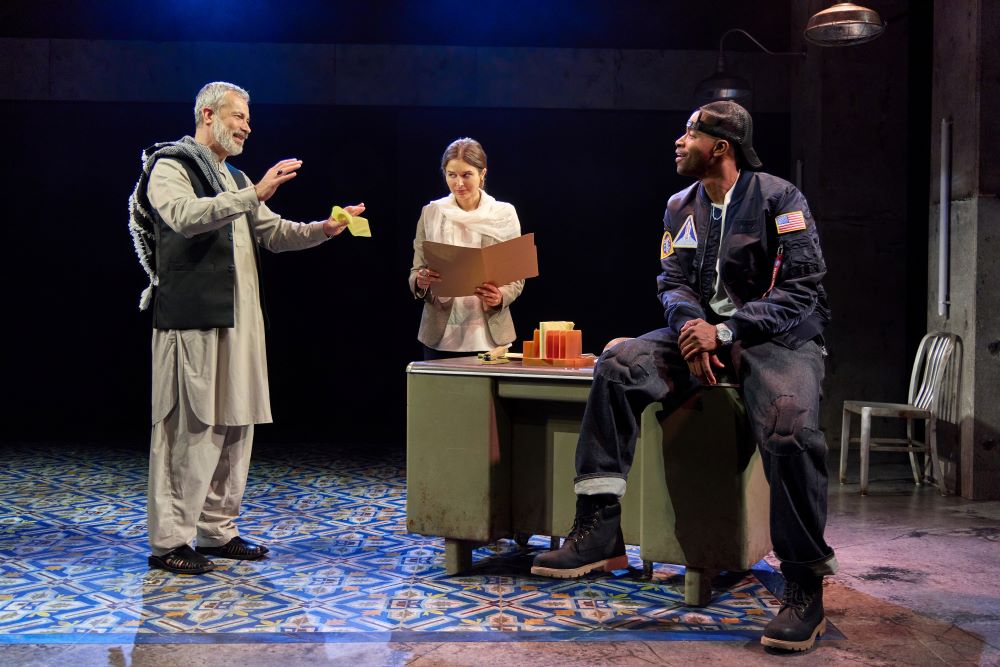
Also, in pointing out facts about the culture clashes and the Afghan war, Randolph-Wright shows the poisonous fallout when the Taliban made a peace deal with the Trump administration without the commitment of Afghan President Ghani. This led to a disastrous withdrawal of American troops and chaos, torture, imprisonment and death for Afghani/US government employees left behind. (Though it is true President Biden extended the evacuation dates, he could not delay the withdrawal indefinitely. Forced to cave to the previous administration’s pressure, he evacuated American personnel and as many of their Afghan counterparts as possible.)
As Duke and Roya mature over the 9 year period, Ellis particularly reveals his maturity during the completion of his interview at the play’s conclusion. Finally, when Duke and Roya meet up again after things become settled, we enjoy watching how their relationship continues to evolve into something profound. Whether or not they end up together is uncertain. However, they have earned their joyful moments together, especially when Ellis’ Duke sings his rhymes for Nur’s Roya with energy and pace. (Ronve O’Daniel’s original music and lyrics are easy and approachable in Ellis’ presentation.)
Amina Alexander’s lighting design, Sanowber Sabrina Spanta’s costume design, Taylor J. Williams sound design and additional music, and Caite Hevner’s projection design provide the background to enhance Chin’s minimal props and set design. These suggest an office at Bagram Air Force Base, an exterior scene in Kabul at night, a swanky hotel room in Dubai, an interrogation room and more.
As one of the more unique, nuanced offerings during this summer Off-Broadway, Duke & Roya shouldn’t be missed.
Duke & Roya runs 2 hours 20 minutes with one 15-minute intermission at the Lucille Lortel Theatre (121 Christopher Street) until August 2nd. https://dukeandroya.com/

Posted on July 25, 2025, in NYC Theater Reviews, Off Broadway and tagged afghanistan, Dariush Kashani, Duke & Roya, Jay Ellis, Noma Dumezweni, Off Broadway, politics, Stephanie Nur, taliban. Bookmark the permalink. Leave a comment.
 CAROLE DI TOSTI
Leave a comment
Comments 0