‘Punch’ Makes its Vital Impact on Broadway
In 2025 when US citizens witness violence by those who profess patriotism, conservatism and religious fervor, one must look past the cognitive dissonance for clarity and understanding. Though the setting of Punch is Nottingham, England between 2011-2025, it is representative. The initial events might have happened in the US or any other country where punches are thrown as a right of passage for strapping young men. For these reasons Punch at Manhattan Theatre Club arrives at a crucial time.
Importantly, the heartfelt drama explores trending social concepts and themes that impact our cultural well being. The play presses hot button issues with vitality and energy. It examines the ethos of violence as the evidence of weakness. It explores how accountability for wrongdoing must be a part of rehabilitation or the likelihood of rehabilitation decreases. Finally, through the arc of the protagonist’s transformation, the play reveals that restorative justice can promote self-forgiveness and healing.
Based on Jacob Dunne’s book Right from Wrong, playwright James Graham with crystal clarity squares off against the confusion associated with brawling as thrilling, fun and justifiable. The play identifies the societal constructs that in the last decade have been infused with political nuance to exploit division and violence. Such constructs lift up physical assault as an emblem of masculinity. Likewise, they demean and dismiss kindness, compassion and empathy as true measures of strength and power.
Through Graham’s well-articulated characterizations of Jacob (the sensational Will Harrison), whose one punch kills James, and James’ mom Joan (the equally sensational Victoria Clark), we learn that redemption, forgiveness and hope are not empty words bandied about after violent acts that kill. Made alive by spiritual goodness, the process of redemption and forgiveness can manifest positive results. And with hope and persistence, nihilistic behavior can be turned around.
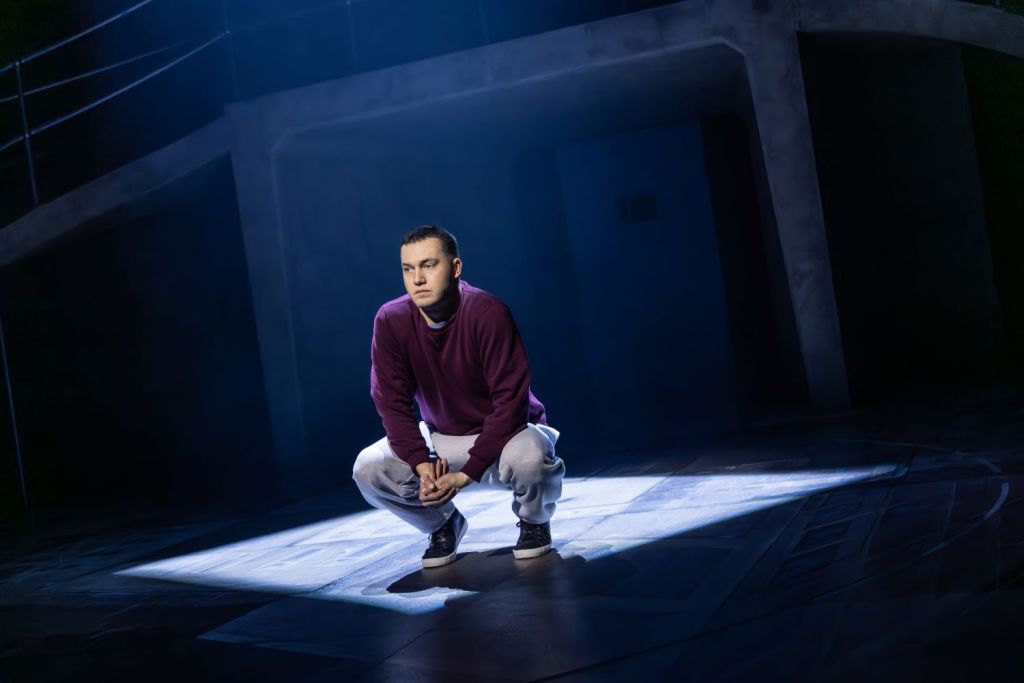
The two act structure of Punch stylized by minimal sets and props put to suggestive use seems front-loaded with exposition in the first act. In the prologue Graham carefully creates the circumstances moving from the present to Jacob’s past during the fateful night that changed his life. In the present Jacob barely is able to articulate what happened to a facilitator and “circle group” in an initial therapy session. To them he describes the night of Raf’s birthday celebration and the reasons how and why the confrontation with a stranger upends his life.
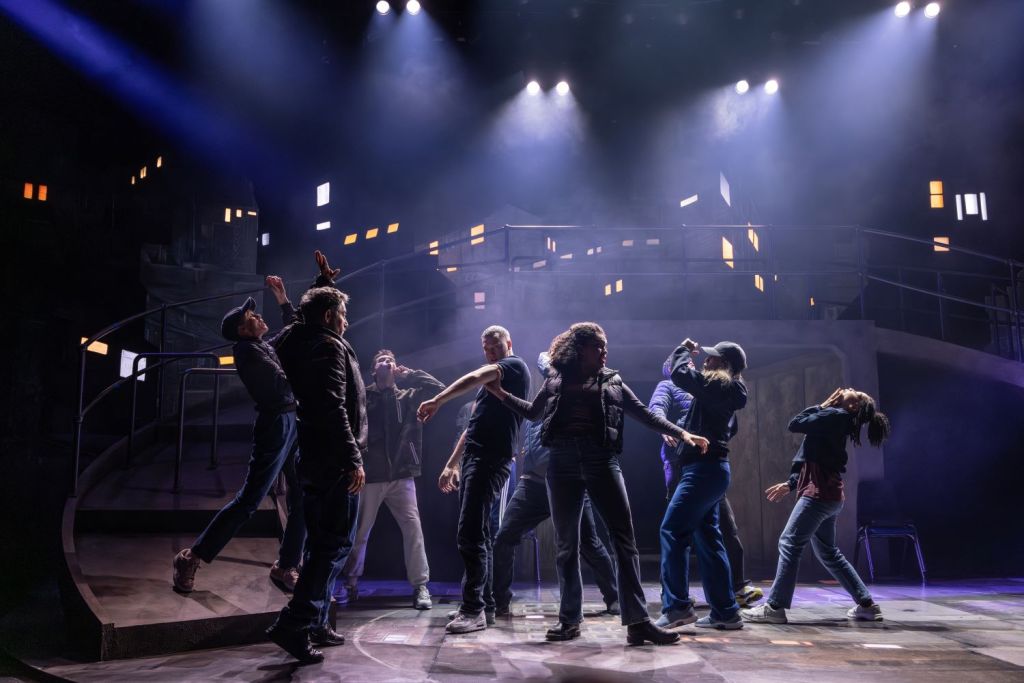
Principally through his precise descriptions, the choreographed action via Leanne Pinder’s movement direction, and director Adam Penford’s staging of Jacob and his mates, we understand how and why the killing happened. After they celebrate with drugs and pub crawls, his friends scatter in various directions planning to meet up later. Jacob runs into a girl, Claire (Camila Canó-Flaviá) and has a brief flirtation. Then, Raf phones him for some “action” going down at Yates’ Bar in Market Square. For Jacob, “You always step in, your mate, my mates, your people.”
Sadly, Jacob allows himself to be Raf’s and his friends’ tool. Jacob describes that he arrives at Market Square where they wait for him but they take no responsibility for their own provocation. Helping his “mates” Jacob slams a man with his fist during what he assumes to be a brawl. With one blow, he knocks down the guy he doesn’t know whose name he discovers later is James. It is a punch that lasts forever, symbolized effectively in a freeze frame tableau and directed lighting.
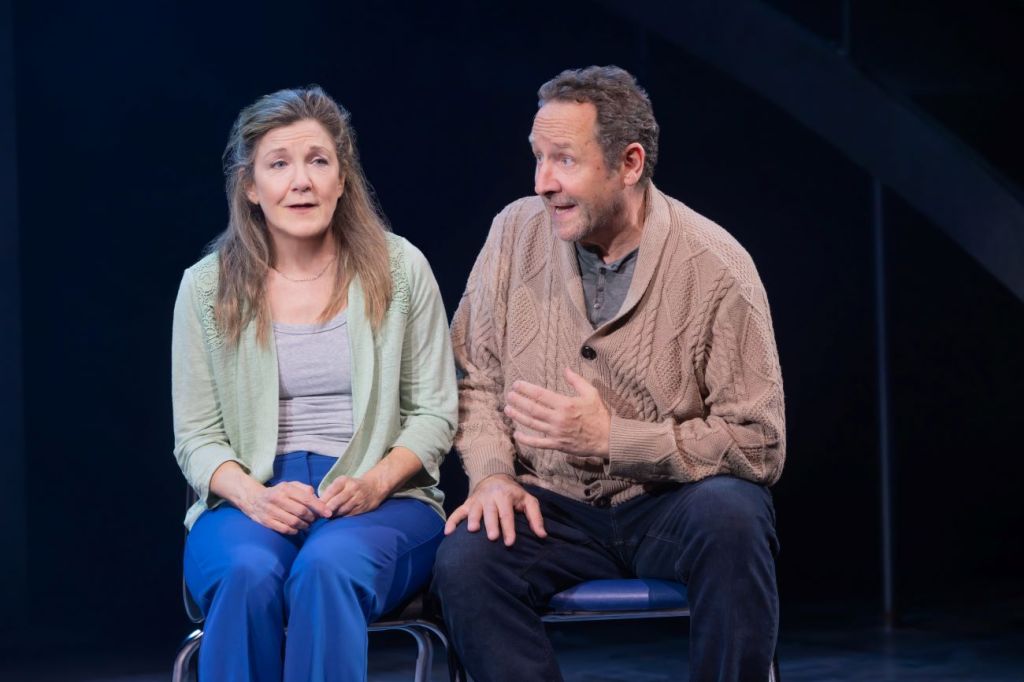
In the first act the events move to James’ parents David (Sam Robards) and Joan (Victoria Clark), who deal with James’s condition and eventual diagnosis that he can’t just sleep off being drunk in the ER. Through a series of acute, brief questions, Joan queries David why James needs hospitalization. We divine he received a severe concussion. Subsequently, a diagnosis comes. A brain bleed requires James to have surgery. However, he never regains consciousness. After a decision to pull him off life support, his parents review how and why their giving, gentle, twenty-eight year old son died.
In his circle group, Jacob discusses his childhood, parents divorce, change of living arrangements and choice of friends in school. Jacob makes the point that his early decisions to choose one group of friends over another directly influenced his life negatively. Additionally, trouble in his school work because of autism adds to his alienation from school, his feelings of inferiority and need to fit in with “his mates.” For them engaging in violence bonds them together in a show of masculinity and power.
These scenes and Jacob’s discussing his jail time and encouragement by convicts to seek revenge on Raf for tipping off the police alternate with scenes between David and Joan. The couple discuss wonderful memories of James, the trial, appeals for a tougher sentence for their son’s killer and the underestimation of the “one punch” that frequently causes death. In another turning point, Joan discusses the uselessness of the situation where she feels no relief. In seeking relief, she ends up in a program called “restorative justice.” During the program she communicates with Jacob who is encouraged by his social worker (Camila Canó-Flaviá) and parole officer (Lucy Taylor).
Segments of the first act might have been streamlined and tightened as the repetition of scenes with Jacob and his mates become tiresome. The second act moves more quickly. It profoundly deals with Jacob’s self-realizations and transformation prompted by communication with David and Joan. The three, who agree to participate in the British restorative justice system communicate through letters. At this point Jacob is out on parole after 14 months. David and Joan question him about the circumstances of the fateful night. In the last scenes, they meet face to face and Jacob asks for forgiveness.
Harrison and Clark with the assistance of a fine ensemble (who take on many roles) breathe life into the characters and make them identifiable. The power of the play lies in the performances. Harrison’s move deeper into the emotions of Jacob as he seeks relief, redemption and forgiveness astounds. Clark’s Joan makes one admire James’ mother’s spiritual strength. She recognizes that she cannot live with hate and resentment toward her son’s killer. By seeking to understand and have hope for Jacob’s future, she gives birth to the possibility that Jacob can make something of himself. That satisfies her so that her own son’s sacrifice gains meaning in Jacob’s redemption.
The adaptation from narrative to drama requires theatricality. At times, the dialogue doesn’t deliver and must be activated. In the shuffling into action some scenes are awkward and need tweaking. Some might have been removed altogether. Overall Punch rides the zeitgeist of the moment. Its performances elevate its timeless themes and strike us with their vitality and power.
Punch runs approximately 2 hours and 30 minutes with one intermission at the Samuel J. Friedman Theatre until November 2nd. https://www.manhattantheatreclub.com/shows/2025-26-season/punch/

Posted on October 2, 2025, in Broadway, cd, NYC Theater Reviews and tagged Adam Penford, Jacob Dunne, James Graham, Punch, Right From Wrong, Sam Robards, Will Harrison. Bookmark the permalink. Leave a comment.
 CAROLE DI TOSTI
Leave a comment
Comments 0