‘Kyoto,’ Climate Science vs. Oil Billionaires’ Profits as the Planet Crisps, Theater Review
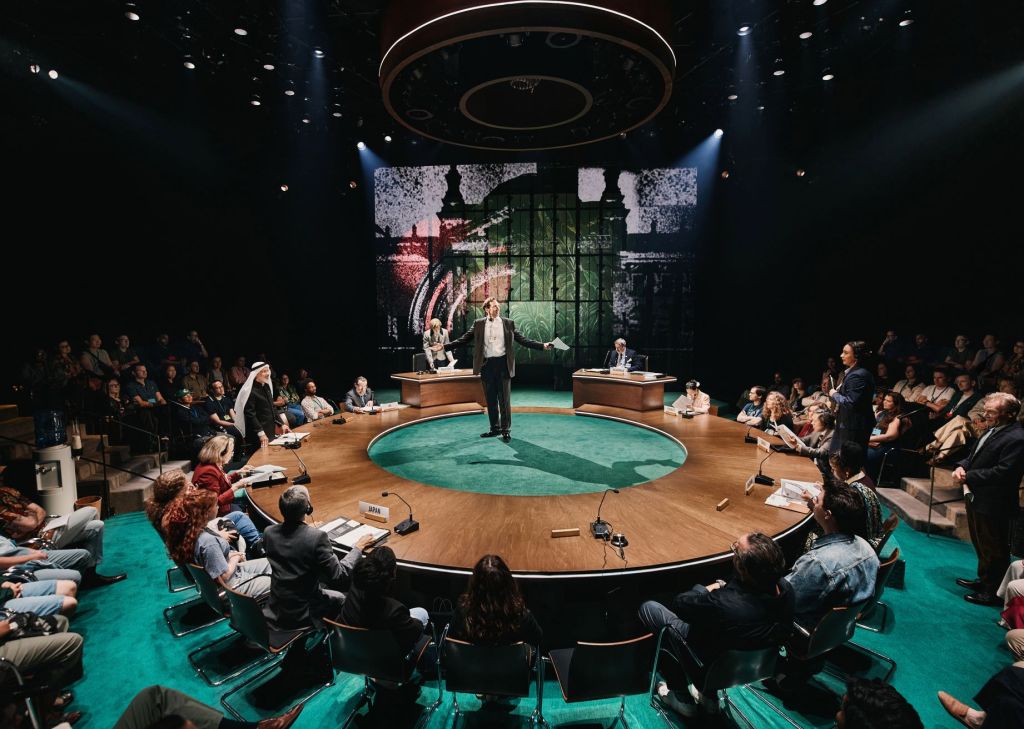
Based on events beginning in 1989 leading up to the 1997 United Nations Climate Change Conference in Kyoto, Japan, Joe Murphy and Joe Robrtson’s Kyoto explores the momentous occasion when nations agree to confront climate change. The two-act political thriller is in its US Premiere at the Lincoln Center Theater at the Mitzi E. Newhouse until November 30th. Compressing extensive detail, the playwrights reveal how representatives from 160 nations negotiated the Kyoto Protocol. The Protocol committed first world and emerging nations to limit/reduce greenhouse gasses after setting targets and timetables.
Stephen Daldry and Justin Martin co-direct Kyoto, which enjoyed its world premiere at the Swan Theatre, Stratford-upon-Avon. Due to its continued success, it transferred to London’s West End before debuting to American audiences, who don’t always relate to the ironies and humor in the play (directed at the US). Indeed, the US representative (Kate Burton), and American oil lobbyist Don Pearlman (Stephen Kunken) and the representative of Saudi Arabia (Dariush Kashani) become the objects of humor and frustration. They continually oppose any movement to pin down emissions’ timetables or support decreasing oil production.
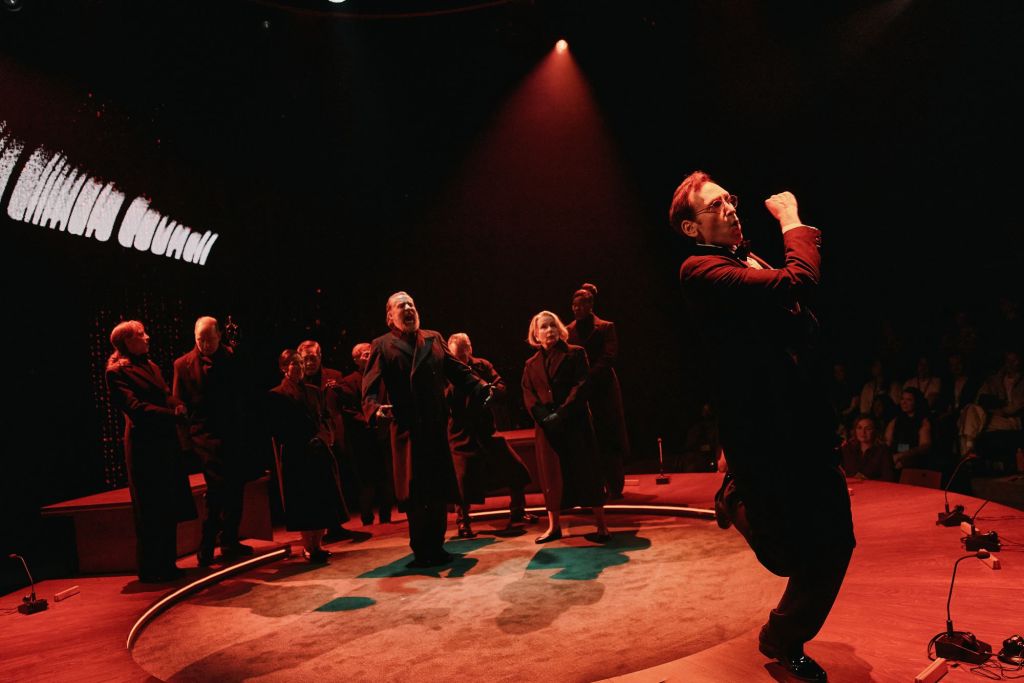
The set is a circular conference table where members sit and sometimes interact with the audience. The table serves also as a raised platform for Don Pearlman, placing him above the fray. In its design by Miriam Buether, Pearlman stands at its center and addresses the audience. Variably it becomes a private meeting area where Pearlman speaks with those opposed to any “progress” on emissions. It becomes a setting in his home, and several hotel rooms where he converses with his wife Shirley (Natalie Gold) and others. The co-directors keep the play in the realm of ideas, not material places. In one instance Shirley and Don join Raul Estrada (Jorge Bosch), the Argentinian representative for China, in a rain forest. The fluid, minimal set design forces the audience to keep up with the dialogue cues which indicate setting changes.
The playwrights have chosen the “well-meaning,” slippery lawyer Don Pearlman, as their spokesperson to reveal what happened from 1989 through1997, when nations finally achieved consensus in Kyoto. At the outset Kunken’s disarming oil lobbyist begins by discussing how the Seven Sisters (big oil, i.e, Exxon, Shell, BP) appoint him as their agent provocateur to stall and delay any UN agreement about greenhouse gas emissions.
Like Iago in Othello, Pearlman instructs the audience in his nefarious plans. Though the events happen at lightning speed, Kunken’s Pearlman slow walks us with his wise words and commentary about how to derail progress among the nations.
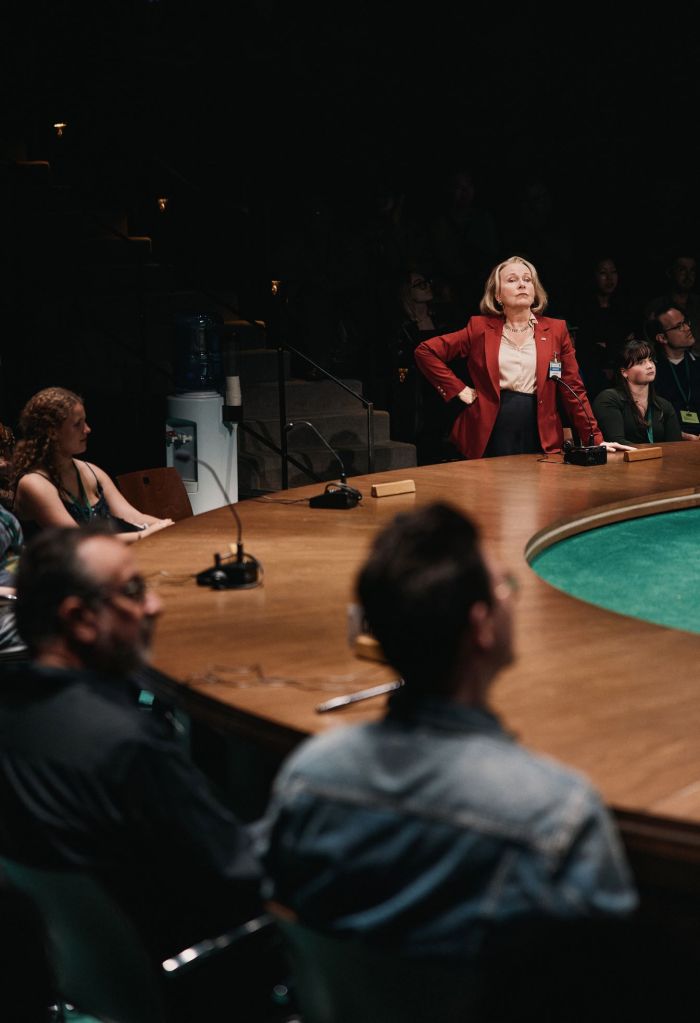
We become mesmerized as we note how he thwarts the representative countries who have different agendas than big oil conglomerates. Also, by extension we understand why little has been done to effectively curtail global warming. Without particular malice or a sinister tone, Kunken’s Pearlman humanely portrays a man who justifies his mission to support American’s “freedoms” to have a first world economy delivered by fossil fuels. Any change disrupting the oil supply, decreasing fossil fuels and harming profits must be stopped. Truly, Pearlman believes in his job and he believes in doing it well. This makes him and the Big Sisters utterly terrifying and wicked when one stops to consider the consequences.
As we follow along with the various conferences and summits beginning with the 1990 World Climate Conference in Geneva, through the Rio Earth summit, the many rounds of talks with scientists among countries, to 1995 Berlin, the First Conference of the Parties, COP-1, we see Kunken’s Pearlman enact the strategies and philosophies he first discussed with us and his wife Shirley. Without glee, with more than a soupcon of irony, Pearlman, ever the oil lobbyist, proves his genius standing up to various representatives with his knowledge about the process of negotiation, as well as his breadth of knowledge about the subject matter.
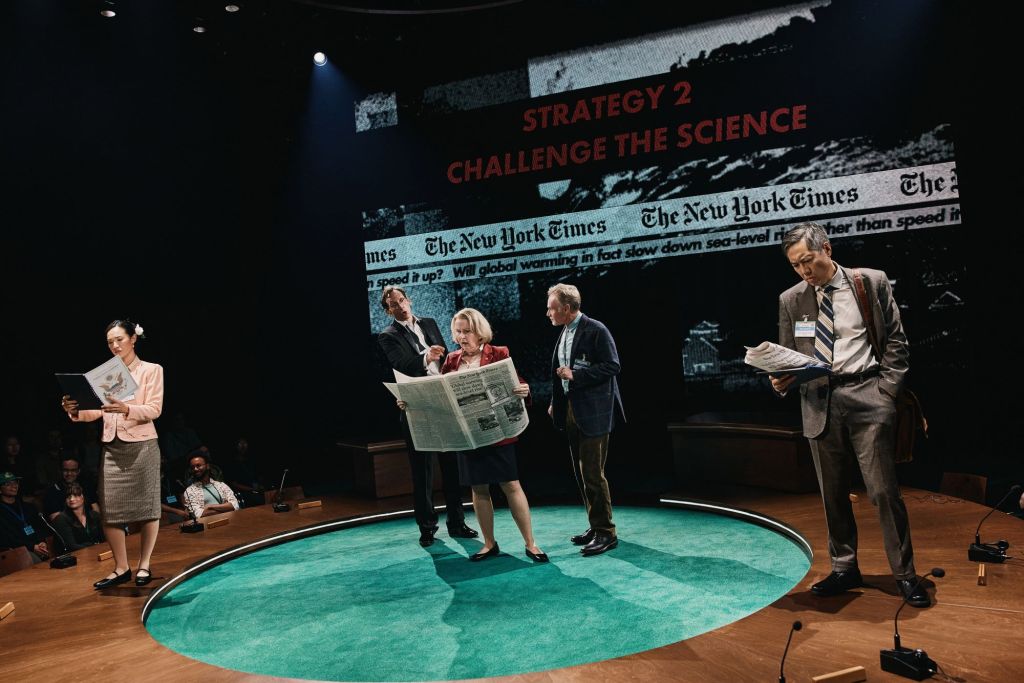
He, Burton’s US representative, Kashani’s Saudi Arabian representative for OPEC, and others dismiss the gravitas of what climate scientists have presented about global warming. However, Pearlman’s and others’ delinquence in acknowledging the looming disaster for representatives of low-lying coastal nation states comes to a screeching halt. The representative from Kiribati (Taiana Tully) joins forces with 39 other coastal nations to create a powerful negotiating bloc, The Alliance of Small Island States. They make it clear they will not allow the first world nations to marginalize and destroy them. For it is the first world nations’ oversized pollution that predominately contributes to the polar ice caps melting, and that puts the coastal nations at grave risk.
Thus, the conflict begins in earnest as the first world nations strain against the emerging nations, China having joined the coastal states. Few if any concessions are made for any collective unity as they delay for years, sea levels rise, and time runs out. However, a turning point occurs with the new appointment of Raul Estrada. Bosch’s Estrada eventually bans Pearlman from conferences, despite his being the CEO of the NGO, Climate Council (a blind to get him on the inside). Estrada knows Pearlman’s intent, and Pearlman shows no inclination to change his mission. Their war proceeds as representatives criss-cross the world in jets and add to the increasing emissions they seek to control.

Importantly, the play’s dynamism, pacing and urgency are conveyed by Kunken and Bosch’s performances and the co-directors’ staging and directed momentum. The lead actors who reprise their roles from the London production, have settled into their portrayals. As in real life, the oil lobbyist vs. the Argentinian representative to China smile and joke while warring against each other in a deadly “game” to stop big oil from holding the planet hostage.
Interestingly, the playwrights use the character of Shirley as a foil to soften and humanize Pearlman. However, when she finds out that the Seven Sisters knew about the consequences of global warming since 1959 and have kept this research under wraps, she realizes the wickedness of what her husband attempts. If she gives this information to him will it change his approach to his handlers? How can he live with himself and continue to support big oil knowing what the conglomerates have intentionally done for decades to keep profits flowing while endangering life on the planet?
At its strongest and most profound Kyoto dramatizes the tense political and scientific life and death battles that eventually result in the world’s first legally binding agreement to limit greenhouse gas emissions. That such Sturm und Drang resulted in so little is disappointing. However, in light of today’s international global divisions, to arrive at such a consensus seems miraculous and gives us pause.
Kyoto runs 2 hours 40 minutes with one intermission until Nov. 30 at the Mitzi E. Newhouse Theater, lct.org.

Posted on November 13, 2025, in Lincoln Center Theater and tagged Joe Murphy, Joe Robertson, Jorge Bosch, Justin Martin, Kate Burton, kyoto, Natalie Gold, Off Broadway, Peter Bradbury, Stephen Daldry, Stephen Kunken. Bookmark the permalink. Leave a comment.
 CAROLE DI TOSTI
Leave a comment
Comments 0