‘Ulster American’ Matthew Broderick Leads the Bang on Ensemble at Irish Repertory Theatre

With sardonic wit and dark farcical elements David Ireland’s Ulster American sends up the differences among Irish-American, left-wing British, and Northern Ireland’s Unionists’ views about identity politics. David Ireland also ridicules the hypocrisy of those who adhere to political correctness and equanimity when it serves their purpose, but when push comes to shove and the stakes are raised, they easily throw overboard their posturing to reveal ugly, ingrained prejudices not yet reconciled.
The play’s humor lands sometimes with subtly, other times with uproarious riot and full throttled mayhem in this wonderful production acutely, specifically directed by Ciaran O’Reilly. Ulster American runs at Irish Repertory Theatre through May 10, 2026.
Using theater as the medium to express his themes, Ireland begins with a simple “meeting of the minds,” among an actor, director and playwright. They join up to discuss the play which has been scheduled for its first rehearsal the following day. The individuals include Jim Conway, the lead actor (Matthew Broderick) of Irish ancestry from America. Conway has been cast for his talents and star power. The play’s British director (Max Baker), runs his own theater company that produces the play. Most importantly, the director has chosen a Northern Ireland female playwright (Geraldine Hughes) because her play is exceptional. He will present the play in London which is also where the director’s home conveniently is. Scenic designer Charlie Corcoran provides the comfortable environs where the characters discuss the play and where their true emotions explode.
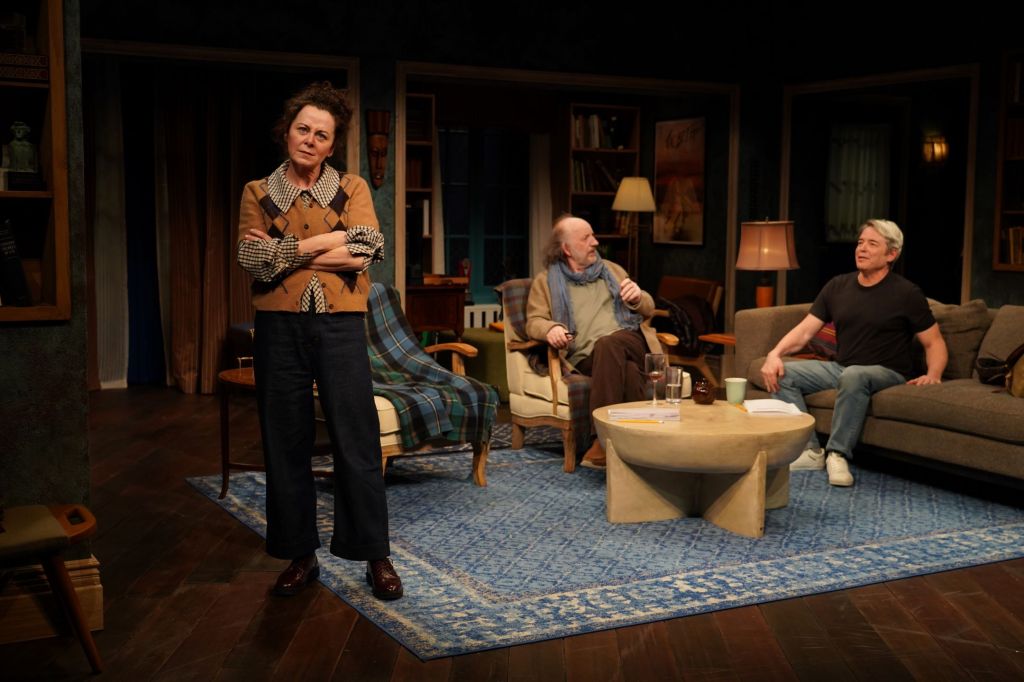
But what can go wrong among these artists who pride themselves on their craft and their humanity as creatives? Indeed! The diverse ethnic combination in itself indicates a potential powder keg for those in the know about the history of the Republic of Ireland, England, Northern Ireland, and America’s roots in all three. However, the beauty of David Ireland’s play and the talents of the dynamic cast manifest in the gradual reveal. Discovering who these people are and what each assumes about the others is the order of the day. If they achieve a consensus and understanding of the play, then they hope it will be a smash that takes them to Broadway and eventually to a friend of the actor’s doorstep, filmmaker Quentin Tarentino.
The fun is in watching the characters’ assumptions about each other and “their” play go up in flames, and seeing their shock when they realiz who everyone is as the smoke clears. How Ireland turns everything on its head after the opening scene is terrific theater. The actors deliver, hitting every bullseye Ireland sets up.
Matthew Broderick’s Irish American Jay Conway reveals the underlying pomposity of an Oscar-winning film star who attempts to evolve into a better person as he conquers his alcoholism with the help of his priest sponsor. Deft with the character’s initial humility, decency and humanity Broderick pings these notes with earnestness. Conway and amenable theater director Leigh Carver (Max Baker) become better acquainted discussing topics ranging from the use of the “N” word, to the importance of “women’s voices crying out,” to Irish history, and being of the patriarchy only as a necessary evil, though it demeans them.
Ironically, both disavow the patriarchy and uplift themselves as feminists. Though they dismiss the inherent power and status they’ve received from being males at the top of their game, in due season, the worm turns. We watch delighting in their hypocrisy as they riotously try to exert power over playwright Ruth Davenport by changing her play among other actions. Under the right conditions everyone’s truth emerges and deeper unconscious impulses explode to the surface.
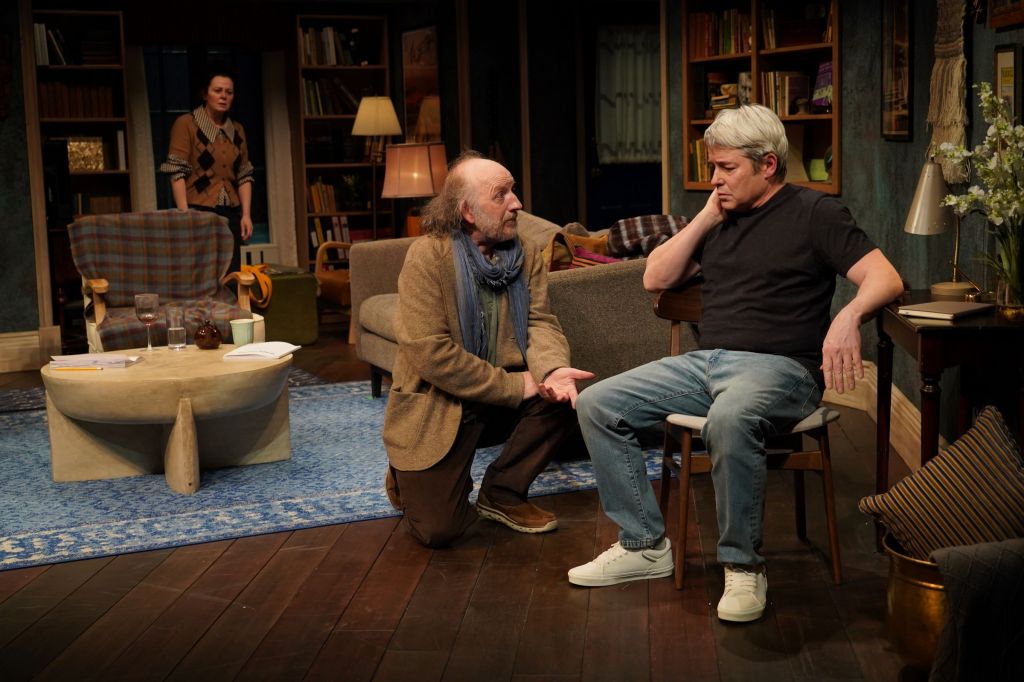
The men’s discussion topics conclude with a scene in a film early in Conway’s career which involved Jay’s character raping a woman at the direction of a terrorist who would bomb Minneapolis with a nuclear bomb if he didn’t do the deed. The studio cut the scene from the script because the women at the studio felt it was objectionable. However, Conway considered the scene thought provoking and thought about who he would rape to save the city, as hideous as it was.
Why Conway brings each of the topics up, especially the latter one, he ascribes to nervousness and being overly talkative. Perhaps, it is an attempt to deepen the feelings and get on solid footing with his director in a relationship which he believes should be close, intimate, like family. Nevertheless the question Conway innocently poses to the reticent, Brit Leigh alienates the director. Not only does he lie and pretends it’s OK when Conway confronts him, but he is so upset he spills to Hughes’ Ruth, though Conway told him in confidence. Eventually, this causes havoc for the actor, director and playwright, who swore that being true to oneself and being honest were paramount.
David Ireland has peppered the scene between the two men with platitudes and their agreed upon myths about themselves and each other which he gradually topples on the proving ground of working with Ruth after she arrives. She is late because of a car crash which lands her mother in hospital. After pleasantries and compliments the artists get to the “nitty gritty,” what the play is about.
We learn interesting bits of information along with Conway who asks what and why Ulster. The questions about Irish vs. British identity arise and unsettle Conway who expected something else. Ruth calls him on his misunderstanding. Did he really read and “get” what her characters were about? Does Conway really mean it is the best play he read in a decade and that it’s like Chekhov? And does Leigh mean the play is better than Harold Pinter? If one knows Pinter’s attitude about his own work, Leigh’s compliment that even Pinter would say her play is better than his is particularly ironic.
Of all of them Ruth holds her own and finds ways to fight back, using their own admissions against them. Remembering how they patted themselves on the back for their feminism, we note that white knights become black knights as they attempt to change the play and save their egos. For her part Ruth cleverly makes her demands and uses impeccable leverage to get what her play needs.
The specific details about how these webs are woven to catch the self-duplicitous are entertaining and surprising. The actors move from moment to moment and give nothing away, least of all the last five minutes until lights out. Great stuff.
Ulster American runs 1 hour 30 minutes with no intermission at Irish Repertory Theatre until May 10, 2026. https://irishrep.org/whats-on/ulster-american

Posted on March 17, 2026, in Irish Repertory Theatre and tagged Ciarán O'Reilly, David Ireland, Geraldine Highes, Irish Rep, Matthew Broderick, Max Baker, Ulster American. Bookmark the permalink. 2 Comments.
 CAROLE DI TOSTI
Wonderful review Carole!! Amazed
LikeLike
Thanks, Jane. Appreciate it.
LikeLike