‘Antigone (This Play I Read in High School)’ Review
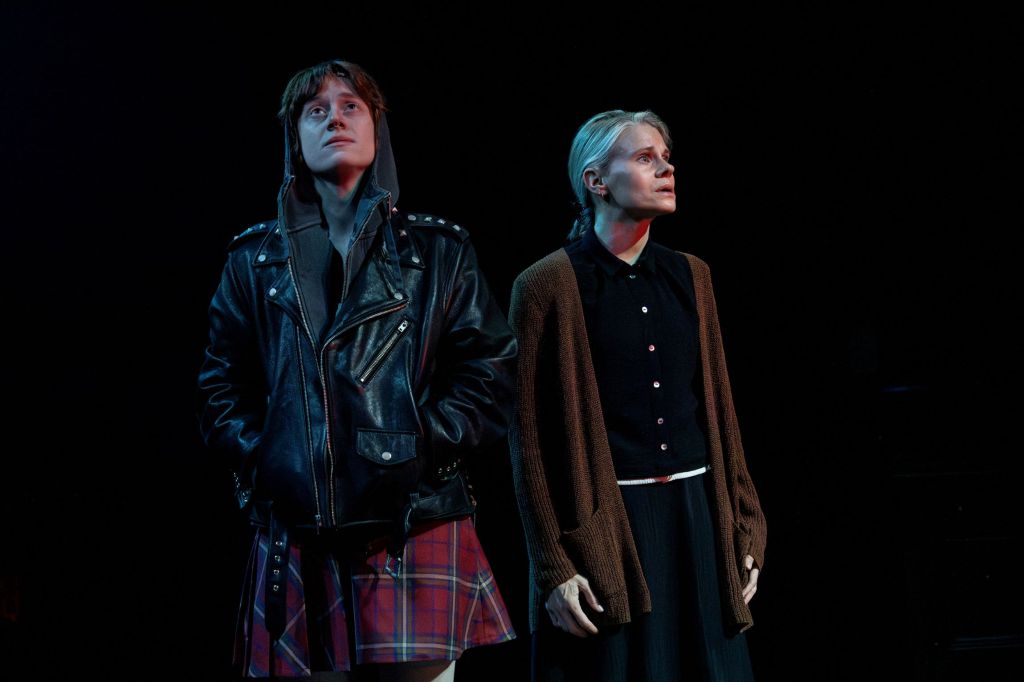
Strong performances from the leads Celia Keenan-Bolger, Susannah Perkins and Tony Shalhoub lift up Anna Ziegler’s unbalanced, convoluted feminist revision of Sophocles masterpiece Antigone. An irony not to be overlooked is that Antigone is a tragedy about a profoundly heroic and powerful women who overturns the rule of the patriarchy-her Uncle Creon’s leadership-and destroys it and its future by adhering to spiritual and moral laws rather than the state’s. Ziegler gives a nod to the inherent “feminism” in Antigone in her adaptation which must be lauded for her attempt. However, its execution and rearrangements as well as themes fall far short of the original. Directed by Tyne Rafaeli, Antigone (This Play I Read in High School) runs at the Public Theater until April 5, 2026.
Zigler reconfigures Antigone through the lens of Keenan-Bolger’s unnamed “Chorus/Narrator.” The playwright uses modern, feminist issues to frame and review Antigone’s heroism by having the Chorus/Narrator create her own scenario of the play she knew from high school. In effect, she imagines the Antigone/Creon conflict in a winding plot that relates to the Chorus/Narrator’s womanhood and identity.
Finding she is pregnant at an older age, the Chorus/Narrator must decide if she should keep the child or get an abortion, given who she thinks she is. However, this straightforward question comes after we witness her shadow her version of Antigone (exiled Oedipus and deceased Jocasta’s rebellious daughter) calling her up during events in the Chorus/Narrator’s life. In effect she uses Antigone to surge power into her own life over the years and help her resolve her problematic relationship with her mother, who she believes didn’t love her. The process of revisiting her own reclamation of the Antigone/Creon conflict enables her to validate her identity and her choices, and establish the power of her voice which she does by the play’s conclusion.
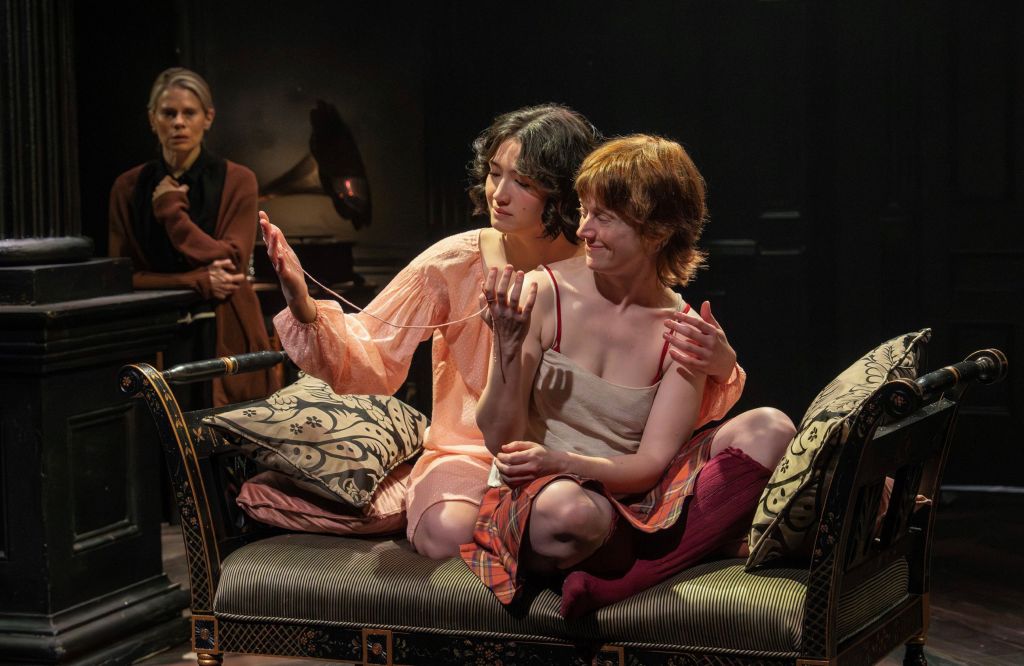
Through the Chorus/Narrator’s lens Antigone is a hip teenager with cropped hair (designers Robert Pickens, Katie Gell), wearing a black leather jacket, loosely fitting top and red plaid skirt courtesy of Ever Chakartash’s costume design. All of the characters are in modern dress, save Ismene, Antigone’s sister, who the narrator “sees” in a smock dress which she wears during her own self-imposed isolation while Antigone makes defiant decisions. The set design (David Zinn) is minimalist mostly defined by props, for example, a lectern when Creon speaks to the crowd, a security screener at the palace entrance, a settee for Ismene’s room and more.
In the narrator’s first scenario the wild and recalcitrant, Antigone carouses in a bar and ends up with a pickup instead of going to her Uncle Creon’s coronation. She hears he’s become a hard-line politician and to keep control has established many strict laws to create order out of a chaotic Thebes. One of his laws is the banning of abortions which gives rise to illegal abortionists in the back of bodegas. Antigone eventually visits one of these after discovering her pregnancy from her love relationship with Haemon, Creon’s son, her fiance whom she has cheated on.
Key to the Chorus/Narrator’s conflict with herself is establishing her own life and identity, so scenarios especially between Creon and Antigone that she envisions help her. In the second act Antigone confronts Creon about having the illegal abortion. She tells him her body is her own and her choices are her own. They are acts of freedom. She will not be ruled by state laws or Creon’s laws, but by herself. The fact that she asserts this because she believes she can and should is a revolutionary act. The Chorus/Narrator’s view of Antigone is an independent, autonomous being beyond any laws, speaking truth to power, brave and unafraid. Her ultimate power is in ending a pregnancy, another life, if she chooses.
Creon has no power over Antigone in this context, over her reproductive rights. Thus the Chorus/Narrator imagines a powerful scene where Antigone illustrates her act of freedom and of owning her body to Creon. Perkins’ Antigone disrobes and points to various injuries and scars only she knows about. Naked, in full possession of herself in front of Shalhoub’s Creon, we believe in the power and determination of Perkins’ Antigone. Only she can objectify her own body, if she so chooses. Perkins makes a meal of this scene and we can identify with her argument keeping in mind how long it took for women to get to this point which was overturned federally in Dobbs after women experienced the freedom to choose via Roe v Wade for 49 years.
Apart from this high-point and Shalhoub’s Creon’s impassioned speech justifying why she must apologize publicly for getting the abortion, the characters don’t resonate. In Sophocles’ Antigone/Creon conflict we feel the enormity of the stakes and the depths of Antigone’s despair which prompts her decision to disobey Creon and not let her brother’s spirit wander for eternity. Unfortunately, Ziegler’s Chorus/Narrator’s inner conflict is not fully explored with grist or emotion. This prevents us from engaging with her as we look through the Chorus/Narrator lens darkly and have difficulty completely identifying with her version of Antigone.
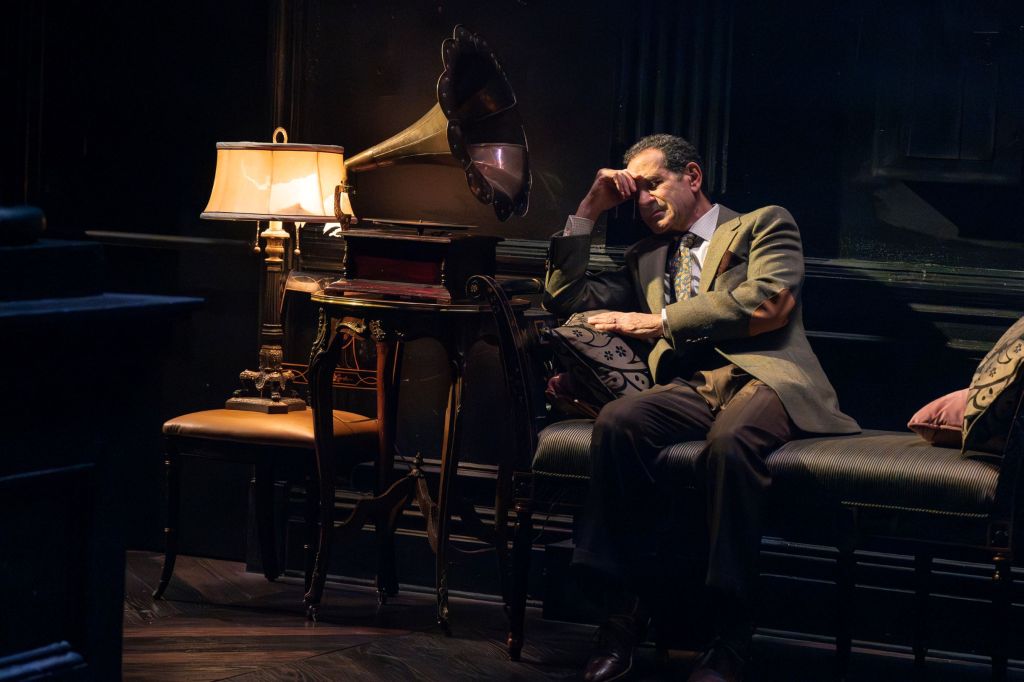
It is an irony that Tony Shalhoub’s Creon, so expertly acted, elevates Creon. We note his character loves his son, niece and family. Unlike the more brutal tyrannical Creon of Sophocles’ original, Shalhoub’s Creon delivers the most reasoned and believable argument for his actions. Shalhoub actually humanizes Creon. Antigone’s choice, apart from her action of naked self-possession becomes reduced from the heroic, noble Antigone in the original play to that of a willful revolutionary who does what she wants not because of any other reason, but to assert her will against the state, because she can. She refuses to apologize but her revolutionary act of facing death is not realized in Creon’s death penalty. She bleeds out from the bad abortion, the meaning of her act diminished.
Unfortunately, Ziegler’s framing structure reduces the characters’ stakes and prevents the audience from being drawn into the plight of Keean-Bolger’s Chorus/Narrator or Perkins’ Antigone to care about what happens to them. This occurs despite the acting chops both women acutely display. The structure is at fault, not their performances.
Antigone (This Play I Read in High School) runs 2 hours15 minutes through April 5 at the Public Theater https://publictheater.org/productions/season/2526/antigone-this-play-i-read-in-high-school/

Posted on March 30, 2026, in Off Broadway, Public Theater and tagged Celia Keenan-Bolger, Anna Ziegler, reviews, theatre, Books, Sophocles, Susannah Perkins, Tony Shalhoub, philosophy. Bookmark the permalink. Leave a comment.
 CAROLE DI TOSTI
Leave a comment
Comments 0