John Lithgow in ‘Giant,’ a Towering Triumph in a Giant of a Play
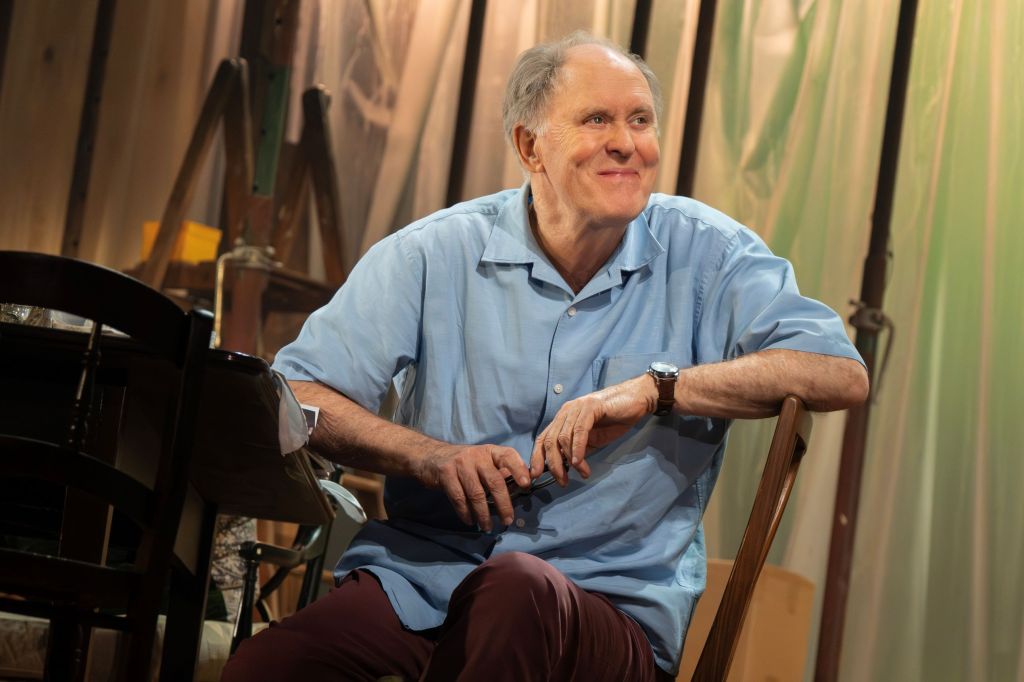
Roald Dahl, beloved British children’s author and poet, has sold more than 300 million copies world wide. He has been called “one of the greatest storytellers for children of the 20th century.” Dahl was also a self-proclaimed anti-Semite. How could a tender-hearted children’s author who answered children’s letters and nursed his wife back from death, be a bigot? The answer to this question turns the drama Giant by Mark Rosenblatt into thrilling, dynamic and controversial theater. Acutely directed by Nichols Hytner and designed by Bob Crowley, Giant runs in a limited engagement at the Music Box Theatre until June 28, 2026.
Mark Rosenblatt’s thought-provoking and slippery play about Dahl takes place in 1983 in the deconstructed living room of Dahl’s family home in Buckinghamshire, England during a summer afternoon. At the odd moment workers who renovate upstairs, pepper the quiet with loud bangs thanks to Darron L West’s sound design, which supports the set design, an undressed living room awash in plastic curtains, boxes and a table and chairs. The cacophony drives John Lithgow’s Dahl up the wall as he discusses the final draft of his latest children’s book, Witches, with Tom Maschler (Elliot Levey). Tom, the managing director of his British publisher, counters Dahl’s complaints with cheerfulness and irony.
With this foray into book corrections we get a glimpse of the terrific John Lithgow’s best selling children’s author responsible for Mathilde and James and the Giant Peach to name a few. Rosenblatt painstakingly constructs the direct, intrusive style of the author with specificity. We note that Dahl listens to every word and humorously spits out whiplash retorts. Apparently, he finds fun in provocative wordplay and enjoys stirring argument.
Lithhgow, who has gotten inside the skin of Dahl and walks in his shoes comfortably, reveals Dahl’s steel-trap mind, and his prickly personality, a mine field to carefully navigate with eyes open. His adversary Mrs. Jessie Stone (Aya Cash), discovers by the play’s end that his cheeky, dark, playfulness should not be underestimated as silly or childish. Indeed, his actions reveal intention. His demeanor may be dismissed as egotistical and inflexible, but it can also be described as adamantine regarding his convictions, however wrong-headed one may think them. On closer investigation Dahl is the giant that should not be self-righteously challenged. He must be responded to in like kind to bring out his generous, sensitive heart to receive the best results for all involved.
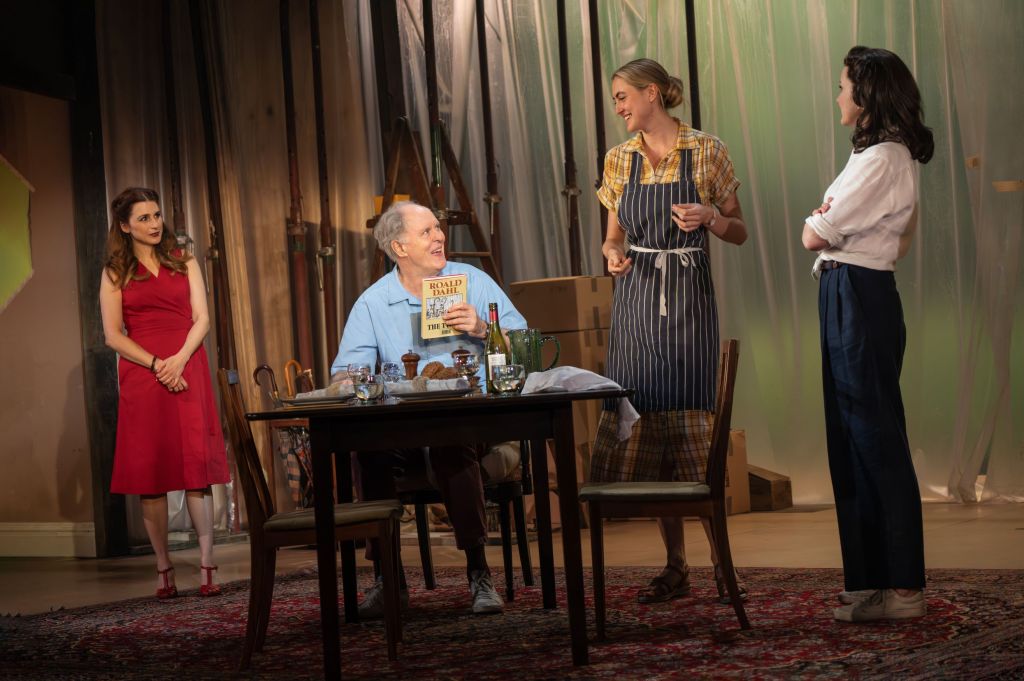
Tom and Liccy, Dahl’s long-time lover and fiancée (Rachael Stirling), have learned to smartly counsel him. And this particular day of aches and pains and banging and agitation requires that he be subtly “managed.” Grumbling about royalties, Dahl waits for Jessie Stone, the sales representative from his American publisher. Prompted by the publishing house, she visits to discuss a scandalous review he wrote that exploded with negative press into a death threat by a “crank-caller.” The book Dahl reviewed was God Cried by Catherine Leroy and Tony Clifton. It concerns the 1982 siege of Beirut, Lebanon where Israeli soldiers killed 22,000, mostly Lebanese women and children.
An RAF fighter pilot who shot down German Junker 88s during WWII, Dahl knows the death threat was from a coward because “genuinely violent people don’t call beforehand.” He remains nonplussed, despite Liccy and Tom’s concern, but he keeps the hired policeman stationed outside to protect his family. Furthermore, he dismisses the impact of his review. Later in the play Liccy implies he knew what he was doing and avoided discussing it with her because she would have moved him to take out his inflammatory statements.
Gradually, we learn of the trouble Dahl caused for himself as Liccy and Tom discuss how to “make the stink go away.” Liccy quotes the “Spectator’s” Paul Johnson, who said Dahl’s book review was, ‘The most disgraceful thing to be written in the English language for a very long time.” Though Tom dismisses Johnson as “a hysteric,” Liccy says the criticism about Dahl is “everywhere. All the rags. Left and right.” The point seems to be how badly this will tank his career, reputation and book sales without an apology.
However, we don’ t know what Dahl wrote in his book review until after Jessie arrives. Her mission is to run interference, reveal the fallout in the United States and get Dahl to make a statement, at best, disavowing his objectionable comments so the company’s profitability and launch of Dahl’s Witches goes swimmingly.
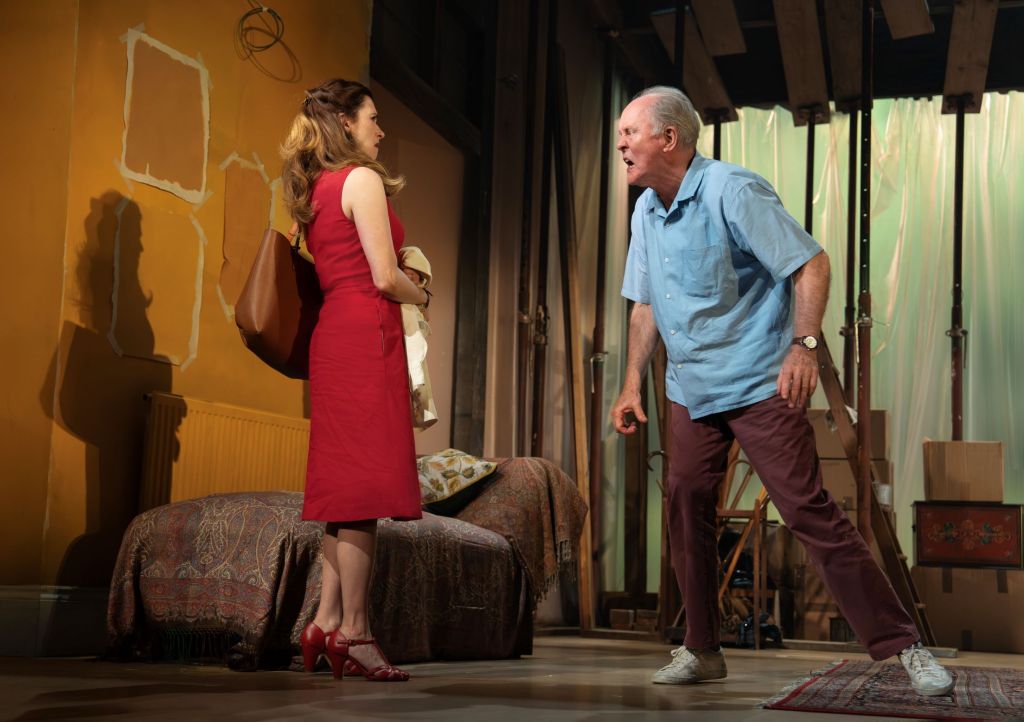
The controversy begins when Dahl asks if she’s Jewish, a question Liccy gently chides him about because of its rudeness. However, Jessie’s answer about her name change from Stein to Stone helps Dahl consider how he should proceed. Does she feel attacked by Dahl’s remarks which she deems antisemitic because they are anti-Israel? Dahl’s provocative question rankles her. A cut-out of his review with her accusatory notes scribbled on it that falls out of her son’s book she wished him to sign provokes him.
Rosenblatt sets up the mounting drama conveniently. Tensions increase as Jessie backs Dahl into a corner and the celebrated author reacts defensively. In a private moment Tom criticizes Jessie for not keeping quiet and for not “managing” Dahl away from his incendiary impulses. If only she had returned Tom’s call so he might have debriefed her about how to best conduct the meeting which now, crashes and burns.
As adversaries, Cash’s Jessie and Lithgow’s Dahl electrify the audience to side with their opinions as the characters take their stands. Obviously, Dahl feels justified about condemning Israel for its heartless massacre in the siege of Beirut. He will not amend his comments, one of which stated, “Never before in the history of man has a race of people switched so rapidly from being much pitied victims to barbarous murderers.” But by the end of Act I Cash’s Jessie counters his view with forceful righteousness. She points out Israel’s response to Lebanon’s attack as self-defense. And, she takes umbrage with Dahl’s blaming all Jews for the actions of Israeli soldiers. Additionally she reminds Dahl that 400,000 Israeli citizens condemned and protested the attacks, “protested Sharon, and the Supreme Court forced him out of the army.” The audience responded to Cash’s Jessie with applause and cheers the night I saw the play. She wins a vital, personal victory in her confrontation with Dahl.
Her remarks, however forceful, propel the second act into darker rumblings, her conciliation, Dahl’s growing uncertainty about his remarks, and further attempts by her, Tom and Liccey to get Dahl’s apology on the record. When Liccy reveals his antisemitic comments may inhibit his investiture, Dahl hesitates for her sake, though he dislikes the thought of doing a “begging” interview before a committee to qualify for a knighthood. Further insights into Dahl’s character in a conversation with his gardener Wally, reveal a kind, loving individual who Wally counsels to be himself. But in his last conversation with Jessie, she cannot resist provoking him with one final salvo about how she responds to this experience with Dahl.
Unwittingly, she escalates Dahl’s anger with the revelation of a “white lie” that pushes Dahl over the edge. He sees what he now must do in a final response to the press in remarks which he will not take back. He proclaims his antisemitism with a caveat and qualification, easily overlooked because he mentions Hitler. Only long after his death does the family apologize. How and why he responds to a white lie that Jessie reveals clues us in to his identity. Depending upon how one perceives the portrayal of events, Rosenblatt’s alignment of Dahl with a giant found in his stories, may be interpreted a number of ways in this memorable, wonderfully acted, tragically current play.
Giant runs 2 hours 20 minutes through June 28 at the Music Box Theater, gianttheplay.com.

Posted on April 2, 2026, in Broadway, NYC Theater Reviews and tagged Aya Cash, Ellior Levey, Giant, John Lithgow, nicholas-hytner, Rachael Stirling, roald-dahl. Bookmark the permalink. Leave a comment.
 CAROLE DI TOSTI
Leave a comment
Comments 0