Category Archives: Irish Repertory Theatre
‘Ulster American’ Matthew Broderick Leads the Bang on Ensemble at Irish Repertory Theatre

With sardonic wit and dark farcical elements David Ireland’s Ulster American sends up the differences among Irish-American, left-wing British, and Northern Ireland’s Unionists’ views about identity politics. David Ireland also ridicules the hypocrisy of those who adhere to political correctness and equanimity when it serves their purpose, but when push comes to shove and the stakes are raised, they easily throw overboard their posturing to reveal ugly, ingrained prejudices not yet reconciled.
The play’s humor lands sometimes with subtly, other times with uproarious riot and full throttled mayhem in this wonderful production acutely, specifically directed by Ciaran O’Reilly. Ulster American runs at Irish Repertory Theatre through May 10, 2026.
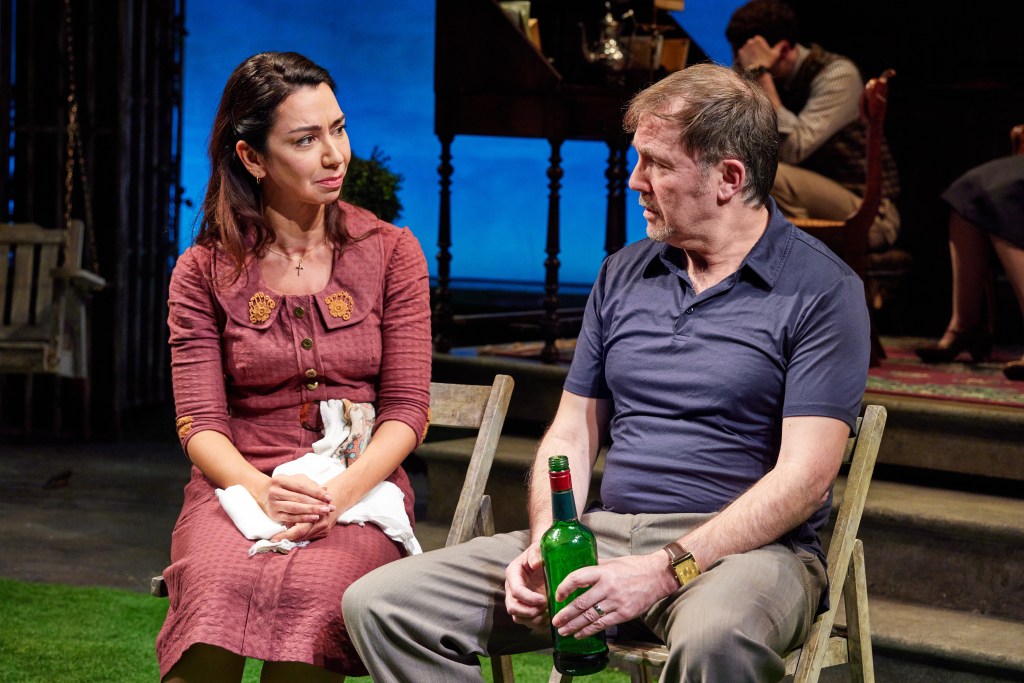
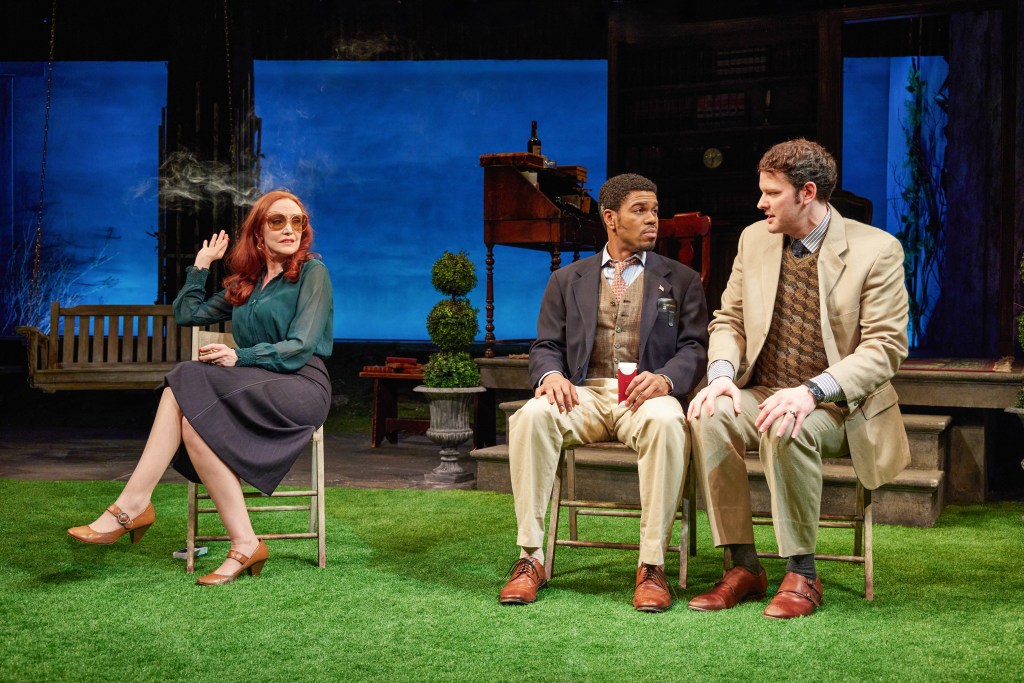
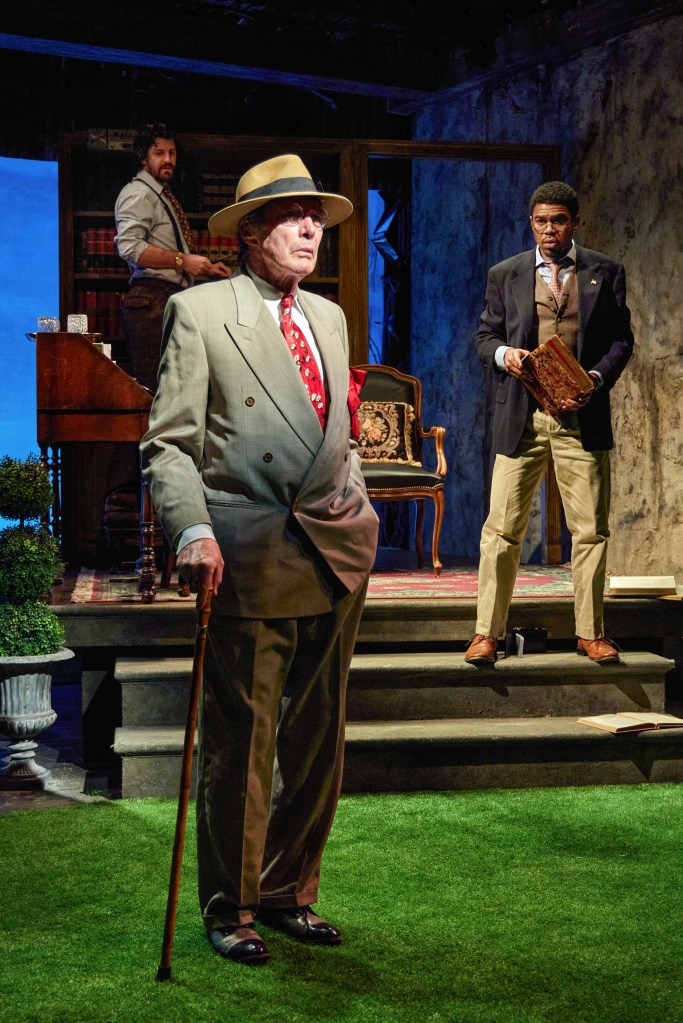
Using theater as the medium to express his themes, Ireland begins with a simple “meeting of the minds,” among an actor, director and playwright. They join up to discuss the play which has been scheduled for its first rehearsal the following day. The individuals include Jim Conway, the lead actor (Matthew Broderick) of Irish ancestry from America. Conway has been cast for his talents and star power. The play’s British director (Max Baker), runs his own theater company that produces the play. Most importantly, the director has chosen a Northern Ireland female playwright (Geraldine Hughes) because her play is exceptional. He will present the play in London which is also where the director’s home conveniently is. Scenic designer Charlie Corcoran provides the comfortable environs where the characters discuss the play and where their true emotions explode.
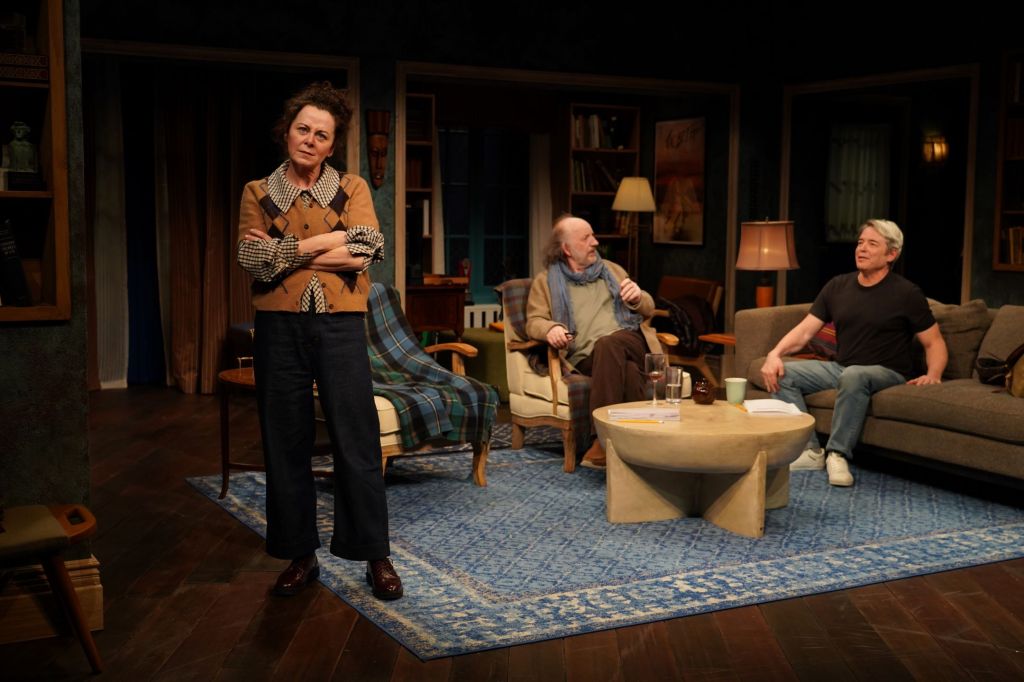
But what can go wrong among these artists who pride themselves on their craft and their humanity as creatives? Indeed! The diverse ethnic combination in itself indicates a potential powder keg for those in the know about the history of the Republic of Ireland, England, Northern Ireland, and America’s roots in all three. However, the beauty of David Ireland’s play and the talents of the dynamic cast manifest in the gradual reveal. Discovering who these people are and what each assumes about the others is the order of the day. If they achieve a consensus and understanding of the play, then they hope it will be a smash that takes them to Broadway and eventually to a friend of the actor’s doorstep, filmmaker Quentin Tarentino.
The fun is in watching the characters’ assumptions about each other and “their” play go up in flames, and seeing their shock when they realiz who everyone is as the smoke clears. How Ireland turns everything on its head after the opening scene is terrific theater. The actors deliver, hitting every bullseye Ireland sets up.
Matthew Broderick’s Irish American Jay Conway reveals the underlying pomposity of an Oscar-winning film star who attempts to evolve into a better person as he conquers his alcoholism with the help of his priest sponsor. Deft with the character’s initial humility, decency and humanity Broderick pings these notes with earnestness. Conway and amenable theater director Leigh Carver (Max Baker) become better acquainted discussing topics ranging from the use of the “N” word, to the importance of “women’s voices crying out,” to Irish history, and being of the patriarchy only as a necessary evil, though it demeans them.
Ironically, both disavow the patriarchy and uplift themselves as feminists. Though they dismiss the inherent power and status they’ve received from being males at the top of their game, in due season, the worm turns. We watch delighting in their hypocrisy as they riotously try to exert power over playwright Ruth Davenport by changing her play among other actions. Under the right conditions everyone’s truth emerges and deeper unconscious impulses explode to the surface.
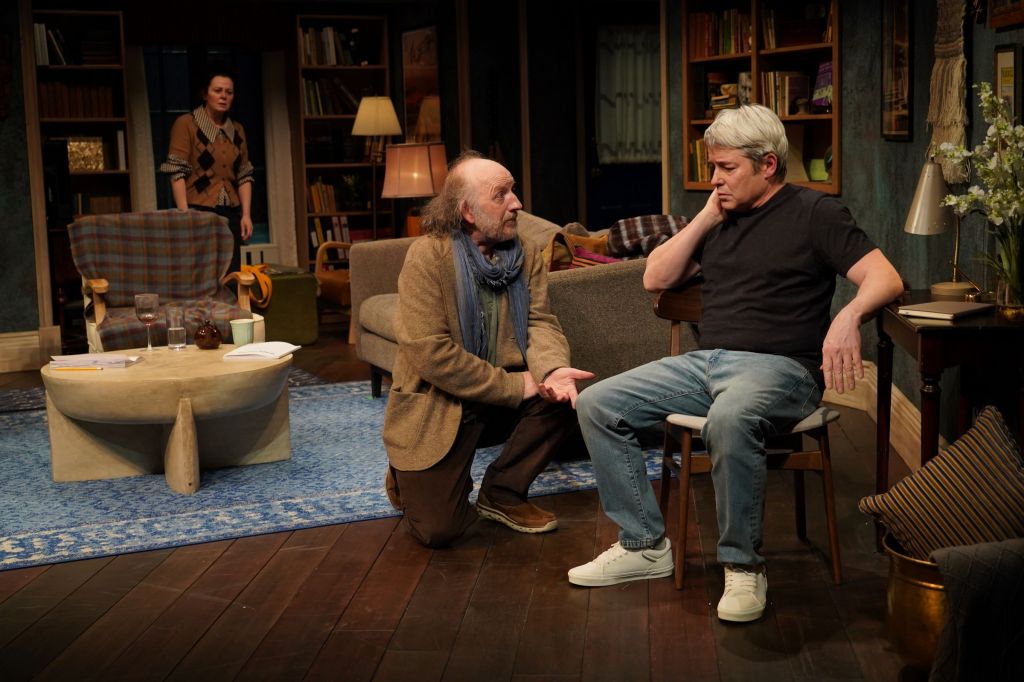
The men’s discussion topics conclude with a scene in a film early in Conway’s career which involved Jay’s character raping a woman at the direction of a terrorist who would bomb Minneapolis with a nuclear bomb if he didn’t do the deed. The studio cut the scene from the script because the women at the studio felt it was objectionable. However, Conway considered the scene thought provoking and thought about who he would rape to save the city, as hideous as it was.
Why Conway brings each of the topics up, especially the latter one, he ascribes to nervousness and being overly talkative. Perhaps, it is an attempt to deepen the feelings and get on solid footing with his director in a relationship which he believes should be close, intimate, like family. Nevertheless the question Conway innocently poses to the reticent, Brit Leigh alienates the director. Not only does he lie and pretends it’s OK when Conway confronts him, but he is so upset he spills to Hughes’ Ruth, though Conway told him in confidence. Eventually, this causes havoc for the actor, director and playwright, who swore that being true to oneself and being honest were paramount.
David Ireland has peppered the scene between the two men with platitudes and their agreed upon myths about themselves and each other which he gradually topples on the proving ground of working with Ruth after she arrives. She is late because of a car crash which lands her mother in hospital. After pleasantries and compliments the artists get to the “nitty gritty,” what the play is about.
We learn interesting bits of information along with Conway who asks what and why Ulster. The questions about Irish vs. British identity arise and unsettle Conway who expected something else. Ruth calls him on his misunderstanding. Did he really read and “get” what her characters were about? Does Conway really mean it is the best play he read in a decade and that it’s like Chekhov? And does Leigh mean the play is better than Harold Pinter? If one knows Pinter’s attitude about his own work, Leigh’s compliment that even Pinter would say her play is better than his is particularly ironic.
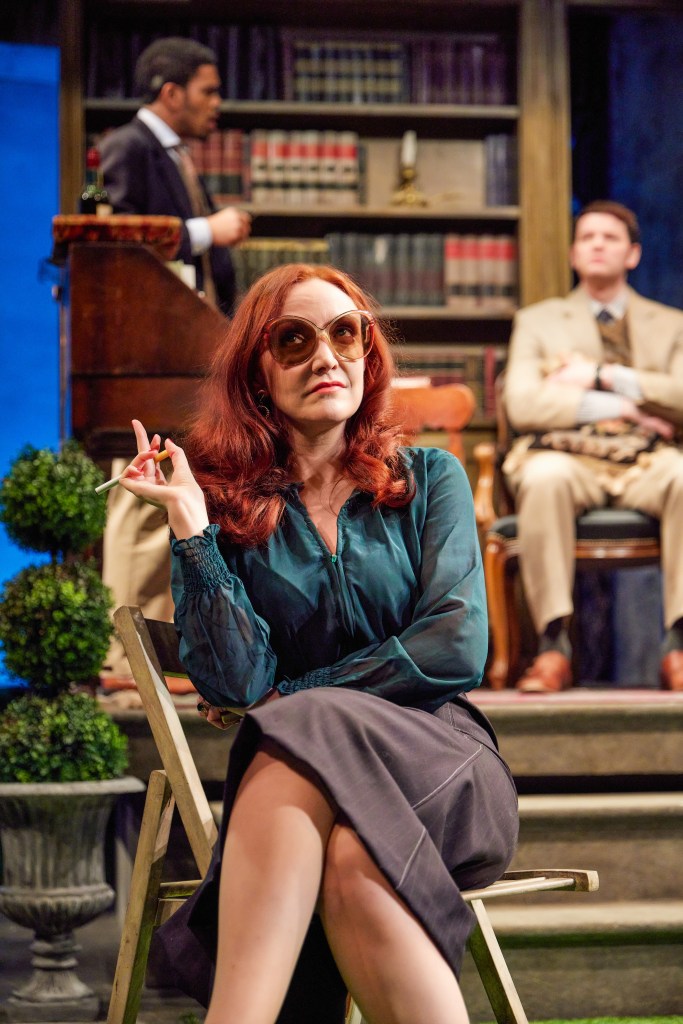
Of all of them Ruth holds her own and finds ways to fight back, using their own admissions against them. Remembering how they patted themselves on the back for their feminism, we note that white knights become black knights as they attempt to change the play and save their egos. For her part Ruth cleverly makes her demands and uses impeccable leverage to get what her play needs.
The specific details about how these webs are woven to catch the self-duplicitous are entertaining and surprising. The actors move from moment to moment and give nothing away, least of all the last five minutes until lights out. Great stuff.
Ulster American runs 1 hour 30 minutes with no intermission at Irish Repertory Theatre until May 10, 2026. https://irishrep.org/whats-on/ulster-american
‘The Honey Trap,’ Irish Rep’s Acclaimed Production Returns

Subscribe to continue reading
Subscribe to get access to the rest of this post and other subscriber-only content.
‘The Weir’ Review: Drinks and Spirits in a remote Irish Pub
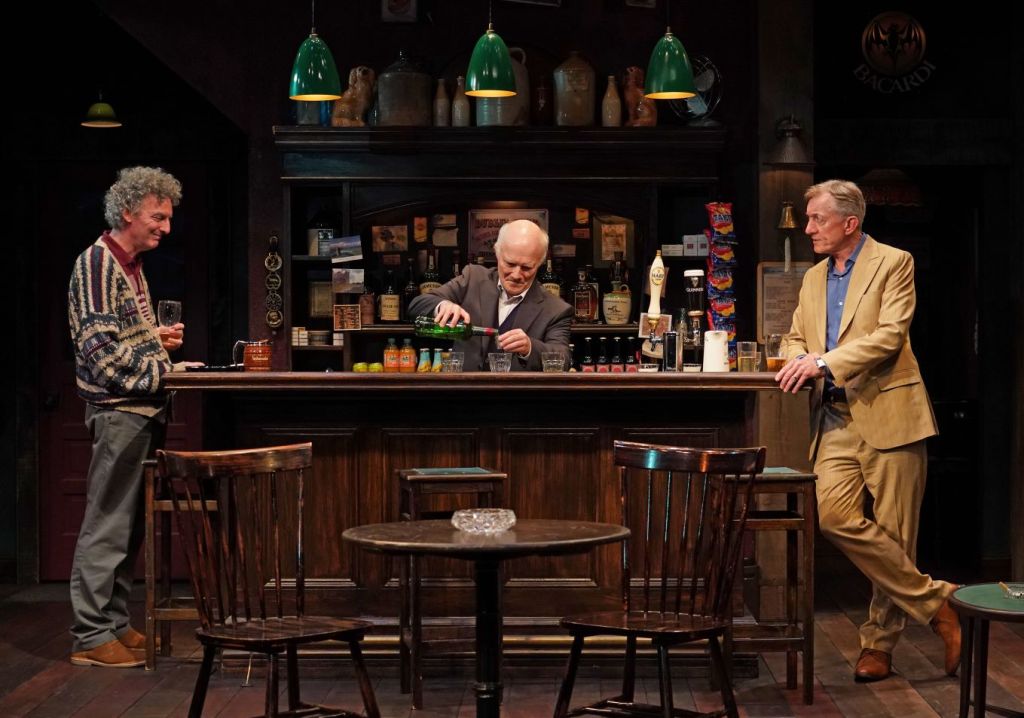
Conor McPherson’s The Weir currently in its fourth revival at Irish Repertory Theatre has evolved its significance for our time. It captures the bygone Irish pub culture and isolated countryside, disappeared by hand-held devices, a global economy and social media. Set in an area of Ireland northwest Leitrim or Sligo, five characters exchange ghostly stories as they drink and chase down their desire for community and camaraderie. Directed with precision and fine pacing by Ciarán O’Reilly, The Weir completes the Irish Rep’s summer season closing August 31st.
Charlie Corcoran’s scenic design of the pub with wooden bar, snacks, bottles, a Guinness tap and heating grate is comfortable for anyone to have a few pints and enjoy themselves at a table or nearby bench. With Michael Gottlieb’s warm, inviting lighting that enhances the actors’ storytelling, all the design elements including the music (Drew Levy-sound design), heighten O’Reilly’s vision of an outpost protective of its denizens and a center of good will. It’s perfect for the audience to immerse itself in the intimacy of conversation held in non-threatening surroundings.
On a dark, windy evening the humorous Jack drops in for drinks as a part of his routine after work at the garage that he owns. A local and familiar patron he helps himself to a bottle since he can’t draw a pint of Guinness because the bar’s tap is not working. Brendan (Johnny Hopkins) owner of the pub, house and farm behind it informs him of this sad fact. But no matter. There are plenty of bottles to be had as Jim (John Keating) joins Jack and Brendan for “a small one.” The entertainment for the evening is the entrance of businessman Finbar (Sean Gormley), who will introduce his client Valerie to the “local color,” since she recently purchased Maura Nealon’s old house.
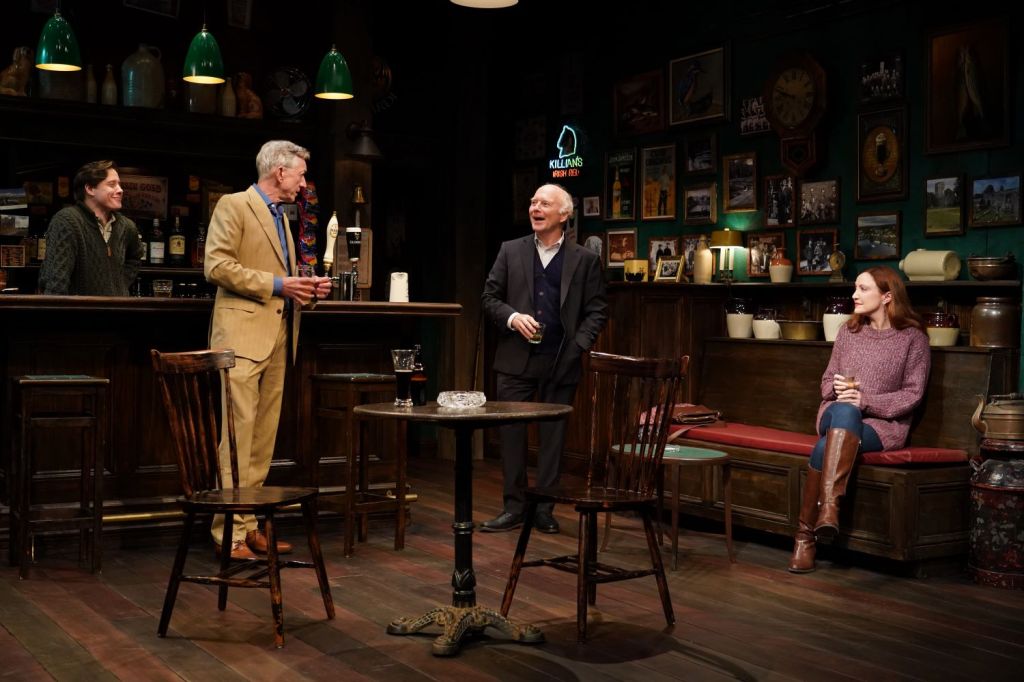
Initially, Jack, Jim and Brendan gossip about the married Finbar’s intentions as he shows up the three bachelors by escorting the young woman to the pub. Jim, caretaker of his mom, and Jack are past their prime in their late 50-60s. Brendan, taken up with his ownership of the pub and farm, is like his friends, lonely and unmarried. None of them are even dating. Thus, the prospect of a young woman coming up from Dublin to their area is worthy of consideration and discussion.
McPherson presents the groundwork, then turns our expectations around and redirects them, after Finbar and Valerie arrive and settle in for drinks. When the conversation turns to folklore, fairy forts and spirits of the area, Valerie’s interest encourages the men to share stories that have spooky underpinnings. Jack begins his monologue about unseen presences knocking on windows and doors, and scaring the residents until the priest blesses the very house that Valerie purchased.
Caught up in his own storytelling which brings a hush over the listeners (and audience), Jack doesn’t realize the import of his story about the Nealon house that Valerie owns. Thankfully, the priest sent the spirits packing. Except there was one last burst of activity when the weir (dam) was being built. Strangely, there were reports of many dead birds on the ground. Then the knocking returned but eventually stopped. Perhaps the fairies showed their displeasure that the weir interfered with their usual bathing place.
Not to be outdone, Finbar shares his ghost story which has the same effect of stirring the emotions of the listeners. Then, it is Jim who tells a shocking, interpretative spiritual sighting. Ironically, Jim’s monologue has a sinister tinge, as he relays what happened when a man appeared and expressed a wish, but couldn’t really have been present because he was dead.
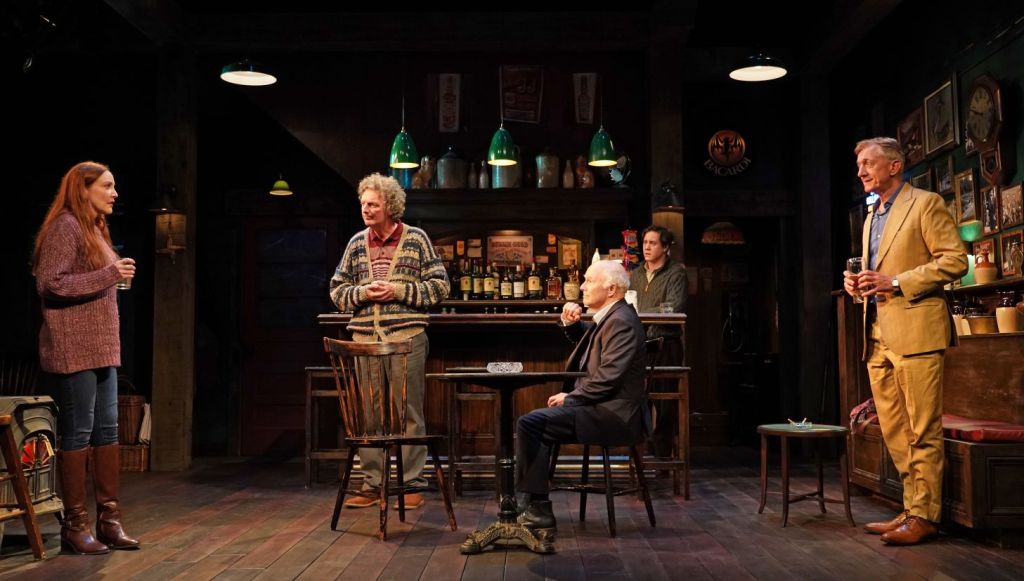
As drinks are purchased after each storyteller’s turn, the belief in the haunting spirits rises, then wanes as doubts take over. After Jim tells his story about the untoward ghost, Valerie goes to the bathroom in Brendan’s house. During her absence Finbar chides all of them. He regrets their stories, especially Jim’s which could have upset Valerie. With Jack’s humorous calling out of Finbar as a hypocrite, they all apologize to each other and drink some more. By this point, the joy of their conversation and good-natured bantering immerses the audience in their community and bond with each other. I could have listened to them talk the rest of the night, thanks to the relaxing, spot-on authenticity of the actors.
Then, once more McPherson shifts the atmosphere and the supernatural becomes more entrenched when Valerie relates her story of an otherworldly presence. Unlike the men’s tales, what she shares is heartfelt, personal, and profound. The others express their sorrow at what happened to her. Importantly, each of the men’s attitudes toward Valerie changes to one of human feeling and concern. Confiding in them to release her grief, they respond with empathy and understanding. Thus, with this human connection, the objectification of the strange young woman accompanied by Finbar at the top of the play vanishes. A new level of feeling has been experienced for the benefit of all present.
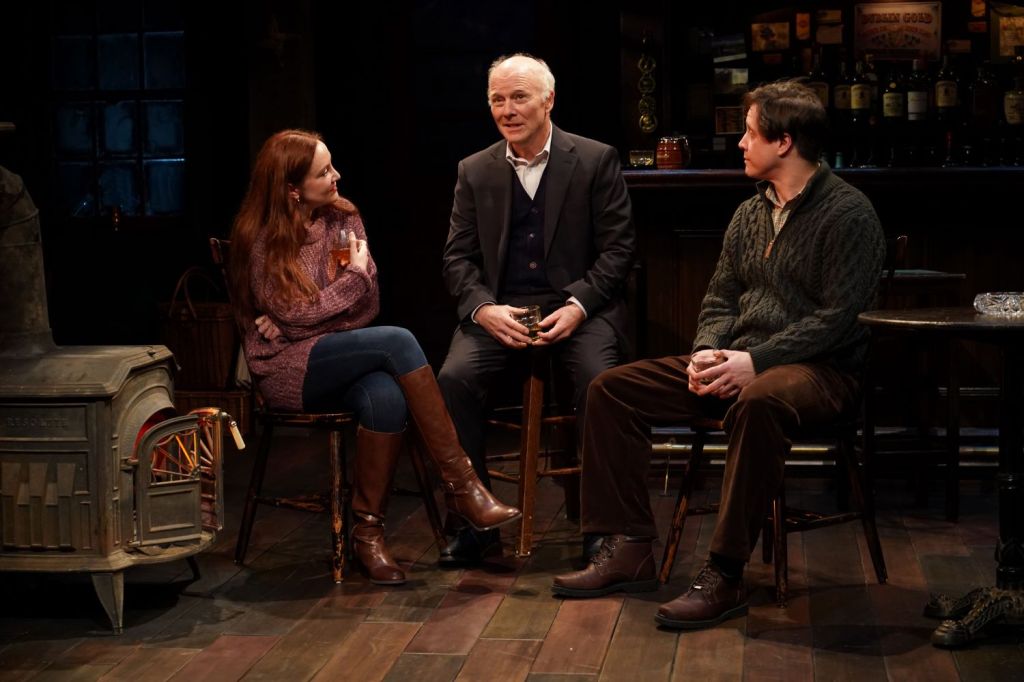
After Finbar leaves with Jim, McPherson presents a surprising coup de grâce. Quietly, Jack shares his poignant, personal story of heartbreak, his own haunting by the living. In an intimate emotional release and expression of regret and vulnerability, Jack tells how he loved a woman he would have married, but he let her slip away for no particularly good reason. Mentoring the younger Brendan not to remain alone like he did, Jack says, “There’s not one morning I don’t wake up with her name in the room.”
McPherson’s theme is a giant one. Back in the day when the world was slower, folks sat and talked to each other in community and conviviality. With such an occasion for closeness, they dispelled feelings of isolation and hurt. As they connected, they helped redeem each other, confessing their problems, or swapping mysteries with no certain answers.
As the world modernized, the ebb and flow of the culture changed and became stopped up, controlled by outside forces. Blocked by fewer opportunities to connect, people retreated into themselves. The opportunities to share dried up, redirected by distractions, much as a dam might redirect the ebb and flow of a river and destroy a place where magical fairies once bathed.
McPherson’s terrific, symbolic play in the hands of O’Reilly, the ensemble and creative team is a nod to the “old ways.” It reminds us of the value of gathering around campfires, fireplaces or heating stoves to tell stories. As companions warm themselves, they unfreeze their souls, learn of each other, and break through the deep silences of human suffering to heal.
The Weir runs 1 hour 40 minutes with no intermission at Irish Repertory Theatre (132 West 22nd St). https://irishrep.org/tickets/
‘Irishtown,’ a Rip-Roaring Farce Starring Kate Burton

Irishtown
In the hilarious, briskly paced Irishtown, written by Ciara Elizabeth Smyth, and directed for maximum laughs by Nicola Murphy Dubey, the audience is treated to the antics of the successful Dublin-based theatre company, Irishtown Plasyers, as they prepare for their upcoming Broadway opening. According to director Nicola Murphy Dubey, the play “deals with the commodification of culture, consent and the growing pains that come with change.”
Irishhtown is also a send up of theatre-making and how “political correctness” constrains it, as it satirizes the sexual relationships that occur without restraint, in spite of it. This LOL production twits itself and raises some vital questions about theater processes. Presented as a world premiere at Irish Repertory Theatre, Irishtown runs until May 25, 2025. Because it is that good, and a must-see, it should receive an extension.

The luminous Kate Burton heads up the cast
Tony and Emmy-nominated Kate Burton heads up the cast as Constance. Burton is luminous and funny as the understated diva, who has years of experience and knows the inside gossip about the play’s director, Poppy (the excellent Angela Reed). Apparently, Poppy was banned from the Royal Shakespeare Company for untoward sexual behavior with actors. Burton, who is smashing throughout, has some of the funniest lines which she delivers in a spot-on, authentic, full throttle performance. She is particularly riotous when Constance takes umbrage with Poppy, who in one instance, addresses the cast as “lads,” trying to corral her actors to “be quiet” and return to the business of writing a play.
What? Since when do actors write their own play days before their New York City debut? Since they have no choice but to soldier on and just do it.

The Irishtown Players become upended by roiling undercurrents among the cast, the playwright, and director. Sexual liaisons have formed. Political correctness didn’t stop the nervous, stressed-out playwright Aisling (the versatile Brenda Meaney), from sexually partnering up with beautiful lead actress Síofra (the excellent Saoirse-Monica Jackson). We learn about this intrigue when Síofra guiltily defends her relationship with the playwright, bragging to Constance about her acting chops. As the actor with the most experience about how these “things” work in the industry, Constance ironically assures Síofra that she obviously is a good actress and was selected for that reason alone and not for her willingness to have an affair with Aisling.
Eventually, the truth clarifies and the situation worsens
Eventually, the whole truth clarifies. The rehearsals become prickly as the actors discuss whether Aisling’s play needs rewrites, something which Quin (the fine Kevin Oliver Lynch), encourages, especially after Aisling says the play’s setting is Hertfordshire. As the tensions increase between Quinn and Aisling over the incongruities of how an Irish play can take place in England, Constance stumbles upon another sexual intrigue when no one is supposed to be in the rehearsal room. Constance witnesses Síofra’s “acting chops,” as she lustily makes out with Poppy. This unwanted complication of Síofra cheating on Aisling eventually explodes into an imbroglio. To save face from Síofra’s betrayal and remove herself from the cast’s issues with the play’s questionable “Irishness,” Aisling quits.
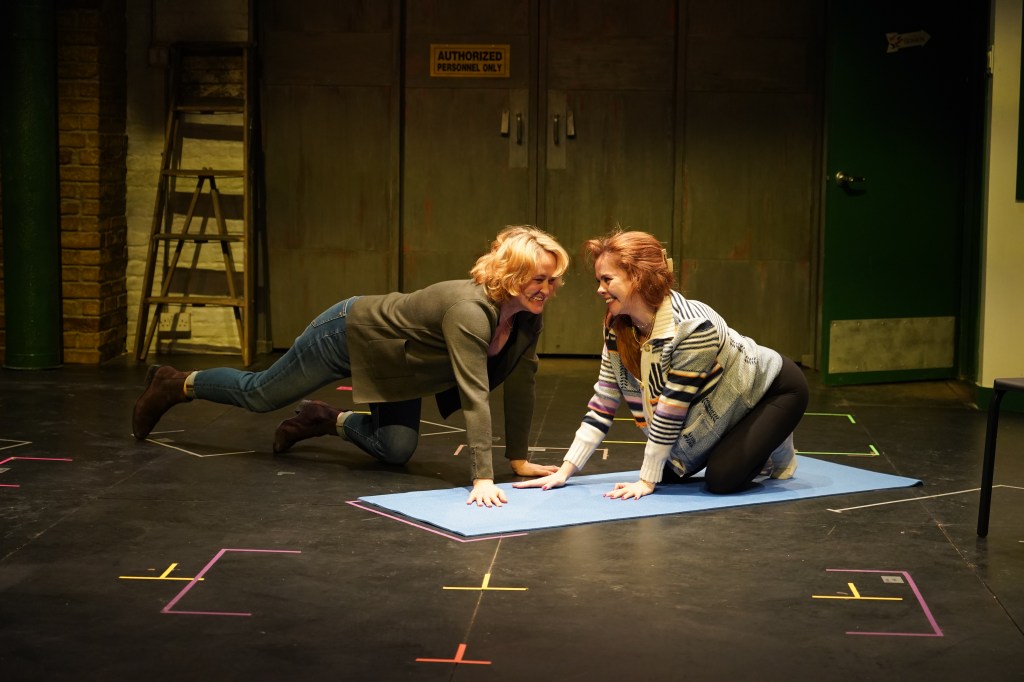
Enraged, the playwright tells Síofra to find other living arrangements. Then, she tells the cast and director she is pulling the play from the performance schedule. This is an acute problem because the producers expect the play to go on in two weeks. The company’s hotel accommodation has been arranged, and they are scheduled to leave on their flight to New York City in one week. They’re screwed. Aisling is not receptive to apologies.
What is in a typical Irish play: dead babies? incest? ghosts?
Ingeniously, the actors try to solve the problem of performing no play by writing their own. Meanwhile, Poppy answers phone calls from American producer McCabe (voice over by Roger Clark). Poppy cheerily strings along McCabe, affirming that Aisling’s play rehearsals are going well. Play? With “stream of consciousness” discussions and a white board to write down their ideas, they attempt to create a play to substitute for Aisling’s, a pure, Irish play, based on all the elements found in Irish plays from time immemorial to the present. As a playwright twitting herself about her own play, Smyth’s concept is riotous.
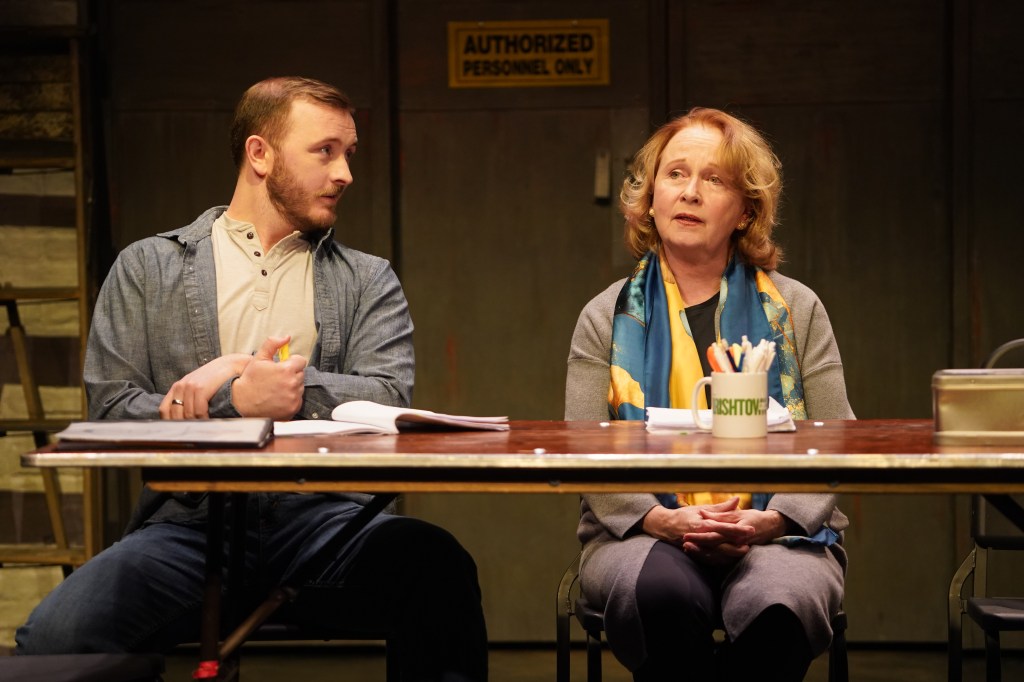
The actors discover writing an Irish play is easier said than done. They are not playwrights. Regardless of how exceptional a playwright may be, it’s impossible to write a winning play in two days. And there’s another conundrum. Typical Irish plays have no happy endings. Unfortunately, the producers like Aisling’s play because it has a happy ending. What to do?
Perfect Irish storylines
In some of the most hilarious dialogue and direction of the play, we enjoy how Constance, Síofra and Quin devise their “perfect Irish storylines,” beginning with initial stock characters and dialogue, adding costumes and props taken from the back room. Their three attempts allude to other plays they’ve done. One hysterical attempt uses the flour scene from Dancing at Lughnasa. Each attempt turns into funny scenes that are near parodies of moments in the plays referenced. However, they fail because in one particular aspect, their plots touch upon the subject of Aisling’s play. This could result in an accusation of plagiarism. But without a play, they will have to renege on the contract they signed, leaving them liable to refund the advance of $250,000.

As their problems augment, the wild-eyed Aisling returns to attempt violence and revenge. During the chaotic upheaval, a mystery becomes exposed that explains the antipathy and rivalry between Quin and Aisling. The revelation is ironic, and surprising with an exceptional twist.
Irishtown is not to be missed
Irishtown is a breath of fresh air with laughs galore. It reveals the other side of theater, and shows how producing original, new work is “darn difficult,” especially when commercial risks must be borne with a grin and a grimace. As director Nicola Murphy Dubey suggests, “Creative processes can be fragile spaces.” With humor the playwright champions this concept throughout her funny, dark, ironic comedy that also is profound.
Kudos to the cracker-jack ensemble work of the actors. Praise goes to the creatives Colm McNally (scenic & lighting design), Orla Long (costume design), Caroline Eng (sound design).
Irishtown runs 90 minutes with no intermission at Irish Repertory Theatre, 132 West 22nd St. It closes May 25, 2025. https://irishrep.org/tickets/
‘Aristocrats,’ Irish Repertory Theatre, Review
Dysfunction and decay are principle themes in Brian Friel’s Chekovian Aristocrats, a two-act drama about a once upper middle class family in precipitous decline in the fictional village of Ballybeg, County Donegal, Ireland. Currently at the Irish Repertory Theatre as the second offering in the Friel Project, the intricate and fine production is directed by Charlotte Moore and stars a top-notch cast who deliver Friel’s themes with a punch.
Two members of the O’Donnell family, headed up by the autocratic and dictatorial father, former District Justice O’Donnell (Colin Lane),, who remains offstage until a strategic moment brings him on, have arrived at the once majestic Ballybeg Hall. They are there to celebrate the wedding of Claire (Meg Hennessy), the youngest of the four children, who still lives with her sister Judith (Danielle Ryan), the caretaker of the estate. Well into the play, Ryan’s Judith reveals the drudgery of her responsibilities caring for her sickly father and her depressive sister Meg, as well as managing the estate and the chores of the Big House.
At the top of the play, we meet the grown children who live abroad and arrive from London and Germany. These include Alice (Sarah Street), her husband Eamon (Tim Ruddy), and the O’Donnell brother Casimir (Tom Holcomb). As Friel acquaints us with his characters, we discover Eamon, who once lived in the village, claims he knows more about Balleybeg Hall from his grandmother, who was a maid servant to the O’Donnells. Also present is Willie Diver (Shane McNaughton), who is attentive to Judith as he helps her around the estate and farms and/or rents out the lands to the locals. Initially, we watch as Willie organizes a monitor through which Justice O’Donnell can speak and ask for Judith to attend to him.

By degrees, through the character device of the researcher, Tom Huffnung (Roger Dominic Casey), and especially the ironic comments of Eamon, Friel discloses who these “aristocrats” of Ireland are. First, they were the upper class with land, who once dominated because the English protestant faction empowered them to do their bidding. The irony is that over the years, they have devolved and have imploded themselves. The sub rosa implication is that the seduction of the English, to give these Catholic Irish power, has led to their own emotional and material self-destruction.
The father, the last of the dying breed of “gentlemen,” like his forebears, took on the cruel, patriarchal attitude of the English. Raising his family in fear and oppression, and indirectly causing his wife’s suicide, he has deteriorated after strokes. We learn this by degrees, as Friel catches us unaware, except for the title of the play, by revealing the characters to be on equal class footing at the play’s outset. We learn the irony of the great “fallen.” The past distinction between the “superior” O’Donnell’s of the Hall, and the rest of the village peasantry, who referred to them as “quality,” (Eamon’s grandmother’s definition), has faded and is only kept alive in the imagination of a few.
Throughout, Claire’s music can be heard in the background as Alice and Casimir converse with Huffnung, whose research topic is about the impact of the Catholic Emancipation laws on the “ascendant Roman Catholic ruling class and on the native peasant tradition.” In other words Huffnung has come to Ballybeg Hall to research the aristocratic O’Donnells and discover the political, economic and social impact they have had on the villagers.
Interestingly, Eamon sums it up to Huffnung when he ironically answers the question as an insider who knows the Hall and what it is like being married to Alice, one of the former “ruling class.” Alice and her sister Judith were repeatedly sent away from home for their schooling. Alice marries Eamon who, caught up in the Civil Rights action against the English Protestants, loses his job in Ireland and eventually works for the English government in London. Alone most of the day, Alice has become an unhappy, isolated alcoholic. Eamon, whose irony wavers between obvious bitterness and humor tells Huffnung that the O’Donnells have had little or no impact on the local or “native peasants,” of which he numbers himself as one of the classless villagers.

Indeed, noting the shabbiness of the Hall and the problems of the family members, we see the pretension of superiority has long gone. All of them face emotional challenges and need rehabilitation from their oppressive upbringing under their father, Justice O’Donnell who seems to have be a tyrant and unloving bully. We note this from his rants over the monitor and Casimir’s response to his father’s imperious voice.
Judith contributed to causing her father’s first stroke having a baby out of wedlock with a reporter, after joining the Civil Rights fight of the Catholics against the British Protestants. Forbidden to raise her child at home, which would bring shame to the family, she was forced to give him up for adoption; he is in an orphanage. Over the monitor in a senile rant we hear the bed ridden O’Donnell, refer to her as a traitor. Thus, we imagine the daily abuse she faces having to care for her father’s most basic needs, while he excoriates her.
Meg is a depressive on medication who helps around the house, plays classical piano, and plans for her marriage to a man twice her age in the village, a further step down in class status. Desperate to leave, she selects escape with this much older man who has four children. She enjoys teaching piano to them.
Casimir is an individual broken by his father’s tyranny and cruelty. Holcomb’s portrayal of the quirky, strange Casimir is excellent, throughout, but particularly shines when he reveals to Eamon, how Justice O’Donnell’s attitude shattered him. The Justice’s cruel judgments about his only son, are revealed by Casimir toward the conclusion of the play. Ironically, Casimir politely attempts to uplift the family history to Casey’s clear-eyed Huffnung who, tipped off by Eamon, fact checks the details and realizes that Casimir exaggerates with a flourish. Additionally, most of what Casimir shares about his own life is suspect as well, and used to appear “normal,” though he may be gay.
Thus, as Friel unravels the truth about the family, largely through Eamon, we come to realize the term “aristocratic” is a misnomer when applied to them. The noblesse oblige, if it once existed, has declined to mere show. As Casimir attempts to enthrall Huffnung with the celebrated guests who visited the Hall (i.e. Chesterton, Yeats, Hopkins), his claims by the conclusion are empty. In turn Huffnung’s research seems ironic in chronicling the decline of an aristocracy that has self-destructed because it remained isolated and assumed a privileged air, rather than become integrated with the warmth and care of the local Irish Catholics.
The brilliance of Friel’s work and the beautiful direction by Charlotte Moore and work of the ensemble shines in how the gradual expose of this family is accomplished. As the ironies clarify the situation, Friel’s themes indicate how the oppressor class inculcated those who would stoop to their bidding to maintain a destructive power structure which eventually led to their own demise. Of course, Eamon, who is bitter about this, also finds the “aristocracy” enchanting. He wants them to maintain the Great House and not let it go to the “lower class” thugs who will destroy it further, though it is in disrepair and too costly to keep up.

The class subversion is subtle and hidden. What appears to be “emancipation” perhaps isn’t, but is further ruination. How Moore and the creatives reveal this key point is vitally effected.
Thanks to Charlie Corcoran’s scenic design, we note the three levels of the Big House’s interior and exterior where most of the action takes place. David Toser’s costume design is period appropriate. Ryan Rumery & M. Florian Staab’s sound design is adequate. The original music is superb along with Michael Gottlieb’s lighting design. Accordingly, Justice O’Donnell’s entrance is impactful.
This second offering of the Friel Project is a must see. Aristocrats is two acts with one fifteen minute intermission. For tickets go to the Box Office of the Irish Repertory Theatre on 22nd Street between 6th and 7th. Or go online https://irishrep.org/show/2023-2024-season/aristocrats-2/
‘The Saviour,’ a Tour de Force at the Irish Repertory Theatre
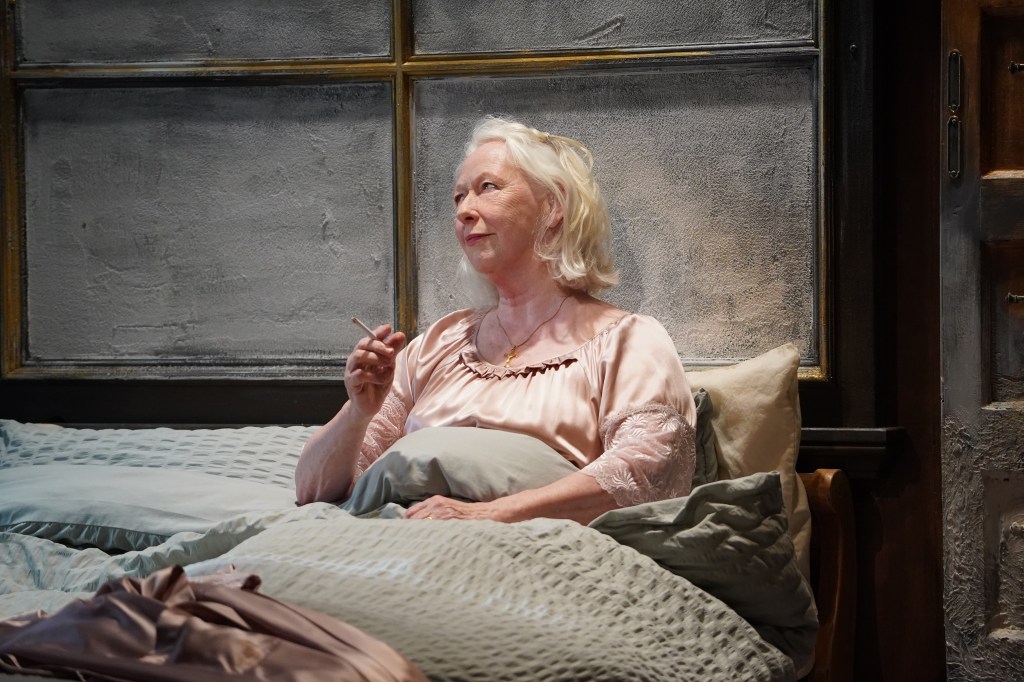
The Saviour, a powerful, ironic character expose, written by Deirdre Kinahan and directed by Louise Lowe, presents the wonderful Marie Mullen in a performance which strikes at the heart of Catholicism, paternalistic culture and hypocrisy. The World Premiere by Landmark Production is being performed on the Francis J. Greenburger Mainstage at the Irish Repertory Theatre until August 13.
Kinahan begins her 70 minute play as Marie Mullen’s Máire resides in bed enjoying a “fag” (cigarette) and laughing to herself at what has just transpired with Martin. She expresses her enthusiasm and joy to her great confidante Jesus, whom she addresses for half of the play.
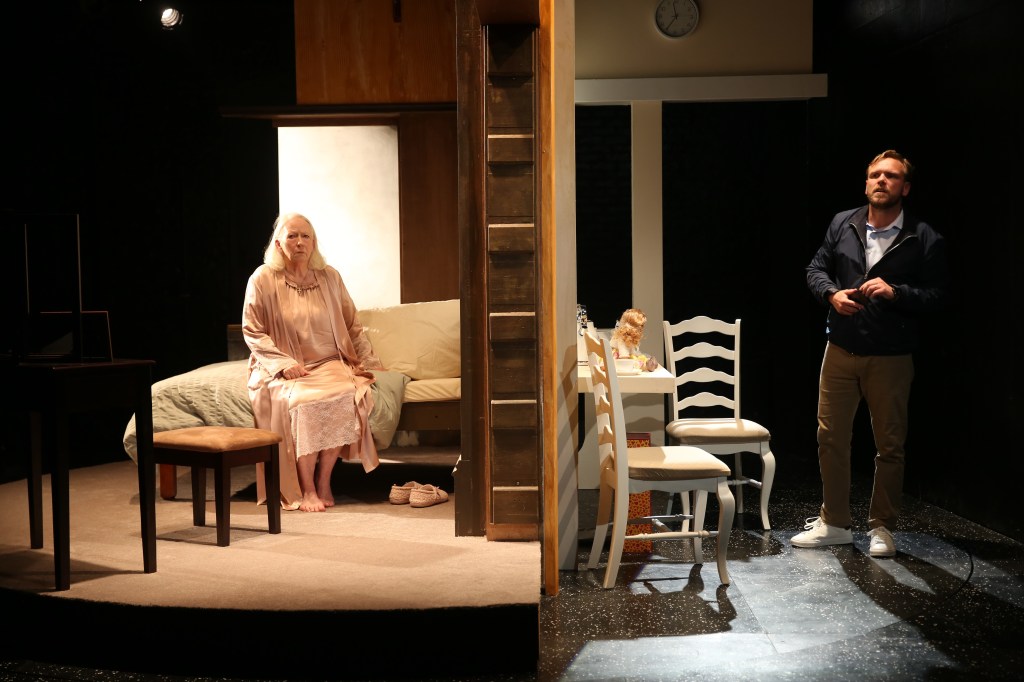
The audience is shocked into laughter at the unexpected subject matter of her descriptions. Máire (thanks to Joan O’Clery’ costume design), is the opposite of a woman that others might describe as a “dolled-up floozy,” generous with her affections and body. The protagonist is a senior citizen. Her environs and bedroom are neither opulent nor well-appointed thanks to Ciarán Bagnall’s scenic and lighting design. The sets on a revolving platform of bedroom and kitchen are a clue to her financial situation.
In other words, Máire is not the type to be taken advantage of for her money or what she has which looks to be the stylized bare minimum of possessions. Thus, she must be taken at her word, or she is completely fantasizing the circumstance with Martin, who, like Jesus, remains invisible. She is an unreliable narrator, so we are left guessing about the truth of the present circumstance she describes.
Louise Lowe’s acute direction shepherds’ Mullen’s fabulous performance as Máire to lead the audience in wonder, enthralled in the grip of hearing about Máire’s relationship with Martin as she discusses it with Jesus.
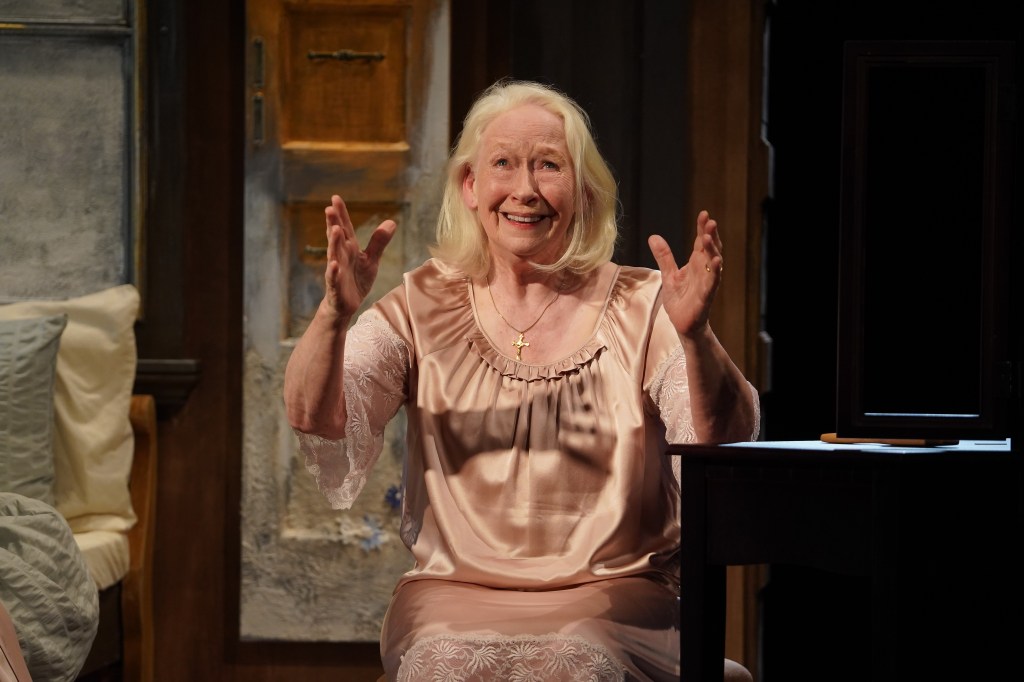
As Máire waits for Martin to come upstairs with her coffee, she glories that it is her birthday and she celebrated a wonderful evening with Martin who shopped and cooked for her and appreciates her more than her husband who died years before. Indeed, Martin even appreciates her more than her children, who are now grown and have children of their own. She reviews the circumstances of her life with Jesus in light of her relationship with Martin. She believes that her relationship with “the saviour” is somehow in concert with her Godly interactions with Martin, because he prays, believes in God, goes to church and wouldn’t be with her if Jesus didn’t accept him.
Kinahan’s characterization of Máire, effected through Mullen’s interpretation, is completely believable, especially when she speaks to Jesus as if He is her “all in all.”
As the monologue continues, we question the reality of what Máire shares with Jesus with regard to Martin who is shadowy and mysterious. Is it true or isn’t it? However, we do accept her discussion with Jesus about her devastating upbringing. This includes the death of her mother, and her father’s abandonment. He left her with the nuns where she is abused and made to work in the oppressive, hot “laundry.”
The reference is perhaps to the Magdalene Laundries in Ireland, run by the nuns and Roman Catholic orders to give shelter to “fallen women” from poor backgrounds. To punish them with proper penance and hide their shame, parents sent them to these asylums which were secretive and oppressive. Exploiting the girls’ labor, they offered little emotional respite from condemnation. Sadly, the babies born out of wedlock were taken away from their birth mothers and adopted out by the nuns for donations.
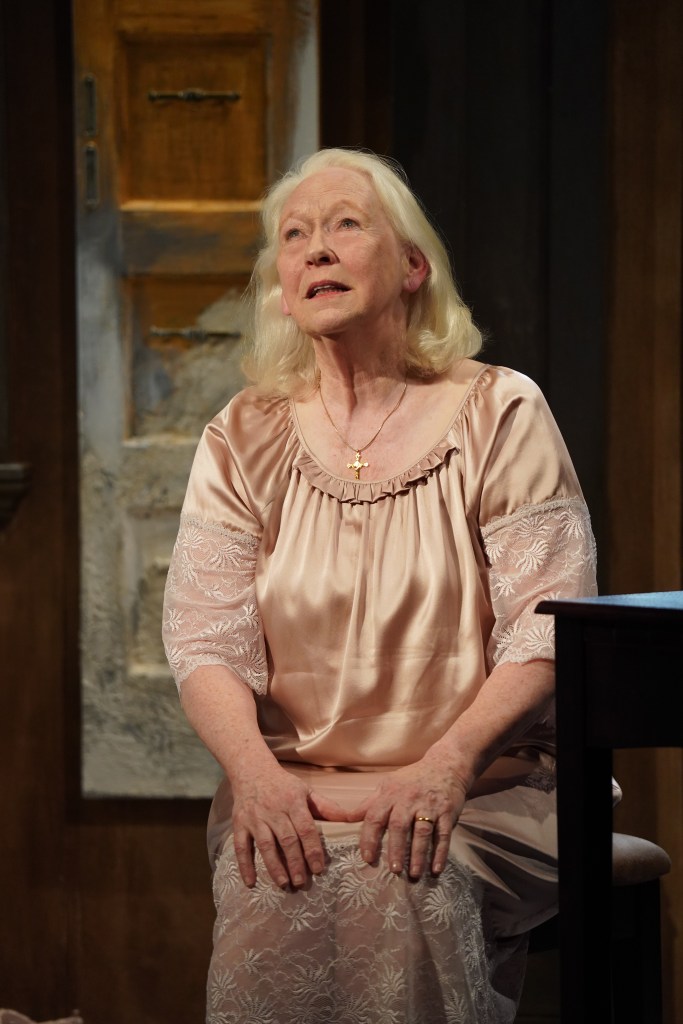
As in the case of Máire, orphaned girls were placed there so they could be properly raised by the goodly nuns. However, as Máire indicates, her situation was equally terrible, not because she “sinned,” but because poverty relegated her to a life of misery of hellish toil and fear with the nuns at a young age.
It is during this discussion of the laundry, whose atmosphere and terror is effected by Aoife Kavanagh’s crushing sound design (as Máire recalls her past), that she reveals her only salvation was her faith in Jesus. She refers to “her loving Jesus” as not the “nuns’, Jesus.” Her Jesus helps her survive the nuns’ cruelty, condemnation and judgment until she manages to free herself with a job. And it is then she meets her husband with whom she has a loving relationship and family.
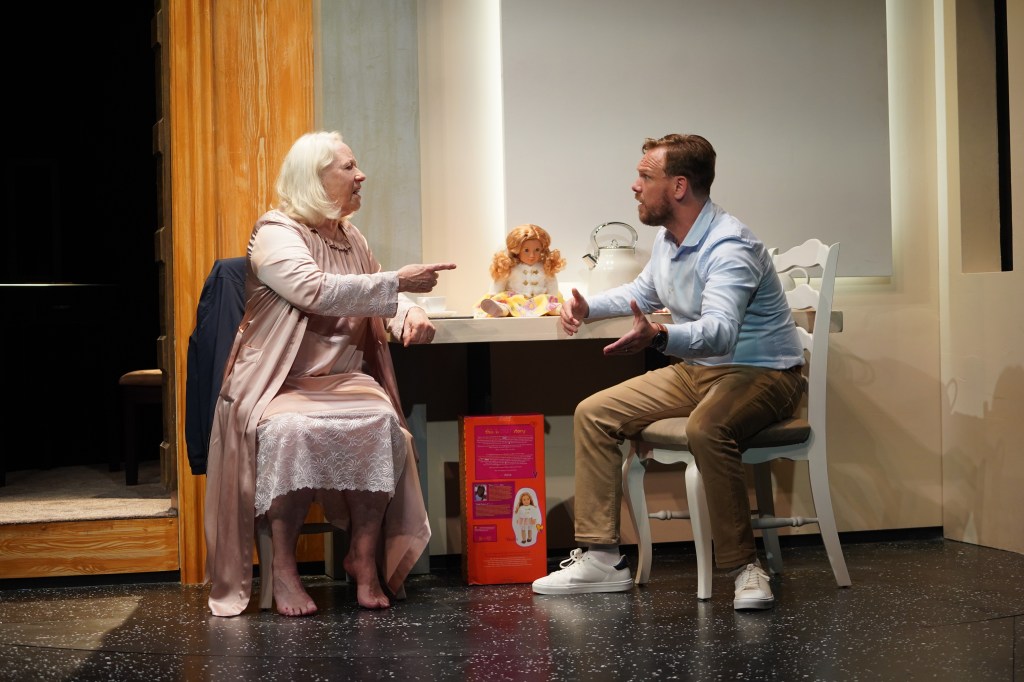
Marie Mullen’s is absolutely terrific in animating Máire and establishing Jesus as a “living” being with whom she shares the most intimate of secrets. Mullen’s authenticity is spot-on. We accept how Jesus affirms Máire’s life to receive this new beginning in her relationship with Martin. Though there doesn’t appear to be a conflict, the dramatic dynamic unfolds in earnest when son Mel (the superb Jamie O’Neill) appears. He brings her a present (a doll which has symbolic significance), to celebrate her birthday.
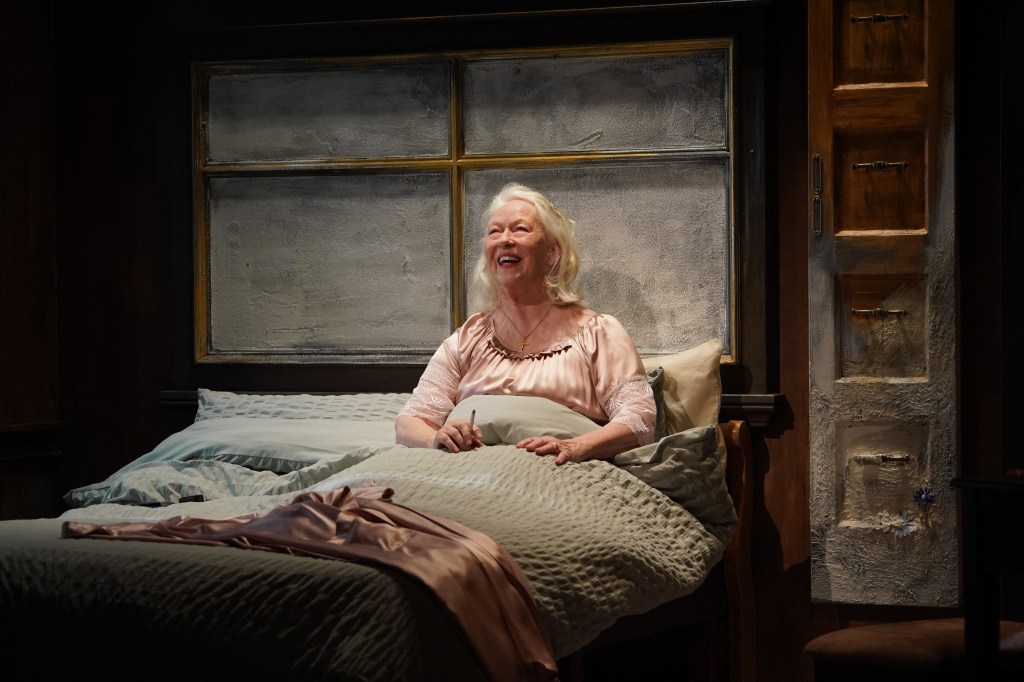
Her relationship with Mel seems loving enough, until Máire’s behavior references Martin’s visit. It is then that they make statements which explode with revelation and meaning in a myriad of emotions including anger, torment and hate. Both mother and son hurt one another. Their comments are severe. No apologies can be made to salve the wounds. We question where is forgiveness? Where is Jesus? Where is love? All appears to be confusion, fear and obfuscation.
Kinahan’s dialogue cleverly builds as Mel and Máire turn to the undercurrents of the past. Clearly, we understand the impact the church has had upon them. After Mel leaves, Máire must grapple with what the truths may be and either confront and accept them, or reject them finding justifications. Ironically, this leaves the audience in uncertainty with more questions which are never answered.
Kinahan’s suspenseful events beautifully build toward the high point at the conclusion. The mesmerizing play is directed and acted to perfection. Thematically, the characters’ acceptance of lies as truth and their ability to be duped by “isms,” philosophies and trends is incredibly current. Mel uses the truth to bludgeon his mother which appears vengeful. On the other hand, Máire selects which truths to believe and which to reject, hypocritically.
Both son and mother are flawed. Both need redemption and love from each other. Both have been caught in a web of religion, either rejecting/rebelling against it, or embracing it but not in the fullness of its meaning. As a result, caught up in their own agendas, they cannot communicate to use the very tenets of faith that are supposed to heal, bring peace and redeem. This is a terrible, magnificent irony where Jesus is called upon, but never arrives to heal and mend the differences. Additional work must be done for that to occur.
Unfortunately, this is a story visited again and again in religious households. It is thematically universal. Kinahan, Lowe, the actors and creatives have expressively highlighted the conundrums of faith, hypocrisy, forgiveness, spiritual truth and condemnation in this amazing and unforgettable production. It is a must-see.
For tickets and times go to their website https://irishrep.org/show/2022-2023-season/the-saviour/
‘Love Letters,’ by A.R. Gurney, Starring Matthew Broderick & Laura Benanti, The Conclusion of Irish Rep’s Letters Series.

The intimacy of listening to the voices of individuals’ emotional grist, concern and vibrance through letters written to a secret confidante is delicious and stirring in this time of 140 characters where “brevity is often not the soul of wit.” Irish Repertory Theatre’s “Letters Series” portrays the profound, intimate relationship between two individuals not “visible” to the naked eye of friends and relatives, and sometimes not gleaned by the characters themselves until it is too late.
The first series, now ended, starred Melissa Errico and David Staller in Jerome Kilty’s play Dear Liar. Kilty reconfigured his play from the decades-long epistolary relationship between George Bernard Shaw and the actress, Mrs. Patrick Campbell. The second part of the series highlights Matthew Broderick and Laura Benanti in A.R. Gurney’s (Pulitzer Prize finalist for Drama) Love Letters, directed by Ciarán O’Reilly. The staged reading of the drama with prodigious comedic elements runs with one intermission on the Irish Repertory Theatre’s Francis J. Greenburger Mainstage and concludes on the 9th of June.
Gurney’s two-act play explores the arc of the decades long relationship between friends and eventual lovers, Andrew Makepeace Ladd III (played by the inimitable Matthew Broderick) and Melissa Gardner (Laura Benanti is fresh, witty, humorous). These individuals write letters to each other over a span of decades (1937-1985), beginning in the second grade when Mrs. Gardner sends Andy an invitation to Melissa’s birthday party, and Andy responds to Melissa accepting the invitation.

From then on the the individuals share a profound written correspondence, though Melissa tells Andy to stop writing to her initially and at various times during their lives. At first, it is because she prefers pictures to words. Afterwards, it is because the words are so heartfelt and searingly directed to her, they are breathtaking to process and conflict with her estimation of Andy when they meet in person.
Oftentimes, reverse psychology is at work in Gurney’s pla,y where subtext and undercurrent in the dialogue between the characters takes precedence. The characters are confessional, argumentative, challenging, and interested in each other as friends, though there is always the sense that their concern for each other, authenticity and the bond formed through words reveal theirs is not an ordinary friendship, but one of the most sincere, transcendent and special that love might bring, even though it is not formalized in marriage.
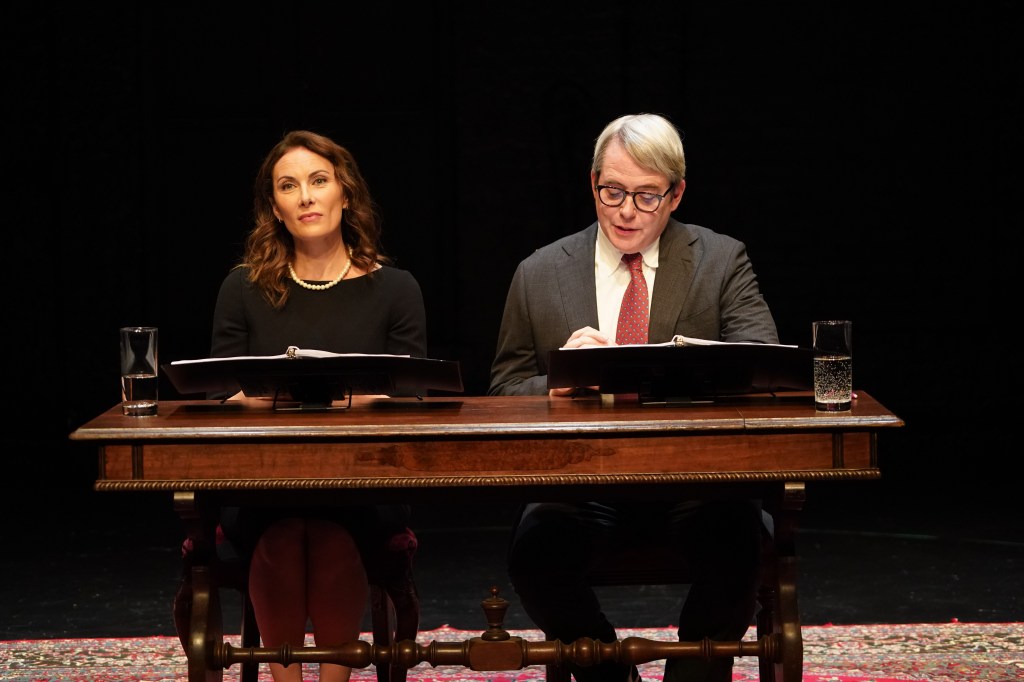
Gurney intimates the possibility that their feelings have the potential for intimacy with their child-like innocent abandon (in 2nd grade), when Andy asks if Melissa will be his valentine, and Melissa agrees that she will, if she doesn’t have to kiss Andy. The verbal affection continues when we learn that Andy repeatedly asks Melissa to marry him. She gets him to stop, by telling him she will go with him to get the milk and cookies for the class, if he stops proposing to her. When Melissa employs her skills drawing, which she enjoys doing, she draws pictures of them without their bathing suits on, asks if he knows which one he is, then importunes him not to tell anyone about her drawing. She concludes by telling him she loves him.
This thrust and parry structurally mirrors the pattern of their relationship. Andy initiates his desire to be close to her. Melissa avoids responding, then eventually comes around to agree with him. Then, something intervenes and prevents them from actually becoming boyfriend and girlfriend or partners. When they finally try to extend their relationship beyond the intimacy of their writings and meet “live” for a weekend at the Harvard/Yale game, their date, including sexual coupling explodes in their faces. There is more “aliveness” in their writing, than in their ability to regain the soulfulness of their correspondence face to face. It will take other circumstances to transpire in Act II before any meaningful physical coupling occurs.

Ironically, despite their union and knowledge of each other that they’ve gleaned over the years and expressed in writing in the comfort of their surroundings, confronting each other in their “real” identities is problematic. Or perhaps the mental/spiritual connection through letters is their real identity.
Their written consciousness is a mystery. As Andy attempts to rationalize why their intimacy backfired when they met in person, Melissa blames the letter writing and suggests Andy phone her. However, this doesn’t work out and Melissa becomes infuriated with Andy when she hears he is writing letters to someone else, because he has fallen in love with the words coming out of his soul. Through their correspondence, he has discovered that he is compelled to write letters to “someone” to better know himself.
Andy’s love of writing and expressing himself to Melissa who listens and responds to him throughout elementary school, high school, college, the Navy and their travel to various places on the globe manifests in his career as a lawyer. Melissa’s drawing talents, that she initially felt comfortable to share with Andy, burgeon into a full-blown career as a professional artist who exhibits in New York City. Their epistolary relationship reveals a love, honesty and encouragement unlike that found in their other relationships. However, whether Melissa can bear continuing the writing when she dislikes it and believes it is keeping them apart physically gives both of them pause. Andy suggests that he hopes they can work it out and keep writing.

The suspense whether or not they will ever “get together” in a lasting marriage carries into Act II. However, by then, both end up with other individuals. Again, something intervenes to keep their love distant and unfulfilled. Every time Andy asks if Melissa is OK, she provides a “stiff up lip” response that she is “fine,” though we know she is not. Likewise, Andy never goes beyond his father’s folkways (family country, himself) which Melissa proclaimed was stifling him when they were teenagers. Following his father’s dictum, Andy fulfills his obligations to his family, country and himself sacrificially.
Though he and Melissa fulfill their love which blossoms, unlike that which they experience with others, Andy eventually falls back on his father’s belief, uplifting the traditional sacrifice of his own happiness. His choice to put his own desires last has disastrous consequences for both of them, only realized too late.
Broderick and Benanti bring their own unique talents and personalities portraying Andy and Melissa. Shepherded by O’Reilly, they strike the right tonal notes and pacing to engage us. We become involved in these two individuals to care about them and take the journey of life through elementary school, private high schools, college, careers and marriages to other individuals, all the while reading the sub rosa signs that they mean so much to each other and missed their destiny by never marrying and having children. Thus, the tragedy of the ending is all the more greater.

Throughout, Gurney’s clever dialogue, wit and fervor crafts individuals that Broderick and Benanti solidly inhabit to make them believable to us. From halting, shy children who are obligated by their parents to write birthday thank yous to hardened adults who have veered off their truth and empowerment, we accept all, even the abrupt conclusion which belies their soulful devastation leaving Andy to pick up the pieces.
The importance of this two-hander’s themes about human nature, love, cultural influences and the power of intimacy in correspondence lies in Gurney’s characters as they age. Andy and Melissa perceive each other’s identities and ethos first as innocent, frank children. As the corrupted environments harden them, they push each other away. The irony is that they are the only individuals that truly matter to each other in their lives as adults.
That Gurney has selected individuals who are upper middle class and are white, Protestant and privileged is telling. To a large extent it is their background folkways and traditions that Melissa rebels against and Andy adheres to that walls them off from each other. In their heart of hearts they are soul mates which Andy expresses and Melissa acknowledges, though they are incapable of taking the plunge to overthrow the strictures that bind them.
That Gurney in his notes wisely instructs the minimalism of sets (a table and two chairs facing out to the audience), simple lighting and reduced theatricality enhances the dialogue and focuses our attention on realizing the humanity of these two lovers traveling their destiny together in written words.
Broderick portrays Andy with unaffecting humor which allows Gurney’s ironies to be revealed all the more quickly. Benanti is sardonic and edgy with rebellion that is balanced just enough so as not to be curdling or understated. Both hit the mark to tease out their characters with a poignancy and grace that reminds us that love requited but not fulfilled is its own tragedy. In this staged reading we understand Gurney’s emphasis on the power of expression in a truthful exploration of relationships and love under the guidance and wisdom of director Ciarán O’Reilly.
For tickets to this fine staged reading with superb actors see below.
‘The Smuggler,’ A Thriller in Rhyme at Irish Repertory Theatre

In an energetic, boisterous performance delivered with a fever pitch that doesn’t quit or pause with quieter notes, Michael Mellamphy’s Tim Finnegan spills out The Smuggler, a story about how, as a naturalized citizen from Ireland, he was forced into a black-hearted situation he couldn’t refuse. In his delivery Mellamphy is like a high-speed train barreling down the track on a joy ride that threatens catastrophe at each turn in the journey, as customers and audience members alike are drawn in with his humor, excitement and storytelling verve, unfolding in rhyming couplets, that at times are insecure and slant. Written by Ronán Noone, himself an Irish-American immigrant from Galway, and directed by Conor Bagley, The Smuggler runs a slim 80 minutes at Irish Repertory Theatre in the W. Scott McLucas Studio Theatre. It has been extended until March 12.
At the heart of The Smuggler the protagonist (a con artist) attempts to get over with his charm and engagement to elicit audience sympathy. He seeks this as he tells about his plight to make a way for himself and his family in a culture that is the antithesis of welcoming and helpful to those “down on their luck.” When he’s fired from his job as a barman in Amity, Massachusetts, every door appears to shut in Finnegan’s face. Understanding the dark irony that America is portrayed as the land of “opportunity” in the alluring myth (the streets are paved with gold) told to strangers from other shores to entice them to leave their home country to provide cheap labor whether legal or illegal, he is caught in a morass of financial wrack and ruin of his own making.

Not only does Finnegan enjoy “a bit of drink” (an explanation for the selection of his job as barman) he appears not to be too swift in forward planning financially with his wife. Everything is a surprise that happens to them, not that they are responsible for selecting actions that leave them hanging off a cliff.
Many immigrants face hellish experiences, exploited by craven, greedy bosses, forced to live in overcrowded quarters, the pawns of merciless overlords wherever they turn. We have only to read about the history of America’s labor movement or Cesar Chavez and the farmworkers, or superlative, recent, non-fiction works (Tomato) to understand the desperation that immigrants go through, first to leave their countries, and then to attempt to “make it,” continuing the hell of the past in the present new “home.”

Thus, life moves from wheel to woe for those like Finnegan, who strike out to start a family, make missteps with bad choices, then fall on hard times. Finnegan and his wife live in a rental, that is no more than a shack with non-functioning plumbing. It is owned by a slumlord, a sleazy landlord who refuses to fix much of anything. As Finnegan unravels his dire circumstances with heavy poetic description, we identify with the immigrant experience, recognizing that the uniform abuse by those happy to mistreat and exploit the cheap labor of aliens and immigrants, is all too familiar.
What makes Finnegan’s experience a bit more interesting is how at each turn, being backed into a corner, by his boss, the landlord and the wife, he seeks a way to improve his family circumstances by “any” means necessary. Of course there’s the rub. “Any” reverts to lowering standards and morals he may have as a human being, as he turns to a life of theft and exploitation of other aliens and immigrants, he works with at his construction job.

Noone characterizes Finnegan during his monologue confessional with an emphasis on masculine bravado, fearlessness (especially when he confronts a menacing, “man-eating” rat) and chivalry in saving his wife and child from poverty, destitution and want. The heroic portrait is right out of “Captain America,” part of the glorious beauty of the American Dream of success, which lifts up the “heroic struggle” and vitiates the criminality, exploitation and violence that under-girds it. A good scam artist, Finnegan seductively blinds the audience to see things “his way,” so that they accept his justifications for his choices. His “bravery” and good will serves him like a magician’s prestidigitation at redirecting our understanding away from his conning nature.
Because his storytelling appears authentic and forthright, we gloss over his lack of accountability and responsibility in taking the low road toward crime, which he admits with (feigned?) abashment. Though he selects the exploitative way that harms and abuses others, we look at his efforts to succeed materially, not the dark side which he uses to get his “ill-gotten gains.” Finnegan’s “happy-go-lucky” attitude indicates that he knows the difference, but makes excuses for his behavior: “what else could he do?” The conclusion reinforces his triumph at “getting over.” The knock at the door, which we may anticipate brings recompense and punishment, never comes. Instead, the knock at the door brings a blessing. (There is no spoiler alert. You’ll just have to see The Smuggler to understand the symbolism of the knock on the door of the bar he was fired from, that his life of crime enabled him to buy back later on.)

Thus, Finnegan’s ultimate success as an Irish American is in how well he has gotten over, gotten the loot, made a beautiful material life for himself and his family, so they can “live happily ever after.” That there is some danger that lurks behind the triumphant Finnegan brand is smothered over by his intrepid nature and gumption to “just do it!” His is a male Cinderella story of achieving wealth. His macho actions to sacrifice for “the wife and family” actually reference the Trumps and Putins of the world and ridicule those who amass little monetarily, but scrape enough to get by, living in humility, honesty and decency. With boldness, his bravado encourages criminality and uplifts the fact that the law (represented by his adulterous cop brother-m-law) is capricious, unequally meted out and dysfunctional. Dali Lama, an unqualified loser, you have no place in America with your muted, unmaterialistic, nice-guy values
Rather than to evolve with hard work, sobriety, education and an ethos that undermines the exploitation of the abusive system that enslaves its workers and has converted Finnegan into a criminal, Finnegan jumps right in and embraces the “opportunity” to be at the top of the heap as “King Rat.” The symbolism of his killing the rat “guarding” a safe in the basement, whose contents he takes, is quite apparent. Ultimately, if justice ever knocks at Finnegan’s door, then he will have effected his own final self-destruction. Maybe! However, with his glib rhyming he proves to himself that there is nothing he can’t accomplish to become a success and be the type of “American” that extols scammers, con artists, schemers and material wealth, regardless of the soul damage and foulness created in the process. If he needs to, Finnegan has proven he’s a survivor. He can even get over in prison, if need be.

Clearly, Finnegan is smuggling more than a few ideas past the audience to justify his successful existence as proof of his greatness. The irony of themes and the well-written characterization acted by by Mellamphy and enhanced by the director’s vision is one more blow to smash the myths we may use to live by, as we dupe ourselves about America as a great nation. Clearly, it is fabulous for billionaires. For the immigrants who exploit and shred each other as the bosses divide and conquer them and us, it’s another America entirely. That Finnegan’s survival is cast in monetary terms aided and abetted to by his wife is his chief tragedy. But “what else can he do?” It’s the “land of the free and the home of the brave,” sung at every sports event nationwide.
Thanks to the creative team’s execution of set design which is just superb (Ann Beyersdorfer) atmospheric lighting design (Michael O’Connor) and sound design and original music (Liam Bellman-Sharpe). The production is first rate, if unsettling, as it leaves us with profound questions about how much we accept our foundational culture’s lies as truths.
For tickets to The Smuggler at Irish Repertory Theatre in the W. Scott McLucas Studio Theatre, go to their website https://irishrep.org/show/2022-2023-season/the-smuggler-2/
Ronán Noone
‘Endgame’ by Samuel Beckett at Irish Repertory Theatre is Amazing
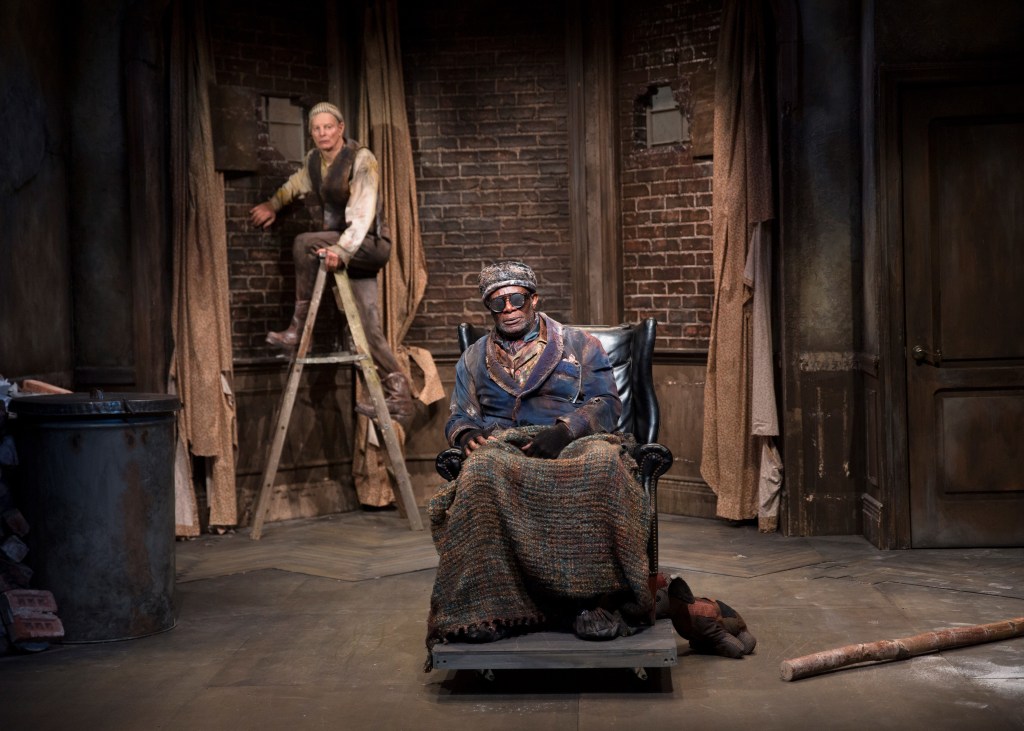
Nobel prize winner Samuel Beckett suffered years of rejection until his wife managed to sell his work which gradually put him on the map. Now we question how this rejection was possible because his work is timeless and exemplifies his genius. His particular greatness lies in his creation of spare, staccato, memorable dialogue, enigmatic characters and static situations as metaphors of human existence and its banal, opaque meaninglessness. How could anyone miss Beckett’s exceptionalism? In Endgame Beckett believed he was at his best. Gloriously, the Irish Repertory Theatre is presenting this work and the production directed by Ciarán O’Reilly reflects the accuracy of Beckett’s opinion.
Starring the irrepressible Bill Irwin as Clov and stolid John Douglas Thompson as Hamm, the production is perfection in its minimalism and ironies. It appropriately allows the audience to focus on the principal characters and their dire circumstances as they confront the end of the world, the end of their relationships with each other, their personal closure, and the abject null of lives lived in their last days, without joy, empathy or compassion. Interestingly, the play’s conclusion appears to happen in real time. When the final words are proclaimed, Hamm’s story is told and the lights go out to audience applause. All that has been said and has needed to be expressed is said and done. And there is the precise end of it, as the audience is left to wonder and take nothing for granted about their own existential happenstance and what they have just witnessed in this shared humanity that plays out in a tragicomic unspooling.
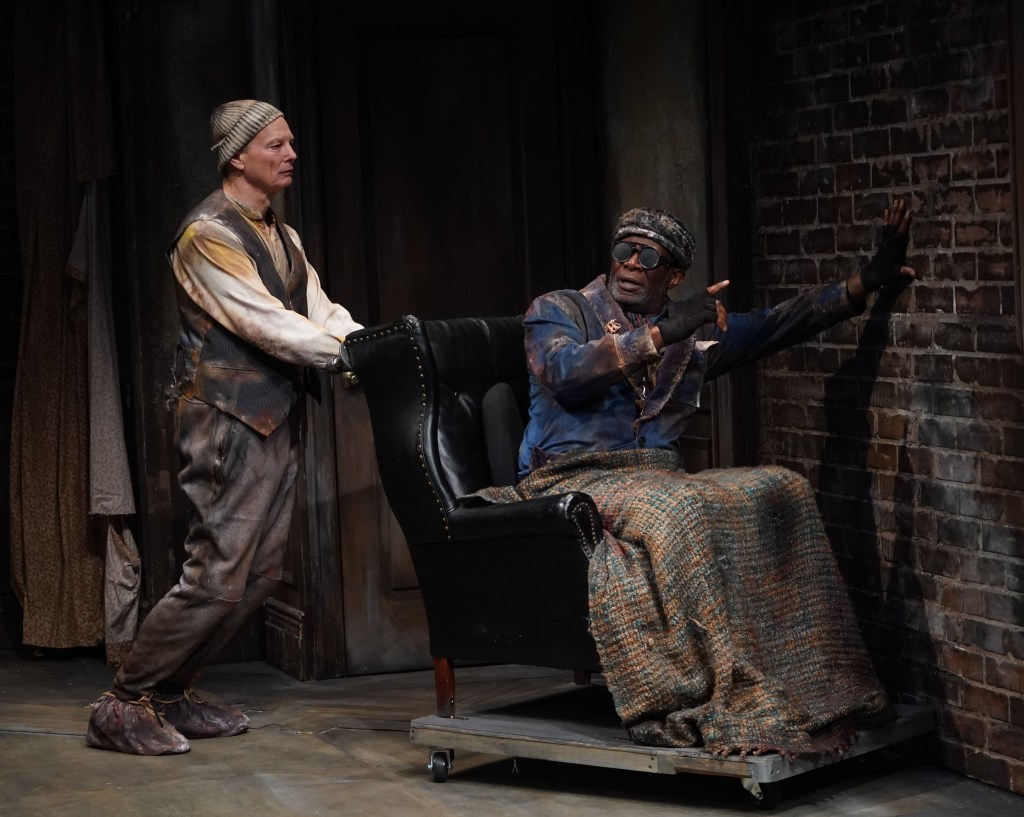
Apart from their physical conditions of wrack and ruin, the characters are essentially ciphers. Hamm is blind and wheelchair bound, dependent on Clov, his handicapped, scattered servant, who begrudgingly comes to his every “whistle” and obeys Hamm’s commands. Clearly, their symbiotic relationship is one based on mutual abuse and co-dependence, as there is no love lost between them, though they’ve known each other since Clov was a child. Throughout the play, Clov limps with a barely controllable gait and awkward mobility to Hamm’s imperious orders. Toward the end of their repetitious tedium together, Clov even remarks he doesn’t understand why he continues to obey the cantankerous, unloving, pain-filled, acerbic older man.
In addition to Clov and Hamm are Hamm’s elderly parents who abide in the same large, spare room. They, also have lost their mobility and live without their legs in garbage cans filled at the bottom, first with sawdust, then more recently with sand. There are lids on the garbage cans, and the parents pop up for a conversation, until Hamm is tired of them and tells Clov to shut them up and close them out. Ironically, in the brief time we come to know father Nagg (Joe Grifasi) and mother Nell (Patrice Johnson Chevannes), we appreciate their relationship and the affection between them. Beckett reveals their togetherness as they recall the good times they had with each other, even making light of the accident when they both lost their legs. They put up with their son’s abusive, cruel nature and forbear under his insults (he refers to Nagg as a “fornicator”). As a result we perceive them as empathetic characters, while Hamm appears all the more obnoxious and querulous.

These four hapless individuals are perhaps the last human beings in the world. Hamm refers to the external environment outside the ramshackle building where they reside to be filled with death. The assumption is that the apocalypse has happened and there’s nothing left but a wasteland. The only objects that appear to make sense are inside their meager abode. These include Hamm’s piercing whistle, a few biscuits (in the play they look like dog biscuits) and Clov’s paraphernalia which include a spyglass and a ladder, an alarm clock and a few other items. There is also Hamm’s pet dog which is a stuffed animal, which may or may not give him comfort amidst his whining about “it’s” being enough, asking for his pain killer and his attempts to finish the story that he’s trying to tell, which symbolizes his and Clov’s lives.
The laughable irony is that the end of days are inhabited by these infirm individuals led by a powerless, despotic miscreant who presides over the others like a king, though he is powerless, halt, lame and blind (the Biblical reference is intimated). Instead of his physical helplessness guiding him into humility, the opposite is apparent. He is full of himself in his miserable state, which he appears to masochistically enjoy. (“Can there be misery loftier than mine? No doubt.”)
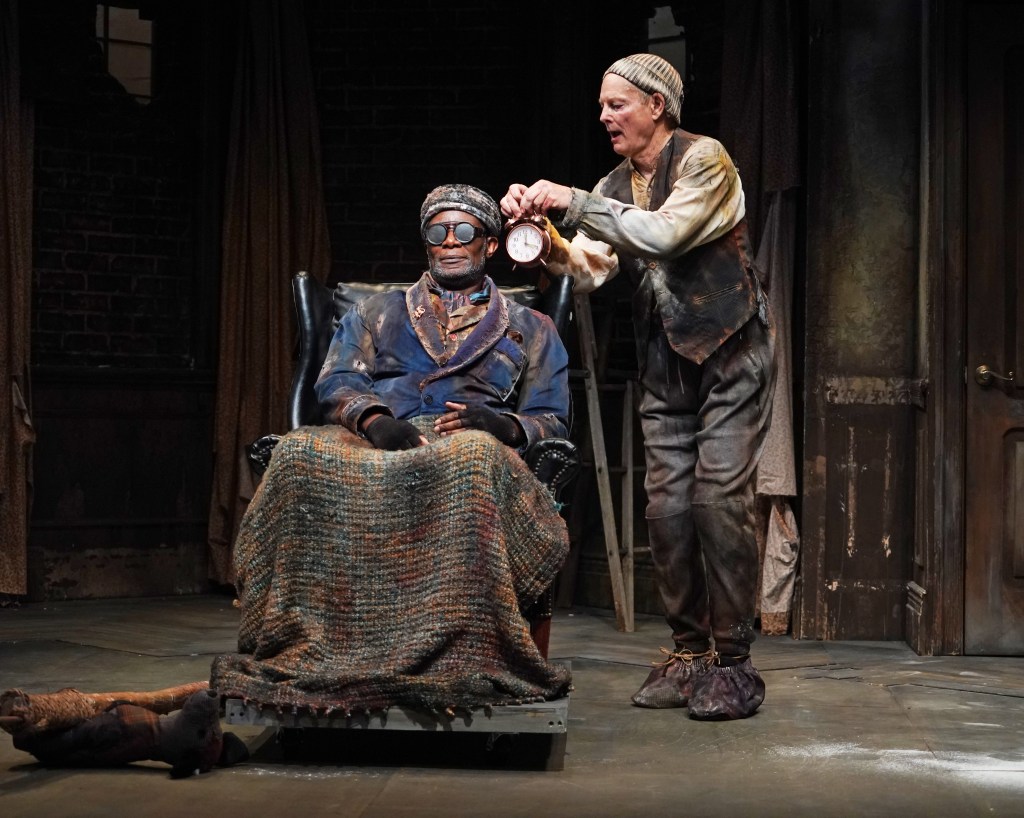
Hamm and Clov are contrapuntal. They are unique personalities and they contradict each other but come to the same conclusions. Their state of existence must end and it has gone on long enough without meaning. As they speak to each other in short bursts of, oppositional banter, the overall effect is humorous, like a bad joke or punchline. However, their thrust and parry about “nothing” has philosophical power in their sporadic digressions about life, time and existence. Their interactions often end with a surprising, pithy statement from either of them and the overall effect is also like a poetic riff. For example Hamm says, “It’s a day like any other.” Clov counters, “As long as it lasts. All life long the same inanities.” In their counterpoint, there is the great observational moment about the redundant, vapid routines of living.
Considering that apart from a few moments when Clov looks out the window, and Hamm directs him to “drive” his wheelchair around in a circle, Clov kills a flea by throwing powder down his pants and Hamm uses a staff-like implement to try to move himself which he can’t, little happens. From beginning to ending they know the situation is absurd because their end is inevitable and irrevocable. And because they are helpless against time and existence itself, they can do nothing except what they do and say which is both funny and tragic.

Bill Irwin’s Clov is a mastery of awkward physicality precisely effected. He is imminently watchable and uncharacteristic in his movements which are surprising and antic. In his stasis, John Douglas Thompson is his frustrated counterpart. Their banter is humorous and paced with authenticity bringing on the chortles and laughter because their characters are so passive and truthful about their condition. No one is raging against the storm which has already happened. They are waiting the interminable wait for “the end.”
O’Reilly’s direction and staging align with Beckett’s intent and we find ourselves mesmerized and waiting for the shoe to drop,, which only does in the little details and actions. One example of this occurs when Clov sets up the ladder and climbs it, anchoring his leg so he might safely look out the window on the “grey.” Another example occurs when Clov gets rid of the flea with the white powder which he roughly sprinkles down his baggy pants. A third action occurs when Clov brings out an alarm clock and hangs it on the wall. Each of these “events” and others (Hamm’s petting his stuffed dog, Hamm’s attempting to move himself with the gaff) create a kind of suspense that ends in nothingness. This is one of the themes of Endgame; ultimately, our actions result in little that impacts or changes existence. However, they do help to pass the time and “entertain” us until “the end,” which is uncertain.

Charlie Corcoran’s scenic design, Orla Long’s costume design, Michael Gottlieb’s lighting design, M. Florian Staab’s original music and sound design convey the austere setting of a ramshackle room in a house beset by a post-apocalyptic, end times scenario. That the title references a game of chess where there are no winners and one of the players (Clov) threatens to leave numerous times but remains at “the end” is to Beckett’s purpose that all inevitably wanders into empty inaction which has little substance or meaning. Thus, we are left seeing characters confronting what they cannot, as we witness our own inability to reckon that there is an “end” to all of “this.” And as Nell states, nothing is funnier than unhappiness. So as we watch the characters struggle with their fateful endings, we laugh because life is nonsensical. And we are sad for the tragedy that reflects our own humanity.
This is an amazing production with flawless performances that you don’t want to miss. For tickets and times go to their website https://irishrep.org/show/2022-2023-season/endgame-2/
‘A Child’s Christmas in Wales,’ Tidings of Comfort and Joy in Dylan Thomas’ Reflections

Irish Repertory Theatre’s A Child’s Christmas in Wales by the brilliant Dylan Thomas, adapted and directed by Charlotte Moore hits the spot for Christmas loveliness and grace. An old-time favorite of Irish Repertory Theatre, this is the sixth version they have produced since their first adaptation in 2002 of A Celtic Christmas. Thanks to Charlotte Moore’s prodigious dramatic talents this is one of the most heartwarming, elegant and memorable of versions and I’ve seen a few. Perhaps it is because of its simplicity as a chamber musical, which features poignant songs written by Charlotte Moore, and the favorite traditional carols of the season, one receives a new appreciation of Christmas. Its vitality in bringing together a community that greatly longs to erase thoughts of separation that have characterized the past few years, cannot be underestimated.

For this production of A Child’s Christmas in Wales, the stage is flanked with tall, stalwart looking Christmas trees uniformly lit against a mirrored background which adds to the stage width and depth, thanks to John Lee Beatty’s set design. There are even large presents tucked away in a back corner on the left side of the stage continuation. The light reflections, and nuanced lighting (Michael Gottlieb) softly enhance the six singers. These include Kerry Conte, Ali Ewoldt, Jay Aubrey Jones, Kylie Kuioka, Ashley Robinson and Reed Lancaster, who was covering for Dan Macke the night I saw the production.
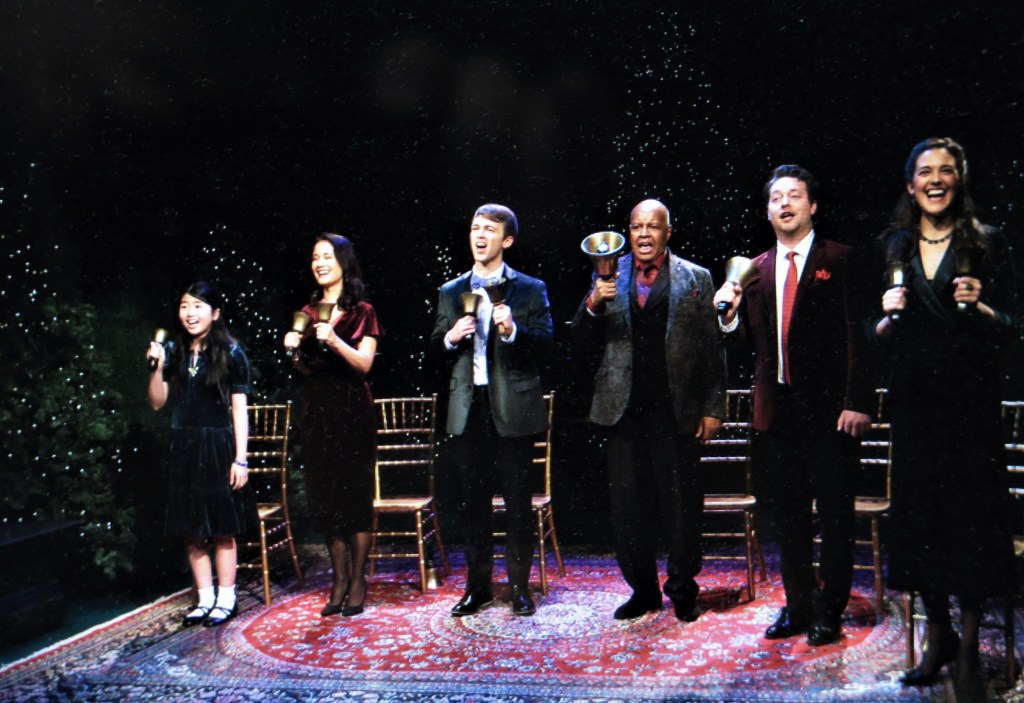
The trees in their arrangement are an excellent choice not only for their placement but for their symbolism representative of Christ and Christianity. The fir tree was widely adopted during the Victorian Age after a picture of Queen Victoria, German Prince Albert and their family appeared in Illustrated London News. Queen Victoria was so popular that the public became enamored of the royal family standing around the decorated, tall, fir tree. They clamored to make it fashionable, cutting down their own trees or purchasing them from vendors after demanding them. Certainly, the historic Christmas captured by Thomas’ gorgeously poetic language seems best ringing out the holiday season with the trees as a evergreen, mythic backdrop.
The music supervision by John Bell and music direction by David Hancock Turner are impeccable. I particularly enjoyed the carols I hadn’t heard in a long while, the traditional ones like “A-Soaling” (Hey, Ho, Nobody Home), “I Don’t Want a Lot for Christmas” and the humorous “Miss Fogarty’s Christmas Cake.” There are songs sung in Welsh “Tawel Nos” (“Silent Night”) which moves to a beautiful segue of “O Holy Night.” And I was surprised to discover that “Deck the Halls,” All Through the Night” and “Suo Gan” are traditional Welsh songs.

I felt an otherworldly appreciation of the carols and live music and singing arranged with thoughtfulness and joy. Thoma’s clever and poignant remembrances narrated with every attention to his incredible wordcraft by the ensemble remind us of a romantic past that we all long for. I am so sick and tired of the canned, artificial music signaling commercialism and grasping greed as it pipes over the loudspeakers of big box stores and various establishments. I do hope this chamber musical was recorded. Its one-of-a-kind exceptionalism in its celebration of a historic time before cell phones, mass media, television and the complications of what at times seems like overwhelming chaos, is bar none.

What was another pleasant surprise were the songs “Take My Hand, Tomorrow’s Christmas,” “Open Your Eyes,” and “Walking in the Snow.” The music and lyrics are Charlotte Moore’s and they appropriately threaded throughout the 75 minute presentation among Thomas’ memories that speak of childhood innocence, frankness (in his recall of the quirky aunts and uncles) and sense of security and safety embraced by a loving family. His work is a milestone and thankfully Irish Repertory Theatre has shared its immutable glory with us, reminding us of family, friends, love, community, history and the meaning of such vital themes that strengthen our lives.

David Toser’s costume design are befitting of the fashionable stylishness of a lovely holiday party where everyone is shining in their finery like their own decorated Christmas trees. In this “never to be forgotten day at the end of the unremembered year” Thomas’ snowy Christmas Day in Wales at the Irish Repertory Theatre is a stunner whose nostalgia is all the more affecting now that Christmas has passed.

See it before it closes. For tickets and times go to their website: https://irishrep.org/show/2022-2023-season/a-childs-christmas-in-wales-4/
 CAROLE DI TOSTI