Category Archives: Off Broadway
‘Babe,’ Theater Review: Marisa Tomei, Rocking Through to the Next Phase
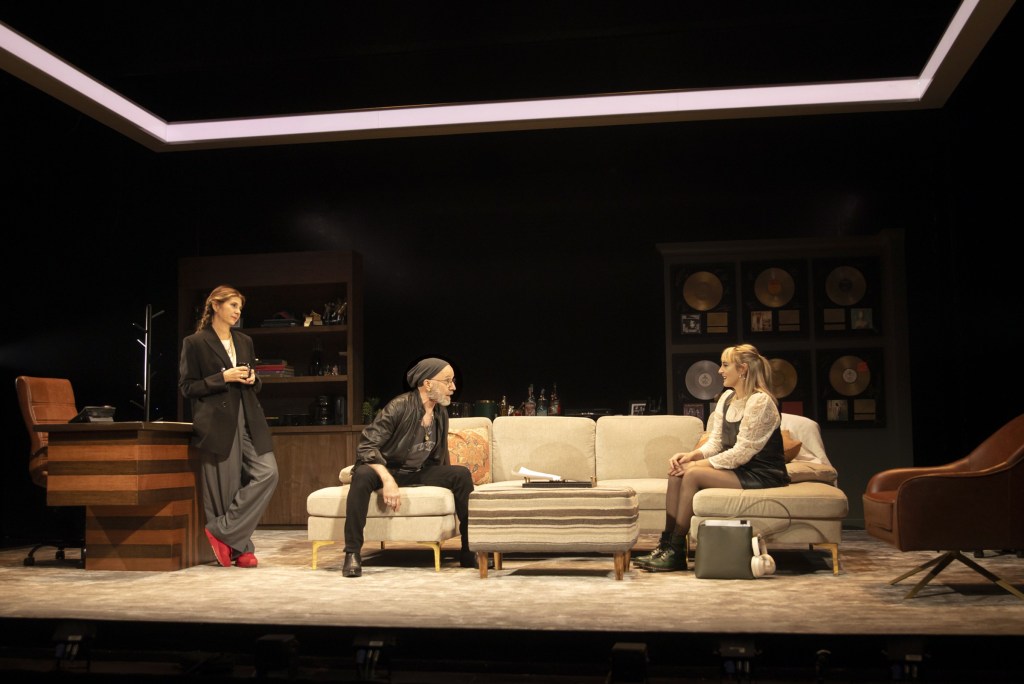
Babe
Can people change? Or do they just flip their perspectives and deceive themselves to believe they’re “evolving?” In the New Group presentation of Babe, written by Jessica Goldberg, directed by Scott Elliott, Abigail (Marisa Tomei), is Gus’ (Arliss Howard), invaluable collaborator in the music industry. The comedy/drama focuses on a number of current issues using Abby and Gus’ relationship as a focal point to explore the landscape of shifting political correctness, power dynamics, generational conflicts, delayed self-actualization, and more. With original music by the trio BETTY, Babe runs approximately 85 minutes with no intermission at the Signature Center until December 22nd.
Treading lightly on Gus’ rocky ground, Abby has been instrumental in maintaining their successful, collegial relationship for thirty-two years, though at a steep, personal price. She hasn’t acknowledged the sacrifice to herself or been inspired to make a change until the confident, twenty-nine year old, Katherine, interviews with Gus, while Abby monitors their conversation and tries to give him clues when to end his political incorrectness. Katherine’s poise and forward attitude develops during the play as the catalyst which ignites a fire that turns into a conflagration between Gus, Abby and Katherine by the conclusion.

Tomei’s astute Abby is sensitive and insightful
Tomei’s astute Abby provides the sensitivity and insight into the zeitgeist that electrifies fans and brings in the gold records, a number of which hang on the walls of Gus’s chic office (sleek, versatile set design by Derek McLane). The producing legend now in his 60s, but fronting his hip, “with-it” ethos in his tight, black pants, chains, stylized beret, and black leather jacket (Jeff Mahshie, costume design), is at “the top of his game,”and on a down-hill slide, indicated by the sensitivity-training Abby references he has had to withstand. We learn it has been ordered by patriarchal, music company head Bob, who also needs to correct himself, but is powerful enough not to. The hope is with Abby’s continual guidance, and the training, Gus’ boorish, self-absorbed, toxic maleness and unrestrained egotism, encouraged at the company by the other men in the past, will refine. Not a chance, as old dogs refuse to learn new tricks.
As groundbreaking, protective and vital as Abby has been to Gus, the two A & R reps, who have discovered and fashioned some of the most successful solo artists in the business, are not equal in stature, success or monetary rewards. Abby’s discovery of Kat Wonder epitomizes these disparities between her boss Gus, and her, as his second. The only woman in the company for years, Abby suffered through the vulgar and abusive patriarchy, a fact she admits late in the play. To her credit, she managed to gain Gus and the others’ respect and esteem. They keep her around because, as Gus suggests, they think she is like them. We learn by degrees that this is because she is silent and as apparently sedate as her bland, grey pants, white top and black jacket. She is unobtrusive and remains professional, the perfect “Girl Friday,” who allows them to “let it all hang out,” without judging their behavior or making them feel like pigs.
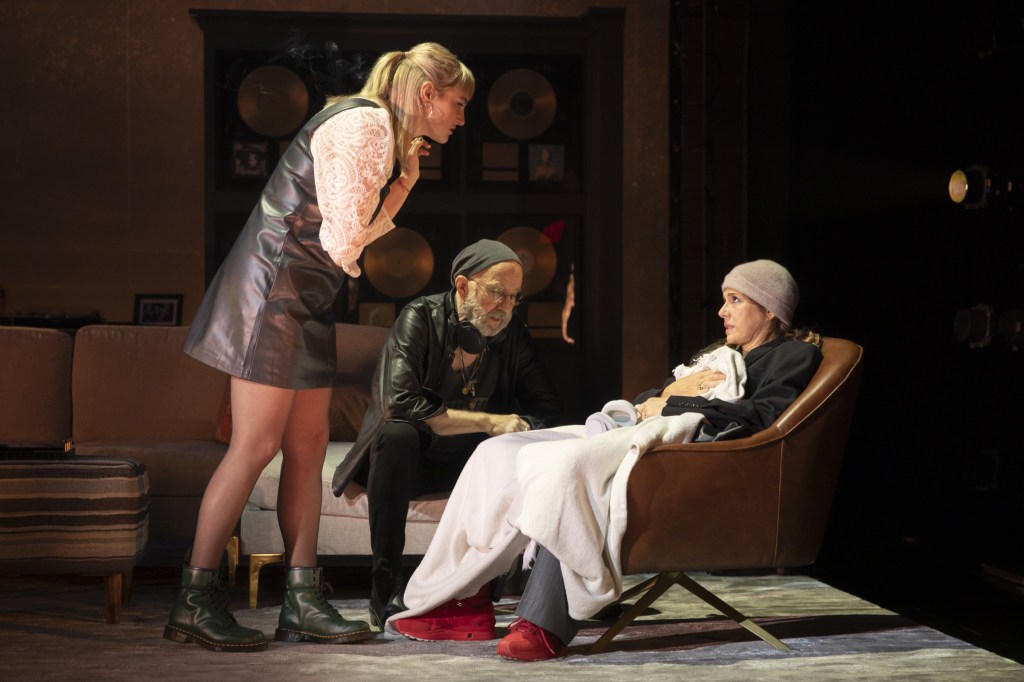
Abby is shut out of receiving credit for her sterling efforts
For her pains to participate, Abby didn’t receive credit on any of the Kat Wonder albums, an “invisible” co-producer. Nor did she share in the spoils as Gus did with global residences and a townhouse he forces the staff to meet in at his convenience, instead of the conference room.
However, ignoring Gus as “all that,” Katherine conflicts with his philosophy, his pronouncements, his ideas. If opposites attract, these two are an exception. Gus sees Katherine’s cultural approaches as pretentious and immaterial (vegan he is not). Katherine is gently oppositional as she pitches herself, her education and background. Interestingly, Katherine sees Abby as a hero to admire. In the initial meet-up, Katherine recognizes Abby from a photo Abby appears in with phenom of the time, “Kat Wonder” at CBGB.Admiring Abby and fawning over her after the interview, Katherine tells Abby that she has been her inspiration to get into the business and wanted to be her.
As obnoxious as Katherine’s forward presumptuousness is, her confidence and appearance remind Abby of Kat Wonder, whose wild grace and energy haunts her throughout the play. Kat appears in her imagination in flashbacks at varying, crucial turning points, with Gracie McGraw doubling for Kat Wonder. These memories of their time together direct Abby toward self-realization and an eventual confrontation with Gus about his unjust treatment of her. This is obviously a painful realization which Abby eventually allows, despite acknowledging Gus’ platonic love, and respect. His concern for her is apparent when he sits with her during a very uncomfortable chemo treatment for her breast cancer.
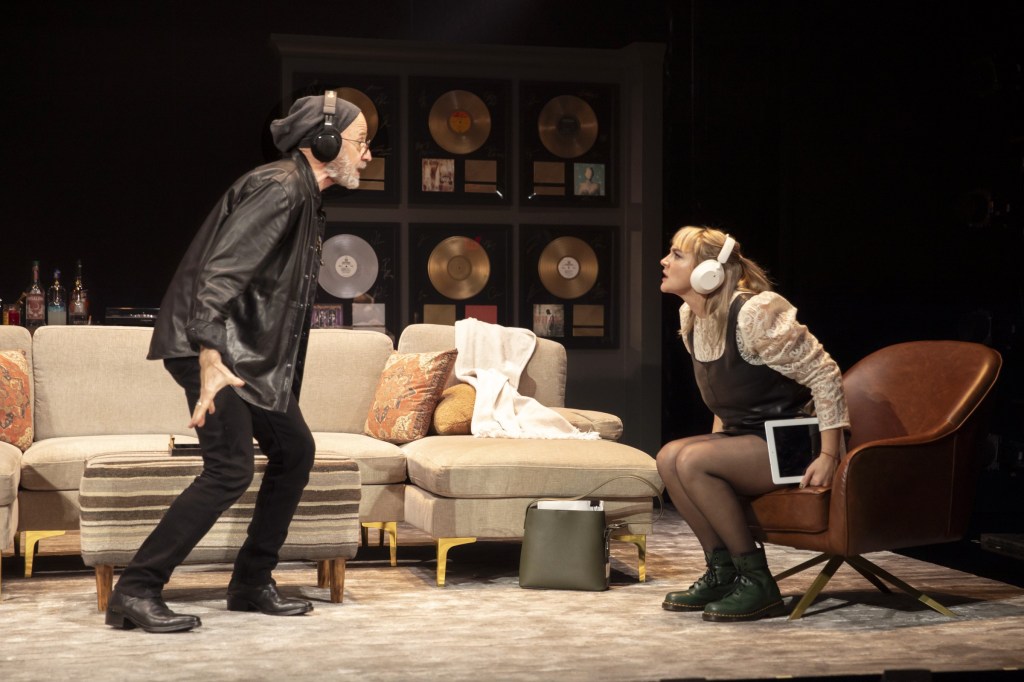
Katherine visits Abby in an unusual get-together
After Katherine again attempts to rise in the company in another interaction with Gus, she visits Abby at her apartment (McLane’s set design again shines in the transition from Gus’ office to Abby’s apartment and back). They listen to music and Katherine asks Abby probing questions. Then they rock out to music and she dances with Abby, at which point Katherine pushes herself on Abby. Abby is forced to rebuff her because any relationship between them is inappropriate. Nevertheless, this trigger, Goldberg implies, impacts Abby. Abby’s remembrance of her relationship with Kat brings her into a deepening realization of herself because of her experiences, including feeling responsible for Kat Wonder’s death, and being shut out of the glory of notoriety as producer who discovered grunge-rocker Kat.
Abby’s realizations about what she has allowed emotionally, which may have contributed to her physical illness and stress, coupled with a twist that Katherine generates, bring about a surprising conclusion. However, Abby’s response to the final events is the most crucial and important. Maybe it is possible in one’s middle age to forge a new path and become one’s own self-proclaimed star.

The ensemble melds with authenticity and flair
The actors convey their characters with spot-on authenticity, aptly shepherded by Elliot’s direction. Arliss Howard manages to break through Gus’ character with a winning charm and matter-of-factness, which throws dust in the audience’s eyes, even after Katherine corrects his back-handed compliment of her as a “smart girl.” Marisa Tomei as Abby is imminently watchable and versatile as she moves from quiet restraint, to the throes of physical and emotional suffering. The development and culmination of her rage and satisfying expression of it in rocking-out with Kat Wonder is powerful especially at the conclusion. As always Tomei gives it the fullness of her talent, rounding out the Abby’s humanity despite Goldberg’s thin characterization.
Gracie McGraw’s portrayal of Kat Wonder, the 1990s grunge rocker who embodied “centuries of female rage,” before she self-destructed is too brief, perhaps. Much is suggested in Kat’s and Abby’s relationship, but remains opaque. However, we do get to see McGraw’s Kat cut loose. And the memory is so alive and vibrant, it encourages Tomei’s Abby to be her own rock-star, wailing out her repressed rage by the conclusion of Babe. And the women in the audience wail with her, especially now, after the election.
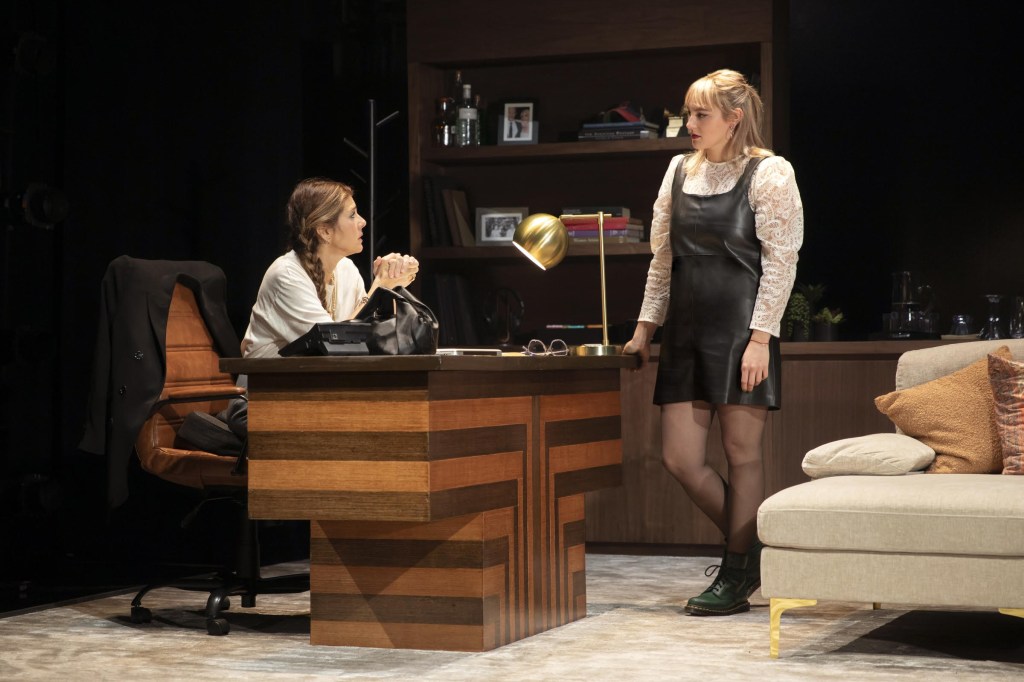
Babe covers many interesting points. To what extent has music been egregiously shaped by the current technologies? What damage has been done as the music and entertainment industry, hypocritically shaped by cultural politics, only creates artificial boundaries on the surface that don’t penetrate the noxious back room parties and behaviors which have given rise to worse abuses? Another issue defines the difficulties of compromise and corruption which spans every institution, every industry. To be a part, one has to be complicit, and then be satisfied with less of a reward because others hold the power and money and make up the rules. Babe scratches the surface and leaves food for thought. The performances are noteworthy and should be seen.
Kudos to the creatives not mentioned before which include Cha See (lighting design), Jessica Paz (sound design), Matthew Armentrout (hair and wig design), and not enough of BETTY’S original music.
Babe runs 85 minutes with no intermission at the Signature Center.
‘Shit. Meet. Fan.’ Neil Patrick Harris, Debra Messing, Jane Krakowski in a Scatalogical Romp Through Coupledom

Shit. Meet. Fan.
It’s an intriguing title. Stepping into the audience seating area of the MCC Theater, what’s not to like? Clint Ramos’ scenic design sparkles as the audience gazes upon Eve (Jane Krakowski), and Rodger’s (Neil Patrick Harris), upscale condo in Dumbo, NYC, a shimmering spectacle of Manhattan lights twinkling in the distance, visible through windows on the second floor which includes a “must-have” telescope on an “elegant” terrace.
From the title Shit. Meet. Fan. to the conclusion, the production screams with sardonic hilarity. Thematically, playwright Robert O’Hara presents characters who exude the allure of security, prosperity, white privilege and “happiness,” conditions to be envied. Perhaps. However, as the evening unspools on this party night when three couples and odd-Black-man-out, Logan, (Tramell Tillman), gather and have their vicious fun, we note that prosperity without contentment, truth or happiness is anything but “all that.”

The shoe drops at the outset
The shoe drops immediately, as promised in the title, and we are startled into recognition that in the opening scene, “it” is hitting the fan, as mother Eve (Jane Krakowski), confronts daughter, Sam (Genevieve Hannelius), about a box of condoms she found that Sam glibly professes isn’t hers. Though the scene concludes with Mom’s peaceful concession and return of the box to her daughter, the screaming match which paves the daughter’s way to success, is revelatory. In their heated interaction, O’Hara, who also directs, discloses a “hip,” ribald mother and daughter, whose frank rants about having sex are “no big deal,” though mom appears to protest too much for 17 year-old-Sam’s liking.
From then on as the guests arrive, “it” grows more plentiful. The characters fan the room, drink, do cocaine and spray their increasingly toxic, chaotic, mind games and patter to the back row of the audience. By the conclusion the audience is “covered.” It is funny, but not necessarily what we’ve wished for during the 105 minute romp through a tragic waste of humanity. However, O’Hara wishes us to laugh at ourselves as much as at the characters. Their hypocrisy, toxic masculinity, feminine one-up-woman-ship, and misery may be ironically recognizable to those able to afford a ticket to this Off Broadway production.

O’Hara based Shit. Meet. Fan. on the popular 2016 Italian film Perfect Strangers
Based on the 2016 Italian film Perfect Strangers, by Paolo Genovese, in the similar development, Rodger and Eve have invited their couple friends to celebrate the eclipse. The bonds of friendship were formed in college when the four men were in the same fraternity and consider themselves “bros.” They are a hotbed of toxic masculinity, fitting all the stereotypes one loves to despise when they are “under the influence” of drugs and alcohol. The men are TV celebrity heavyweights. Besides Neil Patrick Harris, who is always spot-on in whatever role he acts, the superb actors include Brett (Garret Dillahunt), Frank (Michael Oberholtzer), and the aforementioned Tramell Tillman as Logan.
On the other hand the women are close, but ancillary to the key relationships in this comedy that has a number of thematic twists, especially in O’Hara’s version. Joining Jane Krakowski’s Eve and Genevieve Hannelius as Sam, there are Brett’s wife, Claire (Debra Messing) and Frank’s wife, Hannah (Constance Wu). All reveal comedic perfection. The women circle the wagons when attacked, questioned or prodded by their spouses whose vulgar, women-demeaning, objectifying tales and shared secrets, divide the party among gender lines.

As the eclipse presumably occurs the characters get wild and wooly
As the party progresses and the eclipse occurs, which is more symbolic than visualized since no one really watches, the teeth and nails sharpened for this occasion extend for the vicious “fun,” prompted by Eve. She suggests that they play a “game of phones,” and willfully violate each other’s privacy for each other’s amusement, by publicly reading or putting on speaker every phone text, email or call received for an hour during the evening. For one hour there are no secrets; all the dirty laundry is aired. As each unwillingly gives up their phones because no one protests, they put the “black boxes” that record their lives on a centrally located table ready for exposure and humiliation. After that, the drama and comedy intensifies.
The first to suffer the slings and arrows of shame in front of his “bros” is Frank when Rodger calls him from their unknown landline and breathes heavily into the phone. Hannah, newly married to Frank in the heat of their first year together, is ready to knife out his eye. But Rodger comes down the steps heavily breathing into the phone in a classically delivered, brilliantly funny, Neil Patrick Harris, dead pan moment. It is priceless and one of the biggest laughs in the first half of the production.

The “free-for-all” occurs after Logan receives a call
After that it becomes a free-for-all. Logan receives a phone call from his sister who insists humorously that he take her off speaker so those “white b%$ches” don’t hear “her business.” Censorship and political correctness cloaks are off; it’s expose time. Since there is no spoiler, you’ll just have to see the production to witness how each “bro” is delivered a blow and each spouse is found out to be doing numerous things other than being the sweet, loyal “wifey.”
Here are some clues. There are folks on the down low, alternate sexual preferences, affairs referenced by jewelry purchases, a proposal to throw mama in a nursing home behind sonny-boy’s back and more. O’Hara has pegged the jabbing one liners and jokes trippingly to the rapid-fire comedic rhythms which begin casually at an even pace, then pick up and race into the territory of high farce. Then, when the eclipse ends, all settles into normalcy as if nothing untoward, raw and menacing happened. Such is upscale life among the white privileged and two token persons of color. Oblivion after emergences of poisonous, festering wounds.
Meanwhile, we have the opportunity to peek into the illusions, lies and self-gaslighting of these peculiar and infantile minds that may not evolve beyond what we note as entertained watchers.
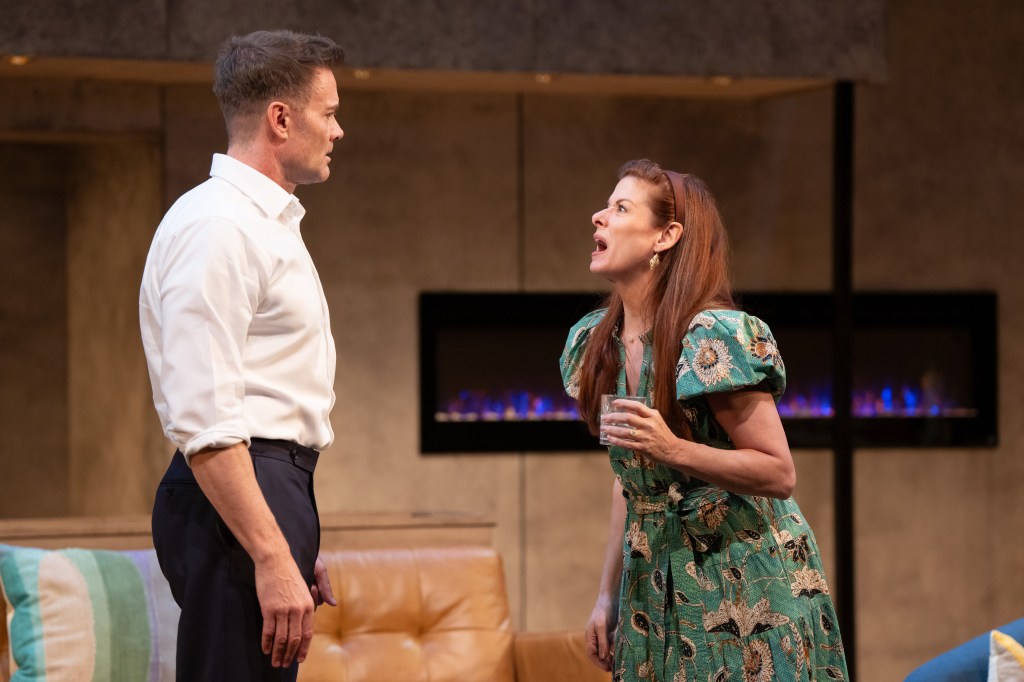
O’Hara portrays boorish, unlikable characters
Clearly, O’Hara finds these individuals boorish and craven, especially the white, toxic stereotypical males who make everywhere their preferred locker room, especially out of their wives earshot. The women are the fairer but not gentler sex. Together, we allow that this night of frolicking fun doesn’t happen often. If it did, there would be three divorces on the horizon except for one, perhaps, though Rodger loves his wife Eve, even if he dislikes who she is as they both contemplate divorce. Thematically, O’Hara proves that individuals choose the friends they deserve as they periodically are tortured and tormented by them under the guise of “fun and games” which are anything but.
O’Hara’s creative team in addition to Clint Ramos’ scenic design, includes Sarafina Bush’s costume design, Alex Jainchill’s lighting design, Palmer Hefferan’s sound design, and Cookie Jordan’s hair design. Each of these creatives assists O’Hara’s sardonic vision of these upper brow professionals in their one night of infantilism and terrorism of each other which is perhaps more well deserved than we know.
Shit. Meet. Fan. runs 1 hour forty-five minutes with no intermission at MCC Theater (511 West 52nd Street between 11th and 10th Avenue), until December 15th. See it for the celebrities who are glorious, as O’Hara intentionally tries the audience’s patience with their characters’ crass and vapid immaturity.
‘From Here,’ Poignant, Uplifting Musical, Theater Review

From Here, the musical by Donald Rupe, with arrangements and orchestrations by Jason M. Bailey, is a framed story told by the delightful narrator, Daniel (Blake Aburn), a gay man in Orlando, Florida. Daniel journeys us through his relationships with his selected family of friends and lovers, as he confronts his estrangement from his single mother.
From Here is a revelation of love and hope, as the musical’s events beginning in January of 2016 hurtle us toward June 12th, the date of the Pulse Night Club shooting, the largest mass shooting in the United States up to that point in time. Currently, the musical is running with no intermission at the Alice Griffin Jewel Box Theatre, at the Pershing square Signature Center until August 11tth.
The musical opens with Daniel’s introduction of himself, his problems and his friends who help him relate his angst at this time in his life. Blake Aburn’s Daniel focuses on his mother whose love he craves as he calls her every day, though she refuses to pick up. Though the reasons for their alienation are not revealed initially, in the tuneful song “Where do I go?” which begins “Hey Ma,” we learn the backstory of his love for his mother, her ambivalence toward him and his life questions about his future. Then, as this introductory song continues, we meet his partner Michael (Julien Aponte), and they go clubbing.

At the club, their friends pick up the refrains of the song which concludes the first scene. Thus, we have a picture of Daniel and his friends who are the players whose lives will be impacted by the shooting in June. Importantly, we note that Michael and Daniel’s relationship appears comfortable and warm. We learn it has burned brightly for seven years then blow”s up in the next scene when Michael dumps Daniel, who admits Michael’s reasons for their split are right-on. After they split, they decide to remain friends.
Another key figure in Daniel’s and his friends lives is Jordan (Michelle Coben), a petite but mighty powerhouse of a club singer who invites Daniel to her performance and also invites his mom to bring them together and smooth over their separation. As his mom, Becca Southworth spills her emotions about her failed marriage and her alcoholic husband who blamed Daniel’s homosexuality for leaving. Unable to assuage the guilt she feels, she carries her wounds around with her, and like Daniel, is forced to reconcile a situation which neither she nor Daniel are responsible for, but is dumped upon them by an emotionally damaged and sick man.

After his breakup with Michael, Daniel meets Ricky and forms an attachment which is binding by the end of From Here. Shy, awkward and sweet, Omar Cardona, as Ricky is embraced by Daniel and his family of friends. Cardon’s Ricky has an incredible voice and a deep heart. As the friends gather for togetherness and comforting, whether for fun, for a birthday party of just to hang out, we note how these gays and Jordan who is straight but who enjoys the warmth and non-judgmental attitude of these friends/family, remain uplifted despite whatever happens. This is especially so after they learn of the shooting in a scene of shared humanity, love and feeling as one after the other they confess their weaknesses and gain strength from their truthfulness to each other.
As the narrator who guides us from beginning to end with a variety of songs, monologues, beautiful philosophical bits of poetry (I.e. “Hand in hand, Time and her lover, Regret, dance circles around us, their loyal subjects.”), Daniel’s pointed self-reflection as a gay man strikes us as we note he hopes to evolve to a place where he is comfortable. The monologues and various bits are authentic and well-written by Rupe. Blake Aburn also grows upon the audience with his familiarity and confessional tone, winks and endearing expressions which he uses as Daniel twits himself and lets the audience in on his humorous self-deprecation.

Though he doesn’t take himself seriously for the most part, Daniel does take his relationship with his mother very seriously. When she doesn’t receive a call from him the night of the shooting, the only day he did not call, she is beside herself. He is sorrowful for causing her suffering. It is then he realizes the great love, perhaps unacknowledged before, between them. Their reunion is touching and leads to the last scenes of the play where the family of friends gathers together to uplift each other and speak a memorial to those who lost their lives in a senseless needless killing spree of hate.
By the conclusion, the musical’s themes are apparent. Without the friendships and love of community, we are lost. It is the lack of the friendship and love of community that caused a killer to wreck a vengeance of hate to answer the misery of his failed life. Without collective bonding and sharing of love, whatever one’s sexual preference, humanity can face little safely, and the darkness overwhelms. But the light of love and friendship sustains as friends go “from here,” to spread to others, what they’ve found with each other.

Importantly, Daniel concludes with the aftermath which establishes the goodness of people despite the horror of one night. Daniel remarks that Orlando has changed.
“For months after Pulse, each night the skyline would light up in Rainbow lights. Murals dedicated to angels appear when you least expect them to. There’s more art now. People stare less.” (at the gay-ness expressed). Daniel also reflects about the “quiet monument where Pulse once stood. It’s a rare time that you drive past and there isn’t someone sitting, quietly paying their respects.”

Rupe’s contemporary score succeeds lyrically because of its pop-ballad simplicity and repeated refrains of melody that are memorable, especially in the opening song. For example, the vital and effective “I love you/I miss you/I’m sorry” theme is resonant and a foreshadowing of the musical’s finale when we imagine that those words were said to those who were killed. Though the four piece band (bass, guitar, keyboard, and drums) accompanying the performers is excellent, the sound system (Matt Craig), needed adjusting the evening I saw the performance. Sometimes, the lyrics in the group numbers were unclear. However, that is not only in this show. Annunciation is a dying art in theater, oftentimes.

Rupe, who also directed, keeps the staging and scenic design spare and minimalist thanks to Philip Lupo. That simplicity serves to emphasize the dialogue and songs well, without any unrelated extravagant numbers distracting. All coheres in unity. Choreography is by Adonus Mabry and costume design is by J. Marie Bailey.
As a unique regional theater production, presented by Renaissance Theatre Company, which has transferred to New York’s Off Broadway, From Here succeeds largely because it doesn’t focus luridly on the Pulse mass shooting, but allows it to hover in the background. Indeed, Daniel’s narrative in songs with good will and humor presented to an interested audience occurs as a retrospective, a flashback of events leading up to that horrific night. And seen in light of the wisdom that memento mori, Daniel is chastened, and grateful for all he has, especially his community who are unique and wonderful.
From Here runs with no intermission for 1 hour 40 minutes. For tickets go to the box office at Pershing Square Signature Center or online at https://fromhere.com/
‘Here There Are Blueberries,’ No Evil. Just Ordinary, Enjoyable Routines.

Here There Are Blueberries, now in its third extension at New York Theatre Workshop, is a many-layered, superb production running until June 30. Stylized and theatricalized as a quasi-documentary that travels back and forth from present to past to present by enlivening characters in various settings, the play unravels the mysteries centered around an album of 116 photographs taken at Auschwitz. Though the album has no photographs of the victims to be memorialized, it eventually is donated to archivists at the US Holocaust Memorial Museum, by a retired U.S. Lieutenant Colonel.
Based on real events, interviews, extensive research and photographs rarely seen of the infamous concentration camp from another perspective, the play follows archivists who shepherded the photographic artifacts toward a greater understanding of the political attitudes and the daily routines of the people who ran the camp. Written by Moises Kaufman and Amanda Gronich, and directed by Moises Kaufman, Here There Are Blueberries is a salient, profound work that has great currency for our time.
With expert projection design by David Bengali, Derek McLane’s scenic design, which suggests the archivists’ workplace, and Kaufman’s minimalism, characters/historical individuals step forward to bear witness, like a Greek chorus, to speak from the ethereal realms of history. The play which has some Foley sound effects for purposes of interest, dramatizes scenes which hover around a concept. All of the fine artistic techniques by Dede Ayite (costume design), David Lander (lighting design), Bobby McElver (sound design), further the plays probing themes which examine questions the researchers ask about those who murdered and why they murdered. As the drama poses questions to its audience and itself, some, the play answers. Others, the audience must answer for themselves.

At the outset, a narrator explains the importance of the Leica camera for the people of Germany in the 1930s, when the society was at a crossroads after economic depression and the reformation of Hitler’s new government. Perched on a stand center stage is the camera in the spotlight, while projections of black and white photos scroll in the background, exemplifying the subjects taken by people using it. Some are of German people enjoying family events, as we note the narrator’s comment that in Germany, amateur photographers took up the activity as a national pastime and became “history’s most willing recorders.”
As the photos scroll showing stills of children and young adults giving the Hitler salute, the narrator suggests that “each frozen moment tells the world this is our shared history.” Her tone is ironic and the Hitler salute, as terrible as it is, physicalized by the bodies of children, indicates an alignment with Hitler’s politics, attitudes and way of life. Additional photos of children and adults enjoying outings, show Nazi flags; the narrator continues, the “apparent ordinariness of these images does not detract from their political relevance.” Indeed, she states, “On the contrary: asserting ordinariness in the face of the extraordinary is in itself, an immensely political act.”

In photographs and videos of Hitler’s marches by soldiers of the Third Reich (shown in the Nazi propagandist films of Leni Riefenstahl, etc.), we note Nazi militarization and might, which after a while are easily relegated to “the past.” Photographs throughout the play’s album note the Nazi flag, Hitler salute and SS uniform as a common fact of life lived at that time. Indeed, Hitler’s politics became the breath of life itself and all aspects of the German people’s existence and happiness were intertwined with Nazism, Hitler’s “great” leadership, his conquests, economic prosperity, and the ready identification with all of this by the average German. This was so until things went terribly sour and German war losses multiplied.
However, the Third Reich’s asserting ordinariness and commonality, when in fact it was anything but, is one of the concepts the archivists deal with throughout their journey to organize the photographs, categorize them and analyze what they are looking at in the photo album of the SS’ lives at Auschwitz.
The playwrights introduce us to the archivists in the second scene. It is then Rebecca Erbelding (Elizabeth Stahlmann), first reads the letter from the Lieutenant Colonel notifying the museum that an album with photographs from Auschwitz that he possesses might be of import. From that juncture on, we become engrossed in the archival journey as the researchers, experts and others delve into the album and attempt to understand it. Curiously, there are no photos of the victims and prisoners of Auschwitz.
As they take on the difficult task and uncover details through trial and error, eventually, researchers bring together the puzzle pieces which explain the photographs and identify the SS officials and the various workers up through the hierarchy, who helped Auschwitz seamlessly function. Clearly, Auschwitz was a huge endeavor that contained an industrial complex and barracks for laborers, housing for guards and administrators alike, and a killing machine and ersatz assembly line of death.

After pinpointing the owner of the album as Karl Höcker, who moved his way up to become the administrative assistant to the head of Auschwitz., the archivists (who also bring to life Karl Höcker and others via dramatization), gradually explore the lifestyle of those in the photographs. These include the SS guards, top brass, doctors, various secretaries (Helferinnen, who were in communications, etc., and held jobs at the camp), staff and others having meals, relaxing at a nearby resort and more daily activities.
None of the photos show the functions of Auschwitz, the prisoners, victims or crematoria. All is pleasant and reflective of the wonderful world that Hitler spoke about bringing to mankind after the “vermin” were removed. That the Helferinnen were photographed surprised a number of researchers who wondered if the young women knew about the gas chambers in the camp or smelled the acrid air of burning flesh in the crematoriums. After denials and relatives probing and finding innocence, what the women knew is later answered by one of the secretaries who was at Auschwitz. She was questioned after the war. Charlotte Schunzel stated she and the other women recorded how many were sent to hard labor and how many were sent to SB, “special treatment,” a euphemism for the gas chambers.
The archivists pin down the identity of the SS officers and high command in the photographs, one of whom was the notorious “Angel of Death,” Dr. Menegele. Another is the commandant who set up Auschwitz-Birkenau, Rudolph Höss. The researchers determine that the photos are like selfies that reveal the happy life of Karl Höcker (Scott Barrow), who would have been a “nobody” if he had not joined the Nazi party in 1937 and arrived at the camp in 1944, just in time to help “process” the thousands of Jewish Hungarians (350,000), who rode in trains three days, only to be murdered in gas chambers after they arrived.

Kaufman and Gronich seize our interest especially when actors take on historical personages, relatives of the SS, survivors, researchers, historians and others. in view of the audience, actors create Foley sound effects to usher in events and accompany Erbelding, Judy Cohen (Kathleen Chalfant), Charlotte Schunzel (Nemuna Ceesay), Tilman Taube (Jonathan Ravlv), Melita Maschmann (Erika Rose), Rainer Höss (Charlie Thurston), Peter Wirths (Grant James Varjas), and others as they uncover bits of information and puzzle together what is happening in each photograph.
The global attention the album receives (revealed by projections of headlines), brings new interest and revelations, some by grandchildren of the SS who are horrified to see uncovered aspects of their relatives they didn’t want to imagine. These aspects have been kept hidden from families out of shame and especially to avoid accountability. Perpetrators of murder and the accomplices to murder are still being located and held to account, even as recently as the last two years. Murderers and the complicit and culpable had a great need for covering up their crimes, as long as they were alive.
Another revelation comes from Holocaust survivor Lili Jacobs, who contacts archivists, as a result of the press reports. She had been holding on to an album she uncannily found of 193 photographs of the Hungarians arriving on the trains, all of whom were “processed” by the SS and high command in the photos. After she donates her album (it contains pictures of herself and family taken by the SS in the camp the day she arrived from Hungary), the researchers are able to solve the dates of the mystery of one photo which shows all the SS, high command and workers celebrating at Solahütte (a resort), where Karl Höcker occasionally rewarded the SS guards, workers, Helferinnen etc., when they did something special.
One example is given when guards prevented an escape by killing four prisoners. Administrator Höcker rewarded them for their “courage” by sending them to Solahütte for a few days.
Previously, the archivists couldn’t understand what and why the large group of camp officials, workers, drivers, Auschwitz staff, referred to by one archivist as the “Chorus of Criminals,” were photographed celebrating. However, through interviews with experts, and piecing together the facts, they divine why the entire group of Auschwitz Nazis standing and smiling, were enjoying the accordion music in one, fine, inclusive photograph, from the top brass in the front, to the lowly staff standing on a hill in the back.
With the evidence of the two albums together, archivists complete the full story of murderers and victims. The victims in Jacobs’ album were those who arrived in train transports from Hungary. The photographs included photographs of Lili and her family and her rabbi, right before they were separated into the lines for labor camp and gas chambers. In Höcker’s album, the administrator assembled and photographed the “Chorus of Criminals'” photograph for a vital reason. The murderers celebrating at Solahütte were congratulating themselves. They had successfully finished a job well done, the massive operation, processing Hungarians, dividing and selecting, so that 350,000 could be exterminated, among them Lili’s parents and two younger brothers.

Through their research, archivists discovered that Lili arrived one day after Höcker arrived at Auschwitz. He most probably received a career bump up to administer the massive “Hungarian Project.” In light of Lili’s discovery and sharing it with the archivists at the museum, she and they “get the full picture.” She sees the identity of the men who murdered her family. Finding the album of herself in the tie in with the album of the SS who ran the camp is an extraordinary sequence of events that is beyond coincidence. For her, the discovery is mystical and divinely spiritual.
Ironically, in Here There Are Blueberries, the victims that the Holocaust Memorial Museum has been so diligent about uplifting and respecting are not the only ones to be considered in studying and understanding the Holocaust. The innocent victims, indeed, were the extraordinary ones in Hitler’s politics that had infiltrated into the bones of the German people, but not the bones of the innocent ones ravaged by acts of the brutal tragedy delivered for the “good of the nation” in its lust for domination. The victims’ impossibly painful stories of survival or loss, escape, surrender, the trauma, and the horror, shock, astound and enrage.
That the ones who perpetrated murder and genocide were able to do it day in and day out as a matter of routine, a job to be done, exemplifies the normalization and internalization of a monstrous political attitude. That attitude that the SS, many Germans and surrounding cultures (i.e. Austria) adopted as right and true, a way of being, a way to live one’s life, which necessitated that others bleed and die for it as a general social good, is evidenced throughout Hocker’s album of photographs of the SS’s smiling faces as they perform daily activities.
It is this above all that Kaufman and Gronich bring to the table and highlight like no other work, with the exception of Martin Amis’ novel Zone of Interest, about the life of Auschwitz commandant Rudolf Höss, which was recently made into a film, directed by Jonathan Glazer. However, unlike Zone of Interest, Kaufman and Gronich don’t include responsive photos to the crematoria. All photos of camp function and purpose are missing. Only in Lili Jacobs’ companion album do we note the horror of the transports and the photos of her rabbi, her parents and siblings who died.
The photos of those accountable for all of the activities at Auschwitz, their reason for being there-to kill, oppress, subjugate and promote the war effort-is implicit. Their very images in the photographs stink with the noisome odor of the gas chambers. The absence of the victims and any evidence of the killing machine, a final realization of the archivists who investigate the album, if anything, incriminates all of the SS officers even more in their guilt. If they were innocent and in the right, why did Höcker need to edit out the buildings of the killing machine, the prisoners and torturing that happened in the labor complex? Why did he need to present his album of “happy days are here again?” when obviously the smoke of the burning had to be hidden?
In the archivists’ explorations they learned the backgrounds of the SS running the camp were ordinary-former clerks, bank tellers, confectioners, teenage girls. We are prompted to ask what separates these murderers and accomplices to murder from the rest of us? Stating the Nazis were monsters allows us the luxury to say “we are not like them.” It dupes us to think we would never be caught up as these were, convinced in the rightness of their actions. This is a dangerous attitude. Indeed, playwright Kaufman reflects the overriding theme of Here There Are Blueberries when he states that “the Nazis were not monsters-they were normal people who did monstrous things.”
How are political cults convinced of their rightness convinced to murder for the right? How did the January 6th insurrection fomented by a sore loser with revenge on his mind to punish his VP because he didn’t do what “was right” happen? Are there any elements that might be compared? This amazing play is filled with parallels to our time, as it raises profound questions about our humanity. For that reason, as well as the fine dialogue and overall presentation and ensemble work, one should see this play.
Here There Are Blueberries runs 90 minutes with no intermission at NYTW on 4th St. between 2nd and the Bowery. Don’t miss it.
‘Sally & Tom,’ Suzan-Lori Parks’ Brilliant Play About Hemings and Jefferson, a Must-see

That “all humankind is created equal,” never was penned by Thomas Jefferson, nor by our most illustrious founding founders, who insured that only privileged white men with property were “equal” enough to vote. This is well noted by Suzan-Lori Parks in her satiric, New York premiere Sally & Tom, directed by Steve H. Broadnax III, currently running at the Public in its fourth extension until June 2nd.
Suzan-Lori Parks (2002 Pulitzer Prize and 2023 Tony Award winner for Best Revival of a Play for Topdog/Underdog), takes up Thomas Jefferson and fillets him for a farcical repast in this exceptional, complex new work. Examining Jefferson’s relationship with his slave mistress Sally Hemings (with whom he fathered six known children), Parks uses “their love” as fodder for her satiric cannons. She employs a play within a play structure to heighten the complexities of shedding noxious, historical, cultural notions and facing the contradictions in human behavior when attempting to do so.

During the process, where she alternates scenes from the play Pursuit of Happiness set in the past, and the actors working backstage to rehearse, revise and reconfigure the play in the present, Parks elucidates themes about racism, slavery, the patriarchy and power domination. Gradually, she reveals how the actors, and three of the technical team realize that these elements permeate their cultural attitudes in their own lives, despite their assumptions that they’ve released themselves from such bondage. Parks’ intention is for us to identify with the Good Company’s enlightenment and self-awareness toward a new “freedom.” Finally, Parks uses the occasion to expose fascinating information about “Sally and Tom” that the audience may not have known before.

Taking cues from Parks’ dialogue, Broadnax III’s setting leaps seamlessly as it alternates back and forth from 1790, Monticello, Jefferson’s plush home where the play, Pursuit of Happiness predominately takes place. Then Sally & Tom shifts to the present, backstage, and in the apartment of actors and lovers, Mike, the director, who plays Jefferson (Gabriel Ebert), and Luce, the playwright, who plays Sally (Sheria Irving). Like the characters they portray, Mike and Luce are intimate partners in their lives. Like Sally Hemings, Luce discovers she’s pregnant during the course of reworking and acting her role in the Pursuit of Happiness.
As a humorous, Mark Twain-like ironist, Suzan-Lori Parks sends up the cliche that truth in life is stranger than fiction, as the parallels between Sally and Tom and Mike and Luce blow up by the conclusion.

Broadnax III’s technical team crafts the sets (Riccardo Hernandez), costumes (Rodrigo Munoz), hair, wig, and make-up (J. Jared Janas & Cassie Williams), lighting (Alan C. Edwards), sound (Dan Moses Schreier), and music (composers-Parks and Dan Moses Schreier), to clarify when and where the action is unfolding. As the actors wrangle with increasingly desperate and funny problems, putting on the performance about Jefferson and Hemings, all of the characters/actors have different goals in their own pursuits of happiness. We get to see some of them blossom and others implode.

The enjoyment of Parks’ delightfully meaningful work is that one becomes immersed in both the Monticello past and the backstage present. The illusion of Jefferson’s Montocello is recreated at the top of the play as Tom and Sally dance the minuet accompanied on the violin by the slave, Nathan-actor counterpart Devon (Leland Fowler), as guests regaled in period clothes and wigs, enjoy their turns around the dance floor. As Parks exposes the colonial, repressive, anti-democratic culture of that time and stands it on its head in Pursuit of Happiness, she twits the current politically skewed theater trends presenting upbeat, nonthreatening productions, which offer “talk backs” when subjects skirt the edges of “triggering,” in order to “work through” potentially offended audience sensibilities.
Indeed, the actors of Good Company have changed their attitude toward offending audiences in this latest play to “stay alive,” and keep their company solvent. Good Company has been stretched to its limits in the past because audiences have rejected their “in-your-face” productions like “Listen Up, Whitey, Cause It’s All Your Fault.” Their producer and key financier Teddy schmoozes Luce and Mike to keep Pursuit of Happiness palatable to a diverse crowd.
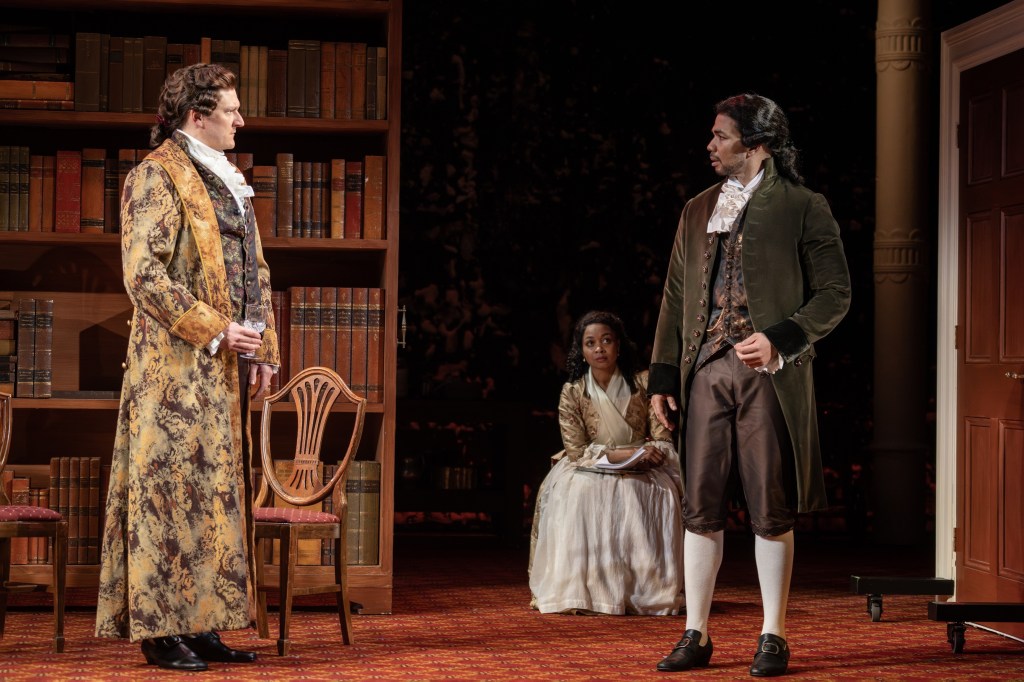
The play is heavy on accurate information. Jefferson’s “kindness” to his slaves is suggested up to a point. However, one senses the irony of a sub rosa rebellion underneath this essentially Black play which points up the scandalous “relationship” of the “good guy” Jefferson and presentation of Sally, Jefferson’s mistress, who gently gestures to her baby bump at the end of the play. Theirs was no love relationship, Luce, the playwright insists.
As the playwright Luce and director Mike rework various scenes, put in and take out inflammatory speeches, and try the patience of their producer, who eventually quits because the play is still too “in your face,” they evolve in their understanding. They are forced to modulate their impulses which reflect the present.
Some of the actors, prefer to show that the oppressed slaves had agency. In one instance, a beautiful speech is so incendiary, Teddy wants it to be removed because then, the play would be a hit and “sell,” and he’d get his money back, obviously. The point is made that during Jefferson’s time, a slave’s agency would be construed as an act of rebellion and punished with death.

The tension between what was (the oppressive horrors of slavery), and what is (current cultural freedom especially in New York City), rocks Kwame (Alano Miller), who is on the verge of “making it” in the business. Kwame portrays Sally’s brother James, who Jefferson promised to free when they returned from Paris, where James enjoyed freedom as the other Blacks did. However, when Jefferson et. al. return to Virginia where slavery is the law of the land, Jefferson makes excuses about freeing James, because why would he do what is illegal and frowned upon by the society of his plantation peers?
James continually confronts Jefferson about his promised freedom, and stands up to Colonel Carey portrayed by Geoff (Daniel Petzold), who refers to Sally, his sister, as a “fine animal.” When Jefferson “mildly” rebuffs James telling him to “remember himself,” James holds forth in a three minute speech which producer Teddy insists must be cut.

As brother James, Kwame enjoys speaking truth to power, though it is completely ridiculous for the 1790s South. It is clear that Kwame chafes at portraying a slave and feels he must redeem himself in such a role. The speech, which he delivers to “perfection” is his shining moment. The cast initially agrees and Luce, believing that Teddy is under her power, massages the producer to keep the speech and prevent Kwame from walking. Instead, Teddy quits and Mike and Luce are left with a financial abyss to fill and a long speech which makes no sense in Jefferson and the fledgling United States’ tide of times. Of course the “full of himself” Kwame believes his empowerment speech is the only value Pursuit of Happiness has.
The show, however, does go on as Mike and Luce’s relationship is sacrificed, Kwame quits, scenes are rewritten at the last minute and the acting “troopers” pull together and get to opening night. In the process, the farce unleashes and the admixture of revelation and forgiveness but not forgetfulness wins the day for the actors, and even for Sally and Tom at the “perfect” conclusion, that a sadder but wiser Luce has written for Pursuit of Happiness.

The actors are top notch in this glorious ensemble where Sun Mee Chomet, Kristolyn Lloyd and Kate Nowlin portray supporting roles. For those who gloried in founding father Thomas Jefferson’s iconic stature, Parks, speaking through Luce, pointedly suggests Sally did not love Tom. Though he supposedly was a kind master, unless one could go back in a time machine taking one’s present-day perceptions with them, it is impossible to know, given he kept 600 slaves and sold them off to raise money when he went to the Capitol, New York City. Finally, the audience is reminded that our great founding father never gave Sally her freedom. It was Jefferson’s daughter Patsy, disappointed at her father’s lascivious behavior, who finally freed Sally after Jefferson died.
If the Good Company had had their way with Teddy, who most probably insisted they change it, the title would have been E Pluribus Unum (“out of many, one”), instead of the benign Pursuit of Happiness. One would think that the implied unity has yet to be achieved in our nation, culturally fractured by foreign adversaries like Putin for politically opportunistic reasons. However, looking beyond social media posts of Marjorie Taylor Green, MAGAS, and Russian and Chinese trolls, federally, we are indeed, E Pluribus Unum, united and standing tall, while we attempt to iron out issues, as Parks points out, that are extremely complex.
Sally & Tom runs two hours, thirty-five minutes with one intermission at The Public Theater, on Lafayette Street. I loved it.
‘Pericles’ by Fiasco Theater a Joyful, Redemptive Must-See at CSC

Fiasco Theater’s Pericles presented by CSC is one of William Shakespeare’s works written in the twilight of his career that reveals a “hero” who the fates torment and play with until it is enough, and he receives his wish of a fulfilled life with family. The production directed by Ben Steinfeld is stylized and cleverly wrought, advancing storms, shipwrecks, kidnappings and more with the ingenuity and charm joyfully delivered with as little forced spectacle as possible, yet with an intriguing, bold and seamless minimal set and prop design. Currently at CSC until March 24, this is a must see which Fiasco has brought for us to appreciate.
Steinfeld is Gower, the troubadour whose tale this is. Through his music, lyrics and poetry he sets up the play and requires the audience to use their imagination to become involved with Pericles of Tyre’s harrowing and amazing adventures of a lifetime. Steinfeld’s Gower introduces every section and gives a summation of events essentially cluing in and reminding the audience to stay focused and attentive. He leads the cast in song initially and establishes the mood for each of the acts, making sure to recap the events in rhyme after the audience returns from the 10 minute intermission before Act 2.
There are four actors who portray Pericles and give their timber to each scene and adventure that Pericles experiences as he goes on a hero’s journey learning wisdom, perseverance, patience and fortitude, struggling to overcome whatever Fortune brings.
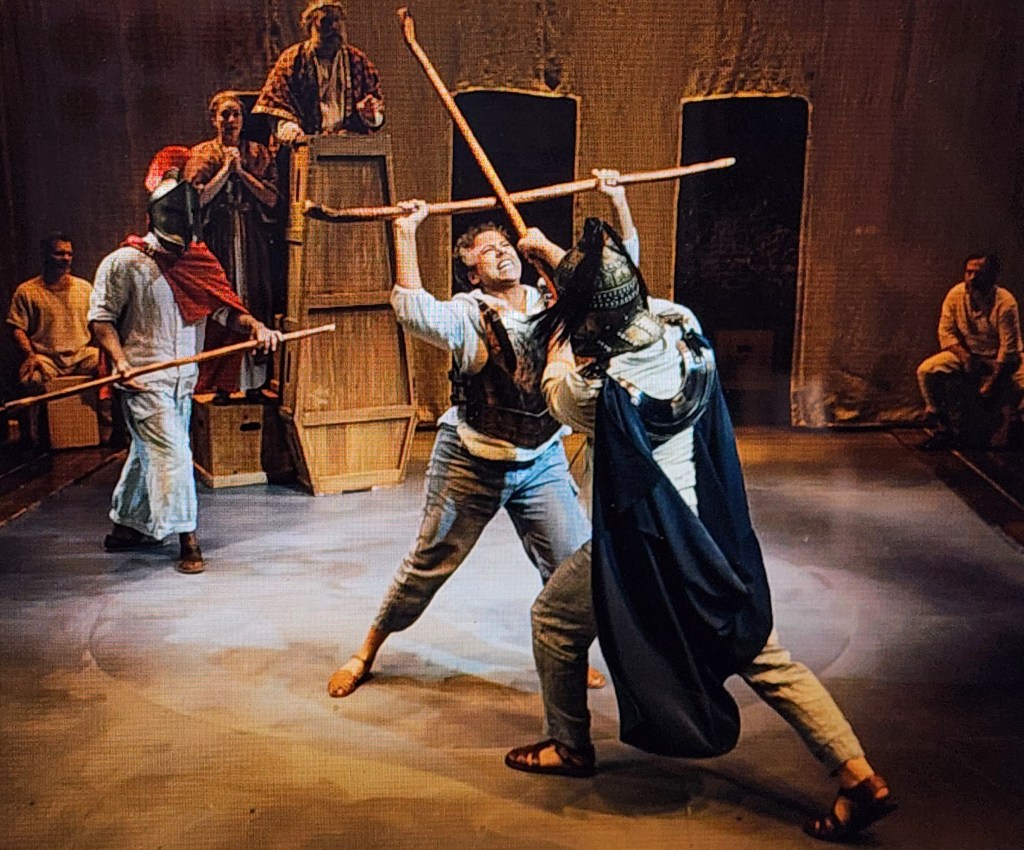
The first Pericles is Paco Tolson who journeys to the kingdom of Antioch where he must solve a riddle to marry King Antiochus’ (Noah Brody) beautiful daughter (Emily Young). If he doesn’t solve the riddle, he forfeits his life and hangs like the other suitors in the public square which the creative team and actors simplistically yet fearfully stage with staffs and boxes/crates. Hearing the riddle, Pericles shows his brilliance apart from all the suitors who have courted the king’s daughter and died. He understands King Antiochus’ treachery. The riddle infers the king’s incestuous relations with his daughter, who he will never give to a suitor.
Upon realizing this horrid circumstance, Pericles also realizes his own fate. Either way, if he reveals the riddle and exposes the king’s sin to public humiliation or doesn’t, he’s a dead man.
Making his excuses, Pericles ends up escaping Antiochus’ kingdom. He intuits the king will figure out why he left and come after him, so Pericles goes on a journey to Tarsus where King Cleon (Devin E. Haqq) and Dionyza (Titiana Wechsler) make their home and suffer through the dire misery of famine that has struck their lands. Knowing their plight, Pericles brings corn to Tarsus’ starving people and saves them from death. Forever grateful, King Cleon makes Pericles revered and celebrated in the land with friendship and goodness. However, we learn that kings are political and variable and circumstances change to sever the friendship.

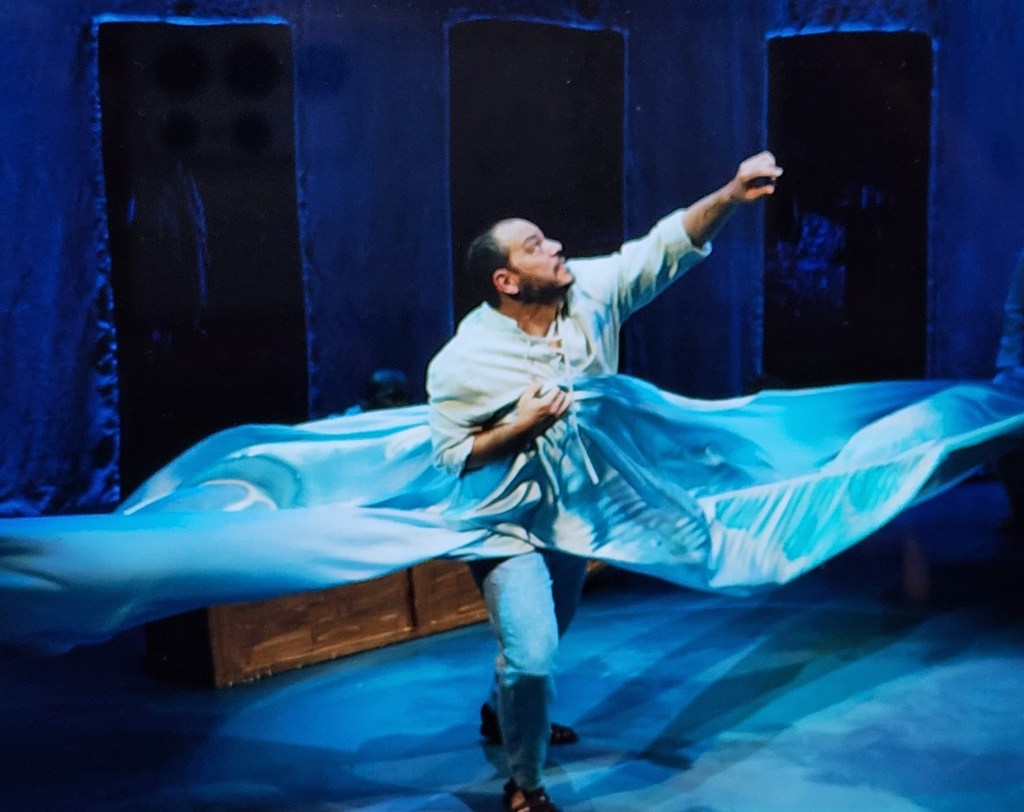
For the moment in his life’s travels Pericles is unaware of the possibility of deceit and betrayal. Called back to his home in Tyre by the administrator he left in charge, Helicanus (Paul L Coffey), Pericles once more bares himself to Neptune’s wrath on the fickle Mediterranean where the god upends and destroys his ship. Fiasco Theater’s inventiveness of Pericles braving the storm’s fury (Mextly Couzin’s lighting design and the Fiasco’s production design), using a bolt of cloth to suggest the tempestuous waves, maintains the stylized, roughly-hewn playfulness of the production. The soft, shimmery cloth symbolizing the waves belies the irony of Pericles’ situation on the roiling sea.
Pericles loses everything but his life and is washed up on the shores of Pentapolis. There, he is at the mercy of the fishermen who find him and change his fortune with happy information. Pentapolis is ruled by the goodly King Simonedes, (the humorous Andy Grotelueschen), a pleasant reversal of the kings who have gone before.
Shakespeare contrasts the kingdoms and their kings: the first is a lecherous murderer, the second variable in deceit and this third king. The fun loving Simonedes is popular even to the lowly fishermen who tell Pericles that the king holds a tournament and feast for his daughter’s birthday. The celebration is so that Thaisa (Jessie Austrian) may find suitors among the knights who joust for her. When Pericles’ armor washes ashore, the fishermen encourage him to compete for the king’s daughter. Shakespeare makes it a key point that though he is a stranger (an migrant) in their midst, he receives their country’s hospitality and mirth.
Pericles wins the jousting matches, performed with the sames staves Fiasco used to suggest the suitors’s hanging in Antioch. It is an example of how the theater company employs the props efficiently and meaningfully to emphasize themes of power, leadership and control. Through their variable exchange we note the contrast between the kingdoms and their rulers’ leadership, either deceitfully tyrannical or happily beneficent.
After the tournament, King Simonedes invites all the knights for a feast. The wooden crates which have been used as a throne, to circumscribe walls, etc., are now used to effect a long feast table. And there, Pericles (Titiana Wechsler portrays Pericles in this segment) gains the king’s favor and the love of Thaisa.

For his pains and pleasure, the Simonedes playfully uses reverse psychology to have the couple declare their love to each other by pretending to forbid their union. Jokingly, he reveals his pleasure at their marriage which produces an heir. In the next scene we see that a pregnant Thaisa, and husband Pericles (Noah Brody in this version) go on an ocean voyage back to Tyre to check on his kingdom.
Again, there is a storm at sea and dire circumstances. Thaisa who dies in childbirth must be thrown overboard to steady the ballast or the ship will sink. Pericles prepares her coffin with spices and jewels with a note to whomever finds the coffin to bury his wife whom he greatly loves. The child who was born as Thaisa died Pericles names Marina. To redeem the time, Pericles leaves Marina with those who revere him in the land of Tarsus. King Cleon and Dionyza promise to care for Marina like she is their own, while he returns to rule Tyre.

The staging of the scene where Marina is given to King Cleon is simultaneously juxtaposed with the fate of Thaisa whose coffin washes ashore at Ephesus. The director makes excellent use of the space at CSC to clarify what happens. As Pericles hands over baby Marina to his friends, a woman with powers of healing (Tatiana Wechsler with hair down in flowing priestly robes) restores Thaisa back to life. So thankful is Thaisa that she becomes a devotee of Diana and officiates at her temple. Meanwhile, Pericles is heartbroken and grieves his dead wife but joys that his child is being raised well. As fate would have it, during the fifteen years Marina has been brought up with the daughter of Dionyza, things grow problematic.
Dionyza envies Marina’s beauty and talents and decides she must be murdered for the sake of her own daughter, so their child will shine if the glory of Marina is removed. Though Cleon opposes Dionyza’s evil act, he is powerless to stop her. But just as Marina is about to be killed, pirates kidnap her and thwart the murder. In the following sequences, Gower shifts the mood once more and the riotous humor of how Marina’s chastity is used to great effect proves comical in a brothel run by Bolt (Andy Grotelueschen) and Bawd (Jessie Austrian). There, Emily Young’s Marina turns away the lusty, hot clients who are horrified that she pushes her virginity onto them and attempts to make them Diana (the feminist of the time) devotees. Of course the irony is that Thasia, her mother, is back in Ephesus praying as a Diana devotee.
In the second act, Fiasco’s farcical skills shine and the atmosphere shifts from Fate’s woes to merriment at those lecherous males who should be ridiculed for their unseemliness. However, when it is least expected, Pericles, who returns to Tarsus to bring his daughter back to Tyre to rule with him, discovers through Cleon that Marina drowned. Indeed, King Cleon and his wife have betrayed Pericles’ goodness and there is no punishment for them as there was for King Antiochus who the gods burned up. It would seem that incest is the worst crime when it begets murder. Dionyza’s intention of murder the wicked pirates interrupted; it is an irony is that the pirates evil act is turned around for goodness. Dionyza’s envy and murderous intention the gods leave to her and Cleon’s consciences to seek redemption.
Inconsolable that she is gone, Pericles (an excellent David E. Haqq in the last, most emotional segment) will not speak and is dead in spirit. How events change magically to effect Pericles’ reunion with his wife and daughter is poignant and heart-rending, if not fanciful in hope. Interestingly, Shakespeare makes abundant use of the Deus ex Machina (the gods interrupt evil fate to save the hero) in Pericles. As Gower and the cast conclude the tale of Pericles, King of Tyre, we are uplifted by the grace of a happy ending, and the redemption offered to Marina, Pericles and Thaisa because of their goodness, devotion to the values of truth, generosity, decency and steadfastness.
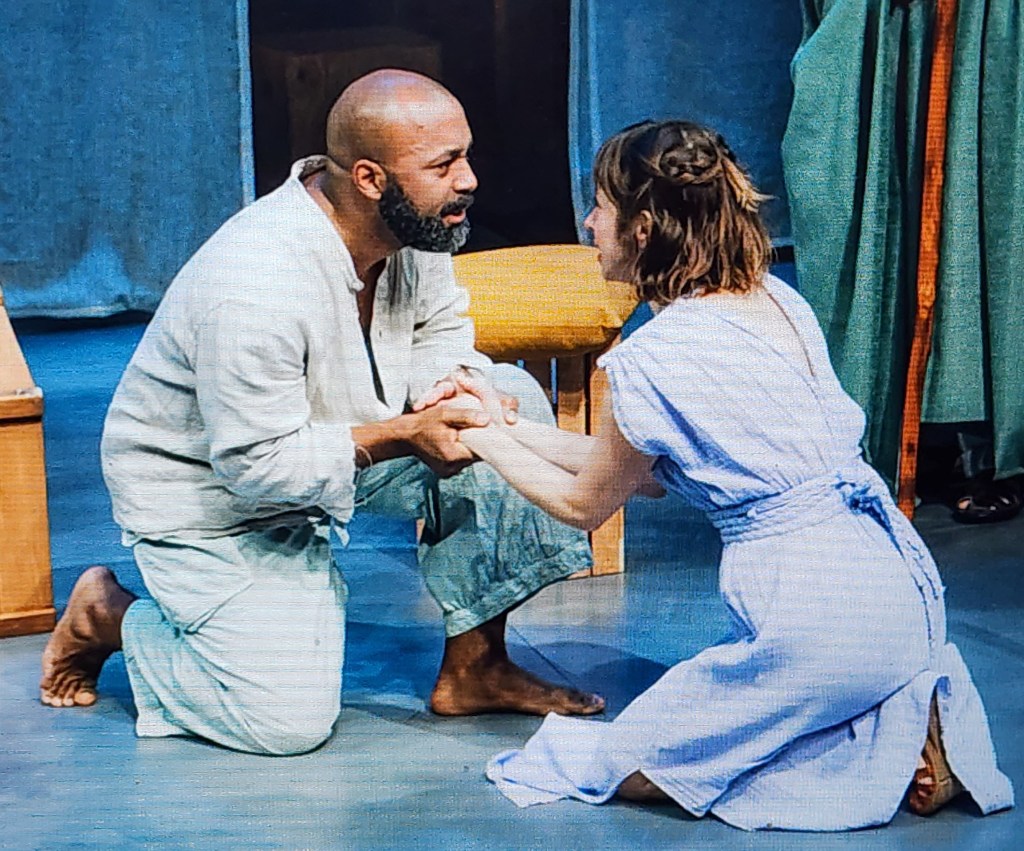
The strengths of this production include the fine ensemble’s seamless acting which provides the coherence throughout, even though the character of Pericles has four actors which was initially confusing. The whimsical and at times farcical, lighthearted approach toward myth-making and storytelling through music, rhyme, dance and song are superbly balanced throughout. The stylization is the correct choice for a play that gyrates throughout voyage, disaster, and roller coaster storms that metaphorically parallel human joys and sorrows.
That the play has been spurned as silly and not worthy of being produced has been a misread of the depth of one of Shakespeare’s most trenchant latter plays. The life theme is an important one. For those who patiently endure, they gain wisdom in temperance and the power to face and overcome trials of their faith. The obstacles help one all the more appreciate and be grateful for a life that acknowledges human beings live on the brink of peril every moment of their lives. To be numb to that knowledge is to live a zombie death in life.
This is a must-see, for the music, songs, fantasy, laughter and fanciful, profound truth-telling.
Pericles. CSC, 136 E 13th St between Third and Fourth Avenues. Closes March 24th. https://www.classicstage.org/pericles/
‘Corruption,’an Important Play at Lincoln Center Theater, Mitzi E. Newhouse

Corruption‘s well paced reimagining of the UK phone hacking scandal involving Rupert Murdock’s News Corp. empire is written by JT Rogers (Oslo) and directed by Bartlett Sher (Oslo). The hybrid drama/comedy is enjoying its premiere off Broadway, Lincoln Center Theater at the Mitzi E. Newhouse. Rogers’ epic chronicle exposes key individuals employed by News Corp who follow a dangerous ethic: the ends justify the means. These media players believe that corporate profits legitimize any deleterious impact the media may have on the victims they exploit.
In the era of US fake conservative news, Roger’s two act play trenchantly reminds media consumers that malignant CEOs of companies monopolize and weaponize power and influence to oppress human rights. Ultimately, they direct global political affairs to their profitable advantage. Even if the companies harm the populace, and there are lawsuits, in the corporations’ ethos, it’s OK as long as the bottom line is not irreparably damaged. Corruption reveals that there are always ambitious and warped lackeys at the ready, like Rebekah Brooks (the excellent Saffron Burrows), who may engineer or accept malign acts for the company’s betterment.
Based on Tom Watson and Martin Hickman’s book Dial M for Murdock: News Corporation and the Corruption of Britain, Rogers’ play is an exhaustive and detailed examination of the players and insider events which reveal the cover up of News Corp’s employees illegally trashing the privacy of 11,000 citizens. These not only included celebrities. Reporters used “information” illegally sourced from politicians and ordinary people alike. With this material reporters sensationalized stories for maximum shock value. When they couldn’t get enough truth or facts to fill a teaspoon, they made up lies out of whole cloth.

During the unspooling of the play’s events, we learn that no one was considered too great or too small to smear and damage, as long as the effect produced was eyeballs glued to the tabloids, specifically “The News of the World” headed up by Rebekah Brooks CEO of News International.
The play is at its edgy, sharp best when Rogers dramatizes the conflict between key adversaries Rebekah Brooks (Saffron Burrows), and Tom Watson (Toby Stephens), as well as their allies and foes. For Brooks, problematic allies she manipulates are legal counsel Tom Crone (Dylan Baker), and Rupert’s son, James Murdoch, (Seth Numrich) in addition to Prime Minister Gordon Brown (Anthony Cochrane). For Watson, major allies include Martin Hickman, friend and reporter for the Independent (Sanjit De Silva), the lawyer representing hacking victims, Charlotte Harris (Sepideh Moafi), and Siobhan, Watson’s wife (Robyn Kerr).
There are forty-six characters portrayed ably by thirteen actors. Rogers sacrifices in-depth characterization, in part, to relay the sweeping phone hacking story that energizes his themes. In the forefront is the imperative that a free, vital press, unhampered by a company’s profit motive, is essential to produce the facts and information which enable a democracy to function. That way citizens can make informed decisions to improve the social good and hold bad actors to account. However, to receive such news and information, the populace must be educated and knowledgeable. It is up to them to reject a diet of calumny, lies, and sensationalistic fabrications that support anti-science “the earth is flat” stupidities, and “in your face” political propaganda and nihilism.

Escapist tabloid journalism which exploits the “sickness” of others in a voyeuristic display to make the reader feel better with their lot, capitalizes on the lowest bar in human nature. Rupert Murdoch’s News Corp revels in feeding the populace trash for high profits, then projects that citizens are to blame for demanding such fare. This is an affirmation that the character Rebekah Brooks suggests at the play’s conclusion. In her final commentary, she justifies the necessity of The News of the World with a presumption that without the tabloids’ profitable journalism, there would be no other journalism. “The
profits from my papers allow the papers you read to exist. There is no journalism without my journalism.”
However after careful consideration Rogers’ Corruption shows that Brooks and Murdoch’s tabloids and his faux “news” empire normalized indecency, negative propaganda and lies in order to control and gain power. The playwright’s overriding question is whether Murdoch and Brooks truly provided a necessary service or negatively frayed the social fabric of goodness because of their own greed and rapacity.
The play opens at Rebekah Brooks’ wedding reception, where Rogers introduces the ambitious woman that Rupert Murdoch trusted to make him money. In a private room, newly appointed head of News Corp UK, James Murdoch, and Brooks go head to head. They argue about the direction of News Corp’s future. James Murdoch asserts that the print division barely makes money. From James, we learn that Brooks has clawed her way through the ranks to be editor of The Sun, a powerful position which gives her equal footing to counter his arguments.
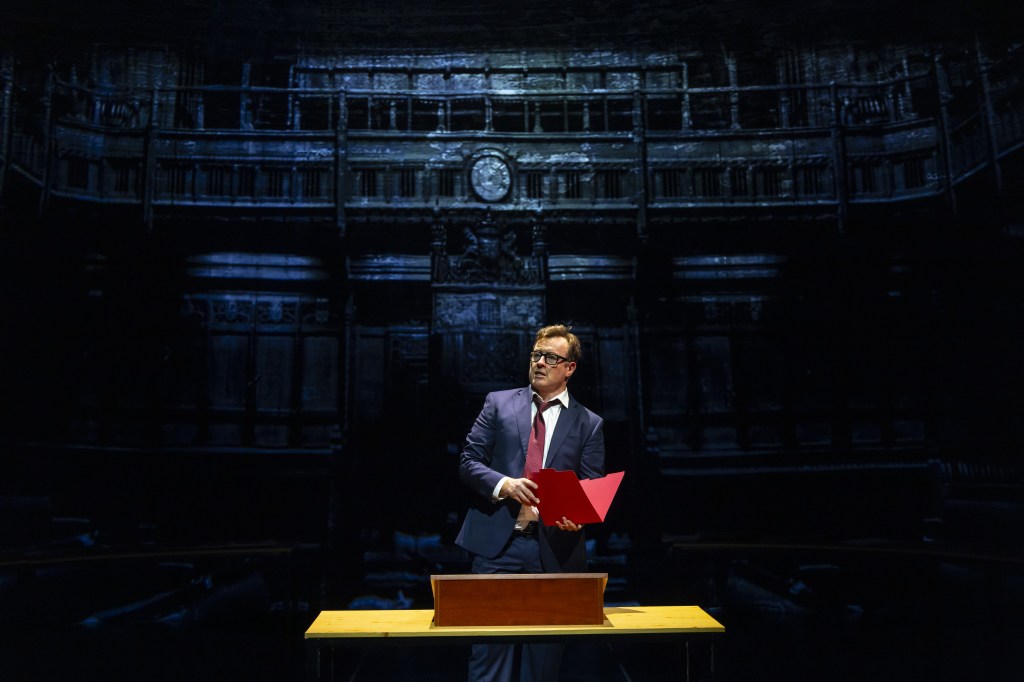
Numrich’s Murdoch states that technology, digital media, and TV are where News Corp will be in the future because print journalism is a relic of the past. Brooks argues that her print division fuels all other journalism. At the end of the scene James Murdoch congratulates her on her new appointment as CEO of News International. Father Rupert Murdoch trusts her with the responsibility of continuing the profitability of all the Murdock tabloids. She will not let papa down.
Throughout the play, Rogers highlights the nefarious brilliance of Brooks who maintains the efficacy of the scurrilous tabloids and stops at nothing to ensure they add to the soaring profits of News Corp. No wonder why old school Rupert Murdoch loves her more than his son, and does everything to keep her near, even after the scandal blows up in their faces.
In attempting to cram in salient details, Rogers keeps scenes short. Sher directs the action at a seamless, brisk pace with minimal set design by Michael Yeargan. The tech crew interchanges and rearranges tables between scenes to provide the change of setting and atmosphere of alacrity. The staging reflects the rapid and shifting state of the “news” media, hyped up on digital steroids. It predominately features multiple TV screens onstage and at the top of the proscenium. The screens show various news clips and shows during that time. The blinking screens are purposefully a distraction from the dialogue. When text messages are posted, we see the quotes projected on the back wall via 59 Productions projection design.

Ironically, with the media constantly flickering at us, the audience becomes numbed to the visuals and eventually ignores them. One of the takeaways of Sher’s staging is that the media overload we are expected to negotiate and be aware of on our phone screens numbs us and in fact dulls our awareness. It becomes harder to keep up or understand the complexity of events that are reduced to a few words of soundbites and quickly edited visuals. Without that complexity of understanding, facile, wrong opinions are formed and judgment is skewed toward the superficial assumption and wrong conclusion.
Companies like News Corp rely on tabloids to offer a contrast to the in-your-face screens which mesmerize and numb. The tabloids give the reader the semblance of “controlling” the information that they have bought in print. However, the opposite is true and, as Rogers’ drama proves, the tabloids are filled with mostly exploitation pieces that masquerade as factual and realistic. Understanding and depth are sacrificed for the superficial and shocking.
During the the first act, we note Brooks and News Corp’s power. Brooks gently threatens Prime Minister Gordon Brown to fire Tom Watson (his labor MP who has been his hatchet man). She warns Brown that the story she is releasing about Watson will create havoc and implies if Brown doesn’t get rid of him, it may take down the Labor Party and Brown with it by association. Brooks jokes that Brown is “running the country, isn’t he?” Indeed, maybe he isn’t, if Brooks is leveraging lies to force Brown to fire Watson.

Brooks wields tremendous power as a kingmaker and king breaker. She operates with impunity, because no one has the courage to investigate or litigate against “The News of the World’s” defamation, lies, calumny and payoffs. We learn the tabloids’ shock and scandal value are critical to blackmail. Brooks and the tabloid intimidate almost everyone who is anyone in the culture and society of the UK.
Watson confronts Brown about Brooks’ political hit job. Sher has the actual headlines projected on the backstage screen, “Treacherous Tom Watson,” “Mad Dog Trained to Maul,”etc. Brown soft pedals Watson by saying no one believes the lies that Watson “registered pornographic websites under other politicians’ names.” However, Brooks doesn’t retract the lies as other UK papers do. Siobhan, Tom’s wife, insists that Tom lay low in parliament and say nothing because she is tired of the negative PR and the outrage and stalking that has hounded them and terrified their son. Watson quiets down in parliament in the next scene and we see how Brooks gets her way now and in the future when News Corp backs the Tory Party candidate James Cameron to win.
Though Brooks has sucked the life and power out of Watson, he sues and his fury converts to action as he teams up with his friend Martin Hickman from the Independent and other allies after learning the police quashed an investigation into phone hacking. Brooks and Andy Coulson, the heads of News International disavow any knowledge of the hacking, despite documents that link hired investigator Glen Mulcaire’s (Dylan Baker), illegal acts to News International reporters.

The fact that only Mulcaire goes to jail while Andy Coulson is promoted to director of communications for David Cameron and the Torys spurs Watson and his team to apply pressure via Twitter, blog posts and other social media questioning why the police backed off the investigation. Not only do they elicit the help of a wealthy individual who had been hacked and slimed, eventually, they pull in the New York Times to cover their story. Watson’s team brings into view how Brooks and her cohorts have destroyed the lives of ordinary citizens and caused destruction and misery for profit.
In the very long first act which is expositional, perhaps some of the details and/or scenes may have been edited and reworked. The second act moves quickly to a satisfying resolution as The News of the World, Coulson and Brooks are held accountable. However, the punishment is a mere slap on the wrist for Coulson-four months in prison. Brooks is found innocent of all charges. Though Murdock closes down Brooks’ tabloid, after a time, she is keeping things humming elsewhere.
When the question arises, what did they all go through hell for, it is Watson’s wife Siobhan who encourages Tom to continue to stand up for the truth. Only with persistent fighting against the maelstrom of lies will the truth ever be seen. One can only hope.
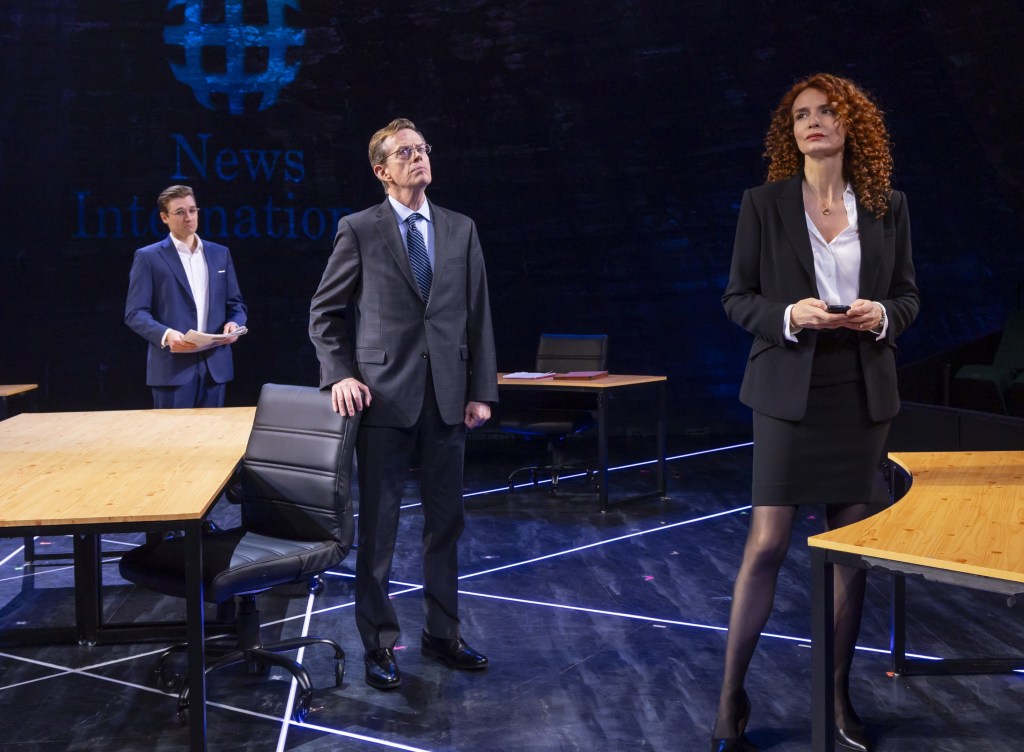
Corruption is an important play about the Murdoch empire that reveals how News Corp steamrolled through the UK first to gain extraordinary power which then was used to blossom evilly in the US. Leaping across the pond News Corp’s malignant MO impacted the 2016 US presidential election by helping to install the incompetent, unqualified, Donald Trump as president. His negligent, derelict actions during the COVID-19 pandemic had serious global economic impact and social repercussions that many countries are still reeling from today.
Fox News in the US perpetuated Donald Trump’s making COVID-19 a political crises. Tragically, this political emphasis actually spread the contagion and made it difficult to ameliorate, especially in the southern United States. If the UK had acted to contain News Corp and hold it accountable with massive financial fines and more severe punishments, it may have paused News Corp’s Brooks, Coulson and others and curtailed its power and influence in the US
Rogers raises important questions in Corruption. What price do we pay for the decency and dignity of privacy? For those who violate our right to privacy, shouldn’t the punishment be severe because it is a crime of violence on our persons, a metaphoric rape and humiliation, especially if the citizens are not celebrities getting paid for their fame?
Though the play has infelicities, the acting, direction and pacing allow the themes to shine. It is these in our time that resonate most fiercely, especially as we face the AI fabrication of photographs, voices and more.
Corruption. Lincoln Center Theater at the Mitzi E. Newhouse. The play is two hours forty minutes with one intermission. https://www.lct.org/shows/corruption/schedule/
‘The Ally,’ Terrific Performances of a Trenchant Play at the Public
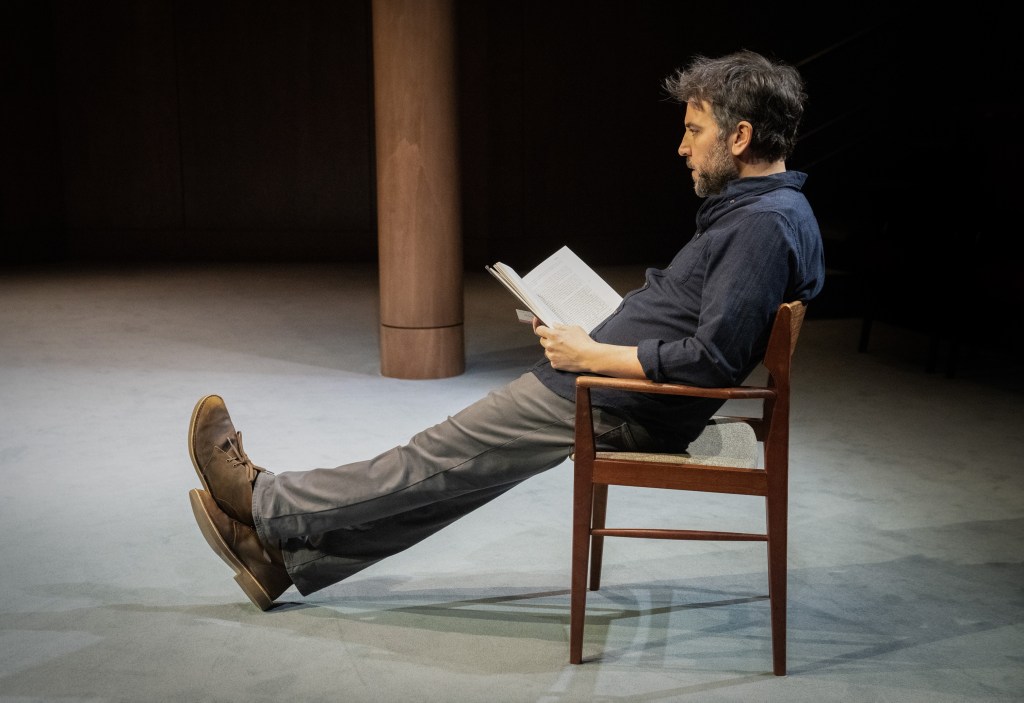
The Ally, written by Itamar Moses (The Band’s Visit), and directed by Lila Neugebauer (The Waverly Gallery), currently runs in a World Premiere at the Public Theater until March 24th. Moses’ two act play that is largely polemical raises important and controversial questions in its two hours and thirty-five minutes. It is thought-provoking, historically informative and profound, and has great currency in light of the Netanyahu government’s war against Hamas. Though the play was written before the October 7th attack, the issues couldn’t be more on-point.
The Ally is short on dramatic tension, and long on terrific performances. The exceptional actors passionately argue about Black and Brown people struggling to achieve human rights in countries (Israel, the United States, etc.), which have their foundations in oppressive, white, patriarchal colonialism. Though the prejudices and discrimination have been called out and strides have been made, often the countries obfuscate justice, and in defensive mode, redirect their institutions, practices and social constructs away from equanimity, foregoing humanity, compassion and empathy to abuse those they subjugate.
To present the arguments and make a case with little resolution, Neugebauer’s vision offers a spare stage and few props to evoke the setting in a professor’s home and office on a University campus which represents a bastion of learning, where allegedly every viewpoint may be expressed without censure, to promote enlightened civil discourse and benefit the social good of the community. Moses’ protagonist on the field of intellectual battle is liberal Jewish professor Asaf (the excellent Josh Radnor).
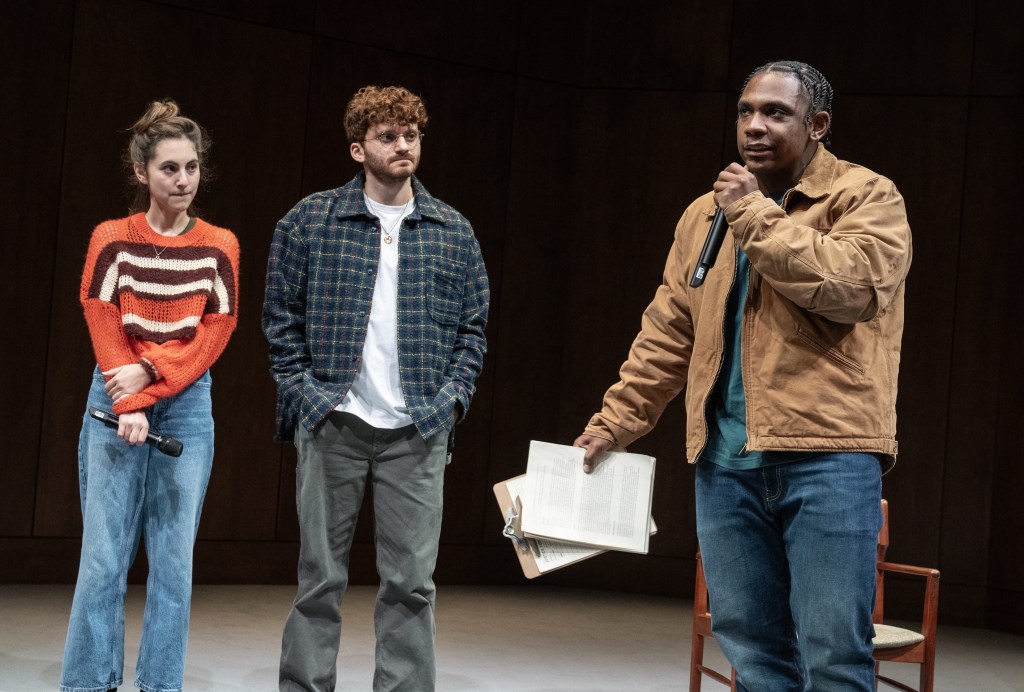
Asaf’s Korean-American wife Gwen (Joy Osmanski), has been hired to give a positive spin on land the University is developing that was formerly used for housing in a lower middle class, Black area. The land has been appropriated, though the University has assured that it will provide housing units to compensate for the dwellings that have been demolished. How the situation evolved, we discover later, is fraught with rumors about underhanded tactics the University used to create circumstances beneficial to University expansion, while dismissing the interests of the Black community.

The main conflict begins when Asaf’s former student Baron (Elijah Jones), who is Black, feels encouraged asking Asaf to sign a social justice manifesto that involves his cousin Deronte, who was killed by police unjustly for a theft Deronte didn’t commit. After agreeing to sign once he looks over the twenty-page manifesto, Asaf realizes that the documented is personally sensitive to him in what it demands.
First, it aligns the history of violence against Black Americans to the violence against oppressed Black and Brown people who have been colonized globally and suffer under inhuman conditions. Additionally, the manifesto targets a controversial subject for Asaf, an American, who doesn’t identify culturally with Israel, though he was born there. The manifesto demands that sanctions be placed on Israel for its nihilistic treatment of Palestinians, resulting in an apartheid state. In clear terms it pronounces that a “failure to do so will leave the United States complicit in the ongoing genocide of the Palestinian people.”
Though he is Jewish, essentially, Asaf is an atheist. But he thoughtfully considers what he is signing, and questions the words “apartheid” and “genocide” as extreme, unrelated positions, though he feels that Baron’s cause is just. Helping support Baron holds no contentions for him, initially. The apparent police brutality in killing Deronte is one more example of murderous racism and the blue wall of silence that fronts against such horrific injustice in a country with a long history of slavery and oppression of Black and Brown peoples.

Gwen tells Asaf’ that his signing the manifesto will undergird her position as a university administrator pushing for expansive development of university housing into the Black community. If he refuses to support Baron it will appear that he cannot align with fighting injustice and it most probably will add to the negative spin already brewing about the expansion project which the Black community is resisting.
It is after Asaf signs the manifesto that problems arise which disastrously make him the “man in the middle” among activist organizations with conflicting agendas which demand that he support and be an “ally” with their specific causes and positions. The situation embroils him deeper in conflict with his conscience and beliefs and forces him to deeply question allegiances he would forge with others on campus, impacting his reputation.
Two organizations confront him after he signs Baron’s manifesto. Jewish representative (Madeline Weinstein), and Palestinian representative (Michael Khalid Karadsheh), ask Asaf to support their bringing a controversial speaker to campus. They tell him that the speaker argues for a revisionist history of Israel’s foundational and follow-up wars. Contrary to the standard view that Israel was defending itself, the speaker posits that the wars were fought ferociously for one reason: “the likely outcome was more territory.”
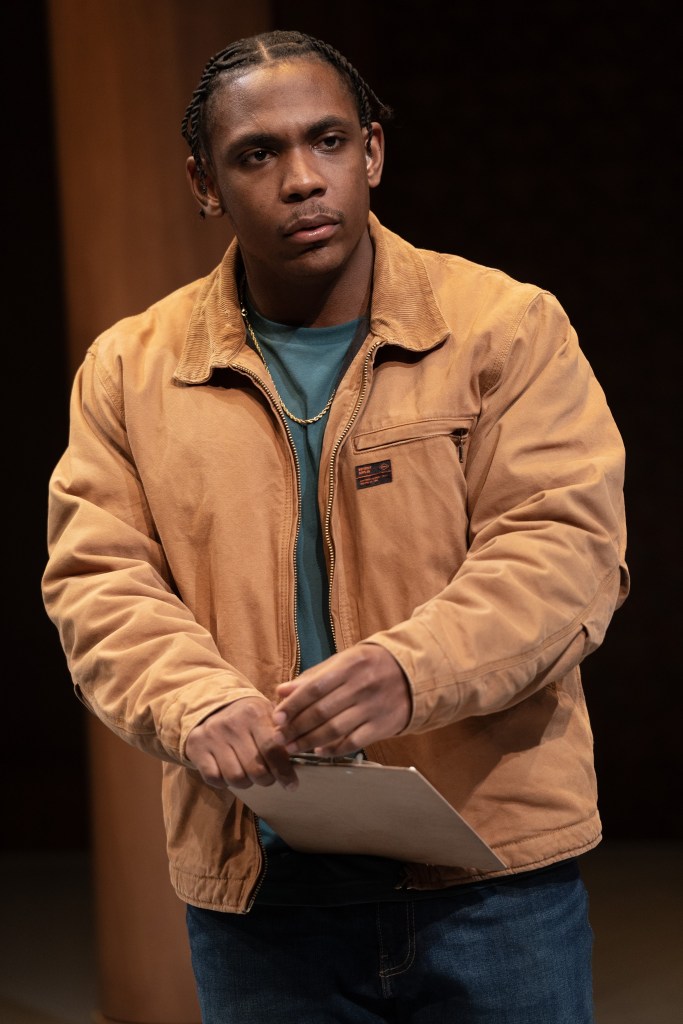
To his credit to give all opinions a place in civil discourse, Asaf discusses the nature of the support they want, but questions why they want this particular speaker. Additionally, with a follow-up which indicates that activist organizations are noting who is importuning Asaf, another oppositional individual shows up to challenge Asaf. Reuven Fisher (Ben Rosenfield), a religious Jewish graduate student attacks Asaf’s arguments and the others that we’ve previously heard. Fisher defends Israel ‘s position with the Palestinians.
Interspersed among those who have backed Asaf into a corner, Nakia Clark (Cherise Boothe), confronts him about his questioning the fact that Israel is the one expected to ameliorate its position and is always used as a “whipping boy,” when it is the only place historically where Jews can find safe on their home turf.
As we listen to their wrangling, we take into account that Nakia and Asaf have history together. Once a couple who dated, Nakia shepherded Asaf in community social justice, inspiring him to go with her on marches, and schooling him in protest as she strengthened her role as a Black community organizer. Now, years later, she challenges him once more to step up and not renege on his support of the manifesto which Nakia, herself, wrote.

Where is Asaf’s place in these arguments when the university community knows the stand he wished to take that he now equivocates about taking? Moses uses the character of Asaf as a canvas upon which to project all the viewpoints in the arguments about Israel, Palestine, Black discrimination and colonial oppression. The playwright proves knowledgeable and informative, especially in recounting the conflicts in the history of Israel starting from its inception in 1948 and its wars against the PLO and the complicated rise of Hamas which didn’t happen in a vacuum but was allowed by an extremist government to its own benefit, not necessarily to create equity and harmony with the Christians, Jews and Muslims who make Israel their home.
However, as has occurred since divisions created an untenable situation between Zionists, Palestinians, Muslims, Christians and Jews when Israel was formed in 1948 and worsened up to the present war in Gaza, there is only the horrific struggle. Moses indicates the lessons in why with his exploration of the reasons in The Ally. Thus, how can there be a positive resolution in this work? All is uncertain, with even more passionate feelings on all sides we’ve heard presented.
And of course, Asaf now has issues with each of the groups because of his lack of certainty; thus, his reputation has received a hit. Even Gwen is annoyed that his equivocation has bounced back to impact her project. Only more questions remain.

However, Moses and Neugebauer have pulled a rabbit out of a hat with this production which focuses the audience on the arguments which make them understandable and relatable, especially because the ensemble is just brilliant. Importantly, we have been shown the intricacies of intense debate which, if continued will eventually lead to the possibility of a positive resolution. Thus, we are left with the feeling that there must be an open dialogue during which responsible individuals listen to each other and again and again hash out some consensus, as impossible as that seems..
This is one to see because of its overall coherence, incredible performances and fine direction. Neugebauer stages the debate amongst the stakeholders, so we thrillingly follow every word. Could there have been edits? Perhaps. However, Moses has built solidly and any removal of the bricks in his structure will lessen the impact overall.
Kudos to the creative team who effect the director and playwright’s vision. These include Lael Jellinek (scenic design), Sarita Fellows (costume design) Reza Behjat (lighting design) Bray Poor (sound design).
The Ally runs 2 hours 35 minutes at the Public until March 24th. https://publictheater.org/productions/season/2324/the-ally/
‘Brooklyn Laundry’ a Soap-diluted Rom-com That Avoids the Soul-dirt
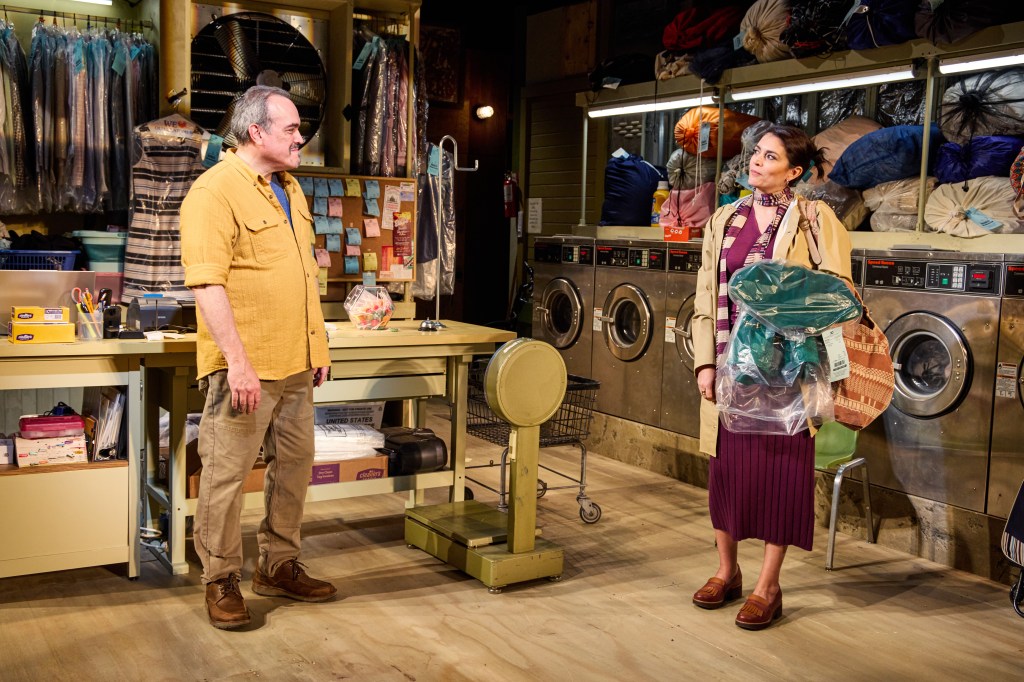
John Patrick Shanley’s Brooklyn Laundry, currently at MTC Stage 1 never quite elucidates trenchant themes though it might have with further character development. The 80 minute play, also directed by Shanley, currently runs at New York City Center Stage 1 until April 14th.
Starring Cecily Strong (“Saturday Night Live”), and David Zayas (“Dexter’), as the principal couple who meet in a drop-off laundry in Bushwick, Brooklyn, in Brooklyn Laundry Shanley presents two individuals who become involved with each other as a result of desperation, depression and loneliness. Also, they are between partners and have not been involved in a successful relationship ever.
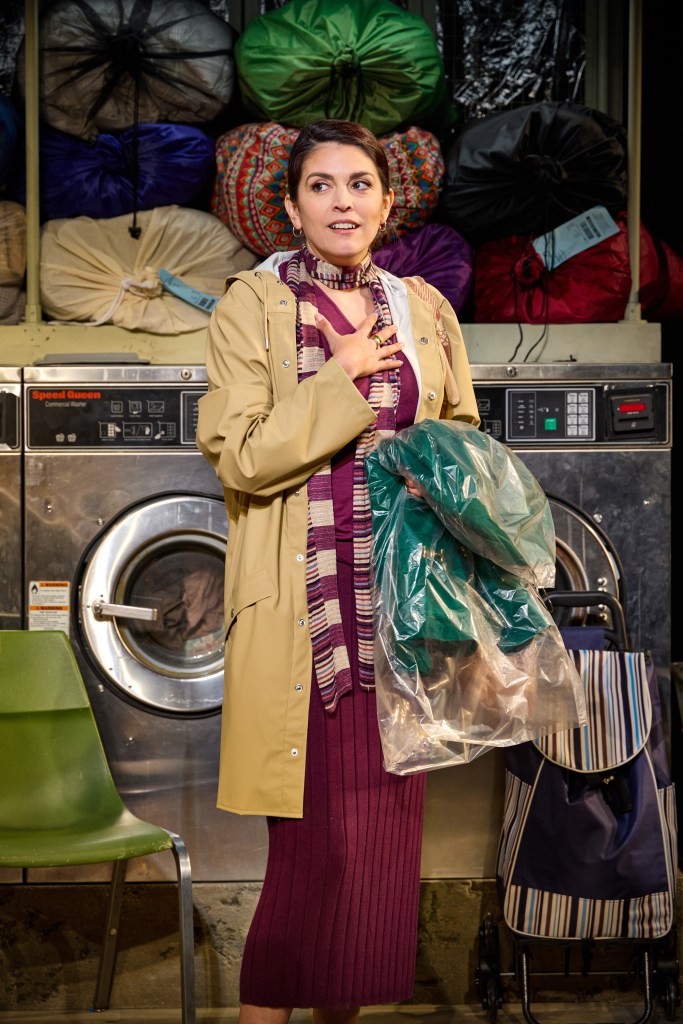
The Meet-Up
Laundry owner Owen (the lively Zayas), engages in light conversation with Strong’s Fran as the play opens. She is an on again off again customer, whose boyfriend left. Fran admits later in the scene that she is self-conscious about the fact that she can barely scrounge enough laundry to drop off for one load. When she was with her boyfriend, the bag weighed thirty-eight pounds; they did their laundry together. Owen, who Fran reminds that he owes her credit for losing a bag of her laundry 6 months prior, acknowledges that her lost laundry is a mystery. He has been giving her credit, though she complains that it doesn’t cover the price of replacing the missing items.
As they chit chat, Owen notes her “gloomy” nature to jostle her out of it. He tells her she reminds him of his fiance, who was “smart, one inch from terrific, but gloomy.” Fran disputes his label about her and suggests reality has brought issues into her life, and it isn’t without reason that her situation doesn’t make her the sunshine kid.

Owen discusses the necessity for positivity and an uplifted attitude, sharing his recent life story. He became the owner of three laundries, after a car accident settlement and lawsuit against his 9 to 5 boss who unfairly fired him. Assured that he has answers for her life in the face of her wishing she could have a car accident and be so lucky for monetary settlements, he takes a leap of faith. With apparent confidence he asks her to dinner. Fran suggests she will after she returns from a family visit in Pennsylvania.
Shanley has established the ground rules for these two individuals from different backgrounds with little in common, who make a connection simply by being present together and willing it. From this initial spark, Shanley takes us on a journey of how unlikely singles Fran and Owen fall in love because of need.
Reality’s Gloom and Fran’s Escape
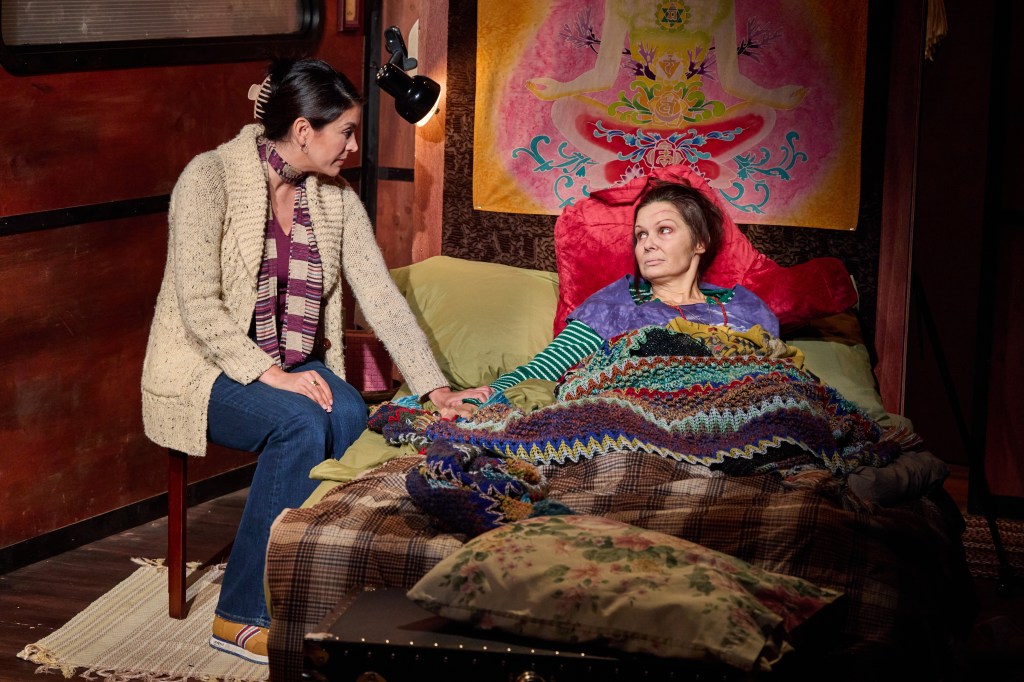
In the next segment, we understand why Fran is depressed when she visits her sister Trish (Florencia Lozano), who is ill with cancer, loopy on meds and lying in bed mostly unconscious. After her visit with Trish, Fran goes on her date with Owen high on magic mushrooms. She offers some to Owen and after a while he catches up to her. Together they experience the beauty of the lights and atmosphere of romanticism and their conversation intensifies.
On a sub rosa level, Fran introduces the mushrooms into the situation because she wants to escape thoughts about her dying sister. She chooses to live in a lovely, seductive place with Owen. She doesn’t share her Trish reality with him for fear it will drive him away. So she suppresses her emotions to suit his needs to be positive and upbeat. She puts aside her gloominess, despite the fact that complications with Trish abound and she has less than a month to live.
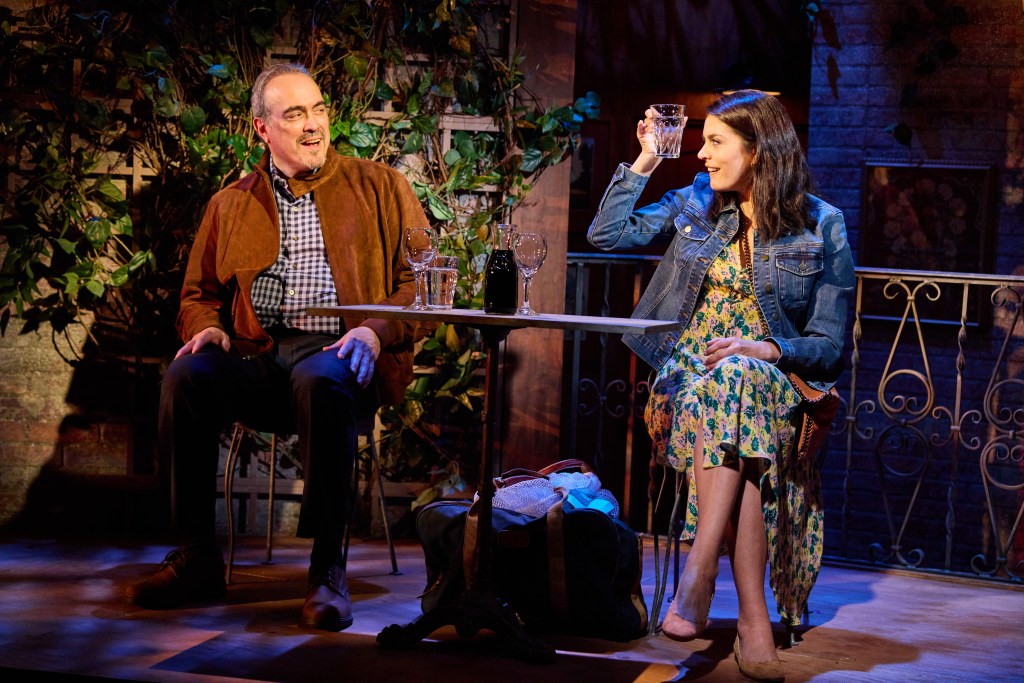
The mushrooms encourage their intimacy and Fran helps Owen conquer his sexual problems that happened as a result of his car accident, problems which turned off his former girlfriend who dumped him as a result of his poor performance. Interestingly, Owen is honest about a very sensitive subject with Fran and of course she helps him. On the other hand, Fran is dishonest with Owen because he set the parameters that she feels she must adhere to to be with him: no gloom. Thus, Fran and Owen become closer after their first date of intimacy, and after three weeks, theirs is a budding love.
However, another jolt of reality intrudes and slams Fran in her “honesty” with Owen. Fran’s other sister Susie (Andrea Syglowski is always spot-on), stops by to collect Fran so together they will make arrangements for Trish’s imminent death. Fran refuses to go with Susie initially. She fears if she leaves Owen to spend time with family, she will lose the momentum of their relationship and he will dump her for someone else. With lies of omission, she lives in her own dream that she can spin along her affair with Owen without introducing the ugly realities about Trish dying.
The argument that ensues between Strong’s Fran and Sydlowski’s Susie about whether to visit Trish before she dies is beautifully paced and authentically threaded by both actors. During their accusations against each other, we learn how high the stakes are for Fran, who has never been married and has been the hand maiden to her two divorced sisters and their relationships with their loser husbands. We realize why she elected to escape to a love relationship with someone off beat which she clings to so she doesn’t have to face the doom and sadness of her life. Because Owen doesn’t appreciate negativity, his wants prevent her from spilling her emotions to him. Ironically, she is cutting off a valuable part of herself because she fears he only wants “happy, happy.”
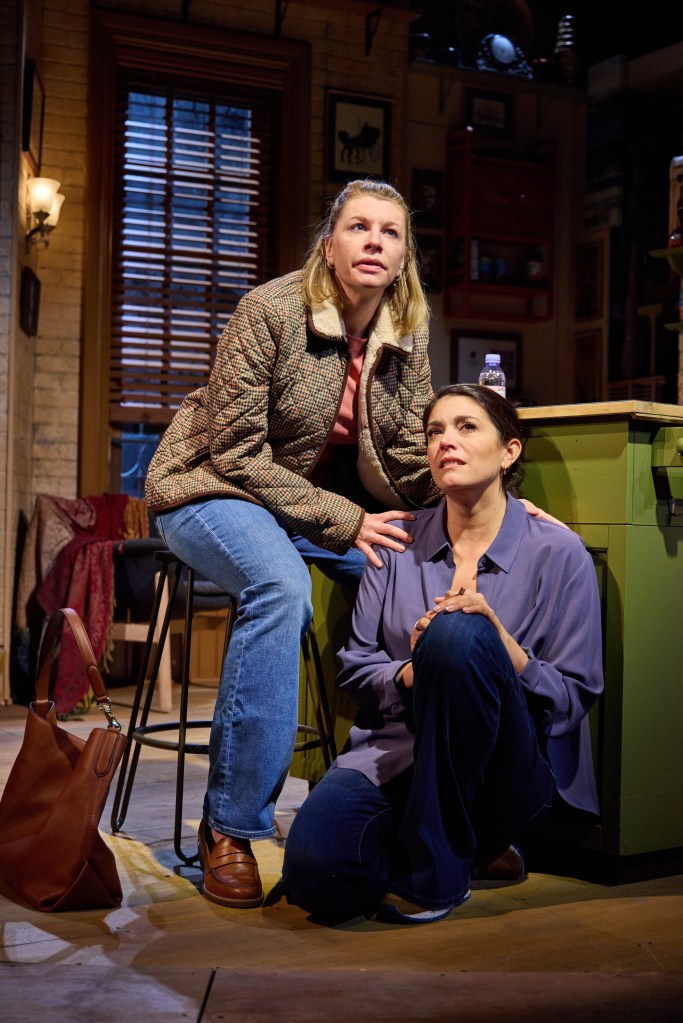
Spoiler Alert
Then Susie levels with Fran about why she didn’t accompany her to see Trish the last visit. Susie is dying of pancreatic cancer.
With charming facility Owen cleaned off the “gloomies” from Fran’s plate to no avail. Susie’s horrible news slams Fran with a triple portion of gloom. Not only must she confront Trish’s impending death and the consequences of its impact on Trish’s young child, Taylor, she must confront the consequences of Susie’s dire prognosis. Fran’s doom and gloom lifted for three weeks by Owen will be a permanent fixture in her life. Additionally, guardianship of her sisters’ three children and their financial custodianship falls to her as their closest living relative. Will Owen want to take on a woman with three kids especially since he confessed he only wants his own child and isn’t looking for huge bills to pay for the upkeep of children who aren’t his?
The strength of Brooklyn Laundry is in how Shanley weaves the events, to back Fran into a corner delivering reality’s blows to her life, while showing her desperation to escape her circumstances by not sharing the truth with Owen. Eventually, her own obfuscations come back to haunt her. When Susie tells her about her cancer, Fran wakes up and stops moving in her imagined dream. She assures Susie she will act responsibly. Shanley’s characterization of Fran reveals her nobility, self-sacrifice and integrity in honoring her sisters by raising their children. She has made up her mind and whatever Owen does is up to him, take it or leave it. Fran puts family first.
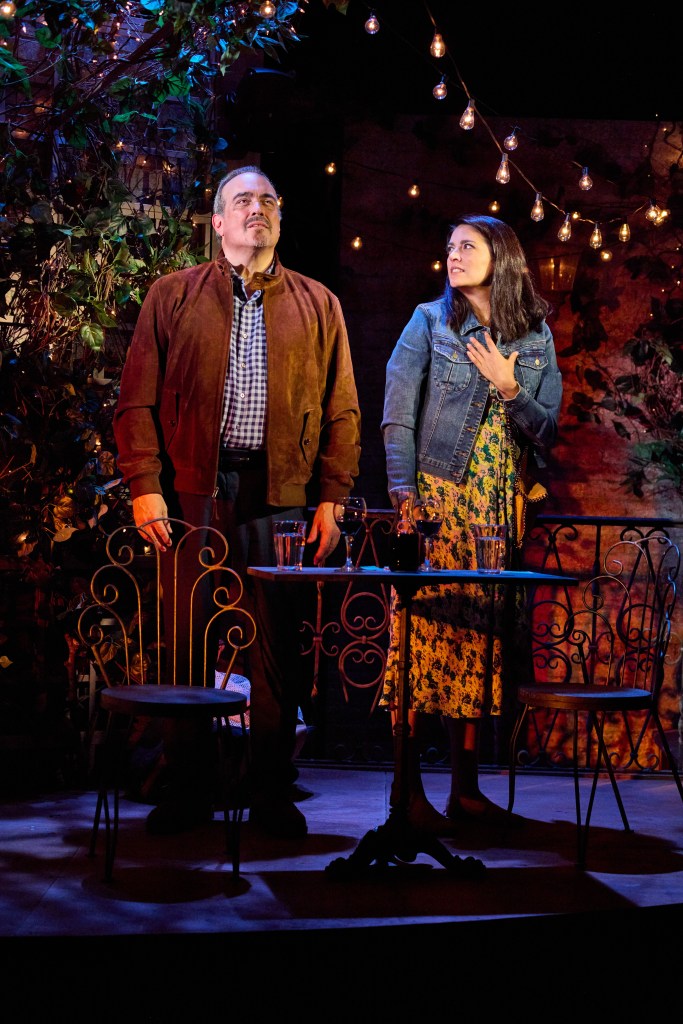
The Last 10 Minutes
The last ten minutes of Brooklyn Laundry are the most dynamic because we note the inner struggles of the characters as they deal with hidden truths. Fran confronts Owen who stopped answering her calls. Though he portrays himself as the victim and ignores her comments that he ghosted her, something he promised he would never do, eventually, he is forced to put his pride aside. They both realize what they will lose without each other, and they are able to accept with humility that they care.
Shanley perhaps misses important dramatic moments by having the characters report their reactions after the fact to each other, instead of establishing a few scenes that are immediate, confrontational and a dynamic build up with irony. Instead, he writes one scene of alive confrontation and saves it for the very end. It is then that Fran’s serenity with reality shines and Owen reveals himself to be a typical male, more full of himself than he needs to be. However, after Fran walks out of his life to live in Pennsylvania, he realizes his mistake. The play’s conclusion falls into place with a few humorous surprises to satisfy audiences.
Kudos to the involved three-set scenic design of Santo Loquasto, Suzy Benzinger’s costume design, Brian MacDevitt’s lighting design. MacDevitt presents the magical fairy land lighting of the restaurant scene perfectly. Additional kudos goes to original music and sound design by John Gromada.
Brooklyn Laundry is facile and enjoyable thanks to the excellent acting ensemble. Shanley’s rhythms about loss, need and taking risks without ego are imminently human and recognizable.
Brooklyn Laundry with no intermission is in a limited engagement until April 14th. New York City Center MTC Stage 1, 131 West 55th St between 6th and 7th. manhattantheatreclub.com.
‘The Seven Year Disappear,’ Mother-Son Relationship Chaos as Performance Art
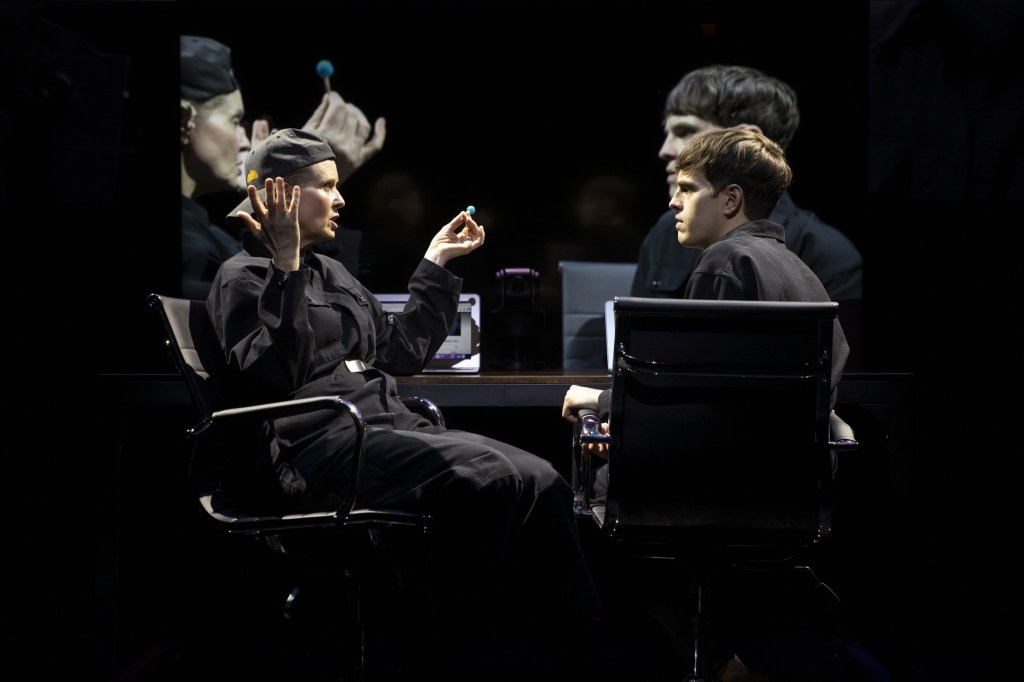
In The Seven Year Disappear, Jordan Seavey (Homos, or Everyone in America), creates celebrated, bi-polar, performance artist Miriam (Cynthia Nixon), and her gay son Naphtali (Hebrew for “my struggle, my strife”), played by Taylor Trensch, to elucidate the darkness in a mother-son relationship when the personalities are hyper creative and high strung. Issues especially evolve when the artists, like Miriam, are complex, self-centered, demanding, assertive and exceedingly ambitious. Indeed, Miriam’s perspective and being blur the boundaries of normalcy and reality and engulf everything and everyone close to her, mostly her son.
Currently running as a World Premiere at the Signature Center, The Seven Year Disappear with no intermission concludes its limited run on 31st of March.
Directed by Scott Elliott with assists by Derek McLane’s scenic design, Rob Milburn & Michael Bodeen’s excellent sound design, Qween Jean’s costume design (workman’s black coveralls and boots), and John Narun’s projection design, which together, keep the audience stirred and engaged, The New Group’s presentation of Seavey’s comedic drama intrigues. There are no easy answers. Complication rules the day, and the overall structure of systematic flashbacks of titled events in three movements, slips backward in time, with four brief returns to the present year, 2016, then back again, to unspool the ominous artistic relationship between Miriam and Naphtali over a twenty-six year period.

The two-hander relies on the dynamic performances of Nixon and Trensch. The wrangling mother and son strike high points of Naphtali’s life, during the time when Miriam disappears for seven years (2009-2016). Her premeditated disappearance, a publicity stunt, happens right after funds have been raised for the first half of her commission as a performance artist in a project to be presented at MOMA. When Miriam goes missing, Naphtali contacts the NYPD and does all he can to relocate her, to no avail. She doesn’t want to be found and perhaps has elicited the help of MOMA to increase the suspense and excitement of her invisibility as performance art, that is a hardship especially to Naphtali. For her, it is a triumph. She will emerge to acclaim when she is ready, and then, present the key moments of her invisibility.
Leaving Naphtali to fend for himself with little money from 2009 through 2016 when she “returns,” he is forced to get a job and apartment and struggle on his own after being dependent on her. For emotional sustenance to fill in the void his mother’s absence has left, he engages with numerous unusual people, all of them portrayed by Cynthia Nixon, using various physical and vocal changes, as he searches for Miriam and irons out his own life. Naphtali is full of questions and feelings of victimization where he sometimes helps himself to drugs and alcohol and attempts to confront her abandonment, which has always been a fact of his life.
MIriam’s durational disappearance is another demonstration of her dislocation from motherhood which initiates when she left four-year-old Naphtali alone at the zoo watching penguins. She leaves him to pursue a drink with Wolfgang, who becomes her intimate partner for a time, then years later becomes Naphtali’s sexual lover for a time during Miriam’s disappearance. Ironically, when Wolfgang is concerned about the young Nephtali in the zoo, Miriam comments, “He’ll be fine.” As it turns out, leaving him traumatizes Naphtali, who never gets over it. We learn it sets him up for a lifetime of his mother’s leaving, which he never conquers.

Clearly, unlike Miriam’s rival, Marina Abramović, one of the most renown performance artists in the world, who chose not to have children, Miriam has Naphtali. However, she refuses to sacrifice her art for her son. Instead, we learn that she exploits him by incorporating him in her work as a durational performance artist. When he is older, he allows her to continue using him, even becoming her manager in order to be close to her, which he says is the only way he gains her attention.
However, Miriam’s seven year disappearance is a piece de resistance, a capstone to shake the art world, which reveals her dedication and wildness in her artistry to effect a total invisibility. On another ironic level, leaving her son and manager behind to go incommunicado is a cheap, attention getting stunt. If it is a cost to her, we don’t see it. We do see the pain it causes Naphtali.
Clues to what Miriam is doing appear throughout the drama which reveals the more pretentious side of the durational performance art world, which we note impacts her son, not necessarily others, as Marina Abramović’s performances do. Where Miriam’s rival has put herself through grueling feats to test her physical, psychic and mental strength to acclaim and positive impact, Miriam’s disappearance doesn’t function positively, though it forces Nephtali to appear to become more independent.
However, during the seven years, everyone Nephtali sees or meets for support (Wolfgang-a sexual father figure, Brayden-a gay lover, Tomas-a gay lover, Kaitlyn-his manicurist, Aviva-an actress, Michael-a gay priest who conducts sex orgies, Nicole-a detective), is a reflection of his mother. Indeed Cynthia Nixon portrays each of these characters.
Thus, though Miriam has “flown the coop,” she is very much present in Nephtali’s life and emotional and psychic imbalances. To say that Miriam’s parenting skills leave much to be desired is an understatement. Her strident character, arrogance, unapologetic nature, and “take or leave it” attitude blaming God for making her this way, only reinforces Marina Abramović’s quote that Seavey includes in the play’s script, which perhaps should appear in the production projected on a backdrop but doesn’t.

‘I had three abortions because I was certain that [having a child] would be a disaster for my
work. One only has limited energy in the body, and I would have had to divide it.’
– Marina Abramović
MIriam, clearly, has difficulty dividing her energies. Thus, she rationalizes using Naphtali to uplift her art at his expense. We learn she has done this cruelly, sadistically with performance art Seavey slyly references. With the artistic endeavors after the disappearance is over, Miriam hopes to achieve a redemptive artistic reconciliation, once again at Naphtali’s expense, though she sells it to him as an equalizer. She claims it will center on Naphtali as a co-partner in making her new performance art to finish MOMA’s commission, as they present their divergent experiences separated during her “seven year disappear.”
However, as we learn piecemeal, in reverse chronology what happens between the mother and son, taking it all in, the result is structural chaos in Naphtali’s life that he is in bondage to. Their relationship is a devastation. And the bits and pieces of performance art evident in the play (at the beginning when Nixon and Trensch stare at each other from across the table), Nixon’s various characterizations pitted against Trensch’s searching, enhanced in closeups by John Narun’s projection design, leave the audience enervated not uplifted.
The Seven Year Disappear is one to see for its performances and play structure. The mother-son relationship disturbs and gives one pause. Nixon’s Miriam is stark. Taylor Trensch’s portrayal is empathetic. Together, they evoke a work which is memorable and unique.
The Seven Year Disappear. The Alice Griffin Jewel Box Theatre, The Pershing Square Signature Center
480 W 42nd Street https://thenewgroup.org/production/the-seven-year-disappear/
 CAROLE DI TOSTI