Blog Archives
‘The Blood Quilt,’ Threading an Ancestral Masterpiece of Hope
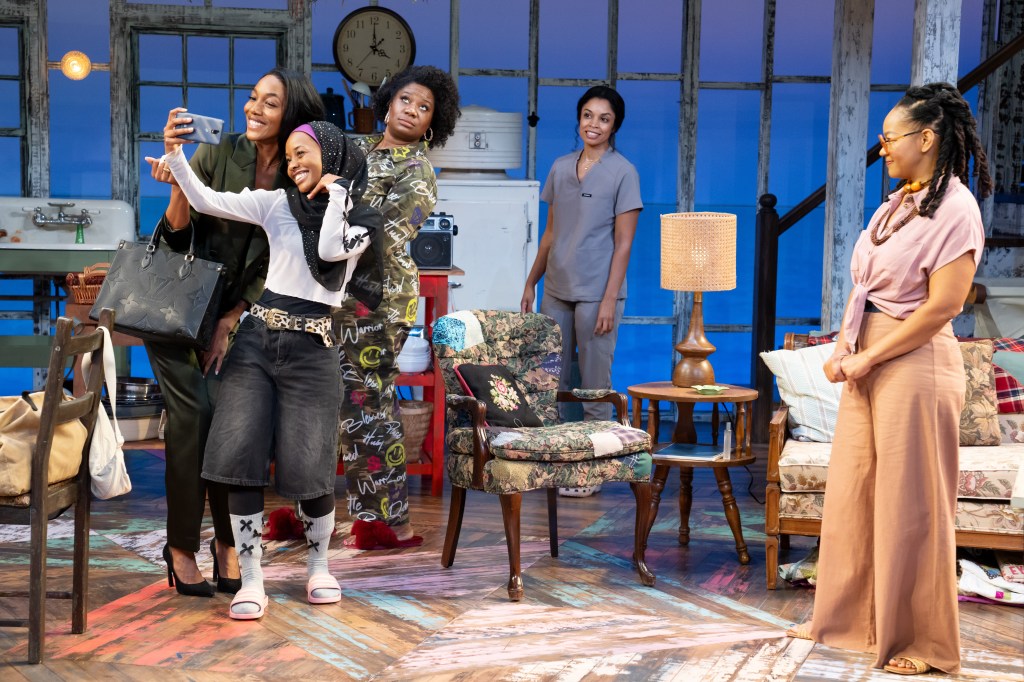
The Blood Quilt
In her ambitious layering of the story of four half-sisters who gather to finally lay to rest their recently deceased mother, Katori Hall, with astute direction by Lileana Blain-Cruz, focuses on complex family dynamics, jealousies, misunderstandings and secrets. The confluence of emotions roil the souls of each sister and a teenage niece, paralleling the stormy seas which crash waves onto the setting, Kwemera Island, Georgia. The culmination of fiery anger, pain and sadness releases in the rituals of quilting and the soul healing of family connections in mysticism, dance and song.
By the conclusion of the two-act drama, currently at LCT’s Mitzie E. Newhouse until December 29, we know the fabric of each of the sister’s lives. As a result we thrill with them when they are able to reconcile their inner wounds and cast them into the sea. It is in the waters fronting the small country cabin they call home, where ancestors have been buried in a symbolic tradition that the eldest sister Clementine speaks of with power, “We all came from the water and we all must return.”
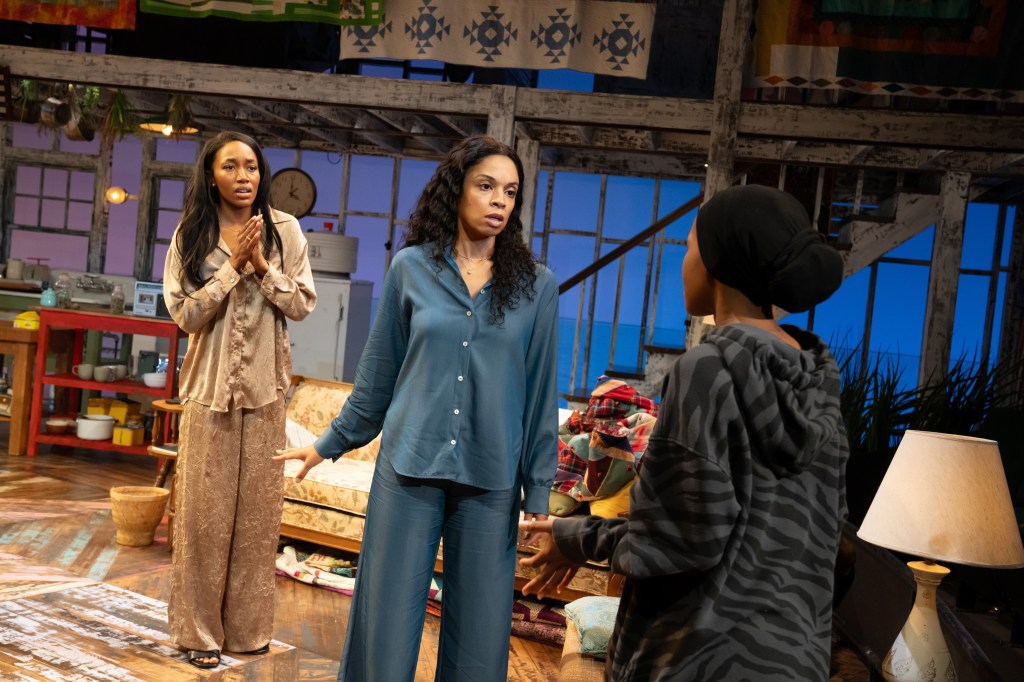
The characters are the patchworks that make up the family masterpiece
Much of the beauty of Hall’s drama, laced with comedic elements, comes from her precise characterizations of the disparate sisters who share the same mother but have different fathers. They are the patchworks that make up the last quilted masterpiece that their mother designed and they gather to finish.
Clementine, Gio, Amber
Clementine (Crystal Dickinson), is the eldest, who lives in the incredible ancestral home. Adam Rigg’s set design hums with authenticity, warmth and life. The cabin is decorated with generational family quilts that cover walls and the balcony railing, each colorful, individual, symbolic. Family ownership of the “chic” cabin with the sea in its front yard is in jeopardy because of unpaid taxes which their mother ignored, while keeping her delinquency a secret from her children.
Clementine, who lives there and became caretaker of their dying mother, best knows the rituals of their Jernigan ancestors. A root worker of potions and spells, she speaks Geechee (from their Gullah Geechee heritage), and emotionally archives their legacy, back to the first slave ancestors that lived and worked on the plantations in the area. She is a master of the rituals and celebration of their heritage through quilting which they practice yearly under her direction. This summer when the play opens, the sisters and their niece Zambia (Mirirai), gather together to complete the last quilt their dying mother/grandmother designed, as they symbolically release her to another plane of existence.
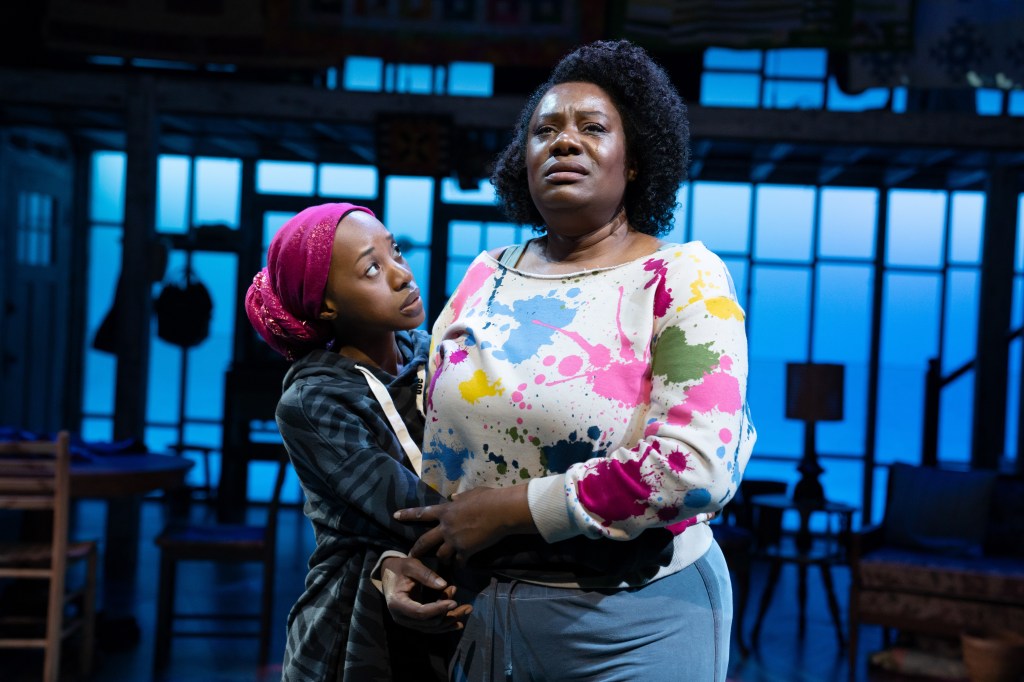
Gio (Adrienne C. Moore), is the second oldest, a roughly hewn, hard drinking, Mississippi cop, who is resentful and jealous of her youngest sister Amber (Lauren E. Banks). Gio’s rancor runs deep because of a traumatic, covert incident unbeknownst to Amber but related to Amber’s father that happened when Gio was a teenager. Sensitive to her own misery, burying hurts from her divisive relationship with their mother who abused her, Gio’s moods, aided by alcohol, swing widely as she peppers them with spicey swearing and insults directed mostly at youngest sister Amber.
Amber is the beauty and reputed favorite of their mother because of her accomplishments. She went to an Ivy league college and eventually becomes an entertainment lawyer of means. Because she missed the last three summers of their quilting ritual, and their mother’s funeral service, her estrangement from her sisters and the difference between her lifestyle and theirs is apparent.

Despite Gio and Clementine’s “guilting” her for not coming to the funeral, we discover Amber was emotionally the closest to her mother. She paid for her cancer treatments, phoned her often and even assisted the family after she left the homestead for California. In spite of their geographical and emotional separation, she paid for her sisters’ needs when they asked her, and especially pays for niece Zambia’s tuition in a private school.
Zambia and Cassan
It is Zambia who is the linchpin of the wayward, patchwork family that hangs together by a slender thread as each sister expels her angst and self-recrimination to each other. However, Hall uses Zambia and her mother, the quiet nurse Cassan (Susan Kelechi Watson), who is the closest to Amber, to round out the backstory with Zambia’s questions. Zambia and peacemaker Clementine move along the arc of development which settles upon two issues. How will they pay off the tax liens against the house, and who inherits the quilts, (pricey relics which are cultural artifacts of a rich historical past), the property and the cabin contents?
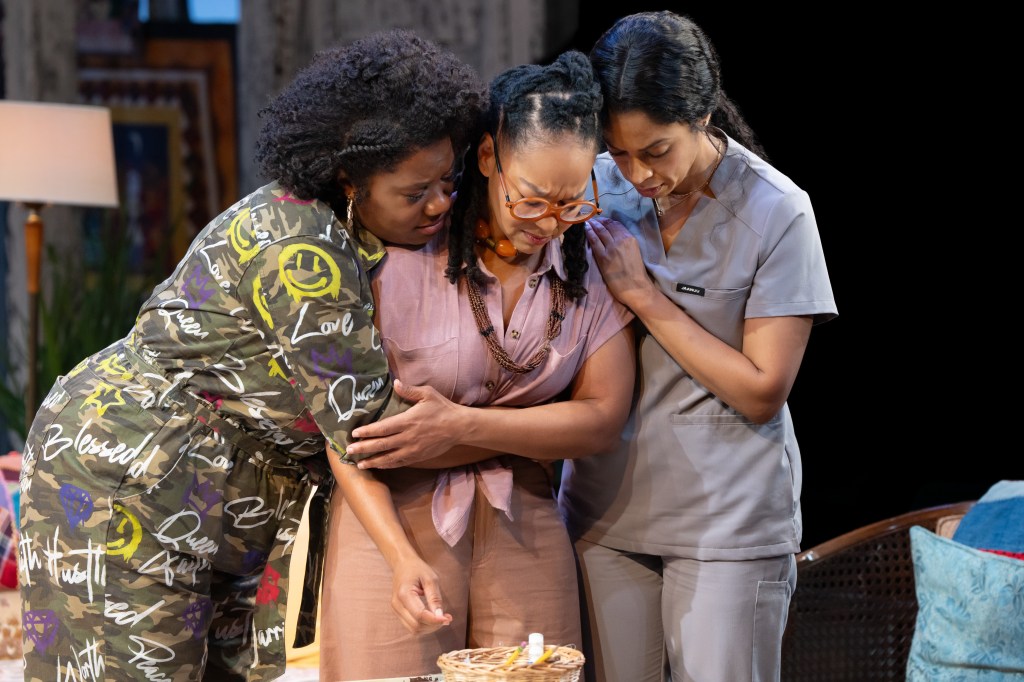
These questions are answered as Hall unspools each sister’s interior wounds via their relationships, revealing their individual portrait of their complicated, intriguing mother. All clarifies and we are brought to the edge of unresolved personal traumas that threaten to further destroy their lives emotionally, physically, spiritually. However, it is the act of quilting together that we view the whole with the sisters contributing to the corners of the ancestral masterpiece that unifies them with a familial love and redemption from past harm effected by their mother, each other and most importantly themselves.
Mystical elements
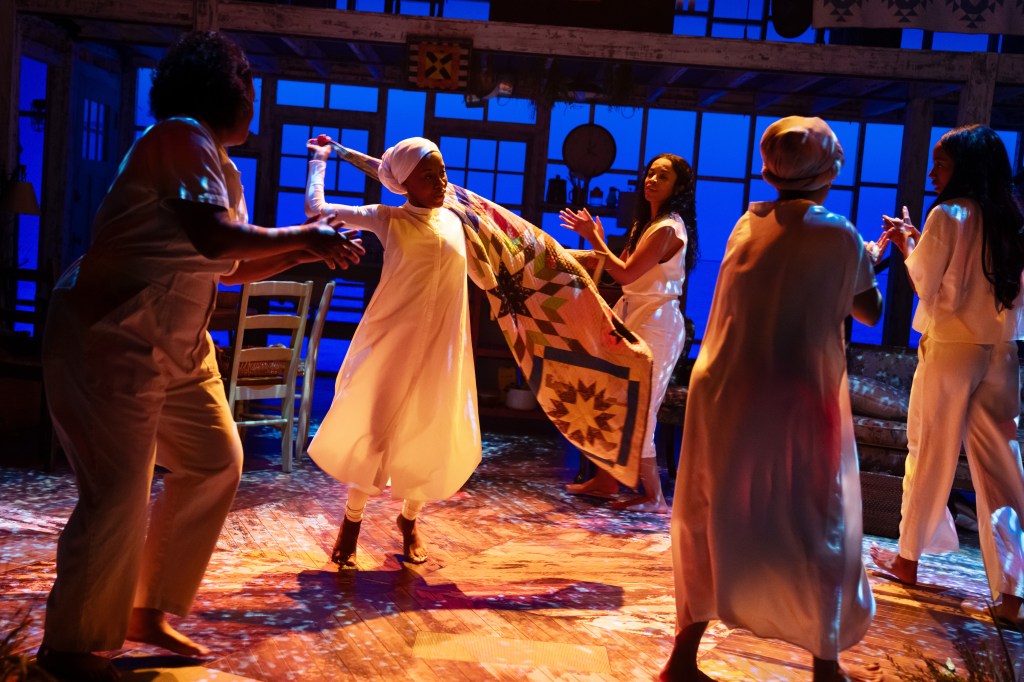
Hall’s first act languishes in exposition until the conflicts among the sisters erupt. The details of the quilting process fascinate and are well integrated into the dialogue. The symbolism and metaphor of the stormy souls aligned with the threatening hurricane’s thunder and lightening effected by Jiyoun Chang (lighting design), Palmer Hefferan (sound design), and Jeanette Oi-Suk Yew (projections), mirror how the natural world, material world and spiritual world often collide until there is a movement toward establishing peace and reconciliation.
Blain-Cruz does a smashing job referencing the impact the spiritual plane of existence has upon the material life of the sisters which is sensationally wrought in Act 2 toward the conclusion when they attempt to place the finished quilt on their mother’s bed and a mystical experience occurs. It is then when Zambia becomes the channel between the past spiritual legacy and the present and the pathway toward healing is realized.
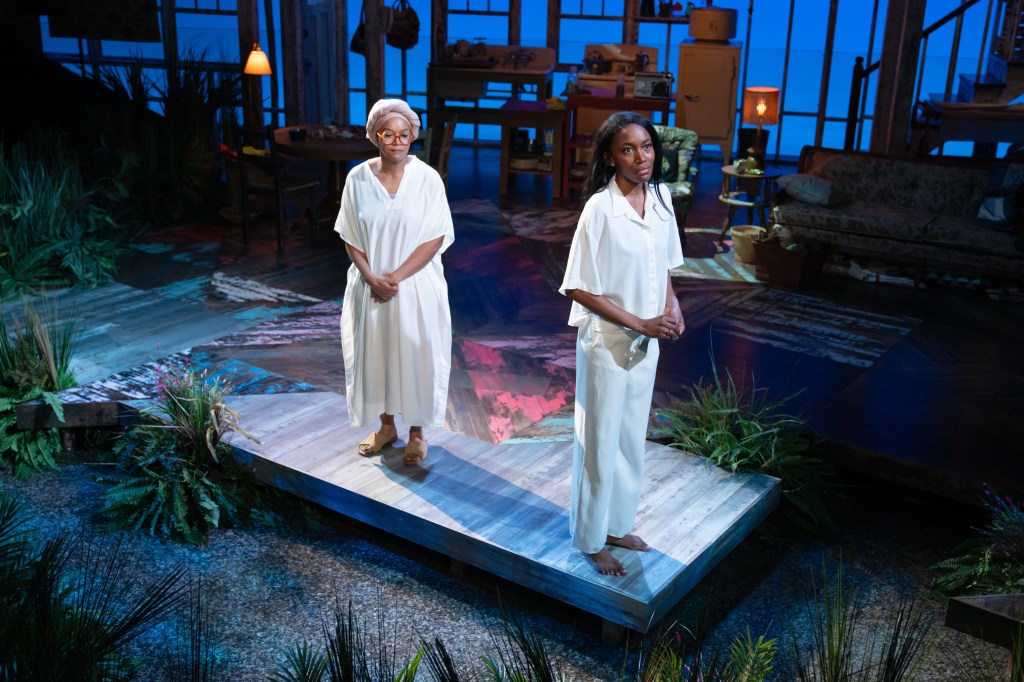
The costumes by Montana Lvi Blanco pointedly imbue each of the sisters and Zambia’s changing “trends,” enhancing Hall and Blain-Cruz’s vision of this family to precisely tie in their characters culturally and psychically. Importantly, the ensemble works together to create a family drama with which we can identify and empathize. Their acting is superb. Perhaps the Geechee deserves a translation either in the program or elsewhere. I was benefited by a copy of the script. Vitally, the different language serves to remind the audience of the African diaspora that beleaguered the Jernigan ancestors-slaves, and unified them as they prospered in a hostile, alien world.
The Blood Quilt
See The Blood Quilt, which runs two hours forty-five minutes with one intermission at LCT, the Mitzi E. Newhouse, until December 29th.
,
‘for colored girls who have considered suicide/when the rainbow is enuf,’ by Ntozake Shange in revival at the Public Theater

The company of ‘for colored girls who have considered suicide/when the rainbow is enuf,’ by Ntozake Shange, directed by Leah C. Gardiner, choreographed by Camille A. Brown (Joan Marcus)
You cannot watch for colored girls who have considered suicide/when the rainbow is enuf without your muscles vibrating in joy to the rhythms of the music of Ntozake Shange’s poetry. And when it is set to the dance with musicians pealing out the songs of multicultural generations with her choreopoem delivered enthusiastically in the personal languages of black women from various backgrounds using their unique words, gestures and dance movements, it is simply grand.
for colored girls... directed by Leah C. Gardner with choreography by Camille A. Brown is now in revival at the Public Theater. Originally, the work premiered on Broadway in 1976 and received a Tony nomination. Notably, it is the second play by a black woman to reach Broadway, preceded by Lorraine Hansberry’s A Raisin in the Sun in 1959. Shange updated the original choreopoem in 2010. She included additional material, the poem “positive,” and added references to The Iraq War and PTSD.

‘for colored girls who have considered suicide/when the rainbow is enuf,’ by Ntozake Shange, directed by Leah C. Gardiner, choreographed by Camille A. Brown (Joan Marcus)
This iteration in its maverick coolness is a celebration not only of black women. It is for women everywhere. The work recalls us to a time when women reveled in the identity and unity of being female. It was a time in the feminist wave when they rejoiced being in a community of sisters from around the nation and the world. It was a time to become visible, be heard, speak truth to power, overcome, conquer. Considering the crisis and chaos the current WH administration attempts to breed in our culture in concert with a senate majority leader supportive of the white patriarchy who revel in misogyny, embrace white nationalism and leverage religion as a political tool, it is time to revisit the themes and messages of for colored girls… and view them through the lens of womenhood, including those who are most in bondage, white women.
Shange’s choreopoem as in other productions includes music and dance with some poems sung. It is performed by seven women each sporting a dress of a different color which combine to make up colors of the rainbow. As an ironic note, remember that all colors combine to create the color white representing what is sanctified and holy, if you will. Indeed, this “is enuf.”
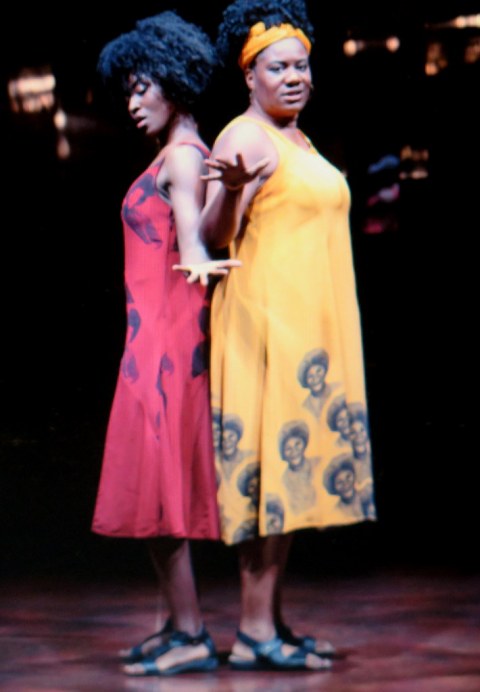
(L to R): Jayme Lawson and Adrienne C. Moore and the company of ‘for colored girls who have considered suicide/when the rainbow is enuf,’ written by Ntozake Shange and directed by Leah C. Gardiner, with choreography by Camille A. Brown, running at The Public Theater (Joan Marcus)
The woman/actors depicted in Shange’s majestic choreopoem are as follows: brown (Celia Chevalier), yellow Adrienne C. Moore) blue (Sasha Allen) red Jayme Lawson) purple (Alexandria Wailes) orange (Danaya Esperanza) and green (Okwui Okpok Wasili). Together and individually, they dance to express their identities throughout the work and also listen and partake in the community by sharing their wisdom and experience. At the outset of the production, each moves to center stage where via monologue, they contribute their personal message of womanhood.
As the various women play “tag, you’re it,” the first to begin, the woman in brown, steps into herself and with her own dialect, rhythms, gestures and carriage tells a story from her youth about her love fantasy Touissant. She first read about Touissant in the “forbidden” adult section of the library. Touissant was the black general who fought for France and ended up starting his own revolution reinforcing the Haitian slaves who ignited an insurrection against their bondage. Touissant continued their work and inspired a revolution against oppression which ended in a free Haiti.
The woman in brown’s love is metaphoric and symbolic. Touissant represents freedom from enforced bondage. In seeking him as her fantasy lover, the woman embraces the freedom to be herself in a culture that attempts to nullify her voice and identity. When she shares that she meets up with a boy named Touissant Jones, she realizes that one is similar to the other in not “taking any guff” from white people. She decides in her quest for escape from white supremacy’s mores (she had planned to to go Haiti) she will continue with the real Touissant Jones and become the freedom that Touissant metaphorically represents. She will make her own place regardless of whether “they” recognize her or not, for she has empowered herself to know who she is.

The company of ‘for colored girls who have considered suicide/when the rainbow is enuf,’ by Ntozake shange, directed by Leah C. Gardiner, choreographed by Camille A. Brown (Joan Marcus)
Each of the women relate their personal stories in choreopoems. Some are humorous. For example, the woman in yellow shares giving up her virginity in a buick on the night of her graduation. When queried about it by the woman in blue, she tells her, “It was wonderful!” Each of the women chime in about where they “lost it.” The effect is funny and the sharing brings the group together in community. Moving in a different direction, the woman in blue riffs on her experiences running off at sixteen to dance with Willie Colon in the Bronx where she feels sublime dancing the mambo, bomba and merengue all night. But when Colon doesn’t show, she goes to a bar where she learns the beauty and subtly of musicians playing the blues. Her time center stage ends with a song/poem to the power of music and life. Sasha Allen’s voice is incredible.

Shasha Allen (center) and the company of ‘for colored girls who have considered suicide/when the rainbow is enuf,’ written by Ntozake Shange and directed by Leah C. Gardiner, with choreography by Camille A. Brown, running at The Public Theater (Joan Marcus)
The woman in red gives a lament about throwing herself into the pursuit of a lover then ending the affair, a place all the women have been as they “dance to keep from” cryin’ and dyin.'” Then there is a transition; the light signals the emotional shift which deepens into the harder subjects beginning with rape. But is it rape when you know your rapist who is a friend or close family member? Each of the women relate their wisdom and finish each other’s thoughts for all have experienced the “latent rapist’s bravado.” These are “men who know us…that we will submit and relinquish all rights in the presence of a man…especially if he has been considered a friend…”
This section is particularly powerful in light of the #metoo movement. The women in the beauty of Shange’s verse and the rhythms of their movements share how the “nature of rape has changed.” You “meet your rapist in coffeehouses sitting with friends.” We can “even have them over for dinner and get raped in our own houses by invitation, a friend.”

The company of ‘for colored girls who have considered suicide/when the rainbow is enuf,’ by Ntozake shange, directed by Leah C. Gardiner, choreographed by Camille A. Brown (Joan Marcus)
Sadly, these lines are even more salient today as we hear the statistics: one in three women are raped in their lifetimes and more than a few are raped more times by different men. One thinks of the power dynamic of the Harvey Weinsteins, the Matt Lauers, the Bill O’Reillys, the Roger Aileses, and all those invisible bosses or friends who laud their “latent rapist bravado” towering over subservient females while boasting about their conquests in gyms and lockers rooms, while showering together. Women reduced, vilified, hated, objectified, say little for fear of more abuse or loss of a job and career. Or they are PTSD frozen by the audacity that someone took what wasn’t theirs to take. The #metoo movement is a first step. When the “latent rapists” are in jail and the men and women they would trample over with their violence are in positions of power, this justice will indicate the culture is climbing to the mountaintop.
Celia Chevalier (foreground) in for colored girls who have considered suicide/when the rainbow is enuf, written by Ntozake Shange and directed by Leah C. Gardiner, with choreography by Camille A. Brown, running at The Public Theater (Joan Marcus)
Whether latent or verbally harass raped or physically abused, rape is violence. There is nothing sexual about it. In the infantile man’s mind, his penis is a weapon to slay and conquer women. Nothing adult or masculine! A man’s sexuality and masculinity are expressed in tenderness, truth and soul giving as the various women point out in their comments about men and relationships. But who is mentoring these traits of grace? Certainly not the president, or Jeffrey Epstein or Bret Kavanaugh or the Republicans and others in positions of power in business, politics and elsewhere who have sexual abuse on their resumes, hidden by AMI’s “Catch and Kill” program. (Read Ronan Farrow’s titular book on this subject.)
From rape, the rainbow of women present choreopoems about abortion, domestic violence, abandonment, devastating relationships and seeking identity through sex and love. And in the sharing of their trials, hurts and losses, especially the loss of self-hood, there is a benefit. Healing comes with love and empowerment to resurrect a new self inspired by the community of women who understand and uplift.
One of the more powerful, humorous and profound presentations references how women give their self-hood and identity to men and or the culture/patriarchy. The audience responded with laughter at what the woman in green meant metaphorically and symbolically with the refrain, “somebody almost walked off wid alla my stuff…now why dont you put me back & let me hang out in my own self?” Okwui Okpokwasili as the woman in green is riotous in her portrayal and stance as a woman who has realized that she has been giving all of herself away to one or many who don’t really understand or want her being.
“i want my own things/ how i lived them/ & give me my memories/how I waz when I waz there/ you can’t have ’em or do nothin’ wit em/stealin’ my shit from me/dont make it yrs/makes it stolen”

Okwui Okpokwasili (foreground) in for colored girls who have considered suicide/when the rainbow is enuf, written by Ntozake Shange and directed by Leah C. Gardiner, with choreography by Camille A. Brown, running at The Public Theater (Joan Marcus)
Okpokwasili’s presentation resonated deeply not only with women but with men. Stealing is an analogy with the robbery of self and what one deems most valuable. In this instance, it also includes physical, mental, emotional and spiritual well-being that has been robbed by the culture and those brainwashed into theft. Just Wow!
The most poignant choreopoem concerns soul sickness and fear in men that converts to abuse and torment. The woman in red shares the dramatic events that encompass her children’s deaths at the hands of a former partner. The pain and torment from these experiences are related to the community of women who give a laying on of hands to bring on healing. And by the end of this section and the conclusion of the production, each of the women separately then in unity chant as a chorus whose vibrations go out into the audience, “I found god in myself & I loved her/ I loved her fiercely.” At this point the women though they may have considered suicide because of what they have experienced, in the companionship of sistahs have brought themselves and each other to the end of their own rainbows, “fiercely.”
This production is momentous. Shange’s poetry shimmers on the page. The creative team makes the director’s vision equally shine with brilliance. Kudos to Myung Hee Cho (scenic design) Toni-Leslie James (costume design) Jiiyoun Chang (lighting design) Megumi Katayama (sound design) Martha Redbone (original music) Deah Love Harriott (music director) Kristy Norter (music coordinator) Onudeah Nicolarakis (director of American Sign Language).
A caveat, however, is that some of the lyricism and the poetic language is lost in the exuberance of the performers’ actions, some more so than others. Specifically, the words, the expressions in all their glory are not always clear. Sometimes, these were garbled or faded as if on the wind. That is a fabulous conception, however, it doesn’t serve the themes that can resonate and should resonate with the audience, especially the men as they learn about women, a subject they often profess to know little about. Men above all need to know the “what” of women’s experiences.
Hamilton, Lin Manuel Miranda’s work is rapped quickly, exuberantly. However, each word is treated with “kid gloves,” to add a simile, like a diamond, or precious ruby. Each word is articulated, pronounced clearly, enunciated. Why aren’t Shange’s words treated like such jewels? Every word is vital to our understanding.
I wasn’t the only one frustrated by the performers rushing over the poetry to make the production come in at a certain time. In my section of the audience, humorous segments were missed. Sitting in the round the audience opposite us laughed. The same occurred when we laughed, the audience on the opposite side were silent. Great, if that is a symbolic/thematic notion. I understand, but don’t agree if that is the intentional direction.
Shange’s poetic phrases and word choices are heady. The performers are there to tell a story, to act and be heard and understood. What Shange is saying we must understand. All of it! Okwui Okpokwasili’s “somebody almost walked off wid alla my stuff…” was hysterical and deep, and the audience around me laughed and enjoyed that choreopoem because she slowed down, enunciated, paused, articulated; the same occurred with Adrienne C. Moore. And Alexandria Wailes’ signing was excellent and powerful. But some of the other women at times didn’t completely come through to us. That disappointed me because I loved the production’s energy and profound themes. Despite that caveat, it is smashing!
for colored girls who have considered suicide/when the rainbow is enuf runs with no intermission at the Public Theater until 8th December. For tickets and times CLICK HERE.
,
 CAROLE DI TOSTI