Blog Archives
‘The Shark is Broken’ Three Men Missing a Shark, Broadway Review

Much of the real terror related to the film Jaws (1975), was experienced behind the scenes. The film was over budget $2 million and its flawed premise needed correction because the star of the picture, Bruce (the monster great white shark), was unworkable. To add insult to injury, director Steven Spielberg and the main cast were unproven at the box office and had issues to overcome. Finally, there was no finished script. For all intents and purposes, the film looked to go belly up, just like the three versions of mechanical Bruce, who foundered, sputtered and sank forcing the director and writer John Milieus into extensive rewrites.
However, Hollywood is the land of miracles. Jaws (adapted from Peter Benchley’s titular novel), broke all box office records for the time, despite the frankenfish never really “getting off the ground” the way Spielberg intended.

The Broadway show The Shark is Broken, currently sailing at the Golden Theatre until the 19th of November is the story of the three consummate actors behind the flop that might have been Jaws if Spielberg and his team didn’t rethink their broken monster, proving less screen time is more powerful when the shark finally shows up. The amusing play co-written by Ian Shaw (Robert Shaw’s son) and Joseph Nixon, and directed by Guy Masterson comes in at a slim 90 minutes. It features Alex Brightman (Beetlejuice the Musical) as Richard Dreyfuss, Colin Donnell (Almost Famous at The Old Globe) as Roy Scheider, and Ian Shaw (War Horse), who plays his father Robert Shaw.
The play focuses on these three actors who attempt to deal with the circumstances and each other as they try to make it through the tedious days waiting for Bruce, the real star, to “get his act together.” However, Bruce never does. Indeed, if one revisits the film, one must give praise to the superb performances of Dreyfuss, Scheider and Shaw who make the audience believe the shark is horrifically real and not a broken-down, mechanical “has been.”
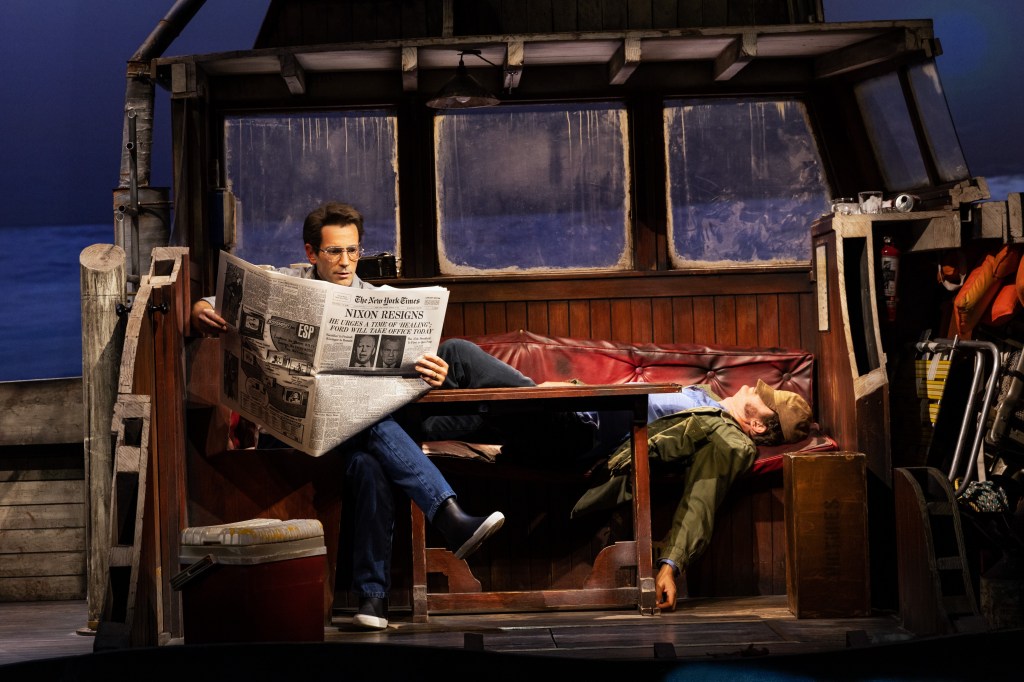
Crucial to the film’s success are the dynamics among the actors which The Shark is Broken highlights with sardonic humor and a legendary sheen. Once the film skyrocketed to blockbuster status, the high-stress problems surrounding the film’s creation could be acknowledged with gallows humor. Such is the stuff that Ian Shaw and Joseph Nixon configure as they reveal intimate portraits of the actors’ personalities, foibles, desperations and bonding, while waiting for their “close-ups” with Bruce. Though the play appears “talky,” the tensions and undercurrents form the substance of what drives the actors. Like a shark that glides with fin above water, what lies inside each of the actors threatens to explode when least expected.
Even seemingly mild-mannered, emotionally tailored Scheider flips out. When his luxurious sun bathing is curtailed and his presence demanded on set, Donnell takes a bat and smashes it on the deck in fury. Donnell has no dialogue but his actions and body speak louder than words and we see how underneath that calm demeanor, Scheider is capable of potential violence which he keeps on a leash and, like a dog, gets it to heel when he wishes.
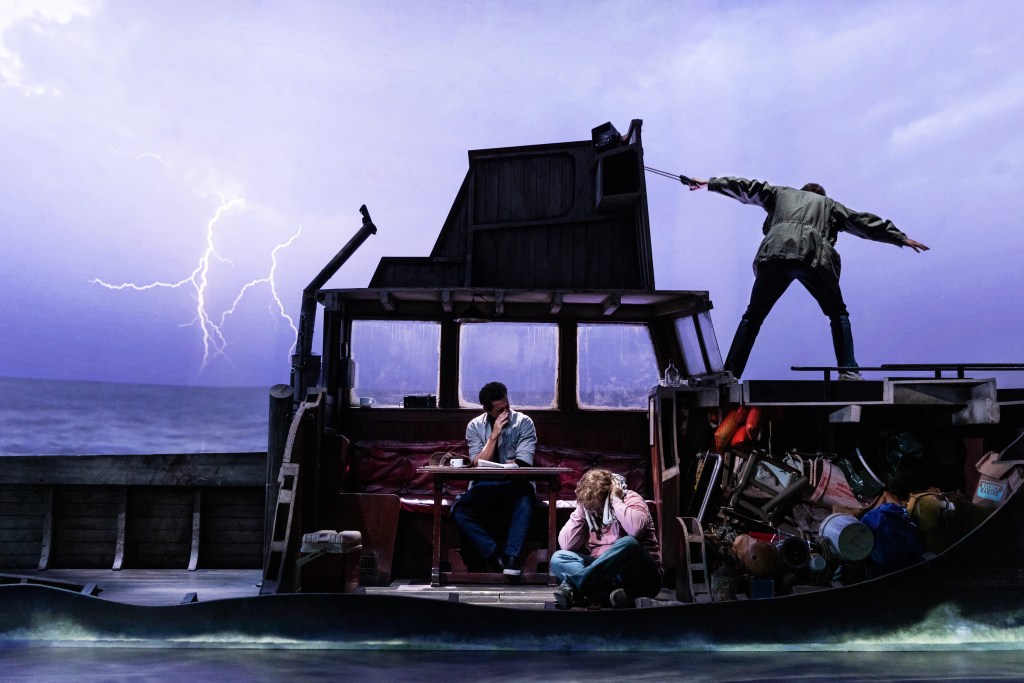
Based on Robert Shaw’s drinking diary, family archives, interviews and other Jaws‘ sources, Shaw and Nixon pen an encomium to the actors’ efforts and relationships forged during their claustrophobic time spent on the Orca, which floated on the open ocean east of Martha’s Vineyard between East Chop and Oak Bluffs. As the actor-characters arrive, we note the resemblances to their counterparts, further emphasized by their outfits, (costumes by Duncan Henderson), speech (dialect coach-Kate Wilson), and mannerisms.
Donnell is the fit, tanned, attractive, temperate Scheider, well cast to portray police chief Brody, head of the shark expedition. Brightman is the pudgy, scruffy, angst-filled Dreyfuss, who sounds and looks like the actor, and is filled with brio and insecurity as Ian’s Shaw batters his ego. As a dead-ringer, Ian portrays his father Robert Shaw, who merges the steely-eyed, gravely voiced, hard-drinking Quint with himself so the boundary between actor and character is seamless. Ian’s Shaw is comfortable in his cap and jacket ready to conquer his prey which includes the poorly written Indianapolis speech, and Richard Dreyfuss.

Thanks to the creative team, Duncan Henderson’s set and costume design, Campbell Young Associates wig design and construction, Jon Clark’s lighting design, Adam Cork’s sound design and original music, and Nina Dunn for Pixellux’s video design, the scenes when the three are on the Orca waiting for the great white to arrive include the manifested cross section of the boat interior, undulating ocean with seagulls flying overhead, wave washing sound effects, sunsets, and a lightening storm during which Ian’s Shaw stands rocking near the boat railing as he challenges the storm. The designated force of Robert Shaw comes through particularly, as he stands arms outstretched, back to the audience, accepting whatever the chaotic, dangerous elements unleash on him.
What do these men do to redeem the time as they wait for one of the three versions of Bruce to be commissioned to work? They do what sailors have done time immemorial: play innumerable card games, read the newspaper, play pub games and verbally and physically attack each other parlaying wit, wisdom, insults and choking. The latter occurs when Brightman’s Dreyfuss calls Shaw’s bluff about giving up drinking. With a quick maneuver, Dreyfuss takes Shaw’s bottle and tosses it over the side, a severe cruelty for a drinking man. Ian’s Shaw leaps into ferocity. It is only Scheider’s peacemaking and his threat that Shaw will be sued for delaying the film further, that remove Shaw’s ham hands from Dreyfuss’ quivering throat.
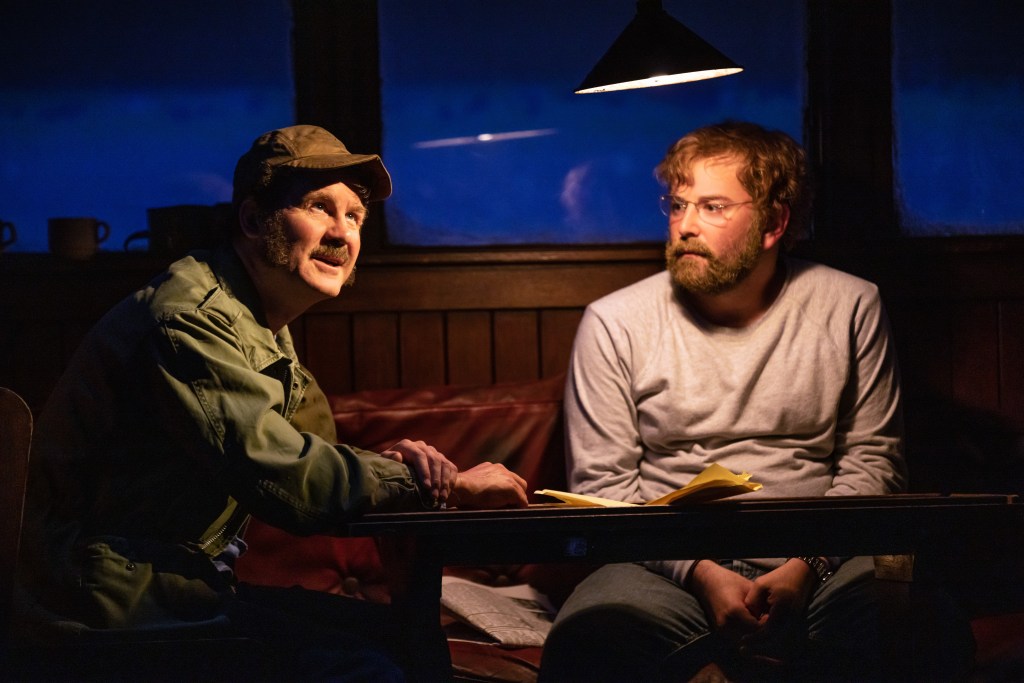
The feud between Dreyfuss and Shaw is exacerbated by inaction and the actors’ boredom between scene takes. This gives rise to the competitive hate/love emotions between the two men, which escalate during the play and are a fount of scathing, sardonic humor. When confronted about it, Shaw insists he is helping to improve Dreyfuss’ performance, and indeed, the tension between the actors behind the scenes travels well to their portrayals on film. The thrust and parrying of epithets and wit, which Scheider attempts to mitigate to no avail, forms the backbone of the dialogue which comes at the expense of Dreyfuss’ savaged ego.
Shaw, a noted writer and giant on the stage, sharpens his wordplay on Dreyfuss’ attempts at rebuttal. It is only after a quiet moment between Scheider and Shaw when Scheider tells Shaw how much Dreyfuss admires him, that Shaw lets up, but only a bit.

Son Ian is not shy about his father’s alcoholism and he plays the role as if he was familiar with how crusty and gritty his father could get when he was “three sheets to the wind.” Though he lost him at a young age and most probably doesn’t remember him all that well, the point is made that alcoholism and loss is generational. Robert Shaw shares that he lost his father to suicide when he was a youngster and always rued that he could never assure his dad that things would be all right. By that point his father had killed himself. Robert Shaw also died young and left his nine children wanting him. Thus, homage is paid by Ian to his grandfather and father who both battled alcoholism and died before their sons could really know them.

At its most revelatory, The Shark is Broken is about fathers and sons and how their father’s abandonment and/or rejection traumatized the actors who struggle to get out from under the sense of loss, rejection and insecurity. Dreyfuss shares that his father left the family and wanted him to be a doctor or lawyer. Scheider reveals his father disdained his acting career, until he eventually accepted it and became proud of his son. It is the few shared moments like these where the men bond and find common ground that are strongest and wonderfully acted. The play might have used more of these moments and fewer attempts at ironic jokes about how Jaws won’t be memorable in film history.

Shaw’s reductio ad absurdum of the future of films as a measure of sequels: sequels will beget sequels of sequels that have sequels rings true, of course. But the statement for humorous purposes is far from prescient.
The Shark is Broken premiered in Brighton, England, went to a 2019 Edinburgh Festival Fringe run then opened on the West End before it arrived on Broadway. The play is humorous and entertaining with some missed opportunities for quiet, soulful moments. Certainly, those who have seen Jaws and its sequels will have fun and enjoy the near replica of the Orca and its inhabitants for a captured moment in film history made alive. The acting is crackerjack and Ian’s interpretation of the Indianapolis speech, which Shaw wrote himself, is at the heart of the film. As Ian delivers it, it is at the heart of the play and symbolically profound.
The Shark is Broken runs without an intermission at the Golden Theatre (252 West 45th Street). For tickets and times, go to their website https://thesharkisbroken.com/
‘Beetlejuice’ Argh! DEMONS! on Broadway

Alex Brightman in ‘Beetlejuice,’ directed by Alex Timbers, Music & Lyrics by Eddie Perfect, Book by Sott Brown & Anthony King (Matthew Murphy)
It is one thing to see the outrageous big kahuna on a tablet, your phone or even on a beautiful Samsung 146″ Modular TV in the safety and security of your living room. It is quite another to witness him live and in person at the Winter Garden Theatre sporting green mold and rot. Yes, that ethos of evil Beetlejuice, Tim Burton’s imminently genius evocation of all things hellish, demonic and flat-out-funny. has come to Broadway. This theatrical extravaganza from soup-to-NUTS is based on the Geffen Company Picture, the titular fan favorite cult film starring Michael Keaton and Winona Ryder (story by Michael McDowell & Larry Wilson).
To see the musical comedy Beetlejuice with Music/Lyrics by Eddie Perfect and Book by Scott Brown and Anthony King, come prepared with crosses, bibles and whatever else it takes to prevent that arch fiend from possessing you. But if you dare risk it, drop all notions of restraint and be prepared to fall into laughter.
The production stars the hysterical and wildly cryptic Alex Brightman as the beloved, infernal monster Beetlejuice. Sophia Anne Caruso is the dour, morbid Lydia, whose belt becomes as brave as her bravura performance to resist marrying the redolent demon costumed in hell’s black and white striped prison garb with greenish tinges (a William Ivey Long costume). Rounding out the principals are Rob McClure as Adam, Kerry Butler as Barbara, Adam Dannheisser as Lydia’s Dad, Charles, and Leslie Kritzer as Delia, the girlfriend.
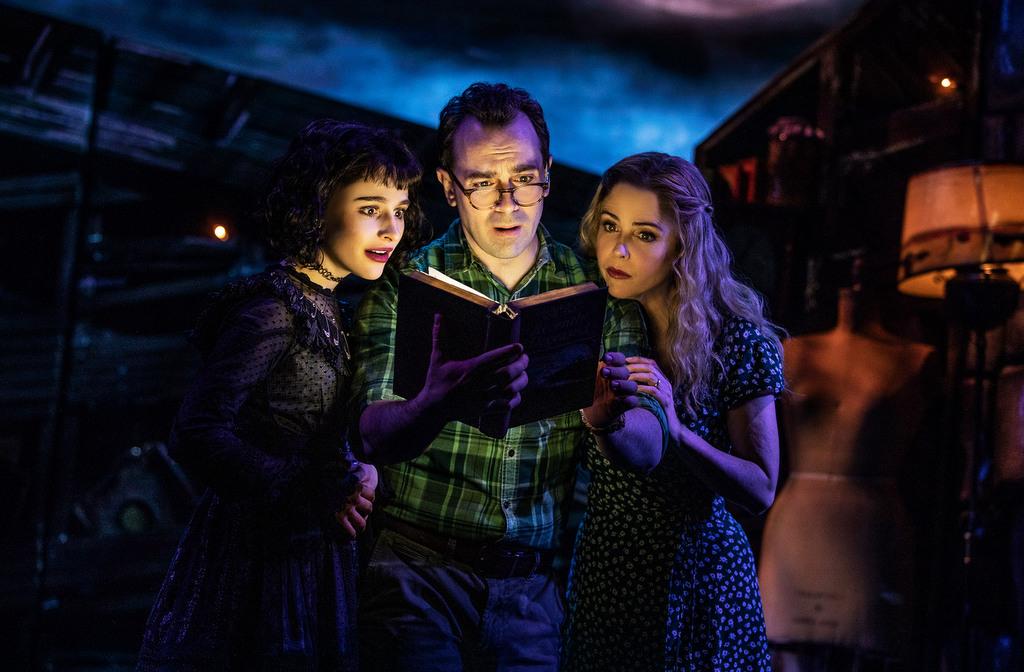
(L to R): Sophia Anne Caruso, Rob McClure, Kerry Butler in ‘Beetlejuice,’ Music & Lyris by Eddie Perfect, book by Scott Brown & Anthony King, directed by Alex Timbers (Matthew Murphy)
If you are a great fan of Tim Burton’s creative genius and his enlightened vision of the “Netherworld” and the malevolent, frightful spirits that populate it, you will not be disappointed by this glorious iteration that replicates them with the brilliance of twitting itself in the process. The creative designers, director Alex Timbers, ensemble, and even the ushers who escort you down the aisles of the theater (decked out with luminescent green and otherworldly trimmings) have worked prodigiously to make the production shine. And it appears that they have had all the fun in the world doing so. Certainly, the ghosts of Broadway must be happy, for the audience fans of the film, are over the top beside themselves with joy.
There’s a lot to be thrilled about. The puppetry is spectacular thanks to Michael Curry. I was happy to see the sandworm is alive and well arriving in varicolored clouds of sulfur and brimstone. Likewise the Scenic Design by David Korins, Kenneth Posner’s Lighting Design and Peter Hylenski’s Sound Design effects a supernatural realm and crashes it into reality, as does Jeremy Chernik’s Special Effects Design and Michael Weber’s Magic and Illusion Design. Because of their off-the-charts artistry, Beetlejuice’s command of the other worldly in defiance of time and space is satisfying. The haphazard, off-kilter and ultra modern design interiors and appointments of Lydia’s haunted home (from purple to silver and black after Beetlejuice takes over in Act II) are equally smashing.
Alex Brightman’s exuberance, authenticity and zaniness carries the production from the outset solidified by the tenor and mood of the opening number. His easy interaction with the audience is an assist to the funny and brilliant send up of our nascent fears about death and dying which he blasts away by landing that subject squarely in our laps so we might ridicule its “power” with him.
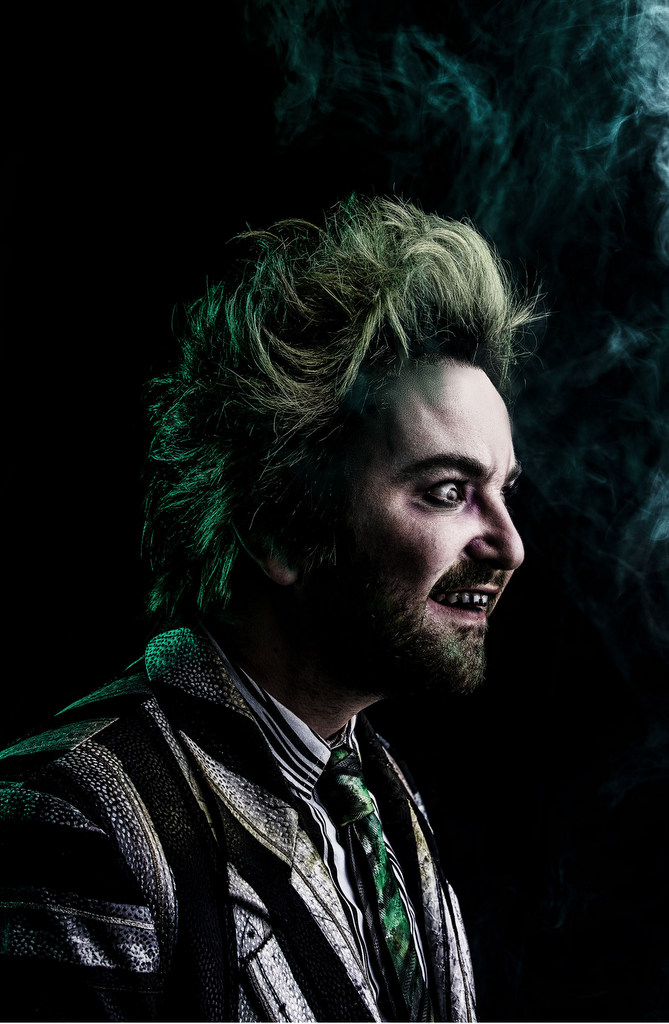
Alex Brightman in ‘Beetlejuice,’ directed by Alex Timbers (Matthew Murphy)
It’s an important opening, well-staged and acutely directed by Alex Timbers. Brightman’s demon clown cavorts; with joie de vivre he stomps down death, mournfulness and morbidity, all the while reminding us we’re dead folks, eventually. He and we are thus driven to rollicking laughter about our immortal presumptions!
Beetlejuice is our Virgil (our guide in the encounters with Morpheus and Legion minus the philosopher’s wisdom and grace) and we walk in the place of Dante (the poet of The Inferno). We are without Dante’s talent, but we retain hope and a penchant for having fun. Indeed, on this amazing journey with the fracasing Beetlejuice we do learn some secrets from him; yes, he reveals a wacky wisdom and astutely nefarious preeminence. This is especially so as he attempts to come back to life through delightful acts of chicanery and cunning misdirection to connive Lydia into marriage. After all, she too has talents; she’s the only one alive who can see him and traverse the realms of life and death.
Beetlejuice’s humorous introduction is an excellent counterpoint to the morbid reality of the scene that follows with Lydia in the graveyard. There, the stereotypes of the cemetery, rainy day, black clothing and umbrellas bring us to what Beetlejuice made us laugh about, Death. But in Lydia’s case, it is horrific, sad. Its fearful aftereffects include the yawning absence of the loved one it snatches away.
As Lydia mourns her mother in song, it is a let down, albeit an appropriate initiation of the play’s actions. Timbers’ staging and William Ivey Long’s costuming are effective in conveying the gravity of the macabre and the brutal “death process” with coffins, funerals and interments so we empathize with Lydia’s loss. Thankfully, there are comical touches which thread humor from the previous scene with Beetlejuice, whom we miss.
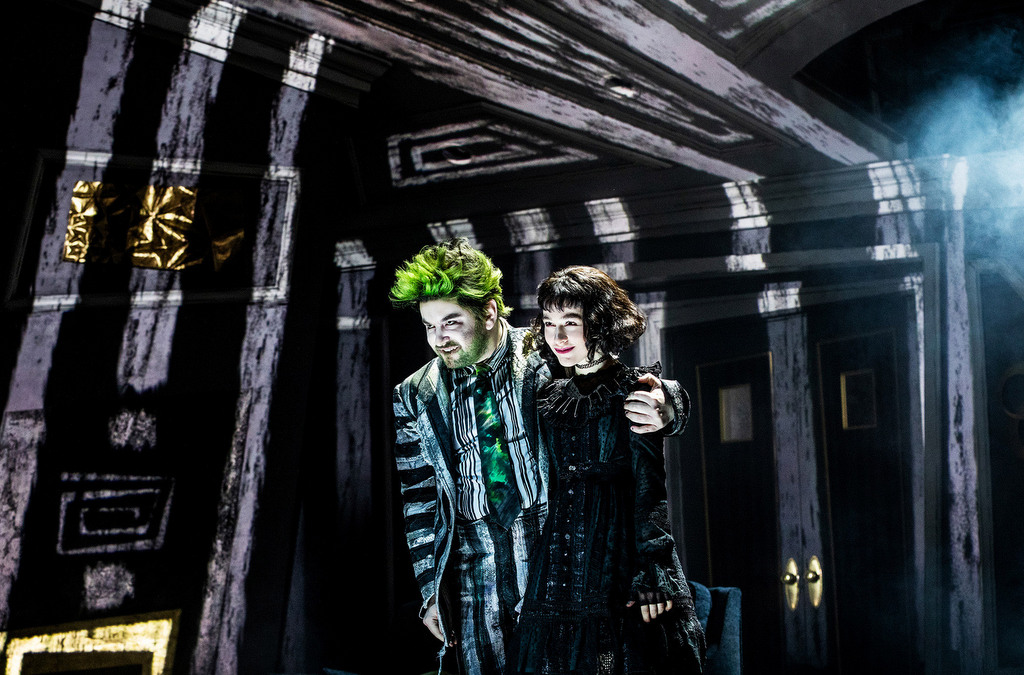
Alex Brightman, Sophia Anne Caruso in ‘Beetlejuice,’ (Matthew Murphy)
The plot is morphed from the film with songs to propel Lydia’s emotional moments and to introduce the characters of Barbara and Adam, owners of the house who meet an untimely death that Beetlejuice predicts, as he guides us through the events he directs to get himself resurrected. Kerry Butler and Rob McClure as the young couple become more interesting as they work with Lydia to overthrow Beetlejuice’s insidious intentions spurring on the dynamic conflict of the story.
Sophia Anne Caruso’s portrayal of Lydia is appropriate mouse at the outset as she sings in a near whine at the funeral, overwrought by her mom’s death. She becomes intriguing when she grows furious and insistent that her father Charles (Adam Dannheisser) will not even refer to his wife by name. Her empowerment increases after Charles brings along “life coach” Delia (the LOL Leslie Kritzer) to the house to assist him with his business development sales. She rebuffs Delia and then becomes rebellious when she finds her in her Dad’s bed. Lydia’s rebellion and loyalty to her mother’s memory blossoms into the secondary conflict.
The production builds rather slowly to develop these conflicts and characters; perhaps some of the songs of Act I drag. But if it’s in the service to form a contrast with Beetlejuice whose vibrant presence flings across the stage with unpredictability and surprise, then OK. Importantly, the build-up to the last scene of Act I is a fury of chaos as “Beetlejuice, Beetlejuice, Beetlejuice” usurps control and the house guests are possessed. Most humorous is the duplicitous Delia (Leslie Kritzer) whose Zen vibe flies out the window as she burps in shock, “Day-O,” and sings other phrases of “The Banana Boat Song”with the gyrating ensemble.

Leslie Kritzer, Adam Dannheisser in ‘Beetlejuice,'(Matthew Murphy)
This scene is smashing. We are delighted that Beetlejuice turns the world upside down as he breaks hell loose from its normally restrained moorings in the natural world. The handwriting is on the wall! Clearly, no one in the household stands a chance against him and his Legion. That is, unless Barbara, Adam and Lydia come up with a plan to thwart him.
Act II delightfully catapults one scene into the next as Beetlejuice attempts resurrection and Lydia seeks her mother. The cracked, funny characters of the Netherworld from the film pop out when Lydia travels there to seek her mom. But when she returns, she is anointed to escape hell’s clutches, so she successfully scrambles, racing away from demon football players and the cadaverous Juno (the funny Jill Abramovitz). All this is a power point presentation build-up to the riotous and satisfying last scenes of the play. This is no spoiler alert. You will just have to be brave, ignore the critics and see what happens. Unless you have forgotten how to laugh, you will roll in the aisles with delight.
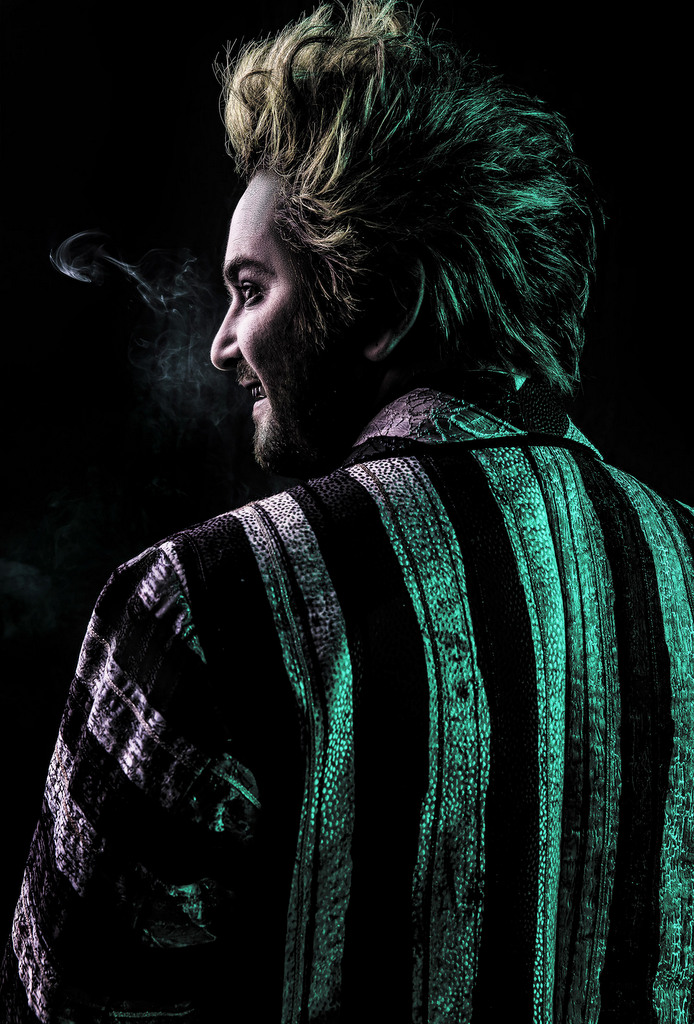
Alex Brightman in ‘Beetlejuice’ at the Winter Garden Theatre (Matthew Murphy)
The production is a frolic of ingenuity in its reproductions of Burton’s artistic design genius with enhancements that are novel thanks to the show’s creators and artistic team. Importantly, the musical retains the originally stylistic elements that worked to make the film into a cult classic. Fans are especially looking for this.
Where it is uneven is in setting the conflicts in Act I. Some of the songs seem lackluster and overlong. The strength of this musical comedy is in its tantalizing reproduction of the best of the film and how it threads the action and startling themes related to Beetlejuice’s intentions to resurrect himself. How he lets us in on his scheme then guides us through his process is the central focus. Beetlejuice and Lydia hold the strongest dynamic. Their developing characterizations are key. Brightman and Caruso rise to the level required for this with their extensive acting and musical talents, especially in the second act. Brightman’s performance is gobsmacking throughout; Caruso’s voice is sensational. The ensemble rounds out the performances adding fun and humor with great energy.
Beetlejuice is a LOL ride and must-see especially if you saw the film a number of times and appreciate its wit and originality.That is duplicated here with tantalizing twists as it leaps into life so disparate from the digital flats. The production runs at the Winter Garden Theatre on Broadway. For times and tickets go to their website by CLICKING HERE.
 CAROLE DI TOSTI