Blog Archives

Jonathan Groff is Phenomenal in ‘Just in Time’

Oftentimes, singers have the gift of reconstituting songs and making them iconic, then become celebrated for doing it. One example is Bobby Darin (1936-1973), who took the droll, sluggish “Mack the Knife” from Kurt Weill’s Three Penny Opera, and with a jazzy, upbeat swing, gave it a reverential life of its own. A singer, songwriter, and actor, Darin ambitiously sang all music styles from swing to folk, from rock and roll to country music. He played three instruments, won two Grammy awards and a Golden Globe in a fifteen year period before he left this earth, only to win more awards posthumously. For his efforts, he was inducted into the Rock and Roll Hall of Fame (1990) and the Songwriters Hall of Fame (1999).
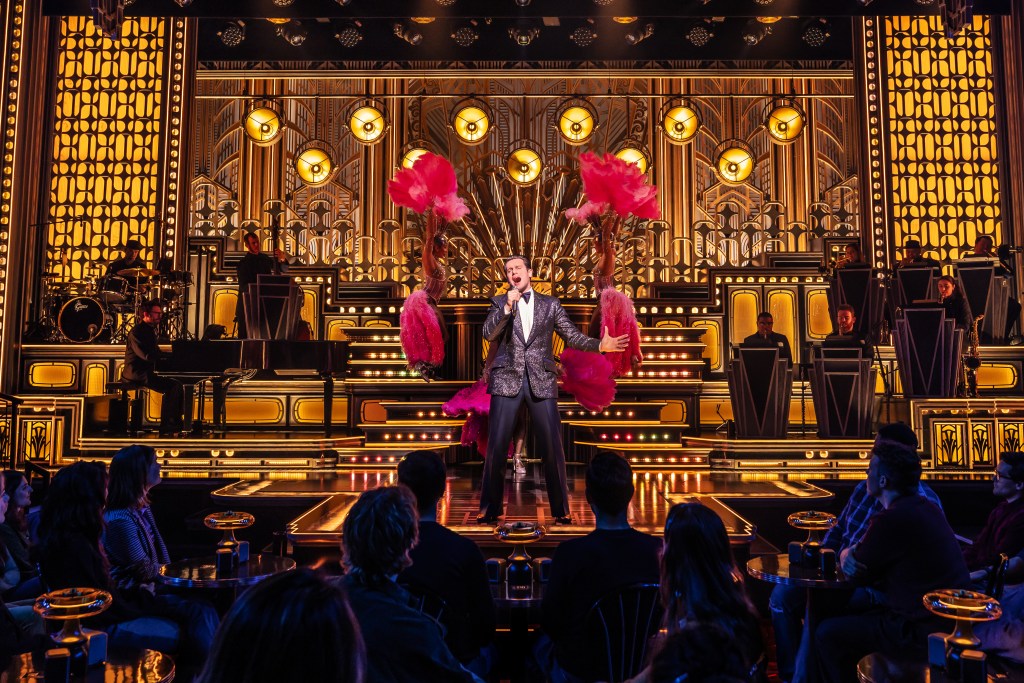
The chronicle of his life manifested a candle burning at both ends to accomplish whatever he could in his short lifespan. Just in Time starring Jonathan Groff as Bobby Darin shines a spotlight on what made Darin a consummate performer, as he reinvented his career by adjusting to the times. Key to this production is Groff’s winning, adorable persona and uplifting and empathetic approach to portraying Darin’s mystique.
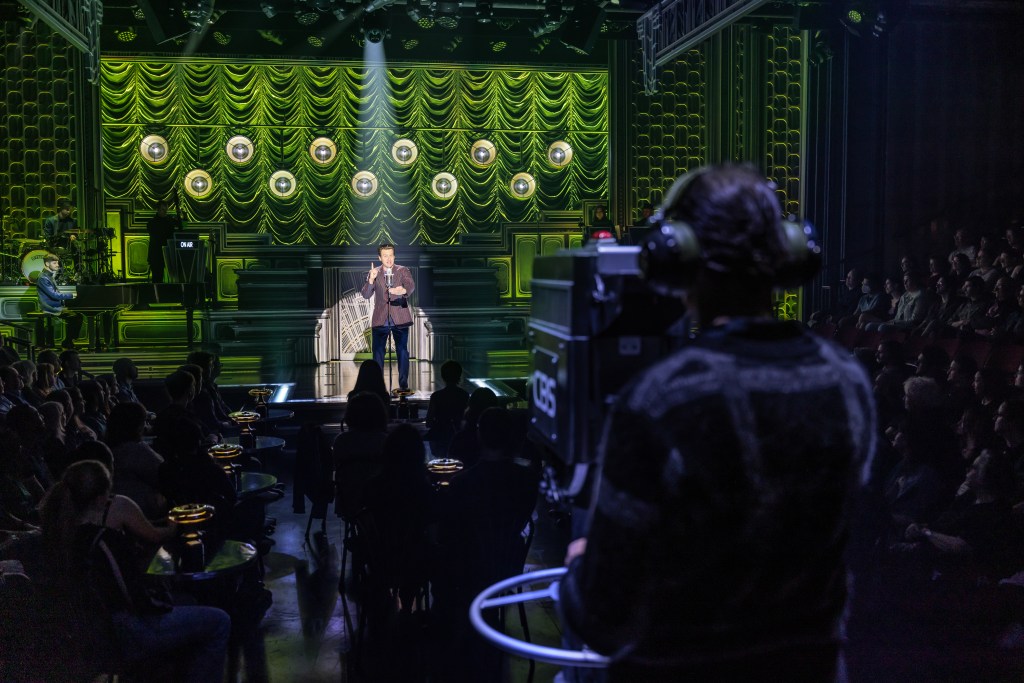
With an 11-piece band accompanying him and fine orchestrations by Andrew Resnick, this is an incredible show right out of the gate, though the book by Warren Light and Isaac Oliver based on an original concept by Ted Chapin cannot cover all of the salient information about Darin’s life for purists. However, it indeed is enough and a must-see. The exceptional Just in Time, developed and directed by Alex Timbers currently runs until November 30th at Circle in the Square.
To represent Darin’s ethos the production places the star in his favored venue, the nightclub. With set design by Derek McLane, Justin Townsend’s lighting design and Peter Hylenski sound design, Circle in the Square Theatre is transformed into both an exclusive nightclub and swank, intimate cabaret. There, Groff singularly portrays Darin’s trajectory in what has perhaps wrongly been limited as a “jukebox bio musical.”

The stunning sets around which Groff and the cast perform and enact more intimate scenes, open another aspect of the Darin persona. The immersive nightclub with two sections also converts to other settings with the use of a scrim and props. The floor area holds a cabaret-style seating arena where Groff and the others act amidst the patrons seated at tables. The multi-tiered stage of steps includes a dancing area banked on either side by the band, led by Andrew Resnick. Resnick plays piano, and supervises the music he has arranged which is vibrant, updated, resonant and heady.
Groff performs in both areas, but the showpiece numbers are on the higher levels where Darin’s Sirens dance, sing and perform with him in finely tuned, tightly choreographed numbers by Shannon Lewis. Darin’s glittering, alluring assistants include Valeria Yamin, Christine Cornish and Julia Grondin. Interestingly, theirs is an economy of movement as they surround Groff/Darin and join him with verve and style within the multi-levels of the set.

This design is exceptional and reflects the tenor of restraint, an ironic, perhaps meaningful limitation. Darin had severe health issues throughout his life and the knowledge that death was near, a terrible psychological/emotional/physical limitation, nevertheless spurred him on with a driving urgency. Darin pushed himself and everyone around him. He was about, “having a lot of living to do” because of his rheumatic heart. Despite his “mother’s” (the wonderful Michele Pawk), adjurations that the doctor told him nonsense that he would die in his teenage years, Darin took the doctor’s warnings “to heart.” He daily lived with death, and using the warning like a stoic’s “memento mori,” inspired himself to “live to the fullest.”

If anything, that is a theme of Just in Time. It is a riff on the idea that our time is limited and we must make the most of it with the gifts we have, as Bobby Darin did.
Just in Time originated as The Bobby Darin Story, a series of five concerts in 2018 at the 92nd Street Y, starring Groff as Darin. Since then its book and Timbers’ development and direction manifested a production with flowing, urgent forward momentum. Groff/Darin freezes the action with a “snap of his fingers” to add briskly paced narrative humor. These asides and direct addresses to the audience unfold Darin’s life story between upbeat club numbers dated for the time, but redirected for our time via Resnick’s arrangements. The entire production is set up as a series of night-club acts, and a stage performance to familiarize non fans with the man and his career.

However, before we discover Darin’s ambition and death-spur that propelled him, Groff is introduced as himself and assumes the relaxed, dressed to the nines (Catherine Zuber’s costume design), carefree, Groff-styled night-club persona. Groff twits the audience, making them his confidante, grounding it for his future direct addresses that will follow as a device that cycles through Darin’s life events briskly. These cover his childhood, the start of his career writing songs for Connie Frances, their relationship and break-up, his hits, the record company bosses, his revolutionary stylization of “Mack the Knife” and beyond to his relationship and marriage to Sandra Dee, its end, and his reinvention after he goes bankrupt.
As Groff zips and zags through the retrospective of Darin’s too brief life, we follow the whirlwind. Occasionally, we glimpse through the pull back of the curtain into his failing health, as Groff’s Darin initializes the stresses of his broken marriage and the revelation of a family secret that devastated him and most probably impacted his health.

In the opening set up of crooning songs “This Could be the Start of Something Big,” “Just in Time,” and lead in to the story of Darin’s life with the vamp of “Beyond the Sea,” Groff’s interpretations are sensational. Then, the audience is off and running with Groff’s self effacing line, “Whether you’re a fan of Bobby Darin, or one of the twelve people who watched “Mindhunter” – it doesn’t matter how I got you. All that matters is that you’re here and, tonight, you’re mine.”

And no joke, that’s the truth. We go with Groff down Darin’s memory lane, meeting his sweetheart that was not to be, Connie Francis (the sensational Gracie Lawrence), his “sister” always concerned for his health (Emily Bergl), his loving, show business influential “mother” (Michelle Pawk), and wife Sandra Dee (Erika Henningsen), among others who fill in various roles (Joe Barbara, Lance Roberts, Caesar Samayoa). As swiftly and smoothly as the first act spools, the second act covers his relationship with Sandra Dee, giving it short shrift, along with Darin’s political endeavor helping Bobby Kennedy’s presidential campaign. Darin was present at the Ambassador Hotel and suffered another devastation at Kennedy’s death.

The show concludes with Groff/Darin, back in the nightclub where he fits best after a few years of resettlement. As the final capstone song, the production ends with “Once in a Lifetime/That’s All” as Groff powerfully, forcefully pulls out all the stops and his closest family and friends give remarks upon learning of Darin’s death after open heart surgery. Groff concludes with poignant remarks, “Every breath we take is a gift we get to open. It isn’t enough. And yet, it is so much.” Groff back in his own skin, makeup off, in his own robust soul, passionately ends the gobsmacking evening with, “Thanks for spending this time with us. Goodnight. I love you.” And the audience gives love back with a resounding standing ovation.
Just in Time is a fabulous seduction, memorializing the life and times of Bobby Darin through Jonathan Groff’s being and perspective. To say he channels Darin limits the depth of the production. The separation between the men is always present and that is what makes this production rise above a “jukebox bio musical.” None of the songs are jukebox, but reformulated. None of the patter and narrative are crassly biographical, but more at symbolic and synoptic, like a review with song twists to elucidate the events and key turning points throughout Darin’s life. Time and effort have been taken to thoughtfully render the production’s success to a new crowd of Darin fans.
Just in Time runs 2 hours 25 minutes with one intermission at Circle in the Square. https://justintimebroadway.com/
‘Gutenberg! The Musical!’ Featherbrained, Loopy, Josh Gad and Andrew Rannells Shine!
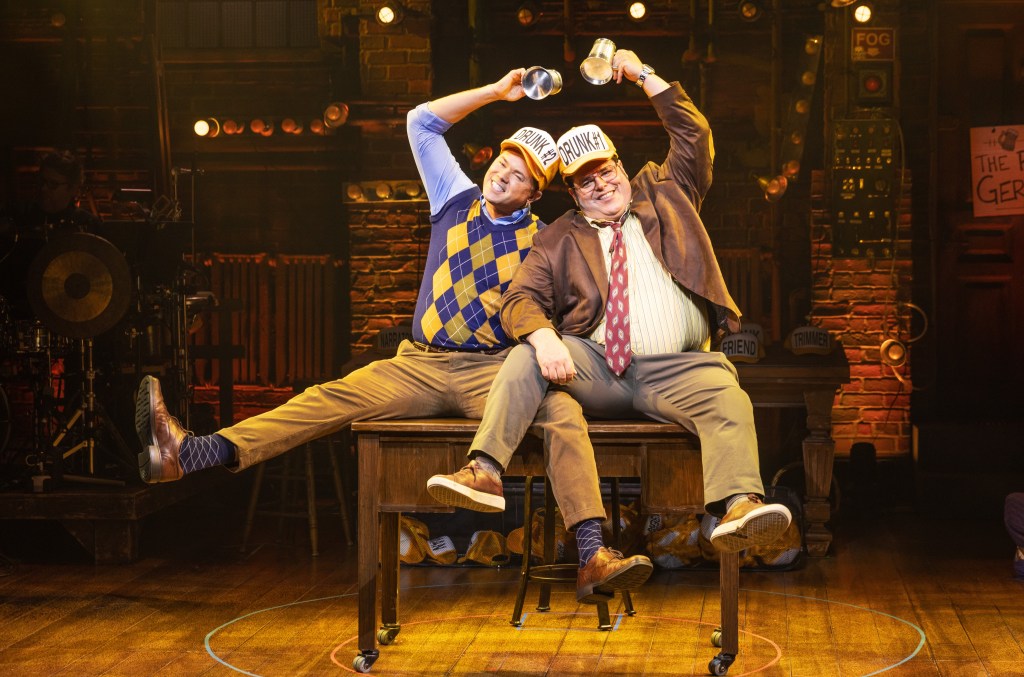
If you are looking for laughs and ridiculous fun, Gutenberg! The Musical! is the show for you. Thanks to the superbly wacky performances in this farce where Josh Gad and Andrew Rannells make a twosome of bat-sh*t silliness, Gutenberg! is a standout. Currently running at the James Earl Jones Theatre with one intermission in a two hour time slot, the zaniness is a treat to take you out of yourself. And who doesn’t need to “forget your troubles and get happy” in these times that try all of our souls?
The premise is well known: amateurs strike out for Broadway, draw in by the allurement of the “great white way.” In this iteration, two guys from New Jersey decide to toss the dice and bankroll a musical they’ve written to pitch it at a backer’s audition they set up at the James Earl Jones Theatre for a one night rental. Because they have to scrounge up the money by using the last dime of their inheritances, they can only afford a bare bones cast. Both play a total of twenty parts. They never change costumes except for hats in bold, black print which state their roles. For accompaniment they’ve hired a three-piece, local band that plays weddings, bar mitzvahs, retirement parties, etc.
Their thought is if they are good enough (ah, there’s the rub), they will get funding from producers to mount their musical on Broadway. Thus, Gutenberg! is theater “vérité,” happening with immediacy. Sitting in the audience, we are told, are various producers who’ve received invites. Thus, the audience bears witness to whether or not these Jersey guys have what it takes to sizzle and shine or fizzle and die on the vine of their dreams.

Scott Brown and Anthony King (book, music and lyrics), launch the show into the stratosphere of inanity. Not only are Bud (Josh Gad) and Doug (Andrew Rannells) below average talents, they have little expertise about what makes a musical or any show for that matter. Furthermore, their lyrics, rhymes and meaning rival the simplicity of Dr. Seuss.
But all is not lost. Interestingly, Dr. Seuss is extremely popular because it capitalizes on being silly. Additionally, the wild duo are winning and lovable. What Bud and Doug lack in talent and expertise, they make up for with enthusiasm, joie de vivre and hilarious, charming schtick.
As a side note, Gad and Rannells, who haven’t been together since Book of Morman, are terrific in curtailing their exceptional talent just enough to be a tad off, making their portrayals as Bud and Doug even funnier. Of course, this adds to the inside joke about who they really are and what they are capable of. Indeed, the audience was tuned to the inside jokes.

Gad and Rannells have fun playing it to the hilt with tongue in cheek direct addresses to the audience and a shattering of the fourth wall, as they move along the plot about a dry subject, the life and times of Johannes Gutenberg, inventor of the printing press. As it turns out Gutenberg is a topic about which little is written and much can be embellished and fictionalized. That is why Bud and Doug have found it to be a glorious subject for a “fantastic” musical.
Ironically, referring to their content as historical fiction, they share little factual information about the man and the time. In falling back on fabrication, which currently is trending in political news and the radical conservative, nihilistic, QAnon wing of the “Republican” Party, Bud and Doug’s fantastic tale is hugely satiric. It indirectly points the finger at the last seven years of Trumpism, when the playing field of misinformation became normalized through the efforts of conservative media. Lies of omission, conspiracy theories and sheer made-up junk swanned as legitimate and newsworthy.

Take for example reports on Italian space lasers causing the 2020 election to be stolen from former president Donald Trump. (Look up recently convicted Trump lawyer Sidney Powell, if my reference to Italian space lasers eludes you.) Such theories are inane fabrications such as those found in this musical.
On the other hand for all its guffaws, belly laughs and puerility, Gutenberg! is as serious as a heart attack. If you peek underneath the abundant blanket of hysteria, it actually makes grave points.
That Scott Brown and Anthony King convert the momentous occasion of the birth of Gutenberg’s printing press, a turning point in history, into a farce that nuances themes about the perils of illiteracy, is profound as well as riotous. In truth illiteracy and “not reading books” is disastrous, when considering the culture wars of the South and their twisted turn into banning books. Making indirect inferences to the QAnon pride of ignorance against the elitism of the educated, Gutenberg! twits us with its ridicule about our present time.

This is especially so with the musical’s humorous, historical reminder of how ignorance leaves an open door for the power hungry. In its Act II arc of development, after the printing press has been invented, the villainous, devilish monk completes his scheme to target Gutenberg and destroy his press. Representing the power of the church which historically exploited the ignorant and illiterate, we understand the benefits of keeping the uneducated, non-reading masses brainwashed, oppressed and afraid.
In portraying the monk with a nefarious purpose, Gad is riotously funny. He pings all the notes of the stereotypical wicked, leaving the audience LOL. Of course, his crafty portrayal stings, if one moves beyond the laughter to the quiet message underneath. Despotism only works well with the uneducated, non-reading, non-thinking masses who are often too distracted to distinguish the truth from fiction and lies.
Throughout the winding action which involves anti-semites, Gutenberg’s fictional German town of Schlimmer, a wine press becoming a printing press, a pretty, violent white cat named Satan, a maid named Helvetica, pencils that kill, Brechtian breaks and commentary about the musical, and so much more, Gad and Rannells create their comedic, whirlwind sketches at Alex Timber’s breakneck pace. Seamlessly stirring the narrative segues, then plunging back into the action as they don the various hats of the characters they portray to trigger spot-on caricatures with their voices and gestures, they send up the “politically warped” stereotypes and spin this delightful musical farce with lightening speed.
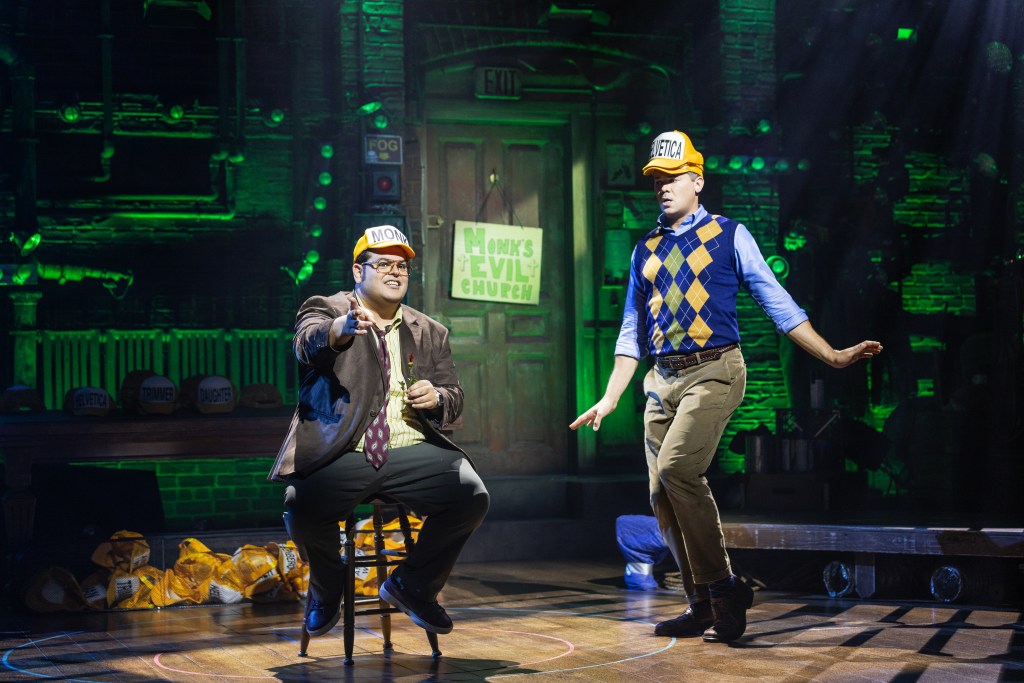
We have been led into the “secret world” of a backer’s audition for a production that is a loser and a winner. Maybe with a little revision, a tweak here and there, a consolidated cast, a reworking of the more incredible elements, a producer will envision its commercial vitality? Maybe not. You have to see it to find out if the producers line up to sign on or hold their noses and back out quietly.
Importantly, during the process, Gad’s Bud and Rannells’ Doug steer the audience from joke to quip to zany song with an aplomb that is exhaustive and exhausting. Assisted by Scott Pask’s scenic design of the stripped down stage, Emily Rebholz’s costume design which is appropriate for Doug and Bud’s dorkish affability, Jeff Croiter’s lighting design and Tommy Kurzman’s hair design, the actors fulfill Timber’s tone and vision for this seemingly facile, but humorously febrile, profound musical. M.L. Dogg and Cody Spencer’s sound design is spot on; I could hear every word.
Kudos goes to the orchestra which includes Marco Paguia (conductor/keyboard 1), Amanda Morton (associate conductor/keyboard 2) and Mike Dobson (percussion). Additional arrangements are made by Scott Brown and Anthony King. T.O. Sterrett is responsible for music supervision, arrangements and orchestrations.
This is one to see for the fun of it. It is also a sardonic criticism of our time, which, thankfully, doesn’t slam one over the head with pretentious probity. For tickets go to the Box Office at 138 West 48th Street or visit their website online https://gutenbergbway.com/ It closes January 28th.
‘Here Lies Love,’ The Stunning Bio-Pop-Musical Sounds Alarms About the Price of Democracy

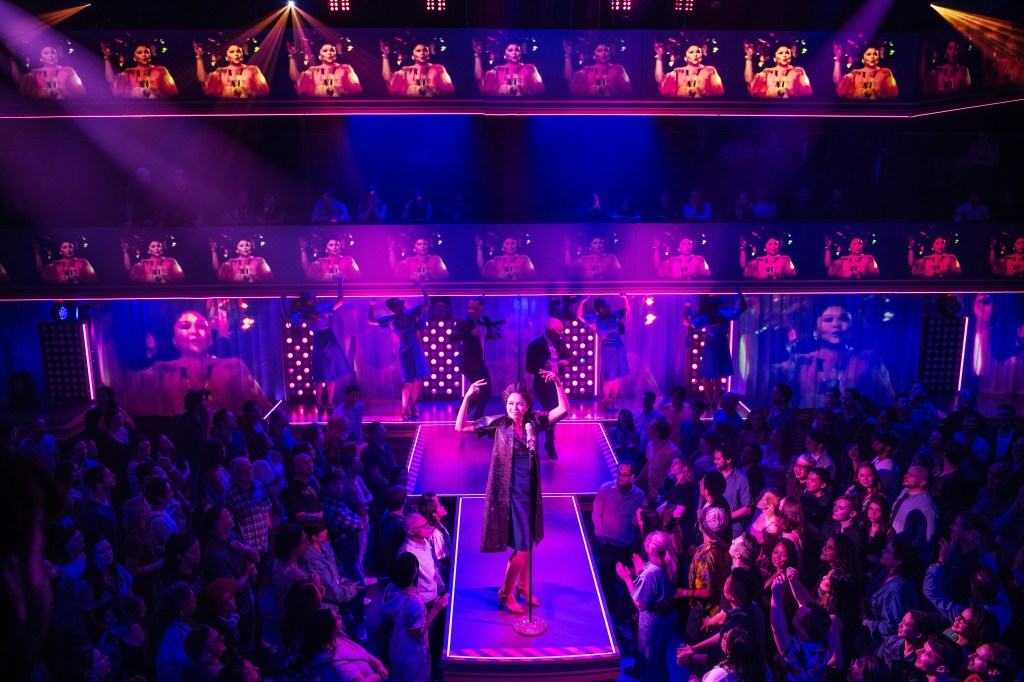
The Millennium Club is the phenomenal, multi-level, theatrical setting of the bio-pop musical Here Lies Love. The resulting panorama is a monolith of disco and pop music, many-hued neon lights, black and white historical film clips, multiple dazzling screen projections, and spot-on performers’ heightened song and dance moves “here, there, everywhere” in living color. With 12 musicians (guitar, percussion, bass, etc.) some of the musical backing is prerecorded like karaoke, a cultural staple in Filipino lives. All this is the backdrop to David Byrne and Fatboy Slim’s spectacular immersive, sensorial, orgiac experience currently at the Broadway Theatre.
At the unfolding of the alluring dance party, the political and social history of 20th century democracy in the Philippines coalesce under a gleaming, disco ball. On the dance floor the pink, jump suited ushers shepherd and move the audience around a platform in the shape of a cross (a coincidental reference to the predominately Catholic country) that in a different configuration later becomes the bier upon which the coffin of the assassinated Ninoy Aquino moves leading the audience in the funeral procession.

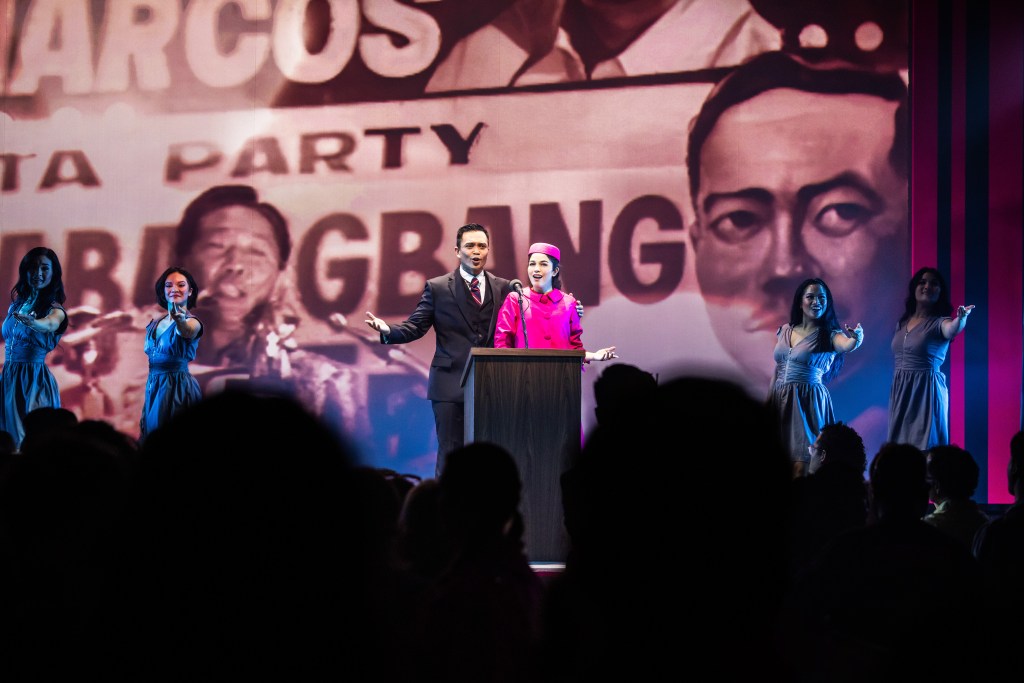
On the second level, the jazzy, sun glass-wearing, cool, black-leather outfitted DJ (Moses Villarama) amps up the crowd, encouraging their investment in the show’s diversions. Throughout, the audience members in the balconies on three sides and on the first level dance floor, cheer, mourn, laugh and applaud. Their interactive roles as the captivated conspirator/citizens allow them to witness and participate in the iconic rise and fall of Ferdinand (Jose LLana) and Imelda (Arielle Jacobs) Marcos, celebrity leaders turned dictators.
With American encouragement and influence steeped in an autocratic colonial past, the Marcoses’ initially inspired governance devolved into a brutal, self-serving regime. Peacefully overthrown by the People’s Revolution (1986), after years of repressive, murderous authoritarianism, the Marcoses’ story masterfully stenciled by Byrne, Slim, Clint Ramos’ research and Alex Timber’s enlightened direction, is an important work for us in our time of QAnon, Donald Trump, the Federalist Society’s purchase of Supreme Court Justices, the Dobbs’ Decision and foreign donor’s dark money purchasing politicians, who, to feather their own agendas and dilute and destroy global democracies and the right of the people to self-governance.

The narrative of Here Lies Love is an encomium in song and dance. In its Broadway premiere ten years after its off-Broadway premiere at the Public (2013), the musical features Filipino producers and is brilliantly performed by an all-Filipino cast. With passion they portray the narcissistic Marcoses and their acolytes, who conspired to gradually hoodwink citizens to dance to the Marcoses’ siren songs.
Importantly, the production highlights the heroes. It is their vision for the Filipino people, and their hopes for a democratic country, that inspired them to risk their lives for the Filipinos’ right to “a place in the sun.” These courageous exposed and railed against the Marcoses’ excessive squandering of millions of dollars in a luxurious lifestyle, while a majority of deprived citizens had insufficient access to life-sustaining food, shelter, clean water and the freedom from military terror. This is the story of their love, and the sacrifice of their lives in the revelation of how easily leaders may fall prey to their own crass weaknesses and destroy a nation they disingenuously proclaim to love.

Key among the heroes is the liberal leader of the opposition party, Ninoy Aquino (Conrad Ricamora in an inspired and dynamic portrayal), and those aligned with Aquino like his mother Aurora Aquino (the wonderful Lea Salonga). Aquino’s persistent example, assassination by the Marcoses who were never held accountable, and subsequent martyrdom paved the way for the People’s Revolution.
Though the Marcoses are key players in the musical, Byrne and Slim make sure through quotes and commentary from interviews and news reports that praise does not go to the despots, one of whom is still attempting to exert power today through her son and president of the country. Here Lies Love is an object lesson in vanity, dereliction of duty, self-deception and treachery which Fatboy Slim and Byrne spin with irony in their lyrics in the title song, “Here Lies Love,” and in Imelda’s concluding song, “Why Don’t You Love Me?” written by Byrne and Tom Gandey.

Though the title of this production belies Imelda Marcos’ “love” for her country (she affirms her epitaph should read “here lies love”) Byrne, Fatboy Slim and director Alex Timbers underscore the hypocrisy of her love revealed in the musical’s arc of development. Her hypocrisy and velvet insidiousness are especially demonstrated in the 3,200 Filipinos killed, 30,000 tortured and disappeared and 70,000 imprisoned (the numbers are higher most probably).
These statistics are listed in the surrounding projections in black and white. The musical uplifts the Filipino people’s resilience, courage and love of their countrymen and women. The citizens are a shining example for democracies around the world and for whom the musical’s title really applies. Indeed, the Filipinos’ love is demonstrated in the People’s Revolution at the conclusion, and culminates memorably in the final poignant song.

The production is majestic and profound. Its themes counsel that citizens of democracies must be sentinels against those like the Marcoses, who would exploit democratic elections, usurp power, declare martial law, and order the military to protect the powers of the executive, while disbanding all the other branches of government. By silencing their critics and killing opponents, dictators like the Marcoses rebrand terrorism as law enforcement in order to steal from the treasury and maintain their hold on power. This follows after smearing the opposition, jailing perceived enemies without due process, nullifying democratic laws and wiping out a free and fair press, who cannot call out their crimes.
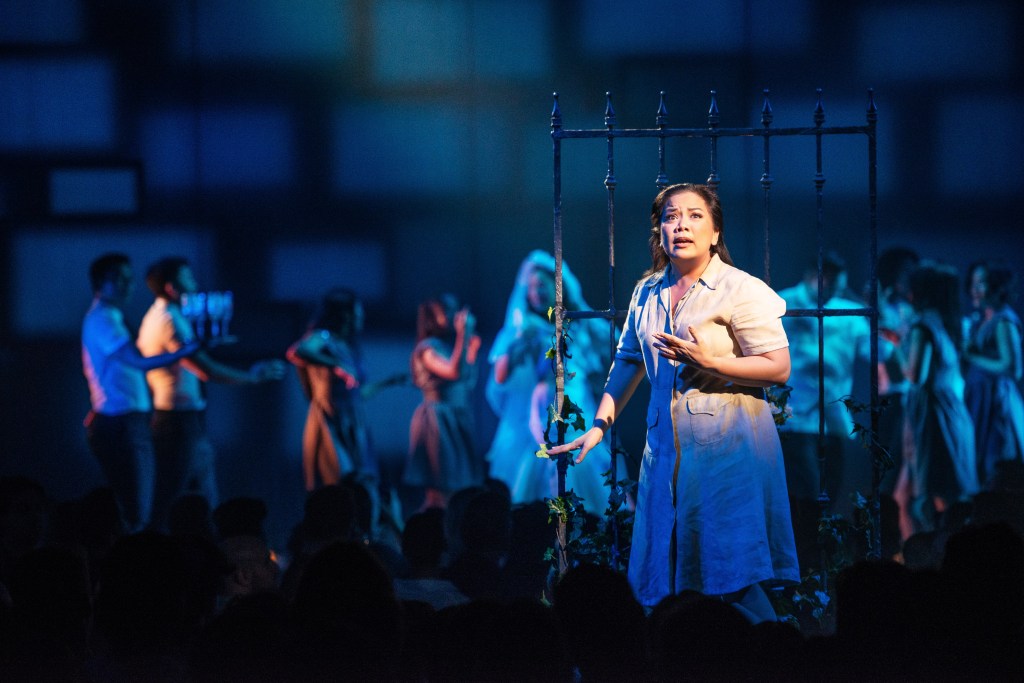
All of these egregious actions Ferdinand and Imelda Marcos did while the United States turned its head and looked away.

Thus, as the audience dances and follows the guidance of the ushers and DJ, they are initially blinded and mesmerized by the fantastic surreality of beauty, fun and energy. And as Imelda the beauty queen ends her relationship to Nimoy Aquino and takes up with Ferdinand on a publicized 11 day whirlwind romance that ends in a white wedding, we watch as she morphs from the naive country girl to the savvy doyen of American fashion and celebrity. The “steel butterfly” (a nickname given to her by the press), has become a clever political animal, who is a help meet to ruthless Ferdinand right before our eyes.

The 90 minute dance party summarizes the Filipino seduction and decades of growing repression in key events. After their marriage, Imelda is overwhelmed by being in the limelight and has a nervous breakdown, requiring therapy and becoming addicted to drugs. Jacobs portrays the changes in Imelda convincingly. When she sings “Walk Like a Woman,” we realize that the once innocent girl has become a seductively calculating political creature as she tirelessly campaigns with her husband and helps him win the presidency. She becomes knowledgeable about culture and obsessed with the construction of buildings (The Philippine Cultural Center), which draw attention to herself as a celebrity but do nothing for Filipino citizens.

The projections and black and white film clips from archives are salient in revealing the glittering Marcoses rise. Byrne’s lyrics are from interview quotes and reports covering the Marcoses and Aquino. Photographs show Imelda with everyone from Andy Warhol to various leaders like Ford and later Reagan,, who propped up the Marcoses and gave them sanctuary in Hawaii after they fled during the People’s Revolution. Ricamora’s Aquino gives rousing speeches about Imelda’s egregious use of funds for a cultural center (“The Fabulous One/I’m a Rise Up”) which sets the audience/citizens on edge and alerts them to financial corruption in the Marcos’ regime every time Aquino calls them out. Byrne creates lyrics that borrow heavily from his speeches.

The turning point comes after Marcos’ scandal with American actress Dovie Beams, whose impact on Imelda is ironically highlighted in a dance number with multiple “Dovie Beams” in black bikinis and blonde wigs. The original tape recording between Beams and Marcos is played during this point in the production accompanied by music and lights reinforcing the spectacle. Imelda considers that “Men Will Do Anything” (Jasmine Forsberg is Imelda’s powerful inner voice).
Losing trust in Ferdinand, she conveniently latches onto self-deception and sings of her dream that she is the people’s star and slave (“Your Star & Slave”). As she disingenuously commits herself to her country, Ferdinand, licking his wounds in embarrassment, retires to the hospital with Lupus and attempts to win Imelda back. Jacobs and Llana’s duet “Poor Me,” is a beautiful example of a couple lying to each other, complicit in keeping their hold on power.

The beating of students protesting the Marcoses’ corruptions, Estrella’s (the heartfelt Melody Butiu) revelations of Imelda’s lies about her heritage (“Solano Avenue”) and Estrella’s subsequent arrest and punishment for going to the press, puts the Marcoses’ maladministration on everyone’s radar. Aquino speaks for the masses in his criticism of Imelda, which she and Ferdinand not only ignore, but feel victimized by. The easy way dictators shift blame and beat their breasts about being persecuted is highlighted by Byrne’s song and incredibly acted by Llana and Jacobs. One almost believes they are victims and the unjust criticism is weaponized by Aquino, protesting students and opponents.
After bombs go off in Miranda Plaza wiping out almost all the liberal party, Marcos blames it on the liberals (1984 fascist logic-why would they intentionally kill themselves) and declares martial law in Order 1081. Byrne and Fatboy Slim have outdone themselves in the lyrics and forceful, pounding music that codifies the new dictatorship and power grab by the Marcoses. During the performance of “Order 1081,” the statistics enumerate the casualties of the Marcoses’ punishments for for protests. Ninoy Aquino is jailed for 7 years. There are no trials, just guilt and oppression. The staging and performances are shocking and disturbing.

We ask, what? Are the glorious Marcoses murderers? Indeed. And they act privileged and justified in brooking all “nefarious” opposition.

After seven years when the jailed Aquino needs a heart operation, the Marcoses send him and his family to America on the stipulation that he never return. Aquino doesn’t keep his promise to the criminal dictators. Instead, he sacrifices his life, an assassinated martyr, which is another shocking blow in the musical slammed into the audience’s psyche with all the force of lights, sound effects and music that explode when the audience least expects it. And in the aftermath with Salonga’s song as Aquino’s mother, the crowds at his funeral effected by the ushers and the coffin on the platform are staged with impeccable emotional poignance.
Timbers reveals how the Peaceful Revolution happens in the staging and the surrounding projections. We understand that the crowds demand Marcos’ resignation after a rigged election in which he proclaimed himself the winner. The people’s massive protests demand the Marcoses resign. Ronald Reagan gives his friends sanctuary in Hawaii, announced via projections of New York Times’ headlines. It’s an appalling closure to the Reagan administration’s supporting dictators and murderers who deny culpability.
Ironically, in the musical it’s a blip that passes speedily which Byrne intentions because he is sardonically indicting the Americans for supporting dictators as a horror of colonialism’s aftereffects. Also, it is incredibly current and an expose of the Republican MO to protect their own. They conveniently pardoned Nixon’s criminality during Watergate and refuse to censure or disqualify Donald Trump as a presidential candidate indicted for his crimes against the country.
The last song “God Draw’s Straight” (But With Crooked Lines) is a testament that democracy depends upon the power of the citizens worthy to govern themselves. The song is magnificent, encouraging and a reminder that citizens must actively resist the lies, excesses and dereliction of corrupt, dangerous leaders, by continually calling them down in peaceful protests.
From the top of the dance party whose song “American Troglodyte” incriminates the Marcoses’ chief influencer, the crass, monopolistic, corporate consumerism of America, to “God Draw’s Straight” (But With Crooked Lines), this gobsmacking production chronicles how the Marcoses, emblematic of how dictator-murderers, subvert democracies and rise themselves up through lies, misinformation, disinformation, propaganda, self-victimization and the vitiation of constitutional government in exchange for military oppression and terrorism. Of course, the dictators justify their crimes with the “poor me” ploy, the refusal to admit responsibility and martial law directed to empower and protect them.
Every American citizen should see this incredible work of art whose creative team worked overtime to meld all the technologies and elements to effect Timbers,’ Byrne, and Slim’s (with additional music by Tom Gandey & Jose Luis Pardo) vision. The performers are incredible, invested, determined to express this vital story that must be told.
Special recognition goes to Annie-B Parson’s choreography, Clint Ramos versatile and quick change costume design (referencing the times according to news articles and video clips), Justin Townsend’s lighting design, M.L. Dogg & Cody Spencer’s well-balanced sound design (not any easy feat with such a venue), Peter Nigrini’s wonderful projection design, Craig Franklin Miller’s spot-on hair design and Suki Tsujimoto’s make-up design. Additional kudos goes to J. Oconer Navarro (music director), Kimberly Grigsby and Justin Levine (vocal arrangement), Matt Stine and Justin Levine (music production & additional arrangements).
I’ve said enough. For tickets and times go to their website https://www.telecharge.com/Broadway/Here-Lies-Love/Ticket
Photos by Billy Bustamante, Matthew Murphy and Evan Zimmerman (2023)
 CAROLE DI TOSTI