Blog Archives
The Fine June Squibb Heads up the Stellar Cast of ‘Marjorie Prime’

When Marjorie Prime by Jordan Harrison opened Off Broadway in 2015, starring Lois Smith, it appealed as science fiction. Since then the use of various forms of artificial intelligence to support human behavior have become ubiquitous.
Reinforcing this new reality the playwright and director Anne Kauffman dusted off the prescient family drama and shined it up for its Broadway premiere with few changes to the script. Maintaining the prior production values, director Anne Kauffman works with set designer Lee Jellinek, sound designer Daniel Kluger and Ben Stanton’s lighting design to create the almost surreal and static atmosphere where AI takes over the lives of a family and exists for itself in the last scene.
The production runs at the Helen Hayes Theater with the superb cast of June Squibb, Cynthia Nixon, Danny Burstein and Christopher Lowell through February 15. They are the reason to see the revival.
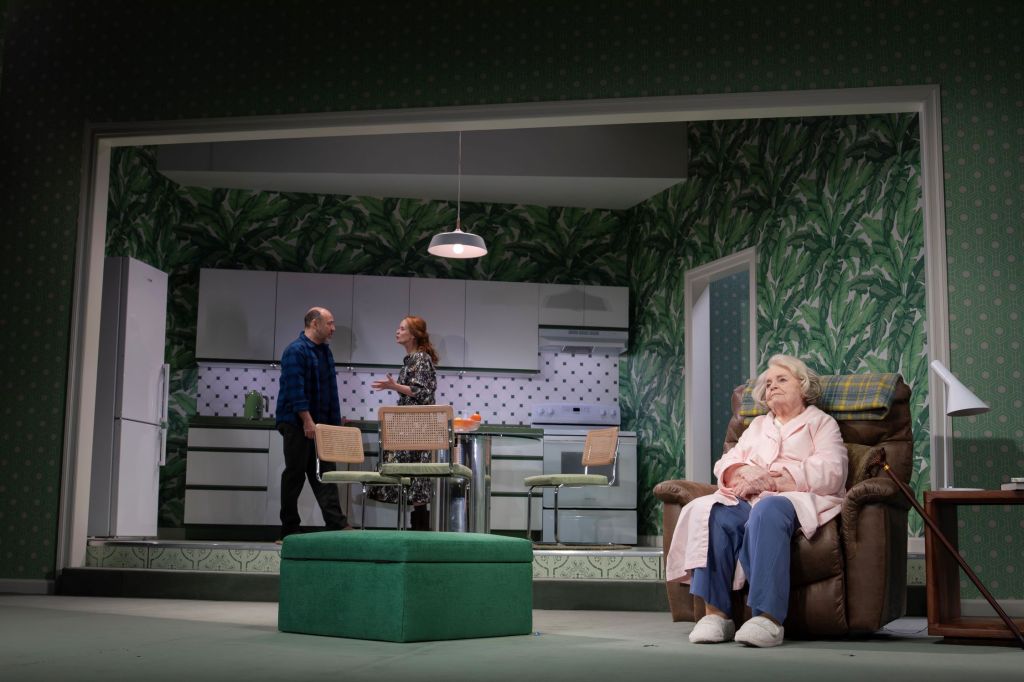
On one level the excellent performances outshine the themes of Marjorie Prime which deal with death, identity, the grieving process, artificial intelligence and more. The science fiction aspect of the play, so striking before, has diminished.
Yet, Harrison’s conceit that AI holograms might be used to reconcile the death and loss of a loved one still fascinates a decade later. Our culture fights death and aging with its emphasis on ageless appearance, looking 25-years-old at the chronological age of 90-years-old. Some other cultures have a healthier approach, viewing the acceptance of death and aging as a normal part of life cycles. However, with technological advancements, regardless of the culture or country, AI will have its uses in the battle against disease, dying, death and mourning.
The “Primes,” in Marjorie Prime are the spitting image of loved ones at a particular time in their lives. Created by the company Senior Serenity to help the bereaved get through inconsolable grief, Marjorie’s family believes a holographic duplicate of husband Walter will help her adjust to his death. The replica keeps her engaged, sentient and interactive, unlike passively watching TV.
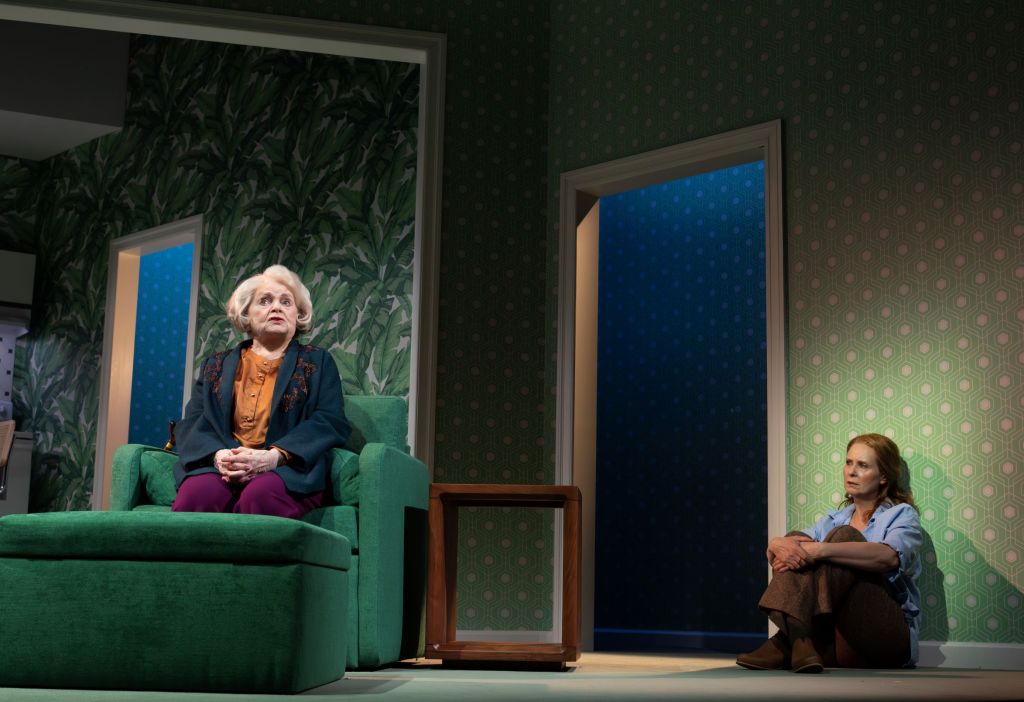
Walter Prime (Christopher Lowell) duplicates the younger, good-looking Walter in his thirties. Happily, he reminds her of the distant past, not the more recent, sick and dying Walter. The hologram’s programming and presence also help stir Marjorie’s memory, complicated with dementia. A work in progress, Walter Prime evolves based on the information that 85-year-old Marjorie (June Squibb), her daughter Tess (Cynthia Nixon), and son-in-law Jon (Danny Burstein), give him about Walter and Marjorie’s life together.
Thus, at the top of the play Walter Prime and Marjorie discuss movies they went to, for example, My Best Friend’s Wedding, which Marjorie has forgotten until Walter tells her the synopsis. The spry 96-year old Squibb, who made her Broadway debut playing one of the strippers in Gypsy (1959), portrays the spicy, funny, confused, chronologically younger woman with a failing memory, an irony that amused me to no end. Squibb is just terrific.
As Marjorie’s identity and memory dim, Walter Prime builds up the identity of Walter with her help. However, Harrison’s play raises questions about this process and never answers them. For example, how much information has Walter Prime been fed prior to his engagement with Marjorie, Jon and Tess? How can Marjorie be expected to keep track of information from before their marriage into their elderly years with her failing memory? Won’t she feed him incorrect details?
Indeed, facts and details shift and Marjorie confuses the truth. An imagined past becomes easier to accept with one’s husband “Prime” fed information by others. This problem never resolves. Neither does Tess’s incomplete acceptance of Walter’s function to stimulate Marjorie, the supposed benefit that Senior Serenity, the company that made him, affirms. The impatient, edgy Tess doubts Walter’s usefulness, but the upbeat Jon thinks that he helps improve Marjorie’s engagement and memory.

When Walter Prime’s presence annoys Tess, Jon accuses her of jealousy. Does Marjorie prefer Walter over Tess, who must nag her mother to eat and “obey” her in the reversal of mother/daughter, parent/child roles? Losing her autonomy Marjorie must rely on Tess and Jon in her living arrangements and personal care needs.
As Jon, Marjorie and Tess converse in Jellick’s minimalist, living room-kitchen combination that lacks futuristic style, Walter Prime sits on a sofa in the living room. He waits in a “listening mode” ready to interact when needed.
For his part Jon is positive about Walter’s impact on Marjorie. As the scene progresses, Tess mentions after an interval that her mother surprisingly recalls a situation long buried in pain. We learn the specifics of this later in the play. Some of the action referred to happens off stage. (i.e. Tess and Jon take Marjorie to the hospital after a fall).
Guided by the “Primes,” who Harrison sequences to move the action forward, time jumps. Marjorie has died and Jon and Tess engage Marjorie Prime to help console Tess and move her through her bleak depression and grief at her mom’s passing. After that we learn through Jon’s conversation with Tess Prime what transpired with Tess. In the various scenes Nixon’s Tess gives a heartbreaking speech about her mother, memory and imagination which sets up the rest of the play. Burstein’s Jon listens and responds with an uncanny authenticity. Both are superb.
Since the “Primes” “live” forever in holographic form until someone decommissions them, they occupy the home in the last scene. Jon is elsewhere, so Walter, Tess and Marjorie converse among themselves having been given life from their human counterparts as an ideal, evolved “being.” Eerie perfection.
Marjorie Prime runs 1 hour 15 minutes with no intermission at the Helen Hayes Theater on 44th Street until the 15 of February. 2st.com.
‘The Bedwetter’ a Hysterical and Meaningful Sarah Silverman Romp

Sarah Silverman is a legendary comic and she may have been born with a funny bone. But how did she morph into the talented comedian who has a musical production about her early life, playing eight times a week at the Atlantic Theater Company? We discover the inspirations that planted the seeds of comedic success in the very humorous, irreverent pop music show The Bedwetter. Based on Silverman’s memoir The Bedwetter: Stories of Courage, Redemption, and Pee, the theater adaptation highlights the most important year of Sarah Silverman’s life, a year that intimated the possible future success Silverman would offer in her unique comic grist.

With book by Joshua Harmon and Sarah Silverman, lyrics by Adam Schlesinger and Sarah Silverman, music by Adam Schlesinger, choreographed by Byron Easley with creative consultation by David Yazbek, The Bedwetter is a hoot. Also, it is ironically woven with themes about divorce, mental illness, childhood angst and dysfunctional families. The two act musical briskly unfolds via the comical and exuberant perspective of precocious, potty-mouth Sarah played by the uber talented and sharply focused Zoe Glick.

Glick is a wunderkind. Her pacing, nasal singing voice and edgy delivery reveal she is a natural. She portrays Sarah as a loving, exhausting, “in-your-face, quick-witted love bug who goes through a series of disastrous events at the worst time in her life. The momentous problems occur at the formative age of ten-years-old when she has to go through her parent’s divorce, her mother’s increasing depression, her father’s philandering with most of the moms in town, and a move which forces her to attend a different middle school where she has no friends.

Though she manages to face these cataclysms with the help of her alcoholic Nana played by the inimitable Bebe Neuwirth in a wonderful turn, there is one issue which is insurmountable. She is a bedwetter. The secret remains among family and perhaps former friends, however, it cramps her style with making new acquaintances. Not only is she embarrassed because she is “too old” to wet the bed, her terrible debility infantalizes her. Thus, she feels inferior and demeaned by a condition she can’t control. The opening number (which also closes the show in a beautifully made sandwich) “Betterwetter” encapsulates all of her issues. Glick sings it with zing, verve and joy.

Interestingly, wetting the bed at her age, we note, must be related to her parents’ divorce, the move and inner stress. And then we discover that it is genetic. Her father Donald (the humorous Darren Goldstein who rocks many women’s boats) also wet the bed. However, as he enjoys reminding her, he did grow out of it. Sarah wonders when that wonderful occasion will happen in her life to end the emotionally painful stigma.

As we follow Sarah who introduces us to her family, we meet her sister Laura (Emily Zimmerman) who disowns her in school and puts up with her at home, decrying she doesn’t know who she is and how she is a part of the family. Interestingly, in Act II, Laura’s approach changes after Sarah’s life takes nullifying downturn. And when Nana has to be hospitalized, the Laura softens her attitude toward Sarah. Then the sisters unite and become close again. As Laura, Emily Zimmerman works the transformation from annoyances to hypocrisies to fear and concern for Sarah in a fine and authentic acting and singing performance.
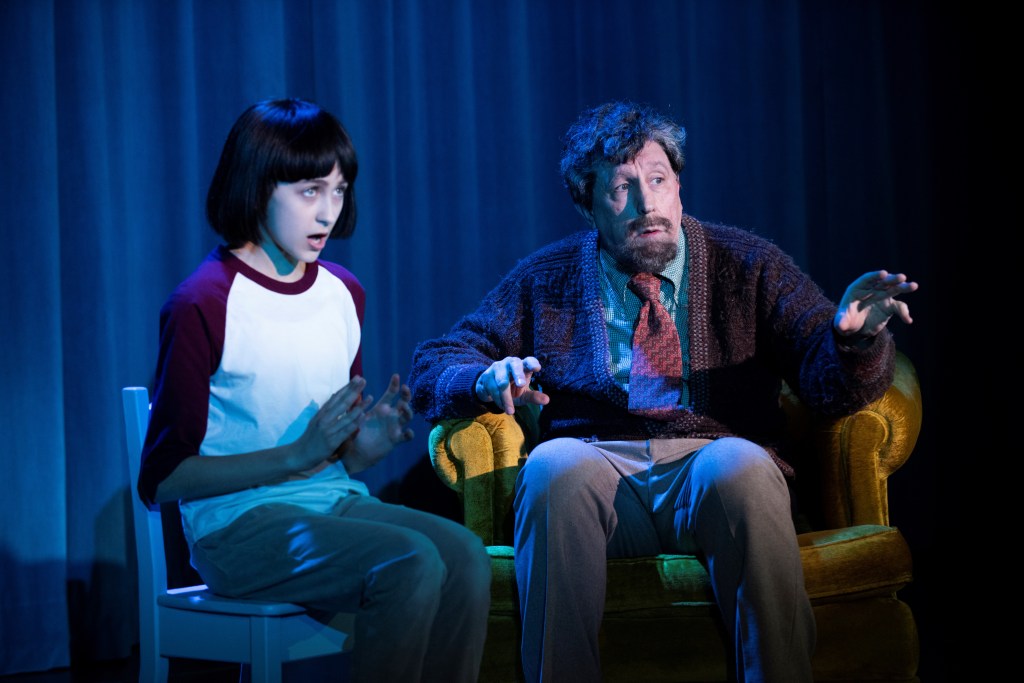
Sarah’s mother Beth Ann, normally portrayed by Caissie Levy covered by Lauren Marcus the night I saw the production is only capable of staying in bed and watching television. We learn why this situation abides in the second act when a fight erupts between Beth Ann and Nana and the truth spills out. It is then we understand Beth Ann’s depression and feel empathy for her. However, Nana ends up becoming sick over the remembrance of what happened. Indeed, her hospital stay reveals self-punishment and feelings of guilt for she feels responsible for events that cause Beth Anns’ depression.

Considering the circumstances of her caved-in life, Beth Ann does the best she can. She is aware of Donald’s philandering, one cause for the divorce. However, he is a good father. He provides enough money to take care of the family and eventually pay for Sarah’s treatments to stop her bedwetting. Also, he is there for his two daughters. Likewise, though Beth Ann’s debilitating depression hinders her for “normal” activities, she stands by her children and when Sarah needs her most, she is present for her.
Initially, Sarah, encouraged by Nana (Bebe Neuwirth comes prepared with an authentic accent and bright, cheerful demeanor) who tells her she can do anything, coasts into school. We are impressed as Sarah’s humor and agreeability eventually lures the girls in her classes to be her friends, rendered in an adorable song with Charlotte Elizabeth Curtis (Ally) Charlotte MacLeod (Abby) and Margot Weintraub (Amy).
Mrs. Dembo their teacher (the very funny Ellyn Marie Marsh) tries to inspire them to hone their talent like Mrs. New Hampshire did (the lovely voiced, effervescent and funny Ashley Blanchet) for their school is presenting a talent show. Sarah and her friends begin to practice songs for the show, inspired by the golden tones of Mrs. New Hampshire. When they practice together, they are crackerjack astounding with their harmonies and seriousness in “getting the number right.” They should form a girl band.

After Sarah invites her new friends to her Dad’s house, they are impressed. Darren Goldstein’s philanderer number as Donald brought the house down when I saw the show. The men loved his machismo, which he manages in the ethos of a hapless idiot far from a hot, “know-it-all” arrogant lothario. His balance in achieving a hysterical, irreverent unpolitically correct and refreshing tone is well shepherded by director Anne Kauffman.
The ease that Donald presents with Sarah and her friends opens a door of hospitality so that Sarah is invited to a sleep over. She almost doesn’t go because she will wet the bed and the girls use the occasion to add to her horrific embarrassment. But her mother unthinkingly tells her she’ll be OK. Meanwhile, Donald tries to find cures for Sarah which result in a very funny bit between the hypnotist portrayed by Rick Crom who is brilliant and whose voice is excellent for the role. Unfortunately, the hypnosis doesn’t work and the hypnotist sings a counterpoint duet with Sarah underscoring that he’s a fraud as she sings that the hypnosis doesn’t work.

When Sarah goes to the sleepover, she has an accident. What happens after this event reaches into catastrophe. However, Silverman’s horrors come with great humor and irony. The number that takes place in the psychiatrists office is farcical in a great way, for the doctor (Crom) sings the praises of the latest cure for depression, the diagnosis he gives Sarah. As the doctor Crom leads the large dancing yellow Xanaxes that come alive to sing along with him about their wonderous effects. Crom attests to their ebullience as he flutters and skips high as a kite on Xanax. The number is one of the best in the show, as well as the most sardonic. Just great!
As the good doctor and singing dancing Xanaxes move off stage, Sarah desperate to do anything to stop her debility pops her pills for “depression.” We shudder understanding that Sarah is too young to take such powerful drugs, but it is a fact that Big Pharma likes to get folks hooked as young as possible. Instead of stemming her depression, anxiety and sorrow, Sarah joins her mom in bed where together the sing of their troubles and their hopes.
Ironically, the depression that Xanax is supposed to cure throws her into a full-blown depression so she must take more to attempt some relief. Once again, the cure is worse than the condition. The resolution does arrive to reveal the need for redemption for the family and salvation for Sarah who is still wetting the bed.
The deus ex machina (a seemingly unsolvable problem in a story is suddenly and abruptly resolved by an unexpected and unlikely occurrence) arrives when Miss New Hampshire appears in a dream. She tells Sarah about her secret which brings the child confidence in knowing that this lovely, talented woman had the same problem. Maybe there is hope for her after all. By the conclusion of this wacky and warm musical, Sarah takes the stage in the talent show and cracks open her wild and authentic comedy number (which we’ve been watching). The show ends with the rousing song “The Bedwetter” sung by the cast, and our delectable farce sandwich concludes.

The production is excellent, though it is “dirty” and “uncouth” and unpolitically correct and indecent for younger girls (that’s for the NEWSPEAK thought police on “the left” and “the right,” reference to 1984 by George Orwell). Anne Kauffman has rehearsed the cast to a fine rhythmic pace, rapid fire delivery of quips and jokes and acute pauses for timing which add to the overall hilarity and upbeat performances.
Nevertheless, when the show turns to the dark side, all of the issues break wide open and we can empathize with what this family has gone through to make it to the next day. Of course the struggles and strains provide the foundation for Silverman’s comedy and engender her growing up beyond her years, sustained by cracking jokes to forestall the misery. Indeed, misery and humiliation provide the meat upon which Thalia, the muse of comedy feeds. Silverman and Thalia are besties in this production. And Silverman’s and Harmon’s and Schlesinger’s book and lyrics inspired by the immortal acquaint us, the actors and director with her finer points of merriment.
The cast works seamlessly as an ensemble. Their voices are powerfully resonant and spot-on. Each of the leads remains precisely authentic in their own songs, whose lyrics are humorous, sometimes wildly hysterical, but always pealing out the human condition.
Kudos to the set design which was functional, variable and effectively minimalistic (Laura Jellinek). Costumes by Kaye Voyce showed up the Ad dancers and Miss New Hampshire well. Japhy Weideman’s lighting, Kai Harada’s sound, Lucy Mackinnon’s projections, Kate Wilson’s dialects made the production’s themes cohere. The music team is exceptional. These include: Dean Sharenow (music supervisor & coordinator) Henry Aronson (music director) and David Chase (orchestrations).
This is one to see for its exuberance, fun, laughter and poignant moments, too rendered by the fine performances of the ensemble and sensitive, balanced direction, keeping the humor in the pathos. For tickets and times to The Bedwetter that runs about two hours go to their website: https://atlantictheater.org/production/the-bedwetter/
 CAROLE DI TOSTI