Blog Archives
‘Cabaret’ Revival is an Expressionistic, Hypnotic, Smashing Must-See

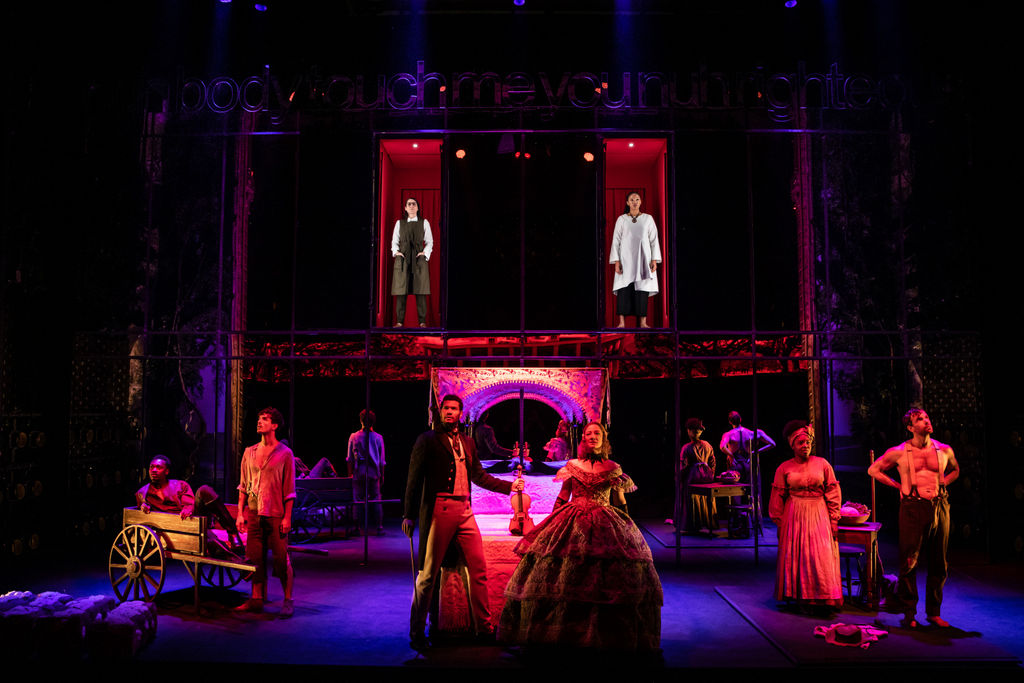
Rebecca Frecknall’s darkly spirited and remarkable revival of the amazing John Kander and Fred Ebb musical Cabaret, haunts as it moves with frenzy toward increasingly frightening revelations filled with understated, metaphoric violence. With book by Joe Masteroff, Julia Cheng’s choreography, and Tom Scutt’s breathtaking scenic, theater and costume design, this latest iteration of Cabaret, which is based on the 1951 play I Am a Camera by John Van Druten, which in turn was based on the 1939 novel Goodbye to Berlin by Christopher Isherwood, is complex, riveting and unforgettable. With Jennifer Whyte as music supervisor and conductor (sensational music throughout), this revival is one for the ages in greatness, for its performances, its technical grace, its energy, its profound conceptualization and brave stylistic choices.
For Cabaret purists expecting benign, “prettified” variations on past revivals (this is the fifth), director Rebecca Frecknall’s vision will probably jars or disgust. Congratulations. It’s one point of the musical. This is especially so, if one doesn’t want to accept the musical’s messages about how one is seduced into embracing ideologies which promote dictatorships that become killing machines. As in Germany then, today, there are those who would twist the law for their own lucrative agendas. These threaten to establish a leader who is above the law and accountable to no one. Welcome to dictatorship 101, if Trump is voted in.
In light of this salient horror in our increasingly fragile democracy, Frecknall’s brilliant production indicates how such a situation may occur here, as it did in Weimar Germany to bring a genocidal killer to power, while the citizenry watched, then gradually embracing the movement’s martial power, cheered him on.To establish these unlovely, and terrifying themes, Frecknall’s creatives display efforts that are non pareil. Tom Scutt is extraordinarily gifted in his theater design and companion costuming. The August Wilson Theater has been astoundingly transformed into a happening, libertine Berlin jazz joint and cabaret, representative of those found at the twilight of the Weimar Republic in Germany, before the Nazis shuttered them for their filthy, hedonistic decadence.

The entrance to Cabaret at the Kit Kat Club reminds one of a hidden speakeasy as it leads into an eerily lit hallway of abundant, green, shiny fringe that walls off an alley of garbage bins and opens into the heady and enjoyable “Prologue.” You have arrived at the Kit Kat Club, a nesting doll arrangement of outer and inner lounges and bars serving drinks.
If one has arranged to be a part of the immersive seventy-five minute “Prologue,” one is offered a schnapps, the favored drink of Herr Schultz (Steven Skybell in a bravura performance). With schnapps in hand, one follows the crowd up and down a series of stairways into a rosy-pinkish-reddish, maroonish spacious, two-room sectioned lounge. In one section musicians (violin, piano, bass, accordion, clarinet, saxophone), in Kit Kat club costumes and make-up of the era play jazz, and vibrant melodies (Did I hear a polka?), on a raised small stage. Other Prologue dancers gyrate beyond the fringed maroon-toned curtains in the long bar lounge, where one may order drinks.
The Kit Kat Club has a variation of its own “Mayfair cocktail” (in honor of Sally Bowles who hails from Mayfair), and it is delicious. Jordan Fein is responsible for this immersive and delightfully surprising program of drinks and entertainment designed to massage you toward expectation, like a fly enticed forward into the web with promises of wild fun and surgery pleasures.

After one makes one’s way back upstairs into a smaller bar-lounge area, one may order dinner (charcuterie or a vegetable equivalent), and a bottle of champagne or wine, etc., and there is also dessert. After you order, you make your way into the Kit Kat Club theatrical space, the center of the web of intrigue. There, you find your seats at lamp lit tables close to the revolving circular stage, or at rows of seating behind the tables, on either side, where you may also order drinks. This is a surround sound event. The audience seating is on all sides, with the orchestra situated in two mezzanines on opposite sides. Additional seating is arranged in the balcony for another exquisite view of the revolving stage platform with risers that appear and disappear, chiefly transporting and featuring the powerful symbolism of the phenomenal, unparalleled Eddie Redmayne as Emcee.
Tom Scutt’s gobsmacking design is wondrous and memorable, and allows for the attractive waiters, which are NOT actors, to move up the slim paths between tables, bringing menu choices you may order (large Bavarian pretzel and a bag of spicy chips). There’s an accompanying selection of drinks at Manhattan prices, which far outstrip the value of Marks in 1929-1930 Berlin. Risque dancers mingle and mix in the audience and cast glances as they gyrate in stylistic modern dance moves, and flit up to the stage gesturing, voguing and vamping to enliven the audience.
This is not your mama’s cabaret. It reflects a cultural environment of excess and wantonness, borne out of desperation and the desire to please, to get someone to use the phone on the table to arrange a later rendezvous which will add a few more marks to a skinny wallet. Frecknall’s creative team are audience directed, striking the right ambience and mood to encourage satisfaction for a fun, boozy time of oblivion, only to be startled by an “ugly” reality.

There is a somnolent lull as the last orders are fulfilled, then patrons are awakened as the lights dim, cymbals crash and the Emcee (the breathtaking Eddie Redmayne), appears dressed in an unlikely outfit for a Master of Ceremonies: wide, knee-length leather shorts, an unremarkable tank top that looks like underwear, and a green party hat on top of red, red, red hair, which is its own costume. The Emcee crouches, hunching down his height to sing, making macabre hand gestures in long, black, thin gloves. He gains your curious trust as he leads you to the center of the web and keeps you there until the final bow and piercing realization that you’ve witnessed much of the prelude to what is going on in fragile democracies today.
Redmayne’s performance is mesmerizing, not because he is sinister, unemotional, or automatonish like other Emcees, who have gone before him. Nor is his flamboyance pushing it to the edge with star quality gay evocations. Redmayne’s sexuality is overshadowed by his stark determination and intention to be the consummate host and director of the audience’s will, which they should just give over to him obediently, like the Nazis gradually captured the will of the German people who stayed. (the fate of Fraulein Schneider, scene stealer Bebe Neuwirth, in “What Would You do”). With astounding presence, Redmayne personifies a quixotic, soul deformed character. He is internally debilitated and lost as are the Kit Kats and headliner, Sally Bowles (Gayle Rankin). Those who are most lost and broken find political movements and cults appealing and join them.

Indeed, in Frecknall’s production underneath the excess and the raucous dance numbers and “shouting,” it is clear why the soul broken, Kit Kats and Sally Bowles eventually embrace the glamor of Nazi strength and power, despite the terrifying violence behind it. This is reflected in the costume design in Act II, when the entire cast (except those who reject the Nazis), dons light brown suits reflective of fascism’s brown shirts until Hitler gained complete control and went over to the colors black and grey.
Wearing the same light brown suits, unified in belief and purpose, the Kit Kats signify they have put aside their individuality, uniqueness and inferiority, displayed in all its tawdriness and extremities in Act I, as they go around in circles on the stage singing and dancing to earn their keep. The costuming of Act II reveals they are united as part of something bigger than themselves that makes them feel empowered and confident. Sally Bowles craves such empowerment in Act I. She sings to Cliff that she was always “a loser,” and that “maybe this time I’ll win,” after agreeing to hook up with writer Clifford Bradshaw (Ato Blankson Wood). Gayle Rankin sings with soulful heart in a style appropriately different from her frenetic, zany cabaret persona.

Frechnall’s vision of the brown suits shows that the Kit Kats, Sally and the Emcee have embraced Nazi ideology and behavior. It is why the Kit Kats sing aggressively at the conclusion, losers singing for low wages in a seedy jazz joint no more. Triumphant at the “Finale,” the Emcee conducts his brown suit troop band as he sings, “the girls are beautiful.” Their beauty signifies they fit in to the “Master Race ideal. Marching as he directs them, we realize they support the fascists accepting the violent aggression against anyone who would disagree, and call that ideal “ugly” and horrible.
In Act I, all of the players we meet inside and outside the Kit Kat Club are crippled souls who are unaware, purposeless, misdirected and scrounging for their livelihood. The exceptions are Clifford Bradshaw (Ato Blankson-wood), Fraulein Schneider (Bebe Neuwirth provides the phenomenal contrast of one who is fairly whole), and Herr Schultz (the incredible Skybell is her counterpart in spiritual beauty and kindness). Clifford, a bisexual writer who comes to Berlin to finish his novel stays at Fraulein Schneider’s boarding house. Fellow traveler, Ernst Ludwig (Henry Gottfried is a friendly, sweet Nazi), introduces Cliff to racy, wild Berlin, the Kit Kat Club and Sally Bowles (“Don’t Tell Mama”). He also provides Cliff with German pupils (budding Nazis), so he can make money tutoring English.
Clifford lets Sally stay with him when her former boyfriend and club owner dumps her (“Mein Herr,” “Perfectly Marvelous”). It is a time when love is in the air. The magnificent Bebe Neuwirth as Frau Schneider is gently wooed by superb Steven Skybell’s Herr Schultz, with a sensual, delicious pineapple (“It Couldn’t Please me More”). The loving, heartfelt union they effect is a joy and pleasure to behold. These incredible on-point actors’ authenticity is a stark contrast to the twisted, grotesque, clown world of the Kit Kat Club. Likewise, Clifford develops a sexual relationship with Sally which encourages both of them for a time until events shift.

The only ones who don’t establish bonds of love are the Kit Kat performers and the Emcee, however, they are open to establishing a greater bond with a political evil spirit that is whipping through the Weimer Republic and ends up at the door of the Emcee, who uncharacteristically appears and without gestures, contortions and antic party costume, stands straight and tall, clothed in a robe. I was amazed at Redmayne’s height after his crouching, slouching postures.
Standing, no longer in the persona of the Emcee, he sings as himself-the anonymous person who portrays the Emcee-whose name we never learn. He’s obviously a representative of the “everyperson.” What he sings is more frightening than what he sings in his role as Emcee at the Kit Kat Club. But I must take a moment to elucidate Frechnall’s striking “before” and “after” and difference between the songs in Act I and Act II regarding their ambience and the behavior of the Kit Kats, Sally and the Emcee. The changes are significant and give rise to understanding why and how the “everyperson” in the Weimar Republic did nothing to stop the Nazi rise to power.
Initially, when the Kit Kats and Emcee appear for their opening song of “welcome” and “introduction to Berlin,” they perform individualistically and are their own “characters,” with stylized moves, costumes and presentations thanks to Julia Cheng’s choreography and Scutt’s costume design. Whether one describes the cabaret scenes as expressionistic or Brechtian, they are weirdly entrancing, strangely removed and objectified. They are masked with Guy Common’s make-up and Sam Cox’s excellent wigs & hair design, covering up the soul infirmities of these individuals who are scrambling for chump change in this seedy club, that can’t afford a more beautiful, divine “decadence”.
Their costumes are not “polished” or “uniform.” The Emcee is not in a tux and tails and top hat. Altogether, their appearance is one level above rag tag, thrown together with party hats. Sally’s “fur” is hardly that; it’s a dyed light turquoise-mint green, massive fluff piece. To state this club and its owner are scrambling is an understatement. But inside it is warm, and the drinks, dancing and atmosphere says “leave your troubles outside.” All the better to anesthetize you out of your money. The irony and conceit is fabulous. Eventually, the troubles in the form of Nazism will arrive and intensify, as asserted at the “Finale.”

Redmayne’s Emcee is the epitome of the Kit Kats’ leader. His gestures, his hands in black gloves are claw-like, opening and closing, pointing. His body is hunched and at times twisted. The disposition the Emcee displays in “Wilkommen” and “Welcome to Berlin” is not only Brechtian it is vampyric and beckoning. In his delivery of the opening songs and “Two Ladies,” some of the marvelous gestures reminded me of Max Schreck’s vampire Count Orlok in F.W. Murnau’s expressionistic film, Nosferatu (1922).
The crippled interior of the Emcee disappears and transforms to strength and power as he embraces fascism when he sings “Tomorrow Belongs to Me,” alone, without make-up, dressed in an unadorned robe singing of Nazi possibilities. “But gather together to greet the storm, tomorrow belongs to me.” Then in the second stanza, “But somewhere a glory awaits unseen, tomorrow belongs to me.” As he sings the Kit Kats place figures representing the tall, straight, martial Emcee on the circular stage as he finishes the song, foretelling of the Nazi’s rise to power, which has seduced him, “But soon says a whisper, arise, arise, tomorrow belongs to me.”

It’s an incredibly profound number, for we note the philosophical and interior change the Emcee goes through physically. Straight and tall he is empowered; he embraces the “positive future” the Nazis will bring to Germany. The sweetness and lyrical harmonies of the song, and Redmayne’s powerful voice and changed mien are terrifying. In the Emcee’s embrace of Nazism, we understand how the desire to identify with a movement’s promised glory can slowly take over one’s intellect and being, beyond rationality.
It is after the Emcee’s adoption of Nazi pride (“Tomorrow Belongs to Me,”), that Frecknall ties in another reason why fascism became acceptable to many citizens in the Weimar Republic in the superb Kander and Ebb song, “Money.” The Emcee arises from the trap below in a striking black outfit whose see through fabric overlays a skeleton pattern underneath. With the chest and hips embossed with metallic beading and a black fascist-looking helmet, the Emcee sings of the economics of politics between the rich and poor. Because “money answers all things,” the rich are obstacle-overcoming winners. Thus, “Money makes the world go around of that we can be sure. (—-) on being poor.”
The Emcee is an iconic figure symbolizing death, dark power and militarization which brought Germany out of its impoverishing depression as Hitler built munitions factories, employed men and built his war machine. In this scene, the simple words and “jingle” of a tune take on darker meaning. All the characters we meet are strapped in by poverty with the exception of widower and love interest Herr Schultz who owns a fruit market. But poverty breeds misery and jealousy.
At a party to celebrate Schneider’s and Schultz’s wedding, Kost (Natascia Diaz), gossips to Ludwig that Schultz is a Jew with money. Of course, Ludwig warns Frau Schneider not to marry Herr Schultz. The scenes following reveal the growing antisemitism (a brick is thrown through his shop window). Herr Schultz dismisses this as “children,” but Schneider fears Ludwig’s warning. Frechnall configures the scene stylistically with power, referencing and foreshadowing the “Night of the Broken Glass,” when every Jewish business was vandalized and shop windows broken. Herr Schultz holds on to the fantasy that he will be all right; he is a German, after all (an irony). But he moves on the opposite side of the plaza to avoid Frau Schneider.
Neuwirth and Skybell’s performances express the human tragedy of two individuals who love, but for fear’s sake break up and move on. We note that in this event alone, the Nazis have won, and love and truth have lost. This is a society and culture whose tomorrows belong to the Nazis, as Kost, Ludwig and the company sing while Cliff decides to break off his friendship with Ernst Ludwig. The writer and thinker sees the ugliness where the others ignore and dismiss it based on information from the past.

But Act II reveals, “the handwriting is on the wall. It is already too late as the Kit Kats’ “Kick Line” led by the Emcee morphs into a militaristic regimented number as they march off as if at a Nazi Rally. With the discrimination increasing (If You Could See Her”), Cliff confronts Sally about leaving. He refers to the danger of blindness and disinterest in political events, trying to get her to “wake up.” When she says the Nazis have nothing to do with them, Cliff says, “If you’re not against all this-you’re for it. Or you might as well be.” This theme that hits the bullseye for us today, is immutable.
Thus, it is no surprise that Sally has made up her mind to return to the Kit Kat Club and leave Cliff. When the Emcee characterizes her relationship with Cliff, singing the beautiful ballad to Sally with sincerity (“I Don’t Care Much” (“go or stay”), she is moved. It is then she dons the brown suit and with the other Kit Kats and Emcee embraces the Nazi’s “tomorrow.”
Rankin’s parting “Cabaret” is sung as a hellion’s frustration at the choice she’s made (the abortion and leaving Cliff), and the questionable options ahead of her. More than ever because life “isn’t a cabaret,” she will make it one with all the fury in her being and end up like Elsie (who partied hard and left a smiling corpse), perhaps, not with a smile on her face. However, Redmayne’s Emcee has a smile on his face as he directs the militaristic “Finale,” all suggestive, risque Kit Kat behavior disappeared. Dressed in the brown suits, the Kit Kats follow regimented movements. All have embraced the Nazis in a stark horrifying sameness. They’ve sacrificed their gorgeous, crippling individuality for the Nazi nationalism and the greater “good.” They’ve accepted fascism which victimizes, ridicules and scape goats the weak.
Those of the Kit Kat Club follow fascism’s hope. That hope, however, bellicose, is easier to accept than the reality of living which frustrates in a never ending wheel of misfortune going around in circles, going nowhere except into more suffering. For such individuals, embracing destruction and death found in the brutal Nazi ideology brings renewal. Older Germans like Herr Schultz and Frau Schneider accept and make excuses or allow fear to control.
Frecknall’s vision and tone are extremely dark and sardonic, heightening the original book of Cabaret and layering it for us today in a disastrous, repellent warning. Its macabre stylization is perfect as are Redmayne, Neuwirth, Skybell, the heroic Blankson-Wood and Rankin’s devastating Sally Bowles.
Cabaret at the Kit Kat Club. August Wilson Theater, West 52nd Street. Running time: 2 hours 45 minutes. 75 minute optional prologue. https://kitkat.club/cabaret-broadway/
‘Hamlet,’ Kenny Leon’s Dynamite Version, Free Shakespeare in the Park

There are more iterations of Hamlet presented globally in the last fifty years than are “dreamt of in your philosophy.” To that point director Kenny Leon’s version of Hamlet, currently at the Delacorte Theater in Central Park until August 6th, provides an intriguing update of the son for whom time is so “out of joint,” he is unable to seamlessly and speedily avenge his father’s murder. Leon’s version shapes a familial revenge tragedy. Once set on its course, dire events cannot be averted, for at the core is the initial corruption, “the primal eldest curse, a brother’s murder” that “smells to heaven.” From that there is no turning, until justice is served, the sooner the better.
In this 61st offering of Free Shakespeare in the Park, we immediately note the conceit of corruption and its ill effects to skew the right order of things, making them “out of joint,” off-kilter. This is an important theme of the play (expressed by Hamlet) and represented by Beowulf Boritt’s set, some of which is a wrecked-out remnant of his design from Leon’s pre-Covid production of Shakespeare’s comedy, Much Ado About Nothing.
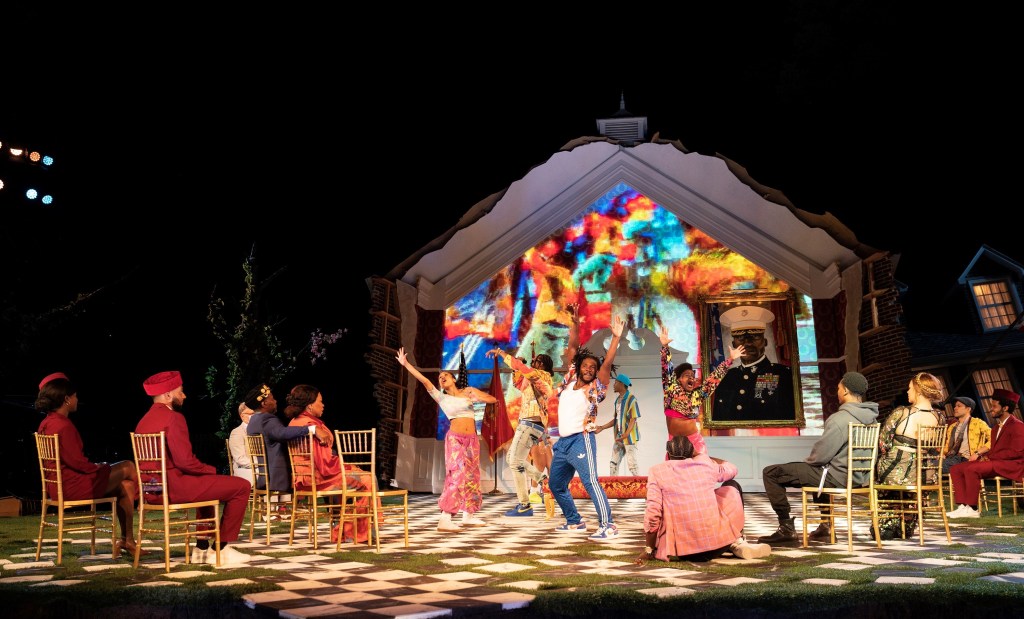
That 2019 design sported a resplendent, brick, Georgian mansion that stylistically conveyed the wealth and rectitude of its Black, lordly owners rising up in a progressive South. Hope was represented by a “Stacy Abrams for President” campaign sign proudly displayed on the side of the building. A towering flagpole and American flag patriotically stood like a sentinel at the ready. Peace and order reigned.
It is not necessary to have seen Much Ado About Nothing to understand the ruination and disorder foreshadowed by Boritt’s Hamlet set which coherently synthesizes Leon’s themes for his modernized version. In one section a tilted smaller version of the former Georgian house appears to be sinking off its foundation. On stage left, an SUV is tilted off center, undrivable, in a ditch. The Stacy Abrams’ sign is torn and displaced on the ground like discarded trash. And the American flag with its long flagpole angled toward the ground signals distress and a “cry for help.”

The only ordered structure is the cutaway of a building center stage (used for projections), whose door the characters enter and exit from.
Boritt’s set design suggests “something is rotten” unstable and “out of joint” in this kingdom. Themes of devolution are foreshadowed. From unrectified corruption comes disorder which breeds chaos and dark energy, out of which destruction and death follow. And all of this springs from the unjust murder of the deceased in the coffin that is draped in an American flag and placed center stage. It is his life which is celebrated by the beautiful singing of praise hymns at his well-attended funeral in the prologue of Leon’s Hamlet. It is his life that is memorialized by the huge portrait of the kingly father in military dress which hangs watchful, presiding over events from its position on the back wall of the only part of the set that is not wrecked and disarrayed.

Cutting Act I scene i (soldiers stand on guard watchful of an attack from Norway), Leon opens with the elder Hamlet’s funeral. A Praise Team joined by a Wedding Singer, who we later recognize to be Ophelia (the golden-voiced Solea Pfeiffer), sing with beautiful harmony. Jason Michael Webb created the music and additional lyrics which set out the Godly tenets that all are importuned to follow or live by. To their downfall they don’t and this is manifested in tragedy.
Importantly, the first three songs are taken from the Bible. The first is from Ecclesiastes (“To everything there is a season). Then follow Matthew 5 (“To show the world your love, I’m goona let it shine”) and I John 5 (“When you go on that journey you go alone”). The last song that Ophelia sings is composed of lines from a love poem that Hamlet wrote for her.
The songs intimate the former moral rectitude and divine unctions found in the former Hamlet’s kingdom. Ironically, the memorial service represents the last peace that this kingdom will appreciate. As the set indicates, wrack and ruin have already begun. The scenes after the funeral represent declension and growing darkness. And after old Hamlet is buried, nothing good follows.
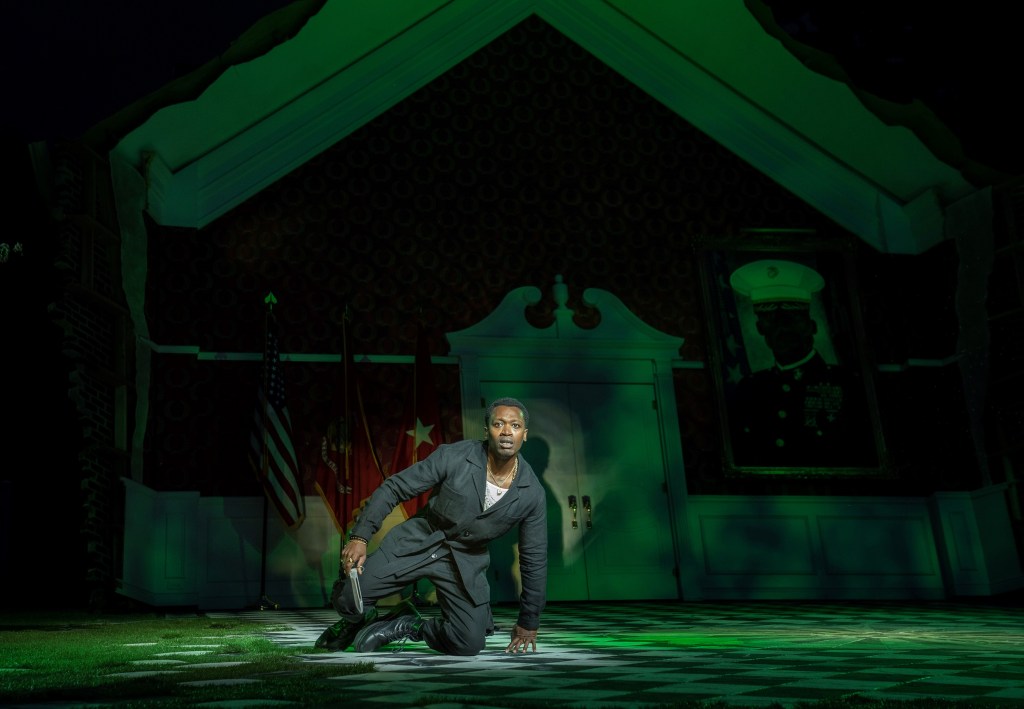
Numerous cuts (scenes, lines, characters) abound in Leon’s version. His iteration presents questions about the disastrous consequences of familial revenge which is different from Godly justice suggested by the songs. Importantly, Leon’s update (sans scene i) gets to the crux of the conflict with scene ii, the marriage celebration of Claudius (the terrific John Douglas Thompson and Gertrude (Lorraine Toussaint is every inch Thompson’s equal). We note their public affection for one another, which Hamlet later intimates is a lust-filled marriage in an “unseemly bed.” The partying has followed fast upon the old Hamlet’s burial, to the dismay and depression of his loyal son.
It is during the festivities when the sinister intent of the new king and duped mother Gertrude chide Hamlet (the fabulous Ato Blankson-Wood). They suggest he put off his mourning clothes, “unmanly grief” and depression for it is “unnatural.” Already, the cover-up has begun and Hamlet is the one individual Claudius must be circumspect about as the rightful heir to a throne which he usurped.
Gertrude importunes Hamlet to remain in the kingdom instead of returning to his studies in Wittenberg, and dutifully, he obeys, stuck with the daily reminder of his father’s death and mother’s “o’er hasty marriage.” This version emphasizes Claudius’ sincerity covering over his suspicion and fear of Hamlet. He is happy to keep him under his watchful eye. Throughout his magnificent portrayal, Thompson’s Claudius gradually reveals his underlying guilt and fear for his crimes of regicide and fratricide. We see his behavior grow more and more paranoid about Hamlet as the conflict between them grows and Hamlet unloads snide remarks on Claudius, Polonius and all those who are obedient to the usurper king as a provocation.

Leon’s version is a familial revenge tragedy which eliminates any reference to Norway or Prince Fortinbras seeking justice for his father’s death in battle with Denmark. Leon is unconcerned with Norway and Fortinbras. The conflict in his Hamlet is internal to Denmark, a divided kingdom like “an unweeded garden, rank and gross in nature.” Divided against itself, with brother vs. brother and son vs. uncle, and Gertrude the exploited, seduced pawn, Claudius’ guilt is a canker worm which gnaws at him. Likewise, gnawing at Hamlet after his father’s ghost’s visit, is the knowledge of what has to be done. But he maintains, “cursed spite, that ever I was born to set it right.”
All is covert and the truth is covered up. Polonius and Claudius spy on Hamlet to divine why he is “mad,” and Hamlet acts mad and rejects Ophelia’s love during the process of divining whether the ghost is telling the truth. Intrigue, chaos and darkness augment and have their way with the innocent and guilty. For Hamlet, the “time is out of joint.” An intellect, he is “blunted” (the ghost later says) from making the correct decisions or acting upon them in a timely fashion. The darkness that Claudius has set loose taints Hamlet and every principal character that must show obeisance to King Claudius’ illegal reign.

Key to the argument of choosing vengeance vs. justice is the enthralling scene when Hamlet meets his father’s ghost. Initially, the creative team (Jeff Sugg’s projections, Allen Lee Hughes’ lighting design, Justin Ellington’s sound design) present the father’s ghost on the back wall with projections on the portrait and the wall, accompanied by the ghost’s booming, shattering voice, which commands Hamlet’s obedience.
But at the description of the murder, the ghost possesses Hamlet. Blankson-Wood’s performance of the ghost consuming his soul is phenomenal and physical. He arches his back with the jolt of spirit possession and then rights his gyrating body as his father’s voice spews wildly from him, eyes rolled back, arms waving, the very picture of the demonic that Horatio (the fine Warner Miller) warned Hamlet might “tempt him to the flood.” At once frightening and mesmerizing, the possession enthralls us and changes Hamlet. It is a dynamic, successful scene showing the decline in the goodness from the initial praise songs to the devolution of the spirit’s will demanding vengeance. We are thunderstruck. Blankson-Wood’s authenticity frightfully convinces us of the spirit’s potential for evil misdirection into a vengeance which is not just and will bring devastation.
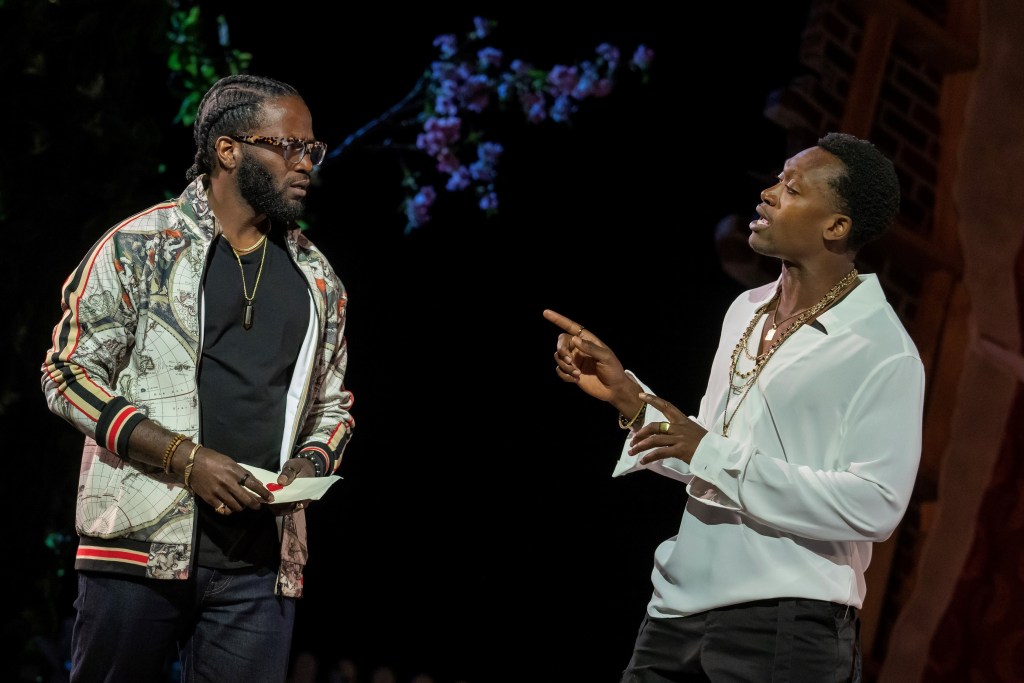
After the ghost leaves the vessel it inhabited and Hamlet swears Horatio and Marcellus (Lance Alexander Smith) to secrecy, Hamlet’s fate is sealed. He moves toward faith in the ghost, farther away from the light-filled unctions in the songs at his father’s funeral. Now, there is no “showing love” and “shining one’s light.” Intrigue and acting “mad” and conspiracy and cover-up overtake the mission of the kingdom. Hamlet toys with and ridicules Polonius (Daniel Pearce gives a humorous, organically funny portrayal) and does the same with Ophelia in a powerful scene, eschewing his love for her. Pfeiffer’s Ophelia shows her devastation and shock. His behavior is a complicating truth for everyone and it intensifies Hamlet’s conflict with Claudius.
Knowing Hamlet’s madness is not for Ophelia’s love, Claudius grows more paranoid and guilt laden. Clearly, when the actors make their presentation of the dumb show (Jason Michael Webb’s song “Cold World” is superb), and Hamlet presents ‘The Murder of Gonzago,’ he and Horatio see that Claudius’ guilty conscience is made manifest in ire and defensiveness. Though this scene is truncated, as is Hamlet’s description of how the actors should proclaim their speeches, no coherence is lost. Claudius runs away, his soul uncovered. Hamlet is convinced vengeance is the right course of action. But he has allowed himself to be misguided. Nothing good will come of following the ghost’s lead.

Leon truncates the minor speeches, retaining those that convey Hamlet’s angst at being stuck in the kingdom which is a prison. He can’t commit suicide (“To Be or Not to Be”) because his morality and fear of death forbids it. Stuck in Denmark, everyone is a potential enemy except Horatio. He uses coded speech with everyone especially Rosencrantz and Guildenstern, who Claudius/Gertrude have engaged to spy on him. Ato Blankson-Wood delivers the key soliloquies powerfully with insight as he makes the audience his empathetic confidante who understands his intellect has chained him to inaction. We are drawn into his plight, but become frustrated when his determination falters.
The paramount event where his intellect intrudes happens when Claudius is praying in the church (fine stylized staging). Coming upon Claudius, Hamlet rejects the opportunity to kill him because he thinks Claudius is confessing his sins and getting right with God. However, it is a missed opportunity which Hamlet squanders because Claudius’ prayers fail (“my words fly up, my thoughts remain below; words without thoughts never to heaven go.”). Claudius realizes to receive forgiveness he would have to give up the throne, Queen and his cover-up which he will never do.
Hamlet lacks proper discernment and moves from his bad decision to impulse. Not killing Claudius in the church, he rashly and mistakenly kills Polonius, assuming incorrectly that Claudius quickly ran up to Gertrude’s room. The stakes are raised for Claudius and Hamlet. Polonius’s death missing body incense Claudius who is overwrought with fear knowing his enemy Hamlet has put a target on his back.
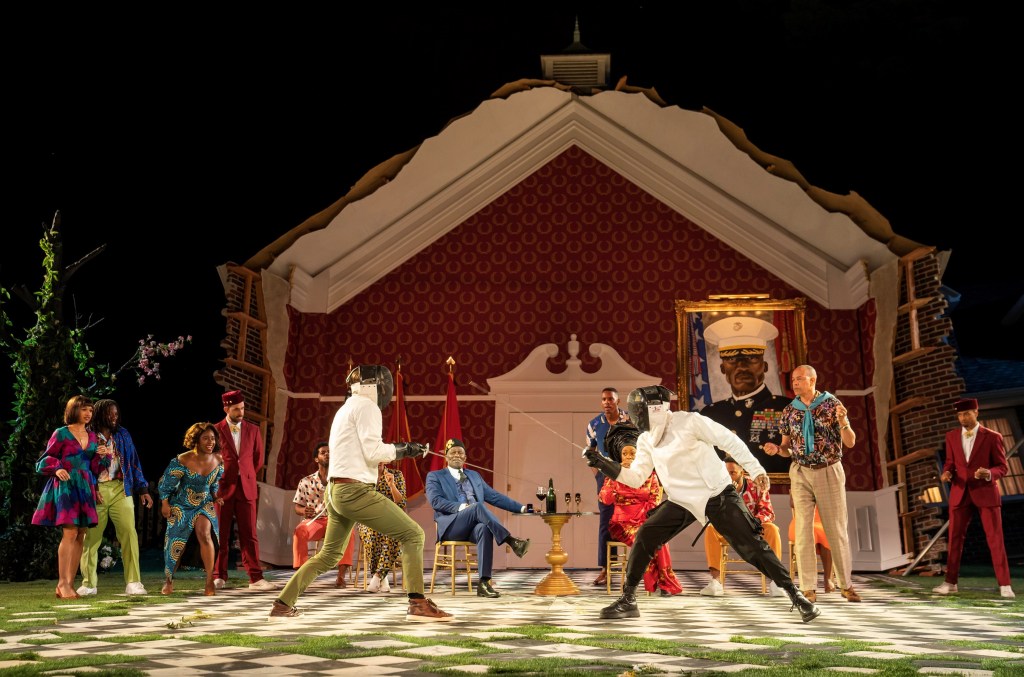
Once more, the “time is out of joint,” and Hamlet defers vengeance and subjects himself to Claudius, finally revealing where Polonius’ body is. For Gertrude’s sake, Claudius sends Hamlet away with the orders for others to kill him in a plan that fatefully backfires.
Leon’s version has clarified the stakes for Claudius to escape accountability, manipulating Laertes (Nick Rehberger) from killing him by blaming Hamlet. Thompson conveys each of these cover-ups with precision. Also, clarified is Blankson-Wood’s angst and struggle confronting his father’s murderer. His use of irony as a weapon to prick Claudius’ conscience is superbly rendered as are his soliloquies whose philosophical constructs tie him in emotional knots. Hamlet, knowing that he is stuck in a morass with no way out, recognizes that like the other characters, he is on a collision course with destiny and ruination which is foreshadowed at the beginning with Boritt’s set.
Also, clarified in this version is Toussaint’s Gertrude who is in a state of ambivalence and guilt stirred by Hamlet’s antic behavior, which she suspects is his response to her marrying Claudius. When their confrontation occurs after Hamlet kills Polonius, she knows her relationship with Claudius must be thrown over, yet she hesitates and discusses Hamlet with Claudius ignoring Hamlet’s wise counsel. The doom she recognizes in Ophelia’s madness will only bring more sorrows, a trend which both Claudius and Gertrude comment upon. Toussaint’s description of Ophelia’s drowning is heartfelt and mournful.
The flow of events coheres because the through-line of Claudius and Gertrude in conflict with Hamlet is maintained with intensity. Stripping Norway from the action and leaving Fortinbras out of the conclusion is to the purpose of Leon’s emphasis of the familial tragedy. The contrast of the good son and man of action who achieves justice (Fortinbras) with Hamlet’s flawed son of inaction who is Fortune’s fool, exacerbating destruction via revenge gone wrong would have pleased Queen Elizabeth I. Contrasting the two Prince’s and showing the heroic one in Fortinbras is an encouragement of how royalty should rule. However, it doesn’t fit with the themes that Leon emphasizes, especially that a “house divided against itself cannot stand.”
Hamlet concludes with the slaughter of two families tainted by their association with a corrupted king, out from which there is no release except death. A final theme current for our time suggests that unless individuals stand against usurpers of power, the usurper and all who are his accomplices by not bringing him to justice will pay the forfeit of their lives and fortunes.
However, only Miller’s Horatio understands the full story of Hamlet and the striving between vengeance and justice. That vengeance brings disaster is why the ensemble finishes with the actors’ song that they sang when Hamlet first meets them. It is poignant and true and heartfelt when the spirit of Ophelia joins them and together they sing, “I could tell you a tale, God’s cry. It could make the God’s cry.”
Kudos to the ensemble and the creative team who carry Leon’s vision of Hamlet into triumph. These include those not already mentioned: Jessica Jahn’s colorful costume design, Earon Chew Nealey’s hair, wig and makeup design, Camille A. Brown’s choreography and Gabriel Bennett for Charcoalblue and Arielle Edwards for Delacorte’s sound system design.
For tickets to this unique Hamlet which has one intermission, go to their website https://publictheater.org/productions/season/2223/fsitp/hamlet/
‘Slave Play’ by Jeremy O. Harris, An Explosive, Archetypal Look at Power, Sadomasochism and Oppression Through the Mythic Lens of “Black” and “White”
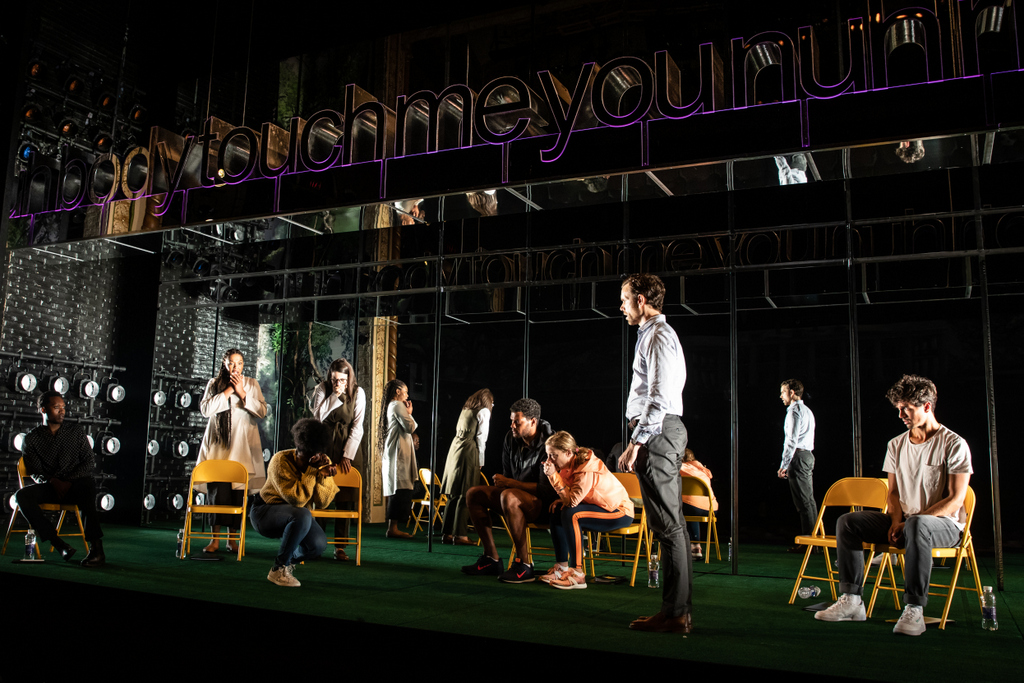
(L to R): Ato Blankson-Wood, Chalia La Tour, Joaquina Kalukango (kneeling), Irene Sofia Lucio, Sullivan Jones, Annie McNamara, Paul Alexander Nolan, and James Cusati-Moyer. in ‘Slave Play’ by Jeremy O. Harris, directed by Robert O’Hara (Matthew Murphy)
Slave Play by Jeremy O. Harris is a mind-bending, brain-slamming earthquake which will strike your soul and disturb you emotionally. Despite your desire to remain unaffected, you will react. Good live productions stir us. The finest plays rock us off our complacency and shatter our intellectual stasis. Slave Play, directed by Robert O’Hara, currently at the Golden Theatre, does that and more. Memorable and profound, it is the epitome of its sardonic genre. And in its ancient modernism, it rises to a level that melds tragedy and comedy.
The searing truths that run through Harris’ themes confound to a new clarity, especially if you see yourself as color blind and gender blind. Harris gouges out our assumptions and parades them in front of our unwillingness to perceive our hidden feelings about race, sex and power, teasing us in the process. By gaming his audience, Harris is all about stopping the games and taking off the masks. And he achieves this through the gyrations of his characters, three mixed-race couples who have sought therapy for their anhedonism (inability to feel pleasure-a symptom of depression and other ailments) with their partners.
The three couples sign up for “Antebelleum Sexual Performance Therapy” in order to expurgate their conflicts concerning race and sex that are ancient unconscious impulses or lesions borne from centuries of oppression in America from before the Civil War. It is an oppression that is in “black” and “white” unconsciousness that transcends skin color because the current society has historical remnants of the degradation of the “peculiar institution” which deformed the psyches of both masters and their slaves, the oppressors and the oppressed. Each couple suffers from these hidden twisted notions that they have ingested from living in American society. It has impacted them and they want a release from their suffering which manifests as alienation from their long-term partners.
This is a spoiler alert!
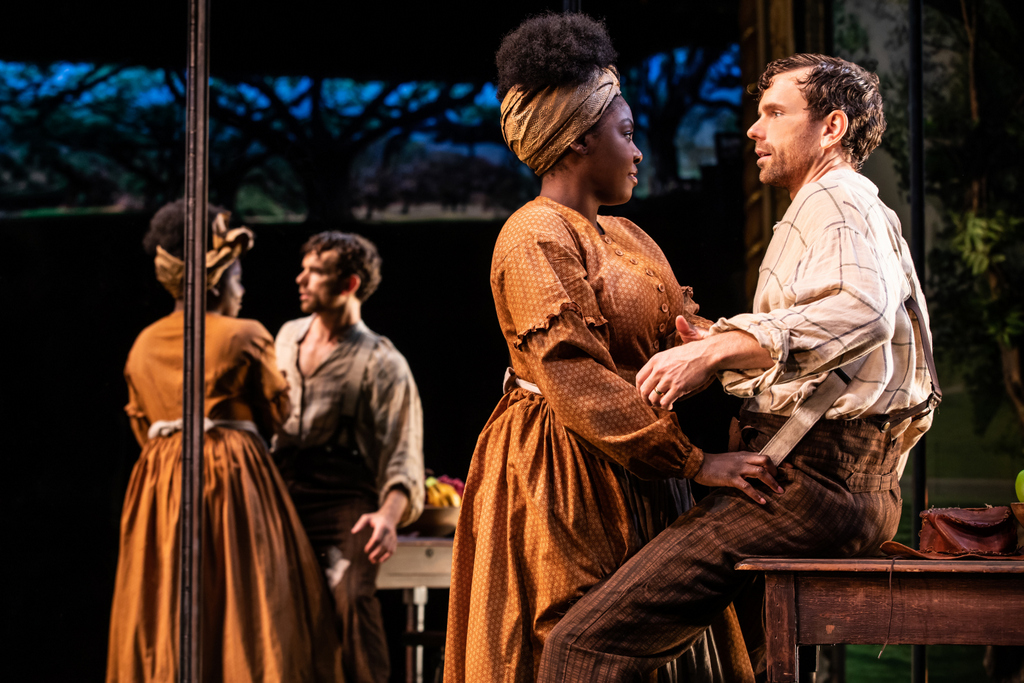
Joaquina Kalukango, Paul Alexander Nolan in ‘Slave Play,’ by Jeremy O. Harris, directed by Robert O’Hara (Matthew Murphy)
Only, you don’t know that at first. Indeed, initially as the play opens, we believe we are watching a scene from the antebellum South involving the abuses of the master slave relationships via sexual sadomasochism. With these scenes highlighting the sexual “play” of the marriage partners, Harris hits us between the eyes and in the core of our presumptions in the hope of laying bare the psycho-sexual racial myths that lurk in our souls.
Thus, everpresent in the scenic design by Clint Ramos is the plantation mentality: the desire to oppress and degrade employing the vehicles of sex. Using mirrors Ramos reflects the white southern archetype of the white antebellum plantation of Master MacGregor’s mansion that encircles the proscenium. Throughout most of the production, the projection of the white plantation remains in the background, symbolizing that we may think we have been released from our history, but it resides just below the surface of consciousness in our relationships and especially in our relationships with members of another race concerning issues of true intimacy and honesty.
It is in this plantation setting that the characters dig in to expose their sadomasochistic impulses from a racist past that they have unconsciously internalized and must expiate to heal their marriage relationships. Harris humorously twits the audience’s assumptions about black sexual prowess and sensuality in the opening scene with each mixed race couple as they play out their fantasies to free themselves of the bondages that hamper reaching a satisfying closeness with their partners.
Gary (Ato Blankson-Wood) and Dustin (James Cusati-Moyer) portray the gay couple who cannot please each other. They engage in the fantasy of master/slave verbal abuse donning fictional characters, Dustin as an indentured servant and Gary as a slave who has been put in charge of him. Through the play acting, Gary reaches fulfillment but in his response to this, he upsets Dustin. There is only a partial breakthrough, tenuous at best. They have not exorcised the notions that harm them.
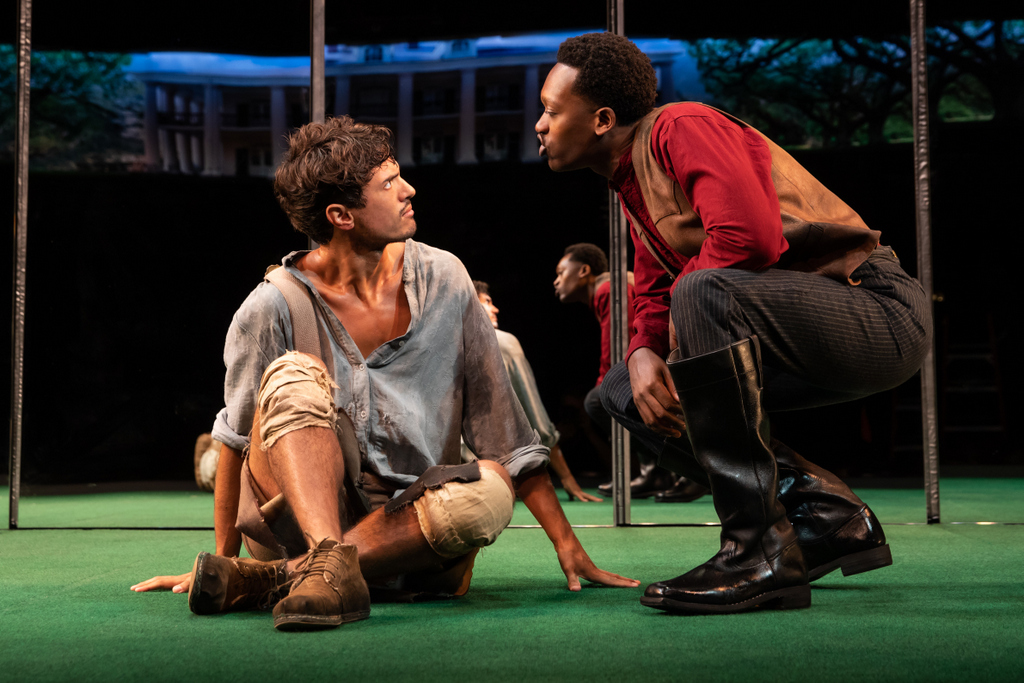
(L to R): James Cusati-Moyer and Ato Blankson-Wood in ‘Slave Play,’ written by Jeremy O. Harris, directed by Robert O’Hara (photo by Matthew Murphy)
Phillip (Sullivan Jones) and Alana (Annie McNamara) portray a married couple who cannot achieve a hot intimacy until they enact their antebellum sex play. In their fantasy Alana is Master MacGregor’s wife and Phillip is her house slave who does what she wants. What pleases her is to take over the masculine role while he takes on the feminine role during a sexual encounter, something which makes her freer for intimacy with her partner. However, they too have issues because of Phillip’s race identity problems which he is loathe to admit and which to him are invisible.
The couple Kaneisha (Joaquina Kalukango) and Jim (Paul Alexander Nolan do not progress on this fourth day of the sexual fantastic. Jim finds the therapy ridiculous and demeaning. Ironically, it is Kaneisha who has engineered the roles and takes the lead in their improvisation. She portrays the slave and Jim (who has a British colonial accent-another irony) is the overseer who commands her unjustly, then sexually uses her as she uses him. But Jim finds her fantasy an impossibility and will not subject himself to it. Is this not a case of subliminal control and domination over his wife Kaneisha?
With each of the couples’ fantasies, there are strong elements of sadomasochism which are supposedly exorcised in the service of removing blocking psychic layers that impede the couples’ pleasure with each other. Unfortunately, Jim has stopped the process for all the couples. A condition of the therapy they have all agreed to is that if one cannot continue, all must not continue. When the couples meet to discuss and analyze what they felt during their fantastic sexual exploits exposing their sub rosa “plantation” mentality, the conflict is on. And Harris’s characterizations continue on a profound and humorous track as problems arise. Each couple ends up confronting their partner with results that are both humorous and poignant.
At this juncture social scientists and therapy guides Patricia (Irene Sofia Lucio) and Tea (Chalia La Tour) attempt to analyze and reaffirm their subjects’ positive changes as a result of the antebellum sexual play therapy. That the researchers do this in a controlled, manipulative way is an irony considering that all seek freedom from their internalized racial oppressions (the predator/prey elements of human behavior). Harris sardonically reveals these individuals, including the scientists, may be duping themselves into believing they’re getting closer to a “clear,” when what they seek cannot be achieved in a week-long process, regardless of how extreme the interventions. Perhaps, what has been internalized must be overthrown with individual introspection on the part of both partners after a long period of time. There is no quick fix except sustained love, growth, patience, understanding and the will to be close which eventually, through loving practice, will manifest. Maybe.
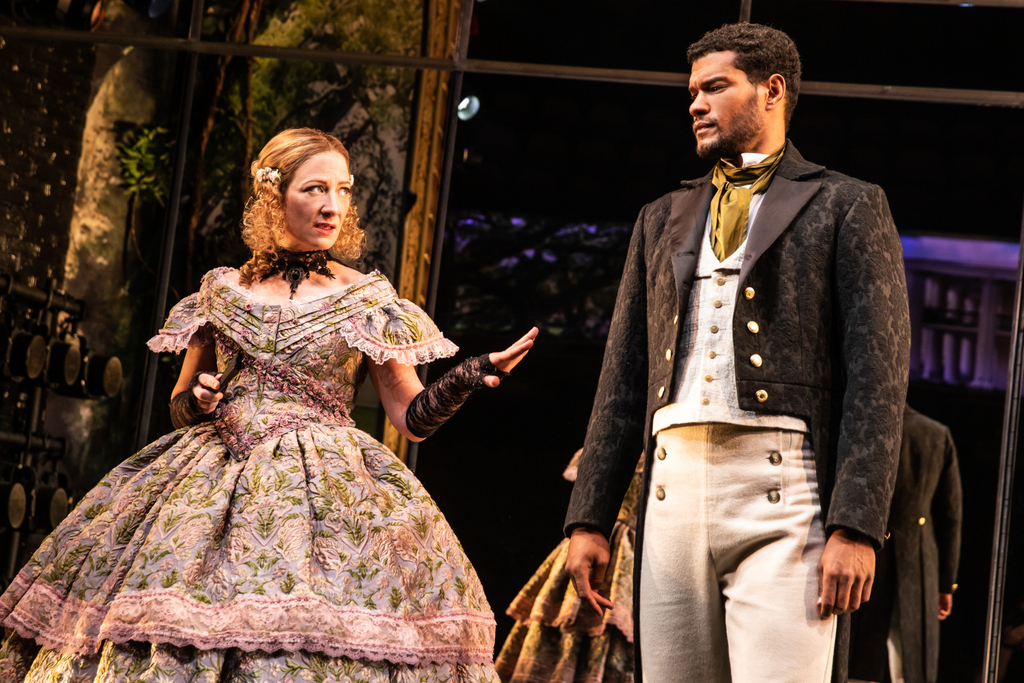
Annie McNamara and Sullivan Jones in ‘Slave Play,’ written by Jeremy O. Harris, directed by Robert O’Hara (Matthew Murphy)
The “liberal” posture which infects the “white” characters who are coupled up with their “darker” equally infected counterparts Harris explodes by the play’s end, as he disintegrates the notion that racism’s complexities may be dealt with through extreme interventions and quickie therapies. Especially for couple Kaneisha and Jim there has been a break through in their relationship at great cost to Jim who upon facing himself, dislikes what he perceives himself to be. Whether they continue together after this turning point doesn’t matter. Each have understood a soul revelation and will never be the same again.
Harris’ Slave Play instructs us about our perceptions, our attitudes and our willingness to go to that place that is uncomfortable to shed the pretense and stop pandering to faux racial equanimity and justice. That is why the curtain mirror that reflects the audience’s faces effected by Clint Ramos’s superb scenic design is a clever touch in keeping with Harris’ themes. The more visible reflections are for the audience members who are down front in the expensive seats.
Shouldn’t we examine our own proclivities and assumptions about sex, race and power dynamics? Or should we just ignore that there is a confluence of currents roiling in the subterranean waters of our souls about race? How do we overthrow our past and live freely without internalized cultural oppressions: misogyny, paternalism, institutional racism, body objectification, appearance fascism, sexism, chauvinism, reverse racism and impulses of white supremacy which move along a continuum from faint to furious? All of these oppressions impact our intimacy with ourselves and others, whether we are in mixed race relationships or not. Harris suggest we investigate these tantalizing questions which are not for the faint of heart.
As Americans steeped in a social history of racial power dynamics that continue today, though many are loathe to admit it, one cannot view this play as a light observer. To have the themes resonate, one should follow the characters to the most profound levels and then consider the myths, the conceptualizations about being black, white and gradations of both culturally. One must see with new eyes what has not been seen before at this crucial time when leaders speak to and embrace racist hate groups (KKK, Neo Nazis, etc.) curry favor with the likes of David Duke and Richard Spencer, and give political advisors like Steven Miller great power and moment over US Immigration policy with the precise intent to discriminate, promote fear and abuse for political purposes.
(On Ground L to R): Ato Blankson-Wood, James Cusati-Moyer, Sullivan Jones, Annie McNamara, Joaquina Kalukango, Paul Alexander Nolan. (In red boxes L to R): Irene Sofia Lucio and Chalia La Tour, ‘Slave Play,’ directed by Robert O’Hara, written by Jeremy O. Harris (Matthew Murphy)
Harris intends to shock us into a dialogue to confront our own assumptions on whatever level we can, so we might grow as Americans who recognize their rich yet horrific social, political and cultural history. As Harris’ characters recognize they are stymied and self-harmed by their own misconceptions, depressions and failures to deal with the historical, ancestral folkways and noxious human behaviors they’ve internalized, at least they attempt to overthrow them. Shouldn’t we, Harris suggests? But are we up for this? We should be! Look at the gun shootings at synagogues and black churches.
Until there are conversations about such controversial topics as Slave Play raises, the country’s divisiveness may be exploited by pernicious leaders and malevolent foreign intelligence services who foment racial hatreds to satisfy their own personal agendas. Our culture’s current divides are toxic. To mitigate them requires a complexity of understanding and introspection on a personal level. Harris indicates dealing with this on an interracial, mixed couple level may be the way to get there if there is love, patience, understanding and will. The issues are hyper complex and are not adequately answered by quick fixes and exotic hyperbolic interventions which themselves represent the internalized predator/prey, oppressor/oppressed remnants of racism.
The ensemble is wonderful and acts seamlessly together with a comfortability at behaviors which appear impossibly raw. The therapy session is particularly acute, funny, authentic and smashing. All the actors are standouts as is required with such an amazing play. Kudos to the director who shepherded them. Each couple ends up confronting their partner with results that are both humorous and poignant.
The design team also shines: Dede Ayite (costume design) Jiyoun Chang (lighting design) Lindsay Jones (sound design & original music) Cookie Jordan (hair & wig design). Conceived at New York Theatre Workshop where it ran in from November 2018 to January 2019, Slave Play has come to Broadway where it is provoking consternation, confusion and revelation. It runs with no intermission until 19 January. There are too many reasons why you should see this play if you are an American, and especially if you have a bit of residual racism within and are adult enough to laugh at yourself. For tickets and times CLICK HERE.
 CAROLE DI TOSTI