Blog Archives
‘Liberation’ Transfers to Broadway Solidifying its Excellence
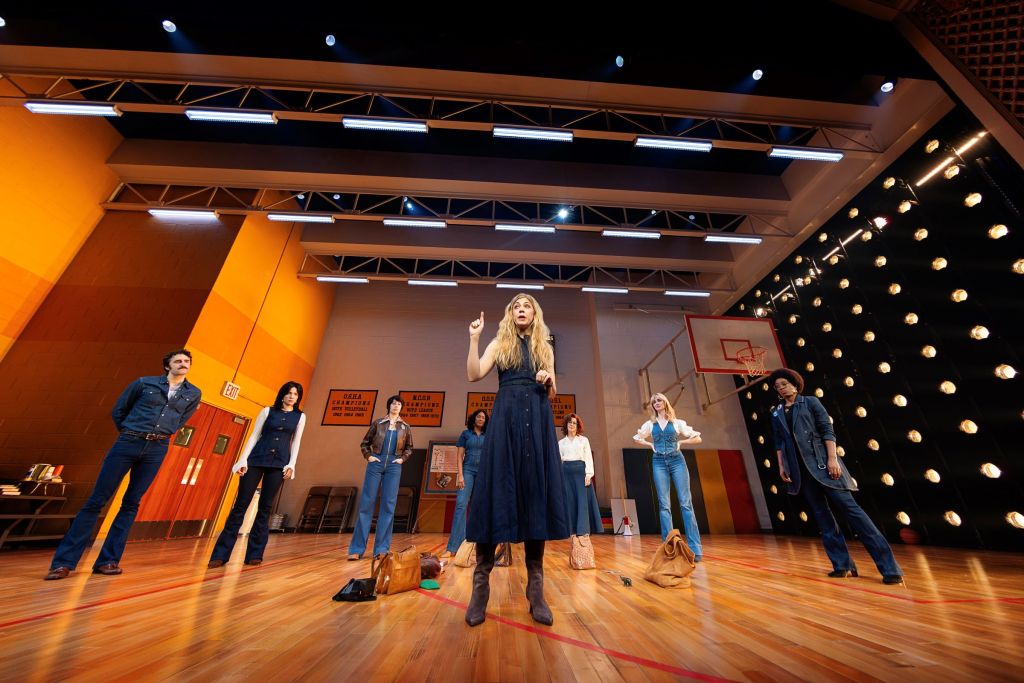
Bess Wohl’s Liberation directed by Whitey White in its transfer to Broadway’s James Earl Jones Theater until January 11th doesn’t add references to the 2024 election nor the disastrous aftermath. However, the production is more striking than ever in light of current events. It reaffirms how far we must go and what subtle influences may continue to derail the ratified ERA (Equal Rights Amendment) from becoming settled law.
To draw parallels between the women’s movement then and now, Wohl highlights the “liberation” of the main character/narrator Lizzie, an everywoman, with whom we delightfully identify. With Lizzie (the superb Susannah Flood) we travel along a humorous journey of memory and self-reflection as she evaluates her relationship to her activist mom, who gathered with a community of women in Ohio, 1970 to “change the world and themselves.”
Wohl’s unreliable, funny narrator, directs the action and also is a part of it. The playwright’s smart selection of Lizzie as a device, the way in to tell this elucidating story about women evolving their attitudes, captures our interest because it is immediate. Her understanding is ours, her revelations are ours, her “liberation” is also ours. Lizzie shifts back and forth in time from the present to 1970-73, and back to the present. One of the questions she explores concerns why the women’s movement cascaded into the failures of the present?
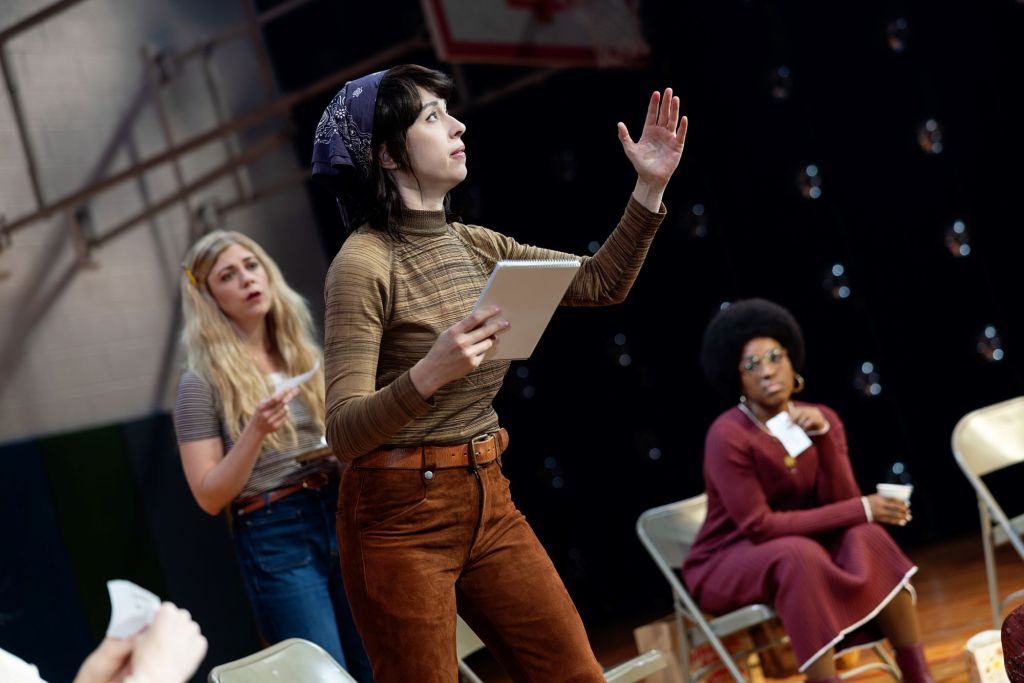
Assuming the role of her mother, Lizzie enacts how her mom established a consciousness-raising group. Such groups trended throughout the country to establish community and encourage women’s empowerment. Six women regularly meet in the basement basketball court at the local rec center which serves as the set throughout Liberation, thanks to David Zinn’s finely wrought stage design. The group, perfectly dressed in period appropriate costumes by Qween Jean, includes a Black woman, Celeste (Krisolyn Lloyd), and the older, married Margie (Betsy Aidem).
Having verified stories with her mom (now deceased), and the still-living members of the group, Lizzie imagines after introductions that the women expansively acknowledge their hope to change society and stand up to the patriarchy. As weeks pass they clarify their own personal obstacles and their long, bumpy road to change, with ironic surprises and setbacks.
For example, Margie voices her deeper feelings about being a slavish housewife and mother. After months of prodding, her husband actually does the dishes, a “female” chore. Margie realizes not only does she complete housework faster and better than he, but her role as housewife and nurturer satisfies, comforts and makes her happy. Betsy Aidem is superb as the humorous older member, who introduces herself by announcing she joined, so she wouldn’t stab her retired husband to death.
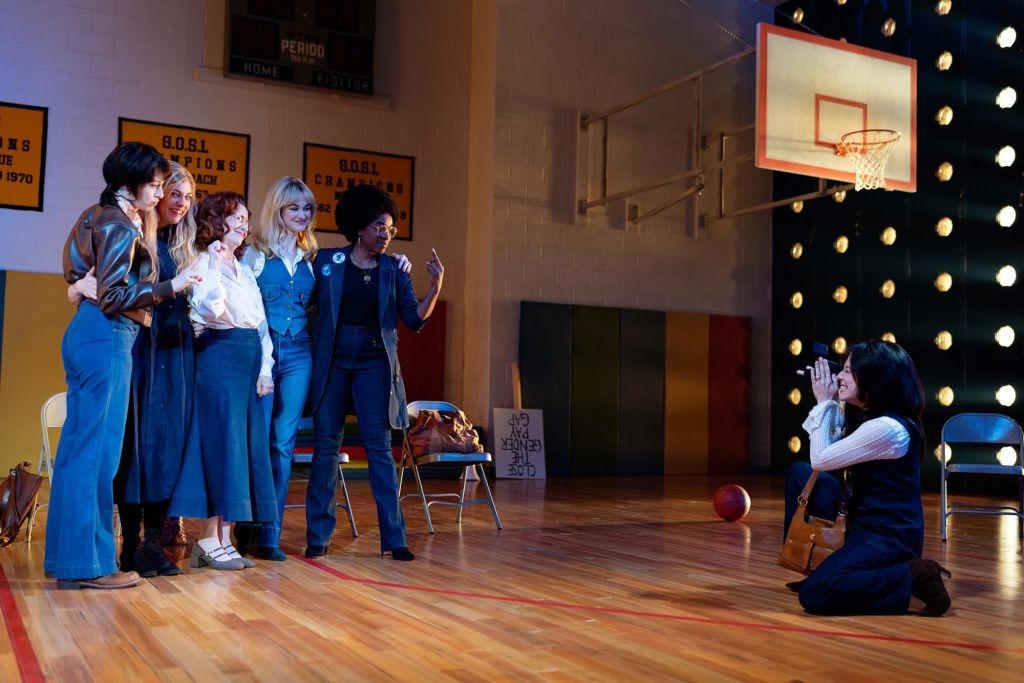
Some members, like Sicilian-accented Isidora (Irene Sofia Lucio), and Lloyd’s Celeste, belonged to other activist groups (e.g. SNCC). Circumstances brought them to Ohio. Isidora’s green-card marriage needs six more months and a no-fault divorce, not possible in Ohio. Celeste, a New Yorker, has moved to the Midwest to take care of her sickly mom. The role of caretaker, dumped on her by uncaring siblings, tries her patience and stresses her out. Expressing her feelings in the group strengthens her.
Susan (Adina Verson) is an activist burnt out on “women’s liberation.” Frustrated, Susan has nothing to say beyond “women are human beings.” She avers that if men don’t treat women with equality and respect, then women’s activism is like “shitting in the wind.”
Lizzie and Dora (Audrey Corsa) discuss how they suffer discrimination at their jobs. Despite her skill and knowledge Lizzie’s editor demeans her with “female” assignments (weddings, obituaries). Dora’s boss promotes men less qualified and experienced than Dora. Through inference, the playwright reminds us of women’s lack of substantial progress in the work force. Very few women break through “glass ceilings” to become CEOs or achieve equal pay.
Act I engages because of the authentic performances and various clarifications. For example, Black women have a doubly difficult time at overturning the patriarchy. Surprisingly, at the end of the act a man invades their space and begins shooting hoops. Is this cognitive dissonance on Lizzie’s part for including him? Have women so internalized male superiority that they become misdirected back to the societal default position of subservience? Is this what thwarted the movement?
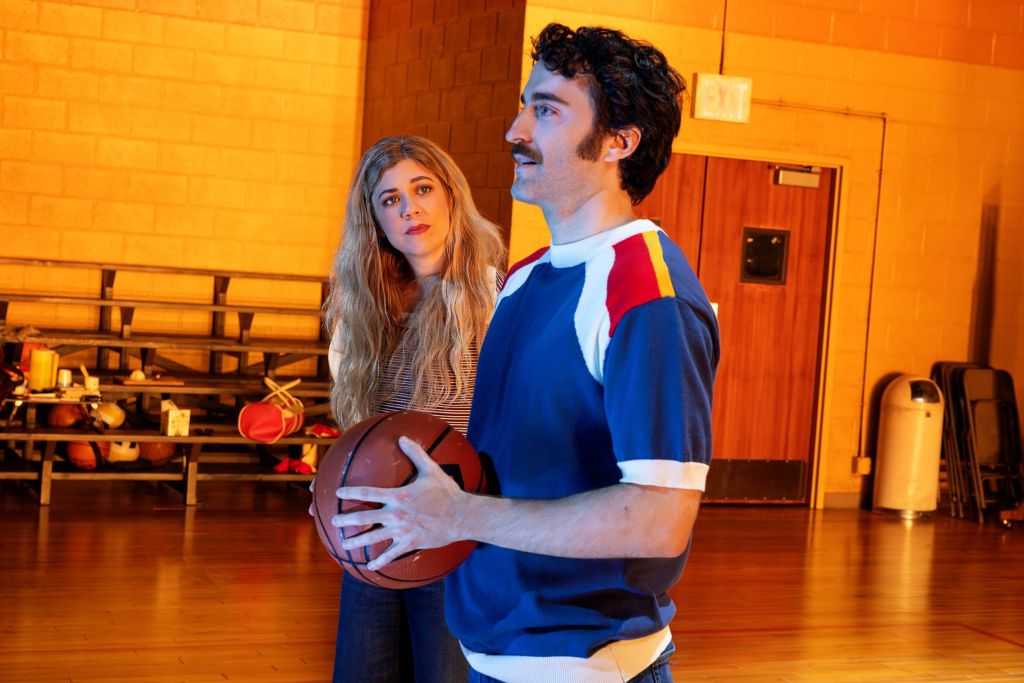
When Lizzie refers to the guy as Bill, her father (Charlie Thurston), we get the irony. How “freeing” that her mom meets her dad as she advocates for liberation from male domination, only to be dominated by an institution (marriage) constructed precisely for that purpose.
Act II opens with additional dissonance. To extricate themselves from the psychological trauma of men’s objectification of their bodies, the women free themselves from their clothes. Sitting in the nude, each discusses what they like and dislike about their bodies. The scene enlivened heterosexual men in the audience, an ironic reinforcement of objectification. We understand that these activists try to overcome body shame that our commercial culture and men use to manipulate women against themselves and each other (surgical enhancements, fillers, face lifts, etc.). On the other hand the scene leaves a whiff of “gimmick” in the air, though Whitney White directs it cleverly.
After the nude scene Lizzie reimagines how her mom and Bill fell in love. To avoid discomfort in “being” with her father, she engages Joanne (Kayla Davion), a mother who drops into the rec room looking for her kids’ backpacks. Through Bill and Joanne’s interaction, we note the relationship that Lizzie keeps secret. When Lizzie finally reveals she is engaged, the dam bursts and each of the women reveals how they have been compromising their staunch feminist position. One even admits to voting for Nixon with a barrage of lame excuses.
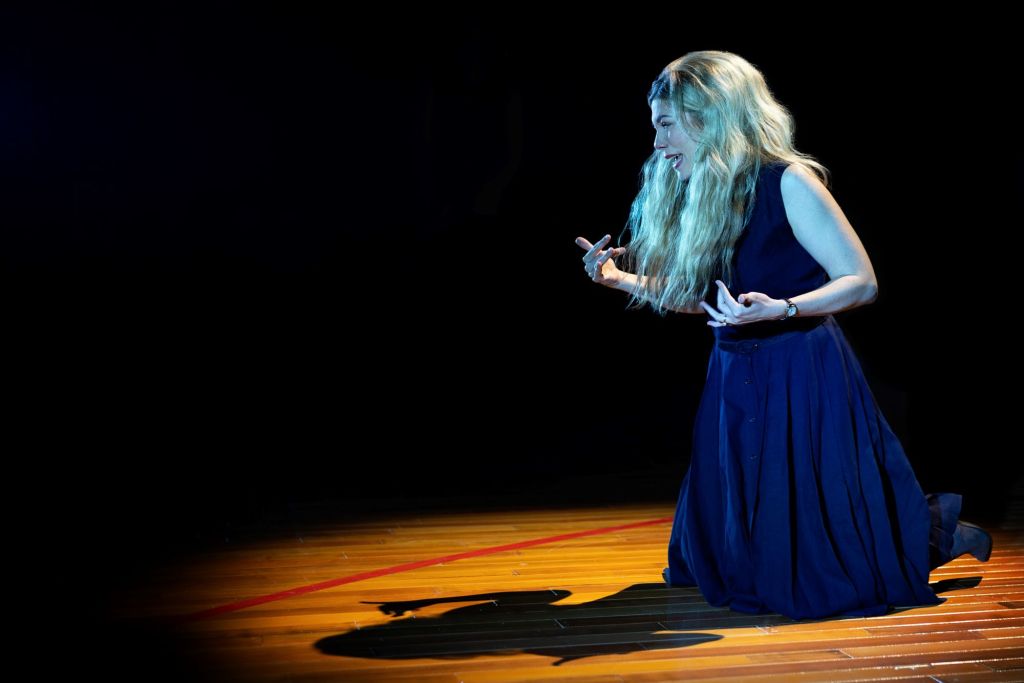
This scene is a turning point that Lizzie uses to explore how women in the movement may have sabotaged themselves at advancing their rights. Reviewing her mother’s choice to get married and co-exist as a feminist and wife, Lizzie reimagines a conversation with her deceased mother played by Aidem’s Margie in an effecting performance. When Lizzie asks about her mom’s happiness, Margie kindly states that Lizzie has gotten much of her story wrong.
Lizzie condemns feminism’s failures. This is the patriarchy, internalized by Lizzie, speaking through her. With clarity through Margie’s perspective, Wohl reminds us that all the stages of the feminist movement have brought successes we must remember to acknowledge.
Lizzie realizes the answer to whether one might be “liberated” and fall in love and “live equitably” within an institution which consigns women to compromise their autonomy. It depends upon each individual to make her own way. Her investigation about her mother’s consciousness-raising group establishes the first steps along a journey toward “liberation,” that she and the others will continue for the rest of their lives.
Liberation runs 2 hours, 30 minutes with one intermission at the James Earl Jones Theater through Jan. 11th. liberationbway.com
‘Prayer for the French Republic,’ Haunting, Current, Universal
Shifting in flashback between (2016-2017) and (1944-1946) set in two different Parisian apartments, Prayer for the French Republic (currently at Manhattan Theatre Club) by Joshua Harmon (Bad Jews), directed by David Cromer (The Band’s Visit), focuses on a Jewish family’s concerns about identity, safety and security in a country that they’ve called home for five generations. The backdrop of their apprehensions then and now is an uncertain world where humanity’s fears and needs turn increasingly predatorial. Capitalizing on such fears, political actors mine the unbalanced, raw emotions of deranged citizens, to create scapegoats which help grow their power and popularity. Whether left or right politically, oftentimes the scapegoats are religiously or ethnically engineered.
Such was the case in France during Hitler’s fascist occupation and the Vichy government’s cooperation with the roundup of French Jews that were murdered or sent off to concentration camps. Such is the case in France in recent years where attacks against Jewish citizens have multiplied, stirred up by opportunistic, right-wing, fascistic politicos ravenous for power.
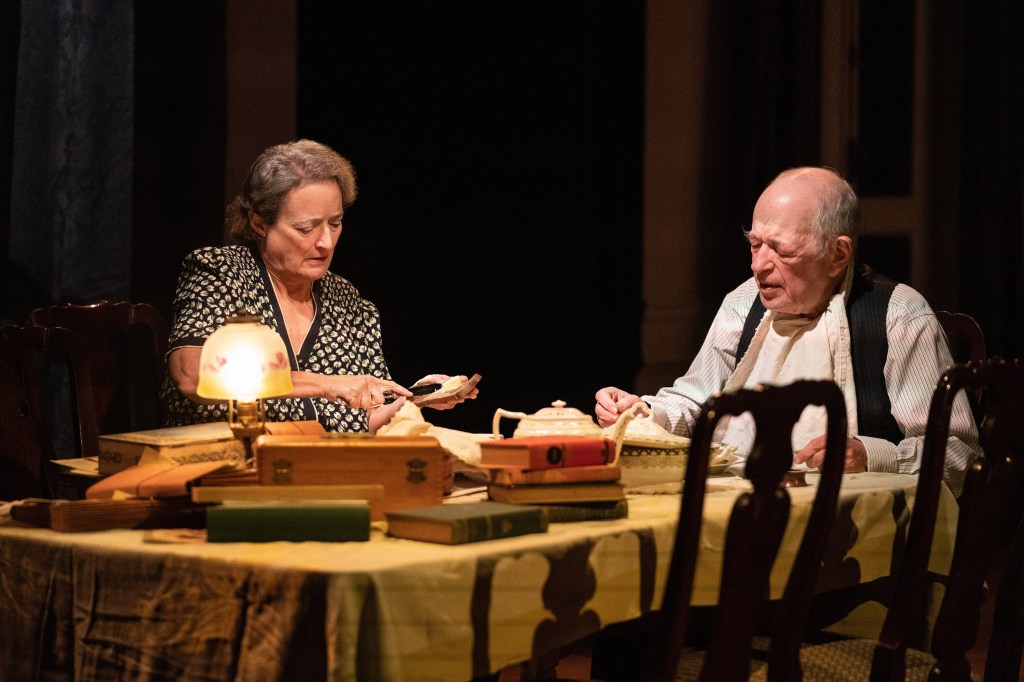
As an overseer, Patrick Salomon (Richard Topol), connects the ancestral ghosts from the past, his great grand parents, Irma and Adolph Salomon, grandfather Lucien and his father Pierre, still living, as a bridge from the past to the present. In the present are Patrick, his sister Marcelle Salomon Benhamon, husband Charles and their adult children, Daniel and Elodie. The play is Patrick’s meditation on five generations of family. Patrick redefines what being a Jew in France means, as he narrates the saga of their Parisian Jewish identity and magnifies it in light of the age-old conundrum Jews historically confront throughout the ages. To survive do they assimilate, or do they risk the danger of standing apart as they embrace their religious beliefs?
As the play progresses, these questions expand and complicate against the current global crises (climate, socio-political, economic). What do Jews do in response to severe persecution? Do they embrace their identity, suffer and die valiantly resisting? In the name of living do they become invisible, marry out of their religion to avoid the turmoil, danger and abuse that comes with the trajectory of uncertain social unrest that Jews inevitably find themselves in the midst of? Do they emigrate to “certain” safety?
Interestingly, before the last generation of the Salomon family makes any final decisions, they confront their father Pierre and present him with their conundrum. Would he go with them, for example, to a safer place with other Jews in Israel? Who better than their father, a survivor of the atrocities of Auschwitz, can ,advise them about their future? Indeed, he made his decision years ago, married a Christian woman and didn’t keep up Jewish tradition, intentionally. He remained safely in Paris raising Marcelle and Patrick without keeping ancient Jewish traditions. And until Marcelle married an Algerian Jewish emigre, they didn’t keep them either.

Patrick (the superb Richard, Topol whose easy, relaxed persona is confidently relatable and empathetic), introduces the Salomon family to the audience and discusses their business operating a store where they attempt to sell beautiful pianos that are no longer viable in modern society. Patrick brings us into 2016 to view his closest relatives, sister Marcelle (Betsy Aidem), brother-in-law, Charles (Jeff Seymour), their bi-polar daughter Elodie (Francis Benhamou), and son Daniel (Yair Ben-Dor). The cross-section of their lives begins as Marcelle (Betsy Aidem in a fine, layered performance), becomes acquainted with her guest, Molly (the clear-eyed, authentic Molly Ranson), a non-practicing Jewish, distant cousin from NYC.
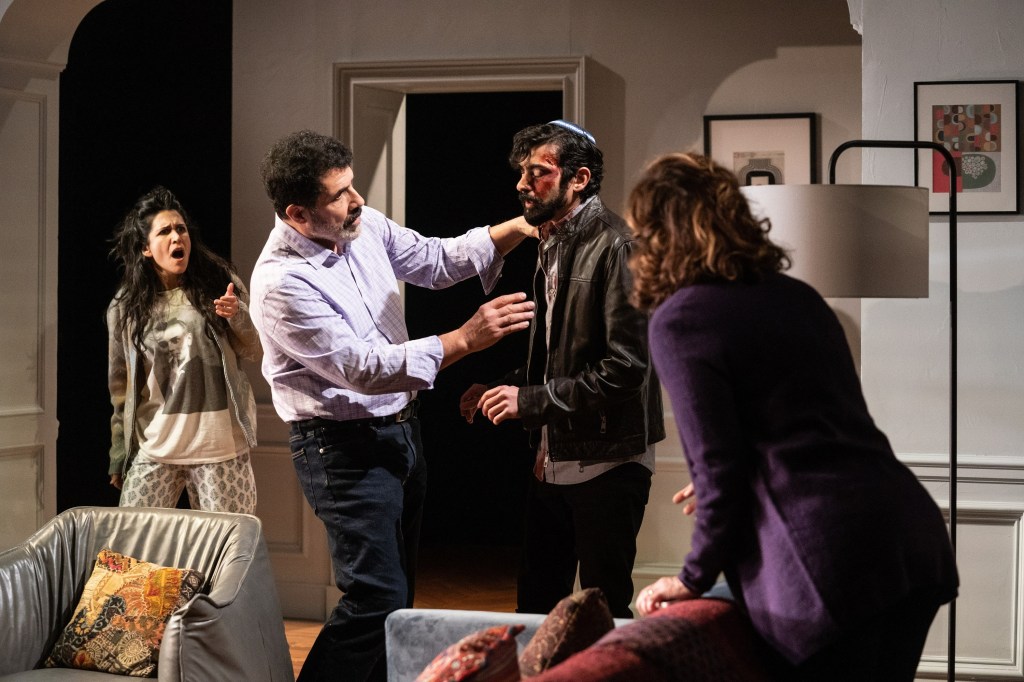
Their humorous exchange ends when Daniel comes in bleeding and an uproar begins in the household. He has been attacked in a hate crime where the young men who assaulted him yell out epithets because he has obviously distinguished his religious identity with a kippah. The arguments ensue and we discover that neither Marcelle nor Charles make an obvious show of their Judaism and that Daniel is the only Orthodox one in the family. Molly watches the scene unfold and learns as we do about family dynamics.
Daniel recently became Orthodox. He doesn’t even want to go to the police to identify his beating as a hate crime. Though Marcelle insists, Daniel makes excuses that he didn’t see his attackers and the police won’t do anything about it. All land on the fact that it will only exacerbate matters in the society and spread more fear. The discussion is closed when Daniel insists Marcelle light Shabbat candles.
The scene deftly shits to the past, as we note that ancestry (the ghosts of time past), runs concurrently and influences the Salomons in the present. The spirits of their forebears come to life, and we watch the characters in their small Parisian apartment in 1944, having a conversation about their children and other family who escaped France rather than stay, which other family did. As Irma (Nancy Robinette), and Adolphe (Kenneth Tigar), wait safely in their apartment, away from the horrific persecution of Jews throughout the Third Reich occupied countries, of which France is one, they pray that Lucien and Young Pierre are safe in the mountains. This is what Adolphe encourages Irma to believe. As they pray that Lucien and Pierre will come home to their apartment in Paris, hope sustains them.
Patrick connects present and past during these moments. He ruminates about what his great grandparents, grandparents and father went through, touching upon the conversations they may have had and the rationing they went through. Furthermore, he reveals the family’s penchant for argument and debate before decisions are made. Adolphe humorously suggests that at the reunion when family is together, after ten minutes of peace there will be arguing and fighting and crying. We marvel that Irma and Adolphe can sit there and imagine what it will be like after liberation. We discover later that most of the family who didn’t escape to Cuba or elsewhere died. Adolphe’s fantasy is a manifestation of hope to uplift Irma. Their safety in Paris affords them this luxury of hope; meanwhile, Jews died in the millions.
How are they alive? Patrick relates that the superintendent of the building didn’t give Adolphe and Irma up to the Gestapo during a roundup. Thus, both escaped in that rarest of occasions; they were protected by other French people. However, at this point, they don’t know the fate of their son Lucien (Ari Brand) and their grandson Pierre (Peyton Lusk) who may have fallen into the hands of the Nazis and ended up gassed in a concentration camp. But Adolphe and Irma live in faith securely, waiting their return.
In the segue back to the present Molly and Daniel form an attachment. Daniel explains why he has become Orthodox when the family never was. He discusses the attacks at the newspaper Charlie Hebdo and the killing of four Jews at the Kosher Supermarket in Paris as proof that the hate crimes against Jews are increasing. On a hopeful note, he tells Molly that the peace marches against the violent attacks were massive, and Prime Minister Manuel Valls stood with the Jews against Benjamin Netanyahu, who told them to leave France and come to Israel. Valls encouraged belief in the French Republic stating, “If 100,000 Jews left, there would be no more France; the Republic of France would be a failure. Daniel points out that Jews left, but only a tiny fraction; the rest stayed. He affirms that always it is a matter of choice. Jews stay in France because they love their nation and have faith in the French people.

It is this concept of choice that carries through the rest of the play in the decision whether to escape persecution and hate crimes or stay and fight with courage and resistance. But slowly, this family because of the past losses, attenuates their faith in the French Republic.
First, it is Charles who rebels against staying in France after we hear the prayer for the French Republic spoken in a voice over in French and English when Charles and Daniel go to the synagogue. The Jews loyally support the French Republic, though some, like Charles, feel it is a waste of time. As father and son walk home, Charles notices the stares of disdain and anger at Daniel’s assertion of his religion. Charles insists, “I can’t take it any more.”
Once again the family is up in arms presenting arguments. Marcelle refuses to leave, decrying the beauty of their life in France. Fed up Charles wants to go to Israel. He remembers the persecution he experienced in Algeria where everyone got along when he was a child, but later socio-political forces disrupted the social fabric. Indeed, he has no allegiance to France. He doesn’t have the history, as Patrick puts it, that Jews have been in France for over 1000 years and have made a way for themselves there.
The discussion and wrangling back and forth between Aidem’s Marcelle and Jeff Seymour’s Charles is powerful and strident. We are riveted by the danger in Charles’ tone, of hidden subtext that is palpable and his fervor to believe there is safety in Israel, though that isn’t necessarily a rational conclusion because of the terrorism there as well.

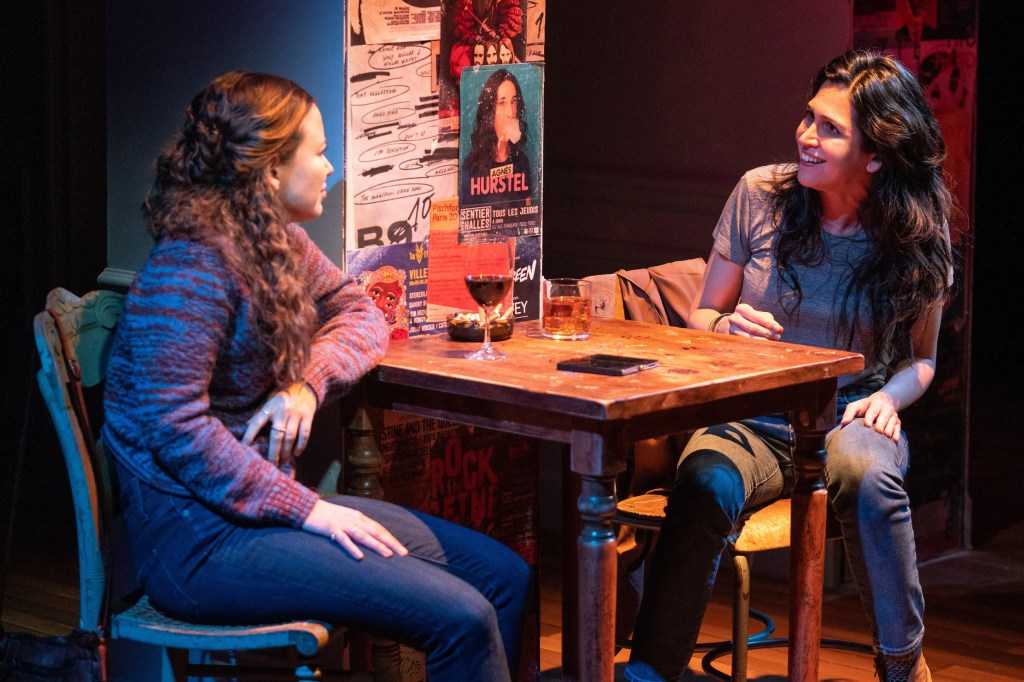
The argument carries over when Molly and Elodie go to a Dive Bar. Francis Benhamou’s Elodie rant against Molly Ranson’s Molly is humorous and as powerfully strident as Charles’ argument with Marcelle. Elodie gives forth, illustrating Molly’s hypocrisy when she argues against Israel’s Palestinian settlements. Elodie’s point drives deeper to human nature. There are the power-hungry and the occupiers; how does one resist not becoming power-hungry as a matter of security? Molly’s criticism belies historic U.S. colonization and oppression of everyone but white males. Elodie indicates that finger pointing is useless.
Eventually, both manage to reach common ground on a personal, familial level. Humanity takes precedence in their discussion when Elodie explains that Daniel became Orthodox because of a girl. Revelation of his vulnerability opens the door to Molly’s and Daniel’s relationship. It also opens the door to Marcelle’s fury because she believes that Molly has taken advantage of her son’s vulnerability.
Nothing is resolved even after Charles and Daniel return from a trip to Israel to look at living arrangements and social culture. Charles gives in; he affirms wherever Marcelle is, he will stay with her. Daniel proclaims that he didn’t want to go to Israel, but just accompanied his distraught father to help him. The playwright indicates the confusion and the stress that accompanies the hassle of confronting danger in one’s daily life, as this family feels they are under siege since Daniel paraded his Jewishness. But it is understandable because the family has a history of loss and death at the hands of French fascism. Furthermore, fascists like Marine Le Pen (Deputy of the French National Assembly), and her right-wing conservative political group don’t readily disavow fascism.
As the scene shifts to the past, Lucien and Young Pierre return from the camps bringing the horrific information that family was lost. Lucien is overcome in the telling of it. Ari Brand’s performance is appropriately drained, inwardly devastated but holding it together as best he can. It is Young Pierre who eventually expresses how his father’s hope saved him. Peyton Lusk gives an incredible portrayal of the PTSD of a young person returning from an unspeakable experience. But as Lusk explains how he survived, once again comes the affirmation that hope is how people survived the persecution, attacks and killing, as community and family helped family. For Lucien always told Young Pierre that they would make it.
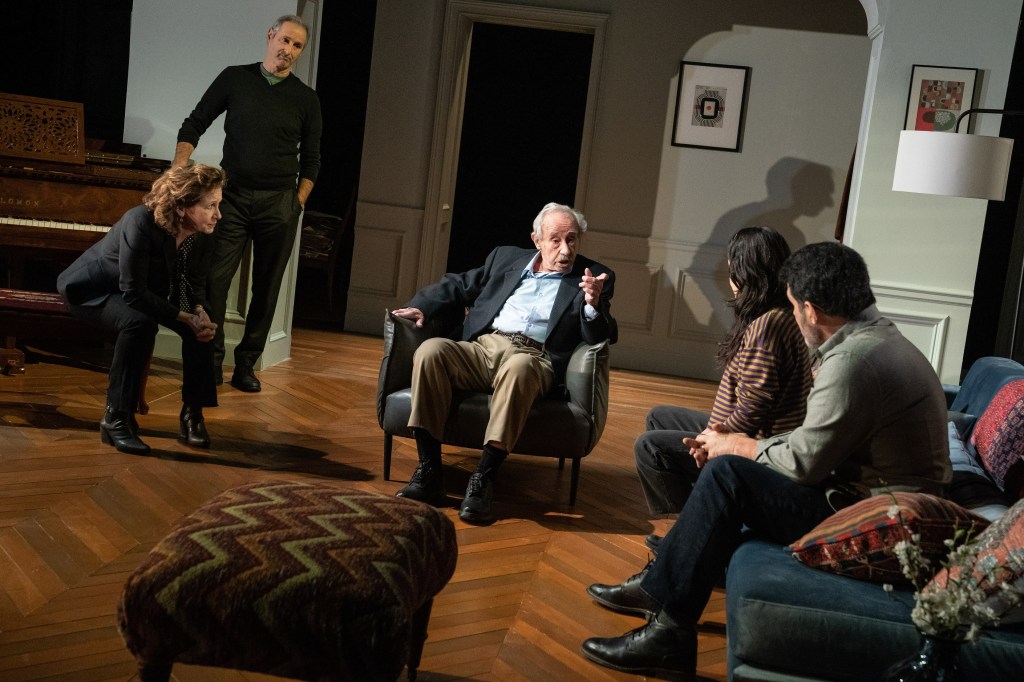
But it is in the final act when the dam bursts with a traumatic episode for Marcelle, who by degrees has given up on her beloved Paris. It occurs at the symbolic Passover Seder, a remembrance of when God wrought miracles to help the Israelites escape slavery in Egypt. At the celebration, when they arrive at the “opening of the door to let the angel in,” Marcelle becomes hysterical like Charles did weeks before. She, too, has a “can’t take it any more” moment and refuses to open the door, terrorized that a Marine Le Pen engineered terrorist will enter and kill them.
The scene is shocking. Betsy Aidem’s performance is riveting as are the other actors. Harmon establishes centuries old horror of death at the hands of haters. Though the idea seems ridiculous, recently a woman was burned alive in her apartment in Paris.
That Harmon has conjoined Marcelle’s terror with the symbolic traditional night commemorating their escape from persecution and oppression is an apotheosis. In an irony of twisted emotion, Marcelle gives in to the terrorists who want Jews gone from “their” country, the most grievous insult of all. It is an incredible message because Marcelle’s fear destroys her ability to believe in God’s protection, a basic fact of her religion. She believes in God’s protection only if she flees, like the Jews of ancient history. The hatred of others intellectually and representationally in various select acts of violence has overwhelmed Marcelle’s ability to feel secure in her own religion, her own apartment, her own country, her own identity. She must leave.
Of course it is a sardonic fact that her family’s escape will be to one of the most dangerous countries on the planet. Patrick raises the issue about the security question in Israel. Indeed, physical security must have as its precursor intellectual and philosophical security in the Golden Rule of “do unto others,” democratic values, an ideal that France attempts to follow and does with exceptions, better than other countries. Certainly, in Israel’s West Bank, the Golden Rule does not abide for Palestinians who are treated as “the other” and are oppressed and have no rights under Netanyahu’s ultra right wing, increasingly anti-democratic government.
Harmon’s play is filled with thesis/antithesis arguments, and this is a family that generationally loves a worthy argument with well supported logic and details. Patrick takes the position that the Republic of France will stand by its ideals and that there is nowhere safe globally, moment to moment; not Israel, not the United States, not Europe, the Middle East, Asia, etc. Human hearts are not safe.
To counter his sister he correctly asserts that the fascistic government of Marine Le Pen will be voted down and the Republic will persist. Harmon’s point is well taken. There are those across the globe who value equanimity in greater numbers than those whose megalomania and craven hate seeks the death of others for power. However, his commentary falls on deaf hears; Marcelle has made up her mind to go to Israel where their Jewish identity may be expressed freely with little fear of reprisal by crazies. For her France has nullified her existence as a Jew.

Whether she will feel safe in Israel relies on hope and sacrifice. In Israel they have to start all over again. They will have sacrificed their careers, friends, culture, language, everything for the hope of a safety and security that is never guaranteed. If they are on a bus that terrorists decide to blow up in Tel Aviv, there is no way to stop that. But Marcelle is convinced, turning 180 degrees from her position at the play’s beginning. Fear possesses her soul and she makes decisions based on it.
In the final segment of the play the argument takes further flight with elderly father Pierre (Pierre Epstein is eloquent in this last speech to the family). If they leave, it is their choice, but he will not go with them. Having the freedom to choose and not be compelled is vital to his identity. Ironically, by giving into their fear, they have compelled and oppressed themselves. Pierre who has seen the worst of the camps and survived, knows the difference of experiencing the worst. His children and grandchildren have not and they don’t want to. That is why Marcelle compels them to leave, though such an event happening again is a probability off the charts. But no one dares speak that to her, not even her own brother.
The performances are sterling and sensitive, at times funny, and always compelling. The canny direction by Cromer to “get it all down” and thrill the audience with ideas and concepts is just great. I particularly enjoyed the Set Design by Takeshi Kata that designated the differences between present and past efficiently and seamlessly. The Lighting Design by Amith Chandrashaker provided the ephemeral, soft, wistful tone of the past and stark contrast with bright light that magnifies the present. Kudos to the other creatives, Sound Design by Lee Kinney & Daniel Kluger, Original Music by Daniel Kluger.
Prayer for the French Republic is revelatory and insightful in questioning our arrogance to believe we, who are transient beings on this planet, have an identity and home, knowing mortality comes to all of us physically. He also twits our assumptions about safety and security, the difference between life’s enjoyments and living an existence permeated by psychological fear. Above all he designates in a Republic, there is the right to choose one’s destiny, free from personal harm because, if applied, the rule of law secures it. But if it is not exercised, then what? Harmon asks the questions through lives, relationships and situations that embody them in seeing the Salomon family live in the past and present. If one delves deeply enough and contemplates like Topol’s Patrick does, one sees the answers can only be individual and personal. No one can answer for someone else.
This is a wonderful play dramatically rendered. It should be seen, especially if you enjoy thought-provoking plays that move swiftly on emotional power. For tickets and times go to their website https://www.manhattantheatreclub.com/shows/2021-22-season/prayer-for-the-french-republic/
Prayer for the French Republic has transferred to Broadway and will run until February 18th at the Samuel J. Friedman Theatre. Look for my review of the Broadway production on Blogcritics.org.
 CAROLE DI TOSTI