Blog Archives
‘Hell’s Kitchen’ Blasts Onto Broadway and Electrifies With New York’s Resounding Energy

Hell’s Kitchen, premiering on Broadway in its transfer from the Public Theater is nothing short of gorgeous perfection. Though the creative team rendered a phenomenal production in the fall of 2023 at the Public’s Newman Theater, the 299 seat venue and smaller stage offered a constricted space. The Shubert Theatre Broadway is the proper venue for this update, expanding the bravura performances and allowing for the outsized dance numbers and abundance of talent that is free to explode with musical glory. This production is totally “on fire” and more than “ready” for Broadway in a masterful presentation of Alicia Keys’ music in a coming-of-age story that is inspired by her own life!
With its apparently seamless transfer, Hell’s Kitchen, with book by Kristoffer Diaz, Alicia Keys’ glorious lyrics and music, Adam Blackstone’s music supervision, Camille A. Brown’s dynamic choreography, Michael Greif’s thoughtful direction and Alicia Keys and Adam Blackstone’s arrangements of key songs from her repertoire (and a few new ones), what’s not to adore?
Integrating Keys’ playlist with an organic story rooted to a New York setting during a period of a few months, Greif, Keys and Diaz’s choices stir up the magic that makes this production uncharacteristic and unique, far from the typical obtuse branding of a “jukebox” musical, which it isn’t. The overriding conflict in Hell’s Kitchen is between mother and daughter in their story of reconciliation, which on another level writes a love letter to New York’s loudness, brashness, street people, and atmospheric social artistry in the 1990s.
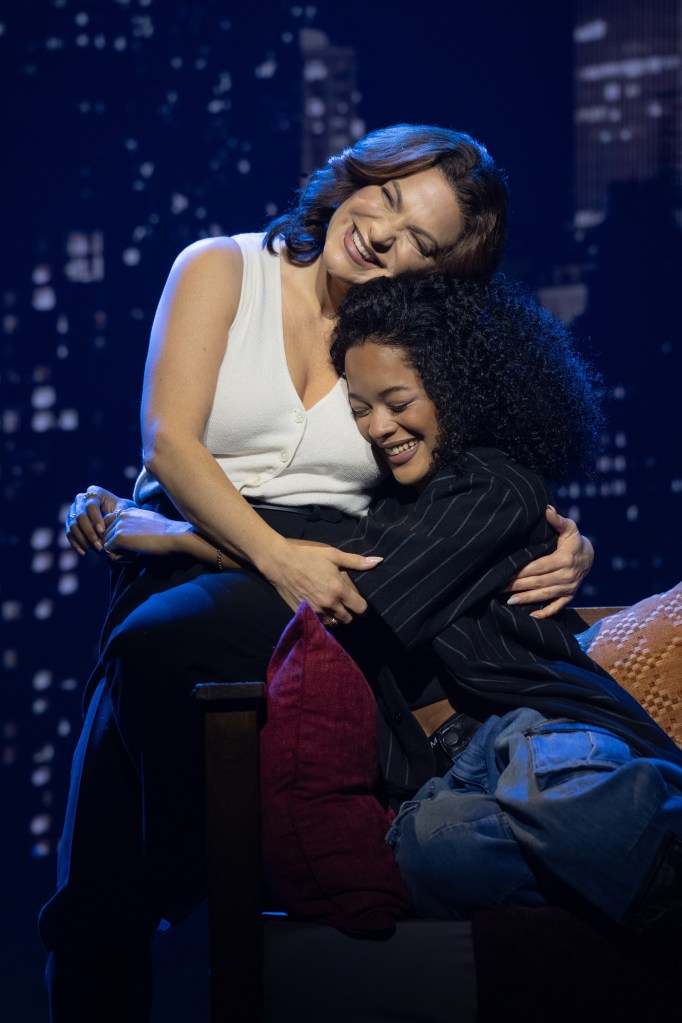
Even if you are not an Alicia Keys’ fan, you will be enthralled with the performance of the sterling, exceptional voice and presence of Maleah Joi Moon, who is the frustrated Ali, who casts herself as the princess her mother (Shoshana Bean), cages in their apartment. Ali fights for her “freedom” against her narrow vision of her “monster” mom who she believes is a restrictive, paranoid, hypocrite who doesn’t know what life is about. Meanwhile, underneath, she is crying inside, but doesn’t realize how and why.

Using flashbacks from the present with events highlighting all the characters that mattered in her life at the time, Ali tells her story of a special summer, not as we are initially led to believe, because she is with a man. Rather it is a reflection on her past from which she gains wisdom and understanding, through love, sorrow, heartbreak and renewal. The backstory of Ali’s life at Manhattan Plaza, a subsidized residency for artists, is revealed in various songs: “The Gospel,” “The River,” “Seventeen,” and others. Through her storytelling, she reveals her understanding of how pivotal these events are in her relationship with her mother and father, and her relationship with herself as an artist.
Ironically, Jersey (the non pareil Shoshana Bean), knows all too well how one is caught up in the distractions of the opposite sex (“Seventeen”). She coupled with Davis (the soulful Brandon Victor Dixon), when both were not ready to be Ali’s parents. While Davis took off to pursue his career, Jersey gave up hers to raise Ali, work two jobs, live in subsidized housing for artists at Manhattan Plaza, and attempt to corral Davis whenever he was in town to be a father to Ali. Though Ali knows the facts about her parents, she doesn’t understand the profound nature of their relationship as it relates to her. She resents Jersey and Davis and tries to suppress underlying anger about feeling unloved, unwanted and tyrannized. The rage spills out continually against Jersey who must take the brunt of it as a single parent.
Ali seeks her identity and purpose apart from the family situation and her father’s “abandonment” that she rages against. Spurred on by her friends she throws herself herself at Knuck (Chris Lee). The twenty something is one of a three-person bucket drumming crew providing excitement and sexy currents busking in the courtyard of Ali’s residence. Ali’s attraction to him is so palpable, Jersey warns the doorman and her police friends to “watch out” for her daughter’s wiles with the “bucket drummer,” which miffs Ali. When tensions increase with her mother, Ali seeks comfort from Miss Liza Jane’s (the incredible Kecia Lewis), classical piano playing in the Ellington Room of Manhattan Plaza, which so inspires her, she realizes she’s found a part of herself, (“Kaleidoscope”).

There is an underlying irony that Diaz’s book suggests about Ali’s selection of Knuck. Of all the guys at her disposal in New York City, the ultimate attraction falls under her mother and her gossipy doorman’s and neighbors’ noses. Of course her mother is provoked and has a friend cop disperse the drummers. The drummers think they are unwanted because Ali’s mom is white and a racist. Though they are not arrested, the event is frightening. Importantly, it reveals Ali is selfish and willful. Her underlying problems with her family will leech out to impact her relationships unless she checks herself and tries to resolve them, but at this juncture, she doesn’t. Instead, she searches out Knuck who tries to tell her his experiences as a Black man fighting an identity he is branded with, in an attempt to get her to understand that the situation with her white mom’s reaction is dangerous (“Gramercy Park”).
In an attempt to reach out to her daughter, Jersey discusses why she is so “paranoid,” and we get to meet the sexy Davis (“Not Even the King”) when Brandon Victor Dixon smoothly croons his heart out. Bean’s Jersey joins him in “Teenage Love Affair,” and we understand how both allowed the sizzling attraction between them to overthrow rationality, precisely what Jersey fears will happen to Ali. After her discussion with Ali, it seems that mother and daughter have reached an agreement and understanding. However, Ali pushes that understanding aside and willfully seeks out Knuck.
With almost unconscious rebellion, without regard for Knuck (she lies about her age), she pursues an intimate relationship with him (“Un-thinkable [I ‘m Ready]). Indeed, with her provocative behavior, encouraged by her friends in the astounding “Girl on Fire,” she boldly brings Knuck to her apartment, flaunting her faux adulthood on Jersey and disrespecting their home. is it any surprise Jersey finds them in a state of undress? The white mother who has branded Knuck throws him out; and that is when he is told Ali is underage. He runs for his life.
When Ali runs after him, there is confusion and chaos downstairs where his friends have been drumming. Ali tries to apologize to Knuck in front of the crowd when Jersey stops her, tells her to go upstairs and slaps her when she ignores her. Jersey’s action serves as a trigger, the doorman catches Knuck, and cops arrive with flashing red lights to arrest the drummers.

In a typical aftermath, we don’t know if the drummers who have done nothing are OK or not. A hysterical Ali is helped by Miss Liza Jane who finally gets through to Ali (“Perfect Way to Die”), helped by the Peter Nigrini’s projection design which include black and white photos of sons and daughters who have been the victims of police brutality, otherwise known in the South as lynchings. In the interlude Miss Liza Jane tries to encourage Ali, inform her about the racial history of the US and quietly suggest that she can’t afford to be reckless in a racist culture. Miss Liza Jane affirms that Ali must take her anger and pain and use it for an artistic purpose. This is another major theme of Hell’s Kitchen, a theme which Alicia Keys and her friends in the music industry realize every day of their lives.
Interestingly, Hell’s Kitchen doesn’t beat the audience over the head with police brutality; no one is injured, but Miss Liza Jane, who shares her historical, personal experiences sings/speaks to Ali like an adult who can understand. Wisely, Keys and Diaz reveal sub rosa the institutional racism in the culture as it is suggested in “You Don’t Know My Name.” In that song, they emphasize the harm in stereotyping, branding and dismissing the humanity of Knuck as “invisible.” Indeed, Jersey falls into the trap out of fear, though she is not a racist and has a mixed race daughter. Nevertheless, this profound concept is revealed; and as open minded as Jersey is, she is unfair to Knuck. Her daughter is to blame for lying to him.. In how many situations like this have Black men been killed? Knuck and his friends, thus far, have been fortunate.

Moon’s Ali is a combination of innocent and alluring, a convincing “wild child” who wants to attract Knuck, the forbidden prize she can toy with, (repeating the same situation her mother was in), to provoke Jersey for love, or perhaps to drive at a deeper understanding between them. Her obtuseness in endangering Knuck and the others, until the amazing Kecia Lewis’ Miss Liza Jane, and Brandon Victor Dixon’s superb Davis counsel her, is key to her evolution. Importantly, it is a vital mentoring theme for teenagers.
In Act II, when Ali suffers a touching loss that she can’t overcome, but can only move forward through, Moon is just terrific in expressing her hurt and sorrow with grace. Her performance is a smashing powerhouse. Likewise Shoshana Bean as Jersey, in her presence, her fear, anger, panic and emotionalism, rocks the role out of the ballpark.

The two actors create a felt relationship that is authentic and heartfelt. They effect a mother daughter bond that satisfies all the digressions from rebellion, to incriminations to regrets, to sorrows, to reconciliation and a forever, spiritual love which Act II’s songs encompass, especially “If I ain’t Got You,” Hallelujah/Like Water,” “No One.” And of course Hell’s Kitchen wouldn’t be “Hell’s Kitchen” without “Empire State of Mind” in which all the creative team, the swings, Chloe Davis (dance captain), and others pull out the stops and dance and sing passionately as Peter Nigrini’s marvelous projections of New York City’s aerial views at night, form the moving backdrop.
Kecia Lewis as Miss Liza Jane, Chris Lee’s Knuck and the smooth, silky voiced Brandon Victor Dixon are the counterparts of Maleah Joi Moon and Shoshana Bean. The bucket drummers, and Ali’s girls have exceptional voices and presence. There is no spoiler; I’ve intentionally left out a discussion of how the resolution and renewal occurs and when it occurs in Act II.
You really shouldn’t miss Hell’s Kitchen, especially if you are a New Yorker.

Finally, Michael Greif’s vision, his integration of Robert Brill’s fabulous scaffolding scenic design with the rectangular construction grids stylizing the New York City buildings with neon lights, is perfect. Situating the musicians above on the scaffolding so the music rings out the harmonies of Adam Blackstone’s and Alicia Key’s arrangements, in fact all of it, including Natasha Katx’ multi-colored lighting and spots are breathtaking. Importantly, Gareth Owen’s sound design is balanced and painstakingly effected, so I heard each word. On many musicals, the sound design is problematic and slips. Owen’s was right on. Dede Ayite’s costume design and Michael Clifton were period appropriate. The Hilfiger and Gap brands, cargo pants, mid-drift tops, low slung pants with jazzy underwear, and sparkles and shimmering outfits when most needed (especially the last song), were fun and New York identifiable.
All the creative elements aligned with Greif’s vision of a Hell’s Kitchen which is undergoing transformation and hope, despite unresolved institutional racism and discrimination.
As with the Public’s production I was thrilled by Camille A. Brown’s choreography and the dancers’ amazing passion and athleticism incorporating a variety of hip hop dances from the period and then evolving into something totally different. Unusually, there is movement during times when least expected, but all correlated with the emotion and feeling of the characters making the dancers’ moves expressive and coherent.
I’ve said enough. Get your tickets. After the Drama Desks and Tony’s the prices will be higher and you won’t be able to get a more affordable ticket. Now is the time.
Hell’s Kitchen in its Broadway premiere runs two hours thirty-five minutes at the Shubert Theatre, 235 West 44th Street between Broadway and 8th Avenue. https://www.hellskitchen.com/
‘Hell’s Kitchen,’ Alicia Keys’ Glorious Musical, a New York High

Vibrant, relentlessly electric, Hell’s Kitchen with music and lyrics by Alicia Keys and book by Kristoffer Diaz sends one out into the night elated and energized. In a sold out run at the Public Theater, Hell’s Kitchen is transferring to Broadway for five good reasons. These include award-winning Alicia Keys’ glorious music, Adam Blackstone’s music supervision, Camille A. Brown’s dynamic choreography, Michael Greif’s thoughtful direction and Alicia Keys and Adam Blackstone’s arrangements of key songs from her repertoire, and three new ones.
Integrating Keys’ playlist with an organic storyline rooted to a New York setting during a period of a few months, Greif, Keys and Diaz’s choices stir up the magic that makes this work sizzle beyond the bounds of the typical jukebox musical.

Clearly, the coming of age story about a seventeen-year old living in Manhattan Plaza takes its inspiration from Keys’ life. She lived in Manhattan Plaza with her mother, and then she took off, living independently after about a year, all before seventeen. Diaz’s book moderates Keyes’ exceptionalism, especially that she began to establish her musical prodigy at 7, and by seventeen was arguing with Columbia records about control of her music, image and songs for an album she already created.
Ali (Gianna Harris the night I saw it), dramatically casts herself as a Rapunzel in cargo pants and Tommy Hilfiger underwear and tops, locked away in the isolated “tower” of Manhattan Plaza by her mother, Jersey (Shoshana Bean). Though mom intends for her to stay safe from the dangers of Hell’s Kitchen, which is gradually being cleaned up of its unsavory druggy characters by then Mayor Rudy Giuliani, Ali questions her mother’s judgment.
Narrating her story in the present, Ali flashes back to key events and key people she meets in her life at the large, subsidized housing arrangement for artists initiated by Estelle Parsons and others. Parsons and other fed up actors, musicians, dancers, etc., encouraged city fathers to create apartments where artists could live while working in the city whose rising costs have continued to this day.
(Joan Marcus)
Artists then and now bring in millions/billions of dollars to the second largest entertainment capitol of the world, yet, subsist on poverty level wages, plying their craft, despite being unable to maintain themselves even on welfare. As a former actress, Jersey is able to meet the requirements at the Plaza for a small living space with Ali, still working part-time as an actress when she can get jobs. However, forced to scramble to support them, Jersey, works the night shift with a steady job, having essentially given up her career to take care of Ali, who doesn’t understand or appreciate the sacrifices her mother has made.Instead, Ali focuses her complaints on her absent father who abandoned the family, and her lack of freedom to hang out with friends and strike out on her own to do what she wants.
The overriding conflict in Hell’s Kitchen is between mother and daughter in their story of reconciliation, which on another level writes a love letter to New York’s loudness, brashness, street people, and atmospheric social artistry in the 1990s.
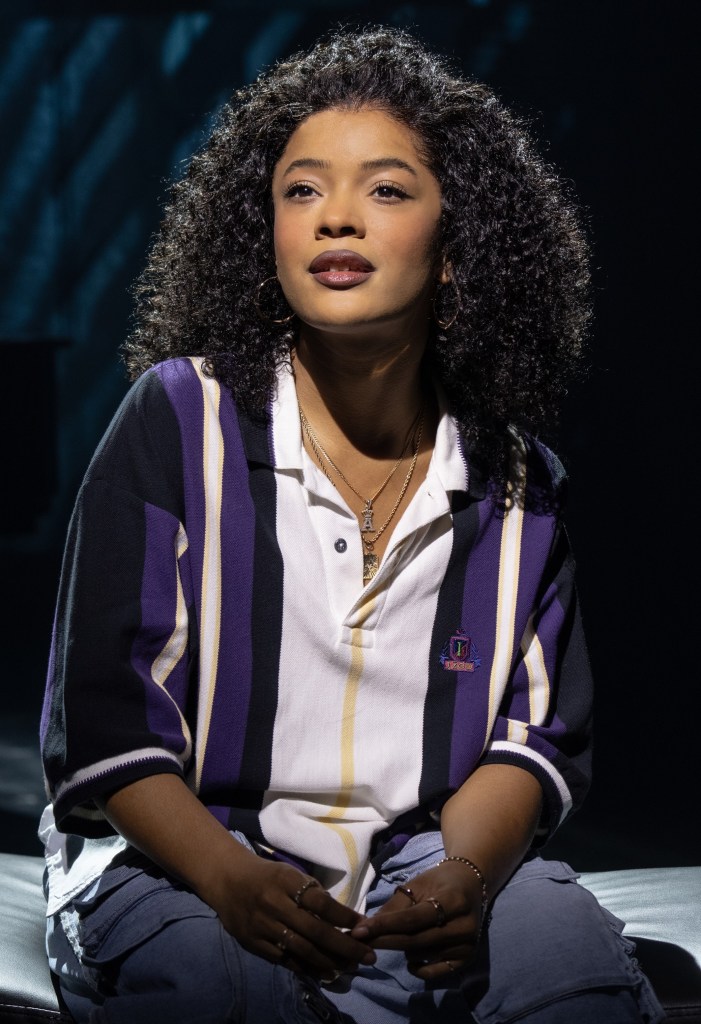
Key to the arc of development is that Jersey doesn’t want Ali to follow in the shadow of her “mistakes” (she got pregnant and had to raise Ali), which she sings about in “Teenage Love Affair” as she affirms why Ali’s soulful father Davis (the smooth-sounding, seductive Brandon Victor Dixon) was not the type of man to settle down. Having heard this story before, the fun and juice of her mother’s passion for her father prod her emotions. She is seduced to walk the alluring tightrope of danger to replicate her mother’s forbidden experiences while trying to find her true purpose which will lift her up from identity disappointments and anger about her father’s neglect. But how can you tie down a crooning club singer who is always on the move and looking for excitement around each corner of life?
This background is presented in Act I (‘The Gospel,” “The River,” “Seventeen,” You Don’t Know My Name,”) as Ali seeks her identity and purpose apart from the family situation she rejects, spurred on by her friends to throw herself at Knuck (the adorable Lamont Walker II when I saw it). The twenty something is one of a three-person bucket drumming crew providing excitement and sexy currents busking in the courtyard of Ali’s residence. Ali’s attraction to him is so palpable, Jersey warns the doorman and her police friends to “watch out” for her daughter’s wiles with the “bucket drummer,” which miffs Ali. When tensions increase with her mother, Ali seeks comfort from Miss Liza Jane’s classical piano playing in the Ellington Room of the Plaza, which so inspires her, she realizes she’s found a part of herself, (“Kaleidoscope”).

Although Keyes’ own storyline is much more complicated, Diaz keeps it simple in order to integrate Keys’ repertoire which includes eleven numbers in Act I and twelve in Act II (according to the program). In Act I, the songs weave Knuck and Ali’s coupling in “Gramercy Park,” and “Un-thinkable (I’m Ready),” and gyrate into an amazing “Girl on Fire” in a heady, rigorous number that involves the entire company and ends in an explosion of emotions.
Unable to contain themselves, Knuck and Ali are intimate in Ali’s apartment. Is it any surprise that Jersey looses it when she finds the older Knuck and her underage daughter on the living room sofa in a rerun of Jersey’s life with Davis? Shocked that the precocious, sexually self-possessed Ali is seventeen (making him a rapist), Knuck is infuriated and races out. He is one step ahead of Jersey but is arrested, and humiliated in public, which Ali tries to prevent but can’t.
Because of her colliding impulses and emotions, Ali has recklessly endangered and effectively punished Knuck for his affections which he tried to resist. In a gender role reversal, she has exploited him as the “innocent,” while “getting off” on using her sexual power. Too late, she backtracks with empty apologies and remonstrances.

The event resolves in the Ellington Room where Ail seeks comfort, while Miss Liza Jane sings the instructive and heartfelt “Perfect Way to Die,” highlighting the culture’s racism, police brutality and discrimination as the daily portion of hatred and violence that communities of color still have to face and fear. Act I concludes powerfully with the song highlighted by Peter Nigrini’s projection design in black and white of victims of future police brutality. Miss Liza Jane and Ali conclude in hope with a focus on Ali’s lesson at the piano. The reveal is that art is the way out of the ghetto, the violence, the discrimination, the institutional racism that so often cuts down Black men and colored populations.
Act II (“Authors of Forever,” Heartburn,” “Love Looks Better,” “Work on It,” to name a few), follows with a lengthy resolution after Ali experiences a loss, ends her brief encounter with Knuck, and Jersey calls in Davis to help her daughter overcome her emotional depression and grief. Together, father and daughter sing a lovely duet with Davis at the piano. Mother and daughter have a new appreciation of one another and the musical ends on a celebratory bow to the city with Keys’ “Empire State of Mind.”

The covers, Gianna Harris, Lamont Walker II, and Crystal Monee Hall are spot-on marvelous, working seamlessly with Shoshana Bean’s powerhouse singing and emotionally riveting portrayal of Jersey. Bean’s Jersey is a tumbling cycle of love, fear, anger and confusion as she tries to negotiate the rebellious Ali. Likewise, Harris perfectly portrays her attempt to kindle a relationship with Davis. The smooth, relaxed portrayal by Brandon Victor Dixon, shines as the counterpart of Jersey. His mellow, and beautifully mellifluous singing is sensational. Dixonl clearly reveals why Bean’s Jersey fell hard for him and was so acutely disappointed and broken when they couldn’t make it as a family.
The musical, pegged as entertainment with the intent of heading for a Broadway audience avoids going as far as it could only inferring Knuck’s arrest might have ended up in a brutal attack against him. Instead, the death that occurs is a loss that is devastating, but not aligned with any cultural indictment. It is most felt by Ali and it triggers her feelings to be more supportive and loving of her mother which ends up in a satisfying and uplifting conclusion.

Nigrini’s colorful projections of New York City lighten up Robert Brill’s grid-scaffolding, dark scenic design and minimalist set pieces. Dede Ayite’s costume design is setting appropriate and dated for that period in time. Lighting design by Natasha Katz, sound design by Gareth Gwen, and hair and wig design by Mia Neal all are in concert with Greif’s vision of a Hell’s Kitchen which is undergoing transformation and hope, despite unresolved institutional racism and discrimination.
I was most drawn by Camille A. Brown’s choreography and the dancers amazing passion and athleticism incorporating a variety of hip hop dances from the period and then evolving into something totally different. Unusually, there is movement during times when least expected, but all correlated with the emotion and feeling of the characters making the dancers moves emotionally expressive and coherent.
Hell’s Kitchen is a winner. Look for it when it opens on Broadway or try your luck with tickets based on availability at the Public Theater on Lafayette Street, downtown. https://publictheater.org/
 CAROLE DI TOSTI