Blog Archives
‘Call Me Izzy’ Jean Smart Triumphs in her Broadway Return

It was a wise casting choice to engage Jean Smart for Call Me Izzy, written by Jamie Wax. Call Me Izzy currently runs at Studio 54 until August 17th. The beloved “Hacks” star, a Six-time Emmy Award winner and Tony nominee is drawing fans who are delighted to see her after a two-decade absence from Broadway.
The 90-minute play is aptly shepherded with fine pacing and staging by Sarna Lapine. This is especially so once Izzy moves from the bathroom where she is forced to write in secrecy. The director’s collaboration with Smart and the technical team reveal a woman’s life under siege in a horrific marriage.
With supporting lighting effects by Donald Holder, compressed interior scenic design and haunting, exterior forest projection by Mikiko Suzuki MacADAMS, the production is nuanced and profound. Though the play does feel contrived in its development, overall, the production is memorable for Smart’s performance and the technical elements that highlight the play’s themes. Even Smart’s costumes (long flannel shirts and jeans by Tom Broecker) and the original music composition by T Bone Burnett and David Mansfield cohere with the characterization and suggest the South.
Smart portrays Izzy in a moment-to-moment solo performance. She takes on the voices of various characters as she relates Izzy’s story. Throughout, Smart shimmers as a powerhouse of feeling, evoking empathy and emotion. Though at times the accent she uses wasn’t clear, (Beth Lake’s sound design), enough of the humor broke through. Smart’s illuminating portrayal of the Louisiana poet who lives in a trailer park with a mean, abusive husband, did override any artificiality that distracted me.
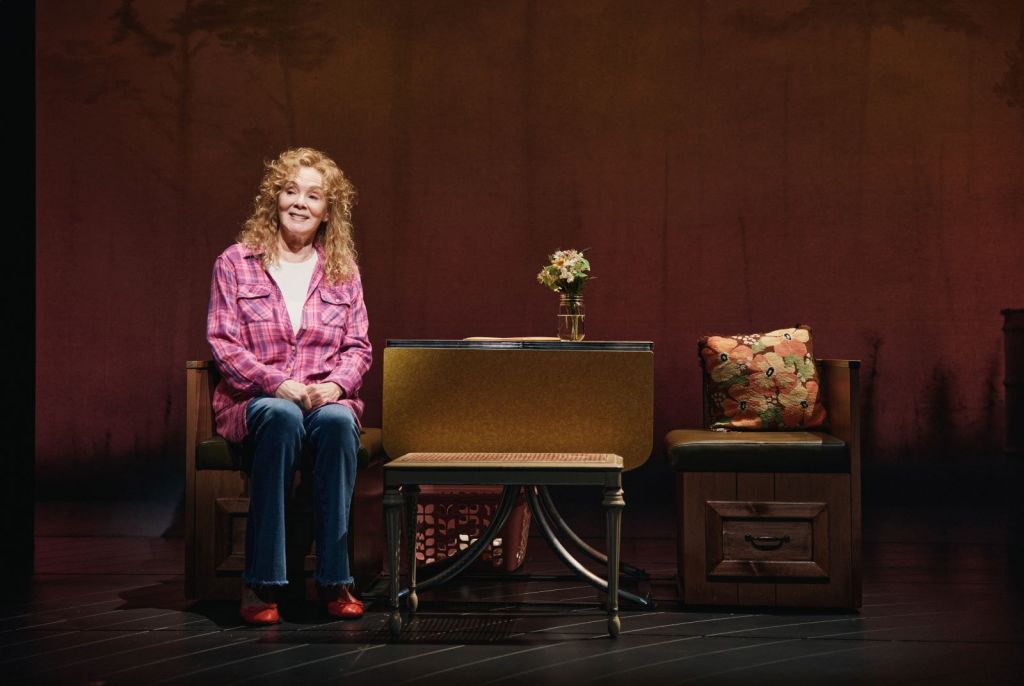
Nevertheless, because of the setting and background details, one can easily figure out the direction of events after the first fifteen minutes. Additionally, the play’s predictability and Izzy’s self-victimization, provoked when she stays with the violent Ferd for years, strain one’s patience. Thank goodness for the talented Jean Smart whose affability and humility lead one to hope for Izzy, despite knowing what the inevitable, dire conclusion will be.
As a housewife in rural Louisiana in 1989, Izzy adores writing, even though it must be in secret away from Ferd’s prying eyes. With exuberance she explains her first inspiration to write, her high school teacher who encouraged her, and a neighbor who takes her to a nearby library where Izzy reads Shakespeare and writes a sonnet. Over the years she fills her journals which she hides away in a back closet because Ferd despises such “uppity ways.” Clearly, as his possession she must remain on his intellectual level. Thus, he prevents her attending college though it might improve their lives. And a monetary award she wins to pursue a writing residency is her curse to be punished, not their blessing.
Izzy writes to express her feelings. Married to Ferd since her 17th birthday, initially they enjoyed each other, prospered and moved to a more upscale trailer park abutting a forest. As Izzy discusses their relationship we note that he gradually meets her attempt to establish her identity through poetry with violence. Tip-toeing around Ferd, Izzy learns to live an inner life apart from him. Whenever she or others inadvertently reveal her talents, Ferd takes offense. He interprets her work as treason and beats her. At a particularly crucial turning point, he takes all of her journals and burns them. He forces her to watch her words, which symbolize her lifeblood, “go up in smoke.” Izzy says with his act he has killed her.
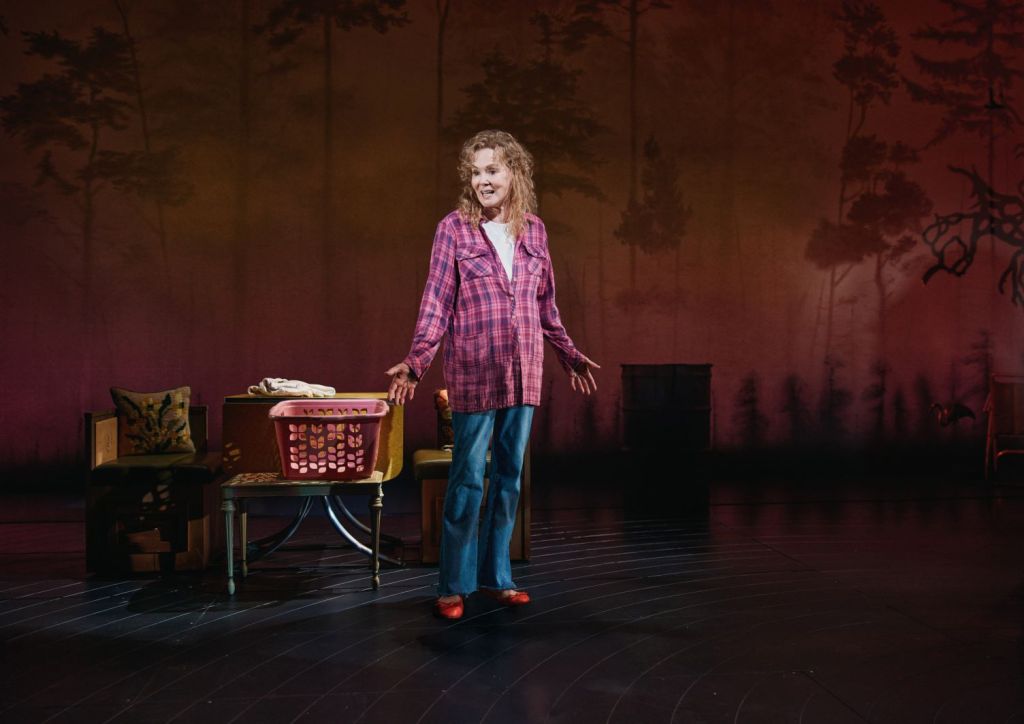
Ferd controls. Izzy lets him believe he is the lord and master, and she bows to his every whim. What sustains her? The inner resilience she receives by writing poetry.
Izzy persists after he burns her journals. Covertly, she evolves herself, her reading and writing. It is why she is in the bathroom discussing the blue tablets she puts in the toilet tank at the top of the play. She shows us how she writes in the bathroom of the cramped trailer. In fact a good deal of the play takes place in the bathroom where she can be alone in quiet to write, think and speak to us.
Mikiko Suzuki MacAdams’ scenic design aptly walls off a bathroom and squeezes in an oversized toilet with a lid that serves as a “table” where Izzy writes on toilet paper. The sonnet and other poems are wadded up and hidden in a Tampax box in a cabinet. The toxically masculine Ferd would never look there. The irony of the bathroom setting is a wonderful touch. In its small space Izzy finds the solace of her wide imagination.
Unfortunately, her writing is not enough. Izzy is a product of the folkways of her culture and her upbringing. Unable to escape them they influence her final actions at the play’s conclusion.
The subject matter of Call Me Izzy is important now more than ever. However, Izzy’s passivity is difficult to experience. It is why, when Smart’s Izzy expresses an interest in leaving Ferd, the audience cheers her on. Too little, too late; we must be tortured by Izzy’s last choice which leaves an uncertain ending.
Call Me Izzy runs 1 hour 30 minutes through August 17th at Studio 54. callmeizzyplay.com.
I
 CAROLE DI TOSTI