Blog Archives
‘Diversion.’ Nurses under Pressure, Forgotten Heroes in Crisis, Review
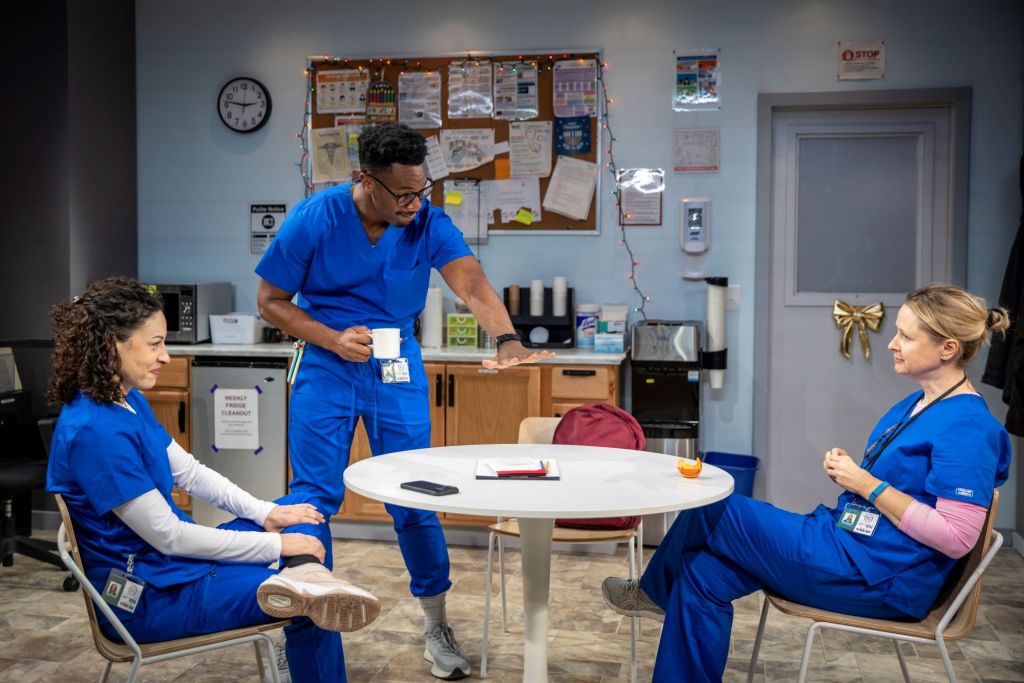
In Scott Organ’s Diversion, the break room of a hospital intensive care unit is a place to let off steam. It is also the location where crimes happen and perps are exposed. Organ cleverly uses this setting for his 90 minute play in an extended run at the Barrow Group’s Studio Theater until December 21st.
The play’s tensions increase after Organ introduces us to four nurses who we later discover negotiate their own personal traumas, while assisting others to live or die. Though we don’t see their trauma, we hear about it and hear about how they may attempt to overcome it through opioids. When their own supply runs out, one or more may have stolen the hospital’s medications to satisfy their addiction. However, the program monitoring the opioids is impossible to bypass without triggering an investigation.
We learn of the conflict when the head nurse Bess (Thaïs Bass-Moore) tells the staff that their unit has been targeted. One or more of the nurses or doctors have diverted drugs. Bess offers to get the individuals into a program to clean up if they quietly come to her first before the company investigator, Josephine (Colleen Clinton), discovers who they are and turns them over to the police.
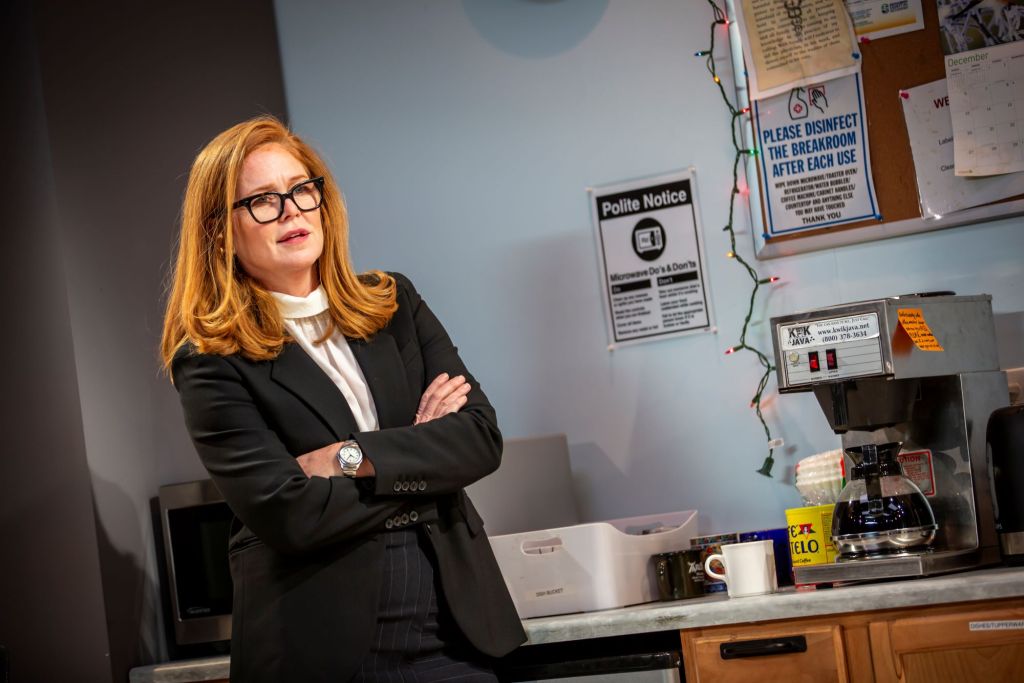
Having been through a disruptive investigation 8 years before when medications were taken, Bess shares her distress. She looks to experienced staff member Emilia (Tricia Alexandro) for help to be her “eyes and ears.” Josephine, a former nurse herself, attempts wisdom and a friendly approach to glean proof she refers to as “data,” by having informal conversations with the staff members. From her perspective, all are suspects, each may have diverted. She will not stop until she proves who the culprit is.
The youngest and least experienced nurse is Mandy (West Duchovny). She keeps late hours, always seems exhausted, and catches up on her sleep in the break room, a clue. The only male of the group, Mike (Connor Wilson), shows his hand when he discusses the street value of a fentanyl patch. The edgy, angry Amy (Deanna Lenhart), insults Josephine publicly to her face, but hypocritically shares the compromising life problems of other staff members to Josephine behind their backs.
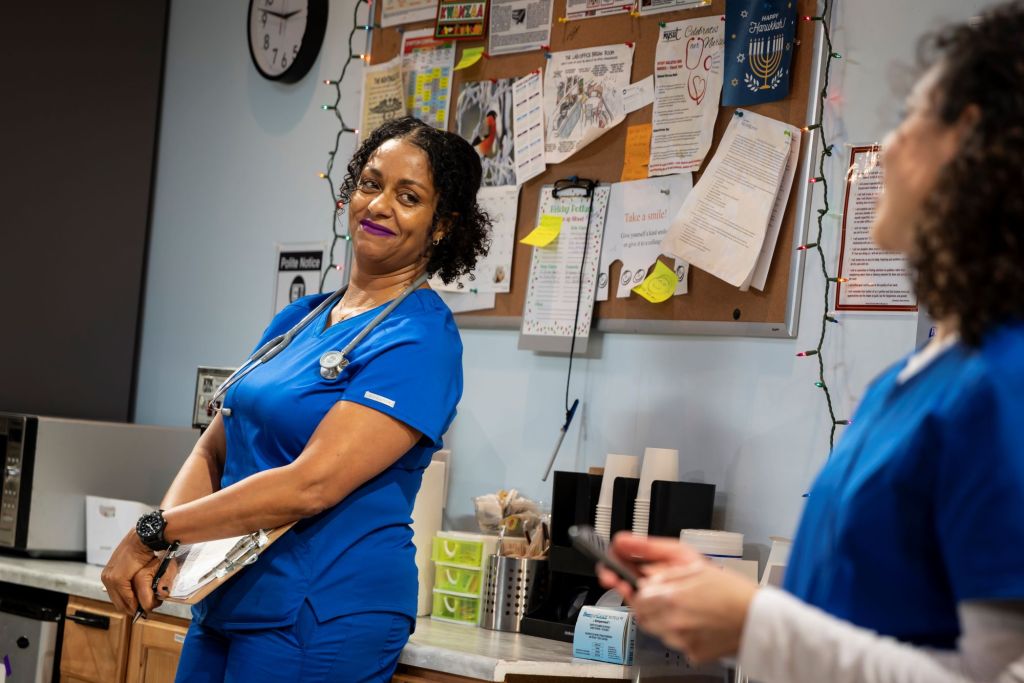
Emilia, the kindest, most compassionate of the group is recently divorced and recovering from the psychological stresses of working through COVID’s long hours, extraordinary emotional demands and understaffed conditions. However, she does admit to Amy that Josephine’s presence is disruptive and adds to their stress, when they should be able to take their breaks from ICU high anxiety in peace.
No one confesses. However, Organ does reveal the addict at the end of Act I. Instead of judgment, Organ’s sympathetic characterizations and the actors’ acute ensemble work create empathy. We easily identify with the individual who is filled with regrets and self-recrimination. In Act II, when they still do not confess, we understand that the cost is too great, as they try to handle their addiction on their own, unsuccessfully. When Josephine closes in to identify the culprit/culprits, Organ allows us to feel what it is like to be a good person stuck in a tunnel of pain and darkness with no way out.
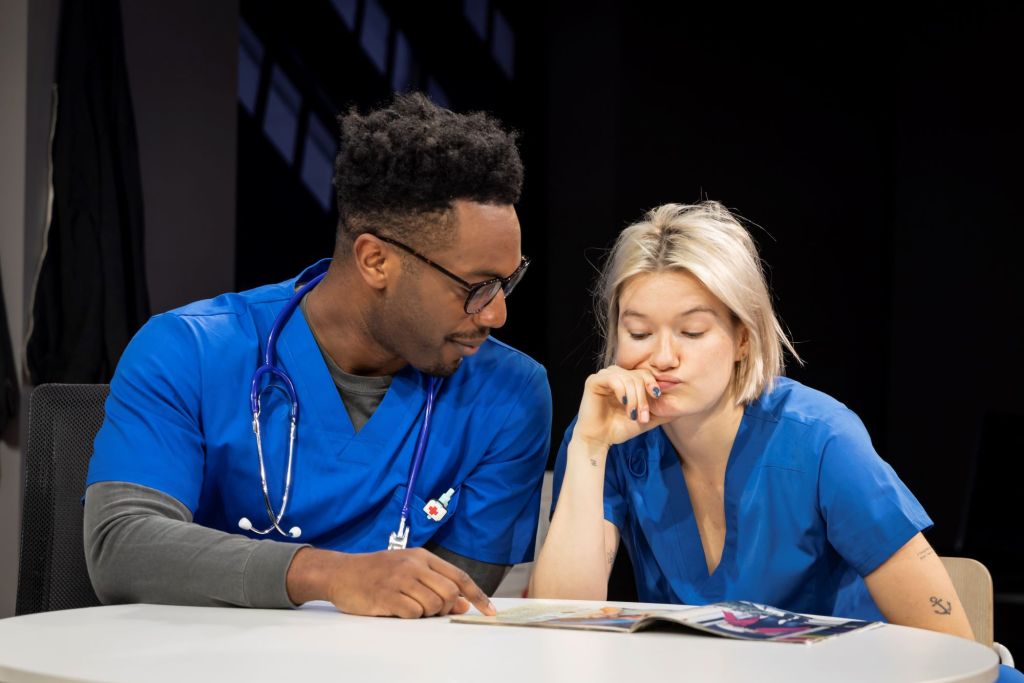
Organ’s poignant, suspenseful and humanly engaging drama has strong elements of comedic relief so we appreciate the relationship dynamic among the nurses which is both tense and humorous. Importantly, the play’s subject matter is topical. It focuses on nurses as the heroes of healthcare. They have been underestimated, underappreciated and, like military veterans, ill-used without proper support. Of course, the opioid epidemic should be front and center in light of our failing healthcare system which is under duress and about to be further de-funded with impactful cuts to Medicaid and possibly Medicare.
Though the production might have run without an intermission to heighten the suspense, director Seth Barrish incisively shepherds the excellent cast for maximum understanding and empathy. The set, costumes, props and lighting cohere with what one imagines of a hospital ICU break room for staff, who seek its respite without gaining comfort, especially since they are suspects of an investigation that can have no happy outcome.
Diversion
The play runs 95 minutes with one intermission through December 21, 2025 at The Barrow Group Performing Arts Center, Studio Theater (520 8th Ave, 9th floor). Barrowroup.org
2019 Tribeca Film Festival Review: ‘Our Time Machine’

‘Our Time Machine,’ at Tribeca Film Festival, artist Maleonn, directed by Yang Sun & S. Leo Chiang (photo from the film)
Our Time Machine won the Tribeca FF Best Cinematography for the Best Documentary Feature Awar, as well it should. The atmospheric lighting and shot compositions helped to create the poignance and poetic beauty of the film.
The arc of development concerns the relationship between the aging Chinese artist (Ma Ke) and his son the famous Chinese photographer and award winning graphic artist (Maleonn). Together, they work on a theatrical project which Maleonn believes will bring them closer together. Through Maleonn’s creation of life-sized father-son machine puppets and a theatrical installation propelled by his family story of life and death, Maleonn hopes to ground his father in a familiar theatrical milieu. Thus, he will receive his father’s wisdom as they work on the project together. Ultimately, Maleonn hopes this artistic endeavor will forestall his Dad’s worsening dementia by linking him with his beloved art form, theater.

‘Our Time Machine,’ directed by Yang Sun and S. Leo Chiang, Tribeca Film Festival (photo courtesy of the film)
Chinese artist Maleonn creates elaborate photo tableaus that blend the real and the surreal in ways that echo his own memories. The installation he hopes to create is his family’s time machine that will symbolically suggest the past, present and future. The filmmakers capture steps of the creative process, the engineering of the puppets, the workshop where they assemble them and various spaces which reveal how the actors/puppeteers gradually take on the ethos of the characters Maleonn has created in his family story.
The documentary directed by Yang Sun and S. Leo Chiang is fascinating on a number of levels: artistic, historical, personal, human, cultural. In reflecting upon the lives of Maleonn, one of China’s most influential conceptual artists today, and Ma Ke, the former artistic director of the Shanghai Chinese Opera Theater who put on more than 80 operas, we are encouraged to see the connections of China’s artistic and cultural past and the burgeoning, innovative artistic China of the present. The new China is reaching out to make its artistic mark internationally, helped along on Social Media and the Internet.
Sun and Chiang reveal the artistic threads between the old China and the China of the digital age as they chronicle Ma Ke’s experiences growing up in a China of varying artistic contours and morphing political philosophies. For Ma Ke, being involved with Chinese Opera Theater (his love and expertise created a wonderful career for himself and his actress wife) was verboten during the Cultural Revolution. He was unable to work for a decade and was humiliated as all theater was politically themed, extolling the glories of communism and the various heads of the Communist Party. There was no place for traditional art forms and especially Opera Theater with its costumes, make-up and hairstyles that reflected ancient China.
After a decade the bans were lifted. Ma Ke was free to work in the theater and he feverishly made up for the lost years. Maleonn appreciated his father’s artistry, but was never involved in it. And he felt excluded because his father’s time and life centered around an art form that had nearly been eradicated. Father and son were on different paths and embraced different artistic endeavors. Maleonn felt resentment. Though he appreciated his father’s artistic passion, he did not like that he was away from home and the family.
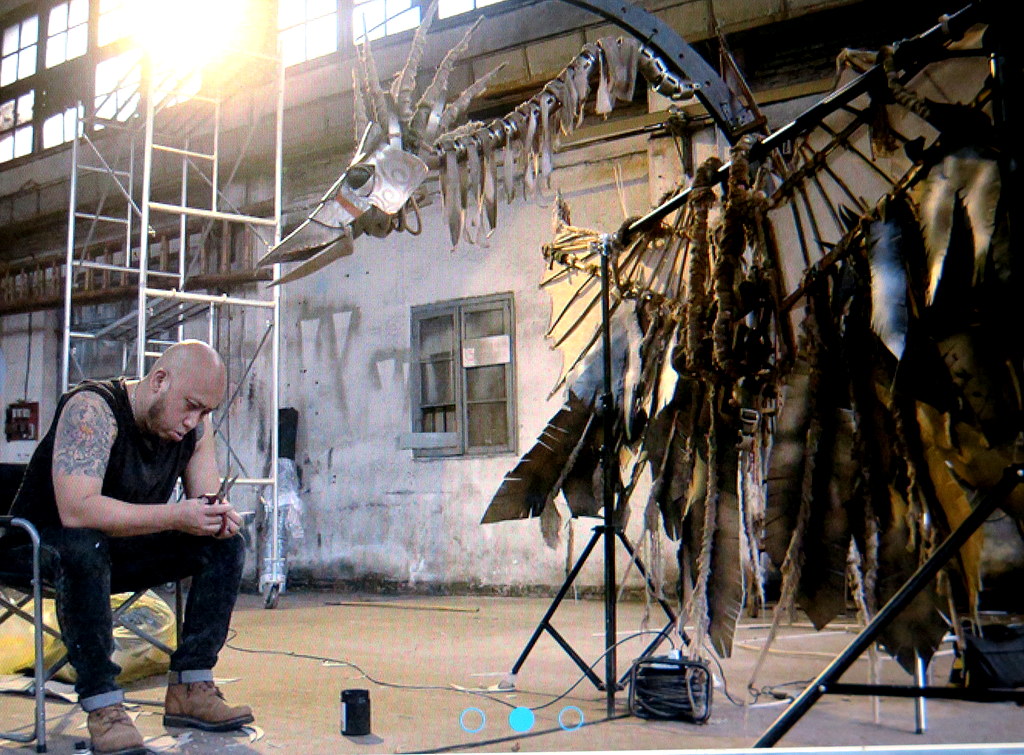
Maleonn, ‘Our Time Machine,’ directed by Yang Sun & S. Leo Chiang, Tribeca Film Festival (photo from the film)
The filmmakers relate the historical perspectives using archival footage and photographs of Ma Ke and his wife and some of the operas that he directed. Parallel to Ma Ke’s story is how Maleonn made a name for himself in photography. However, Maleonn decided it was time to return home when his father was diagnosed with Alzheimer’s and his mother was stressed taking care of him. It is then that Maleonn conceives of the life-sized puppets, the symbolism of going back in time to stir his father’s memories, and a theatrical installation that will be presented in China and abroad.
As Maleonn’s amazing team and Maleonn work to create the human-sized puppets and develop the story, obstacles arise. They manage to overcome each one with enthusiasm. However, there are two they find nearly impossible to overcome: the lack of money and Ma Ke’s deteriorating condition. It is a race against time to find the money and finish the installation so that his father remembers his involvement with it and is inspired by the creation to which he contributed his wisdom and vast experience working in opera.
The filmmakers touch upon the history of China before the Cultural Revolution, during and afterward as they chronicle Ma Ke’s past. In their revelation of the incredible development of Shanghai, we understand the changing world and understand that Ma Ke is losing his place, memory and identity in it. Pushing back against time and the stresses of his own artistic ambition, Maleonn attempts to remain keep his family calm in the face of his father’s forgetfulness and forge ahead with the project. But Ma Ke forgets the operas he worked on and is frustrated that he forgets. He must be reminded about how he is involved with his son’s project and what Maleonn is endeavoring.
The filmmakers chronicle the family’s trials at home, a visit to the place where Ma Ke grew up (which he remembers) and visits to the doctor’s. He juxtaposes the creation of the life-sized father-son puppets, in a symbolic representation of the two of them. This is most poignant for as the puppet creations have life breathed into them, so to speak, Ma Ke loses more of his memory to dementia.
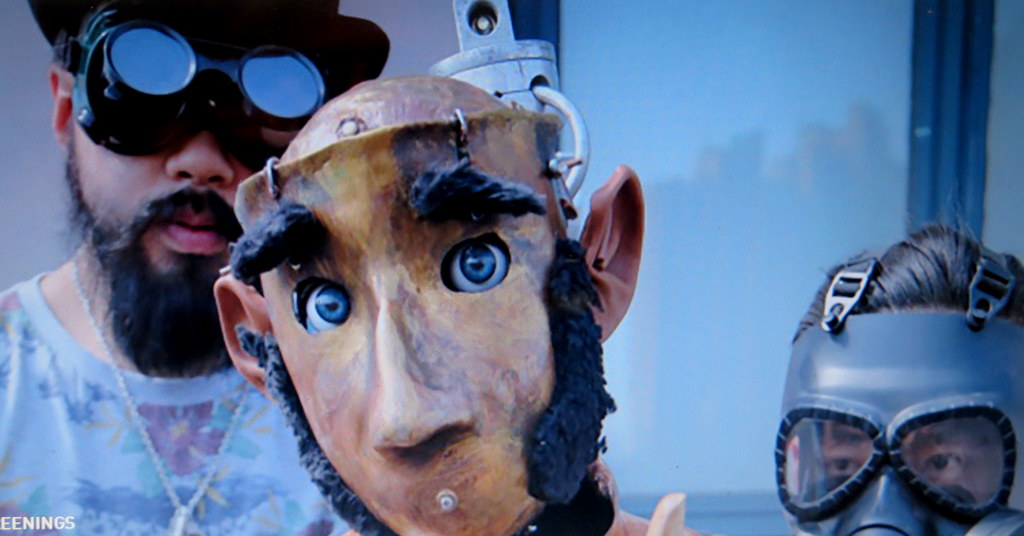
‘Our Time Machine,’ directed by Yang Sun & S. Leo Chiang, Tribeca Film Festival 2019 (photo from the film)
From the shattering of their past relationship overshadowed by theater, Maleonn redeems his resentment during this theatrical creative endeavor making his Dad a part of it as best he can. The documentary is finest in its intimate look at a father-son relationship as it moves toward love and redemption from dislocation and fragmentation. The symbolic transition reflects the cultural divide between the old China and the new reconciled China that is moving into first-world status.
Filmmakers reaffirm that from the past and the present can come inspiration and wholeness that through art, represents the best of the old and the new. It is a powerful message for our time, for China and for countries around the world who are grappling with maintaining their monuments and in the case of Notre Dame now, restoring them. We must develop, yet retain the best of the past as outgrowths into the present.
By the end of the film, Maleonn and his father are reconciled and the installation is able to move forward. One generation springs into the next. Maleonn marries an artist on his team and together they have a child. Ma Ke’s exclamations of excitement and surprise at the baby are touching. Of course, he asks every 10 minutes the name of the baby and whose it is. But Maleonn exclaims that his Dad’s joy returns again and again as he tells Ma Ke that the baby is his.
This is a soaring film that is emotional and sensitive in how it chronicles the family history, and also in how it reflects that the inherent spirit of artistic creation is carried on from generation to generation. Indeed, there is much to learn about how art can be used to sustain memory and identity in the face of the debilitating effects of dementia.
I heartily recommend this film. Look for it. In addition to screenings at the Tribeca Film Festival, tomorrow, the film screens at HotDocs Canadian International Documentary Film Festival, the DocLands Documentary Film Festival, the 35th LA Asian Pacific Film Festival, CAAMFest 2019 and the 2019 Chicago Film Critics Film Festival. The filmmaking team is expected to be at each festival.
 CAROLE DI TOSTI