Blog Archives
‘Tammy Faye,’ Starring Olivier-winner Katie Brayben in a Thematically Charged Musical

Tammy Faye
Tammy Faye, with music by Elton John, lyrics by Jake Shears and book by James Graham stars theater heavyweights Katie Brayben, Christian Borle and Michael Cerveris. All of them are letter perfect in the roles of Tammy Faye Bakker, Jim Bakker and Jerry Falwell. Considering that the show is about the rise and fall of the hugely successful PTL Christian network headed up by televangelists Tammy Faye Bakker and Jim Bakker, the production’s chronicle of a complex period in America’s sociopolitical and religious history is ambitious. Currently at the newly renovated Palace Theatre, Tammy Faye runs until December 8th.
For some, the production is hard to swallow. This is unfortunate because its themes are vitally connected to our country. Also, it is a satiric, entertaining new musical whose theatricality coheres in director Rupert Goold’s vision shepherding a fine ensemble and creative technical team. Because I have a familiarity with the Christian evangelical church and, in fact, went to the same church that Jessica Hahn went to during the PTL scandal, and knew and spoke to her, I have a different perspective. Arguably, I may be biased in favor of the musical. That must be considered when reading this review.
With choreography by Lynne Page and Tom Deering’s music supervision, arrangements and additional music, Tammy Faye presents a fascinating picture of individuals who currently are not held in high esteem. Only one comes out on top as James Graham’s book characterizes her and as the phenomenal voice and acting chops of Katie Brayben performs her. Singing from a core of emotion and heart, illustrating Tammy Faye’s trials of faith, Brayben belts out numbers that overshadow the real Tammy Faye’s voice. These high-points in Tammy Faye’s emotional journey include “Empty Hands,” “In My Prime Time,” and “If You Came to See Me Cry.”

Katie Brayben gives a bravura performance
During these dynamic and compelling songs, Brayben’s Tammy Faye reveals the depth and impact of her betrayal by husband Jim Bakker, as she attempts to find a way forward for and by herself. Not to be underestimated, Tammy Faye is a maverick among the Christian women of the church, a portrayal that we see time and again as she speaks out, despite Christian pastors trying to shut her up. Sharing her opinion at a conference with Billy Graham (Mark Evans), in a beginning flashback of “how it all began,” we note her courage at a time when women took a back seat to any form of leadership. Billy Graham encourages her as the new generation of spiritual warriors in front of a patriarchal, oppressive, conservative group of pastors.
From then on we see her emerge despite being dismissed by the pastors who become the hypocritical villains of Tammy Faye and who sadly lead the way for the massive hypocrisy present in the white supremacist leaning evangelical church today. The Falwell types and white supremacist pastors turn a blind eye to the bullying hatreds and criminality of the MAGA movement they undergird in supporting Donald Trump. Trump’s controversial presidency is in his violating the tenets of Christianity and patriotism. Indeed, he is an alleged pedophile consorting with friend Jeffrey Epstein. He is Putin’s asset who has undermined our election processes twice, and most probably cheated and defrauded the American voter to elicit a “win,” in 2024 (see the Mark Thompson Show on YouTube). He adheres to Putin’s guidance regarding NATO, and on a personal note to emphasize his “godliness,” he’s a lying adulterer and admitted sexual predator (the Hollywood access tape), many times over, in cover ups much worse than Jim Bakker ever committed.

Tammy Faye reveals how we got to the current politics of evangelism
Importantly, for those who would understand how the US “got here” with the rise of evangelism and a brand of political Christianity that belies the true tenets of Jesus Christ’s sermon on the mount, and “Love thy neighbor as thyself,” Tammy Faye gives a crash course in hypocritical Christianity that is right out of St. Paul’s letters to the hypocritical church in Corinthians I and II. It’s interesting to note that over two thousand years later, nothing changes much. Judgment, criticism and condemnation are alive in the human heart and in venues that are supposed to be uplifting the opposite and preaching Christ’s message of love.
Goold stages the production with scenic designer Bunny Christie’s “Hollywood Square” back screen and other projections (video design by Finn Ross), to emphasize the importance of TV to the rise of global evangelism in the 1970s to the present. When the PTL live program is not being taped with dancers and singers, other scenes reflect the importance of satellite TV in the square/screen motif in which appear the various players. Always present as a backdrop are the TV screens reflected in the grid of boxes strikingly lit by Neil Austin that represent what obsesses the actions of the preachers, the Bakkers and their employees (“Satellite of God”). The electric church was televised globally via satellite and its reach was and is expansive, though the screens became smaller on phones after streaming WiFi.
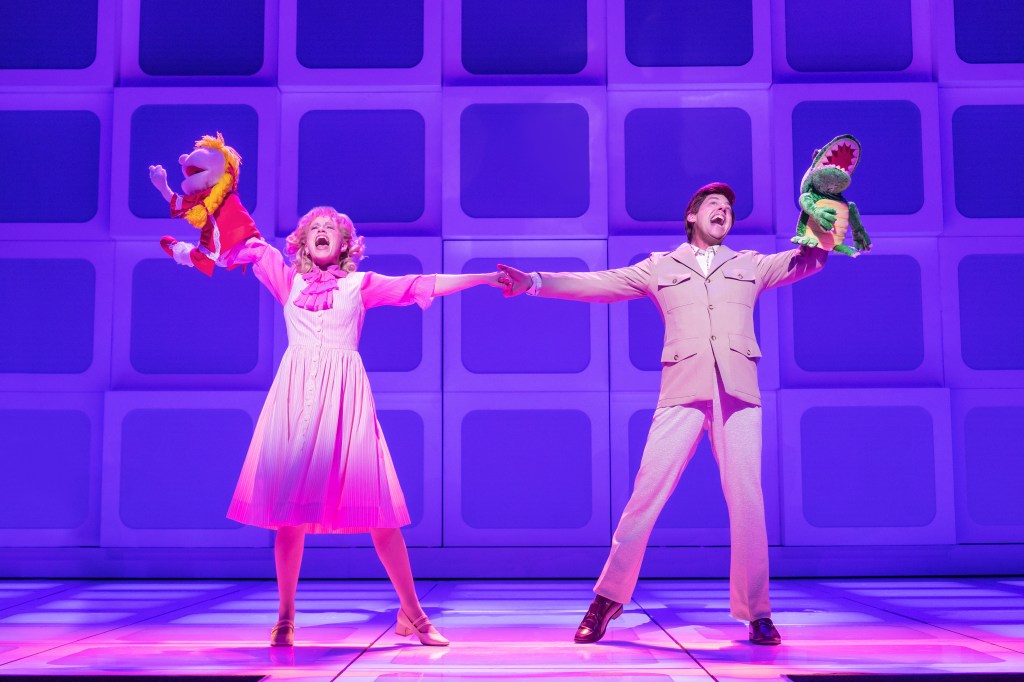
In its symbolism and its wayward themes of church leaders and politicians making damaging and unconstitutional bedfellows, Tammy Faye does its job perfectly, thanks to its creatives. And for that it has received its due misplaced disgust at a time in our nation when Americans have no more patience for hypocrites, scammers and thieves, especially those who profess “Christianity” and lie, cheat, steal, condemn, oppress, restrict, torment and insult as their brand of fun and sanctimony. Hello, Speaker Mike Johnson, Jim Jordan and JD Vance. Nevertheless, Tammy Faye is a vital musical of the time and should be seen for Elton John’s striking music, its irony in how the hypocrites dance around their own lies, and its themes which are more current than ever.
Graham’s book elucidates a version of PTL worthy of note
Book writer James Graham elucidates a version of what happened with PTL that is worthy of note. Laying the blame on the inability of the Christian Church to be united under the first two commandments that Christ preached (love God, love your neighbor as yourself), Graham reveals how Tammy Faye tried to bring disparate groups together with love, but failed. Additionally, to that point, if Tammy Faye had been part of the back room financial arrangements, the fraudulent situation with Heritage Village might not have gotten completely out of hand (“God’s House/Heritage USA”). Indeed, Heritage Village was Jim Bakker’s idea, and clearly, its idea development was mishandled and mismanaged.
Finally, we note that Jim Bakker, whose feckless leadership causes their collapse when he relinquishes PTL and the TV network to Jerry Falwell. With smiling duplicity and treachery, Falwell promises to help the Bakkers get on their feet again and pay their expenses. Tammy Faye warns Jim not to listen to Falwell whom she has always distrusted and deemed a self-serving, condemnatory, hypocritical preacher of hate. Tammy Faye’s unheeded warning proves correct. With his lies, misinformation and mischaracterizations, Falwell upends any goodness the Bakkers accomplish, defames them publicly, and kicks them out of the Christian fellowship for the “good” of the conservative church and himself.
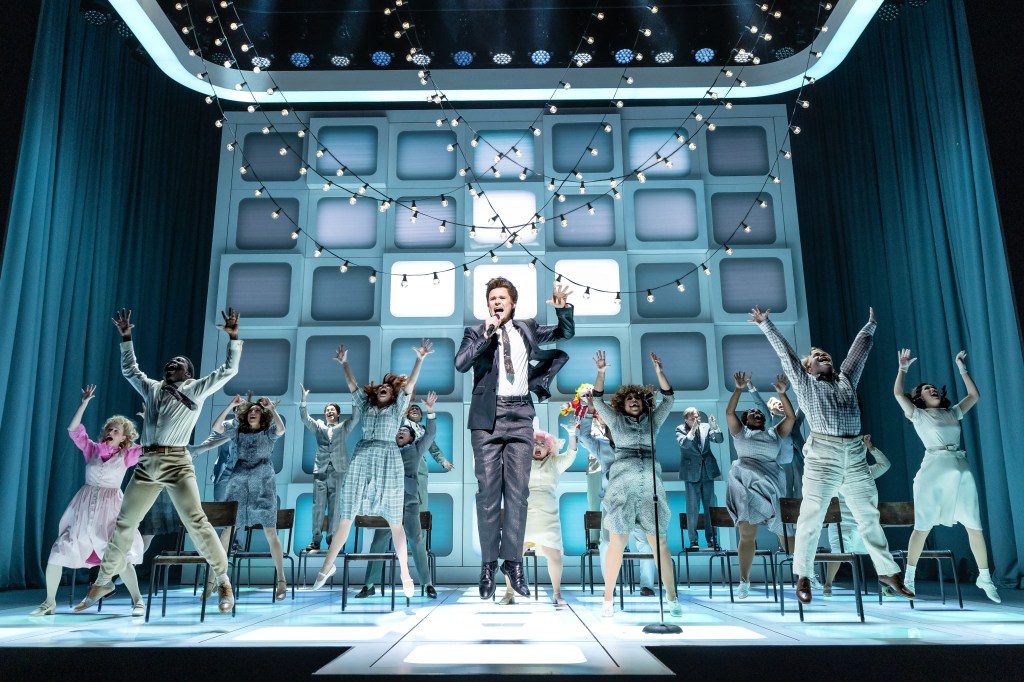
The difference between preachers and preachers
The book underscores the difference between Tammy Faye and Jim, and the other preachers from conservative churches. Falwell (a dynamic Cerveris), Jimmy Swaggart (Ian Lassiter), Pat Robertson (Andy Taylor) and Marvin Gorman (Max Gordon Moore), demean Tammy Faye and Jim Bakker’s way of bringing people to the Gospel. They tolerate them, believing they will fail and are surprised and shocked at their success. Falwell’s massive ego can’t bear to see another preacher in his sphere of influence doing better than he. Not only does Falwell compete for viewership, he goes on their program and insults them attempting to send a message to church goers that they are not of God.
The turning point comes at the prodding of Ted Turner (Andy Taylor), who is concerned about PTL’s finances plummeting because of overspending. Part of the reason Turner suggests the program needs an uplift is because the love and charisma in Tammy and Jim’s relationship has cooled and viewers sense something is wrong. Even friends Paul Crouch (Nick Bailey) and Jan Crouch (Allison Guinn) warn them. At this point in time Tammy has learned of Jim’s infidelity with Jessica Hahn (Alana Pollard), and though he repeatedly asks for forgiveness, Tammy finds it difficult. Increasingly, she relies on prescription pain medicine to anesthetize herself which staff preacher, John Fletcher (Raymond J. Lee), sometimes gives her.
When Tammy strikes out on her own without Jim to carry a show, she draws greater audience viewership which Ted Turner praises. In a heartfelt satellite interview, she speaks with gay pastor Steve Pieters (Charl Brown), about having AIDS. Her public action is courageous. She hugs Steve and accepts him with love into Christ’s fellowship, an anathema to conservative Christianity which condemns gays and believes AIDS is God’s punishment for their sinful homosexuality.

A meeting sealing the fate of PTL
Falwell and the other ministers have a confidential meeting and Falwell even phones President Ronald Reagan (Ian Lassiter), who never acknowledged or worked to stem the AIDS crisis, despite having a gay son and working with gays when he was an actor. Of course, Reagan’s hypocrisy and need for the evangelical church to endorse him is why he speaks to Falwell. In another inflection point, we see the division between church and state morph into an unholy matrimony of religious politicos washing each other’s hands despite the historically traditional separation between church and state.
Thus, Reagan’s public uplifting of the evangelical community via Falwell and others provokes a sea change in the sociopolitical and cultural direction of the nation. The growing intrusion of religion into politics becomes the foundation of constitutional human rights’ reversals seen today, which are particularly uplifted in MAGA states.
Reagan and conservative evangelism, for the voting block-merging church and state
With Reagan in their corner, conservative religious leadership agrees that PTL is moving in an unGodly direction. Falwell and the other preachers see the Bakkers are headed for disaster and they give them a push when the opportunity arises. For example, they get prominent PTL member John Fletcher to turn on Bakker. He sets up Bakker with Hahn, then leaks information when Falwell threatens to expose him of his “infidelities” with gay men if he doesn’t play ball. Falwell also tips off the Charlotte Observer whose reporter Charles Shepard (Mark Evans), investigates the financial arrangements of PTL and finds them to be indebted and insolvent. The situation boils over in “Don’t Let There Be Light.” Tammy, Jim and Jerry recognize their shameful actions and pray that they will not be exposed.
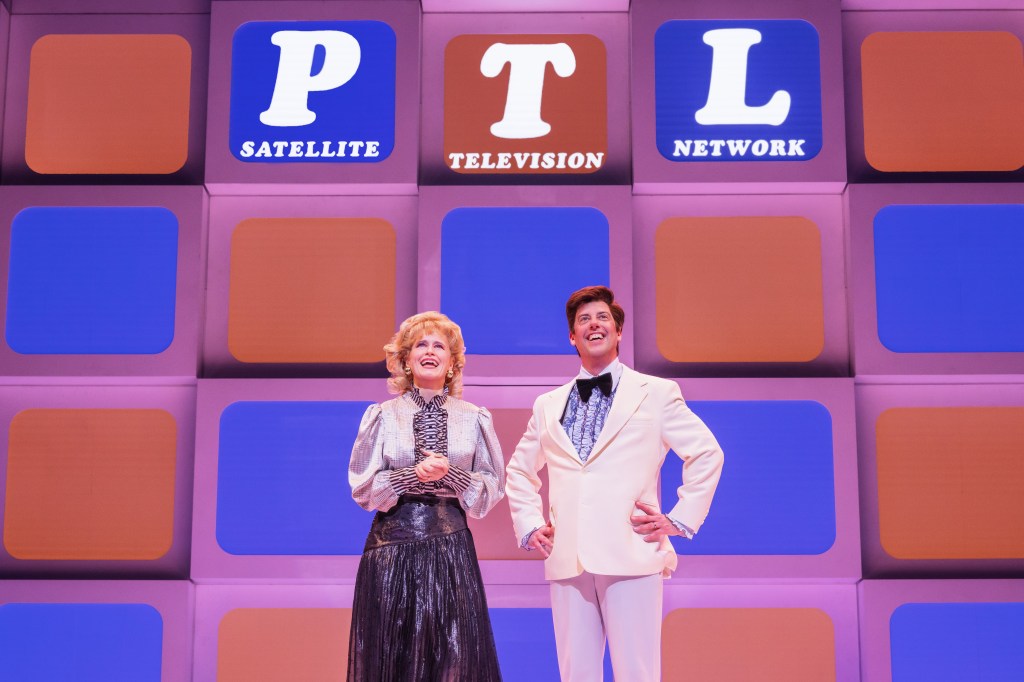
Of course, they are all exposed and vilified by the press and other church leaders. One humorous scene involves Pope John Paul II (Andy Taylor), Mormon leader (Thomas S. Monson), and Archbishop of Canterbury (Ian Lassiter), staged in window squares raised to a higher level above the stage ironically. From their lofty positions, they comment on the troubles of the “electric church” and the Bakkers. Meanwhile, elements of the same unloving hypocrisy are present in their congregations. The pederasty, pedophilia and horrific abuse of the Catholic church is yet to be revealed by the Boston Globe and is still being revealed in the Irish Madeline Laundries and Mother and Baby Homes. Certainly, the church memberships fall off in the Mormon Church and the Church of England. Congregants loathe the leaderships’ hypocrisy.
Acting hate not love
Falwell, Robertson, et. al., end up backbiting each other with hate and jealously. A desperate Bakker, beyond Tammy’s counsel, gives the PTL reigns to Falwell after Tammy learns Jim paid hush money to Jessica Hahn. The scandal widens the more the Bakkers give interviews to defend their positions. In Falwell’s hands, PTL goes bankrupt and is closed down. Tammy divorces Jim and other pastors’ infidelities are exposed as Bakker ends up in jail (“Look How Far We’ve Fallen”). The biased judge ridiculously throws the book at Bakker when murderers are even given lighter sentences.
Eventually, the conservative hypocritical Falwell and Pat Robertson follow in Reagan’s footsteps and run for the presidency. Indeed, their great piety is a sham as they attempt to vault their notoriety to the White House and reap untold rewards, but fail. Unlike Donald Trump who has defrauded his way there again with the treasonous help of various conservative think tanks, True the Vote’s voter challenges in Georgia, voter suppression in swing states, Elon Musk and Putin, Falwell and Robertson’s reputations preceded them and they were rejected as candidates.
Nevertheless, the evangelical Christian movement had an established foothold in politics. The country then wasn’t ready for a conservative, religious president. Now, the MAGAS, building on white supremacists and overturning Reagan’s legacy, have evolved to the point that with Putin’s foreign interference paying influencers to promote misinformation, Trump has become their acceptable, religious MAGA god/autocrat. Despite what Trump/MAGAS/Putin and a complicit press would have voters and the world believe that Trump received “great” voting support, over half the voting public of both parties doesn’t agree with MAGA/Trump’s religious, conservative, oppressive and autocratically unconstitutional mandates. Most probably, if there had been a recount, the results would have revealed otherwise. Better to let sleeping MAGAS, Trump, Putin and others lie.

Favorable reviews in London, bad timing in Manhattan
The show, which originated two years ago at the Almeida Theater in London, received favorable reviews. Opening here at the time it did proved unfortunate because of its subject, a conservative evangelical church, now associated with Donald Trump: a twice impeached, three times indicted, one time convicted criminal, who attempted to overthrow the 2020 election with some of their help via militias and the support of Clarence Thomas’ wife Ginni Thomas.
From Reagan and Falwell and PTL televangelism to the racist, xenophobic, misogynist, MAGA Christianity of today, the conservative brand of evangelicalism has blossomed into “acceptable” white supremacy, oppression, hellfire condemnation and tyranny toward other religions and people of color. Is there any wonder that Tammy Faye, opening around the 2024 election, is a brutal and noisome reminder of what lies, misinformation and money do for those in power, who stir up hate, work unconstitutionally and divide even their own believers from patriotism and the love of God?
Important takeaways
Positive takeaways are the show’s performances which are sterling, especially the leads. The technical team under Goold’s guidance manifests his vision for the production. The book glosses over a complicated series of events (one of which never shows the other side of Jessica Hahn’s professed “virginal innocence,” nor the role her Long Island pastor played in strong-arming the PTL board to pay her hush money).
However, the production does manage to portray one individual, regardless of her psychic flaws, who preached love instead of messages of hate and condemnation (“See you in Heaven”). Tammy Faye did this at a time when standing up for individuals with AIDS was anathema to the general public, let alone Christians. Hers was a courageous, heartfelt stance as an independent Christian church woman. who, alone, went out on a limb to mirror God’s love and show how Christians were supposed to support and help one another.
I heartily recommend this production, especially for those who are interested to understand how evangelism became involved with our politics, despite the supposed separation of church and state. Tammy Faye runs at the Palace Theatre with one intermission until December 8th. https://tammyfayebway.com/?gad_source=1 It’s a shame it is closing so soon.
‘Some Like it Hot’ Fires up the Laughter, Dazzling at the Schubert

One of the more intricately updated movie adaptations on Broadway that sparks a flame that will surely last, Some Like it Hot is perfect for the holiday season and year-round. From start to finish the sensational cast keeps the audience laughing, thanks to enlightened direction, (Casey Nicholaw), seamlessly wrought staging, superb pacing, on-point timing and smashing songs sung by spot-on principals and company.
Performances by standouts J. Harrison Ghee (Jerry/Daphne), Christian Borle (Joe/Josephine), Sugar (Adrianna Hicks), Natasha Yvette Williams (Sweet Sue) and Kevin Del Aguila (Osgood) hurtle the comedy at breakneck speed around the roller coaster turns of plot, mostly familiar to those who have seen the original titular film upon which this two-act musical comedy is based. Currently, Some Like it Hot is at the Sam S. Schubert Theatre without an end-date.
With book by Matthew Lopez and Amber Ruffin, with additional material by Christian Borle and Joe Farrell, music by Marc Shaiman and lyrics by Scott Wittman and Marc Shaiman, Some Like it Hot, mostly through songs unspools the story of two Chicago musicians. Witnesses to a murder by a crime boss and his henchmen, Jerry (J. Harrison Ghee) and Joe (Christian Borle) must leave town to avoid being killed. As they flee for their lives moving from the streets of Chicago to a train journey across country to California, to their hotel destination, the cast joyously sings 10 songs in Act I and 8 songs in Act II.

The strongest numbers meld superlatively with the jazz/blues club and rehearsal scenes and display the wacky characterizations, i.e. Osgood (the marvelous K.J. Hippensteel) and his relationship with Daphne, for maximum humor. The club and rehearsal songs are rollicking, streams of musical electricity that include “I’m California Bound,” “Take It up a Step,” “Zee Bap” and “Some Like it Hot,” and in Act II “Let’s Be Bad,” and “Baby, Let’s Get Good.” The music can’t be beat if you love jazz, blues and a compendium of styles from that era.
The opening speakeasy scene “What Are You Thirsty For,” prepares us for the rousing up-tempo and hot jazz style that characterizes the music of Sweet Sue’s all-girl band. The song, like all of those in the club scenes maintains the high-paced energy which never lets up, thanks in part to Natasha Yvette Williams, whose band conductor Sue rules with a firm hand, is humorous and twits Josephine (Joe) about her age because she looks dowdy and frumpy, in a joke that is milked throughout. In assuming their new roles as women, both Joe and Jerry take pride in their beauty and femininity and are insulted if men “step out of line” and take liberties, or as in the instance of Sweet Sue with Josephine/Joe, feel hurt pride that they do not look pretty and young. Of course the irony that these men are becoming enlightened to what it is really like to be women, pestered and objectified by men is just priceless.

The first number establishes the setting of the Great Depression and Prohibition and introduces three leads two of which by the skin of their teeth avoid a police raid and being locked up by Mulligan (Adam Heller), who hauls in Sweet Sue and her band closing them down. That Jerry and Joe escape, establishes their characters’ MO throughout. They shuck and jive, deep man dive to survive, staying one step ahead of police or gangsters. But I am getting ahead of myself. Out on the street and down on their luck, jobs for a bass player and sax player are hard to come by.
Joe and Jerry try the Cheetah Club, owned by Spats Columbo. Mark Lotito’s convincing no nonsense gangster with a humorous touch is perfect for the role which requires some fleet footedness, during the wild chases and shoot-out scenes acutely conceived, staged and choreographed by Casey Nicholaw.
At the Cheetah Club, Spats’ man Mack (Casey Garvin) hires Joe but rejects Jerry because he’s Black. The musical is savvy about revealing the extreme Jim Crow racism of the 1930s through Mack’s obvious prejudice. The production also beautifully answers the racism and bigotry with the idea of family, love and unity with the cleverly written “You Can’t Have Me (If You Don’t Have Him).” Joe insists he and Jerry are a duo, and family (the Tip Tap Twins) who must stick together. As an act “We’re two of a kind, if you’re colorblind, separate mothers …but we’re brothers under the skin.” The singing is accompanied by Joe and Jerry’s excellent tap dancing which wins the day when Spats himself appears and reveals his approval of their talents.
The irony is not lost on us that Spats is tolerant of Jerry’s Black heritage and in this light is more humane than your average lynching bigot from the South, bullying Blacks to bow and scrape. Of course Spats is a murderer of another type (he kills competitor thugs and rats); he’s just not a racist or lynching bigot murderer. This is a fantastic send-up of “honorable” criminals vs. low-down, scurrilous, hate-filled murderers which is intimated but never stated. Thus, Spats we can laugh at, the the bigot in the Southern shadows we prefer not to think about though they exist and are the reason why Sweet Sue goes to California and not Alabama.

The clever lyrics and humor related to the bigotry toward Black performers during a time of extreme Jim Crow racism in the nation is a subject for jokes delivered by Sweet Sue and Jerry sparingly with irony. The references to racism are understated, and actually highlight the difference between past and present. Yet it is enough as a sad reminder and subtle warning about the uptick in white nationalism and bigotry in our time, hyped up on steroids during the former president Donald Trump’s administration because he gave permission to the KKK and other groups to express their racial hatreds openly as “very fine people.” In this production, the lightheartedness countering the prejudice and racism of the time sends a powerful message about acceptance that is not preachy or overdone.
For example Sue ironically determines the destination of her all-girl band to a place where they won’t be lynched or ostracized since Sue, bass player Jerry/Daphne (J. Harrison Ghee), lead singer Sugar (Adrianna Hicks) and others are Black artists. However, Sue never uses racially charged words. She only refers to how she looks and the audience breaks out in hysteria. After all, it’s the 1930s. Yet residual bigotry is in tragically in the 2022s. Importantly, the beauty of this update reveals the vitality of music and the arts which have always been in the forefront of accepting people, not for their skin color, elitist pedigree or class, but for their artistry and talent. Thus, the theme that art, music and entertainment as a noble calling is underscored as it brings us together in unity and harmony and encourages the best of our humanity.
The complications thicken when Jerry and Joe are at the Cheetah Club and prove themselves to be successful. Excited, Joe wants to discuss their order in the program with Spats at the precise moment when the musicians witness Spats murdering Toothpick Charlie for giving information to Mulligan. The frenzy of Joe and Jerry witnessing the murder and then running away in a marvelous chase scene into the women’s dressing room where they get the idea to go out in drag to save their lives is logically wrought and hysterical. Dressed as Daphne and Josephine, Joe and Jerry are able to walk by Spats and his henchmen without a “hitch.” Now, the only thing left for them to do is follow a tip they receive about joining Sweet Sue’s band.

In a one line quip, we learn they pay two ruffians to steal the instruments of a female bass player and sax player who had jobs in Sue’s band but lost them when they were unable to get instruments at the last minute. Thus, Daphne and Josephine conveniently step up for the positions as the clever Sweet Sue notices their unusual coincidence and timing. This tweak is one of many that works in Matthew Lopez and Amber Ruffin’s well thought out book that is filled with new quips and one-liners that land every time, thanks to Williams, Borle and Ghee’s exceptional timing and delivery.
With the conceit of Daphne/Jerry and Josephine/Joe going cross country as women using the all-girl band as their sanctuary and milked to max, the rest of the action follows a steady route until they arrive at their destination. On the journey the men get to bunk with women and learn temperance and self- restraint as they are reduced to looking but not touching. Also, Josephine discovers the inner workings of the lovely Sugar who he is falling in love with (“A Darker Shade of Blue,” “At the Old Majestic Nickel Matinee”) as she sings the blues ballads about her life and dreams.
In California the intensity increases. Joe and Jerry have to decide whether to leave and go to Mexico. However, there are dangerous reasons that stand in the way of their making the best decision of their lives. Joe has fallen for Sugar and Jerry has fallen for being a woman, a condition which emerges when the wealthy Osgood in “Poor Little Millionaire” shows he is interested in Daphne. As Osgood appeals to the feminine in Jerry, Jerry/Daphne has a new knowledge of himself as an evolved individual whom he actually likes better than when he was Jerry. This is not only LOL and J. Harrison Ghee makes the most of this new knowledge, it is refreshingly current and an excellent update of the original material in the film by Matthew Lopez and Amber Ruffin.
Meanwhile, unbeknownst to them, Spats and his men are making their way toward Jerry and Joe. It is only a matter of time before they will meet face to face. When they do in “Tip Tap Trouble,” the chase is an incredible tap dance with precisely timed, synchronized movement that is choreographed using doors. Nicholaw’s staging is a marvel. The number is paced by the ensemble to perfection with such apt choreography, it is absolutely breathtaking. The number brings down the house.

In this musical comedy as in the film, “all’s well that ends well.” Spats is arrested just in time by Mulligan and the couples reveal themselves and there are no hard feelings. In fact Osgood is pleased. The notion that you love despite gender and race, if you have the openness to allow yourself that joy, is the most satisfying of the musical comedy’s themes. And it is the most welcome and truthful. For, as Some Like it Hot posits, if one looks and truly sees individuals for who they are, no one should be rejected or belittled. It is a fantastic notion for this LOL musical comedy whose profound underlying meaning shouldn’t be underestimated.
From cast, principals, music and every element referred to in this review, the production has been fine tuned as a celebration of one of the greatest comedy films which was a stylistic throwback to the thirties. Likewise with this production there are numbers which reflect the black and white musicals of the past, whether it be their elegance or brassy, jazz tunes and rigorous tap numbers. The ensemble and swings are perfection and add to the enthusiasm and excitement of a show that is beyond sizzling fun. Some Like it Hot is a love letter to Hollywood Studio films that we will never see again, and a love letter to the present that we hope for with unity, tolerance and love.
Kudos go to Natasha Katz (lighting design) Brian Ronan (sound design) Gregg Barnes (costume design) Scott Pask (scenic design) Josh Marquette (hair design) Milagros Medina-Cerdeira (make-up design). The train is amazing thanks to Scott Pask who manages a streamlined, futuristic look that is full bodied and rich. The full bodied richness is especially so with the hotel interiors and various spaces that Nicholaw transitions into and out of in the twinkling of an eye to keep up the pacing. It is as if the entire production is on a metronome and moves to the ethereal beats of hilarity, somewhere out there in comedy heaven.
All praise goes to Mary-Mitchell Campbell for her music supervision, Charlie Rosen and Bryan Carter for their orchestrations. Final kudos goes to all involved with dance, vocal and musical arrangements and the creative team who helped to make this production shimmering glory every night.
What a smashing, important production that is as light as a feather going down but stays with you for its vital themes, music, rhythms (I just adored “Tip Tap Trouble” for its multiple layers) LOL book and great delivery by actors, who managed to be funny and not cartoonish.
See it! Go to their website for tickets and times https://somelikeithotmusical.com/
 CAROLE DI TOSTI