Blog Archives
Kara Young and Nicholas Braun Fine-Tune Their Performances in ‘Gruesome Playground Injuries’

What do people do when they have emotional pain? Sometimes it shows physically in stomach aches. Sometimes to release internal stress people risk physical injury doing wild stunts, like jumping off a school roof on a bike. In Rajiv Joseph’s humorous and profound Gruesome Playground Injuries, currently in revival at the Lucille Lortel Theater until December 28th, we meet Kayleen and Doug. Two-time Tony Award winner Kara Young and Succession star Nicolas Braun portray childhood friends who connect, lose track of each other and reconnect over a thirty year period.
Joseph charts their growth and development from childhood to thirty-somethings against a backdrop of hospital rooms, ERs, medical facilities and the school nurse’s office, where they initially meet when they go to seek relief from their suffering. After the first session when they are 8-year-olds, to the last time we see them at 38-year-olds at an ice rink, we calculate their love and concern for each other, while they share memories of the most surprising and weird times together. One example is when they stare at their melded vomit swishing around in a wastepaper basket when they were 13-year-olds.

How do they maintain their relationship if they don’t see each other for years after high school? Their friends keep them updated so they can meet up and provide support. From their childhood days they’ve intimately bonded by playing “show and tell,” swapping stories about their external wounds, which Joseph implies are the physical manifestations of their soul pain. After Doug graduates from college, when Doug is injured, someone tips off Kayleen who comes to his side to “heal him,” something he believes she does and something she hopes she does, though she doesn’t feel worthy of its sanctity.
Joseph’s two-hander about these unlikely best friends alludes to their deep psychological and emotional isolation that contributes to their self-destructive impulses. Kayleen’s severe stomach pains and vomiting stems from her upbringing. For example in Kayleen’s relationship with her parents we learn her mother abandoned the family and ran off to be with other lovers while her father raised the kids and didn’t celebrate their birthdays. Yet, when her mother dies, the father tells Kayleen she was “a better woman than Kayleen would ever be.” There is no love lost between them.
Doug, whose mom says he is accident prone, uses his various injuries to draw in Kayleen because he feels close to her. She gives him attention and likes touching the wounds on his face, eyes, etc. Further examination reveals that Doug comes from a loving family, the opposite of Kayleen’s. Yet, he may be psychologically troubled because he risks his life needlessly. For example, after college, he stands on the roof of a building during a storm and is struck by lightening, which puts him in a coma. His behavior appears foolish or suicidal. Throughout their relationship Kayleen calls him stupid. The truth lies elsewhere.

Of course, when Kayleen hears he is in a coma (they are 28-year-olds), after the lightening episode, she comes to his rescue and lays hands on him and tells him not to die. He recovers but he never awakens when she prays over him. She doesn’t find out he’s alive until five years later when he visits her in a medical facility. There, she recuperates after she tried to cut out her stomach pain with a knife. She was high on drugs. At that point they are 33-year-olds. Doug tells her to keep in touch, and not let him drift away, which happened before.
Joseph charts their relationship through their emotional dynamic with each other which is difficult to access because of the haphazard structure of the play, listing ages and injuries before various scenes. In this Joseph mirrors the haphazard events of our lives which are difficult to figure out. Throughout the 8 brief, disordered, flashback scenes identified by projections on the backstage wall listing their ages (8, 23,13, 28, 18, 33, 23, 38) and references to Doug’s and Kayleen’s injuries, Joseph explores his characters’ chronological growth while indicating their emotional growth remains nearly the same, as when we first meet them at 8-years-old. In the script, despite their adult ages, Joseph refers to them as “kids.”
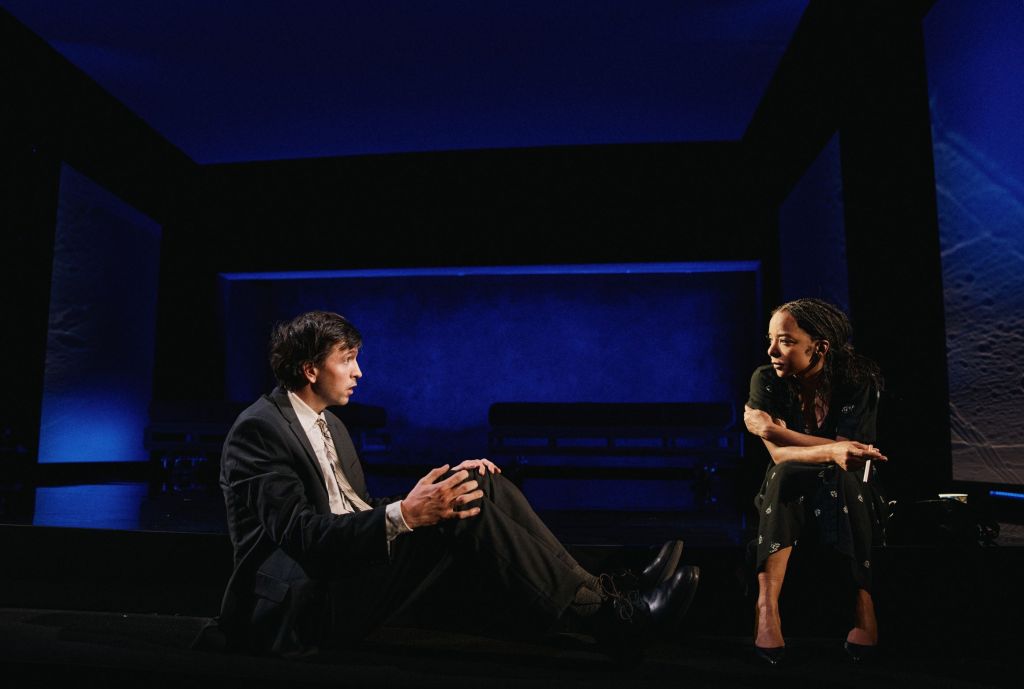
Toward the end of the play via flashback (when they are 18-year-olds), we discover their concern and love for for each other and inability to carry through with a complete and lasting union as boyfriend and girlfriend. When Doug tries to push it, Kayleen isn’t emotionally available. Likewise when Kayleen is ready to move into something more (they are 38-year-olds), Doug refuses her touch. By then he has completely wrecked himself physically and can only work his job at the ice rink sitting on the Zamboni.
Young and Braun are terrific. Their nuanced performances create their characters’ relationship dynamic with spot-on authenticity. Acutely directed by Neil Pepe, we gradually put the pieces together as the mystery unfolds about these two. We understand Kayleen insults Doug as a defense mechanism, yet is attracted to his self-destructive nature with which she identifies. We “get” his protection of her because of her abusive father. One guy in school who Doug fights when the kid calls her a “skank,” beats him up. Doug knows he can’t win the fight, but he defends Kayleen’s name and reputation.
The lack of chronology makes the emotional resonance and causation of the characters’ behavior more difficult to glean. One must ride the portrayals of Young and Braun with rapt attention or you will miss many of Joseph’s themes about pain, suffering and the salve for it in companionship, honesty and love.
In additional clues to their character’s isolation, Young and Braun move the minimal props, the hospital beds, the bedding. They rearrange them for each scene. On either side of the stage in a dimly lit space (lighting by Japhy Weideman), Young and Braun quickly fix their hair and don different costumes (Sarah Laux’s costume design), and apply blood and injury-related makeup (Brian Strumwasser’s makeup design). In these transitions, which also reveal passages of time in ten and fifteen year intervals, we understand that they are alone, within themselves, without help from anyone. This further provides clues to the depths of Joseph’s portrait of Kayleen and Doug, which the actors convey with poignance, humor and heartbreak.
Gruesome Playground Injuries runs 1 hour 30 minutes with no intermission through 28 December at the Lucille Lortel Theater; gruesomeplaygroundinjuries.com.
‘Is This Thing On’ Bradley Cooper’s Third film @63rd NYFF

Comedy and tragedy masks couple side by side for a reason. Bradley Cooper’s third (A Star is Born, Maestro) directorial outing, Is This Thing On?, adds meaning to the notion that misery loves comedy. Will Arnett and Laura Dern play a couple whose separation leads to catharsis and regeneration when Alex turns to comedy to lighten his soul’s unhappiness. Is This Thing On? a World Premiere in the Main Slate section of the 63rd New York Film Festival, screened as the festival closing night film.
Cooper incisively shepherds the intimate and naturalistic performances of Will Arnett (Alex) and Laura Dern (Tessa). The actors portray a long-time married couple. In the opening film scene both agree without fireworks and fanfare (while Tessa brushes her teeth) to call “it” (their marriage thing) off.
Throwing the typical divorce sequences out the window, Cooper skips to the aftermath of the separation and Alex and Tessa’s amicability. First, they split custody of their two 10-year-old sons, played with sharp comedic timing by Blake Kane and Calvin Knegten. Secondly, after the opening shot of agreeing about “it,” we note by the next time they get together with their couple friends (Andra Day & Cooper, Sean Hayes & Scott Icenogle) Alex moved into an apartment in New York City. Meanwhile, Tessa remains in their house with their playful Labradoodles and sorrowful sons who comment that their parents argued a lot.
One evening instead of going home to his empty, lonely apartment after seeing Tessa and friends, Alex saves a few bucks cover charge by adding his name to the open mic list of a basement comedy club (The Comedy Cellar). As a possible joke on himself, Alex sheepishly takes the mic. However, when he spontaneously, unabashedly, surprisingly vomits out personal information about his marriage, a lot of it morose, some of it funny, the last thing the self-loathing Alex imagines, then happens. He gets a few laughs and lots of encouragement from the crowd of wannabe comedians.

In a fantastic twist, Cooper cast many of these real-life comics as audience members. Their authentic jumble of responses picked up by sound designers works to create the naturalistic environment where Alex slowly recharges his deadened mojo.
A guy can get used to this shot of adrenaline to stave off his soul’s sickness. Maybe if he returns a few times, he can reveal to himself what the hell happened emotionally and psychically that caused him to end up alone, without his wife and kids on the doomed path to divorce. If expiation indeed softens a crusty-edged, hardened, sad sack, perhaps more spilling of his guts will be the medicine he needs to ameliorate the hell within.
Thus, the initial few laughs and non judgmental camaraderie of fellow comic wannabes trigger Alex to return for another open mic night. And once more, Alex’s self-abasing confessions to himself and the crowd magically lift his spirits. Alex’s serendipitous impulse not to take his inner angst to heart blossoms. As he evolves his comedic timing and content, he resolves he can become a better person through confessional stand-up comedy. There’s nothing like getting in touch with one’s inner hell via artful performance, where self-reflection brings about self-correction.

Alternating scenes, Alex’s new revelatory jokes at the comedy club, with Tessa and friends meet-ups, we note the gradual change in Alex’ emotions and moods. Even his friend Balls (Cooper in a funny, facially hirsute turn), tells him that maybe he will divorce his wife (the beautiful Andra Day) following Alex’s route, because he seems happier unmarried.
This revolutionary way to deal with divorce among a community of comics really happened to British stand up comedian John Bishop. The true events inspired the script by Cooper, Arnett and Mark Chappell with some of the uneven dialogue prompted by extemporaneous ad libs by the cast.
Interestingly, Alex’s wayward jokes that don’t land had to be worked on by Will Arnett and Cooper. In a Q and A after the screening Cooper grinned when he said that Arnett’s humor out-shined Alex’s and had to be tamped down. Thus, the jokes never flow seamlessly like a professional’s patter since Alex must find his way through trial and error. Likewise, Alex and Tessa’s relationship which took a hairpin turn with their break up, takes another when Tessa goes on a friend/date (with Peyton Manning) in a cute set-up for the possibility of her first sexual encounter after the split.
Where do they show up? At the comedy club where Alex hits a new high/low discussing his first sexual encounter after his break-up. What did he learn from the sex? He tells the audience in a heartfelt moment he missed his wife. Pleasantly surprised and turned on to hear that Alex missed her, Tessa confronts Alex about his “letting it all hang out” riff at the club. Though Tessa’s appearance at the club with her date smacks of contrivance, the coincidence is delicious for the next plot twist. This hearkens back to the film’s title. Finding their attraction to each other rekindled, do they or don’t they get back together? When and where the answer arrives adds hilarity to their tenuous situation.
Importantly, their dead-ended relationship moved off its axis opening up new possibilities. Finally, they communicate their feelings beyond arguing. And just as Alex has found a new trajectory and hope with his comedy club appearances, Tessa returns to her love of volleyball as a former Olympic player, sharing her skills and expertise as a professional coach.

Meanwhile, Alex’s parents (Christine Ebersole and Ciarán Hinds) weigh in with their opinions, though they refuse to choose sides to keep the peace. In targeting the complexity of human relationships, Cooper shows the difficulties in letting go of an old, tired relationship stuck in destructive grooves. Also, he mines the ground of rebuilding a relationship and setting it in another positive direction. With that reconstruction also comes the rebuilding of identity and self-worth if they couple uses the opportunity of a break to begin a renewal.
Dern and Arnett are terrific surrounded by a great supporting cast. These include the actors mentioned above and additionally Amy Sedaris and New York stand up standbys for example Reggie Conquest, Jordan Jensen, Chlore Radcliffe. These comedians help to make the film a love letter to New York and its downtown scene.
For the description of Is This Thing On? at the 63rd NYFF go to their website. https://www.filmlinc.org/nyff/films/is-this-thing-on/ The film will be released December 19th.
 CAROLE DI TOSTI