Blog Archives
‘The Night of the Iguana,’ Theater Review
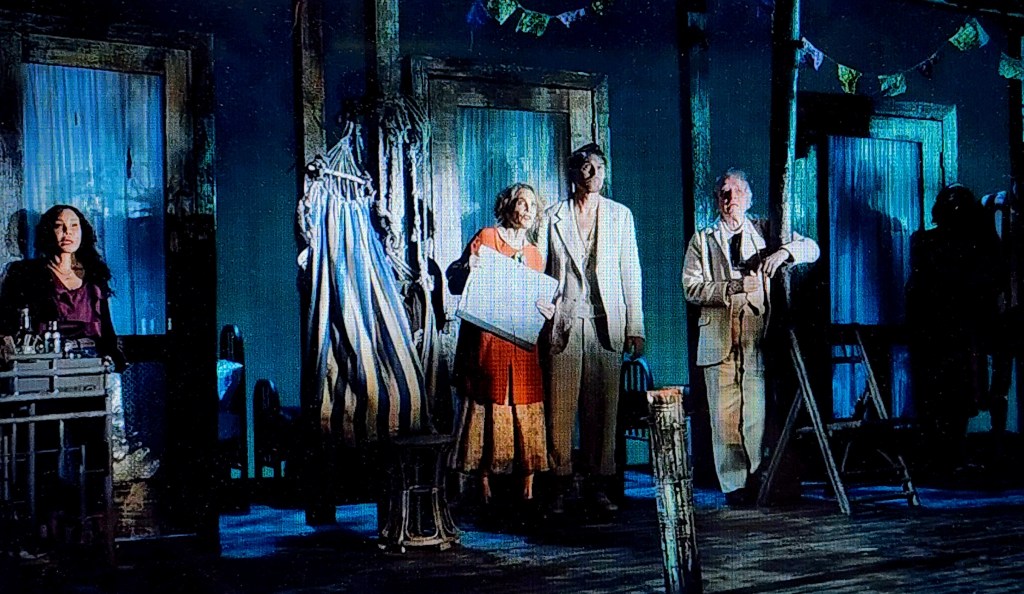
The Night of the Iguana is one of Williams most poetic and lyrical plays with dialogue that touches upon the spiritual and philosophical. On the one hand in Iguana, Williams’ characters are amongst the most broken, isolated and self-destructive of his plays. On the other hand, in their humor, passions and rages, they are among the most identifiable and human. La Femme Theatre Productions’ revival of The Night of the Iguana, directed by Emily Mann, currently at the Pershing Square Signature Center until the 25 of February, expresses many of these elements in a production that is incompletely realized.
The revival, the fourth in 27 years, and sixty-one years after its Broadway premiere, reveals the stickiness of presenting a lengthy, talky play in an age of TikTok, when the average individual’s attention span is about two minutes. Taking that into consideration, Mann tackles Williams’ classic as best as possible with her talented creative team. At times she appears to labor under the task and doesn’t always strike interest with the characters, who otherwise are hell bent on destruction or redemption, and if explored and articulated, are full of dramatic tension and fire.
Beowulf Boritt’s scenic design of the off-kilter, ramshackle inn in the tropical oasis of 1940s Costa Verde, Puerto Barrio, Mexico, and Jeff Croiter’s fine, atmospheric lighting and superbly pageanted sky are the stylized setting where Williams’ broken individuals slide in and out of reality, as they look for respite and a miracle that doesn’t come in the form that they wish. With the period costumes (exception Maxine’s jeans) by Jennifer Von Mayrhauser), we note the best these characters can hope for is a midnight swim in the ocean to distract themselves from their inner turmoil, depression, loneliness, DT’s and brain fever/ The latter are evidence of addiction recoiling, experienced by the play’s anti-hero, “reforming” alcoholic Reverend T. Lawrence Shannon (Tim Daly).

One of the issues in this revival is that the humor, difficult to land with unforced, organic aplomb is missing. At times, the tone is lugubrious. This is so with regard to Tim Daly’s Reverend Shannon, in the scene where he expresses fury with the church in Virginia that locked him out, etc. If done with “righteous indignation,” his rant, with Hannah Jelkes (Jean Lichty), as his “straight person,” could be funny as her response to him elucidates the psychology of what is really going on with the good reverend. It would then be clearer that Shannon is misplaced and just can’t admit he loathes himself and agrees with his congregants who see him as one who despises them and God, an irony. Indeed, is it any wonder they see fit to lock him out of their church?
The ironies, his indignation and Hannah’s droll response are comical and also identify Shannon’s weaknesses and humanity. Unfortunately, the scene loses potency without the balance of humor. Shannon is a fraud to himself and he can’t get out of his own way. Is this a tragedy? If he didn’t realize he was a fraud, it would be. However, he does, thus, Williams’ play should be leading toward a well deserved redemption because of the underlying humor and Shannon’s acceptance that his life is worth saving. In this revival, the redemption merely happens without moment, and the audience remains untouched by it, though impressed that Tim Daly is onstage for most of the play.
The arc of development moves slowly with a few turning points that create the forward momentum toward the conclusion, when Shannon frees an iguana chained at its neck so it won’t be eaten (a metaphor for the wild Shannon that society would destroy). The iguana is released, yet the impact is diminished because the build up is incompletely realized. Little dramatic immediacy occurs between the iguana’s release into freedom and the initial event when Daly’s quaking Reverend Shannon struggles up the walkway of Maxine’s hotel. Daphne Rubin-Vega’s Maxine Faulk and her husband Fred have previously offered escape for Shannon. Now, at the end of nowhere, he goes there to flee the condemnation and oppression meted out by the Texas Baptist ladies he is tour guiding, This slow arc is an obstacle in the play that is difficult to overcome for any director and cast.
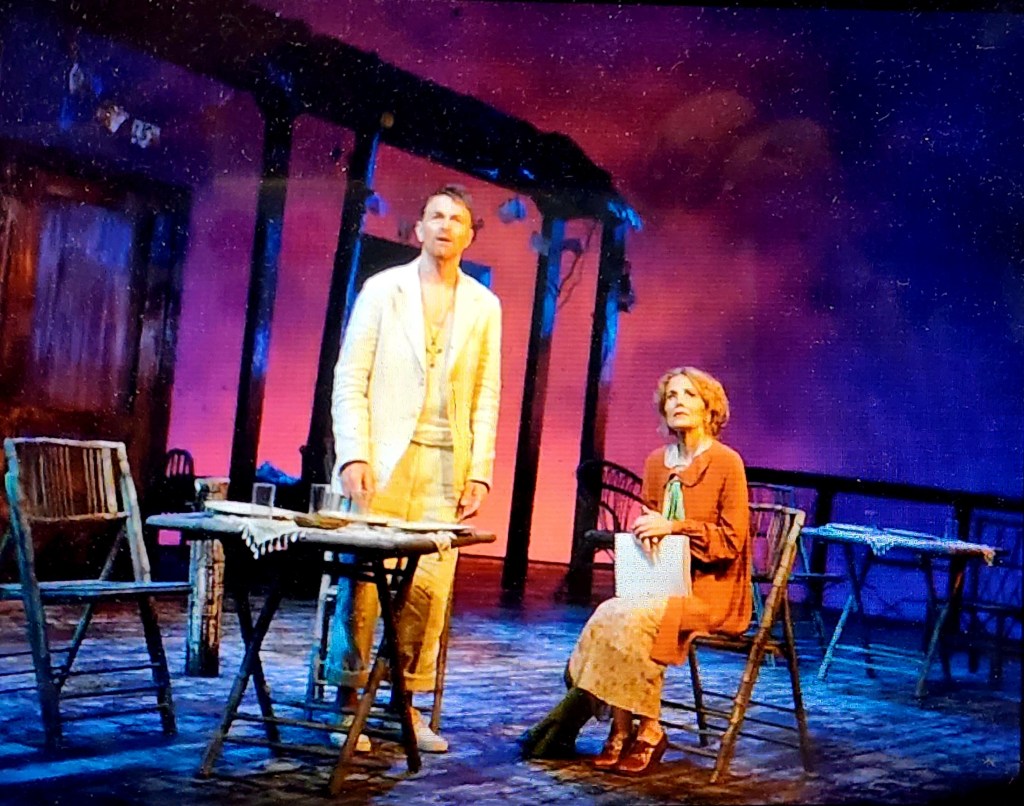
In the Act I exposition, we learn that Shannon’s job of last resort as ersatz tour guide has dead-ended him in a final fall from grace. He is soul wrecked and drained after he succumbs to seventeen-year-old Charlotte Goodall’s sexual advances in a weak moment, while “leading” the ladies through what appears to be paradise (an irony). However, their carping has made the Mexican setting’s loveliness anything but for the withering, white-suited Shannon, who was moved toward dalliances with Carmen Berkeley’s underage nymphet. Whether culturally imposed or self-imposed, prohibition always fails. Ironically, clerical prohibitions (alcoholism, trysts with women), are the spur which lures Shannon to self-destruction.
Already a has-been as a defrocked minister when we meet him, Shannon is hounded by the termagant-in-chief, Miss Judith Fellowes (Lea Delaria), who eventually has him fired. He has no defense for his untoward behavior, nor explanation for his actions, when he diverts the tour, and like a foundering fish gasping for air, flops into the hammock at Maxine’s shabby hotel. There, he discovers that her husband Fred has passed. In her own grieving, desire-driven panic, Rubin-Vega’s Maxine welcomes Shannon as a fine replacement for Fred.
It is an unappealing and frightening offer for Shannon, who views Maxine as a devourer, too sexual a woman, who takes swims in the ocean with her cabana boy servants to cool off the heat of her lusts. Shannon prefers her previous function in her collaboration with Fred, when her protective husband was alive enough to throw Shannon on the wagon, so he could prepare for his next alcoholic fall off of it.
While the appalled Baptist ladies remain offstage, honking the horn on the bus to alert Shannon to leave, and refusing to come up to Maxine’s hotel to refresh themselves, Shannon makes himself comfortable. So do spinster, sketch artist and hustler Hannah (Jean Lichty is less ethereal than the role requires), and her Nonno, the self-proclaimed poet of renown, Jonathan Coffin (Austin Pendleton moves between endearing and sometimes humorous as her 97-year-old grandfather).

Oozing financial desperation from every pore, the genteel pair have been turned away from area hotels. As Hannah gives Maxine their “resume,” the astute owner sniffs out their destitution and is about to show them the door, when the down-and-out Shannon pleads mercy, and Maxine relents. Her kindness earns her chits from Shannon that she will capitalize on in the future. Maxine knows she won’t see a dime from Hannah or her grandfather, whether or not Nonno dramatically discovers the right phrasing and imagery to finish his final poem at her hotel, and earns some money reciting it to pay their bill.
Though the wild and edgy Maxine allows them to stay, she “reads the riot act” to Hannah, suggesting she curtail her designs on the defrocked minister. If Hannah doesn’t go after Shannon, she and her grandfather might stay longer. However, the tension and build up between Maxine and Hannah never fire up to the extent they might have.
To what end does the play develop? Explosions do erupt. Maxine vs. Shannon, and Shannon vs. Miss Judith Fellowes create imbroglios, though they subside like waves on the beach minutes after, as if nothing happened. Only when tour replacement Jake Latta (Keith Randolph Smith), confronts Shannon for the keys to the bus, must Shannon reckon with one who enforces power over him. Neither Maxine, nor her cabana boys, nor Hannah, nor Fellowes can bend Shannon’s will to his knees. Jake Latta’s reality rules the day.

As the bus leaves and his life blows up, Shannon must face himself and end it or begin anew. In the scene between Daly’s Shannon and Lichty’s Hannah after Shannon is tied up in the hammock to keep him from suicide, there is a break through. Daly and Lichty illuminate their characters. Together they create the connection that opens the floodgates of revelation between Shannon and Hannah in the strongest moments of the production. When Nonno finishes his poem and expires, the coda is placed upon the characters who have come to the end of themselves and their self-deceptions. Life goes on, as Shannon has found his place with Maxine who will help him begin again, free as the iguana he set loose. Perhaps.
Williams’ characters are beautifully drawn with pathos, humor, passion and hope. If unrealized theatrically and dramatically, they remain inert, and the audience doesn’t relate or feel the parallels between the universal themes Williams reveals, or the characters’ sub text he presents. Mann’s revival makes a valiant attempt toward that end, but doesn’t quite get there.
For those unfamiliar with the other Iguana revivals or the John Huston film starring Richard Burton and Ava Gardner, this production should be given a look see to become acquainted with this classic. In this revival, there are standouts like Daphne Rubin-Vega as the edgy, sirenesque Maxine, and Pendleton’s Nonno, who manages to be funny when he forgets himself and asks about “the take” that Hannah collected. Lea Delaria is LOL when she is not pushing for humor. So are the German Nazi guests (Michael Leigh Cook, Alena Acker), when they are not looking for laughs or attempting to arouse disgust. That Williams includes such characters hints at the danger of fascist strictures and beliefs, that like the Baptist ladies follow, threaten free thinking beings (iguanas) everywhere.
Humor is everpresent in The Night of the Iguana‘s sub text. However, it is elusive in this revival which siphons out that humanity, sometimes tone deaf to the inherent love with which Williams has drawn these characters. Jean Lichty’s Hannah, periodically one-note, misses the character’s irony in the subtle thrust and parry with Tim Daly’s humorless, angry and complaining Reverend T. Lawrence Shannon. Daly’s panic and shakiness work when he attempts to hide the effects of his alcoholic withdrawal. Both Lichty and Daly are in and out, not quite clearly rendering Williams’ lyricism so that it is palpable, heartfelt and shattering in its build-up to the significance of Shannon’s symbolically freeing himself and the iguana.
The Night of the Iguana with one intermission at The Pershing Square Signature Center on 42nd Street between 9th and 10th until February 25th. https://iguanaplaynyc.com/
Quiara Alegría Hudes’ ‘My Broken Language’ in a World Premiere at the Signature Theatre

Quiara Alegría Hudes (2011 Pultizer Prize winner for the play Water By the Spoonful), is widely known for what The New Yorker has described as her “exceptional body of work, at once lyrical and colloquial, playful and spiritual.” She is best known for co-writing (with Lin Manuel-Miranda), the book for the Tony award-winning musical In the Heights. She also wrote the screenplay for the beloved film adaptation of In the Heights, heralded by audiences around the world.
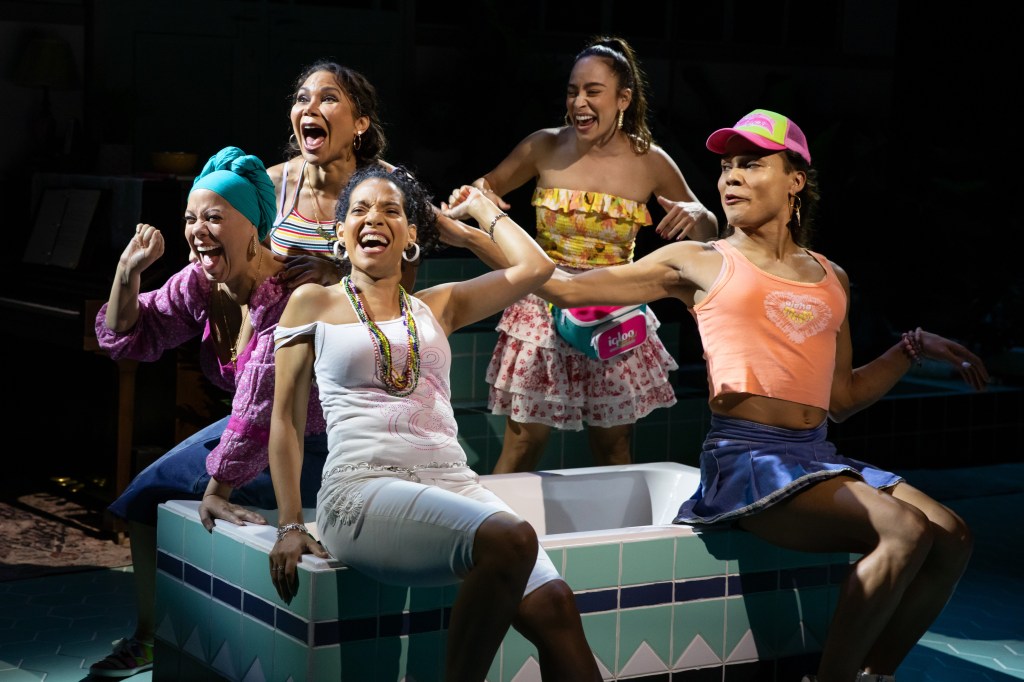
Wanting to keep her family stories from Puerto Rico and Philadelphia alive, in 2021Hudes published her memoir My Broken Language to much acclaim. In it Hudes captured her childhood and teenage years, distilling with sumptuous language and feeling the personalities, ethos, joys and excitement of the amazing women who influenced her life and nurtured her.
Based on her titular memoir, Quiara Alegría Hudes brings My Broken Language to the Signature Theatre with a sterling, vivacious cast who humorously and vibrantly break open Hudes’ memories and bring them to life in their portrayals of Hudes’ strong women. Through the actors’ depictions and Hudes’ fine shepherding of their performances, we understand the love which shaped the artist, who, with poetic insight, invites us to examine their empathy, humanity and humor.

Hudes directs and writes this adaptation for the stage. She divides it into 7 lyrical movements, which elucidate seminal stages in her life. At the top of the presentation, pianist Ariacne Trujillo-Durand enters and strikes us with an upbeat, celebratory merengue as five actors (who play various iterations of the Author character and her relatives), dance then close with an annunciation of the setting and play’s title. It is 1988 in North Philly where Hudes grew up.
We learn why Hudes begins at this point and ends the arc of her play’s development in a memory which is from this vital time in her life. It is the day when she must acknowledge her womanhood, the day when she first menstruates and finds the scarlet “sin” staining her underwear with brown-red blood.

This momentous event happens after she goes to Six Flags Adventure with her god-like, “in the know,” fabulous older cousins. Zabryna Guevara, Yani Marin, Samora la Perdida, Marilyn Torres take up the cousin roles and activate their identities while Daphne Rubin-Vega narrates the Author character descriptions of events. As they carry on and crack jokes and communicate with truck drivers gesturing widely, Rubin-Vega’s Author character becomes sick with heat and nausea. The rollicking trip is fun for the cousins, but the Author stays alone in the car as the others run to the rides without her.
The Author is suffering from her period, she discovers later. However, the event is symbolic. Her life path is different from theirs. Thus, as they leave her to have fun at the park, she will leave them far behind with her educational exploits and journey to become an artist. However, their voices and ethos remain with her because they, her Abuela and mother are integral to her identity. To reconcile the past with the burgeoning evocation of herself, she writes and gives power to her relatives as she remembers and honors the beauty and glory of who these women are.
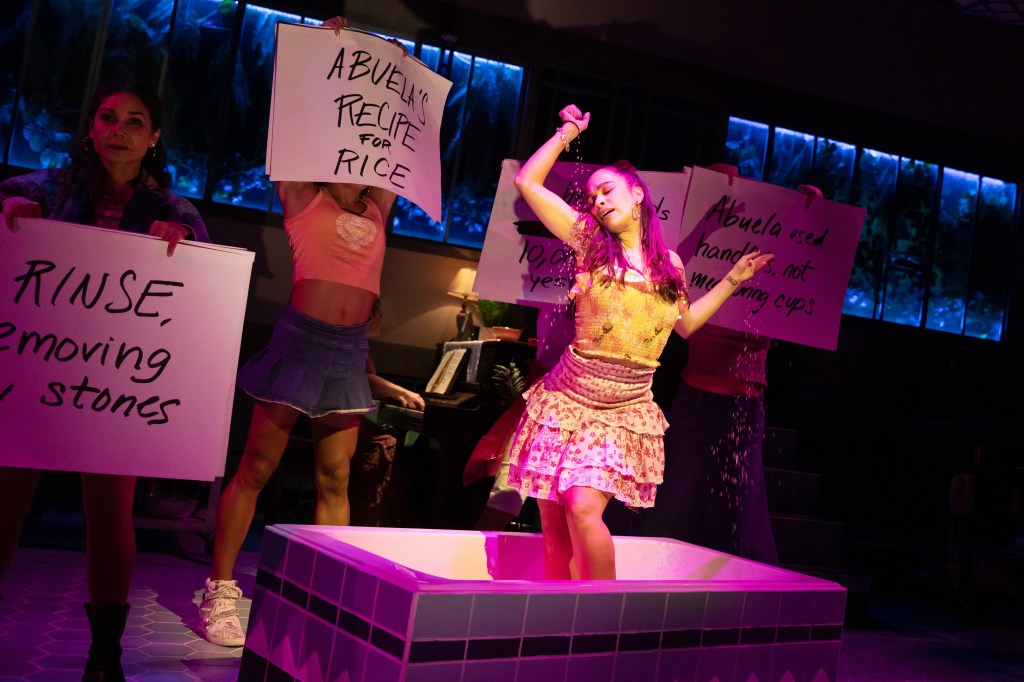
When Rubin-Vega’s Author returns home to find she is now a woman, Hudes uses the occasion for humor. Abuela gives her a huge pair of panties and she is comforted with a warm beverage and watches TV. She considers whether she will be as robust and striking as the women cousins who took her to Six Flags. Interestingly, the contrast between the Author’s life and theirs is manifest at the end of the segment. The Author from the present lists the ages and names of those cousins who die before their time. They are stricken with the ills of the barrio, ills which Hudes manages to avoid through her education and the loving guidance of Abuela, her mom and the watchful spirits hovering to protect her immediate family.
My Broken Language follows the arc of Hudes’ development and ends as Zabryna Guevara’s Author character finishes her first play in the advanced playwriting class at Brown University in 2004, when she is twenty-six. In this last movement Guevara’s Author is possessed with a spirit to perform trance-like writing. After she finishes the second act of her play, the Author notes she’s written a word she never intended to put in her play. It is then she recalls a “minor” incident from her past, that had great meaning for her, but which she didn’t realize at the time.

A few months after the fateful day of her womanhood, she recalls that a scurrilous man on the street pulled her over and whispered a demeaning, paternalistic slur in her ear. The epithet stained the beauty of her female identity and trashed it. The slur reflects how some men objectify and sexualize women to justify abusing them. However, because of the amazing women who guide the Author, as well as her education, and her search to reconcile her identity through her writing, she realizes that she is able to cast off the centuries old label. Influenced by the spirits, she casts off its meaning by using the epithet in her play. It is a unique and triumphant moment that Hudes’ direction and writing memorializes.
Like the first movement, all of the movements reveal significant and symbolic memories from Hudes’ past. The director/playwright focuses on her multi-generational Puerto Rican family, including her Abuela, mother, cousins and herself as Author, as she presents a mash up of monologue, literary text, vibrant music and movement in flashback.
Arnulfo Maldonado’s scenic design is functionally minimalistic in its representation of the Author’s house and environs where she grew up in North Philly. These facilely extend to other settings like Hudes’ room at Brown University where she writes her play. The set pieces, for example tile boxes that match the tile flooring, morph to various items, i.e. a car, a bathtub, etc., as the actors imaginatively recreate important events in Hudes’ life that reflect joyful and sad moments, the spirits, and the celebration of their lives in the dance.

Five actors don the role of the Author. They spin in and out of the various stages of her life in a multiplicity of voices and postures. They represent the Author’s inner voices as she realizes their import in shaping her future and expanding her artistic being.
Ostensibly, the Author character unfolds snatches of Hudes’ memoir in all of it beauty and glory as she strings together unique descriptors that make her experiences and her impressions of her beloved nurturing relatives palpable. Zabryna Guevara, Yani Marin, Samora la Perdida, Daphne Rubin-Vega and Marilyn Torres inhabit the Author character during the various movements. In skirting the margins of many communities, we note that theirs is a language they’ve created as their own, some even without having learned to read. That fact astounds and motivates the Author all the more to devour all literature in a obsession she seeks to fulfill as she reads American and British classics.
When she discovers her relative cannot read, she motivates herself and reads at an advanced level. Her hunger to explore the dominant culture reveals how she intends to escape the barrio as she makes it a point to enumerate family who die young. Having the education and language to use as a vehicle of escape, she returns to her roots. In this adaptation she relays this vital act of memory using a multiplicity of voices and vibes. Ultimately, the beauty of the language Hudes selects brings her Abuela, her mom, her cousins and the spirits into powerful, loving focus.

The production is stylized into narrative that is acted out. The dynamic interactions are less interactive than perhaps one might expect. If Hudes expands each of the seven movements to create consistent, moment-to-moment character dialogue, the power of the inner and outer voices of the Author, represented by the actors/characters, will be strengthened.
Strongest are the music and the celebratory dance. Choreographed by Ebony Williams with music supervision by Alex Lacamoire, the joy and vibrance of Hudes’ past resonates. The actors that inhabit the Author and her various women relatives never drop focus or enthusiasm. They, the music and dance are the electric energy of Hudes’ work. Additionally, her language is soaring. One fully appreciates it by reading her memoir and picking up a copy of the script. It is intense and profound.
Kudos to the creative team including Arnulfo Maldonado (scenic design), Dede Ayite (costume design), Jen Schriever (lighting design), Leah Gelpe (sound design), Ann James (cultural specialist), J. Jared Janas (hair, wig and makeup design).
The World Premiere of My Broken Language, written and directed by Quiara Alegría Hudes, is currently running in residency at The Romulus Linney Courtyard Theatre (at The Pershing Square Signature Center), until November 27th. It is 90 minutes with no intermission. For tickets and times go to their website: https://www.signaturetheatre.org/shows-and-events.aspx
 CAROLE DI TOSTI