Blog Archives
‘Maybe Happy Ending,’ Breathtaking With Darren Criss, Helen J Shen
Maybe Happy Ending
“Memento Mori!” The Stoics created this phrase meaning “remember you must die.” Human beings can be incredibly oblivious to their own mortality, especially when they are young. Indeed, it gets worse as one ages in the attempt to forestall looking old to remain “forever young.” But what does that have to do with robots Oliver (Darren Criss) and Claire (Helen J Shen), simulated, digital human beings who run on technological parts and have operating systems, batteries, chargers, chips, etc.? As it turns out “memento mori” is the linchpin of Maybe Happy Ending, currently at the Belasco Theatre until January 2026.
As with all things, even with long-lived elements like tellurium-128, the second law of thermodynamics applies: all things move from order to chaos, entropy. Heat dissipates into cold. Things fall apart. Things come to an end. It’s irrevocable. And at this point there’s not a damn thing one can do but live life to the fullest, if memento mori..
It is Claire, an advanced Model 5 robot, who is sleek, beautiful, witty and programmed to understand most things, who essentially reminds Oliver that things come to an end.
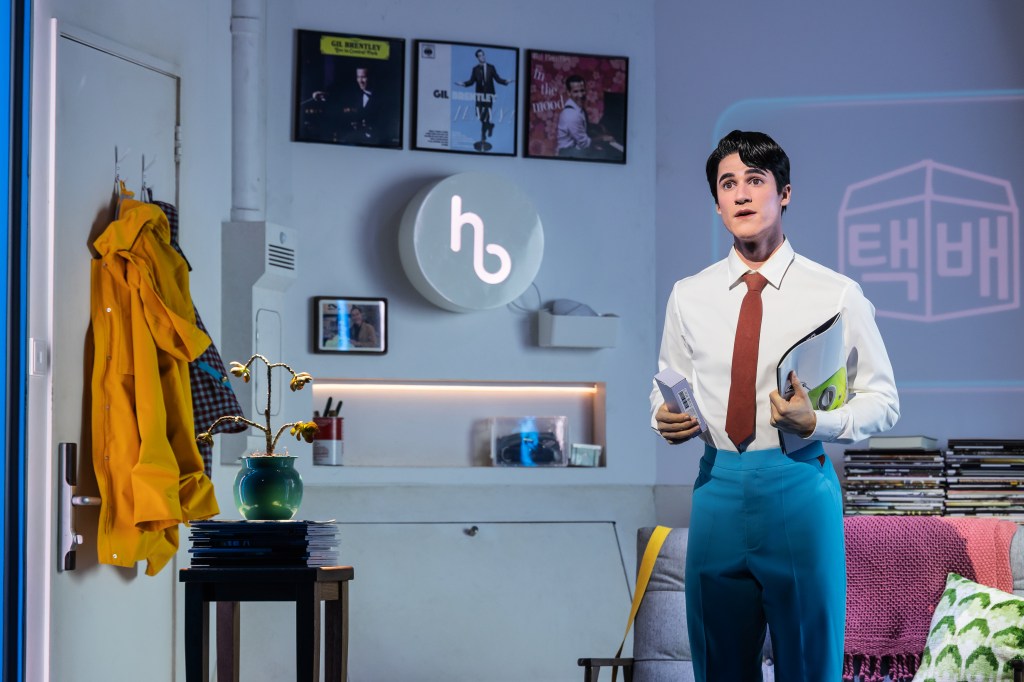
But Oliver doesn’t really get it. Oliver is a less smoothly functioning and quirky-kinky-glitchy robot Model 3. The earlier, older model is more simplistic and durable, programmed to be upbeat, decorous, sweet. He is the perfect companion, friend, son, but unaware about the deeper, more painful qualities and attributes of human beings and the natural order of the known world and his place in it. Innocent, and cheerful, he doesn’t seem to understand the cycles of wheel and woe, peaks and valleys and the end of things, for example humans, relationships, devices, himself. But by the conclusion of this incredible heart-rending musical, Oliver learns about himself. He learns what he is capable of, guided by Claire’s empathy, wisdom and heart.
The year is 2064 on the outskirts of Seoul, Korea when we meet Oliver and Claire, Helperbots (think android servants), once hired out by their manufacturer to assist their human owners with daily tasks. However, a blip has occurred for Oliver and Claire whose existence and purpose has changed. Their antiquated operating systems can no longer be upgraded. Replacement parts are scarce or discontinued. The company has with consideration allowed them to spend their purposeless, remaining days in a retirement home in the Helperbot Yards until they come to the end of themselves.
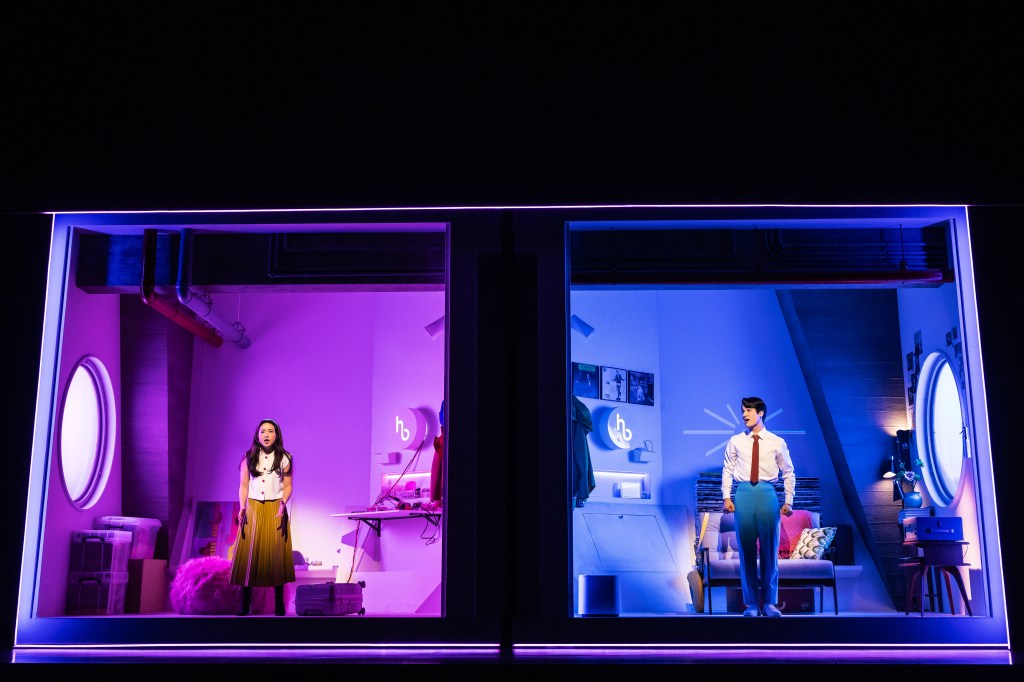
The set design of their rooms at the Helperbot Yards is imagined cleverly by Dane Laffrey via bright lighting in their rooms (Ben Stanton’s design), surrounded by darkness. Neon tube sliding panels separate and feature Claire’s and Oliver’s rooms side by side, or in movement, like a split screen effect. The rooms are color coordinated. Claire’s belongings are pink and lavender with saturated lighting effects. Oliver’s room appointments are mostly neutral influenced by his owner with blue lighting effects. The colors ironically signify their genders, recalling an innocence that belies their knowledge and Claire’s deeper understanding of human beings. As they grow closer, the saturated lighting effects sometimes alternate.
Laffrey’s scenic and additional video design, along with Ben Stanton’s lighting design and George Reeve’s video design cohere perfectly with director Michael Arden’s vision and tone, effected by Hue Park’s book and lyrics and Will Aronson’s book, lyrics and music, which is sonorous, mellifluous and lovely.
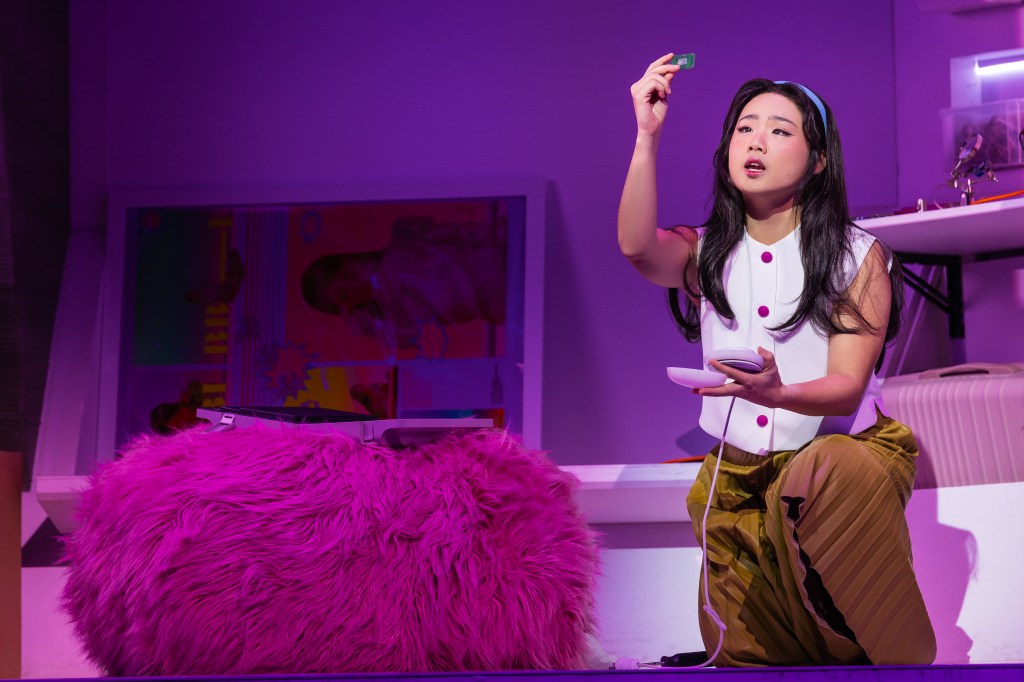
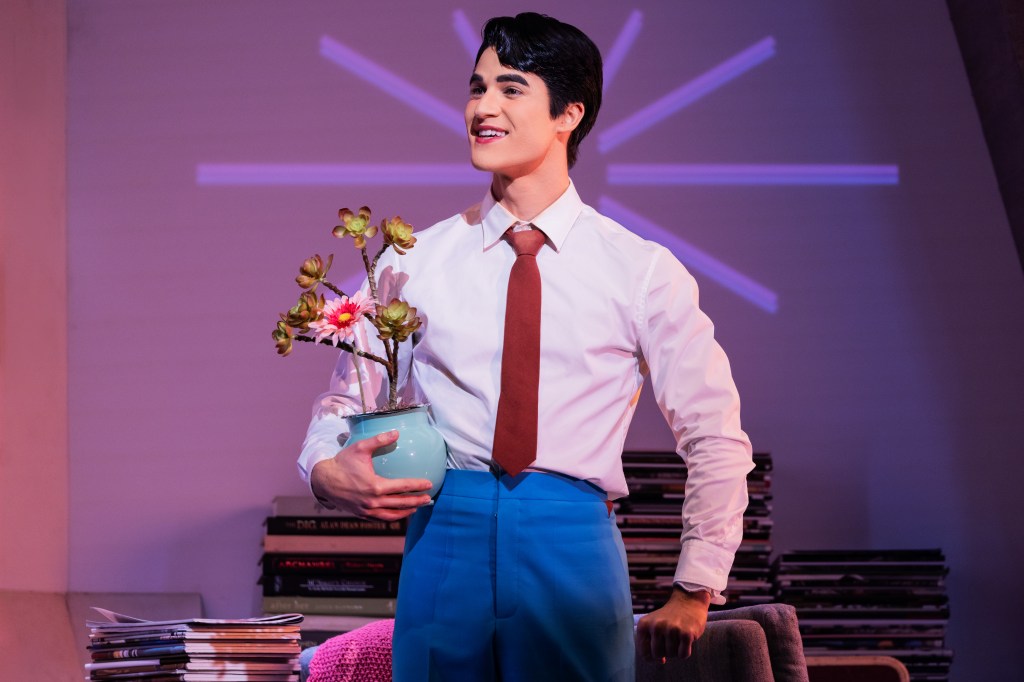
Oliver appears Model 3 robotic with slicked down helmet-headed hair, (Craig Franklin Miller’s hair & wig design), obvious reddish lips and paste skin tone (Suki Tsujimoto) and a perfectly tailored, boyish outfit by Clint Ramos. Claire’s pleated skirt and white blouse are simple, and flowing in more natural colors as the later models were designed to appear real; her hair and make-up coordinate and appear natural. The vibrant color and Ramos’ costumes cohere with the color schemes, save Claire’s initial outfit, though she wears a colorful jacket when they travel.
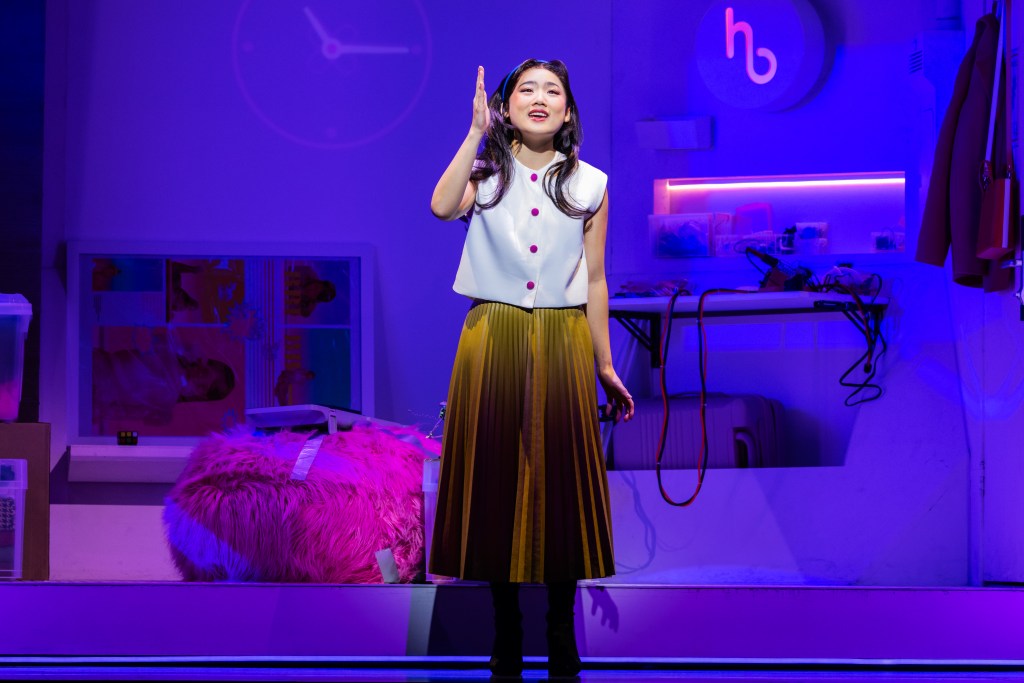
The design features represent the robotic and real worlds stylized appropriately. The real world is dimly lit and in shadow; the natural setting is somber, subdued and minimal. There is no sense of futuristic design consonant with James’ preference of retro mirrored in his acoustic music taste. James and his son (both played by Marcus Choi) naturally. Likewise, singer Gil Brentley appears in fall toned period clothing of the 50s. Sometimes with a microphone, perhaps in a club where he once performed, Brentley sings four songs solo in simple lighting. Finally, the forest scene is magically lit, captivatingly stylized, romantic and “to die for,” which is the point.
Peter Hylenski’s sound design is balanced for Deborah Abramson (music supervision), and the songs are lyrical, the harmonies in the duets gorgeous. Both Criss and Shen have voices that convey the tone of light, love and beauty. The cool jazz numbers sung by the excellent Dez Duron as singer Gil Brentley are seamlessly mixed into the action as a counterpoint to it and commentary on it.

Of the two robots, Shen’s astute, ironic Claire is the more aware, having experienced poignant and hurtful events with her beloved owner who gave her up. We get to see this via amazing digital projections and a hologram (George Reeve’s video design), as Claire revisits memories to fill in the puzzle pieces of a mystery Oliver needs to have solved. Claire is canny, smoothly sophisticated and not easily duped. There is little that she can’t figure out. On the other hand, Oliver is oblivious about why he is where he is. Oliver believes that his beloved owner and friend James will be coming to take him to wherever he has gone so they may resume their relationship which makes both of them happy.
With Oliver’s first song, “World Within my Room,” Will Aronson and Hue Park establish the situation of his isolated living arrangement which he doesn’t mind, convinced James will come for him. He is contented in his own confined world with his friend, the plant HwaBoon, his jazz records, an old-fashioned record player, all given to him by James, a jazz aficionado who converted Oliver to love jazz too. Indeed, Oliver gets to enjoy monthly jazz magazines James has sent to him which Oliver receives via a mail chute. His only interaction over the years is a remote bot (a voice over), that interacts with him if he requests something i.e. a replacement part that has not yet been discontinued.
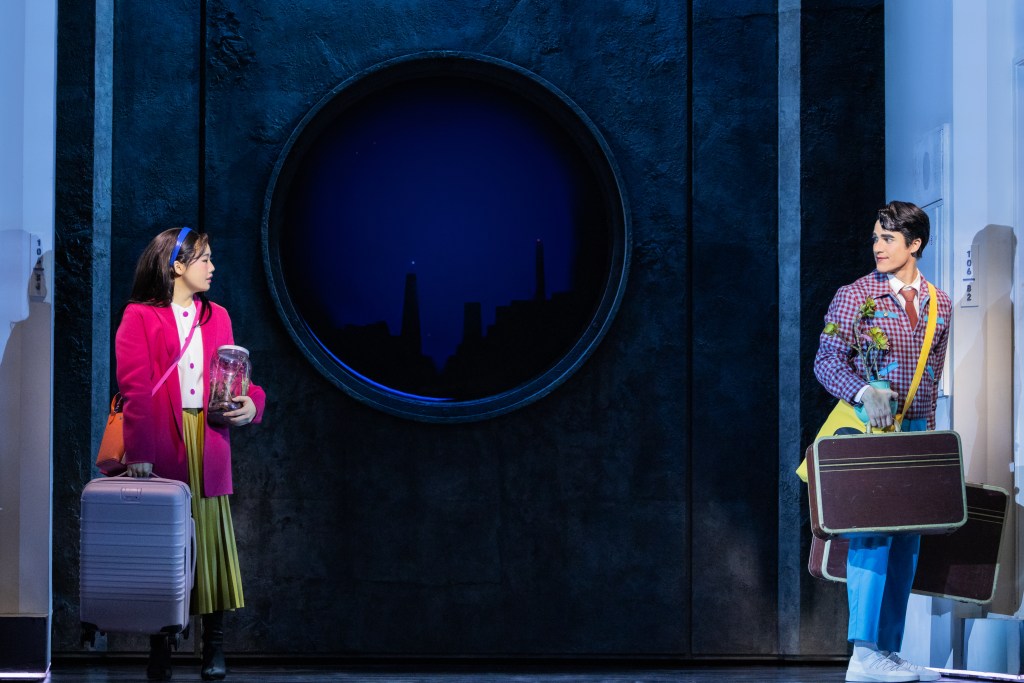
Twelve years go by, then there is an urgent knock that displaces Oliver and his contented isolation. Claire, who lives across the hall, needs a charge because the advanced Model 5s need charging more frequently or they freeze up, as Claire does, arm lifted in the midst of knocking. Oliver is too jarred by a live interaction intruding on his solipsistic existence to immediately answer the door. When he finally does relent, she is stationary, silent, frozen, and he must pick her up and carry her into his room to charge her up (literally and figuratively). Look for all of the double entendres, sly, winking humor, symbolism and metaphors about human existence, human love, human experience and forever love and happiness.
After Oliver “charges” Claire, she takes the lead, as the female model’s advanced assertiveness prompts her to. She queries him, and finding out about James, understands what has happened, but is empathetic enough to wisely counsel Oliver, sometimes with humorous snark about himself. Additionally, she dispels the competitiveness Oliver has about being the less sleek, smart and advanced model. However, she is less durable, a fault he continually throws in her face. Eventually, as Claire repeatedly returns to borrow his charger, one day she cleverly arranges to stop their routine, knowing the less flexible Oliver will freak out about it. Of course, she is correct, and when he begins to seek her out, their relationship faces a turning point and they are off and running to become more involved with each other’s wants, needs and hopes.
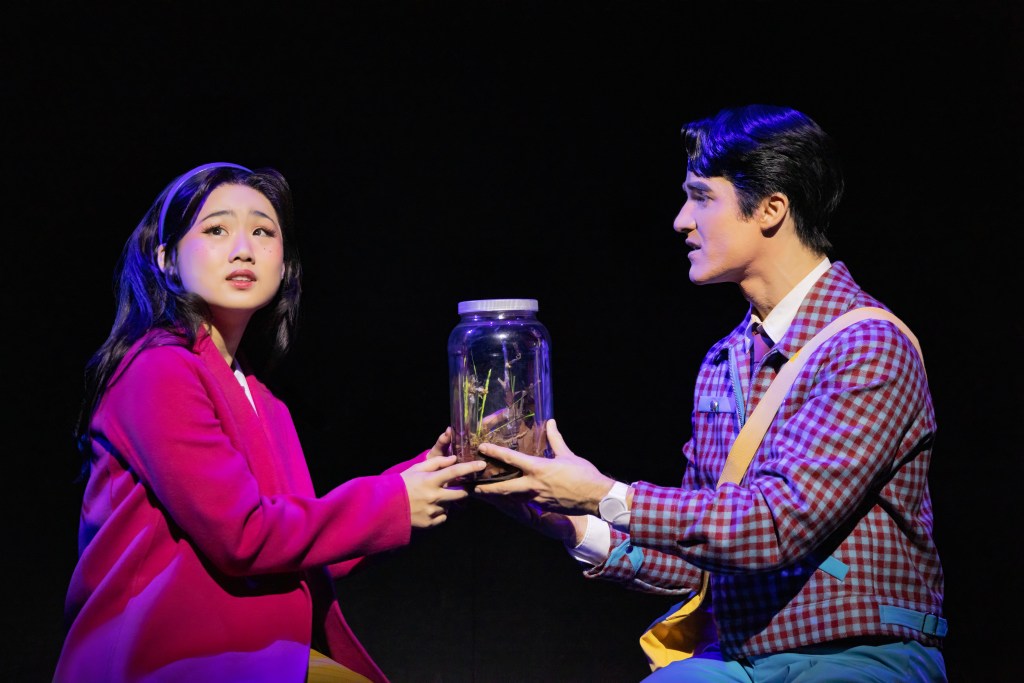
Claire and Oliver’s growing connection is a series of cataclysmic sequences that explode upon the audience’s consciousness. These are taken out of every romantic playbook of “boy meets girl” etc. However, it’s in reversal as Claire is the catalyst. Importantly, there is no equivalence because these robots can’t have emotions, can they? They’re weird, the situation is anomalous, but for the song (“Why Love?”) as a lyrical remembrance at the top of the musical, we don’t quite get it. We think, “OK, theirs is a peculiar and funny meet-up.” Importantly, though they look youthful, they are “discontinued,” seniors in a retirement home, useless, waiting to fall apart (think of “all the lonely people” whether in nursing homes or under sick-bed isolation).
Eventually, the realization hits the audience that they are looking at themselves. There will be an arrow strike into the heart and perhaps the tears or the discomfort will follow, if not at earlier junctures, yet, it will follow. The story and its incredibly coherent, metaphoric rendering in every technical and live-wired aspect (especially performances), by the creatives are designed to penetrate any cynical, hardened emotions and break your heart.
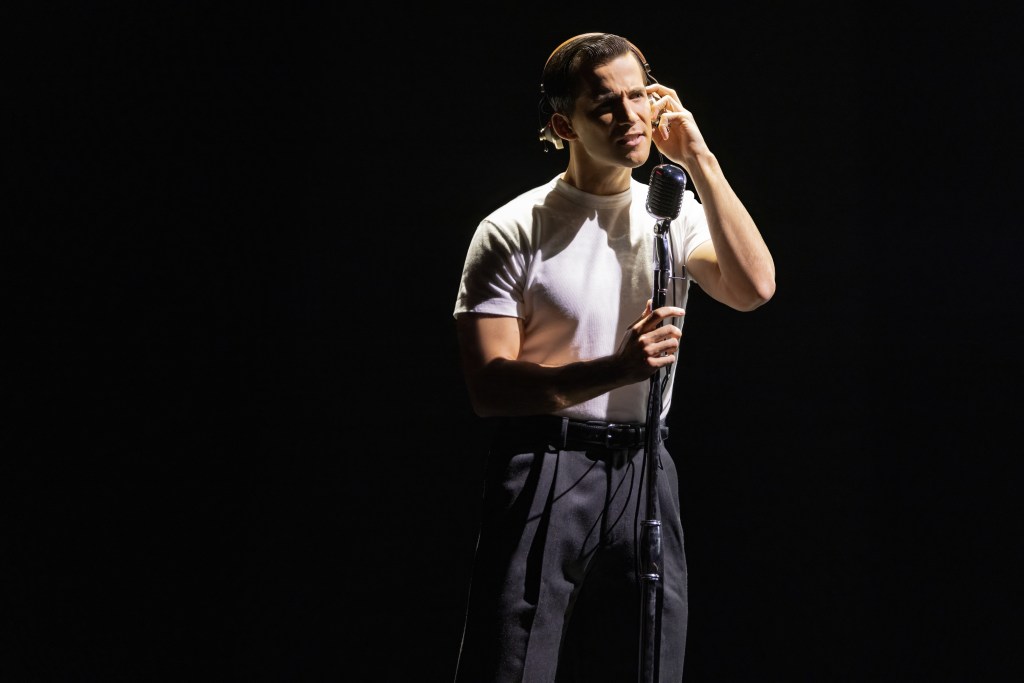
The parallel between Claire and Oliver’s story and variations of our own stings as does the song “Why Love?” sung gorgeously by Duron’s Gil Brantley. The song that James loved (he gave the Gil Brantley record to Oliver), opens the musical and concludes it, a question answering with the question. And we learn its meaning as we know it from our own lives and the journey of Claire and Oliver, as they get to know each other. The irony of these characters and their discoveries about themselves and each other is that we will more readily identify precisely because they are robots. By removing their “humanity,” the intensity of the parallels to human experience crystallizes. You “get it” in revelation, and by then, you are a goner.
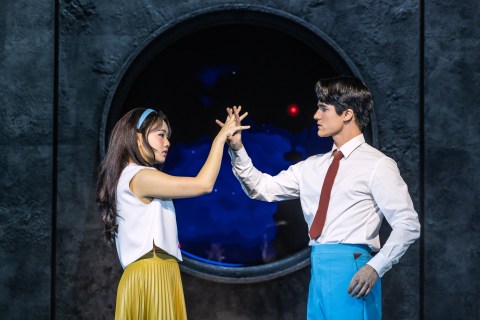
Michael Arden’s shepherding of Criss and Shen ingeniously unfolds and stages their relationship dynamic throughout, moving from their box-like, enclosed, limited existence to a forest field, in a nighttime sky of fireflies (an achingly beautiful sequence lit exquisitely by Ben Stanton). Enlightened from their adventurous “road trip,” they go back home with a new, expansive perspective and realization of their deep connection to each other, a duplication of human experience which they can laugh at as robots, yet sorrow over, for it, and they are perishable.
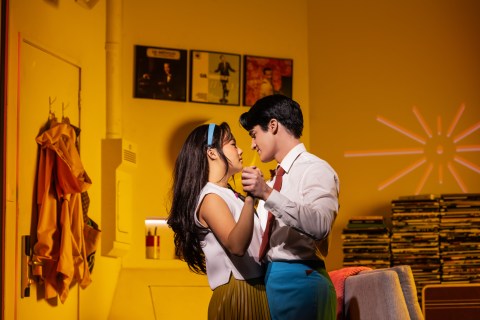
The characters and situation are counterintuitive as are the incredible performances of Criss as the more authentically robotic and Shen’s more progressively human. But by the conclusion both have evolved to decide whether to remember their love or not, knowing there is no way around the second law of thermodynamics. Even robots die. But in this instance, the more durable Oliver will be around with the memories of their love a lot longer than Claire. A decision must be made.
Maybe Happy Ending is not a story about robot love. It is a story about us. Our humanity. Our mortality. Our inability to comprehend loss, and love, and relationships, and other human beings, and emotional pain, and hurt, and tolerance of these experiences, not having the first clue about what they truly are, as we are forced to go through them, sometimes kicking and screaming
If you don’t see Maybe Happy Ending, you are missing an incredible, theatrical event, taking a deep dive into your own humanity through identification with “robots” who just kill it. They will delight, entertain and wreck you emotionally. If that doesn’t appeal, then see it to appreciate its splendiferousness as a gobsmacking, award winning, uniquely, amazing musical.
Maybe Happy Ending runs 1 hour, 45 minutes with no intermission at the Belasco Theatre (111 West 44th Street) until January 2026. https://www.maybehappyending.com/
ENCHANTING, SPELLBINDING, HEART-STOPPING, MOVING, TOUCHING, OVERWHELMING, INTENSE, HEART-RENDING
Maybe Happy Ending runs with no intermission 1 hours 45 minutes. at the Belasco Theatre (131 West 44th Street). https://www.maybehappyending.com/
‘American Buffalo,’ Explodes in its Third Broadway Revival With Phenomenals Fishburne, Rockwell and Criss
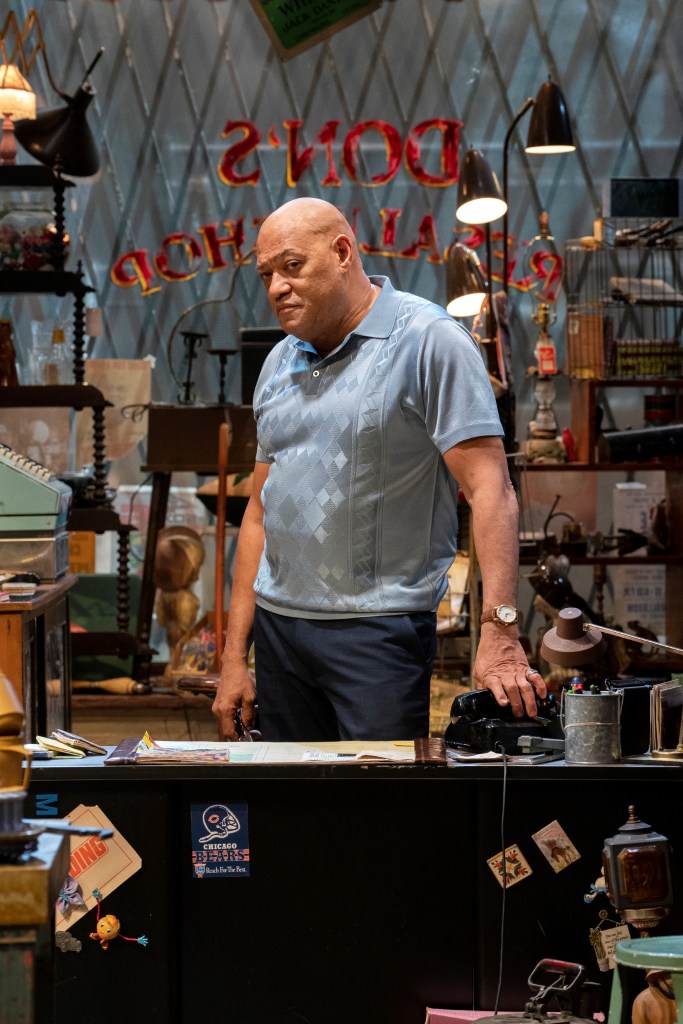
David Mamet’s American Buffalo, first presented on Broadway in 1977 with Robert Duvall as Teach followed with three Broadway revivals. The 1983 revival starred Al Pacino as Teach, the 2008 revival starred John Leguizamo. Eluding the Tony award each time, but garnering multiple Tony and Drama Desk nominations, the 1977 production did win a New York Drama Critic’s Circle Award for Best American Play.
Perhaps Neil Pepe’s direction of this third revival of the American classic, currently at Circle in the Square will bring home a few Tonys. It is a sterling production of Mamet’s revelatory, insightful play about the American Dream gone haywire for a couple of wannabe criminals whose concept of friendship and getting over test each other’s mettle.
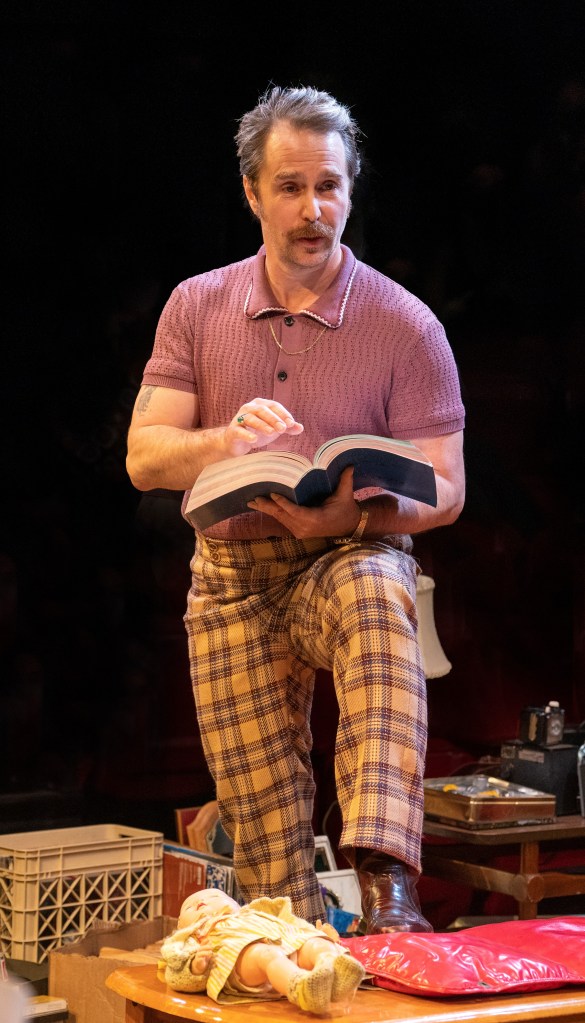
The cast is more than worthy to line up with Mamet’s dynamic, vital characterizations. The actors are seamlessly authentic in the roles of Donny (Laurence Fishburne), Teach (Sam Rockwell) and Bobby (Darren Criss). I didn’t want the play to end, enjoying their amazing energy and finding their portrayals to be humorous, poignant, frightening, intensely human and a whole lot more. Their depth, their interaction, their careful interpretation of each word and action that appeared flawlessly real is so precisely constructed in their performances, it is incredibly invigorating and a justification for live theater-why it is and why it always will be.
Mamet’s early writing is strong and singularly powerful as evidenced in American Buffalo. The play involves a string of events that happen over the course of a day in Don’s Resale Shop which is a hazard of incredible junk for the ages, fantastically arrayed by Scott Pask’s talents as scenic designer. The play opens at the height of drama (we think), when Donny upbraids Bobby about the right protocol to take regarding “doing a thing” as a preliminary action in a future plan they will endeavor. Then the developmental action sparks upward and never takes a breath in the crisp, well-paced Pepe production.

Immediately, we note Fishburne’s paternal and fatherly approach to Darren Criss’ innocent, boyish, “not too swift” acolyte into how to be sharp in business and not let “friendship” get in the way. Donny’s mantra relates throughout American Buffalo. As we watch his interaction with Bobby, we can’t help but see the organic humor in their characters which are contradictory and perhaps disparate from us in intention, discourse, values, initially, but are our brothers in humanity, whether we admit it or not.

At the outset it is impossible not to align ourselves empathetically with these acting icons, each of them award winners with a long history of prodigious talent over decades of experience in film, TV and stage. They are a pleasure to watch as they inhabit these characters, that are a few class steps above Maxim Gorky’s Lower Depths‘ denizens. LIke Gorky’s underclass, these “higher in stature” nevertheless live in their dreams as they deal with the very real and shabby circumstances of their lives. Thus, junk doyen Donny is the wise businessman who, by the play’s end belies all of the instructions he relates to Bobby at the beginning. And Bobby who intently listens to show Donny how much he is willing to learn to remain in his favor, learns little because he has let Donny down at the outset when he is “yessing” him with wide-eyed reception.

As a counterweight to the teacher-pupil, father-son relationship and manipulation between Donny and Bobby, the manic, feverish Teach throws around his knowledge, experience, street smarts and volatile “friendship.” He is their foil, their activator, their stimulator, their inveterate “loser” with a talent for braggadocio and despondency, and clipped epithets about the other denizens in their acquaintance. He is an apparent backstabber and one to watch as someone who sees themselves as dangerous, but botches his self-awareness and presumption to greatness at every turn.
Rockwell knows every inch of Teach and performs him with gusto and relish. He is integral to this team of exceptional actors that Pepe directs to high flashpoints of authenticity and spot on immediacy. This is collaboration at its best. From the layout of their characters’ plans in Act I to the consequences of the plan’s execution in Act II, the still point of behavior is the crux of what Mamet’s Buffalo presents with crushing ruthlessness.
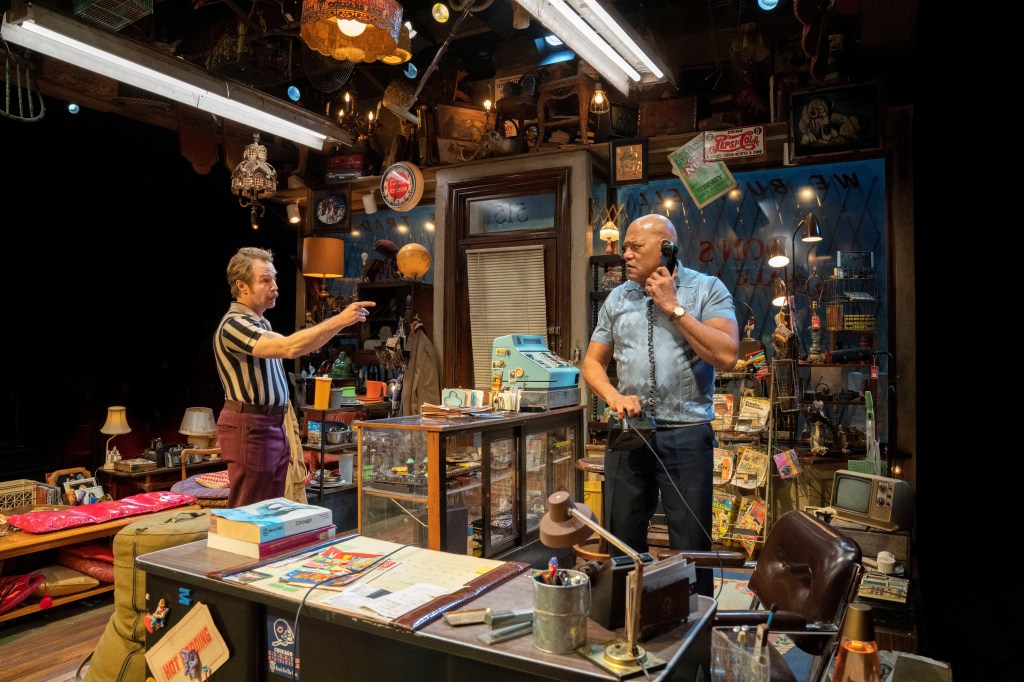
Examples abound throughout, but are particularly manifest in Act II. It is there that Rockwell’s Teach releases the anger within the character to reveal his self-destruction, self-loathing and disappointments. Rockwell’s Teach lashes out, only to be topped by Fishburne’s essentially kind and fatherly Donny, who erupts like a volcano at Teach in a shocking display of force. The drama in the second act is so alive, so expertly staged by J. David Brimmer as Fight Director, if Teach had moved an inch more slowly than he did, he would have been badly injured by the essentially good-natured but seriously, no-joke Donny. The altercation is a work of art, incredibly precise in its build up of the characters’ emotions, then release.
Likewise, Teach’s explosion against Bobby is devastating in another way. Brutal and exacting, Teach exploits Bobby as his victim. Using him as a backboard to release his fury and self-loathing, he redirects Donny to believe Bobby and another individual have double-crossed Donny and Teach in their plot to steal, undercutting Teach’s and Donny’s deal. Bobby’s attempt is feeble as he tries to verbally defend himself against Teach’s relentless onslaught, borne out by Teach’s years of inner frustration which have encompassed failure after failure. Teach won’t hear Bobby. Enraged at himself and his own assumed victimization, as he spews venom on the double-crossing Bobby and his “accomplice” to incite Donny, his violence crashes in a high, then a low.

Once again, the frenemies are tragic counterparts in a social class that is hurting. Teach’s rage is otherworldly. Bobby’s sorrowful reception of it without fighting back is heart-breaking. Criss is just smashing. I wanted to run up with alcohol and bandages to help stem the external wounds, knowing Bobby’s soul harm is irreparable. Through both brutalizations by Fishburne’s Donny and Rockwell’s Teach, the audience was silent in tension and anticipation. And then the mood breaks and here comes humor and apologies and I won’t spoil the rest.
The togetherness and human bonds displayed are as rare as the American Buffalo head rare coin Donny believes he had and lost. The coin lures the three who are governed by dreams of wealth, like iron pyrite. The resultant failure of their plans, emotional devastation and self-harm is never dealt with. Only Donny’s soothing of the situation is a partial rectification. Interestingly, whatever the type of friendship Teach, Donny and Bobby have will be strengthened by the thrill of the gambit, the crooked deal, the need to “get over” to salve lives that exist without purpose, overarching destiny or moment, except to move toward death, with “a little help from their friends.”

This portrait of Americana is particularly heady and current. Though the play is apolitical, it does speak to class, the macho bravado of making plans and screwing up, the lure of illegality as cool, and the consolation provided by the older wiser individual who the younger men are fortunate to befriend, though he is a subtle manipulator and user, as they all are in the game of “getting over.”
In American Buffalo Mamet suggests this game is as American as the American Buffalo, as American as apple pie, as American as the right to bear arms. Indeed, it is in the soil and the soul of our culture and we cannot escape it, though we may not embrace the ethic and ethos of the “art of the steal,” especially when law enforcement comes knocking. Nevertheless, the play suggests a fountain from which to drink and either be poisoned by the perspective, refreshed, nourished, but never bored. For that reason and especially these acting greats, this production should not be missed.
Kudos to Tyler Micoleau’s lighting design, Dede Ayite’s costume design and all the technical creatives whose efforts are integral to Neil Pepe’s vision for this third revival. For tickets and times go to their website: https://americanbuffalonyc.com/
 CAROLE DI TOSTI