Blog Archives
‘Brooklyn Laundry’ a Soap-diluted Rom-com That Avoids the Soul-dirt
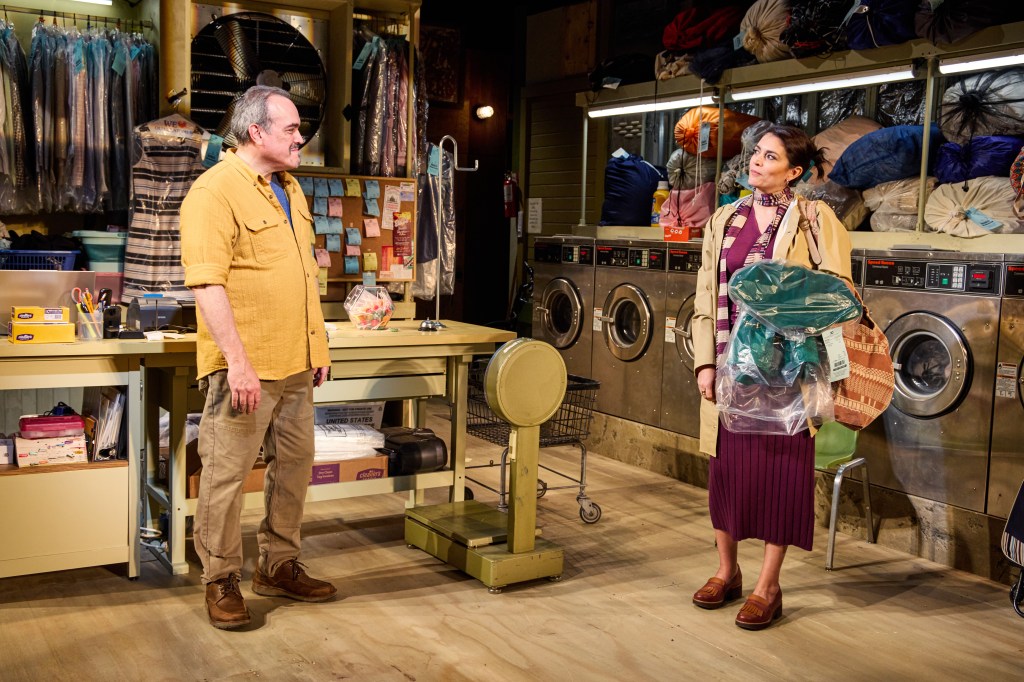
John Patrick Shanley’s Brooklyn Laundry, currently at MTC Stage 1 never quite elucidates trenchant themes though it might have with further character development. The 80 minute play, also directed by Shanley, currently runs at New York City Center Stage 1 until April 14th.
Starring Cecily Strong (“Saturday Night Live”), and David Zayas (“Dexter’), as the principal couple who meet in a drop-off laundry in Bushwick, Brooklyn, in Brooklyn Laundry Shanley presents two individuals who become involved with each other as a result of desperation, depression and loneliness. Also, they are between partners and have not been involved in a successful relationship ever.

The Meet-Up
Laundry owner Owen (the lively Zayas), engages in light conversation with Strong’s Fran as the play opens. She is an on again off again customer, whose boyfriend left. Fran admits later in the scene that she is self-conscious about the fact that she can barely scrounge enough laundry to drop off for one load. When she was with her boyfriend, the bag weighed thirty-eight pounds; they did their laundry together. Owen, who Fran reminds that he owes her credit for losing a bag of her laundry 6 months prior, acknowledges that her lost laundry is a mystery. He has been giving her credit, though she complains that it doesn’t cover the price of replacing the missing items.
As they chit chat, Owen notes her “gloomy” nature to jostle her out of it. He tells her she reminds him of his fiance, who was “smart, one inch from terrific, but gloomy.” Fran disputes his label about her and suggests reality has brought issues into her life, and it isn’t without reason that her situation doesn’t make her the sunshine kid.

Owen discusses the necessity for positivity and an uplifted attitude, sharing his recent life story. He became the owner of three laundries, after a car accident settlement and lawsuit against his 9 to 5 boss who unfairly fired him. Assured that he has answers for her life in the face of her wishing she could have a car accident and be so lucky for monetary settlements, he takes a leap of faith. With apparent confidence he asks her to dinner. Fran suggests she will after she returns from a family visit in Pennsylvania.
Shanley has established the ground rules for these two individuals from different backgrounds with little in common, who make a connection simply by being present together and willing it. From this initial spark, Shanley takes us on a journey of how unlikely singles Fran and Owen fall in love because of need.
Reality’s Gloom and Fran’s Escape
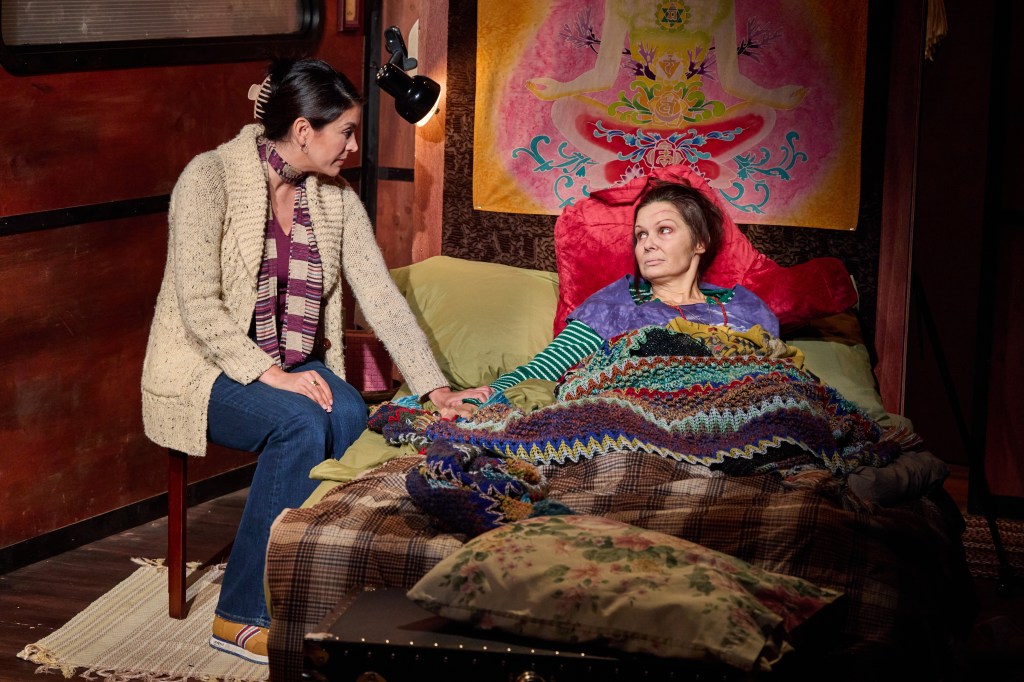
In the next segment, we understand why Fran is depressed when she visits her sister Trish (Florencia Lozano), who is ill with cancer, loopy on meds and lying in bed mostly unconscious. After her visit with Trish, Fran goes on her date with Owen high on magic mushrooms. She offers some to Owen and after a while he catches up to her. Together they experience the beauty of the lights and atmosphere of romanticism and their conversation intensifies.
On a sub rosa level, Fran introduces the mushrooms into the situation because she wants to escape thoughts about her dying sister. She chooses to live in a lovely, seductive place with Owen. She doesn’t share her Trish reality with him for fear it will drive him away. So she suppresses her emotions to suit his needs to be positive and upbeat. She puts aside her gloominess, despite the fact that complications with Trish abound and she has less than a month to live.

The mushrooms encourage their intimacy and Fran helps Owen conquer his sexual problems that happened as a result of his car accident, problems which turned off his former girlfriend who dumped him as a result of his poor performance. Interestingly, Owen is honest about a very sensitive subject with Fran and of course she helps him. On the other hand, Fran is dishonest with Owen because he set the parameters that she feels she must adhere to to be with him: no gloom. Thus, Fran and Owen become closer after their first date of intimacy, and after three weeks, theirs is a budding love.
However, another jolt of reality intrudes and slams Fran in her “honesty” with Owen. Fran’s other sister Susie (Andrea Syglowski is always spot-on), stops by to collect Fran so together they will make arrangements for Trish’s imminent death. Fran refuses to go with Susie initially. She fears if she leaves Owen to spend time with family, she will lose the momentum of their relationship and he will dump her for someone else. With lies of omission, she lives in her own dream that she can spin along her affair with Owen without introducing the ugly realities about Trish dying.
The argument that ensues between Strong’s Fran and Sydlowski’s Susie about whether to visit Trish before she dies is beautifully paced and authentically threaded by both actors. During their accusations against each other, we learn how high the stakes are for Fran, who has never been married and has been the hand maiden to her two divorced sisters and their relationships with their loser husbands. We realize why she elected to escape to a love relationship with someone off beat which she clings to so she doesn’t have to face the doom and sadness of her life. Because Owen doesn’t appreciate negativity, his wants prevent her from spilling her emotions to him. Ironically, she is cutting off a valuable part of herself because she fears he only wants “happy, happy.”
Spoiler Alert
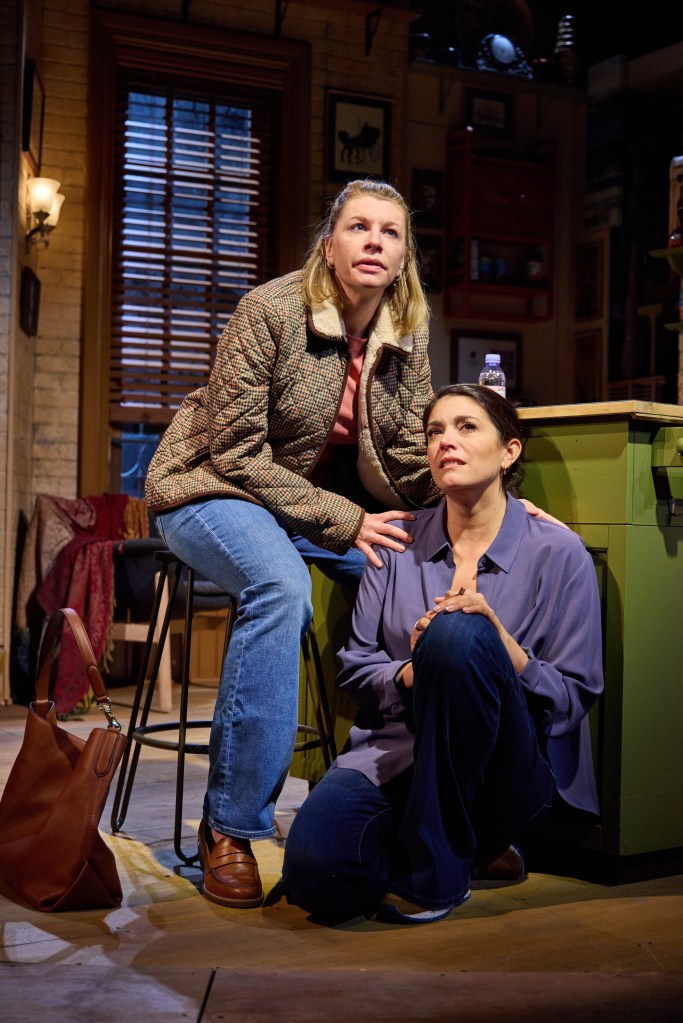
Then Susie levels with Fran about why she didn’t accompany her to see Trish the last visit. Susie is dying of pancreatic cancer.
With charming facility Owen cleaned off the “gloomies” from Fran’s plate to no avail. Susie’s horrible news slams Fran with a triple portion of gloom. Not only must she confront Trish’s impending death and the consequences of its impact on Trish’s young child, Taylor, she must confront the consequences of Susie’s dire prognosis. Fran’s doom and gloom lifted for three weeks by Owen will be a permanent fixture in her life. Additionally, guardianship of her sisters’ three children and their financial custodianship falls to her as their closest living relative. Will Owen want to take on a woman with three kids especially since he confessed he only wants his own child and isn’t looking for huge bills to pay for the upkeep of children who aren’t his?
The strength of Brooklyn Laundry is in how Shanley weaves the events, to back Fran into a corner delivering reality’s blows to her life, while showing her desperation to escape her circumstances by not sharing the truth with Owen. Eventually, her own obfuscations come back to haunt her. When Susie tells her about her cancer, Fran wakes up and stops moving in her imagined dream. She assures Susie she will act responsibly. Shanley’s characterization of Fran reveals her nobility, self-sacrifice and integrity in honoring her sisters by raising their children. She has made up her mind and whatever Owen does is up to him, take it or leave it. Fran puts family first.

The Last 10 Minutes
The last ten minutes of Brooklyn Laundry are the most dynamic because we note the inner struggles of the characters as they deal with hidden truths. Fran confronts Owen who stopped answering her calls. Though he portrays himself as the victim and ignores her comments that he ghosted her, something he promised he would never do, eventually, he is forced to put his pride aside. They both realize what they will lose without each other, and they are able to accept with humility that they care.
Shanley perhaps misses important dramatic moments by having the characters report their reactions after the fact to each other, instead of establishing a few scenes that are immediate, confrontational and a dynamic build up with irony. Instead, he writes one scene of alive confrontation and saves it for the very end. It is then that Fran’s serenity with reality shines and Owen reveals himself to be a typical male, more full of himself than he needs to be. However, after Fran walks out of his life to live in Pennsylvania, he realizes his mistake. The play’s conclusion falls into place with a few humorous surprises to satisfy audiences.
Kudos to the involved three-set scenic design of Santo Loquasto, Suzy Benzinger’s costume design, Brian MacDevitt’s lighting design. MacDevitt presents the magical fairy land lighting of the restaurant scene perfectly. Additional kudos goes to original music and sound design by John Gromada.
Brooklyn Laundry is facile and enjoyable thanks to the excellent acting ensemble. Shanley’s rhythms about loss, need and taking risks without ego are imminently human and recognizable.
Brooklyn Laundry with no intermission is in a limited engagement until April 14th. New York City Center MTC Stage 1, 131 West 55th St between 6th and 7th. manhattantheatreclub.com.
‘Cost of Living’ Broadway Review: Are Lives Lived Well or Wasted?

What price do we place on our own inherent value? What is the rock bottom cost we have to pay to live with dignity and be fulfilled emotionally, physically, materially? These subtle questions as well as questions about our need for respect and life-giving emotional and spiritual connection compose the themes of Martyna Majok’s well-acted four-hander, Cost of Living directed by Jo Bonney currently, at the Samuel J. Friedman Theatre.
The 2018 Pulitzer Prize-winning play originally debuted at the Williamstown Theater Festival in 2016, and appeared off Broadway in Manhattan Theatre Club’s production at New York City Center in 2017. Currently, Manhattan Theatre Club presents Majok’s Broadway debut, adapting to the larger stage and stretching out the precisely appropriate scenic design of the various New Jersey apartments of differing economic scale by Wilson Chin. From the ensemble Gregg Mozgala and Katy Sullivan originated their roles of the differently abled John and Ani. Kara Young as Jess and David Zayas as Eddie portray the able bodied caretakers who learn what physical and emotional skills are required to help the differently abled deal with the most intimate and personal body functions when they cannot.

The actors make a terrific ensemble despite a play that has flawed construction and sometimes is unnecessarily confusing during the first hour of the two hour play which speeds by in some parts and slow walks in others. But for the exceptional performances one wouldn’t completely understand the import of the present immediate timeline of the first scene as it connects to the last scene. Both provide the frame that holds together the substance of the rest of the events which take place in flashback four months prior.
Thanks to the superb David Zayas who portrays Eddie, an out of work truck driver and former alcoholic who is clear-eyed and specific in his discussion of his wife who has passed, we eventually unravel the mystery of events which take place between Eddie and wife Ani (Katy Sullivan), Jess (Kara Young) and John (Greg Mozgala) that unspool in the past and spin into the present changing the direction of circumstances for Eddie and Jess.

If Majok didn’t order the play as a frame with flashbacks, the relationships of the couples would have popped even more than they do. However, it is a way to hide the contrivances that promote surprise and twists in Majok’s exploration of the relationships between Jess and John, Ani and Eddie. These twists set up the concluding scene which effects the most beautiful and resonating of Marjok’s themes of connection and communication. The last scene is the uplifting high-point of the play, carefully shepherded by Bonny and wonderfully acted by Zayas and Young.
The structural difficulty occurs in the initial scene with Eddie’s solo speech to an unidentified individual (the audience) in the setting of a bar with a lovely row of shining alcohol bottles decoratively strung with Christmas lights. Eddie tells us the hipster bar is in chic Williamsburg, Brooklyn where he has been enticed from Bayonne, New Jersey by cheeky texts. The anonymous individual was given his deceased wife’s phone number which Eddie used to text her to not feel so desolate and alone. After being pestered by the texter into curiosity and a desire to stave off loneliness, Eddie decides to accept the offer to meet at the Williamsburg bar on the snowy night in December.

Zayas’s Eddie, in this sprawling introductory opening scene, where he relays some of his backstory about his alcoholism and split with his wife, remains charming, funny and generous. He easily wins us over by offering us (the anonymous guy in the bar) a drink for listening to him as he promises not to launch into the doom and gloom he feels since his wife died. We go along for the pleasant ride, not realizing when he leaves that this is a prologue, one section of the frame in the immediate present. Thus when the scene switches completely to another setting (thanks to Wilson Chin’s upscale scenic design representing John’s apartment) we don’t realize we are in a flashback four months earlier in another situation. We discover it when the director and the playwright unfold the dialogue introducing two characters unrelated to Eddie.
This might easily have been clarified with a notation in the program of setting change. Prosaic and uncool? Hardly. For the purpose of clarification and the heightening of the vital themes and arc of the relationships which the playwright presents and explores, the details would have launched us into the profound characterizations earlier to appreciate the depth of the play. Thus, we must catch ourselves up in the time switch to a flashback that this is John’s apartment in Princeton at a time in September.

Jess (Kara Young) and John (Greg Mozgala) are complex individuals coming from completely different socioeconomic backgrounds and physical and emotional states, key points for what later unfolds. By degrees we learn that Jess and John went to Princeton where John’s stylish apartment is located. John is a wealthy grad student with cerebral palsy (Mozgala has cerebral palsy). Jess graduated with honors and now works in bars where her tips are large. However, she needs the caretaker job John offers for additional money. As both do the interview dance, we are struck by Jess’ unadorned personality and direct authenticity. John must win us over as he comes off as a presumptuous ironist who is taken with himself.
Whether his personality is a pose to cover for extreme inferiority in a culture and society that prizes the beautiful, athletic, young and whole, or his wealth has allowed him to leverage his superior act, we realize that both Jess and John act in control. Like any relationship, even a work one, trust must be gained and built up. Jess is guarded and wary; John is overly confident and wry.

In the next scene switch from John’s apartment in Princeton, we meet Eddie’s wife Ani who is alive at this point in the flashback which she states takes place in September. She is in her new apartment where she will live with outside help. She is a quadriplegic, having suffered a horrific car accident in the previous months where surgeries saved her life but couldn’t restore her use of her arms and both legs which were amputated at the knee. Obviously, Ani is infuriated with Eddie and curses him out as a matter of course, trying to get him to leave. He is moved by her condition and feels guilty and responsible for being with another woman, a cause of their separation and filing papers for divorce. However, because they are still legally together, she is on his insurance. And he kindly suggests she stay on it even after they are divorced.
The play by degrees establishes the warmth of feeling between Ani and Eddie, Jess and John as the caretakers help the differently abled shower, bathe and finish their personal toilet. The intimacy of the activities are matched by the honesty of their conversations so we are struck by the humanity and concern shared by each individual in the couple who helps the other in an exchange. Anit gives Eddie emotional support as he helps her physically. Jess receives a listening ear in John as she becomes adept at transferring him to the shower seat and helps him cleanse himself.
We learn more about Jess’ immigrant background, her mother’s returning home because of financial difficulty and her struggle to send money home to her, during John’s and Jess’ time together. With the once married couple, the former love between Eddie and Ani is still evident but it has changed and deepened. Eddie could just move away from Ani. However, he emotionally needs to be with her and is happy that he can help her and watch her when the agency and nurse call on him because her regular caretakers sometimes cancel.
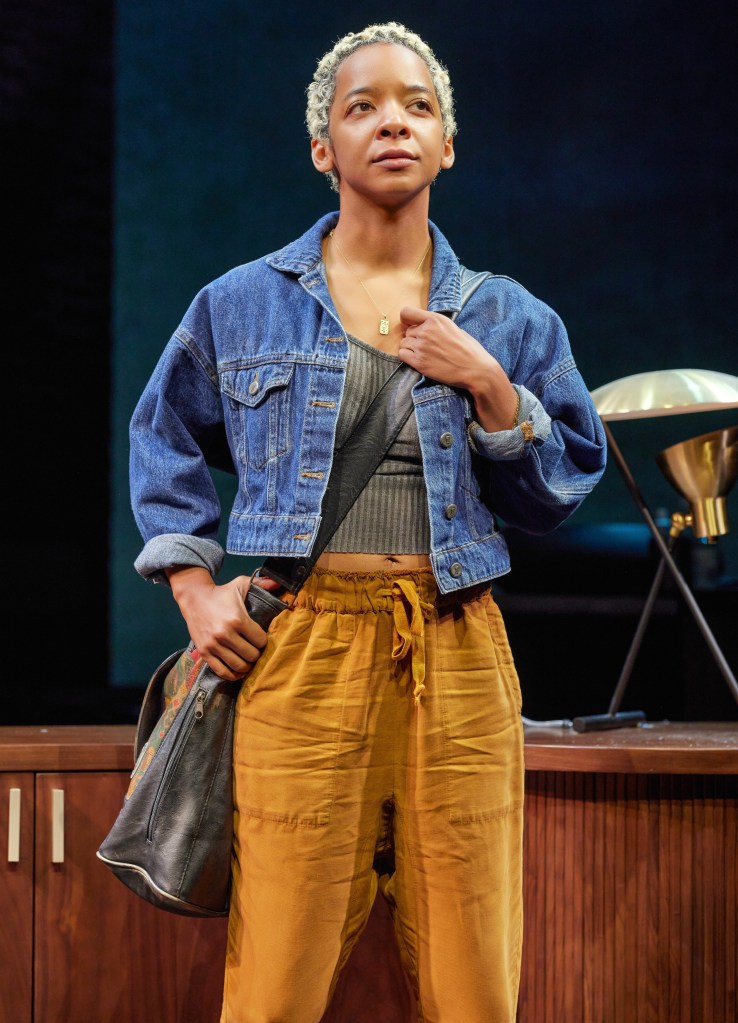
The dynamic relationships created by the superlative actors make this play ring out with hope, even though in the last two flashbacks, the darkness comes and we fear for the characters we have come to like. Also, selfishness is revealed in one of the characters whose clever manipulations are completely unexpected and underestimated. It is a shocking and hurtful reveal and the character never recovers our good will because he has made himself unworthy of it. This twist is seamlessly drawn as Majok plucks at our heart strings and upends our expectations. However, the last scene between Zayas’ Eddie and Young’s Kar is perfection in dialogue, acting, direction. In the actors’ living each moment, we realize why there is nothing like theater.
Cost of Living reminds us of our weaknesses and the consolation that if one feels lonely, all experience the ache even those partnered up. It is a fact of life that neither money nor marriage can salve; it is the cost of being alive, for we are each in ourselves individual and alone. However, only communication, truth and honesty with others can light the way for connection that is sincere and life affirming. It is then that the cost of being alive is worthwhile.
Kudos to Jessica Pabst (costume design) Jeff Croiter (lighting design) Rob Kaplowitz (sound design) Mikaal Sulaiman (original music) and Thomas Schall (movement consultant).
For tickets and times go to their website: https://www.manhattantheatreclub.com/shows/2022-23-season/cost-of-living/
 CAROLE DI TOSTI