Blog Archives
Theresa Rebeck, Presented by League of Professional Theatre Women at NYPL for the Performing Arts at Lincoln Center
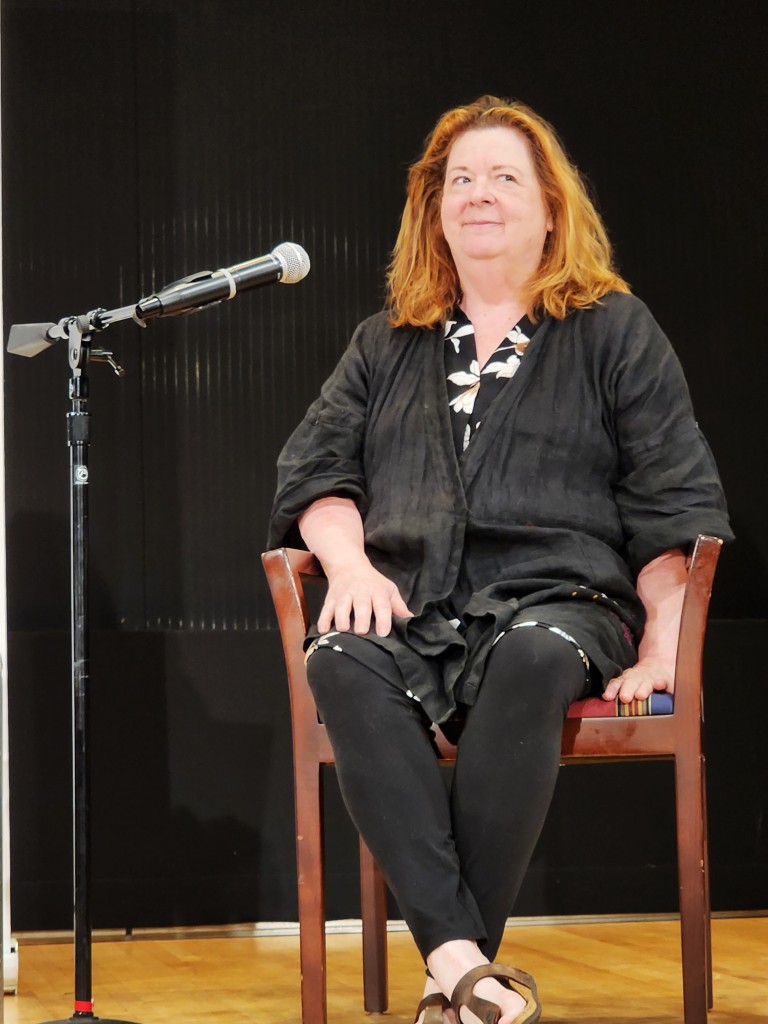
Theresa Rebeck. If the name doesn’t sound immediately familiar, chances are you do know Theresa Rebeck’s work from Broadway, off-Broadway, television, films or literature. A prolific writer, she is the most produced female playwright of her generation. Her work is presented throughout the United States and internationally. Her Broadway credits include I Need That (starring Danny DeVito), Bernhardt/Hamlet (starring Janet McTeer), Dead Accounts (starring Norbert Leo Butz), Seminar (starring Alan Rickman), and Mauritius (starring F. Murray Abraham). Her off-Broadway productions are numerous.
It was a pleasure to hear and see her live in an event sponsored by the League of Professional Theatre Women, Monday, June 3, 2024 at the New York Public Library for the Performing Arts, Lincoln Center’s Bruno Walter Auditorium. Interviewed by her close friend and producer Robyn Goodman (Avenue Q-Tony Award 2004, In the Heights-Tony Award 2008), Robyn founded Aged In Wood Productions in 2000. Their discussion was taped and is part of LPTW’s Oral History Project to preserve visual records of interviews of august women in the theater. The event was produced by director and producer Ludovica Villar-Hauser. A video of the event can be found in the Library’s TOFT Archive.
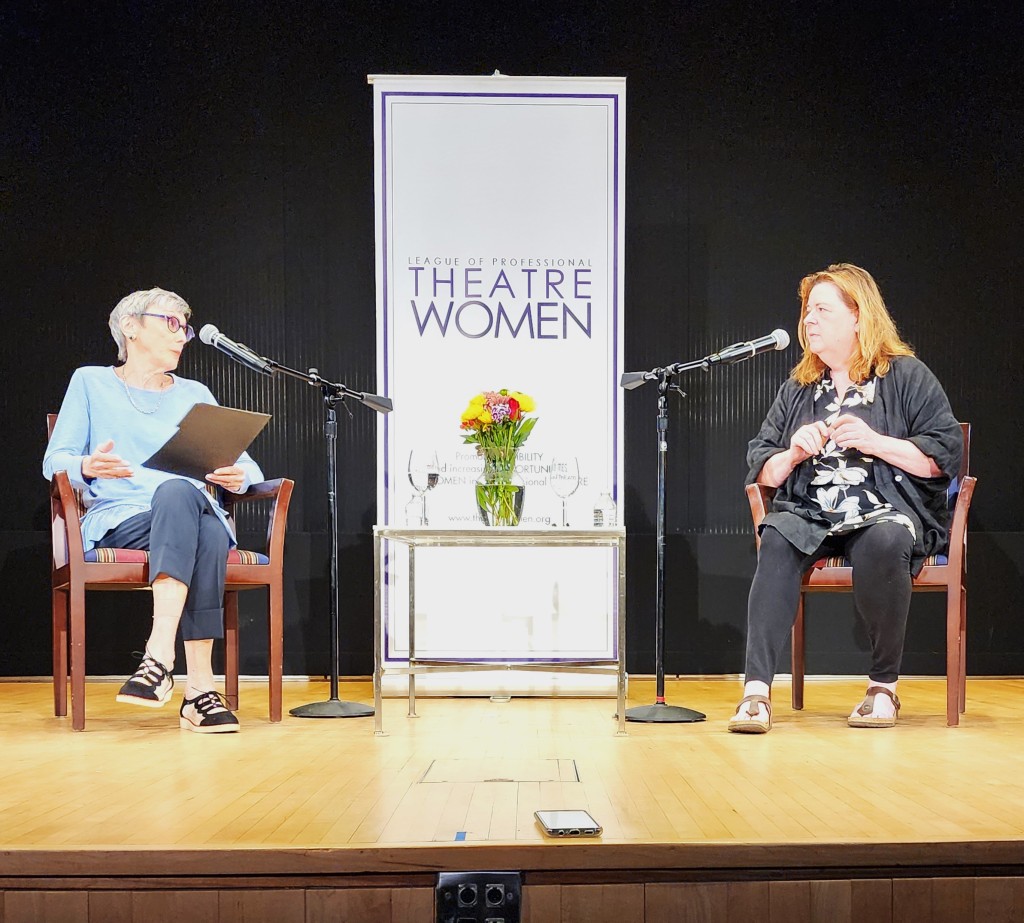
For the members of LPTW, Theresa Rebeck needed no introduction. Robyn Goodman began by asking general questions about Rebeck’s early life, and her background tie-ins to themes which often arise in her plays. This brief post focuses on a few salient highlights of the interview.
Born in Ohio, Rebeck grew up in an “ultra Republican, ultra Catholic” world. Receiving a Catholic education throughout, she graduated from Ursuline Academy in 1976 and continued with her Catholic education, graduating from the University of Notre Dame in 1980.
With irony and humor, Rebeck confided, “My parents didn’t want me to go to any East Coast School because they were afraid I’d lose my faith.” She shared that as a child, at times she went on a bus to see theater productions. Even at a young age, she venerated playwrights, thinking them gods. To her, Shakespeare, Moliere, Arthur Miller and Tennessee Williams were fantastic. She joked that she was already into theater and drama before she got out of grade school.

After Rebeck began acting in earnest at Ursuline Academy, she told her mother “I think I want to be a playwright.” Rebeck got laughs when she joked about her mother’s response, “She turned grey.”
Interestingly, during her freshman year at Notre Dame, Rebeck was invited to a very religious group who was holding a prayer meeting. It was “really spooky,” and the people were “really religious.” Rebeck sensed something “dark and weird going on.” They were speaking in tongues and talking about women being subservient so that everyone “should know their place.” She quipped, “After ten minutes I wanted to go back to my dorm room.” However, she wasn’t sure how to get back.
This was an introduction to members of “People of Praise,” the religious community Supreme Court Justice Amy Cony Barrett has been a member of since birth. “People of Praise,” is associated with the Catholic charismatic renewal movement, but is not formally affiliated with the Catholic Church. Rebeck’s experience at the prayer meeting and listening to the group’s tenets sent her fleeing in the opposite direction. “People of Praise” appears to be unrepresentative of Rebeck’s Catholic upbringing which has well served her life and work.

As a tie-in, Robyn Goodman read a quote from the award-winning playwright Tina Howe (Coastal Disturbances, Pride’s Crossing), who died last year at 85-years old. Howe said of Rebeck that her “Catholic upbringing has had a profound imprint on her work,” and there’s “a moral heart to Theresa.” According to Howe, “She’s a force of nature who always carries her altar with her.”
When Robyn Goodman asked Theresa, “Do you see this in your work?” She responded, “I do.” Rebeck then grounded the history of theater with the idea of faith as an inherent meld. She claimed she is “one of those people” who thinks that the theater is “holy territory.” And she says of herself, “I’m always a person that points out that theater was a religious ceremony.”
In ancient civilizations the dance and tribal ritual and ceremonial presentation had a deep spiritual and religious basis. With the Greeks who allowed even the slaves to take off from work to participate, theater was a celebration of the god Dionysus, and there were annual play festivals and competitions. Rebeck suggested that in various cultures, there was the shaman or priest, and sitting right next to him was the playwright. For Rebeck, “The gathering of people to share stories and identify with the stories is powerful.”
In responding to Robyn Goodman’s question about her transformation to professional theater, Rebeck mentioned her first production was Spike Heels (1993), that Goodman produced at Second Stage Theater. It starred Kevin Bacon, Tony Goldwyn, Saundra Santiago and the great Julie White. “My husband was in it,” quipped Rebeck. Theresa is married to Jess Lynn, and together they have two children.

Goodman asked if the production and notoriety changed her life, especially the good reviews. Rebeck suggests that with the critics peppering her with questions, “It was like watching all the senators grilling Anita Hill.” One of the questions they asked, was, “Are you going to write a book?” Frank Rich compared Spike Heels to the film Pillow Talk. According to Rich, Kevin Bacon was Gig Young, etc.
Four months later, David Mamet’s Oleanna, which premiered in Cambridge, Massachusetts, appeared off- Broadway at the Orpheum Theater. Frank Rich reviewed it and Rebeck noted Rich’s review. He commented that after the Anita Hill-Clarence Thomas fiasco on Capitol Hill, “finally someone wrote a play about sexual harassment.” Rebeck’s response was tellingly frustrated. She shared her feelings about his comment. “Hey! You saw a play about sexual harassment written by a women and you didn’t notice.”

It was “a different time,” Rebeck said, as she discussed how she reacted to the male/female power issues. “You go along with it, get mad when you go home and try to discuss it, and you’re incoherent.” With Rich’s comment about Oleanna, Rebeck says,”I thought, ‘Come on, this isn’t about sexual harassment. This is a women lying about sexual harassment.'” Rebeck affirmed with Goodman that women were fighting for their place and stature at the time, so it was “very important to produce plays like that.” Rebeck suggested, “I was way ahead of my time,” which received an appropriate laugh.
Goodman pointed out another quote about Rebeck’s writing in that she often writes about “betrayal, treason and poor behavior, a lot of poor behavior.” To that Theresa agreed that many playwrights write about “poor behavior.” Goodman added that Rebeck also writes about class and power shifts.
Rebeck discussed her experiences with productions on Broadway and off-Broadway. In fact, she suggested that she began directing because after the effort and time spent writing a play, she got tired of the release process, after her initial involvement with the production. She went to the table reads, heard design presentations and answered questions people asked. Then came the “thank yous” and she would leave. Rebeck didn’t want to be at the side of “the main event.” She wanted total involvement.
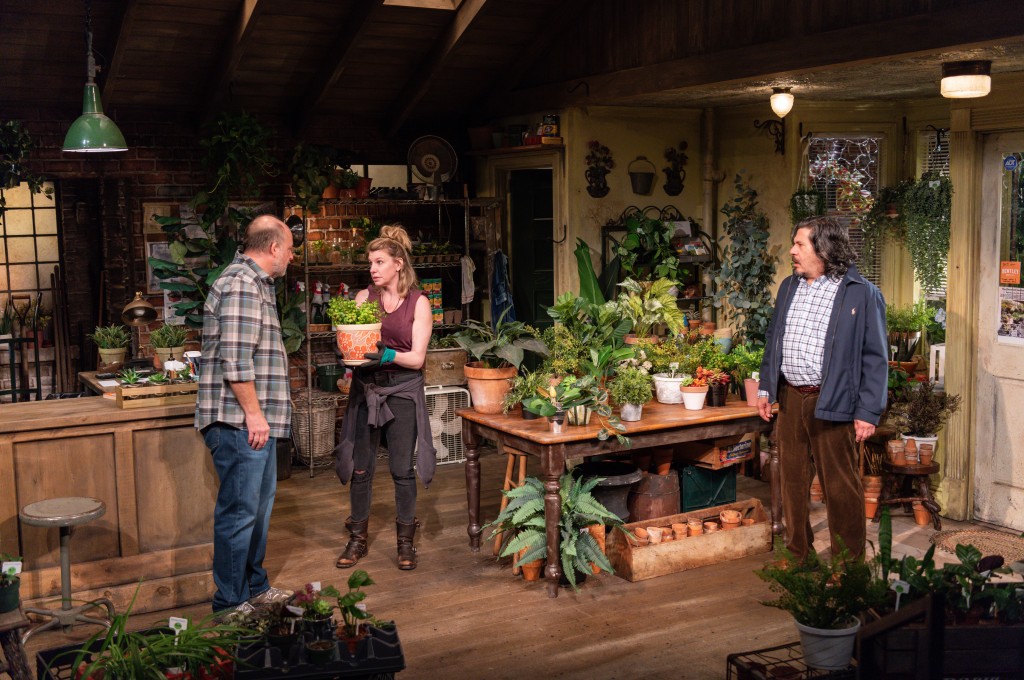
She enjoyed working on Dig, which she also directed and which received wonderful reviews. “I’m so proud of it. It was a good experience.” It is important to Rebeck that the creators have work that they can claim as their own. She enjoys working collaboratively when people are respectful.
Goodman and Rebeck appear to have a shared view of how people negotiate successfully in the “real world.” They negotiate with a sense of morality. Goodman shared the quote which political parties, especially the Trump MAGA Party, eschew as anathema. “If you make the truth your friend, it can’t come and eat you alive.” Rebeck and Goodman agree that a clear, moral point of view in plays, musicals and literature is vital.
Theresa suggested that her alma mater Brandeis University also grounded her toward presenting a clear, moral point of view in her work. She received her three graduate degrees from Brandeis: her MA in English in 1983, a MFA in Playwriting in 1986, and a PhD in Victorian era melodrama in 1989. Fittingly, Rebeck pointed out, that on the seal of Brandeis University are the words, “Truth even unto its innermost parts.” The university president decided to surround the shield on the seal with the quote about truth which is from Psalm 51. Rebeck noted that she recognized the seal on the podium (though it wasn’t clear at that point that it was Brandeis), hearing/seeing a clip of Ken Burns deliver his trenchant Keynote Address to Brandeis University’s 2024 undergraduate class during the 73rd Commencement Exercises. If you haven’t heard any of his speech, you can find it on YouTube. It is definitive and acute.

Rebeck affirms that “writing plays is about people” in the hope to understand “human brilliance and failure.” Of course at times there’s “political content.” However, at the heart it’s about people and human behavior.
In responding to Goodman’s question related to critics, Rebeck agreed that sometimes reviews are devastating and that her husband goes through the process with her. She mentioned that there can be five wonderful or enlightening critiques, and then there is the “crazy” review which is off kilter and seemingly out of nowhere, and people are “foaming at the mouth.” Sometimes, there is that one review while other critics and audiences love the work.
At one point Rebeck thought, “Why do they hate me?” Then, she realized if there’s one outlier, then there isn’t coherence. She mentioned that for a long time people only cared about and quoted the “paper of record.” Of course the irony was that there were many different critics and opinions. The diverse voices and viewpoints are exciting and especially vital for our time. That one opinion held sway and could make or break a play was “damaging to the psyche of the community.” She affirmed, “Now, it’s less dire.”
Rebeck spoke of an incident with a young producer who acted as if there was only one paper that mattered, historically, the “paper of record.” This individual said, based on one review, “Well, the reviews were bad.” Rebeck gave them a reality check. She said that a producer should never act like there is one reviewer who speaks for all critics. To obsess about one review is to bury oneself in negativity and recriminations. She told the producer, “Don’t do that!”
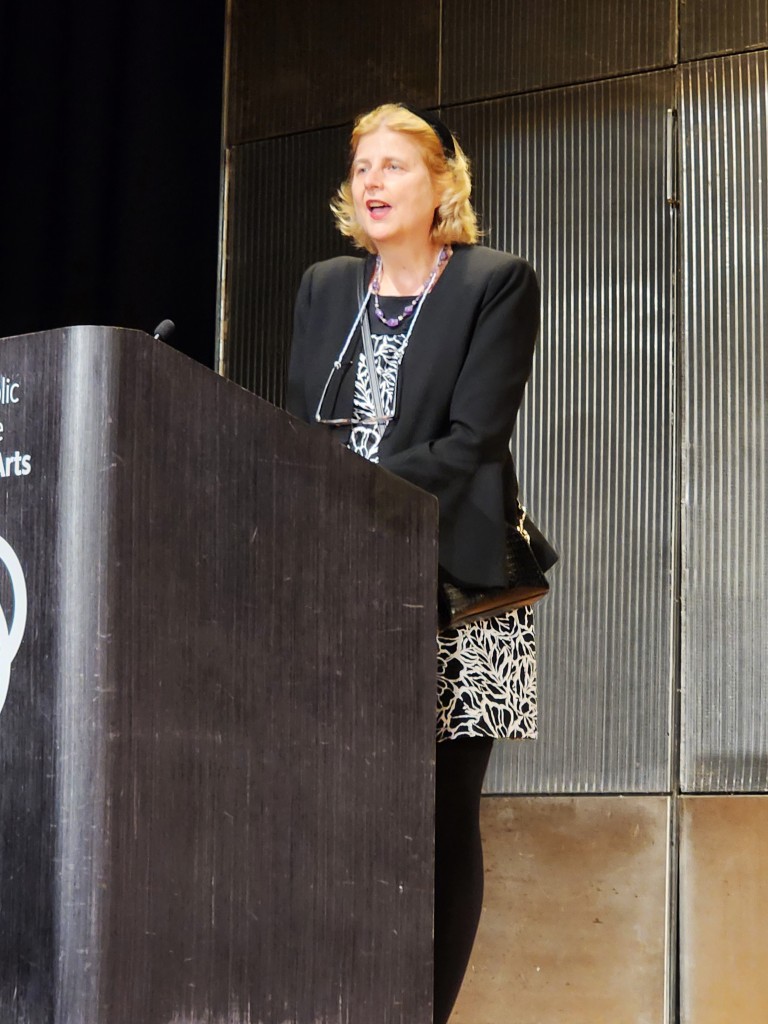
Indeed, Rebeck’s point is well taken. Historically, other critics bought into the prestige factor of “the paper of record,” denigrating their own voices and viewpoints, and bowing to the one review that allegedly spoke for all critics. In this day of book bannings, culture wars and rewriting history, such an approach is tantamount to critics mentally censoring themselves as inferiors. If there is a consensus about a play, that speaks volumes. One “determination” by one critic, regardless of how much he or she is paid, shouldn’t be the “word from on high” that the critics, theater professionals or the public “should” listen to and take to heart.
Rebeck and Goodman are expanding their winning teamwork. They’ve joined together on the musical Working Girl, based on the titular1988 Twentieth Century Fox motion picture written by Kevin Wade. Aimed for Broadway, the musical is presented by special arrangement with Buena Vista Theatrical. Writing the book, Rebeck discussed how she loves working with Tony-winning, composer-lyricist Cyndi Lauper (Kinky Boots), who is writing the score. Tony winner Christopher Ashley (Come From Away) is directing. Producers include Goodman and Josh Fiedler of Aged in Wood Productions, and Kumiko Yoshii.
Rebeck created Smash for NBC and briefly discussed a few highs and lows of working on the showbiz dramatic series. She liked Stephen Spielberg. Since Smash, she has been especially enamored of musical theater. Working Girl is a project that involves collaboration. To have to write a play singularly and then give it to a composer and lyricist is something Rebeck wasn’t interested in doing. She and the team are reimagining and updating the classic. It’s an exciting approach because it also emphasizes women working together and supporting each other on their “climb to the top.” With the political climate as it is, the musical is profoundly important.

One of the themes of the evening was that especially after COVID-19, theater has changed. Theaters around the country are in deep financial trouble. Robyn Goodman suggested that Broadway has gotten out of hand. The business is completely different than what it was two decades ago. Now, to mount a production viably, it costs $25 million dollars. It’s all about the money and finding backers.
As for budding playwrights, Rebeck advised that festivals are a good venue as a place to begin and get noticed. Indeed, 10 minute play festivals allow the creative team to put on “a beautiful event” for little or no money. One can even write a short one-act play and submit it to a one-act play festival. This is a boon for the playwright, who needs to learn how the process works and see the audience’s response to the play. That is an imperative for beginning playwrights.
Rebeck’s plays are published by Smith and Kraus as Theresa Rebeck: Complete Plays, Volumes I, II, III, IV and V. Acting editions are available from Samuel French or Playscripts. For a complete listing of all of her work you can find Theresa Rebeck on her website: https://www.theresarebeck.com/ Robyn Goodman’s website is https://www.agedinwood.com/about
Visit The New York Public Library for the Performing Arts at Lincoln Center, the Library’s TOFT Archive to see the digital recording of the evening. For more information about the TOFT Archives, see this link. https://www.nypl.org/locations/lpa/theatre-film-and-tape-archive To learn more about LPTW, check out their website. https://www.theatrewomen.org/
‘Dig’ by Theresa Rebeck, Caring for Plants and People, Review
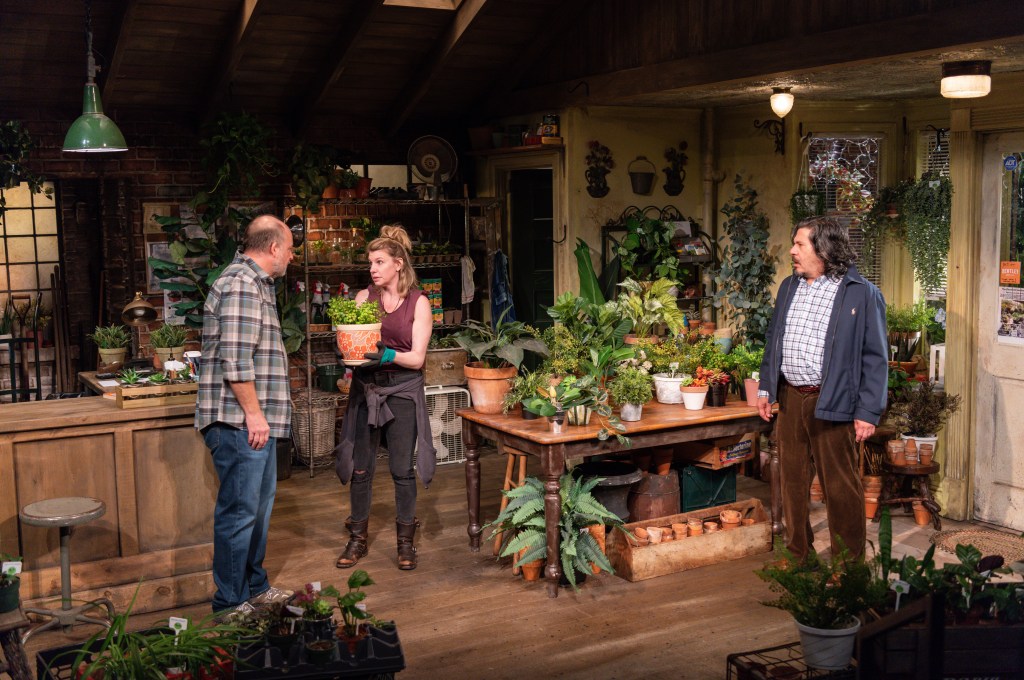
In her comedy/drama Dig Theresa Rebeck (Bernhardt/Hamlet) examines the transformative moments that happen imperceptibly to individuals, when no one is paying attention and they are least expected. With serendipity and the synergy of human need, responsiveness and emotional immediacy, the energy for change becomes the forward momentum of this superb, exceptionally acted and directed production. Rebeck, wearing two hats as director and writer, effects a powerful character dynamic in the play, which first premiered at the Dorset Theatre Festival in Vermont, and is now enjoying its New York City Off- Broadway premiere at Primary Stages, 59E59 Theaters.
With striking characters that Rebeck displays in their quirky, raw humanity, gradually stripped away to their bloody core in an identifiable, magical coalescence, the themes of hope and resurgence are unveiled. That this happens in a small town which is imploding for want of commercial viability, and to an insular shop owner in need of a personal revolution, is all the more engaging.
Importantly, in Dig, Rebeck prods us to recall verities of redemption and reconciliation, which abide in all of our lives. Second chances are possible, regardless of how dire or malevolent the circumstances appear in the lives of the damaged, lost and hurting.

The setting for hope and transformation is fitting. It is the plant shop, “Dig,” where set designers Christoper Swader and Justin Swader have done a magnificent job in displaying wall to wall greenery, and later, as the characters spark to life and regeneration, floral beauty. Roger is the reticent, thoughtful owner who has created “Dig.” He controls his singular botanical world, is knowledgeable about plants, and is an amateur botanist who has a “knack” with encouraging dying plants back to life. Healthy and unhealthy plants are a perfect metaphor for the human condition, and Rebeck with tongue-in-cheek amply uses this metaphor selectively and profoundly.
The playwright initiates this metaphor and other concepts in the opening scene between Roger (Jeffrey Bean in a brilliant, nuanced performance), and his longtime friend, Lou (Triney Sandoval effectively portrays his feisty and catalytic counterpart). Lou has abused a plant Roger gave him with the unwitting behavior of a plant neophyte. He’s underwatered and overwatered the “elephant ears” to it’s last “breath.” As Roger chides him like a school teacher, Rebeck’s humor gains traction. Immediately we understand the relationship between Lou and Roger and the otherworldly importance plants have in Roger’s life. After scolding Lou, he assures him that he will salvage the dying plant. Lou is relieved.

The action redirects when Lou’s daughter Megan (the terrific Andrea Syglowski), speaks up in defense of Roger about the money he gave Everett (Greg Keller in a humorous, off-beat turn) to buy them coffees. Megan, who has quietly disappeared into the background, sitting near the door, is barely noticeable because of her withdrawn posture. Additionally, she is overshadowed by the lively, antic banter between Lou and Roger. Clearly, there are undercurrents in Lou’s neglect of the plant and Roger’s gentle upbraiding. Concurrently, Lou’s suspicion of Everett, Roger’s truck driver, who Lou says smokes pot, is a criticism which chafes Roger.
Lou’s neglectful plant care and his guilty response have more meaning we discover later, when the parallels between caring for plants and caring for human beings comes to the fore. Likewise, Roger’s permissiveness with Everett comes back to “hit him in the face” like a bad karma rash.

In this initial exchange Rebeck has laid the foundation for the interactions among Roger, Lou, Megan, Everett, and Molly (the fine Mary Bacon), who drops in a bit later looking for tulip bulbs. Like strategically placed dominoes that topple and swerve around corners, do complicated gyrations and elaborate tricks, the characters’ knock and shuffle against each other with various encounters, emotional explosions, jealousies and eventual quietude, which Rebeck brings to a poignant and satisfying conclusion at the end of the two hours and one intermission.
How she effects this character sleight of hand, under-girded by the superb actors, leaves the audience feeling they’ve experienced a series of events with surprisingly disparate individuals who, are somehow similar. Each attempts to affirm their identity and place in a life that may or may not have meaning for them, save Roger who is perhaps ahead of the others in finding his place, though the town is dying like a poorly cared for plant. Into this mirror of humanity, we note the pain and struggle of finding a way to understand others, when not all of their truth has been revealed.

Megan, fresh out of prison and rehab is living with Lou, her adoptive father, who has taken care of her for her entire life. She lives with him because she has no money and nowhere else to go. She is responsible for an accident during which she killed her son through negligence. Confused, filled with guilt, Megan tried to end her own life and failed.
This backstory is revealed gradually by discovery through the comments the other characters make about Megan when she isn’t in their presence. Rebeck’s skill in disclosing who Megan and her father are, their close relationship, and the town’s response to Megan’s responsibility in the accidental death of her son, is effected with power and realism. It is a sad tale that has hushed up the community and left Megan with few friends except for the comfort of her father, her trying, martinet-like AA group, and Roger, Lou’s best friend.
Apprised of Megan’s story, Roger is tentative and gentle with her. But he is bewildered when Megan screams at a customer for being nosy about recognizing her (most probably in the news reports on TV). In a follow up of her anger, Megan curses Everett and forces her father to leave before they’ve enjoyed their coffees. Her fury is shocking, however Roger takes it in his stride and defends her against gossip which Everett repeats. It is in Roger’s and Everett’s discussion we learn the way which Megan accidentally caused her son’s terrible death.

In this pivotal scene the stakes are unveiled and Megan’s volatile, unbalanced personality which Lou has confided to Roger places her on a knife’s edge. However, Megan returns the next day to apologize to Roger and is manipulative in wanting to ingratiate herself with him for a job. Interestingly, the job would make her feel useful; she does not want to be paid. And though Roger says he needs no one and rejects her, she pushes her way in, immediately demonstrating her usefulness by potting a plant, Perhaps, she can make a difference in the shop, can stabilize her life and reinvigorate Roger’s life as well.
In her actions, we are watching Megan throw herself a lifeline. Drawn to something in Roger’s nature, perhaps his empathy and his incredible weirdness in caring for his plants and in setting up his environment which is soothing and peaceful, she attempts to try something different.

That Roger allows her into his life to “disturb his peace,” and assist him for no pay, is something that Lou objects to out of fear for his friend. He knows her unreliability and feels guilt for Megan’s causing the accident. Furthermore, with her alcoholism, unless controlled, she can “fly off the handle” and explode into a frenzy.
In a protective mode, Roger recognizes that she is willing to change and work toward improving herself with her apology. It is unmistakable that she took responsibility for acting improperly. Her humility to change is again affirmed for Roger when Molly comes into the store and Megan apologizes to Molly and accepts Molly’s invitation to a prayer meeting at church.
In Act II “all’s well that ends well,” until it isn’t. By that point the shop is blooming with lovely flowers and Roger has fired Everett for his pot smoking antics in the truck and his disrespectful, judgmental attitude about Megan. In an argument which Roger won, Roger suggests his critical attitude toward Megan is unfair because the details surrounding her son’s death were uncertain. Roger has feelings for Megan. And though she senses it and tries to advance their relationship beyond friendship, we learn that Roger has spurned her attentions.

It is in this act when her former husband Adam ((David Mason’s portrayal is potent and searing), tracks her down to to confront her about their son’s death. Once again, Roger defends her. However she stops him and forces him to leave so she can hash out the issues with Adam. This revelatory scene is another turning point where we understand their relationship in an explosion that Roger cannot mitigate or influence. It is up to Megan to deal with the shreds of her life that remain, with the only intervention that might heal her-Roger and the plant store-which she has influenced and helped to make thrive in the fading town. But there are obstacles. Everett resents her taking his place. And in an underhanded, slick seduction, his actions influence her to leave so he can get back into Roger’s good graces.
Rebeck and her cast and creatives have put together a smashing work whose honesty and power is breathtaking. DIG is a refreshing, bold, funny and poignant production which defies easy definition.
In magnifying Rebeck’s vision, the superb design team worked overtime. They include Christopher Swader and Justin Swader (scenic design), Fabian Fidel Aguilar (costumes), Mary Ellen Stebbins’ atmospheric, mood-suggesting lighting design and Fitz Patton’s original music and and sound design. These creatives give the production the medium which allows the actors to seamlessly move and inhabit their characters with humor and probity.
DIG is memorable and metaphoric and profound. In a limited engagement until October 22nd, it is not to be missed. For tickets and times go to their website https://primarystages.org/shows/current-season/dig/
 CAROLE DI TOSTI