Blog Archives
‘Wet Brain’ by John J. Caswell, Jr., a Review

A family in crisis with no way out except love and forgiveness, is the focal point of the play Wet Brain by John J. Caswell, Jr. Directed by Dustin Wills (award-winning director of Wolf Play) the drama is presented by Playwrights Horizons and MCC Theater until June 25. The production reveals the knotty human condition in all its raw, ugly, ironic and humorous digressions, as siblings attempt to confront their father’s alcoholic illness and cope with the intense stress each experiences related to the situation as they interact with each other.
Wet Brain is the vernacular for Wernicke-Korsakoff syndrome (WKS). WKS occurs when alcoholism strips the body of necessary nutrients, vitamins and enzymes as the alcoholic depletes himself of food in exchange for his preferred “liquid diet.” The brain disorder is caused by chronic vitamin B1 (thiamine) deficiency found in those whose long-term, heavy drinking has ravaged their bodies and minds beyond repair, until death comes to “heal” them.

At the top of the play brother Ricky (the fine Arturo Luis Soria) returns home after a number of years to help sister Angelina (Ceci Fernandez) and brother Ron (Frankie J. Alvarez) find the proper way to care for their father Joe (Julio Monge). In this highly pressurized situation the siblings, who carp and criticize each other, must determine the best path for their father’s last months on the planet. This is a tall order. Joe is in and out of reality and takes heart from his “outer-space” fantasies.
He hallucinates? Because reality is so dire, Joe has found an escape route in his imagination. If he can only acculturate his children to his softer way of imagining, perhaps this will foster understanding. Maybe, but Joe is barely speaking and he belongs in an assisted living center with a memory care unit. However, Joe isn’t even on Social Security Disability and he allowed his medical insurance to lapse. Regardless, they can’t afford such a high end place. It is better if he stays at home and they have help come in.

Joe’s lack of balance makes him susceptible to falls. He walks with a severely disabled gait and ends up on the floor part of the time he is with them. He has a hard time keeping down food and vomits. His speech is garbled, though at times he is sentient and recognizes his children if he isn’t on a space fantasy. Among his other handicapping conditions, he soils himself at times and the cleanliness of his home and person is approaching nil. However, he manages to function in keeping himself close to his old friend vodka, which he stashes in Dasani bottles to “get over” on no one except himself.
Angie, who has been living with him can no longer cope with caring for him, keeping the house clean and studying for coursework to become a nurse. Thus, she calls Ricky who hasn’t seen her, his father and Ron for years. It is not a happy homecoming for Ricky or his siblings.
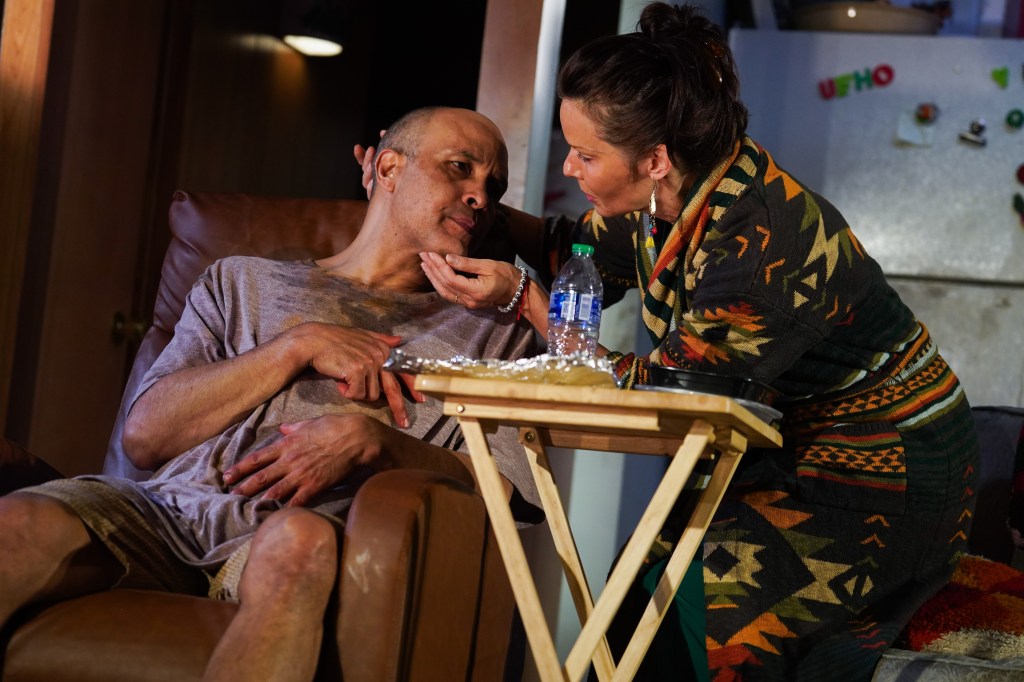
Of the three children, Ricky, who is gay, appears the most humane and empathetic, though Angie has been the stalwart, engaged member of the family, living with her father which she finally admits is beyond her. As the siblings resolve the situation, we understand the nuances of the dynamic that drove Ricky away from a home that was unaccepting and abusive because he is gay. Both Ron and Joe, who are close and worked together in their family business, found Ricky’s homosexuality loathsome. Nevertheless, Ricky has an MBA and has made something of himself. It is his presence that is the catalyst to finalize Joe’s care.
Casewell, Jr.’s drama with sardonic elements is approachable, if one enjoys insult comedy. The siblings shred each other, especially at the top of the play and reveal the horrific abuse they most probably experienced growing up, for they dish it out to each other. They communicate, not necessarily to be heard or understood, but talk at each other. Nor do they easily understand what each other has been going through. Instead, they are reactive and defensive and childish. Both Angie and Ron, themselves are psychologically, emotionally and physically damaged. Staying in the area where they grew up has not been a healthful choice.

How do the debilitated judgmental take care of each other and an acutely disabled father, living with the knowledge that their mother hanged herself because of her own mental illness? They lean on the one who had the perspicacity to leave the toxic environment and become moderately successful and accepting and loving of himself.
The most interesting section of the production occurs during Joe’s “outer-space sequence,” terrifically designed by Kate Noll (scenic design) with the help of Cha See’s lighting design, Nick Hussong’s projection design and Tei Blow and John Gasper’s sound design. The segment is highly symbolic and metaphoric.

During the scene, the siblings, Joe and their mother Mona interact and have a “heart-to-heart.” Mona, who returns as a ghost or another configuration of Joe’s space-time warp, initially hangs in the middle of her brood, and husband. All are able to communicate with each other clearly and soundly. In this sequence, the actors seemed most comfortable in the skins of their characters. They listened to each other with authenticity. The section is so striking in its coherence, the other sections of the play which relay the background exposition seem insignificant by comparison. The fantastic scenes of Joe’s imagination hold more theatricality and drama, thanks to the creative team and direction, then the scenes between the siblings. Importantly Joe’s fantastic reverie is the turning point, after which the characters become more human.
At the conclusion, when Ricky leaves, we note that the house is in order and a caretaker, Crystal (Florencia Lozano also plays Mona), stays with Joe to watch over him. In his imagination, Mona has returned to him for in the final scene, the caretaker moves close to Joe, almost as if they are about to kiss. Indeed, the development moves from the chaos at the top of the play, where we don’t very much like these siblings, to a peaceful resolution. During the play’s development, all have become more loving and accepting, stirred by the experiences with their father and each other. To bring about a resolution for him, they focused on one goal: to have their father cared for in his own home. The ending is uncertain, yet satisfying and filled with hope.

Dustin Wills’ shepherding of his creatives makes the theatrical and technical aspects of the production shine. The designs are coherent standouts that adhere with Will’s vision, from the complexity of the house and its props, to the sometimes sinister trees dwarfing the home, especially when Cha See eerily lights them. The revolving platform upon which the house is built shifts seamlessly and reflects the changes in the relationships among the siblings and their father.
The grinding sounds, the strange twists of darkness and sharp contrasts with light suggest the alternating states of consciousness in Joe’s mind and in the comprehension of the siblings. The irony is that with Joe, it is easy to understand that his condition has impacted his state of consciousness and his apprehension of reality. More subtle is how the siblings are also impacted by Joe’s perspective, most of all Ron, who is closest to him.
Wills’ direction brings Caswell, Jr.’s play to life as the actors nuance their characters. This is one to see if dysfunctional families and interesting characterizations are on your radar. What lifts the character dynamics from the boring repetition of victimization, blame and ranting and makes them interesting is how Wills and Caswell, Jr. integrate Joe’s hallucinations into a reality that is a soothing “what if” at the play’s high point. That it symbolizes a modicum of love and forgiveness is important. If the interrelationships declined, the play would have devolved into unsatisfying melodrama.
For tickets and times to Wet Brain which has no intermission, go to their website https://www.playwrightshorizons.org/shows/plays/wet-brain/
 CAROLE DI TOSTI