Blog Archives
‘The Ally,’ Terrific Performances of a Trenchant Play at the Public
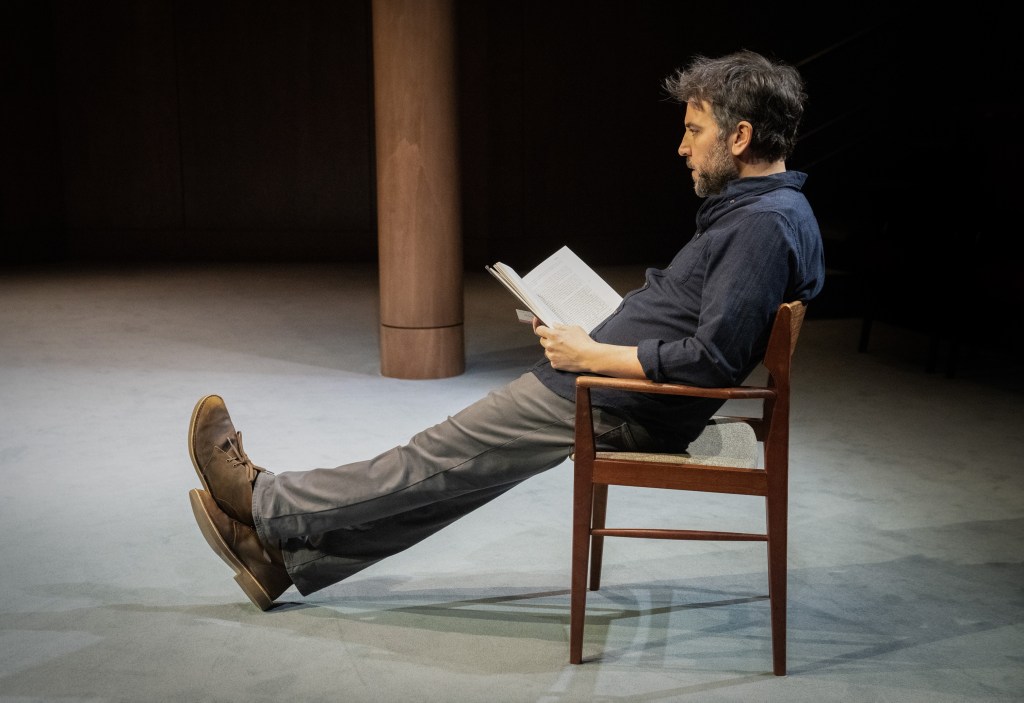
The Ally, written by Itamar Moses (The Band’s Visit), and directed by Lila Neugebauer (The Waverly Gallery), currently runs in a World Premiere at the Public Theater until March 24th. Moses’ two act play that is largely polemical raises important and controversial questions in its two hours and thirty-five minutes. It is thought-provoking, historically informative and profound, and has great currency in light of the Netanyahu government’s war against Hamas. Though the play was written before the October 7th attack, the issues couldn’t be more on-point.
The Ally is short on dramatic tension, and long on terrific performances. The exceptional actors passionately argue about Black and Brown people struggling to achieve human rights in countries (Israel, the United States, etc.), which have their foundations in oppressive, white, patriarchal colonialism. Though the prejudices and discrimination have been called out and strides have been made, often the countries obfuscate justice, and in defensive mode, redirect their institutions, practices and social constructs away from equanimity, foregoing humanity, compassion and empathy to abuse those they subjugate.
To present the arguments and make a case with little resolution, Neugebauer’s vision offers a spare stage and few props to evoke the setting in a professor’s home and office on a University campus which represents a bastion of learning, where allegedly every viewpoint may be expressed without censure, to promote enlightened civil discourse and benefit the social good of the community. Moses’ protagonist on the field of intellectual battle is liberal Jewish professor Asaf (the excellent Josh Radnor).
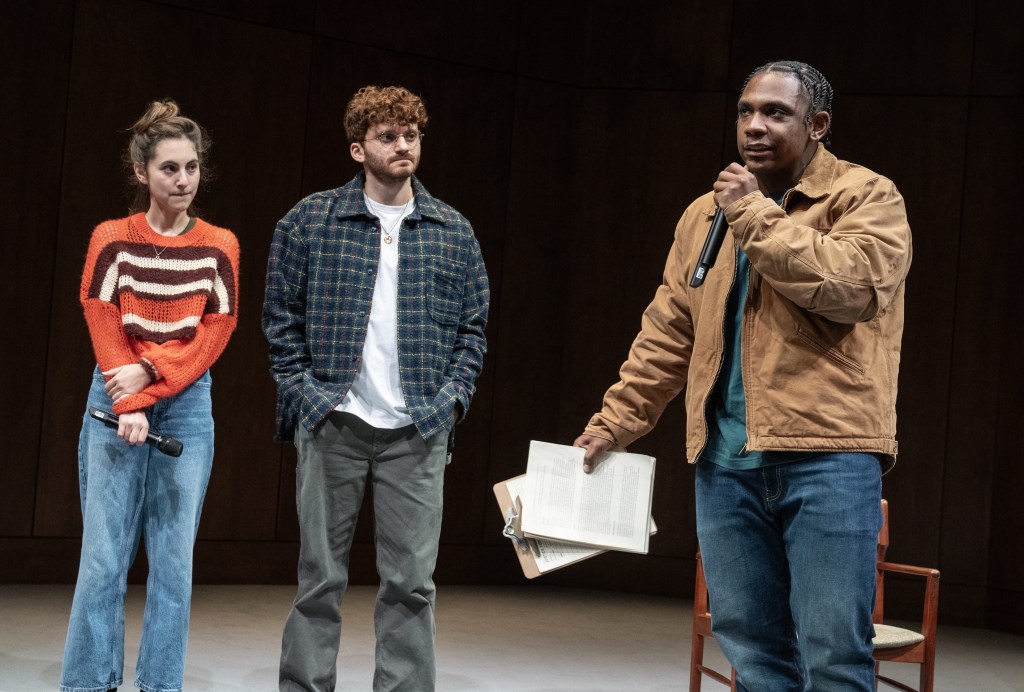
Asaf’s Korean-American wife Gwen (Joy Osmanski), has been hired to give a positive spin on land the University is developing that was formerly used for housing in a lower middle class, Black area. The land has been appropriated, though the University has assured that it will provide housing units to compensate for the dwellings that have been demolished. How the situation evolved, we discover later, is fraught with rumors about underhanded tactics the University used to create circumstances beneficial to University expansion, while dismissing the interests of the Black community.

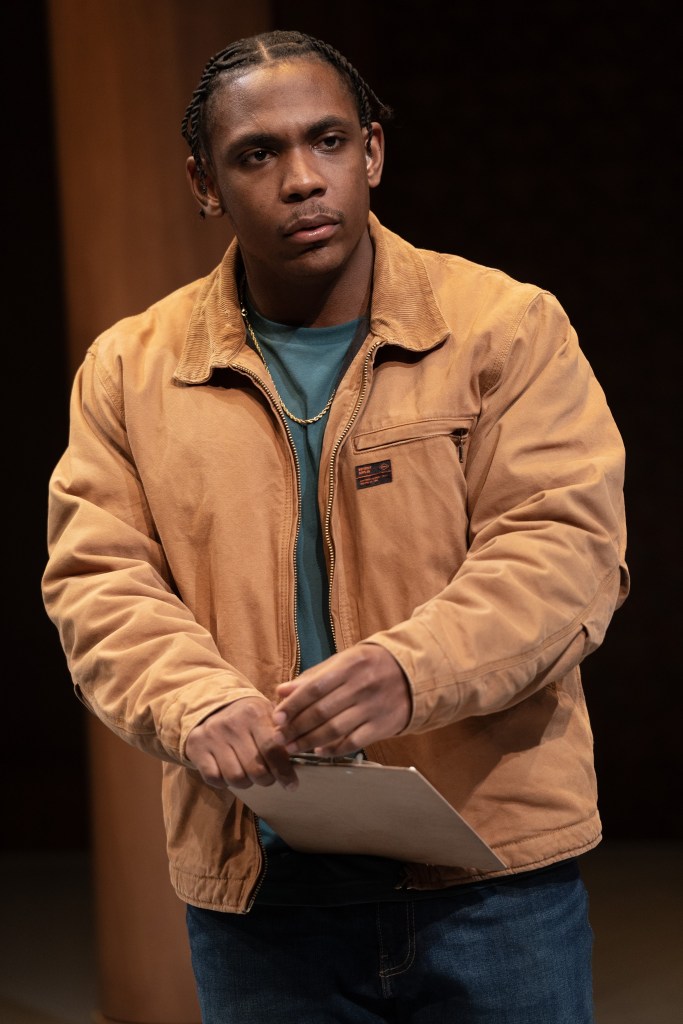
The main conflict begins when Asaf’s former student Baron (Elijah Jones), who is Black, feels encouraged asking Asaf to sign a social justice manifesto that involves his cousin Deronte, who was killed by police unjustly for a theft Deronte didn’t commit. After agreeing to sign once he looks over the twenty-page manifesto, Asaf realizes that the documented is personally sensitive to him in what it demands.
First, it aligns the history of violence against Black Americans to the violence against oppressed Black and Brown people who have been colonized globally and suffer under inhuman conditions. Additionally, the manifesto targets a controversial subject for Asaf, an American, who doesn’t identify culturally with Israel, though he was born there. The manifesto demands that sanctions be placed on Israel for its nihilistic treatment of Palestinians, resulting in an apartheid state. In clear terms it pronounces that a “failure to do so will leave the United States complicit in the ongoing genocide of the Palestinian people.”
Though he is Jewish, essentially, Asaf is an atheist. But he thoughtfully considers what he is signing, and questions the words “apartheid” and “genocide” as extreme, unrelated positions, though he feels that Baron’s cause is just. Helping support Baron holds no contentions for him, initially. The apparent police brutality in killing Deronte is one more example of murderous racism and the blue wall of silence that fronts against such horrific injustice in a country with a long history of slavery and oppression of Black and Brown peoples.

Gwen tells Asaf’ that his signing the manifesto will undergird her position as a university administrator pushing for expansive development of university housing into the Black community. If he refuses to support Baron it will appear that he cannot align with fighting injustice and it most probably will add to the negative spin already brewing about the expansion project which the Black community is resisting.
It is after Asaf signs the manifesto that problems arise which disastrously make him the “man in the middle” among activist organizations with conflicting agendas which demand that he support and be an “ally” with their specific causes and positions. The situation embroils him deeper in conflict with his conscience and beliefs and forces him to deeply question allegiances he would forge with others on campus, impacting his reputation.
Two organizations confront him after he signs Baron’s manifesto. Jewish representative (Madeline Weinstein), and Palestinian representative (Michael Khalid Karadsheh), ask Asaf to support their bringing a controversial speaker to campus. They tell him that the speaker argues for a revisionist history of Israel’s foundational and follow-up wars. Contrary to the standard view that Israel was defending itself, the speaker posits that the wars were fought ferociously for one reason: “the likely outcome was more territory.”
To his credit to give all opinions a place in civil discourse, Asaf discusses the nature of the support they want, but questions why they want this particular speaker. Additionally, with a follow-up which indicates that activist organizations are noting who is importuning Asaf, another oppositional individual shows up to challenge Asaf. Reuven Fisher (Ben Rosenfield), a religious Jewish graduate student attacks Asaf’s arguments and the others that we’ve previously heard. Fisher defends Israel ‘s position with the Palestinians.
Interspersed among those who have backed Asaf into a corner, Nakia Clark (Cherise Boothe), confronts him about his questioning the fact that Israel is the one expected to ameliorate its position and is always used as a “whipping boy,” when it is the only place historically where Jews can find safe on their home turf.
As we listen to their wrangling, we take into account that Nakia and Asaf have history together. Once a couple who dated, Nakia shepherded Asaf in community social justice, inspiring him to go with her on marches, and schooling him in protest as she strengthened her role as a Black community organizer. Now, years later, she challenges him once more to step up and not renege on his support of the manifesto which Nakia, herself, wrote.

Where is Asaf’s place in these arguments when the university community knows the stand he wished to take that he now equivocates about taking? Moses uses the character of Asaf as a canvas upon which to project all the viewpoints in the arguments about Israel, Palestine, Black discrimination and colonial oppression. The playwright proves knowledgeable and informative, especially in recounting the conflicts in the history of Israel starting from its inception in 1948 and its wars against the PLO and the complicated rise of Hamas which didn’t happen in a vacuum but was allowed by an extremist government to its own benefit, not necessarily to create equity and harmony with the Christians, Jews and Muslims who make Israel their home.
However, as has occurred since divisions created an untenable situation between Zionists, Palestinians, Muslims, Christians and Jews when Israel was formed in 1948 and worsened up to the present war in Gaza, there is only the horrific struggle. Moses indicates the lessons in why with his exploration of the reasons in The Ally. Thus, how can there be a positive resolution in this work? All is uncertain, with even more passionate feelings on all sides we’ve heard presented.
And of course, Asaf now has issues with each of the groups because of his lack of certainty; thus, his reputation has received a hit. Even Gwen is annoyed that his equivocation has bounced back to impact her project. Only more questions remain.

However, Moses and Neugebauer have pulled a rabbit out of a hat with this production which focuses the audience on the arguments which make them understandable and relatable, especially because the ensemble is just brilliant. Importantly, we have been shown the intricacies of intense debate which, if continued will eventually lead to the possibility of a positive resolution. Thus, we are left with the feeling that there must be an open dialogue during which responsible individuals listen to each other and again and again hash out some consensus, as impossible as that seems..
This is one to see because of its overall coherence, incredible performances and fine direction. Neugebauer stages the debate amongst the stakeholders, so we thrillingly follow every word. Could there have been edits? Perhaps. However, Moses has built solidly and any removal of the bricks in his structure will lessen the impact overall.
Kudos to the creative team who effect the director and playwright’s vision. These include Lael Jellinek (scenic design), Sarita Fellows (costume design) Reza Behjat (lighting design) Bray Poor (sound design).
The Ally runs 2 hours 35 minutes at the Public until March 24th. https://publictheater.org/productions/season/2324/the-ally/
 CAROLE DI TOSTI