Blog Archives
‘Manahatta,’ Another View of The Lenape at the Public

In Manahatta, written by Mary Kathryn Nagle and directed by Laurie Woolery, the myth of how Manhattan was purchased from the Lenape, and how the exploitation of Indigenous Peoples continues today, conjoins in a powerful message. Nagle’s play, currently at the Public, is more symbolically realized than factual. The playwright admits that the work, though based on true events, is a work of fiction. Nagle researched and conducted interviews with the Lenape and those of the Delaware Nation. What resulted, after workshopping, and full presentations at Oregon Shakespeare Festival and Yale Rep, is an enlightened work whose themes weave from past to present, reflecting issues of our time.
The play opens with Jane (Elizabeth Frances), being interviewed by Joe (Joe Tapper), who would be her boss at an investment bank in the heart of Wall Street. The investment bank is less than a mile from Pearl Street, named for the huge mound of shells the Lenape left after they had been forcefully expelled from their Northeastern homelands to eventually end up in Oklahoma. Jane, a Lenape, who excelled in financial math and was number one in her class at MIT and Stanford, is hired after she reveals to her boss that interviewing for the job was more important than staying with her family, while her dad received open heart surgery.

Jane tells Joe that she didn’t go to Stanford because her parents, who never graduated from high school told her to, like the other privileged, bored, uninterested students she competed against. She went there because she “knocked down every obstacle they placed in my way.”
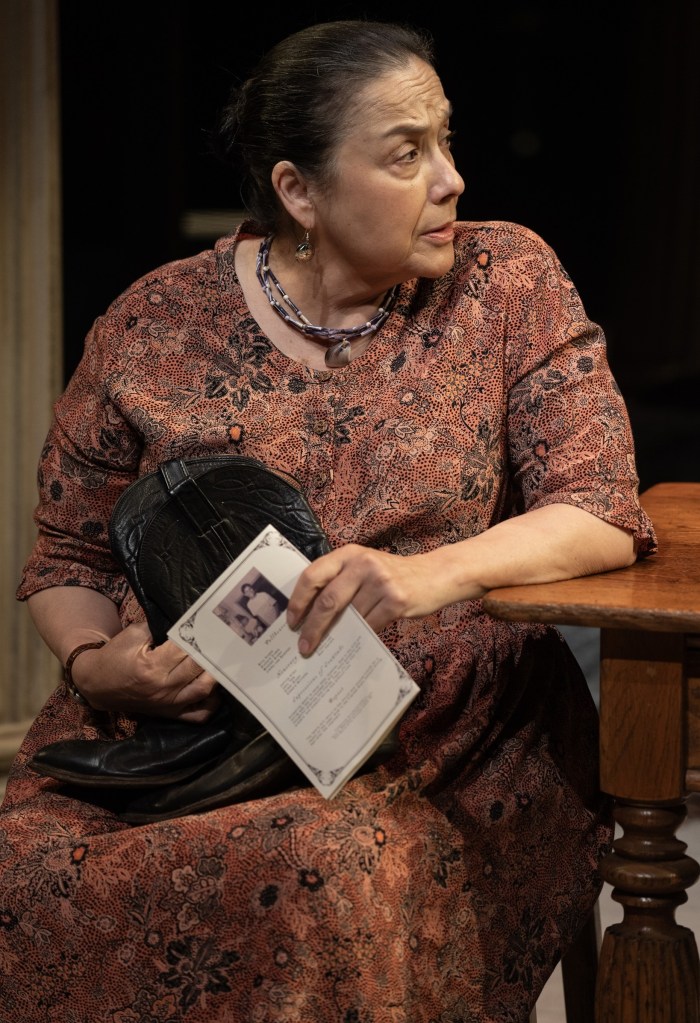
Clearly, Jane is determined, intelligent and the first Indigenous Person hired on Wall Street to return to a place of great symbolism, the home from which her tribe originated. When she returns to Oklahoma, she returns to her father’s funeral, and her sister Debra’s (Rainbow Dickerson) recriminations that she left her family and her tribe for a life in the concrete jungle, “without trees or a sky.” Her mother, Bobbie (Sheila Tousey is terrific as the stoic, ironic matriarch), asks her to find the wampum necklace she will wear at the funeral, a Lenape ritual, which Debra eventually finds because Jane is clueless, not having lived with Bobbie for years.
Significantly, the wampum has been carried down from generations of ancestors and is the most valuable treasure Bobbie owns. Nagle uses the wampum as a symbol of the strength, perseverance and inner fortitude of the Lenape, that abides throughout time, disasters and oppressions by others.
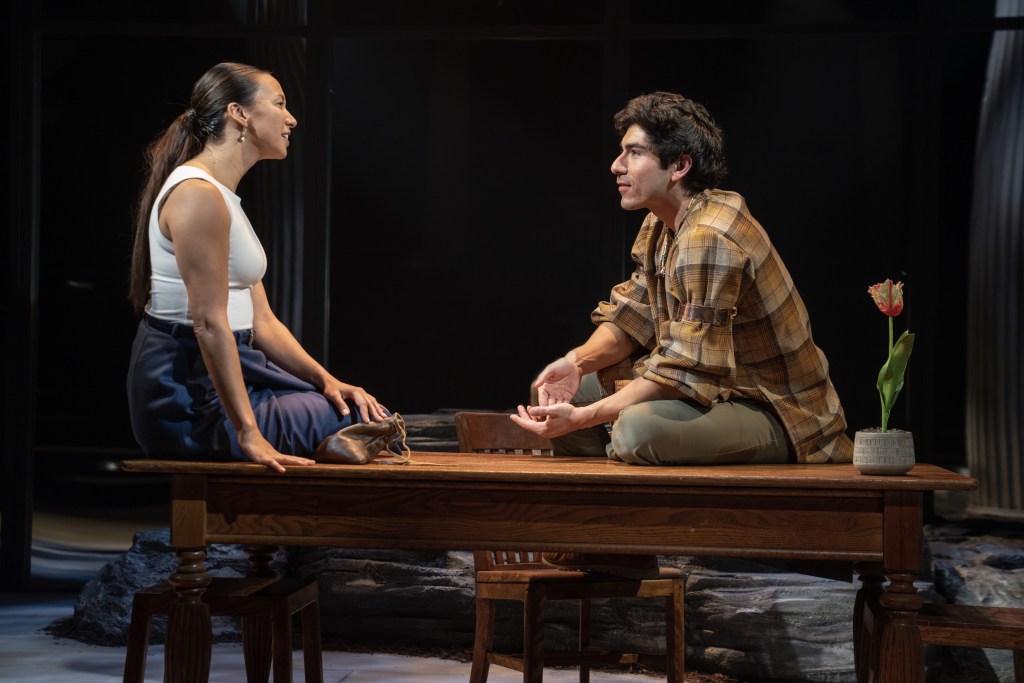
After the funeral, Bobbie engages in a conversation with Michael (Rex Young the evening I saw it), the pastor of the church where Bobbie’s husband sang in the choir. During her conversation with Michael, Bobbie discusses that the Indian Health Service, a government agency responsible for providing health services to Native peoples, refused to pay for the open heart surgery. Bobbie elicits Michael’s help as a loan officer to take out a mortgage on her house to pay for the hospital bills. Not wanting to tell her daughters, she works with Michael and his son Luke (Enrico Nassi), who understands the problem and eventually Michael provides the loan at a high interest rate so she can pay off the hospital bills.
Using seven actors to double on their counterpart roles, Nagle creates a parallel plot point. The setting reverts to 17th-century Manahatta. Se-ket-tu-may-qua (Enrico Nassi), and a Lenape woman, Le-le-wa’-you (Elizabeth Frances), prepare beaver pelts for the Dutch West India Company traders with whom they make trades for wampum. Se-ket-tu-may-qua warns Le-le-wa’-you that she shouldn’t go to the market, even though she wishes to learn the language the Dutch speak. He tells her that he has seen cruel behaviors the men do to Lenape women and suggests they are dangerous. When Peter Minuit (Jeffrey King), realizes the value of the beaver pelts to Amsterdam, he greedily makes deals with Se-ket-tu-may-qua and Le-le-wa’-you for more and more pelts.

Jane’s story unfolds on Wall Street as she begins to realize the mortgage backed securities her team is selling aren’t worth the paper they’re printed on. Though she questions their value, company CEO Dick (Jeffrey King), validates their ratings and justifies the company’s rising stock prices. He also suggests that unless she becomes a real team player, closing many more deals, he will fire her. Jane pulls out a coup, though she must lie to do it. She saves her job, even getting a promotion. Parallel to this action, Bobbie is not making the payments on her mortgage, which ironically is like one of the bad mortgages bundled up into credit default swaps that are worthless, yet are being sold by the Jane’s company and Jane’s team as a great investment.
In the parallel with the past where the notion of money and commercialism was planted like diseased corn in the fields of the Indigenous Peoples to infect their good crops, Peter Minuit (over an alcoholic beverage he shares), strikes a deal with the Lenape and Mother (Sheila Tousey), for the land of Manahatta. Mother, not understanding the concept of ownership of land “in perpetuity,” ends up “selling” Manahatta to Minuit for wampum. This is interpreted as being a gift, making Minuit a part of their family and vice versa. That they are now family members is an incredible irony, for the Dutch with bad will interpret it to mean they have the license to destroy “their Native kin” through assimilation and/or murder if they resist.

With this purchase, Nagle presents the unfortunate fact that the Dutch have insinuated their corrupt and rapacious values into the Lenape culture, eventually overcoming it. Meanwhile, Lenape culture doesn’t have in it such a conceptualization of possession of land, animals, etc. but instead has a view of balance and propriety. Such corrupt transactions symbolically are at the heart of the abuse and recklessness that colonial empires have wielded on Native peoples and the flora and fauna of their lands that they eventually steal outright. The disdainful theft of lands in empire building is a destructive, wicked force that has led to erecting questionable societies that are life defying and earth destroying. Sometimes, little thought is given to the consequences of such tearing down and building.
It is no small irony that the derelict disregard and wastefulness that rapacious possession has perpetrated has as its end game climate change, pollution, and destruction of the very environment possessors and oppressors would call “home.”

After the sale, the Dutch take greater and greater control over the identities and self-determination of the Lenape. They attempt to spread Christianity, demand the Lenape pay a tax to sell the beaver pelts on “Dutch land,” and only pay guilders for the pelts. In this, the playwright foreshadows the downward spiral toward full on oppression and death, as the colonials attempt to wipe out their “sin” by eradicating the cultures of the Native peoples in an explosion of barbarism, greed, corruption and genocide. As Nagle moves the action from Bobbie to the Dutch to Jane we note how the present is mirrored in the past.
In the remaining parallel segments, we see the ill effects of the mortgage debacle visited on Bobbie and others like her, who can’t keep up with the mortgage payments and must default. When Jane offers to pay off her mother’s mortgage, Bobbie refuses the money, standing on her pride and her ancestry. In a heartfelt, beautifully delivered speech Tousey’s Bobbie affirms to her two daughters that material things are worthless, and that she relies on the resilience and strength of her ancestors to withstand any hardships put before them. In keeping the ancestral wampum, she has been sustained and grounded in the true value of life and the sanctity of her culture.

Ironically, this spiritual grounding is something the Dutch and all empire builders do not have and will never understand, appreciate, nor pursue. Ultimately, this blindness works like karma and turns empire builders against themselves so that they ultimately destroy their own empires.
Nagle reflects this truism in the circumstances with Jane. Ironically, Jane who has earned a bonus of $1 million dollars for making an incredible sale, is the only one in the company who actually moves to a better position, while Dick (Dick Fuld of Lehman Brothers), cannot stop the short selling against the firm whose stock price crashes so Lehman goes belly up. Jane, who foresaw what might happen and tried to warn her bosses, learns that the bad faith represented by the credit default swaps of subprime mortgages has created a global financial debacle. However, Dick tells Jane she is in great shape and will be recruited while his career is over, and he will most likely be sued.

At the conclusion Jane affirms her identity as a Lenape, who has returned home to Manahatta, victorious, overcoming the conquerors with the hope that perhaps she can change things. Meanwhile, her mother and sister have joined the homeless populations, and with their few possessions they will carry on and survive, despite the horrific circumstances the blind, derelict empire builders have created.
Nagles’ Manahatta builds toward a satisfying and poignant conclusion because of the efforts of the director and the fine ensemble. As she embodies the past in the present, we recognize the ironic reversal of karmic fortune. Jane triumphs as a woman and Lenape, after besting the colonials at their own game. That she hopes to bring change is questionable. Meanwhile, Bobbie’s values are eternal and overcoming. It is her story that is one of honor and greatness. It suggests immutable truths that affirm the inevitable destruction of empires and those who build them, devoured by their own evil.
The ensemble works seamlessly together and the tension builds so that Nagle’s themes about virtue, honor and the immutability of innocence and goodness are unmistakable against a backdrop of the oppressions of greed that destroy those who allow it to overtake them. Indeed, Nagle affirms the truism that the love of money is the root of all evil.
Kudos to the creative team that help to bring together the director’s vision for this sterling production. Manahatta is at the Public Theater on Lafayette Street downtown. https://publictheater.org/productions/season/2324/manahatta/
 CAROLE DI TOSTI