Blog Archives

Jonathan Groff is Phenomenal in ‘Just in Time’

Oftentimes, singers have the gift of reconstituting songs and making them iconic, then become celebrated for doing it. One example is Bobby Darin (1936-1973), who took the droll, sluggish “Mack the Knife” from Kurt Weill’s Three Penny Opera, and with a jazzy, upbeat swing, gave it a reverential life of its own. A singer, songwriter, and actor, Darin ambitiously sang all music styles from swing to folk, from rock and roll to country music. He played three instruments, won two Grammy awards and a Golden Globe in a fifteen year period before he left this earth, only to win more awards posthumously. For his efforts, he was inducted into the Rock and Roll Hall of Fame (1990) and the Songwriters Hall of Fame (1999).
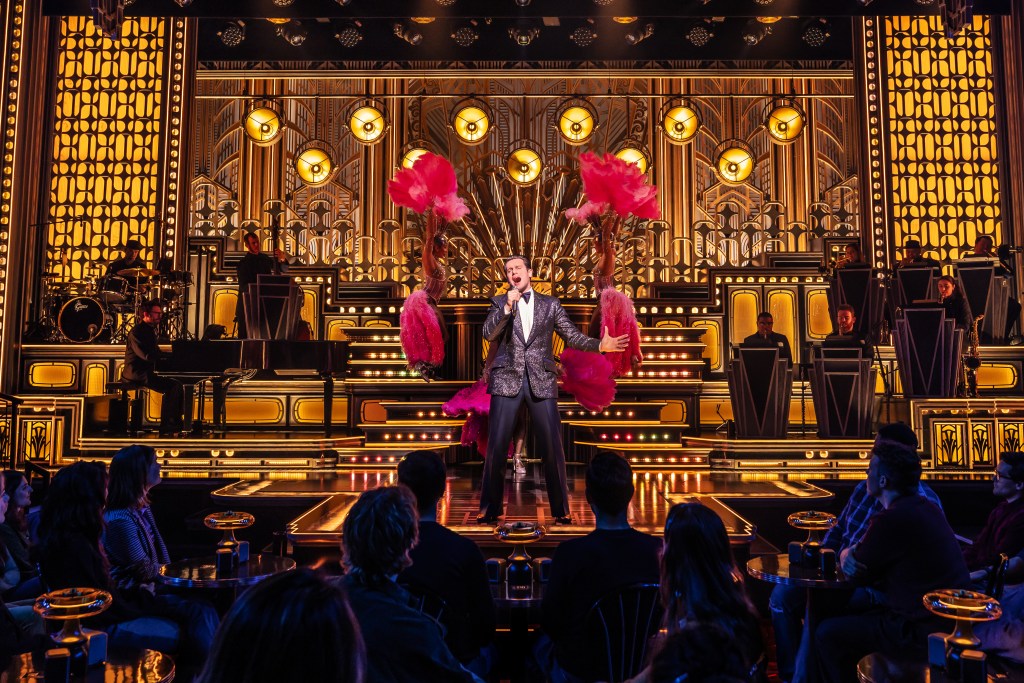
The chronicle of his life manifested a candle burning at both ends to accomplish whatever he could in his short lifespan. Just in Time starring Jonathan Groff as Bobby Darin shines a spotlight on what made Darin a consummate performer, as he reinvented his career by adjusting to the times. Key to this production is Groff’s winning, adorable persona and uplifting and empathetic approach to portraying Darin’s mystique.
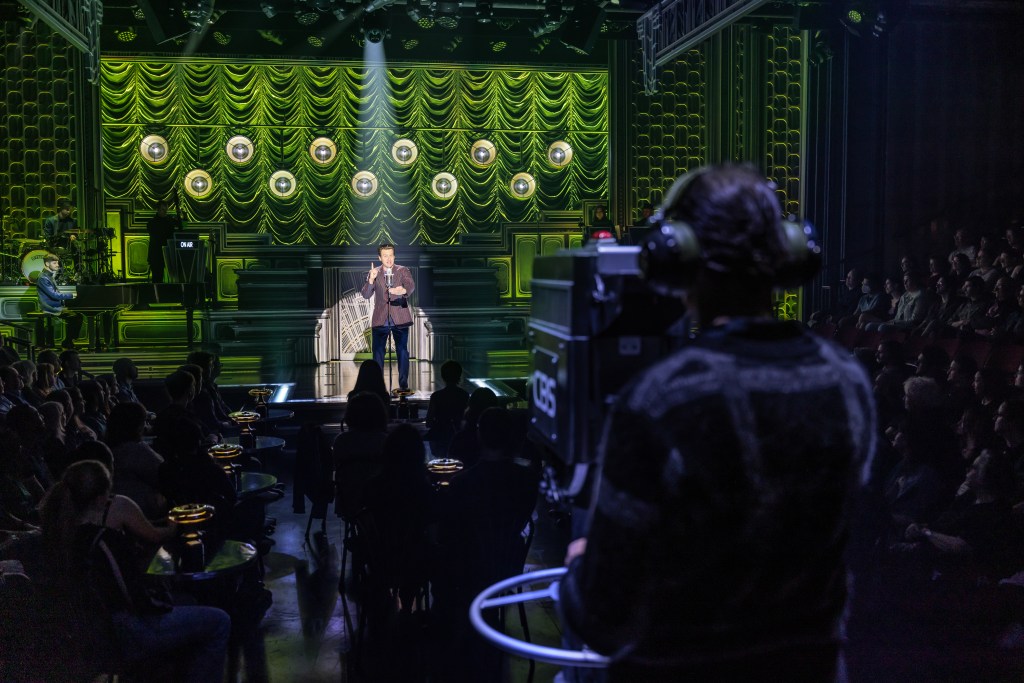
With an 11-piece band accompanying him and fine orchestrations by Andrew Resnick, this is an incredible show right out of the gate, though the book by Warren Light and Isaac Oliver based on an original concept by Ted Chapin cannot cover all of the salient information about Darin’s life for purists. However, it indeed is enough and a must-see. The exceptional Just in Time, developed and directed by Alex Timbers currently runs until November 30th at Circle in the Square.
To represent Darin’s ethos the production places the star in his favored venue, the nightclub. With set design by Derek McLane, Justin Townsend’s lighting design and Peter Hylenski sound design, Circle in the Square Theatre is transformed into both an exclusive nightclub and swank, intimate cabaret. There, Groff singularly portrays Darin’s trajectory in what has perhaps wrongly been limited as a “jukebox bio musical.”

The stunning sets around which Groff and the cast perform and enact more intimate scenes, open another aspect of the Darin persona. The immersive nightclub with two sections also converts to other settings with the use of a scrim and props. The floor area holds a cabaret-style seating arena where Groff and the others act amidst the patrons seated at tables. The multi-tiered stage of steps includes a dancing area banked on either side by the band, led by Andrew Resnick. Resnick plays piano, and supervises the music he has arranged which is vibrant, updated, resonant and heady.
Groff performs in both areas, but the showpiece numbers are on the higher levels where Darin’s Sirens dance, sing and perform with him in finely tuned, tightly choreographed numbers by Shannon Lewis. Darin’s glittering, alluring assistants include Valeria Yamin, Christine Cornish and Julia Grondin. Interestingly, theirs is an economy of movement as they surround Groff/Darin and join him with verve and style within the multi-levels of the set.

This design is exceptional and reflects the tenor of restraint, an ironic, perhaps meaningful limitation. Darin had severe health issues throughout his life and the knowledge that death was near, a terrible psychological/emotional/physical limitation, nevertheless spurred him on with a driving urgency. Darin pushed himself and everyone around him. He was about, “having a lot of living to do” because of his rheumatic heart. Despite his “mother’s” (the wonderful Michele Pawk), adjurations that the doctor told him nonsense that he would die in his teenage years, Darin took the doctor’s warnings “to heart.” He daily lived with death, and using the warning like a stoic’s “memento mori,” inspired himself to “live to the fullest.”

If anything, that is a theme of Just in Time. It is a riff on the idea that our time is limited and we must make the most of it with the gifts we have, as Bobby Darin did.
Just in Time originated as The Bobby Darin Story, a series of five concerts in 2018 at the 92nd Street Y, starring Groff as Darin. Since then its book and Timbers’ development and direction manifested a production with flowing, urgent forward momentum. Groff/Darin freezes the action with a “snap of his fingers” to add briskly paced narrative humor. These asides and direct addresses to the audience unfold Darin’s life story between upbeat club numbers dated for the time, but redirected for our time via Resnick’s arrangements. The entire production is set up as a series of night-club acts, and a stage performance to familiarize non fans with the man and his career.

However, before we discover Darin’s ambition and death-spur that propelled him, Groff is introduced as himself and assumes the relaxed, dressed to the nines (Catherine Zuber’s costume design), carefree, Groff-styled night-club persona. Groff twits the audience, making them his confidante, grounding it for his future direct addresses that will follow as a device that cycles through Darin’s life events briskly. These cover his childhood, the start of his career writing songs for Connie Frances, their relationship and break-up, his hits, the record company bosses, his revolutionary stylization of “Mack the Knife” and beyond to his relationship and marriage to Sandra Dee, its end, and his reinvention after he goes bankrupt.
As Groff zips and zags through the retrospective of Darin’s too brief life, we follow the whirlwind. Occasionally, we glimpse through the pull back of the curtain into his failing health, as Groff’s Darin initializes the stresses of his broken marriage and the revelation of a family secret that devastated him and most probably impacted his health.

In the opening set up of crooning songs “This Could be the Start of Something Big,” “Just in Time,” and lead in to the story of Darin’s life with the vamp of “Beyond the Sea,” Groff’s interpretations are sensational. Then, the audience is off and running with Groff’s self effacing line, “Whether you’re a fan of Bobby Darin, or one of the twelve people who watched “Mindhunter” – it doesn’t matter how I got you. All that matters is that you’re here and, tonight, you’re mine.”

And no joke, that’s the truth. We go with Groff down Darin’s memory lane, meeting his sweetheart that was not to be, Connie Francis (the sensational Gracie Lawrence), his “sister” always concerned for his health (Emily Bergl), his loving, show business influential “mother” (Michelle Pawk), and wife Sandra Dee (Erika Henningsen), among others who fill in various roles (Joe Barbara, Lance Roberts, Caesar Samayoa). As swiftly and smoothly as the first act spools, the second act covers his relationship with Sandra Dee, giving it short shrift, along with Darin’s political endeavor helping Bobby Kennedy’s presidential campaign. Darin was present at the Ambassador Hotel and suffered another devastation at Kennedy’s death.

The show concludes with Groff/Darin, back in the nightclub where he fits best after a few years of resettlement. As the final capstone song, the production ends with “Once in a Lifetime/That’s All” as Groff powerfully, forcefully pulls out all the stops and his closest family and friends give remarks upon learning of Darin’s death after open heart surgery. Groff concludes with poignant remarks, “Every breath we take is a gift we get to open. It isn’t enough. And yet, it is so much.” Groff back in his own skin, makeup off, in his own robust soul, passionately ends the gobsmacking evening with, “Thanks for spending this time with us. Goodnight. I love you.” And the audience gives love back with a resounding standing ovation.
Just in Time is a fabulous seduction, memorializing the life and times of Bobby Darin through Jonathan Groff’s being and perspective. To say he channels Darin limits the depth of the production. The separation between the men is always present and that is what makes this production rise above a “jukebox bio musical.” None of the songs are jukebox, but reformulated. None of the patter and narrative are crassly biographical, but more at symbolic and synoptic, like a review with song twists to elucidate the events and key turning points throughout Darin’s life. Time and effort have been taken to thoughtfully render the production’s success to a new crowd of Darin fans.
Just in Time runs 2 hours 25 minutes with one intermission at Circle in the Square. https://justintimebroadway.com/
‘Good Night, Oscar’ Sean Hayes in a Marvelous Must-See

It is not that Sean Hayes looks like Oscar Levant (he is taller), or speaks like Levant (not really), or accurately displays Levant’s neurotic ticks and eye blinks (he ticks away), or imitates his posture (he slumps, cutting off 2 inches of his own height). What Hayes does nail is Levant’s pacing, deadpan delivery, comedic sentience and his self-effacing, desperate, sorrowful heart. And it is these latter Levantesque authenticities that Hayes so integrates into his being that when he shines them forth, we believe and follow Hayes wherever he takes us during the brilliant, imminently clever Good Night, Oscar, currently running at the Belasco Theatre with no intermission.

With a well-honed, drop-dead gorgeous book by Doug Wright (I Am My Own Wife), and superb production values (Rachel Hauck-scenic design), (Emilio Sosa-costume design), (Carolina Ortiz Herrera & Ben Stanton-lighting design), (Andre Pluess-sound design), and J. Jared Janas for hair & wig design, director Lisa Peterson’s vision brings us back to 1958 in NBC Studios’ inner sanctum, where the backstage drama is more incredible than what happens on live camera. Of course, by the time Hayes’ Levant appears live on The Tonight Show, we, Parr (Ben Rappaport), June Levant (Emily Bergl), Alvin Finney (Marchánt Davis) and head of NBC Bob Sarnoff (Peter Grosz), have lived two lifetimes fearing the worst. After all, this is live television with no splicing tape or editing. Whatever happens is. And that makes the tension and thrill of this production that duplicates the fear of “live,” (just like on Broadway, but with no extended rehearsals), just smashing.

Doug Wright acutely, craftily ups the ante of danger in the 80% probability that Levant will make a mess of things. Perhaps, he won’t make it to the studios, just like the time he left an audience of three thousand waiting in fancy dress to hear him play the piano, concert style, which was popular in those days. Then, he let them wait and never showed up.
Levant is noted for his version of the stellar George Gershwin’s “Rhapsody in Blue.” Parr and the TV audience expect Levant to play it, but of late, he is hesitant and may refuse and walk off the set. So Levant might be on time but blow-up his appearance, as he has done before, saying the extraordinary and surprising, if asked to comment on religion, politics or sex. Furthermore, he is plagued by the spirit of Gershwin and has reveries of the past where, at times, he makes no sense. So much can go wrong, like Murphy’s Law states: “If something can go wrong, it will.” With Levant this has become a truism with scheduled bookings and appearances.
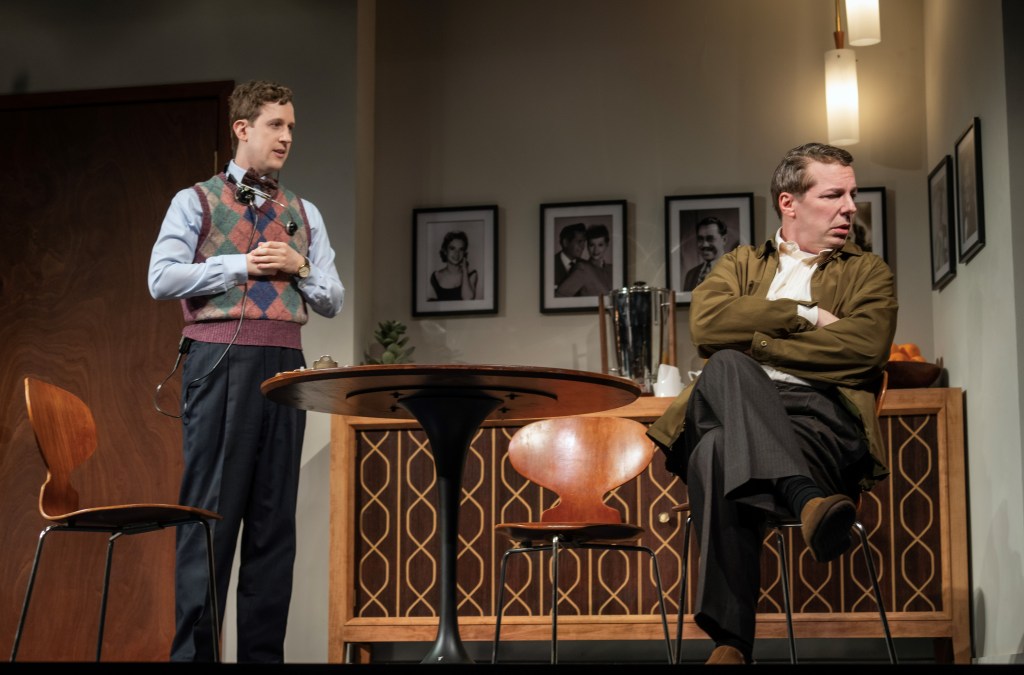
As Grosz’s apoplectic Sarnoff and Rappaport’s reasoned Parr go head to head about the high-risks they are taking because they cannot fail during “sweeps week,” we discover that recently, Levant is completely unreliable and “out there.” Sarnoff refers to him as a “freak.” On the other hand Parr has specifically chosen Levant because he needs his new Burbank show to be a success. Levant always delivers because Parr knows his close friend and can set him up for the best one-liners and witticisms in the business.
With Levant, Jack hopes to compete his way into prime time with a low budget and the talk show format he has perfected. It is a difficult task because he is on every evening, is rather high-brow, and the network underestimates him. However, Rappaport’s Parr believes Levant is a “true original,” who “treats chit chat with all the daring, all the danger of a high-wire act.” Parr knows that he will score with Levant because his unexpected brilliance lands his one liners all the time. Jack will start the engine, and Levant will speed off with the cues for a perfect show, nose diving into space and leveling off every time. He only needs to show up and get in make-up. Wright has created the set up for anticipation so that when Levant arrives, if he does, we are ready for his prime time antics, which happen behind the cameras.

That Parr doesn’t convince Sarnoff to calm down remains a problem. Sarnoff tells Parr he has booked “chica chica boom boom” Spanish musician and band leader Xavier Cugat as Levant’s replacement. He will save the day if Levant stiffs The Tonight Show, like he stiffed The Eddie Fisher Show the week before. In other words, as Levant keeps the studio waiting, the greater the likelihood that Levant’s career is down the toilet, along with the bad will that Parr has contributed making his goal to be in prime time a pipe-dream.
The issues appear to be settled when June Levant, Oscar’s wife, sweeps through the doors in her period piece, flowery outfit looking chic and composed. Parr is relieved until June tells him that she committed Oscar, and he’s in an asylum because she finally had enough. Parr becomes as apoplectic as Sarnoff and the rest of the play spins out of control, is brought back into control, then goes up into the high-wire act Parr wished for, after Levant shows up and fills everyone with expectation and sometime dread that he will blunder irreparably and destroy all they’ve planned.
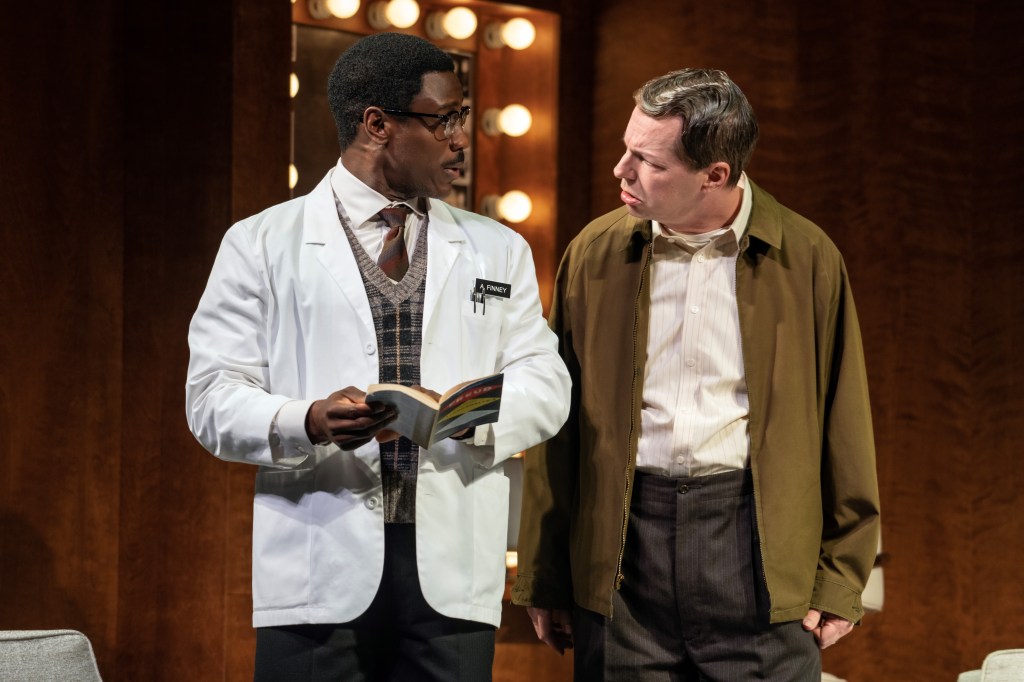
To add to the tension, right before Levant goes on the air, he downs a bottle of Demerol and seems comatose. The saving grace is that Levant is a drug addict and his body is accustomed to so many drugs of his choosing, he has to take a bottle of it to stop his hand from shaking. (I reminded you of that, if you question how taking that many pills and functioning is possible. Think functioning alcoholic.)
Who is this drug addict? Who is Jack Parr? In what century are we? One of the salient take-a ways of Good Night, Oscar is its reverential nod to the Golden Age of Television, when culture, wit, superior comedy shows and superb programs (I Love Lucy, Playhouse 90, Your Show of Shows, What’s My Line, etc.), and actual bona fide news graced the air waves. Jack Parr was one of the first hosts of The Tonight Show franchise, which has lasted to this day and has been duplicated many times over in other shows on other channels.

Then, Parr made individuals famous during his five-year stint. One of his frequent guests was comedic concert pianist and Hollywood celebrity Oscar Levant. Thanks to Doug Wright’s incredible, stylized portrayal of Levant, and Sean Hayes’ remarkable ability to don the ethos of the exceptional pianist and tortured artist, we understand his emotional underpinnings. And we empathize with the psychological whirlwinds captivating Hayes’ Levant. Figuratively haunted by George Gershwin’s shadow, Levant glorifies in and also regrets riding Gershwin’s coattails to celebrity. Wright fancifully manifests this haunting by materializing Gershwin, who cajoles, persuades and torments Hayes’ Levant with remembrances of his greatness and serene notes of “Rhapsody in Blue.” Davis’ Alvin tells Parr assistant Max (Alex Wyse) that these babblings are auditory and visual hallucinations.Max should just “go with it.”
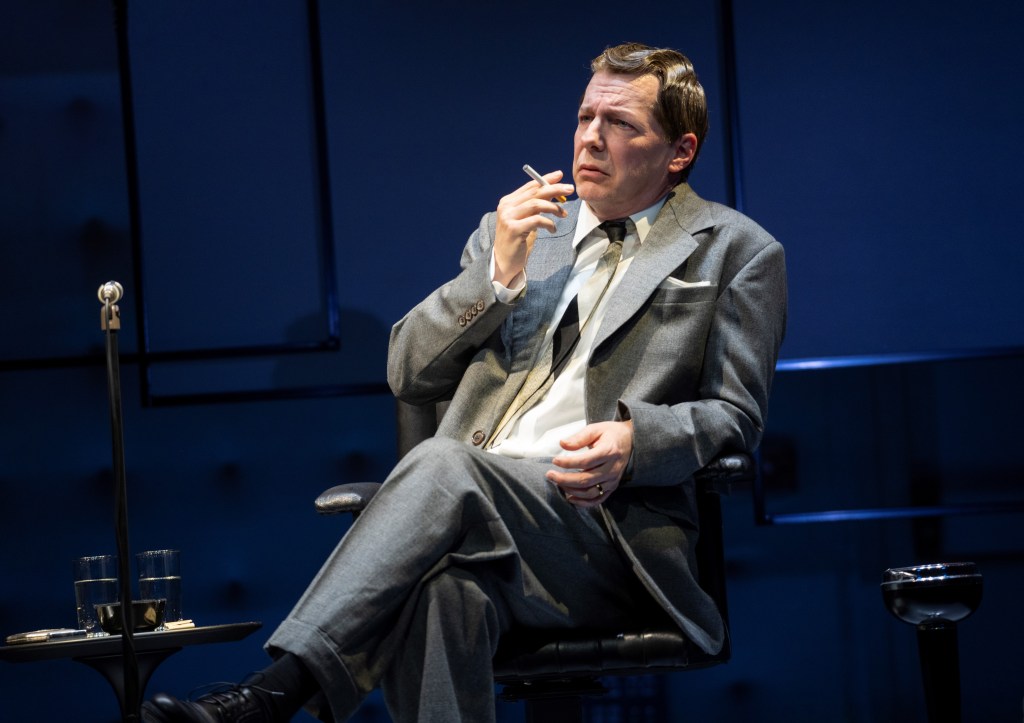
After June Levant and Parr tell Hayes’ Levant he must play, that the concert grand is waiting, Levant goes head to head with Gershwin’s ghost. Portrayed by John Zdrojeski, we note Gershwin’s arrogance and dapper, mordant, ghostly looks. However materially insubstantial he is, to Levant, the only one who sees him, he is beautiful and elegant. We understand that compared to Gershwin, Levant is a midget in looks and talent (in his own flawed estimation). Levant has undermined himself becoming Gershwin’s fawning adherent. Thus, eventually Levant obeys his hallucinations, as the Gershwin ghost compels him. Will Hayes’ Levant be able to play anything with arthritic hands and twenty-five concentrated doses of Demerol in pill form churning around in his stomach?
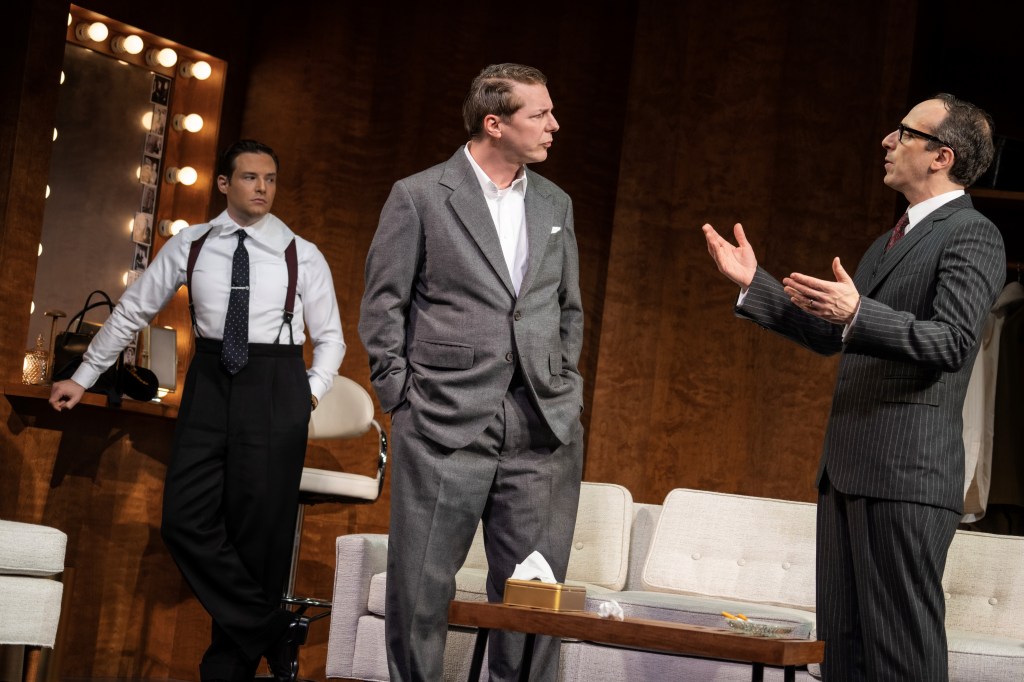
There is no spoiler alert. How Levant, his body hungering for drugs, manages to manipulate Parr assistant Max and his own nurse assistant Alvin to get what he wants is frightening, funny and ironic. Wright employs Max and Alvin as devices to reveal Levant’s backstory and acquaint the audience with his former grandiloquence, while we take in his deteriorating condition. Levant, Judy Garland and other celebrities shared the same fate with the pills and drugs that the studio doctors offered. Ironically, the tragedy of Oscar Levant and his glory and folly, which Hayes portrays with perfection, has great currency for our time.

Though Levant’s story is a throwback to that crueler, exploitive time of the studios, where the industry ground up artists in its maw and left them at the side of the road to deal with their own damage, we see the effects of big pharma today, expanding their client base beyond celebrities to the US public. Additionally, we note that corporations have become even more insidious than the Hollywood studio system as exploiters of writers and other artists. Good Night, Oscar is vital in showing how the then parallels the now.
Wright, Peterson and importantly, Hayes, elucidate how artists were encouraged to destroy themselves gradually for the sake of their “careers.” That Parr and June Levant are similar in their persuasions, pushing Oscar to “entertain,” is answered by the fact that Oscar adores being in front of an audience, even if it’s only for the four hours he has been “sprung” from the asylum. However, his self-harm becomes irrevocable as celebrity self-destruction through addictions to drugs and alcohol, unless redeemed is irrevocable in our time as well.
Wright’s play is an encomium to Levant’s genius, his humanity and his artistry, beautifully shepherded by Peterson and the creatives who convey her vision. And Sean Hayes’ performance is one for the ages.
There are gaps in this review for the sake of surprising the reader. Most assuredly, Good Night, Oscar is a must-see. You should go a few times to appreciate the wit, humor and spot-on performances, all of which are superb. Sean Hayes is especially poignant and authentic. For tickets and times go to their website https://goodnightoscar.com/
 CAROLE DI TOSTI