Blog Archives
‘The Night of the Iguana,’ Theater Review
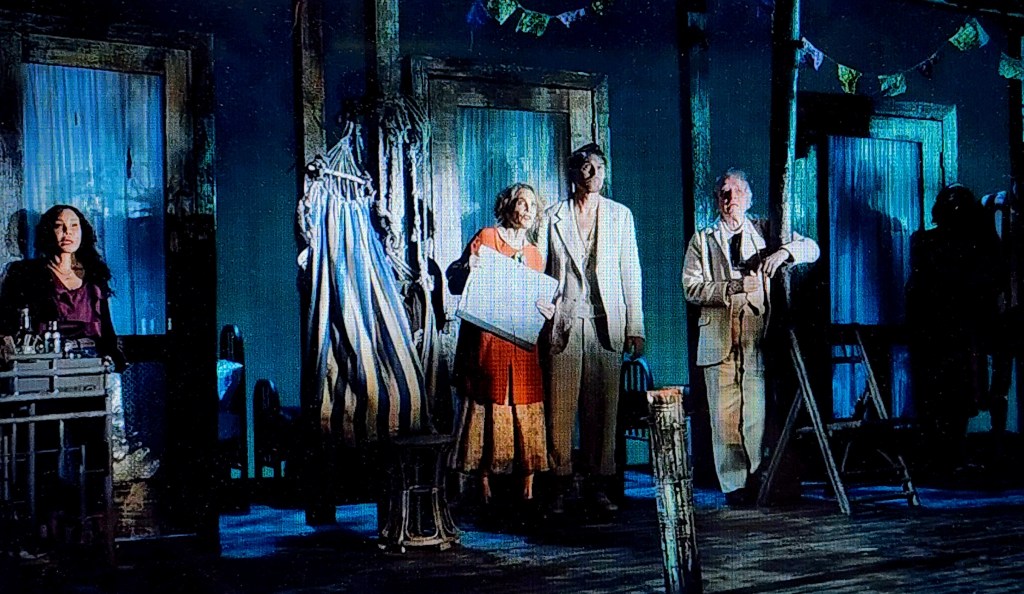
The Night of the Iguana is one of Williams most poetic and lyrical plays with dialogue that touches upon the spiritual and philosophical. On the one hand in Iguana, Williams’ characters are amongst the most broken, isolated and self-destructive of his plays. On the other hand, in their humor, passions and rages, they are among the most identifiable and human. La Femme Theatre Productions’ revival of The Night of the Iguana, directed by Emily Mann, currently at the Pershing Square Signature Center until the 25 of February, expresses many of these elements in a production that is incompletely realized.
The revival, the fourth in 27 years, and sixty-one years after its Broadway premiere, reveals the stickiness of presenting a lengthy, talky play in an age of TikTok, when the average individual’s attention span is about two minutes. Taking that into consideration, Mann tackles Williams’ classic as best as possible with her talented creative team. At times she appears to labor under the task and doesn’t always strike interest with the characters, who otherwise are hell bent on destruction or redemption, and if explored and articulated, are full of dramatic tension and fire.
Beowulf Boritt’s scenic design of the off-kilter, ramshackle inn in the tropical oasis of 1940s Costa Verde, Puerto Barrio, Mexico, and Jeff Croiter’s fine, atmospheric lighting and superbly pageanted sky are the stylized setting where Williams’ broken individuals slide in and out of reality, as they look for respite and a miracle that doesn’t come in the form that they wish. With the period costumes (exception Maxine’s jeans) by Jennifer Von Mayrhauser), we note the best these characters can hope for is a midnight swim in the ocean to distract themselves from their inner turmoil, depression, loneliness, DT’s and brain fever/ The latter are evidence of addiction recoiling, experienced by the play’s anti-hero, “reforming” alcoholic Reverend T. Lawrence Shannon (Tim Daly).

One of the issues in this revival is that the humor, difficult to land with unforced, organic aplomb is missing. At times, the tone is lugubrious. This is so with regard to Tim Daly’s Reverend Shannon, in the scene where he expresses fury with the church in Virginia that locked him out, etc. If done with “righteous indignation,” his rant, with Hannah Jelkes (Jean Lichty), as his “straight person,” could be funny as her response to him elucidates the psychology of what is really going on with the good reverend. It would then be clearer that Shannon is misplaced and just can’t admit he loathes himself and agrees with his congregants who see him as one who despises them and God, an irony. Indeed, is it any wonder they see fit to lock him out of their church?
The ironies, his indignation and Hannah’s droll response are comical and also identify Shannon’s weaknesses and humanity. Unfortunately, the scene loses potency without the balance of humor. Shannon is a fraud to himself and he can’t get out of his own way. Is this a tragedy? If he didn’t realize he was a fraud, it would be. However, he does, thus, Williams’ play should be leading toward a well deserved redemption because of the underlying humor and Shannon’s acceptance that his life is worth saving. In this revival, the redemption merely happens without moment, and the audience remains untouched by it, though impressed that Tim Daly is onstage for most of the play.
The arc of development moves slowly with a few turning points that create the forward momentum toward the conclusion, when Shannon frees an iguana chained at its neck so it won’t be eaten (a metaphor for the wild Shannon that society would destroy). The iguana is released, yet the impact is diminished because the build up is incompletely realized. Little dramatic immediacy occurs between the iguana’s release into freedom and the initial event when Daly’s quaking Reverend Shannon struggles up the walkway of Maxine’s hotel. Daphne Rubin-Vega’s Maxine Faulk and her husband Fred have previously offered escape for Shannon. Now, at the end of nowhere, he goes there to flee the condemnation and oppression meted out by the Texas Baptist ladies he is tour guiding, This slow arc is an obstacle in the play that is difficult to overcome for any director and cast.
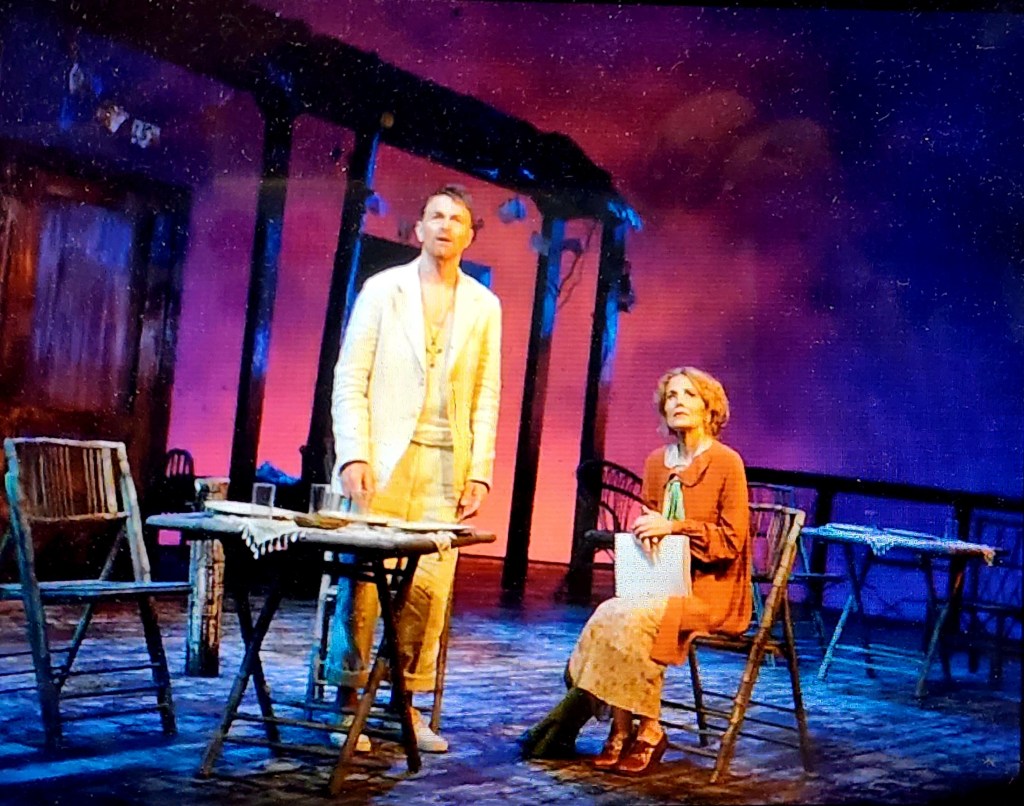
In the Act I exposition, we learn that Shannon’s job of last resort as ersatz tour guide has dead-ended him in a final fall from grace. He is soul wrecked and drained after he succumbs to seventeen-year-old Charlotte Goodall’s sexual advances in a weak moment, while “leading” the ladies through what appears to be paradise (an irony). However, their carping has made the Mexican setting’s loveliness anything but for the withering, white-suited Shannon, who was moved toward dalliances with Carmen Berkeley’s underage nymphet. Whether culturally imposed or self-imposed, prohibition always fails. Ironically, clerical prohibitions (alcoholism, trysts with women), are the spur which lures Shannon to self-destruction.
Already a has-been as a defrocked minister when we meet him, Shannon is hounded by the termagant-in-chief, Miss Judith Fellowes (Lea Delaria), who eventually has him fired. He has no defense for his untoward behavior, nor explanation for his actions, when he diverts the tour, and like a foundering fish gasping for air, flops into the hammock at Maxine’s shabby hotel. There, he discovers that her husband Fred has passed. In her own grieving, desire-driven panic, Rubin-Vega’s Maxine welcomes Shannon as a fine replacement for Fred.
It is an unappealing and frightening offer for Shannon, who views Maxine as a devourer, too sexual a woman, who takes swims in the ocean with her cabana boy servants to cool off the heat of her lusts. Shannon prefers her previous function in her collaboration with Fred, when her protective husband was alive enough to throw Shannon on the wagon, so he could prepare for his next alcoholic fall off of it.
While the appalled Baptist ladies remain offstage, honking the horn on the bus to alert Shannon to leave, and refusing to come up to Maxine’s hotel to refresh themselves, Shannon makes himself comfortable. So do spinster, sketch artist and hustler Hannah (Jean Lichty is less ethereal than the role requires), and her Nonno, the self-proclaimed poet of renown, Jonathan Coffin (Austin Pendleton moves between endearing and sometimes humorous as her 97-year-old grandfather).

Oozing financial desperation from every pore, the genteel pair have been turned away from area hotels. As Hannah gives Maxine their “resume,” the astute owner sniffs out their destitution and is about to show them the door, when the down-and-out Shannon pleads mercy, and Maxine relents. Her kindness earns her chits from Shannon that she will capitalize on in the future. Maxine knows she won’t see a dime from Hannah or her grandfather, whether or not Nonno dramatically discovers the right phrasing and imagery to finish his final poem at her hotel, and earns some money reciting it to pay their bill.
Though the wild and edgy Maxine allows them to stay, she “reads the riot act” to Hannah, suggesting she curtail her designs on the defrocked minister. If Hannah doesn’t go after Shannon, she and her grandfather might stay longer. However, the tension and build up between Maxine and Hannah never fire up to the extent they might have.
To what end does the play develop? Explosions do erupt. Maxine vs. Shannon, and Shannon vs. Miss Judith Fellowes create imbroglios, though they subside like waves on the beach minutes after, as if nothing happened. Only when tour replacement Jake Latta (Keith Randolph Smith), confronts Shannon for the keys to the bus, must Shannon reckon with one who enforces power over him. Neither Maxine, nor her cabana boys, nor Hannah, nor Fellowes can bend Shannon’s will to his knees. Jake Latta’s reality rules the day.

As the bus leaves and his life blows up, Shannon must face himself and end it or begin anew. In the scene between Daly’s Shannon and Lichty’s Hannah after Shannon is tied up in the hammock to keep him from suicide, there is a break through. Daly and Lichty illuminate their characters. Together they create the connection that opens the floodgates of revelation between Shannon and Hannah in the strongest moments of the production. When Nonno finishes his poem and expires, the coda is placed upon the characters who have come to the end of themselves and their self-deceptions. Life goes on, as Shannon has found his place with Maxine who will help him begin again, free as the iguana he set loose. Perhaps.
Williams’ characters are beautifully drawn with pathos, humor, passion and hope. If unrealized theatrically and dramatically, they remain inert, and the audience doesn’t relate or feel the parallels between the universal themes Williams reveals, or the characters’ sub text he presents. Mann’s revival makes a valiant attempt toward that end, but doesn’t quite get there.
For those unfamiliar with the other Iguana revivals or the John Huston film starring Richard Burton and Ava Gardner, this production should be given a look see to become acquainted with this classic. In this revival, there are standouts like Daphne Rubin-Vega as the edgy, sirenesque Maxine, and Pendleton’s Nonno, who manages to be funny when he forgets himself and asks about “the take” that Hannah collected. Lea Delaria is LOL when she is not pushing for humor. So are the German Nazi guests (Michael Leigh Cook, Alena Acker), when they are not looking for laughs or attempting to arouse disgust. That Williams includes such characters hints at the danger of fascist strictures and beliefs, that like the Baptist ladies follow, threaten free thinking beings (iguanas) everywhere.
Humor is everpresent in The Night of the Iguana‘s sub text. However, it is elusive in this revival which siphons out that humanity, sometimes tone deaf to the inherent love with which Williams has drawn these characters. Jean Lichty’s Hannah, periodically one-note, misses the character’s irony in the subtle thrust and parry with Tim Daly’s humorless, angry and complaining Reverend T. Lawrence Shannon. Daly’s panic and shakiness work when he attempts to hide the effects of his alcoholic withdrawal. Both Lichty and Daly are in and out, not quite clearly rendering Williams’ lyricism so that it is palpable, heartfelt and shattering in its build-up to the significance of Shannon’s symbolically freeing himself and the iguana.
The Night of the Iguana with one intermission at The Pershing Square Signature Center on 42nd Street between 9th and 10th until February 25th. https://iguanaplaynyc.com/
‘Gloria: A Life,’ Starring Christine Lahti, directed by Diane Paulus, Off Broadway

(L to R): Joanna Glushak, Christine Lahti, Fedna Jacquet and Francesca Fernandez McKenzie in ‘Gloria: A Life,’ by Emily Mann, directed by Diane Paulus at the Daryl Roth Theatre (Joan Marcus)
An older Irish white woman cabbie driving Gloria Steinem and Flo Kennedy to an event in Boston after overhearing their discussion about abortion said, “Honey, if men could get pregnant, abortion would be a sacrament!” Since then you may have seen that quote on cups, t-shirts, and other memorabilia. That priceless comment/story and countless others, plus witticisms, jokes, truths, and historical facts spill out in Gloria: A Life, written by Emily Mann and directed by Diane Paulus, currently at the Daryl Roth Theatre.
This exceptional production about the life and times of Gloria Steinem moved me to laughter and tears. Writing with extraordinarily seamless beauty, Mann trenchantly underscores how and why Gloria Steinem moved from bondage to freedom in her own life. And this account of how her transformation helped/helps countless women and men move toward freedom from destructive gender folkways resounds with power and reveals why Steinem has become a living legend
Steinem’s development and experiences, and her own influences from so many other women, serve as the backbone of this superb production. With archived photos, videos, voiceovers, and more, the director and writer form a mosaic of the unique perspectives of men and women who have taken part in and still embrace the women’s movement. We discover a key point: that Gloria’s continuing evolution has strode in tandem with the movement’s multiple stages.

(L to R): Joanna Glushak as Gloria’s mom, Christine Lahti as Gloria in ‘Gloria: A Life,’ by Emily Mann, directed by Diane Paulus (Joan Marcus)
Adroitly, director Diane Paulus employs an ingenious, comfortable, interactive approach. She intersperses details, facts, stories, and themes about how women transformed the culture, through Christine Lahti’s portrayal of Gloria. Steinem’s development spins out from the stereotyping oppression and laws against women of her youth, to the legal revolution in support of women, in her 30s, to the current legal assault on women’s rights, in her later years. (As a reminder, our country has yet to pass an Equal Rights Amendment.) The actors take on multiple roles to reveal examples of the nullifying attitudes Gloria encountered early on. Lahti’s humorous portrayal sprinkled with good will reveals how Gloria eventually dealt with such attitudes as her eyes opened and she evolved.
As Lahti’s Steinem sanguinely points out, anti-feminist groups (represented by Phyllis Schlafly in the past) ultimately have the bottom line as their motive. Profits, not people’s concerns, fuel the hate rhetoric against feminists. Attempting to understand the logical truths behind what women are saying puts a downer on money making. Better for companies to stir people’s emotions with propaganda that makes them avid consumers. As such they buy products they don’t need to momentarily salve their soul sickness, stimulated by advertisements that browbeat them for not being perfect. The convenient, vacuous, catchy, divisive memes and gender-perfect advertisements perennially harm.
As she references such truths, Christine Lahti inhabits Gloria Steinem with joie de vivre and humility. Joanna Glushak, Fedna Jacquet, Francesa Fernandez McKenzie, Patrena Murray DeLanna Studi, and Liz Wisan portray the towering women who impacted Gloria. These include major influencers like her mom (a journalist who left her work to join her husband), Dorothy Pitman Hughes (who created the first non–sexist, multi-racial childcare centers), the feisty, no-nonsense Flo Kennedy, and lawyer, activist, and U.S. Representative Bella Abzug.

Christine Lahti as Gloria Steinem in ‘Gloria: A Life,’ by Emily Mann, directed by Diane Paulus (Joan Marcus)
Mann took from Gloria’s 2015 autobiography My Life on the Road the feminist icon’s early experiences and her trials as a journalist. Ironically, when she wrote the book, Steinem most probably didn’t imagine she would be speaking at the greatest global Women’s March ever in 2016. The production includes photographs and video clips of Steinem speaking in Washington, D.C. Though the women’s movement, like Gloria, has evolved, so much more work must be done in the Trump era. The inspiration to get us to move and participate in this work activates the
Particularly startling, Paulus includes video clips of the demeaning, acid attitudes of interviewers like Harry Reasoner, who later apologized when Ms Magazine sold out in eight days. For those too young to realize how far women have come, we see archived photos of memes showing with women whose only functions are as housewives and sex objects. Photos of such advertisements in the 1950s and 1960s prompts Lahti’s Gloria to quip, “Is this what some Americans are nostalgic for?”
I particularly appreciated the historical facts about the movement revealed in archived material. The production cleverly projects video and photographs over two back walls on opposite sides. The entire production seats with benches and colorful pillows for the audience in the round. On the stage in the squarish round, red Persian rugs and pillows suggest discussion circles.
Indeed the discussion circle is an important part of the production. In Act II a special guest each night opens the circle. Audience members may remain or leave. This theme also abides throughout: The discussion and integration of ideas happen in a circle where everyone sits equally. For the hierarchy (the pyramid) to diminish, we must hear, see, listen to, and interact with each other as comfortably as our Native American forebears chose to do. Steinem points out that Native American democracy included such discussion circles and caucuses. Women were integral parts of these, a fact that stunned (and inspired) Benjamin Franklin when he learned about culture of the Iroquois Confederation

(L to R): Christine Lahti as Gloria Steinem, Fedna Jaquet as Dorothy Pitman Hughes in ‘Gloria: A Life’ (Joan Marcus)
Gloria credits her ideas and actions to the mighty courage and determination of black women, Hispanic women, and Native American women. In underscoring who remained instrumental in spearheading second-wave feminism, she presents a list with photographs of black women who were crucial to the movement. Paulus projects their pictures with inspirational quotes on two screens. The list includes Dorothy Pitman Hughes, Flo Kennedy, Pauli Murray, Aileen Hernandez, Fannie Lou Hamer, Shirley Chisholm, Margaret Sloan, and Alice Walker. Wikipedia doesn’t recognize some of these women, but Gloria credits them for their prodigious efforts.
Finally, wonderful milestones are noted. For example we see acutely how our culture changed. Yet more change is needed with regard to the artificial gender images fostered by corporate agendas. As Lahti inhabits Steinem, Mann’s brilliant encapsulation of Gloria’s words through Paulus’ sterling direction opens our eyes. What we may have thought we knew bears hearing and seeing again and again. Indeed, this all-female production stirs us as an amazing, uplifting experience. Most importantly, it has the earthiness, historical universality, and erudition to appeal to all genders, races, and religions.
Would even evangelicals appreciate this production? Of course. Don’t women make up more than half of their numbers? Indeed, sharing stories about men’s personal habits always resonates. For example the actors include humorous stories about non-partnership minded men who leave their underwear on the floor, expecting their wives to pick it up. Such stories of personal lives are integrated beautifully to illustrate the importance of discussion among women. The more women talk to each other, the more healing comes, the more solutions to problems may be found.
At the heart of what is called the women’s movement, Gloria’s life’s work promotes freedom for men. Indeed, women and men both need freedom from the nullifying, dis-empowering macho and female roles of domination and passivity. These roles deny personality, growth, evolution, partnership, friendship, companionship, and the integration of the family unit beyond commands and orders.

(L to R): Christine Lahti as Gloria Steinem, Joanna Glushak as Bella Abzug in ‘Gloria: A Life,’ directed by Diane Paulus, written by Emily Mann (Joan Marcus)
Gloria: A Life suggests that women and men should have equal opportunities for medical care, financial wellbeing, family care, and prosperity. That the privileged wealthy minority will use gender division to cloud our eyes and misdirect our pursuit for human rights for all is a given. Noted, and stopped, say Gloria and millions of others. We must work to bridge the divide and jettison such roles, which crucify all genders and destroy the social good.
By looking at the past, though we may not have been alive at the time, we understand the value of what women globally endured then and now. Also, by understanding the past, we appreciate and value the hard-won freedoms (Roe v Wade, LBGTQ marriage equality, a woman’s right to use her own name, etc.) that women in democracies enjoy. Still, throughout these moments of progress highlighted by the actors and visuals in the production, concerns about the present political climate whisper.

Christine Lahti (center) as Gloria Steinem with cast of ‘Gloria: A Life,’ by Emily Mann, directed by Diane Paulus at the Daryl Roth Theatre (Joan Marcus)
Understanding becomes crucial to our growth. The production fosters understanding. And from this understanding we realize that the current political partisanship has pushed us to a precipice. All the more noxious are the agendas right-wing organizations like the Federalist Society and conservative think tanks use to consolidate power on the right. For these uber-conservative organizations, women’s rights must be overthrown and diminished as a political initiative. The prize to be gained includes corporate hegemony. The power and money behind these groups are used to maintain supremacy over puppet leaders. And they intend to employ “unbeatable” partisan, conservative voting blocks of nativists, anti-feminist groups (Neo-Nazis, white supremacists), and evangelicals (anti-abortionists, etc.) to maintain or usurp power by any means necessary.
For what it encourages – to understand ourselves today through viewing the past – Gloria: A Life is a must-see. Additionally, you will enjoy its humanity, good will, and uplifting remembrance of history, as well as Christine Lahti as Gloria, the sterling ensemble performances, the active staging, and Mann’s integrated writing of Gloria’s perspectives. All of this enthralls and contributes to making the production soar.
Gloria: A Life runs until 31 March 2019 at the Daryl Roth Theatre in NYC. Stay for the discussion circle in Act II and raise questions with the cast, audience, and special guest. Or just listen. Tickets are available online
 CAROLE DI TOSTI