Blog Archives
‘The Great Gatsby,’ Sumptuously Re-imagined, A Must-See, Unforgettable Broadway Spectacle

The Great Gatsby by F. Scott Fitzgerald is an iconic American novel set during the Jazz Age. It is about class, the privilege of old wealth and the excesses of the nouveau riche, who can never attain the status of the generational moneyed class, regardless of how hard they try. The Great Gatsby a New Musical, based on the titular novel, retains this key theme of America’s class system from the perspective of unreliable narrator Nick Carraway (Noah J. Ricketts). Carraway memorializes Jay Gatsby, the extraordinaire, whose ability to distill hope and materialize his dreams achieves its own artistic perfection. Examined from the perspective of Nick Carraway (Noah J. Ricketts), the tragic flaw in Gatsby’s process is that he attaches his hope to the imperfection of love and a woman who wasn’t worthy of his vision, faith or love.

The Great Gatsby, a New Musical made its premiere at the Broadway Theatre after its fall run at the Paper Mill Playhouse in New Jersey. With book by Kait Kerrigan in her Broadway debut, music by Jason Howland (Paradise Square), and lyrics by Nathan Tysen (Paradise Square), the musical is suprbly choreographed by Dominique Kelley and acutely directed by Marc Bruni (Beautiful: the Carole King Musical). Overall, it’s a gorgeously conceived production with exceptional ensemble work and flamboyant spectacle that sumptuously re-imagines the distinctive settings, individualistic characters and seminal events that make the novel a singular and timeless classic.

The strength of this production is that Kerrigan, Howland and Tysen are loyal to Nick’s perception of the magnificent Jay Gatsby, portrayed exquisitely by Jeremy Jordan. Jordan’s luscious, exceptional voice, Gatsbyesque persona, and passion do justice to Howland and Tysen’s lyrical and dynamic songs, “For Her,” “Past Is Catching Up to Me,” and the duet “Go.” We empathize with Jordan’s Gatsby, whose near divine love of Daisy (the lovely Eva Noblezada), never fails him, though Daisy can’t handle the irrepressible and divine nature of his efforts to transform time.
In “My Green Light,” an extraordinary duet between Noblezada and Jordan at the end of Act I, the couple consummates their love in Gatsby’s lavish bedroom with the projection of the rippling Long Island Sound at night, and the green light at the end of Daisy’s dock twinkling behind them in the background.

Bruni’s phenomenal staging, Paul Tate DePoo III’s projection and set unifies the key elements of the love relationship between Gatsby and Daisy, the artistry of Gatsby’s vision and his infinite hope (symbolized by the green light), driving it. The acting talents of Jordan and Noblezada, their lustrous singing and the setting are dazzling in this memorable, uplifting scene, where Gatsby, indeed, for a moment conquers time.

At that point we believe that Gatsby’s love is enough to hold Daisy and take her away from the craven, brutish, hypocritical Tom, who breaks his mistress Myrtle’s nose (Sara Chase), and manhandles Daisy leaving bruises on her arms during their quarrels. We believe like Nick and Jordan (the adorable Samantha Pauly), that Tom doesn’t deserve Daisy. However, by the conclusion of the musical, Nick realizes that Tom and Daisy do deserve each other. She won’t even attend Gatsby’s funeral, acting like he never existed. We agree with Nick that Gatsby is “worth the whole damn bunch put together.”

As Nick spins it, the tragedy lies in Daisy’s soulish weakness and her inability to live up to Gatsby’s love to “forget the past,” which he asks her to do in front of Tom in the superbly acted scene at the Plaza Hotel. Together the characters sing the sensational ensemble number “Made to Last.” John Zdrojeski’s Tom is particularly cruel as he arrogantly denounces Gatsby, his criminal bootlegging and his low class background. The lyrics are profound and spot-on. The dynamic music reinforces the themes which the characters forcefully embrace and symbolize. Tom sardonically sings, “It’s not about wealth, it’s blood. It’s class. The day you were born, your die had been cast.” And Gatsby insists, “Daisy, tell him you’re through.” And he tells Tom to “face reality,” affirming that Daisy never loved Tom.

During the explosive turning point in the song, Gatsby insists she renounce her marriage to Tom, and in effect her position and class to which Tom “elevated” her. When Tom sees she falters, that she honestly admits that she loved them both, and that Gatsby “wants too much,” Tom feels secure. He knows she is too weak and insecure to leave him and their daughter. Noblezada’s Daisy, Zdrojeski’s Tom and Jordan’s Gatsby strike the mixture of emotions of their characters with authenticity and power. Daisy’s heightened angst and tenuous state of mind force her to leave the suite, with Gatsby running after her. It is not a position of power from which Gatsby might redeem himself with her, though he tries.

Tom’s defamation and insults to Gatsby’s face and the reality of what Daisy would be giving up to leave him dislocates Daisy to distraction and ultimately causes the fatal accident and final tragedy of the underclasses, who make the mistake of becoming involved with the soulless, unimaginative upper class.

Noblezada portrays Daisy’s confusion with grist, making Jeremy Jordan’s desperation to stop Tom’s brainwashing and win her back even more pronounced. When Tom’s words hit their mark, it’s as if a curtain shuts down Daisy’s mind. Jordan’s Gatsby sees the impact of Tom’s cynicism as it disintegrates all the romance of what he has accomplished in order to turn back time to the fullness of Daisy’s love when Tom never existed. The scene is the brilliant high-point. What follows is the aftermath from which there is no recovering, except that Nick must lead the musical encomium to the greatness of his friend Gatsby. He alone fully grasps who the man was, so of course, he is furious that the papers slam Gatsby and further drive Daisy into oblivion and Tom into victory, as they jaunt away to Hawaii.

Kerrigan, Howland and Tysen are faithful to the key events in the novel down to no one going to Gatsby’s funeral except Nick which Bruni simply stages with black curtains, the casket and bier and red roses. Howland and Tysen fill out Wilson’s mania as he assassinates Gatsby, after Tom sets him up (“God Sees Everything”). As Gatsby sings the reprise “For Her” and Nick imagines how it happens, Wilson joins in and asks God’s forgiveness for using his hands to met out justice and take responsibility for the execution. Of course, Wilson’s ask is ridiculous as his justice is misplaced. Duped by Tom to do violence and pay for it with his own life, Wilson is a pathetic figure. Reflecting on these events, and Daisy and Tom’s nonchalance about Gatsby and the Wilsons, Carraway disdains Daisy and Tom as representative of the careless rich who destroy people and things leaving the Nick Carraways of the world to clean up the mess.

Comedic elements are found in this adaptation which sometime diffuse the impact of the story, as does attention to the secondary characters who are given greater focus. It is also problematic that Nick’s perspective doesn’t cohere throughout the musical, but leaves off in a few scenes, one between Jordan and Daisy.

Some of the comedy is refreshing as in the scene Nick and Jordan share at Nick’s cottage while Daisy and Gatsby meet for the first time in five years. Their relationship is expanded beyond the novel when Jordan and Nick’s intimacy gives way to his proposal of marriage which she is on the verge of accepting, though in Act I she is against marriage. Her characterization is more in keeping with today’s women than women of the early 20th century. Nick’s characterization is largely faithful to the novel. Noah J. Ricketts does a fine job of rendering Nick the unreliable narrator who thinks highly of himself, but doesn’t completely stand up to Tom and Daisy. Instead, he turns tail and runs back to the Midwest away from the” “evil” East, an irony. The only way he can reconcile his self-loathing about his behavior is to attempt to expiate his guilt by memorializing Gatsby.
The Jordan/Nick scenes are humorous and flirtatious. Their number “Better Hold Tight” is a diversion more for its own sake. However, we are not surprised that Nick throws over Jordan who doesn’t show up to Gatsby’s funeral either. She is one of the bad drivers, the careless rich who sicken and disgust him, for they dupes the fools who would seek the dream “boats running against the current” (“Finale: Roaring On”), to only to stumble because their dreams are behind them in the past.

Kerrigan, Howland and Tysen take even greater liberties with the secondary characters for the sake of dramatic purposes. Kerrigan, et. al. strengthen and coalesce the ideas symbolizing George Wilson (Paul Whitty), George’s wife Myrtle (Sara Chase), and Meyer Wolfsheim (Eric Anderson), by giving each of them solo numbers which define their personalities, desires and attitudes. These add to the themes, though they refocus the thrust of Nick’s story of how Gatsby is a romantic hero. The mystery surrounding Gatsby’s identity which is slowly revealed in the novel, is lost in this musical with attention going elsewhere.

As a representative of the criminal class that feeds the dreams of the lower class, breaking the law to do so, thug Wolfsheim joins the company singing “New Money,” which old wealth (Tom), regards as garish and meretricious. Anderson’s Wolfsheim (“who made Gatsby”), also sings and joins the company dancing in the excellent number “Shady.” As Wolfsheim sings, Bruni stages vignettes with each of the character couples being corrupted in their adultery or “sinful” affairs (Jordan and Nick, Gatsby and Daisy, Tom and the Wilsons). According to Wolfsheim, “I’m okay with keeping secrets. I’m okay with being naughty. I approve of indiscretions, if you know how to hide a body.”

Eric Anderson and cast of The Great Gatsby (Matthew Murphy and Evan Zimmerman)
Read the rest of this entry
‘Hadestown,’ Broadway’s Tone Poem is an Epic, Illuminating Triumph
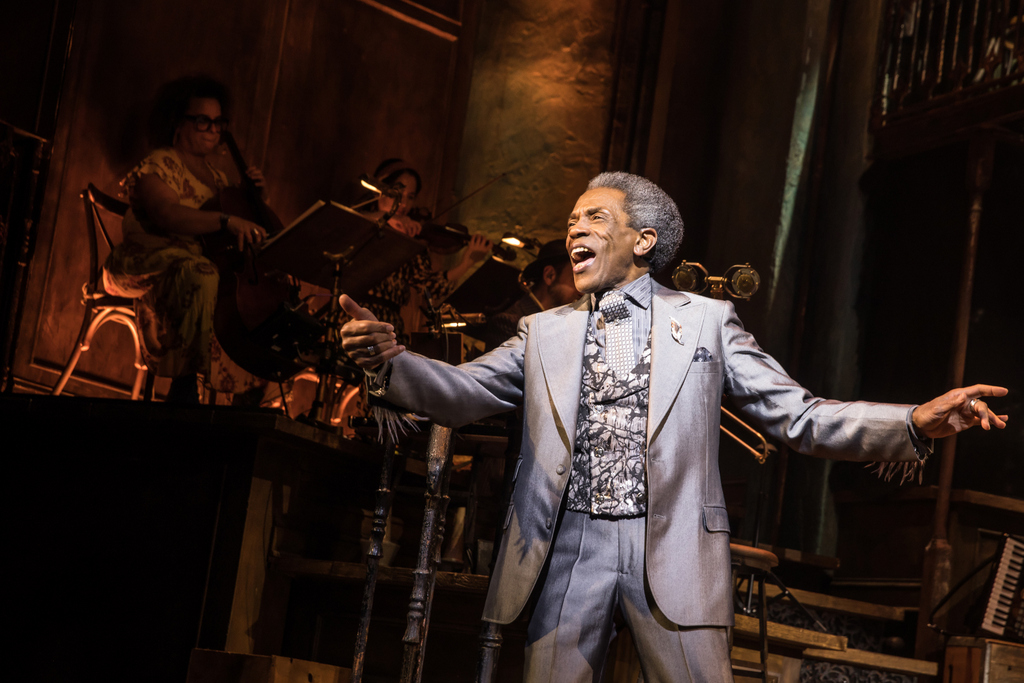
André De Shields in ‘Hadestown,’ Music, Lyrics, Book by Anaïs Mitchell, Developed with & Directed by Rachel Chavkin (Matthew Murphy)
The ending spirals into the beginning, spirals into the ending. And so it goes in Hadestown, the magnificent production by Anaïs Mitchell (Music, Lyrics, Book), and Rachel Chavkin (Direction and Co-development with Mitchell) currently at the Walter Kerr Theater after transferring from other production iterations at the National Theatre, U.K. and NYTW in New York.
Hadestown is a breathtaking journey, into a phantasmagorical world whose musical pageantry and flickering contrasts between revelatory light and atmospheric darkness vibrate to one’s core. The spiritual themes of the play are rife; the irony of life in death (living to die) and death in life (dying to live) resonate for all time. Mitchell and Chavkin adroitly reshape the well-known love myth of Orpheus and Eurydice to parallel it with the equally compelling love myth of Persephone and Hades: Ancient Greece’s metaphoric visions of the immutable power of death, and the mutability of earthly life reflected in the seasons.
Hermes, the lightening-speed god who operates as our guide, negotiates the realms of the earth and spirit for us. We hop on his quicksilver wings of imagination and go along for the death-defying ride to return to earth wiser, perhaps. As Hermes, the inimitable André De Shields transforms into the phenomenal, captivating messenger.
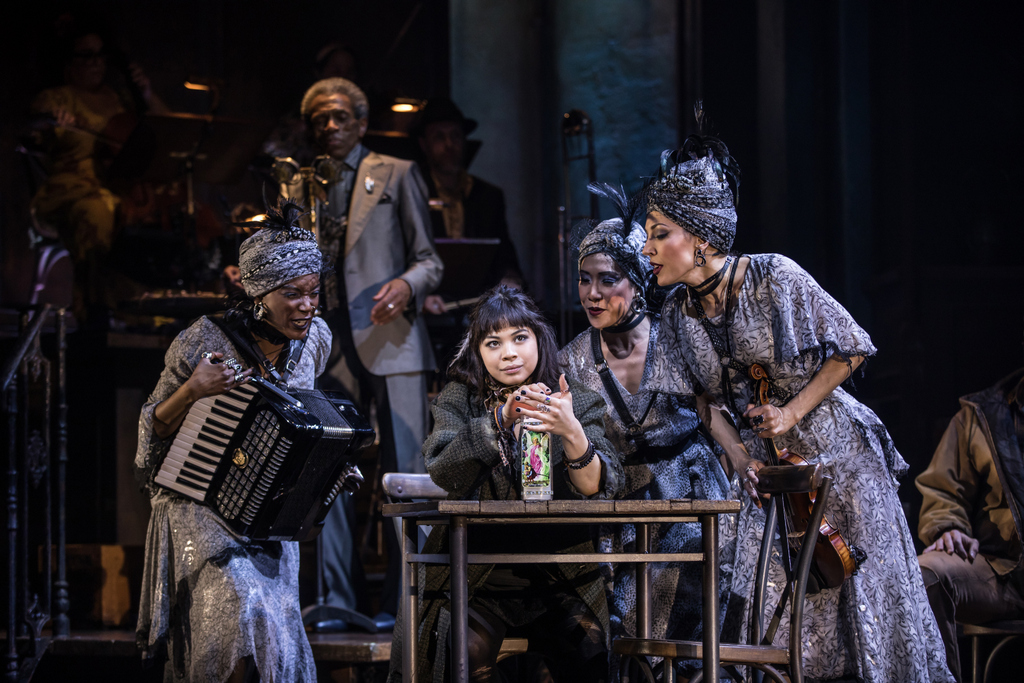
Eva Noblezada and the Broadway cast of ‘Hadestown,’ Music, Lyrics & Book by Anaïs Mitchell, Developed with & Directed by Rachel Chavkin (Matthew Murphy)
With measured grace he combines forceful power with smooth cool. He counsels, philosophizes, warns us in verse and song of an ancient story. It is the story of how the power of love and faith overcome death. And how the fates (the fabulous Jewelle Blackman, Yvette Gonzalez-Nacer, Kay Trinidad in patterned black/white outfits) influence the outcome using fear, doubt and the inherent tragedy of the human condition. Look for their signature song which they beautifully croon to Eurydice who echoes their response (“Any Way the Wind Blows”).
De Shields’ lovable chronicler looks dapper in a silver sharkskin suit with slivery slips on his sleeves which suggest wings courtesy of Michael Krass’ symbolic, well-thought out costume design. (Krass’s costumes enhance the characterization and themes throughout.) De Shields’ moves and manner are so easy, we risk the mysterious train ride with him through light and darkness on the journey to Hadestown and are introduced to all those who play a part in his chronicle of gods and men, life and death, material and supernatural forces (the “Road to Hell”).
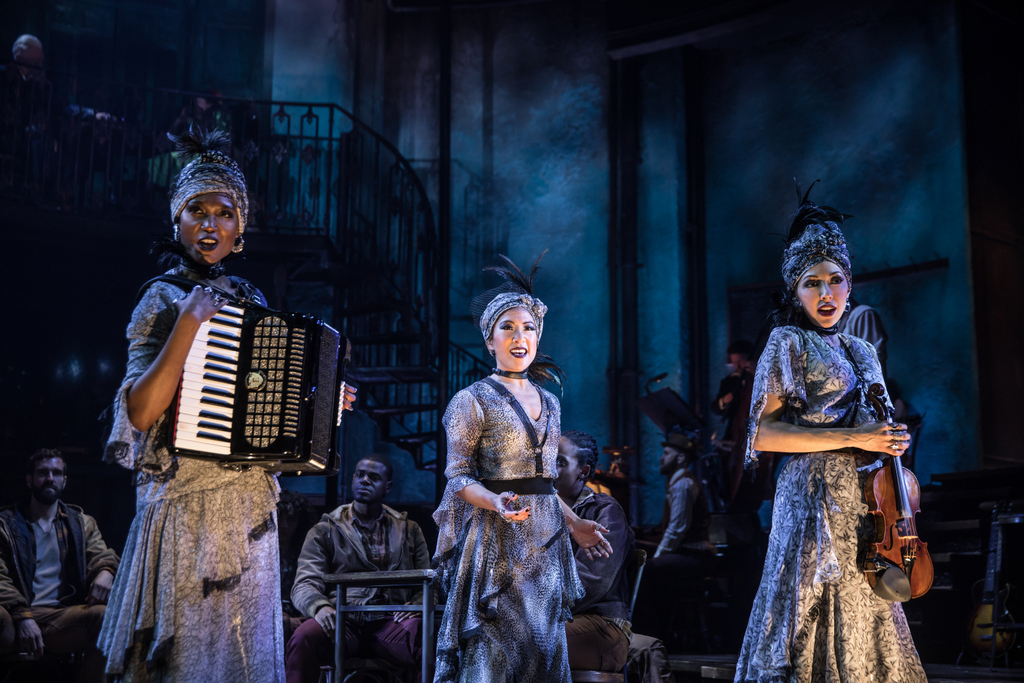
(L to R): Jewelle Blackman, Kay Trinidad Yvette Gonzalez-Nacer, Music, Lyrics & Book by Anais Mitchell, Developed with & Directed by Chavkin (Matthew Murphy)
Mitchell’s and Chavkin’s amazing reconfiguration of these myths is powered by vibrant, musically diverse and multilayered songs and spoken verse. These combine to reveal how climate change has gravely misaligned the world that the characters live in. Chavkin and Mitchell evoke fitting metaphoric parallels with the myths of mutability and immutability. Orpheus and Eurydice become central characters interwoven in the fabric of the play: its action, conflicts, arc of development, symbols, themes.
On the material plane, the situation is dire. Upended by fires, floods and extreme cycles of heat and cold with storms that are off the categorical charts, the earth provides no succor for its inhabitants, many of whom are destitute and dying. Forced into a gypsy lifestyle, outrunning starvation and weather extremes as resources become scarce, migrants like Eurydice (the golden voiced Eva Noblezada) face an arduous, spooky ride to Hadestown unless they manage to get to the next day. Theirs is an existence of slow starvation, chronic sickness, sexual abuse and torment.
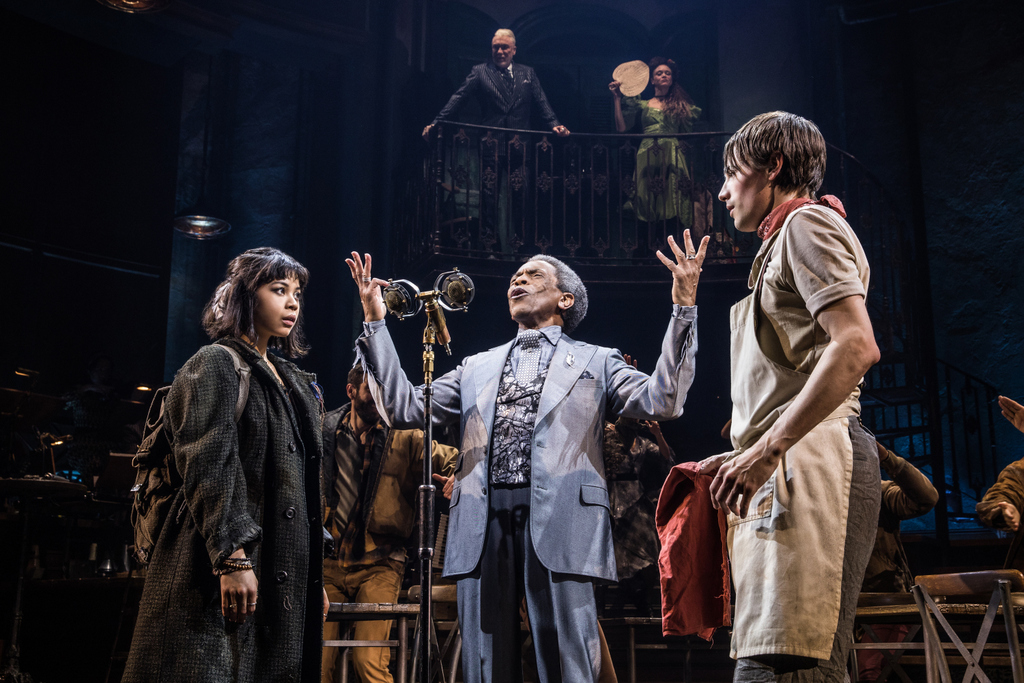
Eva Noblezada, Reeve Carney, André De Shields, Music, Lyrics, Book by Anaïs Mitchell, Developed with & Directed by Rachel Chavkin (Matthew Murphy)
For the haves like Orpheus (Reeve Carney’s naiveté, “touched” grace and beautiful tenor shine throughout) whose ancestor is a Muse and whose life is anointed by the protection of Hermes, the situation is less bleak. Orpheus has a roof over his head and a menial job in a haunting, ambience-rich, New Orleans-like jazz club, a way-station where the customers are soothed by the music of Dixieland before they continue on with the struggles of their miserable lives or elect to ride the train on the “Road to Hell” and get off at the last stop, Hadestown..
It is in this charged, atmospheric, (the lighting is superb thanks to Bradley King) jazz/R & B/folk/pop joint, Orpheus encounters the stunning, waif-like Eurydice, who is blown in by the Fates (“Any way the Wind Blows”). He falls for her and attempts to entrance her with a song of love that will right the world and return spring and abundance to the planet. But Eurydice’s knowledge of the dire, doomed existence of humanity runs deep. She confronts him with the facts of starvation and reality of life’s sorrows. She asserts his song has no power. But as he sings, the generating force of the anointed melody stirs her. She realizes its greatness and tells him to finish the song. He reassures her of his love and vows the song will establish a shared brotherhood and prosperous peace (“Come Home With Me,” “Wedding Song”).
Mitchell and Chavkin use the evocation that Orpheus’ love song is an ancient melody Hermes gave him when he was young. They dovetail this concept into the second love myth of Persephone and Hades. “Epic I” sung by Orpheus and Hermes, reveals how the gods’ love “made the earth go round” and established the beauteous seasonal balance that few remember now that their world is dying. The implication is that Orpheus’ supernatural song will return the earth to its former glory, and Persephone will be present the full six months of the year to celebrate her powers above ground (“Livin’ It Up On Top”).
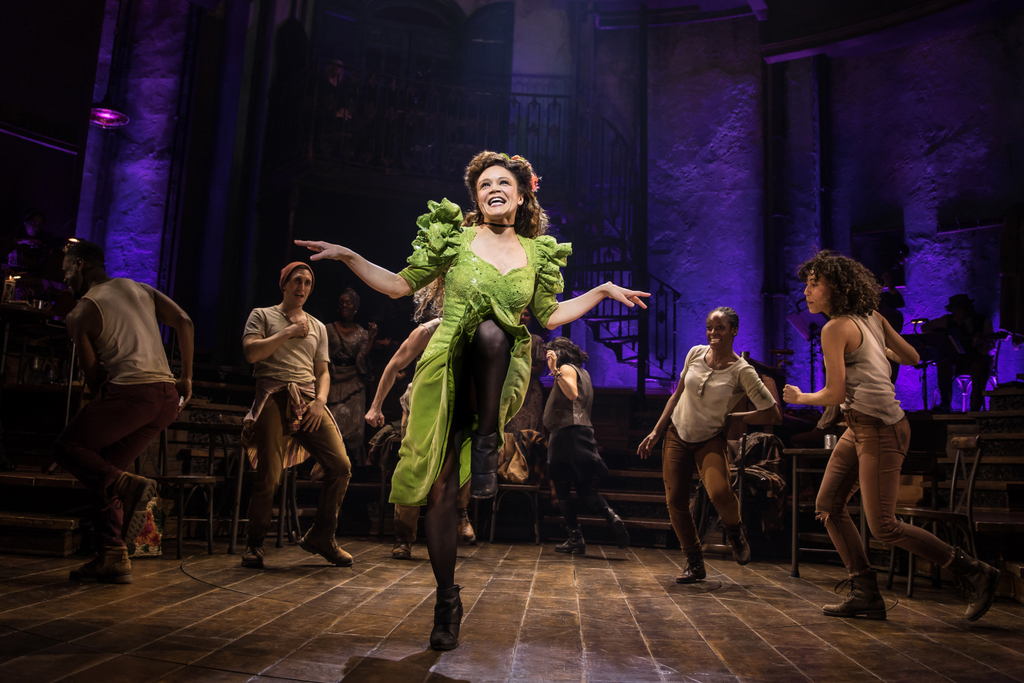
Amber Gray in ‘Hadestown,’ with the company, Music, Lyrics & Book Anaïs Mitchell, Developed & Directed by Rachel Chavkin (Matthew Murphy)
With hope and determination that he can succeed because, as Hermes says, “he’s touched,” Orpheus and Eurydice pledge their forever love in the lyrical “All I’ve Ever Known.” Eurydice forgets the reality of starvation in the warmth of Orpheus’ embrace as she basks in the beauteous spring that Amber Gray’s feisty, ebullient Persephone brings, however, briefly.
The seasons shorten incrementally, reflecting the indelible impact of global warming and Hermes’ injunction of “times being hard.” Persephone’s wine celebration is cut even shorter. Hades’ ride to bring Persephone back to the underworld is foreshadowed in the gyrating rhythms, enthralling melodies, sharp lyrics of “Hadestown,” In this memorable titular song, Hermes, Persephone and the entire company indicate what’s causing the earth’s doom as they illustrate in movement and song what Hadestown is like in its symbolic reflection of its impact above ground.
The themes and plot development merge seamlessly as the love stories meld. Hades, the brooding mover and shaker and oppressed Persephone are brought into focus with intriguing twists. Overwhelmed with anxiety and the stress about growing his powerful underworld empire (precious metals, oil, and attendant industries), Hades has forgotten his youth and the joy of his love for Persephone. He’s dour, commanding; she’s his bored, unhappy, trophy wife. The underlying humor is ironic. He is supposed to be the terrifying, sexy god of the underworld and his wife is, in effect, kicking him out of her bed. Fearing he has lost her, Hades brings Persephone back to Hadestown earlier and earlier triggering weather extremes as the earth cannot adjust (“Gathering Storm”).
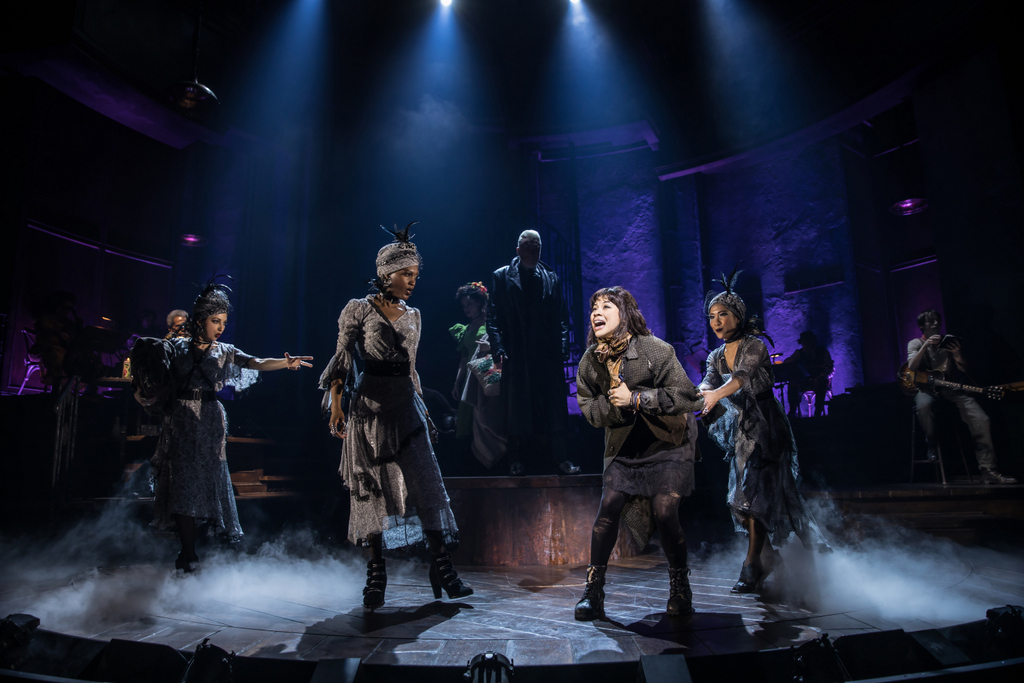
Eva Noblezada and the Broadway cast of ‘Hadestown’ Music, Lyrics & Book Anaïs Mitchell, Developed & Directed by Rachel Chavkin (Matthew Murphy)
When Persephone leaves, weather devastation returns. Eurydice suffers her former hellish grind and panic. She searches for food and firewood, losing patience, dismissing Orpheus’s vows. While Orpheus feverishly works on the song (“Epic II”) she wanders in weariness and hunger. The conflicts intensify. The lure of Hadestown, the world apparently more stable than the cataclysmic earth in the song (“Chant”) trenchantly reveals the strident tensions between Orpheus and Eurydice.
Eventually losing her will to survive, doubting Orpheus’ ability to care for her, Eurydice becomes susceptible to Hades. He finds her fascinating because Persephone has cast him aside (“Hey Little Songbird”). When he offers Eurydice safety, security and freedom, she considers a visit to Hadestown for a bite to eat would be better than waiting for Orpheus in pain. What should she choose? Security and reliability below or starvation, slow torture and uncertainty above. Whether now or in the future, either decision will result in the final stop of her existence in Hadestown. What she does not consider is her will. It is one thing to struggle to survive, dying in the process. It is another to choose to die because it is too tough to go on.
Though this differentiation is inferred in the play, Greek Mythology carries it further. Souls who made good/beneficial choices on earth (they did not commit suicide) went to the Elysian Fields where they played all day: an equivalent of Paradise. Other souls who made harmful decisions were given their just due in the underworld. The souls in Hadestown fall into the latter category, laboring in the toil of the mines forever, in Mitchell’s and Chavkin’s version.
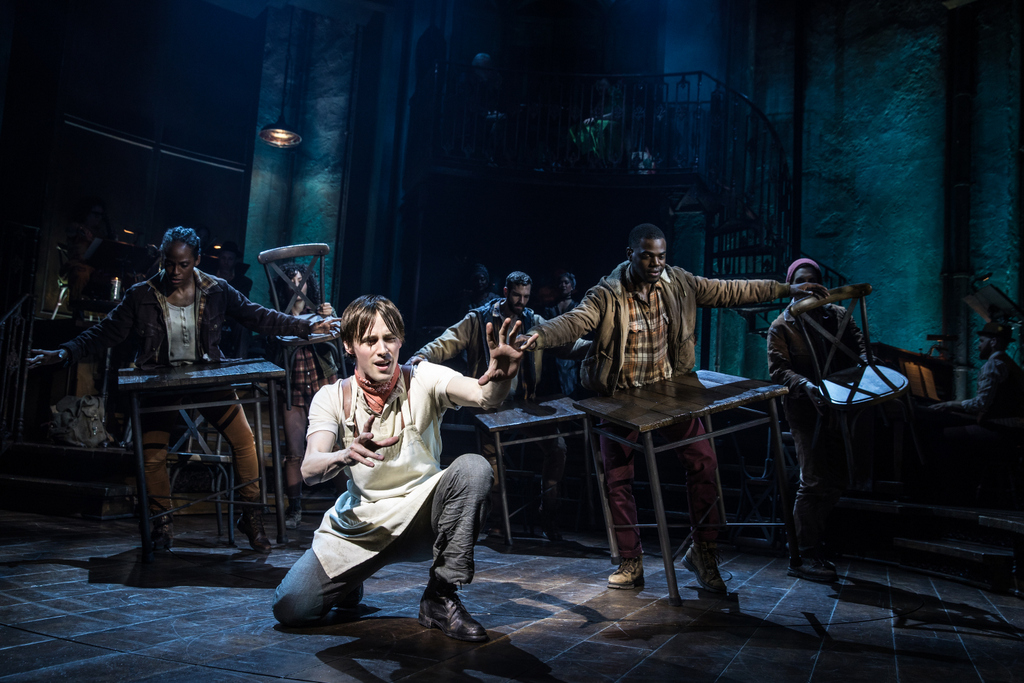
Reeve Carney and the Broadway cast of ‘Hadestown,’ Music, Lyrics & Book Anaïs Mitchell, Developed & Directed by Rachel Chavkin (Matthew Murphy)
As Eurydice considers her options, the Fates influence her with the fabulous, rhythmic “When the Chips Are Down.” (“Aim for your heart, shoot to kill, if you don’t do it, then the other one will”). Eurydice chooses her destiny, allowing material necessity and her flesh to overwhelm her. As she embraces Hadestown’s certainty, she cries out for Orpheus as the Fates admonish the audience that they would do the same as she, if they were in her shoes, in the superb song (“Gone, I’m Gone”).
Eurydice affirms she’ll return (“Wait For Me”) then travels to the underworld lowered into the darkness as ominous clouds of smoke billow up with intimations of flames and intense heat. Orpheus finishes his song, but it’s too late; Eurydice has gone into hell. Hermes guides him along a secret alternate route to Hadestown as Hermes, Orpheus, Fates and the ensemble sing that Orpheus comes for her in the lyrical, powerful ending of “Wait For Me.”
These scenes are uniquely staged, with dynamism and excitement; the lighting enhances throughout. The tension builds to the final revelatory scene in Act I which uncovers Hades’ terrifying realm. The revolving platforms move clockwise and counterclockwise as the ensemble and Orpheus move in the opposite direction. Time reverses and changes course as Orpheus walks with fierce determination to the underworld.
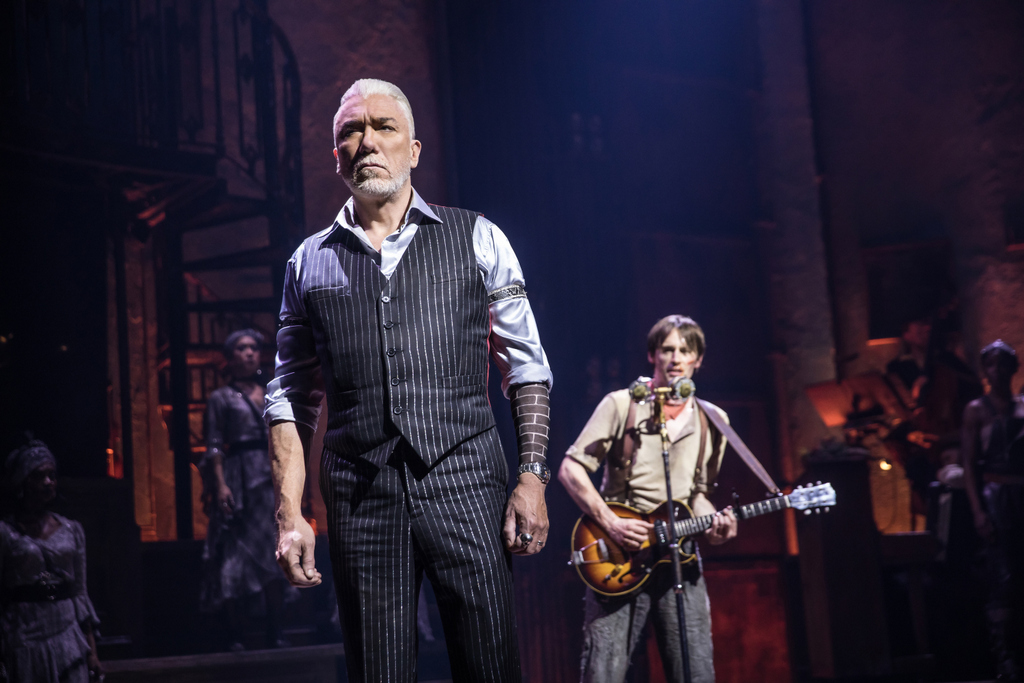
Patrick Page (foreground) Reeve Carney (background) in ‘Hadestown,’ Music, Lyrics & Book Anaïs Mitchell, Developed & Directed by Rachel Chavkin (Matthew Murphy)
The circularity of movement is rich with profound meaning. For example, we make repeat wrong decisions, doing the same thing over and over again with dire consequences This theme suggests the oblivion of Hadestown, (its boring factory sameness) and the waning vitality of Hades. His repeated bad decisions result in the imprisonment of himself, his workers and Persephone, the goddess of change, who abhors the drudgery of the same old same old. Hades has so brainwashed himself, he’s convinced they are free while they are in oblivion as they work like slaves (today’s corporate erosion of worker’s rights…see the film American Factory)
The pounding, thematically “earth-shattering” brilliant song, “Why We Build the Wall” sung by Hades, Persephone and the company is a sardonic paean to wall builders everywhere. The song is Hades’ stubborn justification for his misery, self-torment and the loss of his youth while amassing an empire. By building the wall he and workers he refers to as his “children” keep out the fear of uncertainty and want. They are secure in their never-ending work as they war against deprivation. What he seeks to avoid, he brings upon the entire planet in a self-fulfilling prophecy swaddled by fear. There is only one way to break down the wall: restore Hades’ and Persephone’s love. His fear of losing her will end and he’ll allow her to restore the earth in the natural balance of the seasons. Orpheus must sing his anointed, ancient love song to restore Hades to himself and Persephone, and restore Eurydice to his arms and life.
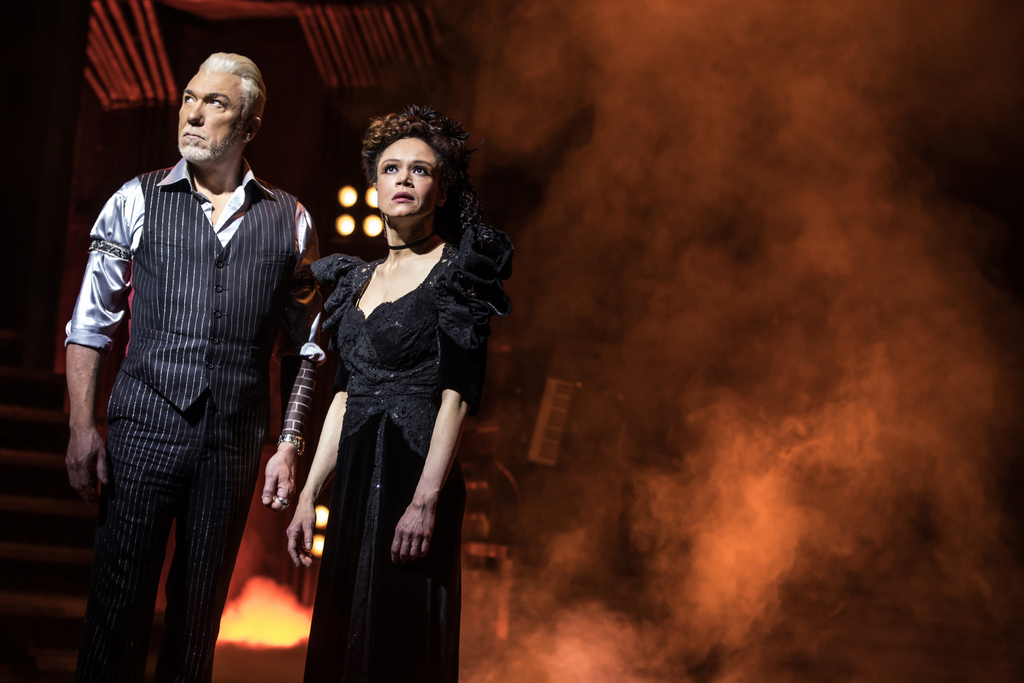
Patrick Page, Amber Gray in ‘Hadestown,’ Music, Lyrics & Book Anaïs Mitchell, Developed & Directed by Rachel Chavkin (Matthew Murphy)
As Hades, Patrick Page’s eminence is superbly realized in his demeanor, walk, voice and appearance. Page’s Hades is a charismatic warlord who sports his sleek brand of “mellow cool” in a gangster-ish pin stripped suit and styled comb-up. His organic, spot-on portrayal makes him human and empathetic. Though he is a god, he fears his adoration of Persephone (“Chant”) is jealous of her absences, and looks for comfort in someone new (“Hey, Little Songbird”). Page’s portrayal is spot-on, mesmerizing.
Amber Gray’s Persephone is an energetic, sun-filled presence. She blooms with razz-ma-tazz vitality above ground but turns it around as an upside down gal in the bleak underworld appropriately dressed for a perpetual funeral. Like the rest of the principals in the ensemble, she is just smashing. Carney’s Orpheus and Noblezada’s Eurydice sing with the lyricism inherent in their gorgeous vocal instruments. They permeate their songs in the second act with soulful, aching beauty, breathing life into the score and lyrics. But then so do Hermes/De Shields (Wow!) Hades/Page (Good gracious!) Persephone/Grey (Yes, ma’am!)
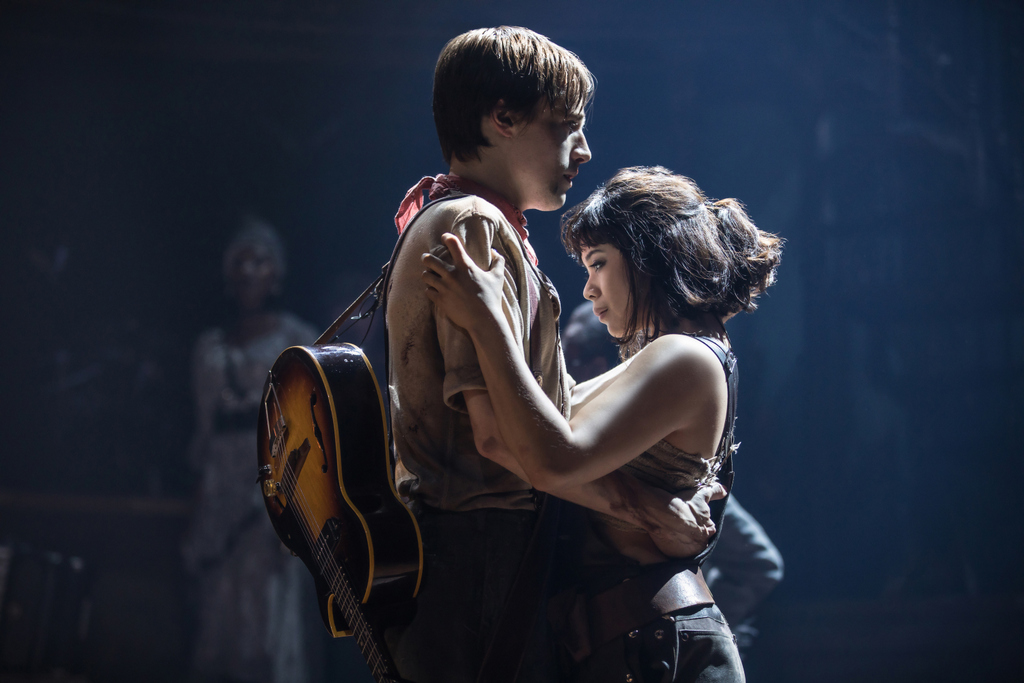
Reeve Carney, Eva Noblezada in ‘Hadestown,’ Music, Lyrics & Book Anaïs Mitchell, Developed & Directed by Rachel Chavkin (Matthew Murphy)
Act II brings the fullness of the plot development, themes and characterizations/gods/lovers that Hermes has so familiarized us with, we’ve come to adore them as family. The song lyrics and music are standouts and build upon what’s been threaded before. You will walk away humming the tunes, drumming the beats. Orpheus’ journey to Hadestown is paced frenetically, with foreboding danger as he moves with stylized grace through his mind of doubt and fear. The use of lighting is sensational and thrilling especially during this sequence (thanks, Bradley King). And at the end, well it’s De Shield’s moment. He stands rooting us in mankind’s tragic history, as the ensemble joins him in soaring song that will be sung over and over again. Ineffable.
This is the type of production that is so jeweled, one will appreciate it in the second seeing or third. You will catch nuances here, symbols there, effects, songs, movements, so much of what your sleight of mind may have missed the first or second time around. All of it is soul careening. This rare production thrums with poetic grace and ancient rhythmic currents that resonate profoundly, irrevocably with life. And occasionally what peers out at us in this play from the other side reminds us of…
Kudos to the creatives who measured the symbols of characterization and themes to synergistically meld them with stylistic, adroit artistry into the play’s fantastic spectacle: Rachel Hauck (Scenic Design) Michael Krass (Costume Design) Bradley King (Lighting Design) Nevin Steinberg, Jessica Paz (Sound Design) Hudson Theatrical Associates (Technical Supervision) Michael Chorney, Todd Sickafoose (Arrangements and Orchestrations).
The music and lyrics are unparalleled, thrilling, coherent. Mitchell and Chavkin, the ensemble and creatives have wrought a divine work for the ages. Surely it is a multiple award winner. Hadestown runs with one intermission at the Walter Kerr Theater (219 West 48th St.) For tickets go to their website by CLICKING HERE.
 CAROLE DI TOSTI