Blog Archives
‘Diversion.’ Nurses under Pressure, Forgotten Heroes in Crisis, Review
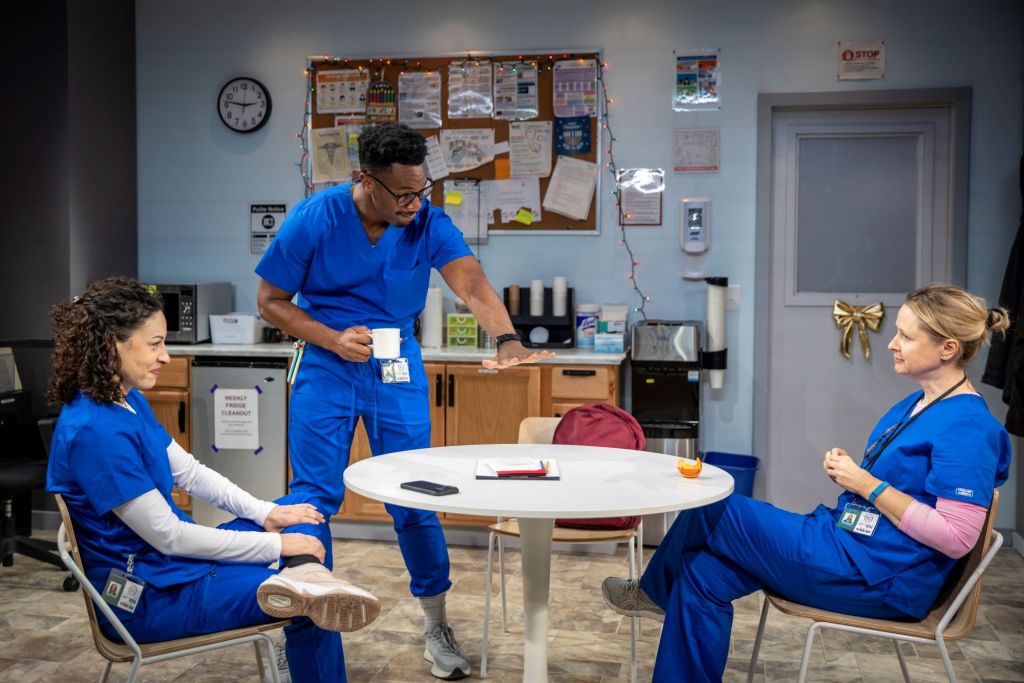
In Scott Organ’s Diversion, the break room of a hospital intensive care unit is a place to let off steam. It is also the location where crimes happen and perps are exposed. Organ cleverly uses this setting for his 90 minute play in an extended run at the Barrow Group’s Studio Theater until December 21st.
The play’s tensions increase after Organ introduces us to four nurses who we later discover negotiate their own personal traumas, while assisting others to live or die. Though we don’t see their trauma, we hear about it and hear about how they may attempt to overcome it through opioids. When their own supply runs out, one or more may have stolen the hospital’s medications to satisfy their addiction. However, the program monitoring the opioids is impossible to bypass without triggering an investigation.
We learn of the conflict when the head nurse Bess (Thaïs Bass-Moore) tells the staff that their unit has been targeted. One or more of the nurses or doctors have diverted drugs. Bess offers to get the individuals into a program to clean up if they quietly come to her first before the company investigator, Josephine (Colleen Clinton), discovers who they are and turns them over to the police.
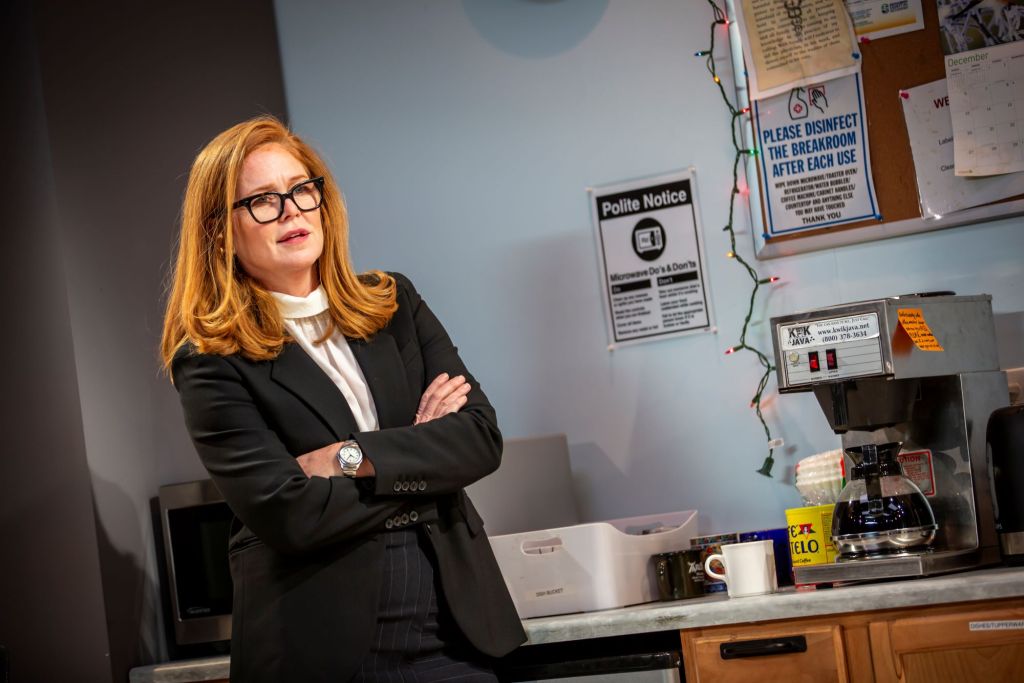
Having been through a disruptive investigation 8 years before when medications were taken, Bess shares her distress. She looks to experienced staff member Emilia (Tricia Alexandro) for help to be her “eyes and ears.” Josephine, a former nurse herself, attempts wisdom and a friendly approach to glean proof she refers to as “data,” by having informal conversations with the staff members. From her perspective, all are suspects, each may have diverted. She will not stop until she proves who the culprit is.
The youngest and least experienced nurse is Mandy (West Duchovny). She keeps late hours, always seems exhausted, and catches up on her sleep in the break room, a clue. The only male of the group, Mike (Connor Wilson), shows his hand when he discusses the street value of a fentanyl patch. The edgy, angry Amy (Deanna Lenhart), insults Josephine publicly to her face, but hypocritically shares the compromising life problems of other staff members to Josephine behind their backs.
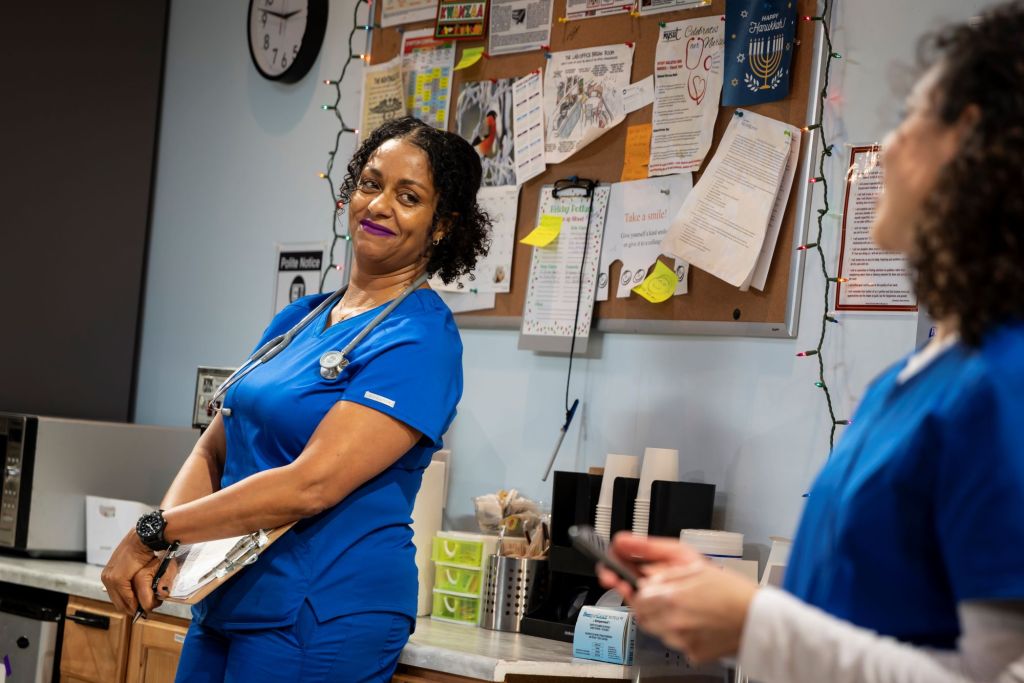
Emilia, the kindest, most compassionate of the group is recently divorced and recovering from the psychological stresses of working through COVID’s long hours, extraordinary emotional demands and understaffed conditions. However, she does admit to Amy that Josephine’s presence is disruptive and adds to their stress, when they should be able to take their breaks from ICU high anxiety in peace.
No one confesses. However, Organ does reveal the addict at the end of Act I. Instead of judgment, Organ’s sympathetic characterizations and the actors’ acute ensemble work create empathy. We easily identify with the individual who is filled with regrets and self-recrimination. In Act II, when they still do not confess, we understand that the cost is too great, as they try to handle their addiction on their own, unsuccessfully. When Josephine closes in to identify the culprit/culprits, Organ allows us to feel what it is like to be a good person stuck in a tunnel of pain and darkness with no way out.
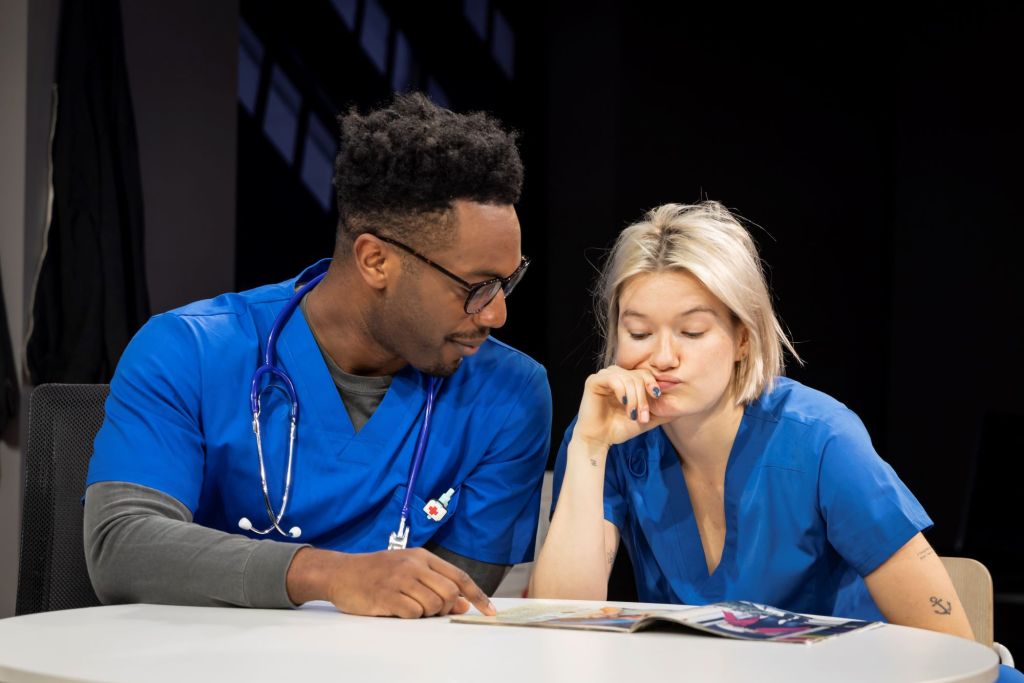
Organ’s poignant, suspenseful and humanly engaging drama has strong elements of comedic relief so we appreciate the relationship dynamic among the nurses which is both tense and humorous. Importantly, the play’s subject matter is topical. It focuses on nurses as the heroes of healthcare. They have been underestimated, underappreciated and, like military veterans, ill-used without proper support. Of course, the opioid epidemic should be front and center in light of our failing healthcare system which is under duress and about to be further de-funded with impactful cuts to Medicaid and possibly Medicare.
Though the production might have run without an intermission to heighten the suspense, director Seth Barrish incisively shepherds the excellent cast for maximum understanding and empathy. The set, costumes, props and lighting cohere with what one imagines of a hospital ICU break room for staff, who seek its respite without gaining comfort, especially since they are suspects of an investigation that can have no happy outcome.
Diversion
The play runs 95 minutes with one intermission through December 21, 2025 at The Barrow Group Performing Arts Center, Studio Theater (520 8th Ave, 9th floor). Barrowroup.org
‘The Burning Cauldron of Fiery Fire,’ Anne Washburn’s Challenging, Original Play
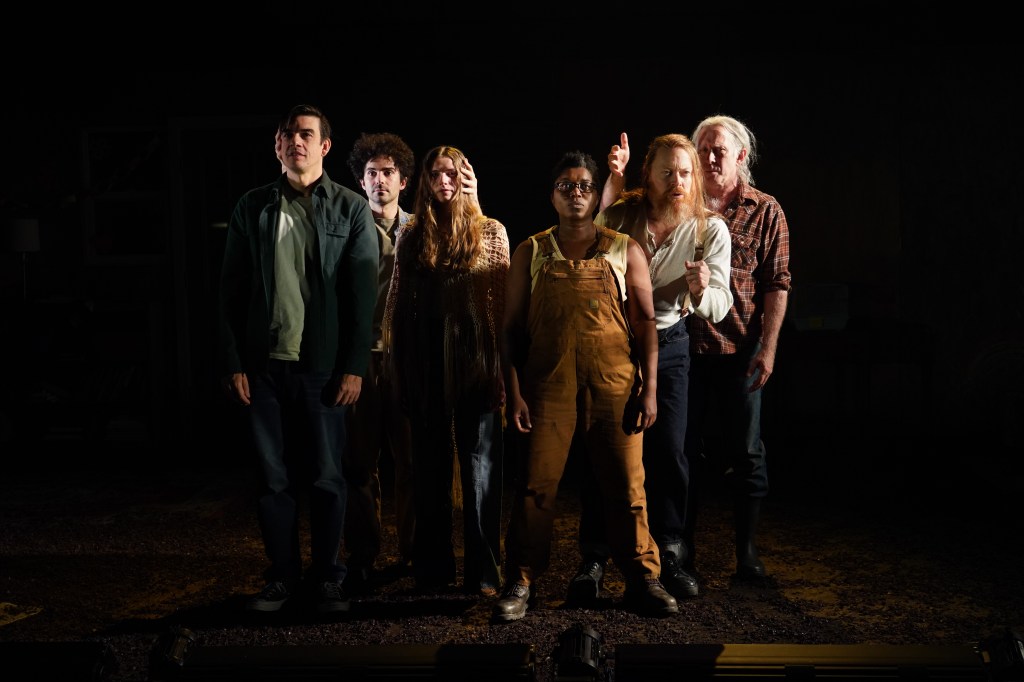
Known for its maverick, innovative productions, the Vineyard Theatre seems the perfect venue for Anne Washburn’s world premiere, The Burning Cauldron of Firey Fire. Poetic, mysterious and engaging, Washburn places characters together who represent individuals in a Northern California commune. When we meet these individuals, they have carved out their own living space in their own definition of “off the grid.” Comprised of adults and children, their intention is to escape the indecent cultural brutality of a corrupt American society, where solid values have been drained of meaning.
Coming in at 2 hours, 5 minutes with one 15 minute intermission, the actors are spot-on and the puppetry engages. However, the play sometimes confuses with director Steve Cosson’s opaque dramatization of Washburn’s use of metaphor, poetry and song. More clearly presented in the script’s stage directions, the production doesn’t always theatricalize Washburn’s intent. Certainly, the themes would resonate, if the director had made more nuanced, specific choices.
The plot about characters who confront death in their commune in Northern California unfolds with the stylized, minimal set design by Andrew Boyce, heavily dependent on props to convey a barn, a kitchen and more. The intriguing lighting design by Amith Chandrashaker suggests the beauty of the surrounding hills and mountains of the north country where the commune makes its home.
The ensemble of eight adult actors takes on the roles of 10 adults and 8 children. Because the structure is free-flowing with no specific clarification of setting (time), it takes a while to distinguish between the adults and children, who interchange roles as some children play the parts of adults. The scenes which focus on the children (for example at the pigpen) more easily indicate the age difference.
The conflict begins after the members of the commune burn a fellow member’s body on a funeral pyre to honor him. Through their discussion, we divine that Peter, who joined their commune nine months before, has committed suicide, but hasn’t left a note. Rather than to contact the police and involve the “state,” they justify to themselves that Peter wouldn’t have wanted outside involvement. Certainly, they don’t want the police investigating their commune, relationships and living arrangements which Washburn reveals as part of the mysterious circumstances of this unbounded, “bondage-free,” spiritual community.
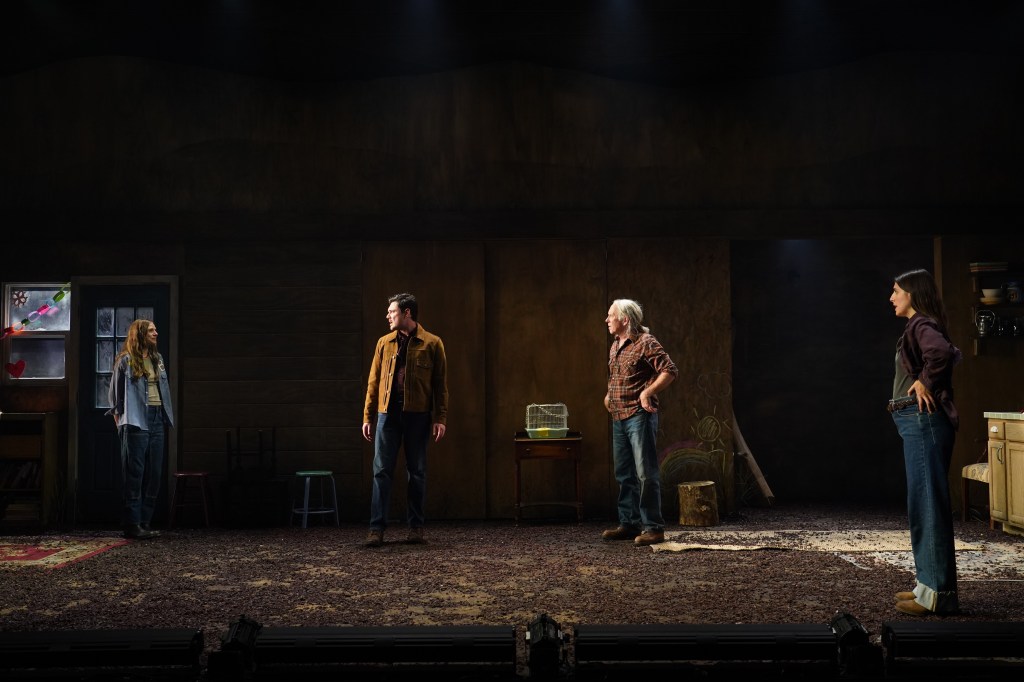
Nevertheless, Peter’s death has created questions which they must confront as tensions about his death mount. Should they reburn his body which requires the heat of a crematorium to reduce it to ashes? After the memorial fire, they decide to bury him in an unmarked grave, which must be at a depth so that animals cannot dig up his carcass. Additionally, if they keep any of Peter’s belongings, which ones and why? If someone contacts them, for example Peter’s mother, what story do they tell her in a unity of agreement? Finally, how do they deal with the children who are upset at Peter’s disappearance?
We question why they feel compelled to lie about Peter’s disappearance, rather than tell the truth to the authorities or Peter’s mom, even if they can receive her calls on an old rotary phone. Thomas, infuriated after he speaks to Peter’s mom who does call, tells her Peter left with no forwarding address. After he hangs up, Thomas (Bruce McKenzie) self-righteously goes on a rant that he will tear down the phone lines.
When Mari (Marianne Rendon) suggests they need the phone for emergency services, he counters. “Can anyone give me a compelling argument for a situation in which this object is likely to protect us from death because let me remind you that if that is its responsibility we have a recent example of it failing at just that.”
Indeed, the tension between commune members Thomas, Mari, Simon (Jeff Biehl), Gracie (Cricket Brown) and Diana (Donnetta Lavinia Grays) becomes acute with the threat of outside interference destabilizing their peaceful, bucolic arrangements. Washburn, through various discussions, brings a slow burn of anxiety that displaces the unity of the members as they work to hide the truth. What begins at the top of the play as they burn the body in a memorial ceremony that allows Thomas and the group to take philosophical flights of fancy, augments their stress as they avoid looking at hard circumstances.
Fantasy and reality clash also In the well-wrought scene where the actors portray the children moving the piglet they believe is Peter when it reacts to Peter’s belongings, specifically, a poem it chews on. Convinced Peter has been reincarnated and is with them, they take the piglet staunching their upset at Peter’s death by reclaiming and renaming the piglet as the rescued Peter. Rather than to have explained what happened, the commune members allow the children to believe another convenient lie.
This particularly well-wrought, centrally staged scene of the children in the pigsty works to explicate the behavior of the commune members. They don’t confront Peter’s death and don’t allow the children to either. The actors captivate as they become the children who relate to the invisible mom Lula and her piglets with excitement, concern and hope. It is one of the highpoints of the production because in its dramatization, we understand the faults of the commune. Also, we understand by extension a key theme of the play. Rather than confronting the worst parts of their own inhumanity, people close themselves off, escape and make up their own fictional worlds.
Washburn reveals the contradictions of this commune who parse out their ideals and justify their actions “living away from society.” Yet they cannot commit to this approach completely because of the extremism required to disconnect from civilization. As it is, they have a car, they do mail runs and sometimes shop at grocery stores. At best their living arrangement is as they agree to define it and as Washburn implies, half-formed and by degrees runs along a continuum of pretension and posturing.
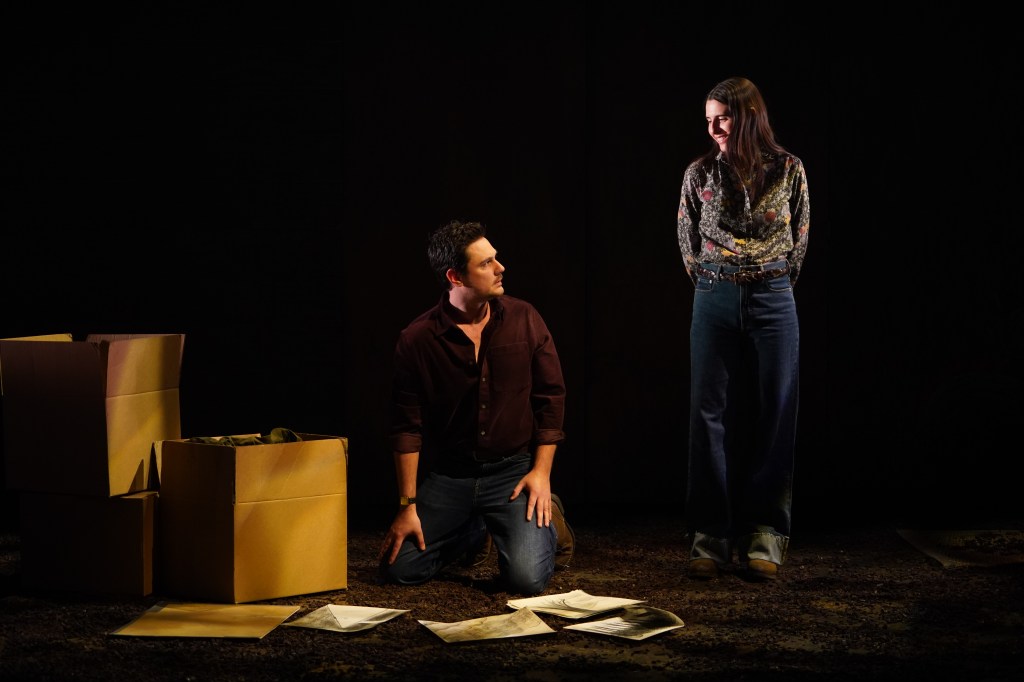
The issues about Peter’s death come to a climax when Will (Tom Pecinka), Peter’s brother, shows up to investigate what happened to Peter. Washburn ratchets up the suspense, fantastical elements and ironies. Through Will we discover that Peter was an estranged, trust-fund baby who will inherit a lot of money from his grandmother who is now dying. Ironically, we note that Mari who claims she had an affair with Peter and dumped him (the reason why he “left”), is willing to have sex with Will. They close out a scene with a passionate kiss. Certainly, Will has been derailed from suspecting this group of anything sinister.
Also, Will is thrown off their lies when he watches a fairy-tale-like playlet, supposedly created by Peter and the children that is designed to lull the watcher with fanciful entertainment.
In the fairy tale a cruel king (the comical and spot-on Donnetta Lavinia Grays), prevents his princess daughter (Cricket Brown) from marrying her true love (Bartley Booz), also named Peter. The bad king thwarts Peter from winning challenges to gain the princess’ love. Included in the scenarios are puppets by Monkey Boys Productions, special effects (Steve Cuiffo consulting), the burning cauldron of fiery flames with playful fire fishes proving the flames can’t be all that bad, and a beautiful, malevolent, dangerous-looking dragon who threatens.
Once again creatives (Boyce, Chandrashaker and Emily Rebholz’s costumes) and the actors make the scene work. The clever, make-shift, DIY cauldron, puppets and dragon allow us to suspend our judgment and willingly believe because of the comical aspect and inherent messages underneath the fairy-tale plot. Especially in the last scene when Peter (the poignant Tom Pecinka), cries out in pain then makes his final decision, we feel the impact of the terrible, the beautiful, the mighty. Thomas used these words to characterize Peter’s death and their memorial funeral pyre to him at the play’s outset. At the conclusion the play comes full circle.
Washburn leaves the audience feeling the uncertainties of what they witnessed with a group of individuals eager to make their own meaning, regardless of whether it reflects reality or the truth. The questions abound, and confusion never quite settles into clarity. We must divine the meaning of what we’ve witnessed.
The Burning Cauldron of Fiery Fire runs 2 hours 5 minutes with one 15-minute intermission at Vineyard Theatre until December 7 in its first extension. https://vineyardtheatre.org/showsevents/
Ashland Independent FF, ‘The Long Long Night,’and Panel with Bruce Campbell on Indie Films
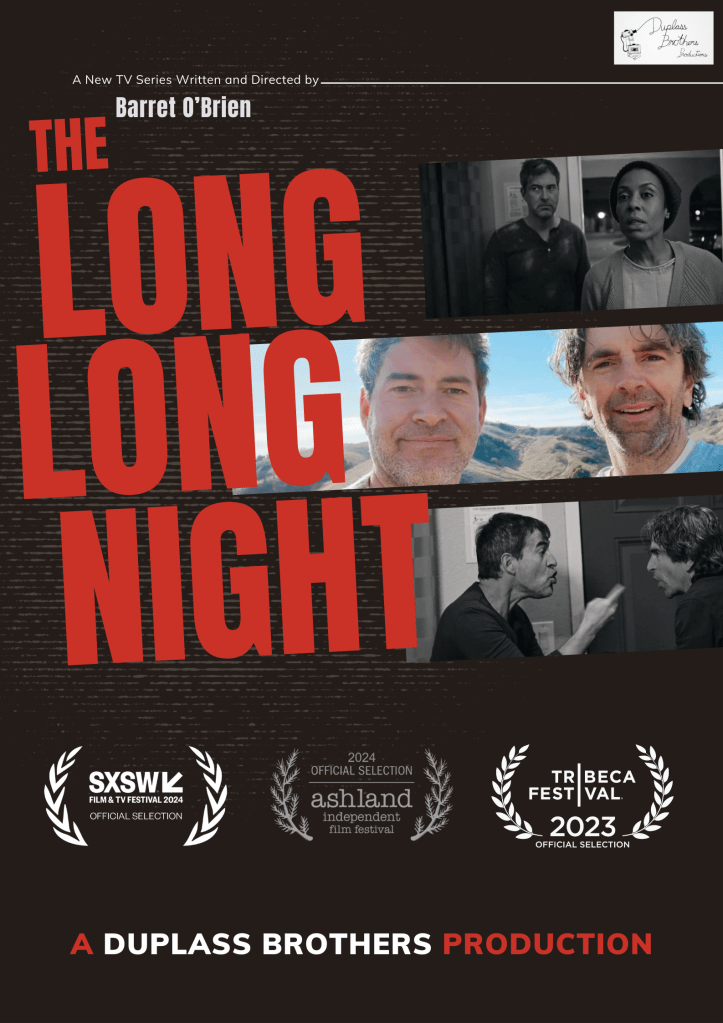
Revisiting The Long Long Night at Ashland Independent FF
I reviewed The Long Long Night when it premiered at Tribeca Film Festival in 2023, which you can read at this link, Tribeca Film Festival Review: ‘The Long Long Night’ With Mark Duplass and Barret O’Brien. I thought the indie series slated for TV, was superbly acted by New Orleans’ natives, the inimitable, Emmy award-winning Mark Duplass, and writer/director Barret O’Brien, who wrote and directed the clever, humorous episodic.

The six episodes of The Long Long Night coalesce around issues of our time in a send up of “white bros” attempting to negotiate a fine balance between screaming into the void of “political correctness,” living an “intentioned” life, and hammering macho male toxicity that uplifts Joe Rogan’s “all that” ethos. In a brilliant and sardonic twist to the “shining white maleness,” Emmy-nominated actor, Karen Pittman, guest stars in a hilarious episode. Her contribution is a counterpoint of “female, Black intention” that is not to be missed.
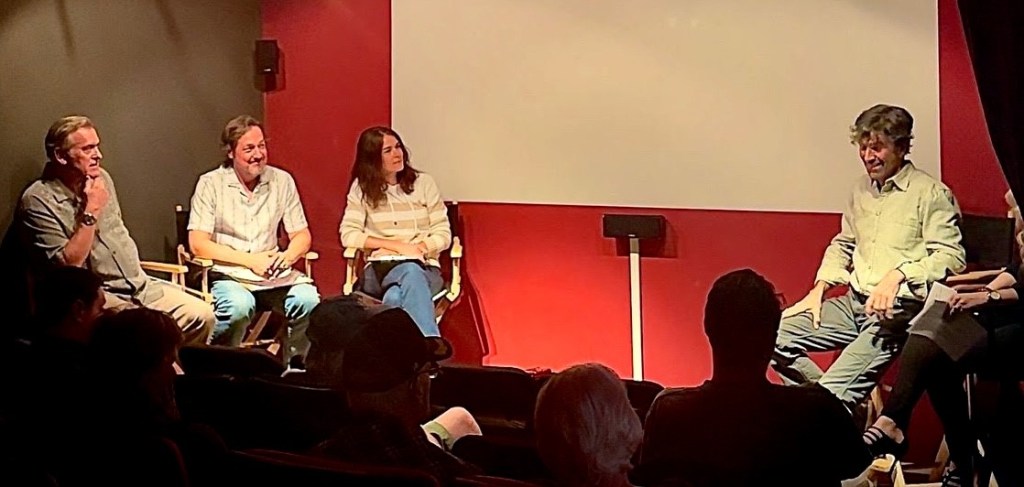
“Future of Indie Filmmaking” (Rory O’Neill Schmitt)
After the 2023 Tribeca premiere, the Duplass Brothers Productions series screened in 2024 at Ashland Independent Film Festival October 2024. Before the screening a panel discussion on the
“Future of Indie Filmmaking” was held. Present at the discussion were actor and writer Barret O’Brien and Rory O’Neill Schmitt, producer of The Long Long Night. Joining her were director, Gary Lundgren, as well as Oregon-based producer Annie Lundgren (Above the Trees).
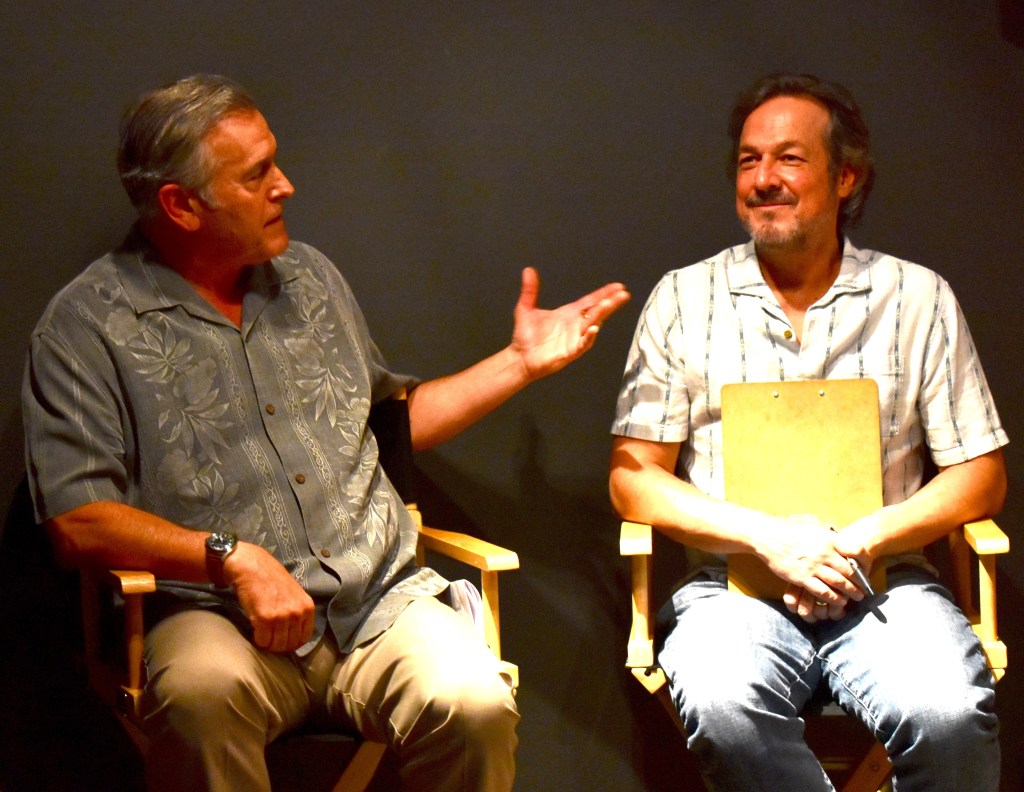
Bruce Campbell
Adding his knowledge, experience and expertise was special guest actor, producer, screenwriter and director Bruce Campbell. Bruce is most widely recognized for originating the role of protagonist Ash Williams in the cult classic, supernatural horror film The Evil Dead (1981). The film has been cited as among the greatest horror films of all time, and Ash Williams has become a cultural icon. From its success, subsequent films blossomed into a media franchise including a TV series, video games and comic books. Campbell, appeared in the films and is also noted for other work including USA Network series, Burn Notice (2007–2013). For the gift that keeps on giving, Campbell reprised his role as Ash for the Starz series Ash vs. Evil Dead (2015-2018). Campbell is currently finalizing his latest film, Ernie and Emma, which was filmed in Oregon.

During the panel filmmakers discussed how to create a successful indie film project, making vital creative choices despite limited resources. Panelists also discussed the importance of using maverick approaches to independent film production and distribution.

Follow-up interview between Rory Schmitt and Bruce Campbell
In a follow-up discussion Rory O’Neill Schmitt honed in on specific questions for Bruce Campbell about the future of independent film. His advice for up-and-coming filmmakers was based on his experiences, including those working with Evil Dead writer/director Sam Rami. Campbell was with Rami at the outset in 1978 working on Within the Woods, the short film which became the Evil Dead. Campbell contributed his creativity and efforts in subsequent films and the TV series in the franchise.
Rory Schmitt (RS): What do you think is the future of indie film?
Bruce Campbell (BC): The future is bright, as long as filmmakers are willing to work outside the studio box and often finance their own work. Independent movies have never been easier because of technology and the amount of platforms to exhibit the finished product.
Rory Schmitt (RS): What continues to draw you to making independent films? What do you feel audiences like about independent films?
Bruce Campbell (BC): I am drawn to independent films because they are the closest to being a single view, a single vision, whereas studio flicks are often driven by popularity. Stories can be more daring and original with indies because studio films feel the need to appeal to a wider audience, so the stories have to be more bland and “appealing.” Indie films can be way more daring.

Rory Schmitt (RS): Can you tell us about your upcoming feature film, Ernie and Emma (shot in Oregon)?
Bruce Campbell (BC): Ernie and Emma is a bittersweet tale of pear salesman Ernie Tyler who is entrusted with his wife’s ashes after she passes. As an executive secretary of a sawmill for 25 years, she has very specific ideas of what to do with her remains – not all of it warm and fuzzy nostalgia. I describe it as “Hallmark with swearing,” a sunrise story where ultimately Ernie learns to move on – with a little help from his wife.
Rory Schmitt (RS): Do you have any advice for emerging filmmakers?
Bruce Campbell (BC): If you avoid the following three systems, you will come out ahead in life: the legal system, the medical system, and the studio system. As a filmmaker, the only freedom you’ll have is owning/controlling your negative. Also, don’t be ignorant about business – learn the ins and outs of contracts, partnerships and financing, domestic and international. Educate yourself!
Look for The Long Long Night, Ernie and Emma and Hysteria (another project with Bruce Campbell on Peacock).
 CAROLE DI TOSTI