Blog Archives
‘Jonah,’ Working Through Trauma Over Time

The world premiere of Jonah by Rachel Bonds directed by Danya Taymor and presented by Roundabout at Laura Pels Theatre, Harold and Miriam Steinberg Center for Theatre, is in a limited engagement until March 10th. Billed as a “coming of age story,” Jonah follows a young girl traumatized by events after her mother joins up with a man and his sons. This becomes an untenable living arrangement from which she and her mother cannot escape, all of which we learn through her dialogue with three characters.
In a nonlinear fashion, with sketchy details, Bonds reveals Ana’s backstory by degrees, as Ana (Gabby Beans-The Skin of Our Teeth) interacts with Jonah (Hagan Oliveras), Danny Samuel H. Levine (The Inheritance), and Steven (Good Night, Oscar), throughout undefined time sequences. Using obscurity, intimation, opacity and mystery as key devices to unfold how the “slings and arrows of outrageous fortune” have impacted the main character Ana, we gradually learn how traumatic events might be worked through with fantasy and the imagination to promote redemption and healing.
Bonds opens the play with Ana at an unspecified educational setting, most probably a private high school where Ana tells Jonah she is on a scholarship. Jonah (the adorable, exceptional Oliveras), walks with her and engages her in friendly conversation. Ana, who attempts to remain aloof, eventually allows him to follow her up to her dorm room after a few interactions outside her dorm. In the next few scenes, Jonah and Ana grow closer and share intimate details about their sex lives. Both are virgins and their intimacy never really “gets off the ground” into something sexual, though what they do share is profoundly substantive, sweet and loving.

The manner in which Jonah leaves, and the fantasies Ana shares about her being in love and sexually fulfilled, indicate the possibility that Jonah is her fantasy. He is the way she wishes a partner in love might be: sweet, caring, solicitous about her comfort, flattering, overwhelmed by her beauty, and articulate to the extent that he engages her trust and faith. It is these qualities that elicit her reciprocation, until shockingly, at the “twinkling of an eye,” he falls back into the blackness of the doorway.
Bonds shifts the time in the next segments. The playwright introduces another character, Danny, who is troubled, confused, traumatized. Though Wilson Chin’s set design remains the same, unobtrusive beige (rugs, bed linens, walls, etc.,), Danny appears at her doorway, taking the place of the sweet Jonah. We learn Ana’s mother has died, after remarrying a violent alcoholic with two sons. He abuses son Danny because he stands up to him. Through Ana and Danny’s dialogue we learn that her stepfather is also brutal to Ana emotionally, but stops at the point of physicality. However, the intimation is that soon he will go after Ana, and perhaps he has already abused her with inappropriate sexual touching.
In Ana’s scenes with Danny, we note how she comforts him and helps him cope with his father’s abusive beatings, either attempting to dress his wounds or give him a head massage. Clearly, Danny is protecting her by taking the brunt of his father’s alcoholic abuse, and he goes to her in kinship for comfort. Bonds doesn’t clarify how her mother died. Nor does she explain what happened to her sisters, referenced in a photo she discussed in the previous scenes with Jonah.

The one positive element in the series of events in the Danny sequences is that Ana is excellent in school and is pursuing writing which helps distance her from the terrible home circumstances. Apparently, Danny effects their escape before the stepfather sexually abuses Ana, who avoids discussion of the specific details of their situation. However, because Danny references that he brought Ana and his brother to a safe place, we note that Ana possibly feels an obligation to comfort Danny.
In one scene when Danny visits her drunk in her new location, presumably another school setting where she is pursuing her writing, they are intimate. The experience isn’t pleasant, but she permits him to “deflower” her out of pity. Because he is “out of it,” he doesn’t realize what he is doing until after it is over and Ana withdraws from him and becomes remote. In the final Danny segment, he reads an assignment that she has written about him, though she attempts to explain it awat. He is so upset by her view of him that he cuts himself to release the pain of what he interprets to be her censure and loathing. As he goes into shock, she is forced to get help to take him to the hospital to stem the bleeding.
Once again, the scene shifts and a new young man appears at the doorway of the same beige room which by now we gather is a combination of Ana’s memory, a fabrication of an alternate reality that Ana constructs to help herself emotionally, or a dorm-like setting in the future that manifests some elements of objective reality. As Ana converses with Steven (John Zdrojeski), the dialogue lets us know the setting has changed to a writing retreat, and Steven is concerned why she is not dining with the other writers. During their conversation, Steven discloses he has read her novel and found it fascinating. As he attempts to become closer to her through his kind manner and friendly conversation, we note that he is more like Jonah from the first segments.
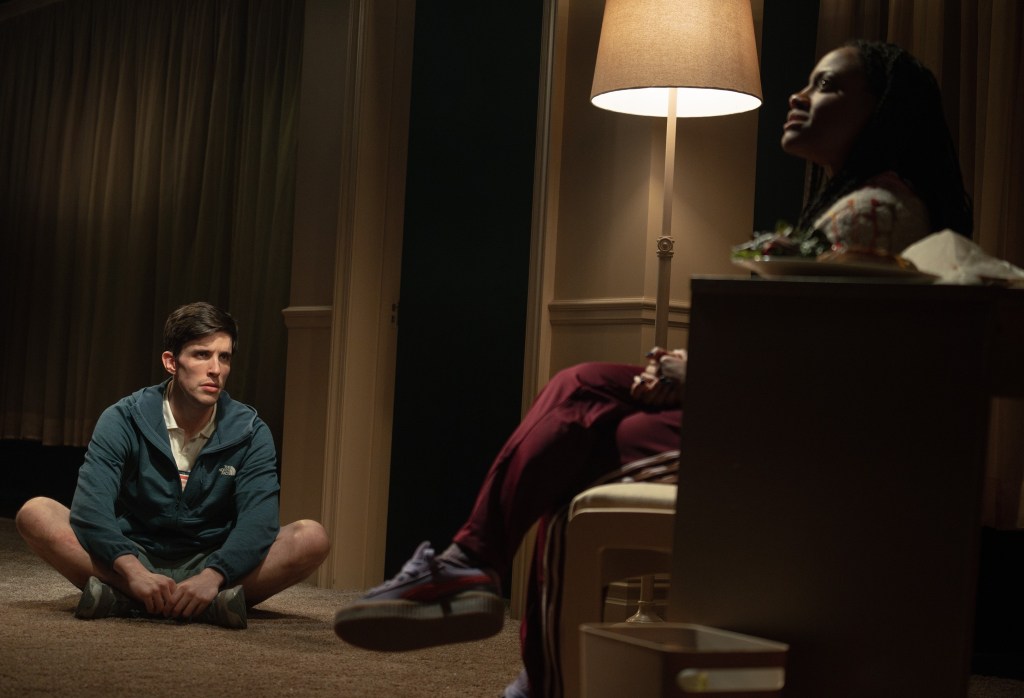
It is in this final segment with Steven that Ana discloses Danny committed suicide. The impact of this years later and the events that occurred in the past Ana relates to Steven, a lapsed Mormon because he wants to know about her family situation and her writing. During these segments with Steven, there is a scene when Jonah returns. He reaffirms their connection from the past. They discuss how they missed each other and Jonah apologizes for perhaps having done something that disconnected their relationship and closeness.
In this last meeting with Jonah, we realize that Jonah is symbolic. Perhaps, he is a configuration of her psyche that is her male counterpart. Perhaps he is a fantasy she uses to bring her to closure, so she can establish an intimacy that will help her overcome the previous traumas and unhealthful relationship with Danny.
Jonah and she briefly reunite in a healing moment and then he leaves. At the right time, Steven who has fallen asleep by her bedside, while Jonah visited, awakens.
It is after her visit with Jonah that Steven and Ana discuss the nature of intimacy and sex. Additionally, she is able to discuss God and answer Steven’s questions. As she describes her experience, we understand the impact of the past traumas. They disassociated her from her body and her faith in God. The pain was so great she went into a deep freeze and felt nothing, nor did she want to feel anything. However, the disassociation became a form of recuperation and allowed her an emotional pause. Eventually, as a result of it, she can begin to restore herself with a loving relationship, release the guilt and shame and become whole again.
During her discussions with Steven, they move to establish a closer, comfortable relationship, as Steven checks to make sure she is comfortable with him. Ana becomes reconciled to herself. She and Steven begin a more intimate chapter in their lives as Bonds concludes on an up note.

Bonds’ play is about the healing process after trauma and how individuals use elements of their own humanity to work through terrible events from their past. She merges fantasy and reality, past and present and cleverly uses the dialogue to identify emotional, psychological time so that we understand the nature of how physical violence and abuse may be worked through. Bonds’ conclusion shows Ana and Steven concerned for each other, unlike Ana’s incomplete, painful relationship with Danny, where Ana nurtured him as far as possible, but she wasn’t enough for him.
Bonds keeps us intrigued, though at times, the dialogue needed tightening. I drifted during some parts. I found the scenes with Jonah the most uplifting and credit Oliveras, who is sensational and believable as the forthright and candid Jonah. Levine has the most difficult role as Danny. His portrayal of Danny as broken, and as a taker is spot-on. Yet, despite the undercurrent of violence and overt neediness, Levine’s Danny is poignant. Additionally, he clarifies that, though Danny apologizes to Ana, we note that he is following in his father’s footsteps. He desperately needs help which Ana cannot give him or she will herself drown.
That she nearly does drown emotionally then closes off herself is a protective device against Danny, who has been so abused, he seeks suicide as a release for his inner torment. The extent to which his suicide impacts Ana and makes her feel guilty is intimated but not spelled out.
Zdrojeski’s Steven is a welcome contrast after Levine’s angst-filled Danny. His tenderheartedness recalls Jonah’s innocence and kindness. That Zdrojeski’s Steven is like Jonah in the concern expressed for Ana’s well being, as well as the admiration of her talent, creates the hopefulness that Bonds wishes for Ana’s emotional recovery. Beans’ Ana and Zdrojeski’s Steven remind us in a world of hurt, torment and violence, there are kind and loving individuals. Perhaps they are there when one doesn’t look for them or more importantly, when one is ready to work through one’s guilt, recrimination and pain.
Though Bonds ends the play affirmatively with Steven and Ana learning to be intimate with each other, she leaves many questions unanswered. What have we just envisioned? Were the scenes mere sketches in Ana’s psyche that are fantastical but not really grounded in objective reality? Or do they convey fictional accounts in Ana’s writerly imagination? Such is the nature of consciousness and the layers of personality when confronting trauma, abuse, violence so that the events tend to merge fantasy and reality in the haze of wounded memory. Taken on that level, Bonds’ work is fascinating and valuable.
The creative team effects Taymor’s unity of vision with Bonds’ themes with effective stylization,. Wilson Chin’s set design defines the place in Ana’s mind which never changes. Kaye Voyce’s costume design similarly remains the same for Ana and the characters with only two tops varying down through the years as Ana’s mind leaps in time segments. Likewise, Tommy Kurzman’s hair design (it stays the same), follows Taymor’s and Bonds’ vision that objective reality has been overcome by Ana’s interpretation and perspective in her conversations as she grapples with the past in her imagination in the present.
Likewise, the light flashes which signify a change in time sequence (Amith Chandrashaker’s lighting design), give structure to the scenes. The overall softness in the lighting when Ana is “in the room” with the young men, appropriately echoes the dimness of memory and hazy suggestion of imagination. Kate Marvin’s sound design accompanies the lighting flashes symbolically and indicates the shifts in time, reality, imagination.
The theme that over time one may heal from past emotional devastation, if one has the will to do so, is a hopeful one. Though we don’t understand all of Ana’s derivations through reality, fantasy, memory, flashback, objective reality, we do understand that she wants to release herself from the pain, and redeem herself so she can be intimate and open to love again. How Bonds effects this process is striking. The performances are terrific. And Beans sustains her energy and vitality throughout.
Jonah, Laura Pels Theatre Harold and Miriam Steinberg Center for Theatre, 111 West 46th Street between 6th and 7th for the Box Office. For their website: https://www.roundabouttheatre.org/get-tickets/2023-2024-season/jonah/
‘Anatomy of a Suicide’ by Alice Birch at Atlantic Theater Company
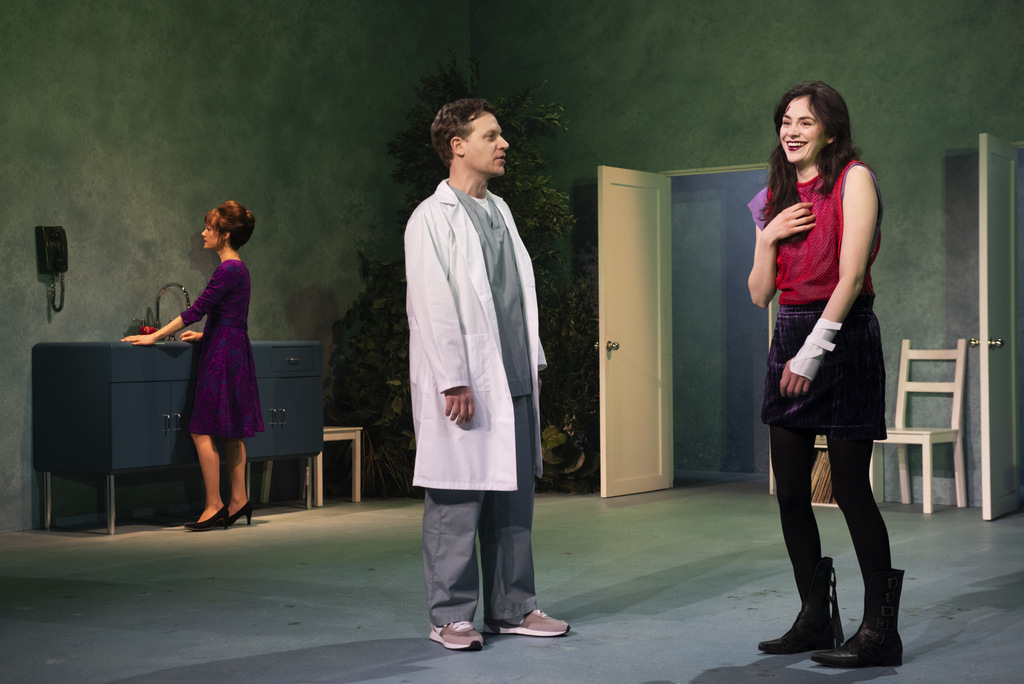
(L to R): Carla Gugino, Vince Nappo, Celeste Arias, ‘Anatomy of a Suicide, by Alice Birch, directed by Lileana Blain-Cruz (Ahron R. Foster)
In Anatomy of a Suicide written by Alice Birch directed by Lileana Blain-Cruz, the playwright examines suicide’s ancestral relativities between and among mothers and daughters. Underlying the developmental arc and structure of her complex play, Birch examines many questions. Two which appear to pertain the most directly are the following. What is the likelihood that a mother’s depressive, suicidal personality may be inherited as part of the familial DNA passed down through generations? If a mother commits suicide, what is the likelihood that her daughter will be unable to overcome the death impulse to follow her mother’s example, unconsciously nurtured by her mother to that end?
Currently running at Atlantic Theater Company’s Linda Gross Theater, Birch’s Anatomy of a Suicide won the Susan Smith Blackburn Prize in 2018. Indeed, her approach to the topic is structurally unique and worthy of the tremendous efforts of the cast and director to reveal the mysterious bond between mothers and daughters that moves them in the direction of soul immolation.
Birch displays three generations of mothers and daughters: Carol (Carla Gugino) her daughter Anna (Celeste Arias) and Anna’s daughter Bonnie (Gabby Beans) on stage concurrently in real time. She unwinds their characters until they reach their apotheosis. They exist in different decades in the 20th and 21st century but appear before us in the present. Each mother anticipates the depressive ethos of her daughter in some of her interactions with others: spouse, friend, family.
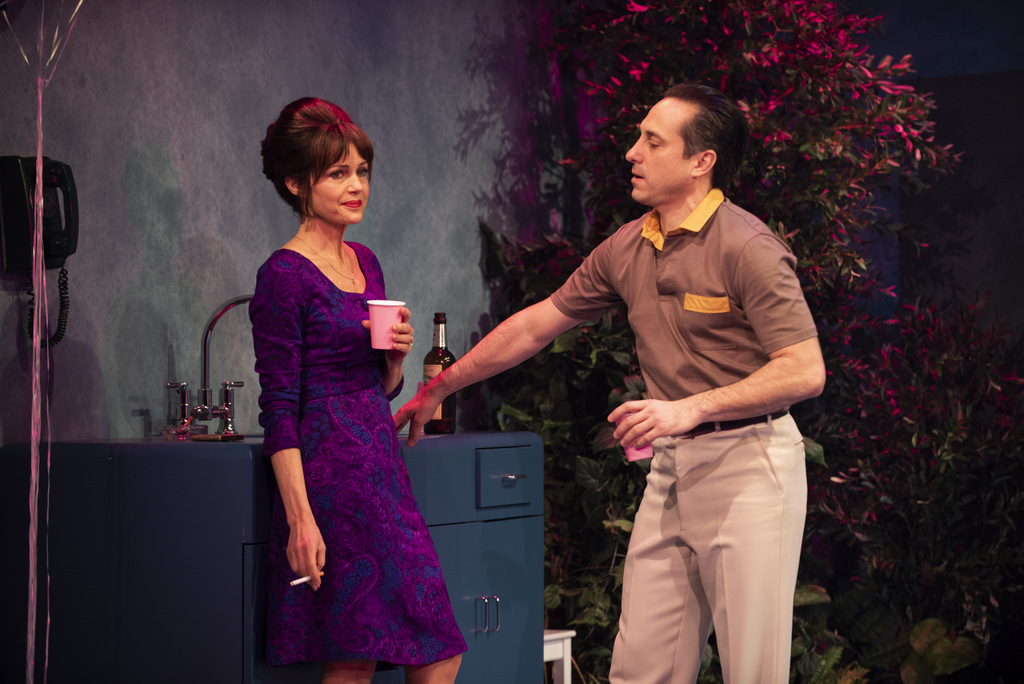
Carla Gugino, Jason Babinsky in ‘Anatomy of a Suicide,’ by Alice Birch, directed by Lileana Blain-Cruz (Ahron R. Foster)
Birch sets these three components of the depressive state in each character on stage simultaneously with their ancestral counterparts by defying the space/time continuum. As each character depicts her own manifestations of her condition, sometimes the dialogue overlaps repetitively as if a time warp occurs and you are allowed to see how the mother has impacted the daughter in the future (i.e. how Carol impacted Anna). Usually, Birch features a key vignette with one character while the other two draw inward. For example while Anna has a scene with a doctor, Carol is occupied in an action, i.e. cutting apples, smoking, etc. and Bonnie is involved in her own action. When their dialogue overlaps and there is a synchronicity of time and space, a still point of connection occurs.
Birch uses this structure of simultaneity, rhythmic dialogue, repetition and overlap to stimulate the audience’s dissection and analysis of the characters. Perhaps it is to understand how suicidal depression in the case of this family leaps genetically (?) telepathically (?) from mother to daughter without knowing the etiology of each woman and specifically how or if such a transmission occurs. Birch depicts Carol’s, Anna’s and Bonnie’s depressive, addictive and emotional isolation in events unique to each and not in chronological order, but always simultaneously. However, though we see the symptoms and reactions which are the tip of the iceberg, we never know the rationale why these women are suicidal because it is unknowable. It is unconscious. Thantos, the death impulse exists in each of us, as does eros, the life impulse. Why does one overcome the other in these women is not what concerns Birch. That it is there in this family group is enough to investigate and atomize.
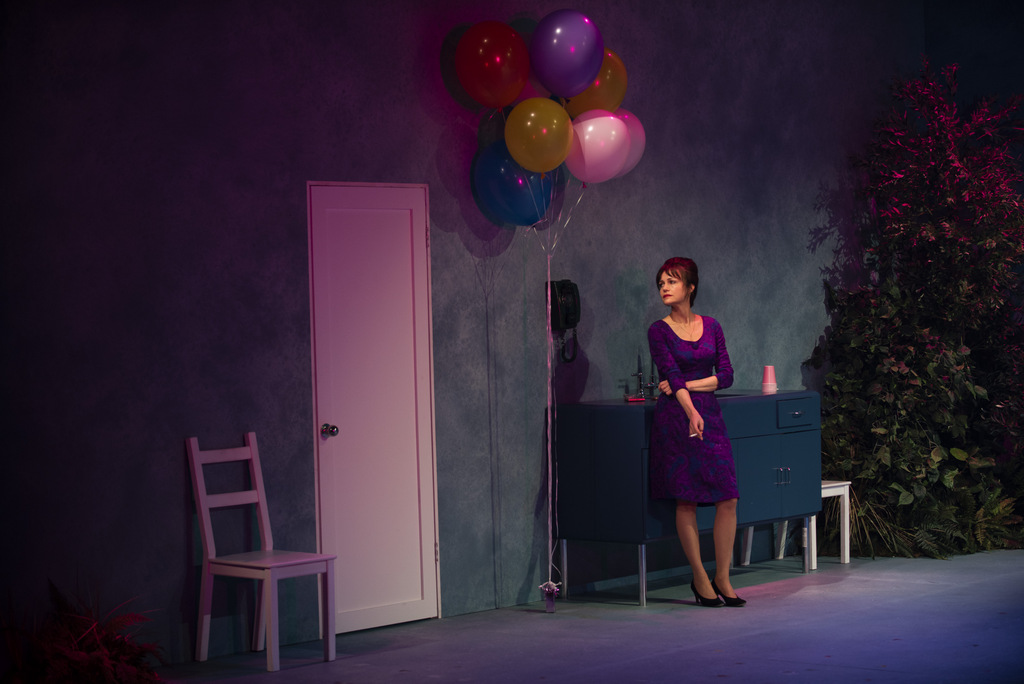
Carla Gugino in ‘Anatomy of a Suicide,’ by Alice Birch, directed by Lileana Blain-Cruz (Ahron R. Foster)
For Carol and Anna the suicidal impulse is acute at the outset of the play. Carol’s husband John (Richard Topol) confronts her about her bandaged/sliced wrists and her thoughtful accommodation for him to have enough dinners for a week or so, which she has cooked and frozen for him to thaw out after her death. Such premeditation is crystal clear; she has thought about what she will do and planned for it, yet she tells John everything is “fine.” Later in her segments the evidence mounts and we understand why “it is fine.”
For his part, John confronts her with great passivity, an element of her depressive state she perhaps wishes to conclude with finality. Divorce would not be final enough, we learn in a subsequent later vignette that is companionable to a simultaneous event with Anna and Bonnie. Nevertheless, John is frightened, yet incompetent to handle her. Through various scenes he cannot read her or cogently, effectively deal with her flattened affect that hides the dark abyss within. Carol’s various scenes unfold tied not to a time order but to a thematic familial order with her daughter Anna and Granddaughter Bonnie who demonstrate their own angst: Anna in her relationship with her spouse Jamie (Julian Elijah Martinez) and Bonnie in her interest and relationship with Jo (Jo Mei ).
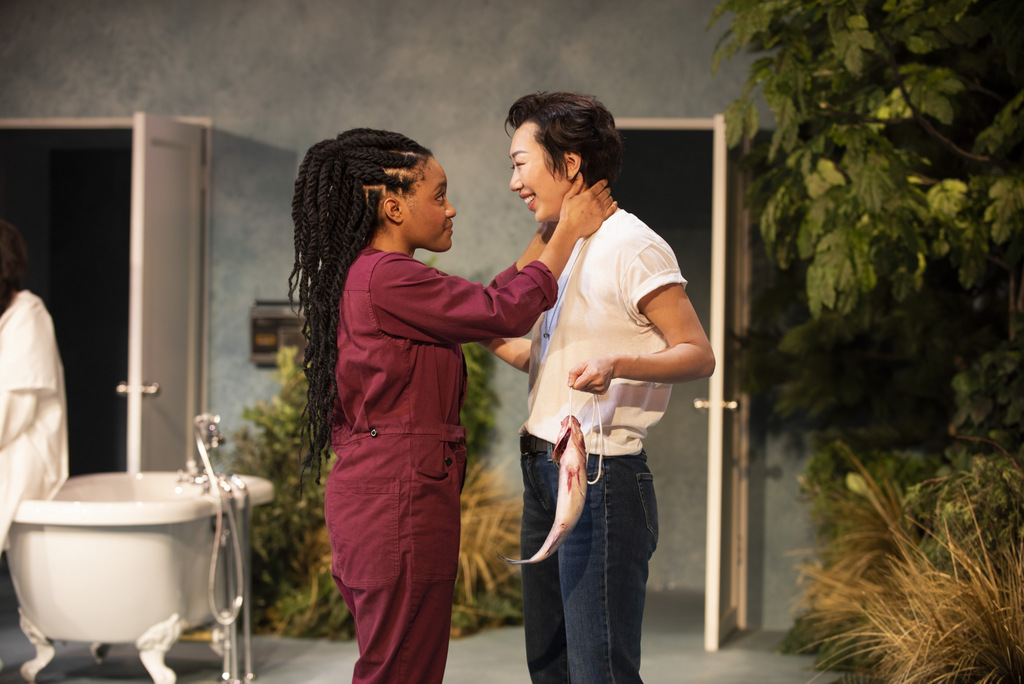
(L to R): Gabby Beans, Jo Mei in ‘Anatomy of a Suicide,’ by Alice Birch, directed by Lileana Blain-Cruz (Ahron R. Foster)
A telling event occurs during Carol’s pregnancy and after baby Anna is born. We and John understand that she will never have another child; sex is not pleasurable and she is only staying in the marriage to raise their daughter. Each vignette reinforces Carol’s intense emotional interior trauma that Carla Gugino’s brilliantly flickers to the surface through the character’s strained, straight-lipped smile, wooden responses and modulated, refined voice.
What happened to her, to Anna, to Bonnie? Why are they depressed? Does the historical cause matter if it is genetic, a brain disorder or some other causation that is beyond the kin of the medical profession? Interventions are tried to no avail: shock therapy, perhaps rehab for Anna for her drug addiction. Nothing works. No human interaction satisfies to stem the death impulse.
We realize Carol is fine when she succeeds in achieving her goal in life. By the end of her scenes (she is staged on the far left as the progenitor mother of depression in the 20th century) we come to understand why Carol responds as she does to John that she is “fine.” Her mind is made up. She has planned and most probably will continue to plan and justify her suicide to herself because her pain is relentless, without limit, infinite as long as she is in her body. Thus, when we finally learn that she has killed herself, it is anti-climactic. The same is not true for Anna who, in her vignettes, gyrates between anxiety and calm, hyperactivity and peace with husband Jamie.
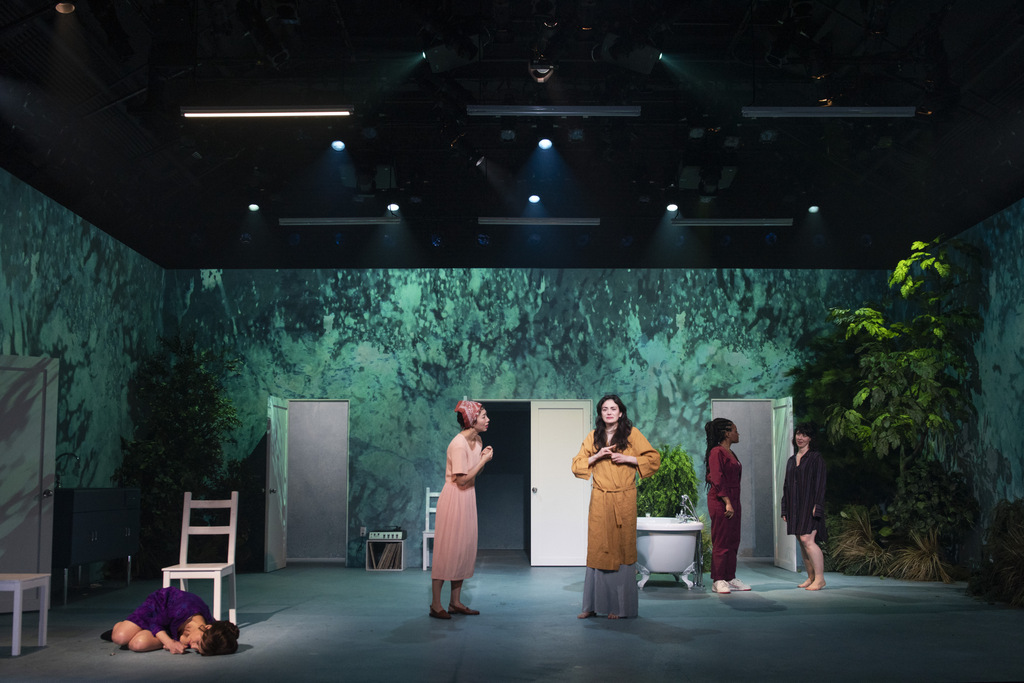
(L to R): Carla Gugino, Ava Briglia, Celeste Arias, Jo Mei, Gabby Beans in ‘Anatomy of a Suicide,’ by Alice Birch, directed by Lileana Blain-Cruz (Ahron R. Foster)
Regardless, Birch blindsides us and Carol’s and Anna’s spouses with their suicides to end the roiling hell within. For Carol we know it is coming, yet when we hear of it surprisingly tucked into a conversation, we remember her memorial to herself, “I’m fine.” Anna’s suicide is as Anna is, dramatic.
At the outset of the play when Carol and John have their discussion about Carol’s suicide attempt and she affirms she’s “fine,” Celeste discusses with a doctor friend (Vince Nappo) the necessity for an injection in a frenetic insistence to charm him. The doctor knows what she wants and ignores her despite her lightening responses and “hail good fellow well met” justification for it. Her heightened state, during which she discounts how she broke her arm, is like an episode of rapid recycling in a bi-polar disorder patient. In their synchronized scenes, obviously, both women display warning signs that they are ripe for suicide, but in their own personalities and iterations which are antithetical.
Perhaps, Birch posits one clue for Carol’s and Anna’s dark intentions and eliminates it for Bonnie. Carol’s and Anna’s intolerable misery is exacerbated when they become pregnant and have their daughters. Does this symbolize the end of their lives? Indeed, Celeste’s nihilism appears even greater than Carol’s and her commitment to killing herself happens in hyperbole part of the up/down of her life that Birch reveals is her nature. On the other hand Bonnie solves the problem of mother/ daughter suicidal ideation carried to her through an inherited gene pool. A doctor, Bonnie makes a canny choice about relationships and doesn’t put herself in the position of her grandmother and mother. But perhaps she is her father’s daughter, not her mother’s. Again the etiology is never clarified, not that it should be.
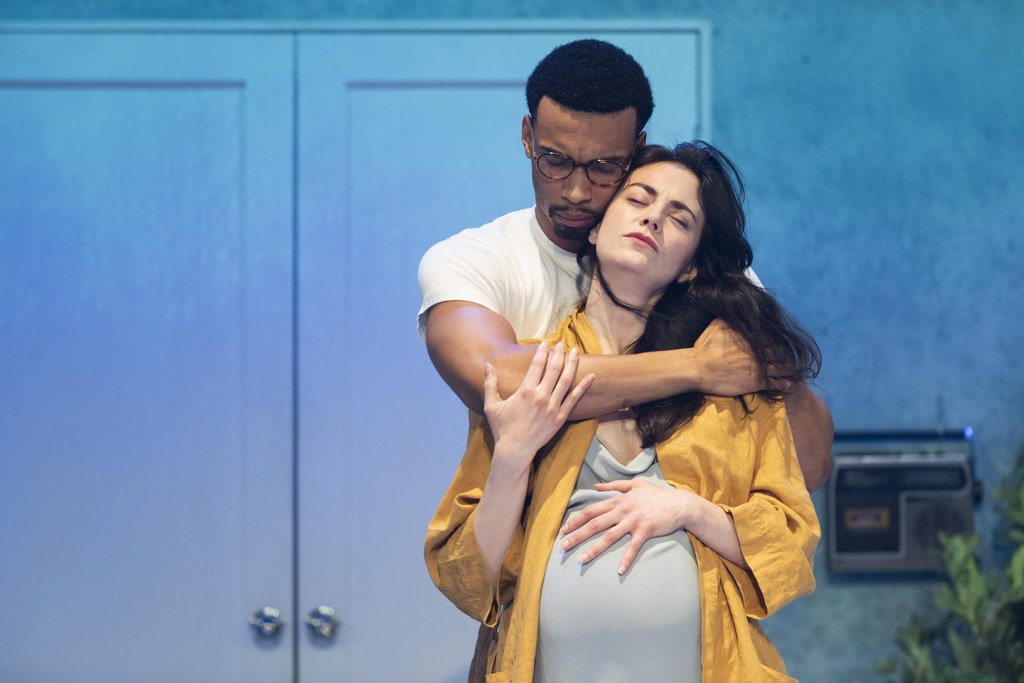
Julian Elijah Martinez, Celeste Arias, ‘Anatomy of a Suicide,’ by Alice Birch, directed by Lileana Blain-Cruz, Atlantic Theater Company (Ahron R. Foster)
The play intrigues with the everpresent present of three women in the same family reflecting how they respond to the unchanging underlying death impulse as it manifests with synchronicity in Carol, Anna and Bonnie over time, yet also with different and particular iterations based upon each individual woman. Staged simultaneously across three time periods, we think we can understand the suicidal threads in these characters and especially that Bonnie doesn’t physically move a hand against herself.
At times refocusing which vignette to watch to break through the overlapping dialogue was challenging. However, the uniform superb acting drew out the sequences appropriately and the pacing of the dialogue was letter perfect so that the key lines to be repeated resonated with rhythmic precision.
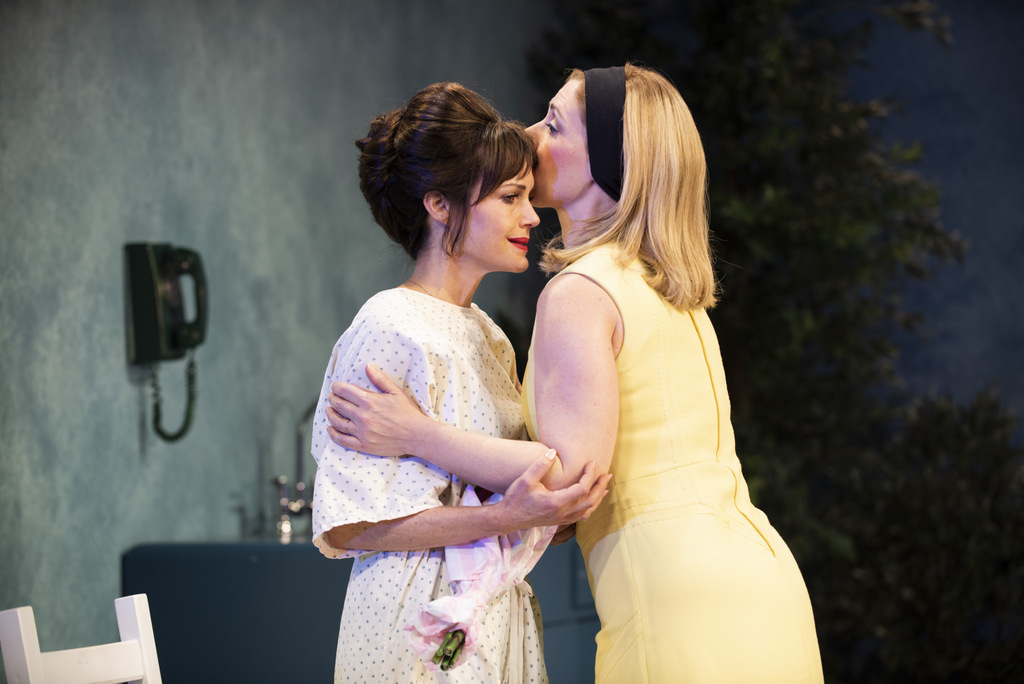
(L to R): Carla Gugino, Miriam Silverman in ‘Anatomy of a Suicide,’ by Alice Birch, directed by Lileana Blain-Cruz, (Ahron R. Foster)
The set whose three walls are painted a green-blue color and beset with complementary plants appears vibrant on first inspection. However, the wash basin in Carol’s space which looks like those in a doctor’s office with the high curving faucet, and a bathtub with similar faucet in Anna’s space convert the set toward the clinical and sterile. This is so despite the ensemble bringing in tables to suggest dinners with friends and other activities.
The set puts one on notice that this will not be a typical play about suicide with its recumbent, empathetic emotionalism. This will be as unique as the title implies and a detached, observational approach will be employed. Indeed, as we follow Birch’s presentation and the director’s shepherding of a truly superb cast, we become like scientists viewing, as if under glass familial fault-lines that break the family. It is an empty exercise and we are no closer to understanding another element of a mysterious anti-life position of human beings: the urge, necessity, the repeated will in some families, in this play mothers and daughters, to end their lives.
By the end of the play, we remain detached. Such detachment about the most violent act one can take against oneself is frightening. But the play encourages objectification for a reason. Objectification in our culture contributes to feelings of isolation. Being or feeling “the other,” not belonging, not communicating in a felt empathetic way to bridge one’s “aloneness” in pain are states of misery. Yet, for these mothers to put their daughters in that state indicates they were hopeless. It is the height of objectification, not having empathy for oneself to live to the next day. Birch’s work enlightens and devastates.
Noted are Mariana Sanchez (sets) Kaye Voyce (costumes) Jiyoun Chang (lights) Rucyl Frison (sound) Hannah Wasileski (projetions) Tommy Kurzman (wig, hair & makeup).
Anatomy of a Suicide runs at the Atlantic Theater Company (336 West 20th) with no intermission until 15th March. For tickets and times CLICK HERE.
 CAROLE DI TOSTI