Blog Archives
‘The Seagull/Woodstock, NY’ Review

The Seagull by Anton Chekhov is a favorite that receives productions and has been made into films, an opera and ballet performed all over the world. Some productions (with Ian McKellen at BAM in 2007) have been absolutely brilliant. What’s not to love about Chekhov with his dynamic and ironic character interactions, sardonic humor, enthralling conflicts that unspool gradually, then conclude with an ending that explodes and carries with it devastation and heartbreak. These elements cemented in Chekhov’s work since its initial production in 1896 represent what Chekhov himself described as a comedy.

Thomas Bradshaw, an obvious lover of Chekov’s The Seagull, has updated and adapted Chekhov’s work in the world premiere The Seagull/Woodstock, NY presented by The New Group. The playwright, who has previously worked with director Scott Elliott (Intimacy, Burning) has configured the characterizations, entertainment industry tropes, humor and setting in the hope of capturing Chekhov’s timelessness to more acutely evoke our time with trenchant dark ironies that are laughable. As he slants the humor and pops up the sexuality, which Chekhov largely kept on a subterranean level, Bradshaw has added another dimension to view the themes of one of Chekhov’s finest plays. Directed by Scott Elliott with a cast that boasts Parker Posey, Hari Nef, David Cale, Nat Wolff, Aleyse Shannon and Ato Essandoh as the principal cast, The Seagull/Woodstock, NY, at the Pershing Square Signature Theater has been extended to April 9th.

The play’s action takes place in a bucolic area in the Hudson Valley. Woodstock is the convenient “home away from home” of celebrities who live, work and fly between Los Angeles and Manhattan, and who feel they need to take a break between jobs, or just take a break from the stress of performance and helter skelter pressures and BS of the industry. The house where they retreat to is peopled by the family, caretakers, guests and a neighbor. The individuals are based on Chekhov’s characters, brother Soron, sister, actress Arkadina and son Constantine, who Bradshaw has renamed Samuel (David Cale) Irene (Parker Posey) and Kevin (Nat Wolff). Chekhov’s Trigoren, Arkadina’s lover, Bradshaw renames William, who is portrayed by Ato Essandoh. Nina, whose Chekhov name Bradshaw keeps is portrayed by Aleyse Shannon. Chekhov’s Masha becomes Bradshaw’s Sasha (Hari Nef).
In his update Bradshaw streamlines some of Chekhov’s dialogue and upturns the emphasis of conversation into the trivial without Chekhov’s character elucidation, as he spins these individuals into his own vision. The cuts truncate the depth of the characters, making them more shallow without resonance or humanity with which we might identify on a deeper level. However, that is Bradshaw’s point in relaying who they are and how they are a product of the noxious culture and the times we live in, unable to escape or rectify their being.

For example the initial opening conversation between Samuel (David Cale) and Kevin (Nat Wolff) loses the feeling of the protective bond between uncle and nephew scored with nuance and fine notes in Chekhov’s Seagull. Additionally, in their discussion of actress Irene, Kevin’s criticism of his mother emphasizes her faults and superficiality. In the Chekhovian version, the son expresses his feelings of inferiority in the company of the artists at his mother’s gatherings. Because of the son’s admissions we immediately understand his inner weakness and hopelessness, feelings which set up the rationale for his devastation of Nina’s abandonment and his suicide attempts later in the play.
Chekhov’s characterization of the actress and mother is tremendously subtle and cleverly humorous. Bradshaw’s iteration of the celebrity actress, her lover, the ingenue Nina and Irene’s brother become lost in the eager translation into comedy without the emotional grist and grief which fuels the humorous ironies of human frailty. Again, as we watch Bradshaw’s points about these individuals which reflect our modern selves, we laugh not with them ruefully, but at them for their obnoxiousness and blind hypocrisy.

Such points appear to be inconsequential and minor, however, the overall impact of Bradshaw’s characterizations makes them appear to be stereotypes of artificiality rather than individuals who are believably sensitive, vulnerable and hypocritical so that we care about them, yet find humor in their bleakness. Irene adds up to a figure of sometime cartoonish arrogance and pomposity without the sagacity and nobility of Chekhov’s Arkadina, who nevertheless is intentionally “oblivious” to herself out of desperation, hiding behind her facade, which on another level reveals a tragic individual. The same may be said for the characters of William and Nina who deliver the forward momentum of the work in their relationship that symbolically and sexually culminates in a bathtub on the stage where Nina previously masturbated as a key element of Kevin’s play. Their characters remain artificial and shallow, and the play’s conclusion and Nina’s collapse follows flatly without the drama and moment so ironically spun out in Chekhov’s Seagull.
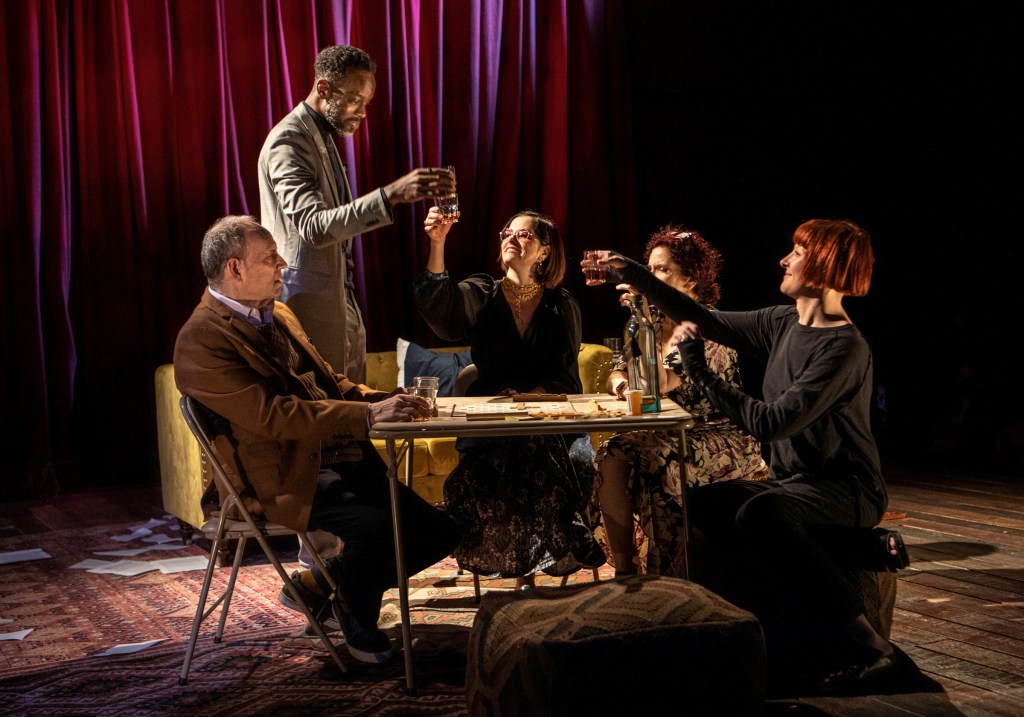
Indeed, the meaning of Bradshaw’s work is clear. There has been a diminution of artistic greatness and sensibility, moment and nobility in our cultural ethos, which makes these players as inconsequential and LOL as he has drawn them. They are caricatures who wallow in artificiality and purposelessness, not of their own making. They have been caught up in the tide of the times and the vapid culture they seek to be celebrated in. That some of the actors push for laughs which don’t appear to come from organic, moment-to-moment portrayals makes complete sense. Theirs is a high-wire act and anything is up for grabs. Whatever laughter can be teased out, must be attempted. That is who these people are in The Seagull/Woodstock, NY.
Though the actors (especially Posey who portrays Irene with the similitude of other pompous, self-satisfied characters we’ve come to associate her with) attempt to get past the linearity of Bradshaw’s update, they sometimes become stuck, hampered by the staging, the playing area and direction whose action perhaps might have alternated between stage left and stage right (the audience is on three sides). Most of the action and conversation (facing the upstage curtain where Kevin puts on his play in the first act) takes place stage right. Since the set is minimalist and stylized with rugs, chairs and other props forming the indoor and outdoor spaces, the stage design might have been more fluid so that the various conversations were centralized. Unfortunately, some of the dialogue became swallowed up and the actors didn’t project to accommodate for the staging.
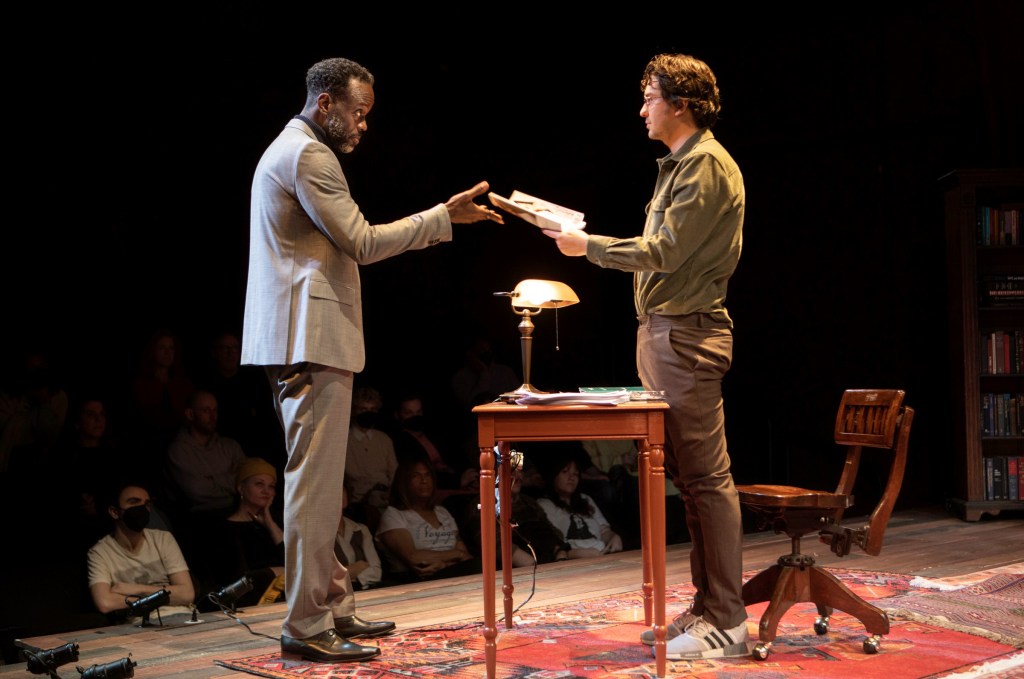
Only Nat Wolff’s portrayal of Kevin rang the most real and authentic. However, this is in keeping with the overall conceit that the playwright and director are conveying. Wolff doesn’t push for laughs and his portrayal of Kevin’s intentions are spot on. As a contrast with the other characters, he is a standout and again, this appears to be Bradshaw’s laden message. Kevin is driven to suicide by the situation, his mother, William’s remote selfishness and Nina’s devastation which she has brought upon herself. He is happier to be away from them. And perhaps Irene will be relieved, after all is said and done, that he has finally succeeded to end his misery. As Bradshaw has drawn her and as the director and Posey have characterized her, Irene has an incredible penchant for obliviousness.

At times the production is uneven and the tone is muddled. At its worst The Seagull/Woodstock, NY is a send up of Chekhov’s The Seagull that doesn’t quite make it. At its finest Bradshaw, Elliott and the ensemble reveal the times we live in are destroying us as we attempt to escape but can find no release nor sanctuary from out own artificiality and meaninglessness, as particularly evidenced in the characters of Irene, William and Nina. Only Kevin appears to have true intentions for his art but is stymied by the crassness of those considered to be exceptional but are mediocre. As in all great artistic achievement, only time is the arbiter of true genius. Perhaps Kevin’s time for recognition will come long after Nina, Irene and William are dead.
The creative team for The Seagull/Woodstock, NY includes Derek McLane (scenic design) Qween Jean (costume design) Cha See (lighting design) Rob Milburn & Michael Bodeen (sound design) UnkleDave’s Fight-House (fight and intimacy director). For tickets and times go to the website https://thenewgroup.org/production/the-seagull-woodstock-ny/
‘Des Moines,’ the Opaque and Mysterious Artfully Shine at TFANA

In Des Moines by award winning writer Denis Johnson nothing vital seems to happen during the time Dan, his wife Marta, their grandson Jimmy, Father Michael and Mrs. Drinkwater get smashing drunk and have a wild party in Dan and Marta’s modest second floor apartment in Des Moines, Iowa. Yet, in the 12 hours they spend together, much does happen. Connections are made, personal revelations are expressed and in each individual’s life, as a result of the dynamic interactions that take place, all experience a shift. For some it’s in perspective. For others the change is behavioral. However, in this deceptively “small” but mighty play, Johnson reveals the importance of listening to others’ faint soul cries and helping them relax into a zaniness that soothes.
At the play’s outset for a moment all is blackness. We hear a deafening roar, a loud cacophony of noise, a piercing, grating, rolling thunderous sound like a ripping away of the earth’s atmosphere as if a bomb had been dropped. We ask what is happening and what does that sound mean?
The lights come up on cab driver, husband Dan who has come home from work. He hits upon what the sound might be as he discusses with wife Marta that Mrs. Drinkwater, the wife of a man who died in a recent plane crash, has sought him out to ask him questions. Dan was one of the last people to speak to Mr. Drinkwater, when he took him to the airport, before he got in the plane that crashed in an embankment, killing everyone onboard. Thus, we put together the roaring sound at the top of the play with the plane engines roaring before the crash.

By the end of the play we are no closer to understanding the symbolism, though it is repeated during a blackout between scenes after a raucous party. Perhaps it symbolizes the “veil being rent,” what must happen in human consciousness to allow enlightenment and an awakening to flood the psyche with new understanding. Though Johnson makes references to being awakened and made aware, these concepts are fleeting, and unexplained.
This is one of the joys of Des Moines in which Johnson seems to suggest that human existence in its greatest depth is about understanding, empathy and the bridge of consciousness between and among people in the realms of their own experience. All of these elements at one point or another Johnson touches upon in each of his characterizations, portrayed by prodigious actors, who are incisively directed by Arin Arbus.

During Dan’s discussion with Marta, we understand that he is startled that Mrs. Drinkwater would seek him out to ask him questions about her dead husband. It is as if she looks for anything to bring her comfort through the trauma she’s experiencing from her partner’s strange death in a shocking, rare accident. During Dan’s discussion, the playwright raises questions about the fragility of life and the permanence of death. The conundrum of dying in life daily, momentarily looms, then vaporizes as Dan jumps to raw reality. He tells Marta how medical examiners attempt to identify the smashed bodies picked up at the crash site. From what he’s learned from Mrs. Drinkwater, the next of kin are asked to think about looking for one identifying feature of their loved one and not look at or imagine the entire body. Immediately, one’s loved one is reduced to one feature to better help the coroners during the cold and alienating identification process. This is another startling crash of death’s finality which shakes Dan.
Arliss Howard who portrays Dan with an organic realism and authenticity relays Dan’s concern about Mrs. Drinkwater. She is Black and Mr. Drinkwater was a prominent Black lawyer. Seeking information, Mrs. Drinkwater has shown up at the car garage daily to joggle Dan’s memory until he finally pictures her husband and remembers snatches of conversation they had in the cab before Dan dropped him off at the airport. Thus, an ancillary, “meaningless” conversation carries with it great moment for Mrs. Drinkwater and for Dan in light of the catastrophe of Mr. Drinkwater’s irrational and sudden death. Indeed, we are reminded if it happened to him, death will happen to us. Momento mori. Mortality is a hard fact Dan nor Mrs. Drinkwater can’t seem to negotiate, nor can Marta as we discover in her interaction with Father Michael when the priest visits.
Johanna Day as Marta is perfect as Dan’s patient, dutiful partner, who listens to Dan’s concern and gets the importance of this last conversation with the husband. Also, it isn’t unusual to her that Mrs. Drinkwater wants to know everything Dan can remember. We learn later that Dan and Marta, too, have suffered a sudden loss of a loved one. Thus, Mrs. Drinkwater’s endless questioning makes weird sense and reveals the pain and hurt she obviously experiences. It is a shared hurt for Dan and Marta, which we note later in Marta’s fleeting few words which vaporize into thin air, not belabored because the pain of loss has settled into the characters’ ethos, becoming a part of their consciousness.

From their interchange in the kitchen, we note that Dan’s and Marta’s is a close relationship. This closeness bears up throughout the play. They appear to be a typical, married, older couple who have lived together for years. However, on closer inspection, there is nothing typical about them. There is a profound comfort to their relationship that reveals a tight bond that connects them beyond understanding. This closeness especially manifests in their drinking, carousing, acceptance and love of their transgender grandson, who lives with them and who is wheelchair bound. They are also bonded together having experienced pain, loss and tragedy.
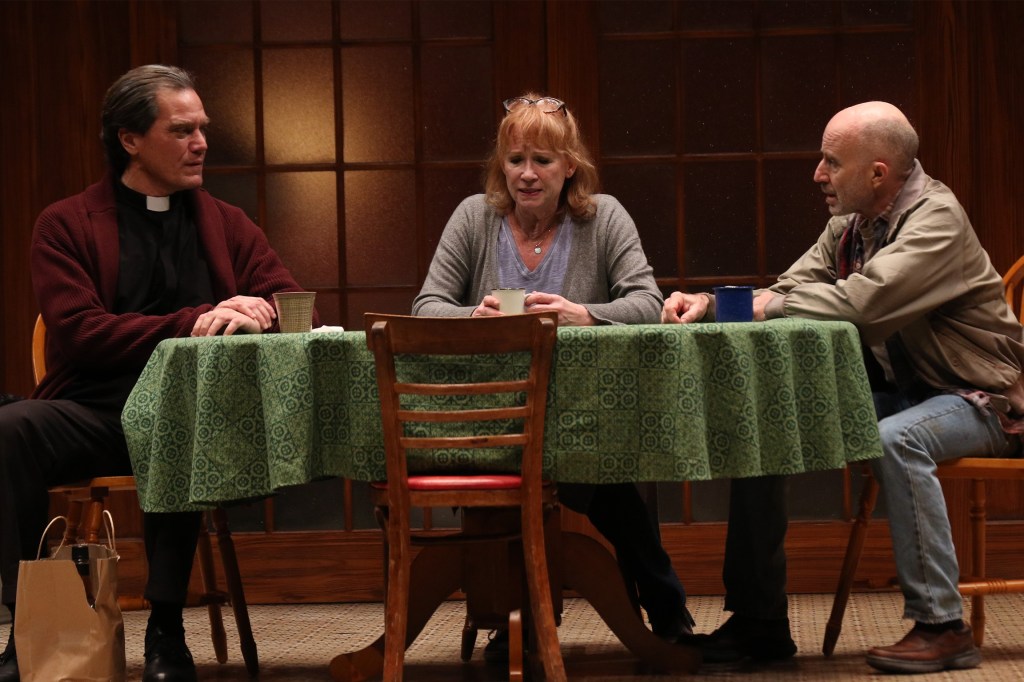
The character dynamics take off when Father Michael (the superb Michael Shannon) visits. Denis Johnson has set up Father’s Michael character by having Dan discuss with Marta that he saw Father Michael wearing make-up in front of a gay bar. Ironically, Dan mentions that he won’t feel so inferior or insecure at Confession knowing that Father Michael is less than perfect and most probably is gay. His response is all about forgiveness and an absence of judgment. And it is clear that this has now become a two way street of forgiveness and acceptance.
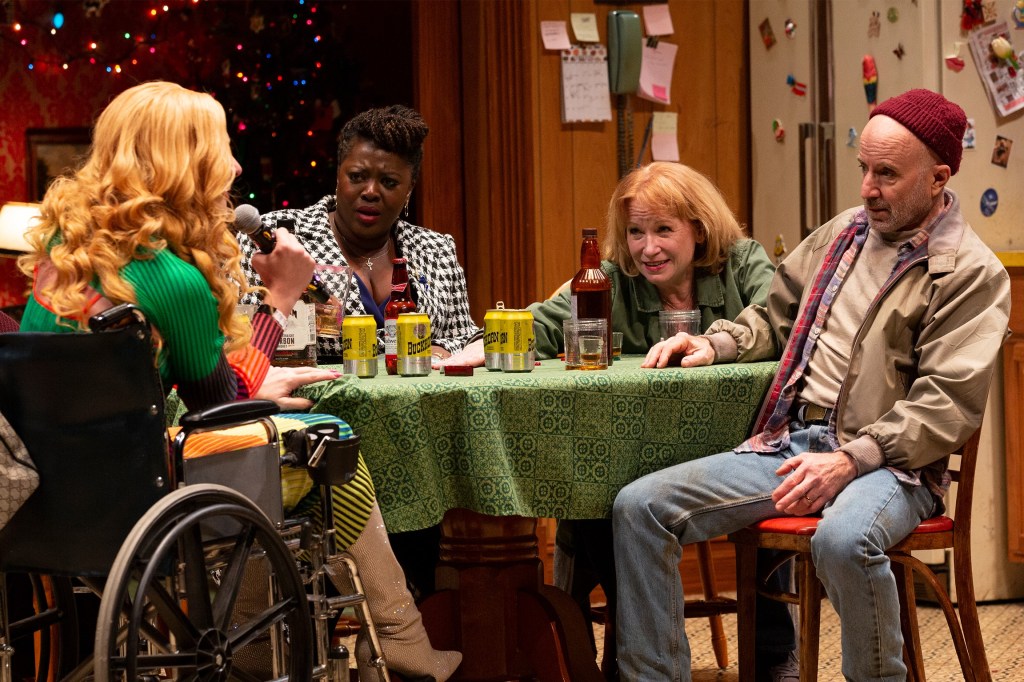
Marta has asked Father Michael to come over to receive comfort and perhaps prayer as she tells Dan that the doctors only gave her two to four months to live because the cancer has spread throughout her body. The only comfort Father Michael gives is his honesty in saying that death is a mystery and one can’t say much about it. However, the most accurate and hopeful comment he tells her is that the doctors don’t know everything. In other words their prognosis may be wrong. Father Michael ends any further discussion of Marta’s cancer and shifts to another topic abruptly which is humorous. Then the action gyrates so that Dan and Marta decide to pick up some beers as if the dire conversation never happened nor should happen. Dan and Marta promise to come back, leaving Father Michael with Jimmy (Hari Nef) in a blonde wig, rhinestone boots, make-up and wheelchair.
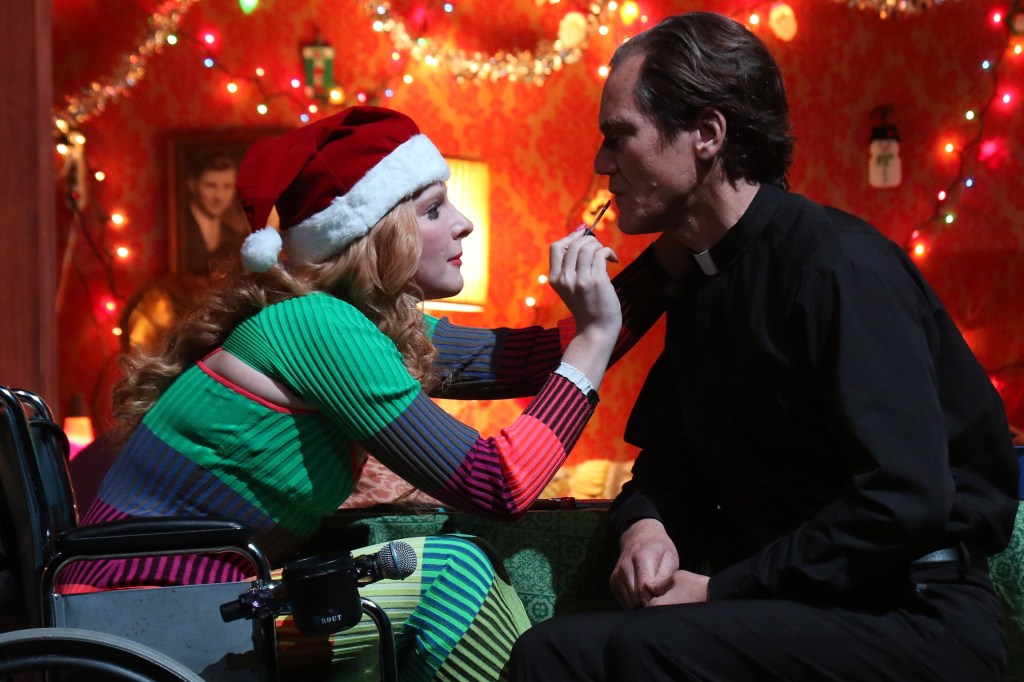
Jimmy who has been crippled by a doctor during the sex change operation appears to take this in stride. However, we discover what is motivating Jimmy’s apparent calm later in the play, the hope of walking again. The scene between Nef’s Jimmy and Shannon’s Father Michael is wonderfully acted, free and spot-on quirky. Jimmy tells Father Michael that he heard his parents discussing that Father Michael wears make-up. Father Michael is honest. Jimmy suggests that Father Michael allow him to be his make-up artist. Though Father Michael prefers putting on his own make up, with good will, he lets Jimmy add lipstick, rouge and eye-shadow to his face. The two bond during this amazing scene because the actors are “in the moment” superb.

As Jimmy, Hari Nef is adorably believable without pushing any of “behaviors” to get a laugh. Shannon’s prodigious versatility as an actor has him portray cruel thugs (Bullet Train) and Elvis (Elvis and Nixon) to name a few of his screen roles. As Father Michael he is organic, hysterical and profound. He negotiates the whimsical and empathetic priest with an uncanny and otherworldly aspect. Shannon’s delivery of Father Michael’s most philosophical and trenchant lines is sheer perfection in their tossed away thoughtfulness. It is as if Shannon’s Father peers into another realm, expresses what he sees, then retracts from it like nothing extraordinary has happened, though it has.
To round out the gathering Mrs. Drinkwater (the heartfelt Heather Alicia Simms) shows up looking for the gold wedding band that she gave Dan and forgot to take back. Dan and Marta have not returned with the beers, so Father Shannon and Jimmy introduce themselves and Mrs. Drinkwater tells them that her husband was killed in the plane crash. Abruptly, Father Michael announces that they need to have drinks and specifically, depth chargers (shots dropped in a mug of beer). At this point, the wild party begins and when Dan and Marta return with more beer, the events revolve upside down and sideways as each takes their turn at Karaoke and “lets it all hang out.” Kudos to Hari Nef, Michael Shannon and Heather Alicia Simms for their passionate renditions of their solo numbers.

The fun is in watching the actors enjoy themselves to the hilt and in the process, convey the loneliness and angst each of the characters personally experiences. We appreciate the drunken camaraderie and comfort they share. It is better than that of “old friends” who know “too much” of their pain and torment. Nevertheless, they have just enough information about each other. They understand that they all are imperfect and have experienced loss, uncertainty, confusion. They have been tossed about by life’s seemingly random trials, forced to assign their own meaning to the haphazard and horrible events. Theirs is the sticky understanding that they can help each other through their personal crises that none of them can specifically explain because it can’t be articulated. All they can do is state concrete facts about conditions. But underneath are miles of subsurface emotions, psychic damage, pain, fear, sorrow.

The hope is that they are alive with the determination to keep on “truckin’,” as they receive solace in understanding the ubiquity of their absurd-life-in-death condition. They, like all human beings, roll a metaphoric boulder up a hill, knowing at the top they will slip and fall to the bottom. Then, they will have to do it again and again does Sisyphus of Greek mythology.
For Dan and Marta, the loss of their daughter who overdosed is most acutely felt, a fact they mention then drop. For Mrs. Drinkwater, the loss of her husband has dislocated her and upended her identity about herself. Who is she now and how does she define herself without him? For Nef’s Jimmy, the paralysis is devastating, but it may not be permanent. At one point when Jimmy is alcohol buzzed, he stands up and proclaims that he, “will walk again.” Lastly, Father Michael is negotiating his physical person, his celibacy, his marriage to Mr. Drinkwater (a mysterious notion) and his straddling the otherworldly realms of consciousness and spirit.
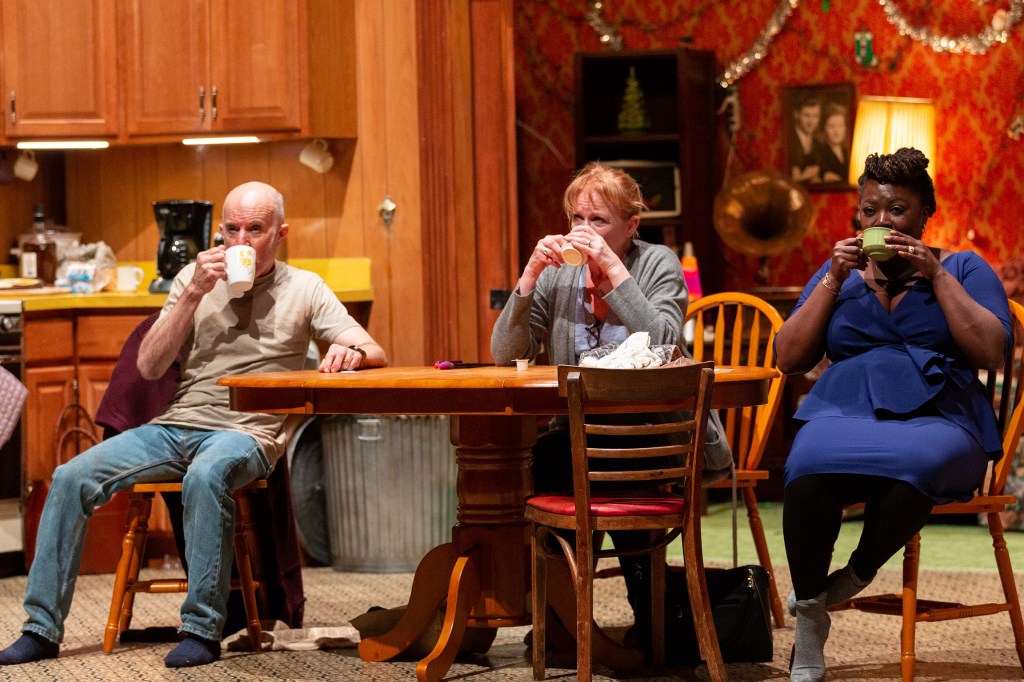
Johnson’s play cannot easily be pinned down in its hybrid, comedic absurdism and avant garde elusiveness. It zips along with unlikely and surprising twists with every character dynamic and every character expose. Its strong spiritual themes about life, the afterlife, consciousness and no boundaries between and among these realities, are thought-provoking. The ensemble’s acting is top-notch and their team work reaches a high-point when each performs their solos while the others move into themselves, all creating an exceptional, flowing dance.
Arin Arbus has staged the wildness so that it is zany yet meaningful with the help of Byron Easley (choreographer). Riccardo Hernandez’s scenic design, Qween Jean’s costume design, Scott Zielinski lighting design and Mikaal Sulaiman’s original music and sound design effectively capture the director’s vision and enhance Johnson’s themes about human nature, pain and seeking to escape from it with like-minded others through alcohol or just letting go. In this production, which emphasizes humanity, forgiveness, understanding and empathy, we realize the isolation of individuality and the commonality of emotions whether joyful or sorrowful, that often prompt escapism to crazy, if only for a moment in an eternity of time.
This is one to see. It ends January 8 and runs with no intermission. For tickets and times go to their website https://www.tfana.org/current-season/des-moines/overview
 CAROLE DI TOSTI