Blog Archives
‘Ulster American’ Matthew Broderick Leads the Bang on Ensemble at Irish Repertory Theatre

With sardonic wit and dark farcical elements David Ireland’s Ulster American sends up the differences among Irish-American, left-wing British, and Northern Ireland’s Unionists’ views about identity politics. David Ireland also ridicules the hypocrisy of those who adhere to political correctness and equanimity when it serves their purpose, but when push comes to shove and the stakes are raised, they easily throw overboard their posturing to reveal ugly, ingrained prejudices not yet reconciled.
The play’s humor lands sometimes with subtly, other times with uproarious riot and full throttled mayhem in this wonderful production acutely, specifically directed by Ciaran O’Reilly. Ulster American runs at Irish Repertory Theatre through May 10, 2026.
Using theater as the medium to express his themes, Ireland begins with a simple “meeting of the minds,” among an actor, director and playwright. They join up to discuss the play which has been scheduled for its first rehearsal the following day. The individuals include Jim Conway, the lead actor (Matthew Broderick) of Irish ancestry from America. Conway has been cast for his talents and star power. The play’s British director (Max Baker), runs his own theater company that produces the play. Most importantly, the director has chosen a Northern Ireland female playwright (Geraldine Hughes) because her play is exceptional. He will present the play in London which is also where the director’s home conveniently is. Scenic designer Charlie Corcoran provides the comfortable environs where the characters discuss the play and where their true emotions explode.

But what can go wrong among these artists who pride themselves on their craft and their humanity as creatives? Indeed! The diverse ethnic combination in itself indicates a potential powder keg for those in the know about the history of the Republic of Ireland, England, Northern Ireland, and America’s roots in all three. However, the beauty of David Ireland’s play and the talents of the dynamic cast manifest in the gradual reveal. Discovering who these people are and what each assumes about the others is the order of the day. If they achieve a consensus and understanding of the play, then they hope it will be a smash that takes them to Broadway and eventually to a friend of the actor’s doorstep, filmmaker Quentin Tarentino.
The fun is in watching the characters’ assumptions about each other and “their” play go up in flames, and seeing their shock when they realiz who everyone is as the smoke clears. How Ireland turns everything on its head after the opening scene is terrific theater. The actors deliver, hitting every bullseye Ireland sets up.
Matthew Broderick’s Irish American Jay Conway reveals the underlying pomposity of an Oscar-winning film star who attempts to evolve into a better person as he conquers his alcoholism with the help of his priest sponsor. Deft with the character’s initial humility, decency and humanity Broderick pings these notes with earnestness. Conway and amenable theater director Leigh Carver (Max Baker) become better acquainted discussing topics ranging from the use of the “N” word, to the importance of “women’s voices crying out,” to Irish history, and being of the patriarchy only as a necessary evil, though it demeans them.
Ironically, both disavow the patriarchy and uplift themselves as feminists. Though they dismiss the inherent power and status they’ve received from being males at the top of their game, in due season, the worm turns. We watch delighting in their hypocrisy as they riotously try to exert power over playwright Ruth Davenport by changing her play among other actions. Under the right conditions everyone’s truth emerges and deeper unconscious impulses explode to the surface.

The men’s discussion topics conclude with a scene in a film early in Conway’s career which involved Jay’s character raping a woman at the direction of a terrorist who would bomb Minneapolis with a nuclear bomb if he didn’t do the deed. The studio cut the scene from the script because the women at the studio felt it was objectionable. However, Conway considered the scene thought provoking and thought about who he would rape to save the city, as hideous as it was.
Why Conway brings each of the topics up, especially the latter one, he ascribes to nervousness and being overly talkative. Perhaps, it is an attempt to deepen the feelings and get on solid footing with his director in a relationship which he believes should be close, intimate, like family. Nevertheless the question Conway innocently poses to the reticent, Brit Leigh alienates the director. Not only does he lie and pretends it’s OK when Conway confronts him, but he is so upset he spills to Hughes’ Ruth, though Conway told him in confidence. Eventually, this causes havoc for the actor, director and playwright, who swore that being true to oneself and being honest were paramount.
David Ireland has peppered the scene between the two men with platitudes and their agreed upon myths about themselves and each other which he gradually topples on the proving ground of working with Ruth after she arrives. She is late because of a car crash which lands her mother in hospital. After pleasantries and compliments the artists get to the “nitty gritty,” what the play is about.
We learn interesting bits of information along with Conway who asks what and why Ulster. The questions about Irish vs. British identity arise and unsettle Conway who expected something else. Ruth calls him on his misunderstanding. Did he really read and “get” what her characters were about? Does Conway really mean it is the best play he read in a decade and that it’s like Chekhov? And does Leigh mean the play is better than Harold Pinter? If one knows Pinter’s attitude about his own work, Leigh’s compliment that even Pinter would say her play is better than his is particularly ironic.
Of all of them Ruth holds her own and finds ways to fight back, using their own admissions against them. Remembering how they patted themselves on the back for their feminism, we note that white knights become black knights as they attempt to change the play and save their egos. For her part Ruth cleverly makes her demands and uses impeccable leverage to get what her play needs.
The specific details about how these webs are woven to catch the self-duplicitous are entertaining and surprising. The actors move from moment to moment and give nothing away, least of all the last five minutes until lights out. Great stuff.
Ulster American runs 1 hour 30 minutes with no intermission at Irish Repertory Theatre until May 10, 2026. https://irishrep.org/whats-on/ulster-american
‘Chester Bailey’ Starring Reed Birney and Ephraim Birney, a Must-See

Joseph Dougherty’s Chester Bailey is a mind-bending drama that tests our understanding of reality, as that which we apprehend with our senses. Taken to its extreme form, those whose senses have been deprived cannot know what reality is and must rely on others to interpret “the reality” of what is around them. However, what happens if they refuse to accept any interpretations and come up with their own? Who gets to interpret what reality is, if the interpretation is repugnant and an encouragement toward self-destruction?
These delicious questions lead to the conundrum that Dr. Philip Cotton (Reed Birney), must resolve as he treats his patient Chester Bailey (Ephraim Birney), who is in a hospital on Long Island in 1945 during the winding down of WW II. Bailey was prevented from going to war by his parents who selfishly wanted to keep their son safe, a notion that Bailey tells us he agreed with so he didn’t rebel against their wishes and enlist.

However, Karma, Fate the Furies spin the family around and have fun with them, proving there is no escape from tragedy. Yet, if we throw caution to the winds and accept what comes, goodness may be around the corner. Perhaps Chester should have enlisted after all. His family and Bailey rue that he didn’t.
Bailey ends up in the psychiatric care of Dr. Philip Cotton after he experiences a traumatic accident at the Brooklyn Navy Yard. A psychotic worker attacks him with a blow torch putting out his eyes, slashing his ear, savaging his face and severing his hands. After defying death, Chester rehabilitates getting through unaccountable pain with the help of huge doses of morphine that foster his dislocation from reality to a place of comfort, and not only physical comfort.

In that haven, he constructs another reality where he believes that he lost his ear and eyesight, but the latter is returning because he sees a bright light that appears to be getting brighter. Furthermore, he “knows” he still has use of his hands and can pick up objects, all despite arguments with the doctors at the general hospital where he’s recovering, who tell him he has no eyes, no hands, one ear and his face is deformed. Indeed, Ephraim Birney’s portrayal of Chester’s believable reconstruction of a world of peace and beauty, where he is becoming whole is sensational. And Birney’s development of Chester’s obstinance and obstruction of anyone who attempts to wrangle his fantasy from him is beyond superb.
Though Chester tells us he receives visits from his father, who tries to encourage him despite his growing alcoholism, his mother refuses to see him. Ephraim Birney’s narration is riveting. Through it we intuit that his mother is overwhelmed by guilt. Smacked by Karma at her selfish attempt to save her son from dying, while other mothers lost their sons, she refuses to visit him and is bedridden with severe depression.
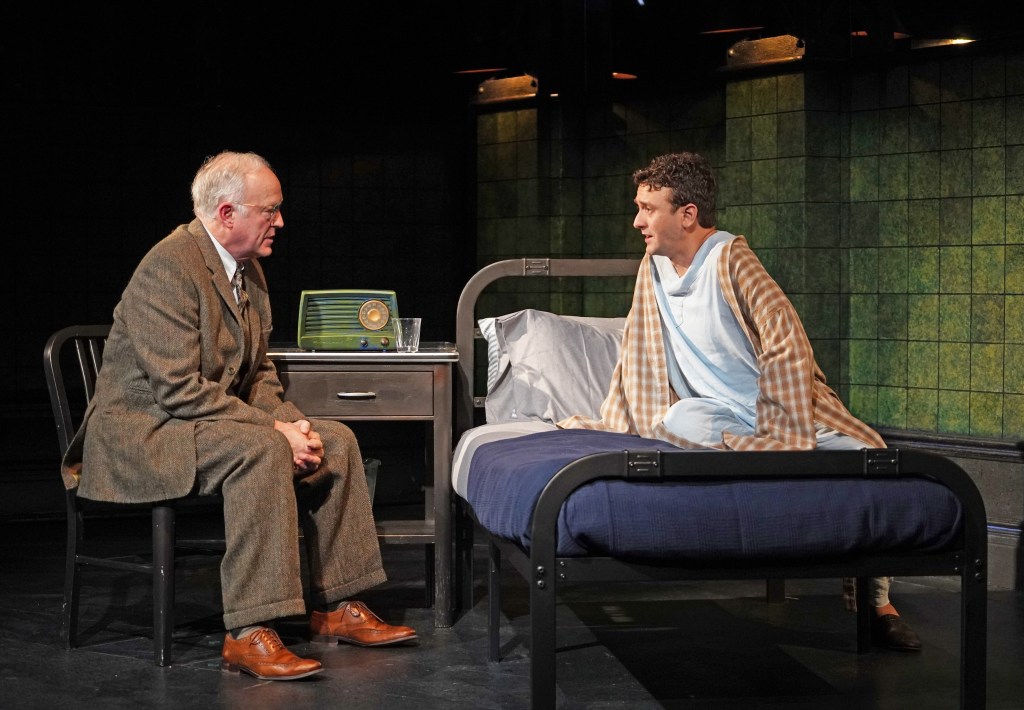
Meanwhile, Birney’s Chester is enthusiastic about seeing shapes and shadows, feeling his fingers and picking up objects. The doctors deem him delusional. Because of Chester’s prognosis, they cannot release him back into society where he will only get worse. Instead, they transfer him to a psychiatric hospital, where he will receive therapy to perhaps encourage him back to the society’s consensus of reality. There he will be forced to accept his condition and receive help to achieve a purposeful life.
Parallel to Chester Bailey’s “delusion” is Dr. Philip Cotton’s response to Bailey. Steeped in partial delusions, we understand that Cotton bends reality toward his own perspective. We discover how both men are two different sides of the same coin from the top of the play, when Dougherty has each man in solo performance introduce themselves when Dr. Philip Cotton meets Chester for the first time in the Long Island psychiatric hospital.
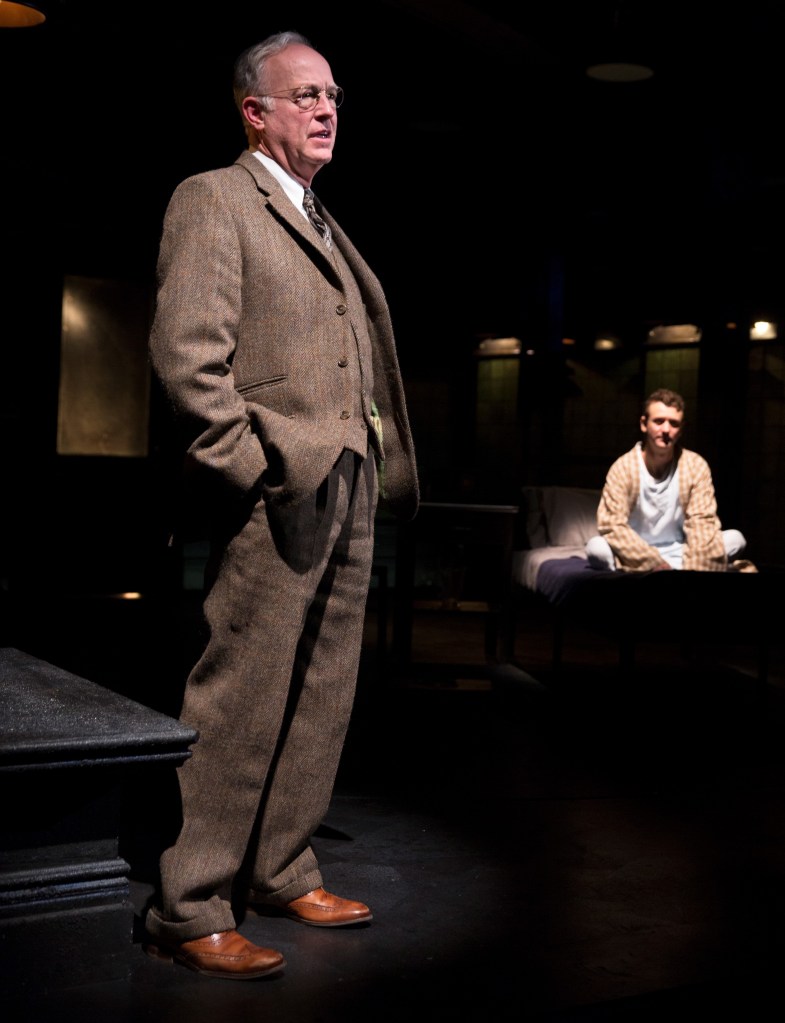
From there time shifts in a flashback to the point before Chester’s accident in the Brooklyn Navy Yard. Through an interlocking web of solo moments addressed to the audience, we discover who these men are and their approach toward their lives, which in actuality isn’t that much different.
Reed Birney is absolutely sensational in his quiet, unspooling of himself as Dr. Cotton who ironically is dislocated from his marriage when he works in Washington, D.C. Birney’s narration of events is engaging and smooth. Alternating with Chester, who discusses his life in parallel themes, Cotton tells us when he was in Washington, D.C. working, his wife had an affair. Its revelation explodes their marriage when he transfers to the Long Island hospital and moves to New York. In fear of discovery, her lover demands that she tell Cotton the truth. Cotton and his wife get a divorce.
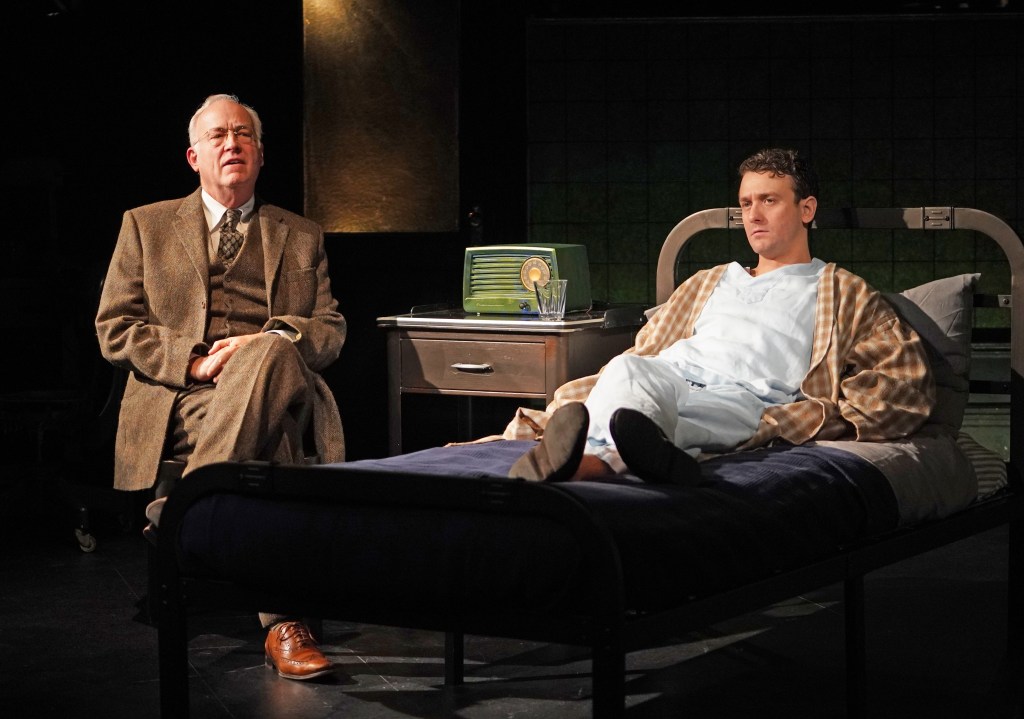
Obtusely moving through his life, Birney’s Cotton doesn’t pick up the signs or even understand why and how his wife could betray him. Instead of learning from this emotional devastation to himself, their daughter and his former wife, he engages in an affair with Cora, his bosses’ wife and wraps himself in her to the point that she becomes his life. Indeed, he lives for the times they covertly meet in various, sleazy, hot pillow motels around the Island.
The beauty of his performance is Birney’s authenticity in portraying Cotton, whose serene and calm self-satisfaction covers up his own delusions about himself and his divorce which he accepts without seeking therapy before or after. His escapism into his affair with Cora conveniently runs him far away from self-analysis or introspection.
Additionally, Birney’s performance is magnificent in its subtly. Cotton manufactures his intent to help Chester Bailey “face” reality so Chester can “better” live his life and adjust to his deformities. In relaying his behavior with Bailey as he interacts with him and reveals his final kindness to him, we are duped by his laid-back good-natured care. Completely taken by his apparent concern for his patient and his romantic interpretations, we ignore why he bestows magnanimity on Chester at the play’s conclusion.

However if one considers the ramifications of what Birney’s Dr. Cotton does when he ignores the truth of what occurs in the hospital, Cotton’s behavior can also be interpreted as permissive and incredibly destructive. Nevertheless, Birney’s Cotton, who is deluded himself and swept up into going beyond his role as a professional, treats Bailey as he, himself, wishes to be treated.
Ironically, Cotton’s interpretation of Chester as an artist of the imagination absolves himself and Bailey of the truth, pushing away the results as if there are no consequences or probabilities of harm. Ignoring his own behavior in accepting Bailey’s behaviors and converting them into harmless obfuscations, he entraps them both in fantasy. Defining Bailey’s actions as self-mercy, Birney’s Cotton removes his own accountability from the situation and demeans Bailey by not challenging him to evolve beyond a “merciful” delusion. The question becomes how merciful is this delusion? And indeed, are delusions merciful?
Engaged and enthralled by the Ephraim and Reed Birney’s portrayals of these intricate and complicated characters, we, too, are swept up in the romance and artistry that Bailey weaves and Cotton accepts and encourages. So what if these flights of imagination have a dark underbelly that perhaps is dangerously dismissed?

We ask, if someone’s life is so physically decimated as Chester’s life is, then what is the harm of his imagining that the woman he saw selling paper and candy in a shop in Penn Station (the beautiful old station intimated with John Lee Beatty’s scenic design and Brian MacDevitt’s lighting design), has become a nurse who visits him? What is the harm if he imagines it is she who has sex with him in his hospital bed late at night and not someone else who has severe problems? He is in love with her, a person he fashions in his imagination. Isn’t that what love is? When we love, don’t we project onto others the beauty and artistry of ourselves? Isn’t that what Dr. Cotton does with Cora? Aren’t we in love with the product of our own imaginations?
Indeed. Of course, there is more to what Doughtery unravels in this rich, dynamically threaded philosophical, psychological work, beautifully shepherded by director Ron Lagomarsino and acted with perfection by father and son duo Reed Birney and Ephraim Birney. Chester Bailey asks so many questions and resolves none of them which makes for a great play that is profoundly rich with thematic gravitas that is resonant for our time.
The production is gobsmacking, helped by Toni-Leslie James’ costume design and Brendan Aanes’ sound design. Performances have been extended because they should be. This outstanding work is its New York Premiere at Irish Repertory Theatre. For tickets and times go to their website. You’ll be happy you saw this amazing, moving play. https://irishrep.org/
 CAROLE DI TOSTI