Blog Archives
‘Saturday Church’: The Vibrant, Hot Musical Extends Until October 24th
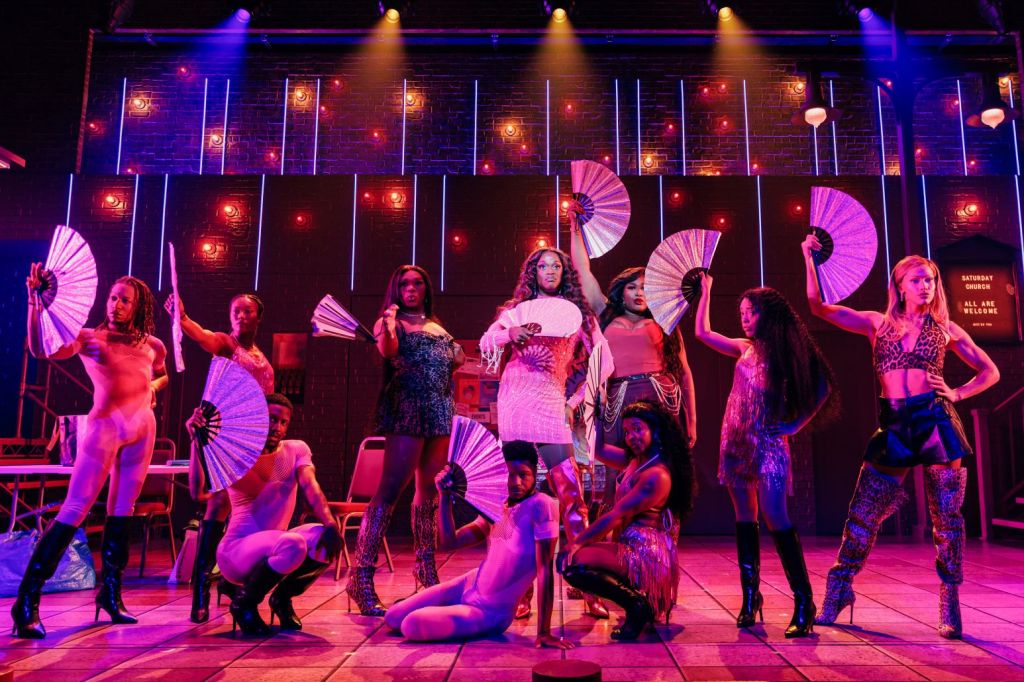
With music and songs by Grammy-nominated pop star Sia and additional music by Grammy-winning DJ and producer, Honey Dijon, Saturday Church soars in its ambitions to be Broadway bound. The excitement and joy are bountiful. The music and songs, a combination of house, pop, gospel spun into electrifying arrangements by Jason Michael Webb and Luke Solomon, also responsible for music supervision, orchestrations and arrangements, become the glory of this musical. Finally, the emotional poignance and heartfelt questions about acceptance, identity and self-love run to every human being, regardless of their orientation and select gender identity (65-68 descriptors that one might choose from).
Currently running at New York Theatre Workshop Saturday Church extends once more until October 24th. If you like rocking with Sia’s music, like Darrell Grand and Moultrie’s choreography and Qween Jean’s vibrant, glittering costumes, you’ll have a blast. The spectacle is ballroom fabulous. As J. Harrison Ghee’s Black Jesus master of ceremonies says at the conclusion, “It’s a Queen thing.”
However, some of the narrative revisits old ground and is tired. Additionally, the music doesn’t spring organically from the characters’ emotions. Sometimes it feels imposed upon their stories. Perhaps a few songs might have been trimmed. The musical, as enjoyable as it is, runs long.
Because of the acute direction by Whitney White (Jaja’s African Hair Braiding), the actors’ performances are captivating and on target. Easily, one becomes caught up in the pageantry, choreography and humor which help to mitigate the predictable story-line and irregularly integrated songs in the narrative.
Conceived for the stage and based on the Spring Pictures movie written and directed by Damon Cardasis, with book and additional lyrics by Damon Cardasis and James Ijames, Saturday Church focuses on Ulysses’ journey toward self-love. Ulysses (the golden Bryson Battle), lost his father recently. This forces his mother to work overtime. Unfortunately, her work schedule as a nurse doesn’t allow Amara (Kristolyn Lloyd) to see her son regularly.
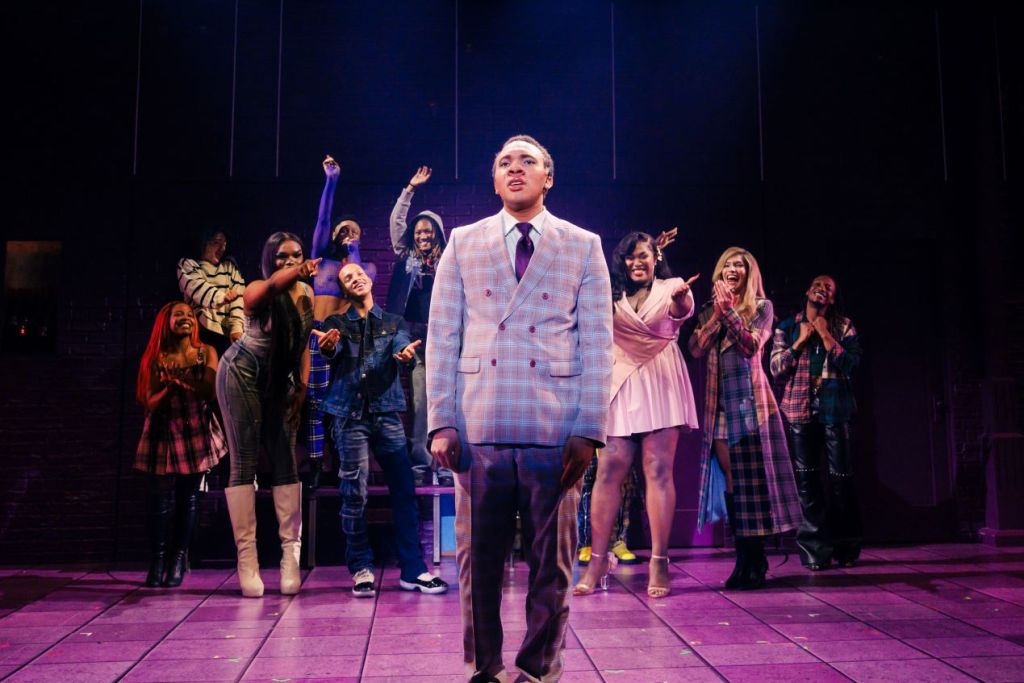
Though the prickly Aunt Rose (the exceptional Joaquina Kalukango), stands in the gap as a parental figure, the grieving teenager can’t confide in her. Even though he lives in New York City, one of the most nonjudgmental cities on the planet, with its myriad types of people from different races, creeds and gender identities, Ulysses’ feels isolated and unconnected.
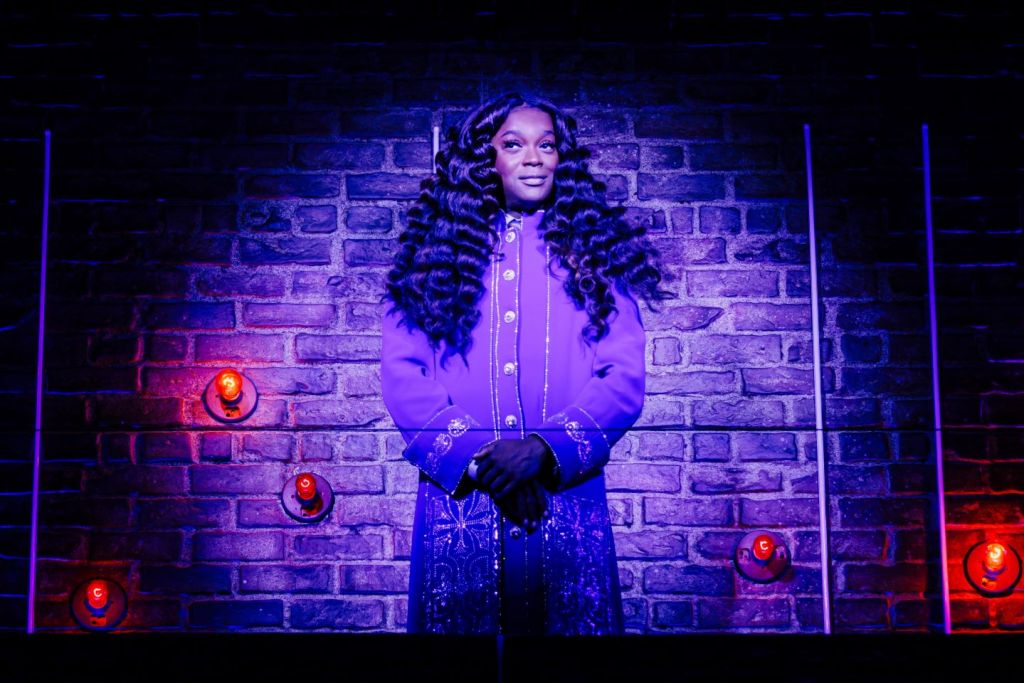
His problem arises from Aunt Rose and Pastor Lewis (J. Harrison Ghee). Ghee also does double duty as the master of ceremonies, the fantastic Black Jesus. Though Ulysses loves expressing himself in song with his exceptional vocal instrument, Aunt Rose and Pastor Lewis prevent him from joining the choir until he “calms down.” In effect, they negate his person hood.
Negotiating their criticisms, Ulysses tries to develop his faith at St. Matthew’s Church. However, Pastor Lewis and Aunt Rose steal his peace. As pillars of the church both dislike his flamboyance. They find his effeminacy and what it suggests offensive. At this juncture with no guidance, Ulysses doesn’t understand, nor can he admit that he is gay. Besides, why would he? For the pastor, his aunt and mother, the tenets of their religion prohibit L.G.B.T.Q Christianity, leaving him out in the cold.
During a subway ride home, Ulysses meets Raymond (the excellent Jackson Kanawha Perry). Raymond invites Ulysses to Saturday Church and discusses how the sanctuary runs an L.G.B.T.Q. program. With trepidation Ulysses says, “I’m not like that.” Raymond’s humorous reply brings audience laughter, “Oh, you still figuring things out.” Encouraging Ulysses, Raymond suggests that whatever his persuasion is, Saturday Church is a place where different gender identities find acceptance.
Inspired by the real-life St. Luke in the Fields Church in Manhattan’s West Village, Saturday Church provides a safe environment where Christianity flourishes for all. When Ulysses visits to scout out Raymond, with whom he feels an attachment, the motherly program leader Ebony (B Noel Thomas), and her riotous and talented assistants Dijon (Caleb Quezon) and Heaven (Anania), adopt Ulysses into their family. In a side plot Ebony’s loss of a partner, overwork with running activities for the church with little help, and life stresses bring her to a crisis point which dissolves conveniently by the conclusion.
The book writers attempt to draw parallels between Ulysses’ family and Ebony which remain undeveloped. As a wonderful character unto herself, the subplot might not be necessary.
As Ulysses enjoys his new found persona and develops his relationship with Raymond, his conflicts increase with his mother and aunt. From Raymond he learns the trauma of turning tricks to survive after family rejection. Also, Ulysses personally experiences physical and sexual assault. Finally, he understands that for some, suicide provides a viable choice to end the misery and torment of a queer lifestyle without the safety net of Saturday Church.
But all’s well that ends well. J. Harrison Ghee’s uplifting and humorous Black Jesus redirects Ulysses and effects a miraculous bringing together of the alienated to a more inclusive family of Christ. And as in a cotillion or debutante ball, Ulysses makes his debut. He appears in Qween Jean’s extraordinary white gown for a shining ballroom scene, partnering with Raymond dressed in a white tux. As the two churches come together, and each of the principal’s struts their stuff in beautiful array, Ghee’s Jesus shows love’s answer.
In these treacherous times the message and themes of Saturday Church affirm more than ever the necessity of unity over division, and flexibility in understanding the other person’s viewpoint. With its humor, great good will, musical freedom and prodigious creative talent, Saturday Church presents the message of Christ’s love and truth against a pulsating backdrop of frolic with a point.
Saturday Church runs with one fifteen minute intermission at New York Theatre Workshop until October 24th. https://www.nytw.org/show/saturday-church/?gad_source=1&gad_campaignid=22911892225
‘Some Like it Hot’ Fires up the Laughter, Dazzling at the Schubert

One of the more intricately updated movie adaptations on Broadway that sparks a flame that will surely last, Some Like it Hot is perfect for the holiday season and year-round. From start to finish the sensational cast keeps the audience laughing, thanks to enlightened direction, (Casey Nicholaw), seamlessly wrought staging, superb pacing, on-point timing and smashing songs sung by spot-on principals and company.
Performances by standouts J. Harrison Ghee (Jerry/Daphne), Christian Borle (Joe/Josephine), Sugar (Adrianna Hicks), Natasha Yvette Williams (Sweet Sue) and Kevin Del Aguila (Osgood) hurtle the comedy at breakneck speed around the roller coaster turns of plot, mostly familiar to those who have seen the original titular film upon which this two-act musical comedy is based. Currently, Some Like it Hot is at the Sam S. Schubert Theatre without an end-date.
With book by Matthew Lopez and Amber Ruffin, with additional material by Christian Borle and Joe Farrell, music by Marc Shaiman and lyrics by Scott Wittman and Marc Shaiman, Some Like it Hot, mostly through songs unspools the story of two Chicago musicians. Witnesses to a murder by a crime boss and his henchmen, Jerry (J. Harrison Ghee) and Joe (Christian Borle) must leave town to avoid being killed. As they flee for their lives moving from the streets of Chicago to a train journey across country to California, to their hotel destination, the cast joyously sings 10 songs in Act I and 8 songs in Act II.

The strongest numbers meld superlatively with the jazz/blues club and rehearsal scenes and display the wacky characterizations, i.e. Osgood (the marvelous K.J. Hippensteel) and his relationship with Daphne, for maximum humor. The club and rehearsal songs are rollicking, streams of musical electricity that include “I’m California Bound,” “Take It up a Step,” “Zee Bap” and “Some Like it Hot,” and in Act II “Let’s Be Bad,” and “Baby, Let’s Get Good.” The music can’t be beat if you love jazz, blues and a compendium of styles from that era.
The opening speakeasy scene “What Are You Thirsty For,” prepares us for the rousing up-tempo and hot jazz style that characterizes the music of Sweet Sue’s all-girl band. The song, like all of those in the club scenes maintains the high-paced energy which never lets up, thanks in part to Natasha Yvette Williams, whose band conductor Sue rules with a firm hand, is humorous and twits Josephine (Joe) about her age because she looks dowdy and frumpy, in a joke that is milked throughout. In assuming their new roles as women, both Joe and Jerry take pride in their beauty and femininity and are insulted if men “step out of line” and take liberties, or as in the instance of Sweet Sue with Josephine/Joe, feel hurt pride that they do not look pretty and young. Of course the irony that these men are becoming enlightened to what it is really like to be women, pestered and objectified by men is just priceless.

The first number establishes the setting of the Great Depression and Prohibition and introduces three leads two of which by the skin of their teeth avoid a police raid and being locked up by Mulligan (Adam Heller), who hauls in Sweet Sue and her band closing them down. That Jerry and Joe escape, establishes their characters’ MO throughout. They shuck and jive, deep man dive to survive, staying one step ahead of police or gangsters. But I am getting ahead of myself. Out on the street and down on their luck, jobs for a bass player and sax player are hard to come by.
Joe and Jerry try the Cheetah Club, owned by Spats Columbo. Mark Lotito’s convincing no nonsense gangster with a humorous touch is perfect for the role which requires some fleet footedness, during the wild chases and shoot-out scenes acutely conceived, staged and choreographed by Casey Nicholaw.
At the Cheetah Club, Spats’ man Mack (Casey Garvin) hires Joe but rejects Jerry because he’s Black. The musical is savvy about revealing the extreme Jim Crow racism of the 1930s through Mack’s obvious prejudice. The production also beautifully answers the racism and bigotry with the idea of family, love and unity with the cleverly written “You Can’t Have Me (If You Don’t Have Him).” Joe insists he and Jerry are a duo, and family (the Tip Tap Twins) who must stick together. As an act “We’re two of a kind, if you’re colorblind, separate mothers …but we’re brothers under the skin.” The singing is accompanied by Joe and Jerry’s excellent tap dancing which wins the day when Spats himself appears and reveals his approval of their talents.
The irony is not lost on us that Spats is tolerant of Jerry’s Black heritage and in this light is more humane than your average lynching bigot from the South, bullying Blacks to bow and scrape. Of course Spats is a murderer of another type (he kills competitor thugs and rats); he’s just not a racist or lynching bigot murderer. This is a fantastic send-up of “honorable” criminals vs. low-down, scurrilous, hate-filled murderers which is intimated but never stated. Thus, Spats we can laugh at, the the bigot in the Southern shadows we prefer not to think about though they exist and are the reason why Sweet Sue goes to California and not Alabama.

The clever lyrics and humor related to the bigotry toward Black performers during a time of extreme Jim Crow racism in the nation is a subject for jokes delivered by Sweet Sue and Jerry sparingly with irony. The references to racism are understated, and actually highlight the difference between past and present. Yet it is enough as a sad reminder and subtle warning about the uptick in white nationalism and bigotry in our time, hyped up on steroids during the former president Donald Trump’s administration because he gave permission to the KKK and other groups to express their racial hatreds openly as “very fine people.” In this production, the lightheartedness countering the prejudice and racism of the time sends a powerful message about acceptance that is not preachy or overdone.
For example Sue ironically determines the destination of her all-girl band to a place where they won’t be lynched or ostracized since Sue, bass player Jerry/Daphne (J. Harrison Ghee), lead singer Sugar (Adrianna Hicks) and others are Black artists. However, Sue never uses racially charged words. She only refers to how she looks and the audience breaks out in hysteria. After all, it’s the 1930s. Yet residual bigotry is in tragically in the 2022s. Importantly, the beauty of this update reveals the vitality of music and the arts which have always been in the forefront of accepting people, not for their skin color, elitist pedigree or class, but for their artistry and talent. Thus, the theme that art, music and entertainment as a noble calling is underscored as it brings us together in unity and harmony and encourages the best of our humanity.
The complications thicken when Jerry and Joe are at the Cheetah Club and prove themselves to be successful. Excited, Joe wants to discuss their order in the program with Spats at the precise moment when the musicians witness Spats murdering Toothpick Charlie for giving information to Mulligan. The frenzy of Joe and Jerry witnessing the murder and then running away in a marvelous chase scene into the women’s dressing room where they get the idea to go out in drag to save their lives is logically wrought and hysterical. Dressed as Daphne and Josephine, Joe and Jerry are able to walk by Spats and his henchmen without a “hitch.” Now, the only thing left for them to do is follow a tip they receive about joining Sweet Sue’s band.

In a one line quip, we learn they pay two ruffians to steal the instruments of a female bass player and sax player who had jobs in Sue’s band but lost them when they were unable to get instruments at the last minute. Thus, Daphne and Josephine conveniently step up for the positions as the clever Sweet Sue notices their unusual coincidence and timing. This tweak is one of many that works in Matthew Lopez and Amber Ruffin’s well thought out book that is filled with new quips and one-liners that land every time, thanks to Williams, Borle and Ghee’s exceptional timing and delivery.
With the conceit of Daphne/Jerry and Josephine/Joe going cross country as women using the all-girl band as their sanctuary and milked to max, the rest of the action follows a steady route until they arrive at their destination. On the journey the men get to bunk with women and learn temperance and self- restraint as they are reduced to looking but not touching. Also, Josephine discovers the inner workings of the lovely Sugar who he is falling in love with (“A Darker Shade of Blue,” “At the Old Majestic Nickel Matinee”) as she sings the blues ballads about her life and dreams.
In California the intensity increases. Joe and Jerry have to decide whether to leave and go to Mexico. However, there are dangerous reasons that stand in the way of their making the best decision of their lives. Joe has fallen for Sugar and Jerry has fallen for being a woman, a condition which emerges when the wealthy Osgood in “Poor Little Millionaire” shows he is interested in Daphne. As Osgood appeals to the feminine in Jerry, Jerry/Daphne has a new knowledge of himself as an evolved individual whom he actually likes better than when he was Jerry. This is not only LOL and J. Harrison Ghee makes the most of this new knowledge, it is refreshingly current and an excellent update of the original material in the film by Matthew Lopez and Amber Ruffin.
Meanwhile, unbeknownst to them, Spats and his men are making their way toward Jerry and Joe. It is only a matter of time before they will meet face to face. When they do in “Tip Tap Trouble,” the chase is an incredible tap dance with precisely timed, synchronized movement that is choreographed using doors. Nicholaw’s staging is a marvel. The number is paced by the ensemble to perfection with such apt choreography, it is absolutely breathtaking. The number brings down the house.

In this musical comedy as in the film, “all’s well that ends well.” Spats is arrested just in time by Mulligan and the couples reveal themselves and there are no hard feelings. In fact Osgood is pleased. The notion that you love despite gender and race, if you have the openness to allow yourself that joy, is the most satisfying of the musical comedy’s themes. And it is the most welcome and truthful. For, as Some Like it Hot posits, if one looks and truly sees individuals for who they are, no one should be rejected or belittled. It is a fantastic notion for this LOL musical comedy whose profound underlying meaning shouldn’t be underestimated.
From cast, principals, music and every element referred to in this review, the production has been fine tuned as a celebration of one of the greatest comedy films which was a stylistic throwback to the thirties. Likewise with this production there are numbers which reflect the black and white musicals of the past, whether it be their elegance or brassy, jazz tunes and rigorous tap numbers. The ensemble and swings are perfection and add to the enthusiasm and excitement of a show that is beyond sizzling fun. Some Like it Hot is a love letter to Hollywood Studio films that we will never see again, and a love letter to the present that we hope for with unity, tolerance and love.
Kudos go to Natasha Katz (lighting design) Brian Ronan (sound design) Gregg Barnes (costume design) Scott Pask (scenic design) Josh Marquette (hair design) Milagros Medina-Cerdeira (make-up design). The train is amazing thanks to Scott Pask who manages a streamlined, futuristic look that is full bodied and rich. The full bodied richness is especially so with the hotel interiors and various spaces that Nicholaw transitions into and out of in the twinkling of an eye to keep up the pacing. It is as if the entire production is on a metronome and moves to the ethereal beats of hilarity, somewhere out there in comedy heaven.
All praise goes to Mary-Mitchell Campbell for her music supervision, Charlie Rosen and Bryan Carter for their orchestrations. Final kudos goes to all involved with dance, vocal and musical arrangements and the creative team who helped to make this production shimmering glory every night.
What a smashing, important production that is as light as a feather going down but stays with you for its vital themes, music, rhythms (I just adored “Tip Tap Trouble” for its multiple layers) LOL book and great delivery by actors, who managed to be funny and not cartoonish.
See it! Go to their website for tickets and times https://somelikeithotmusical.com/
 CAROLE DI TOSTI