Blog Archives
Keanu Reeves, Alex Winter carry Ted and Bill into the adventure of ‘Waiting for Godot’
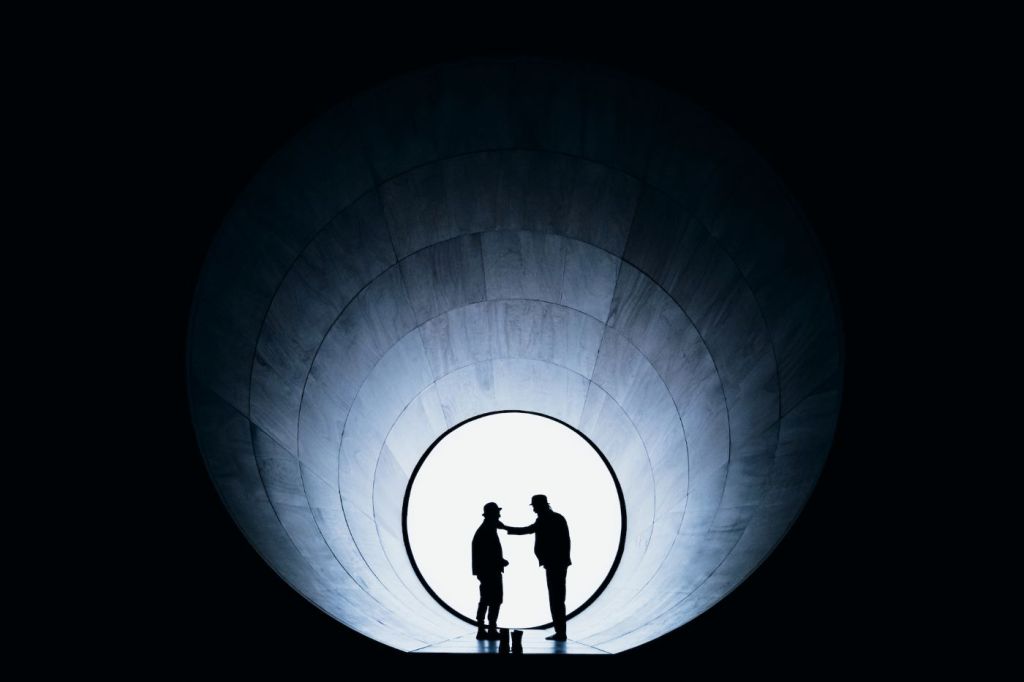
Referencing the past with Bill and Ted’s Excellent Adventure movie series, something has happened. Bill (Alex Winter) and Ted (Keanu Reeves), who long dropped their younger selves and reached maturity in Bill and Ted Face the Music (2020), have accomplished the extraordinary. They’ve fast forwarded to a place they’ve never been before in any of their adventures. An existential oblivion of uncertainty, Samuel Beckett’s Waiting for Godot.
There, they cavort and wallow in a hollowed out, megaphone-shaped, wind-tunnel (Soutra Gilmore’s clever set design). The gaping maw is starkly, thematically lighted by Jon Clark. Ben & Max Ringham’s sound design resonates the emptiness of the hollow which Winter’s Valdimir and Reeves Estragon fill up to the brim with their presence. And, among other things, Estragon loudly snacks on invisible turnips and carrots, and some chicken bones.
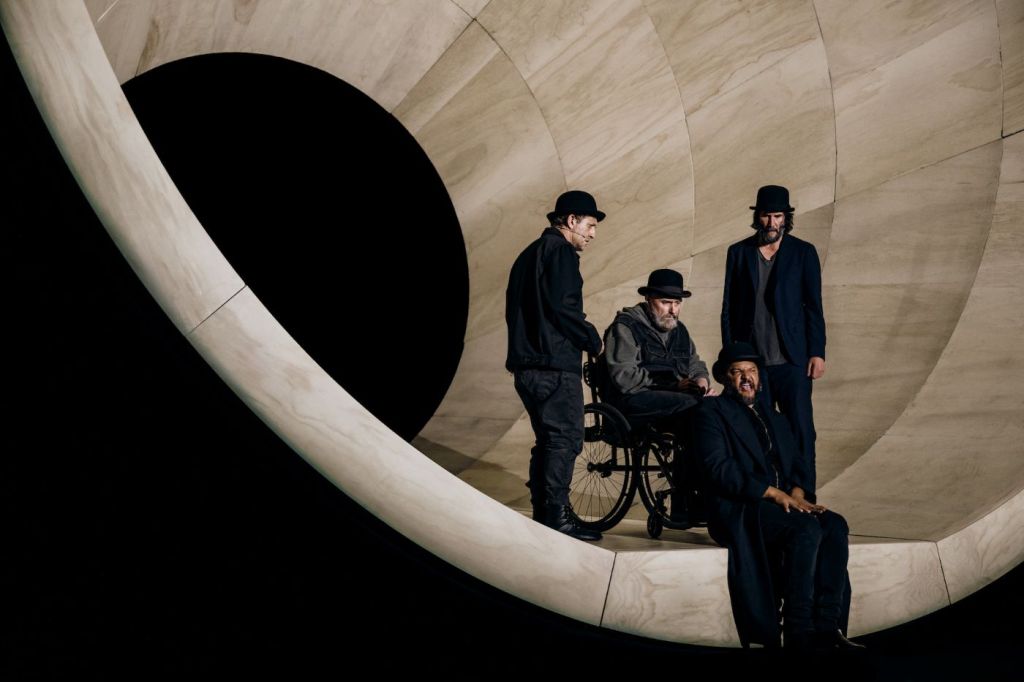
Oh, and a few others careen into their empty hellscape. One is a pompous, bullish, land-owning oligarch with a sometime southern accent, whose name, Pozzo, means oil well in Italian (a superb Brandon J. Dirden in a sardonic casting choice). And then there is his slave, for all oligarchs must have slaves to lord over, mustn’t they? Pozzo’s DEI slave in a wheelchair, seems misnamed Lucky (the fine Michael Patrick Thornton).
However, before these former likenesses of their former selves show up and startle the down-on-their luck Vladimir and Estragon, the two stars of oblivion wait for something, anything to happen. Maybe the dude Godot, who they have an arrangement with, will show up on stage at the Hudson Theatre. Maybe not. At the end of Act I he sends an angelic looking Boy to tell them he will be there tomorrow. A silent echo perhaps rings in the stillness of the oblivion where the hapless tramps abide.
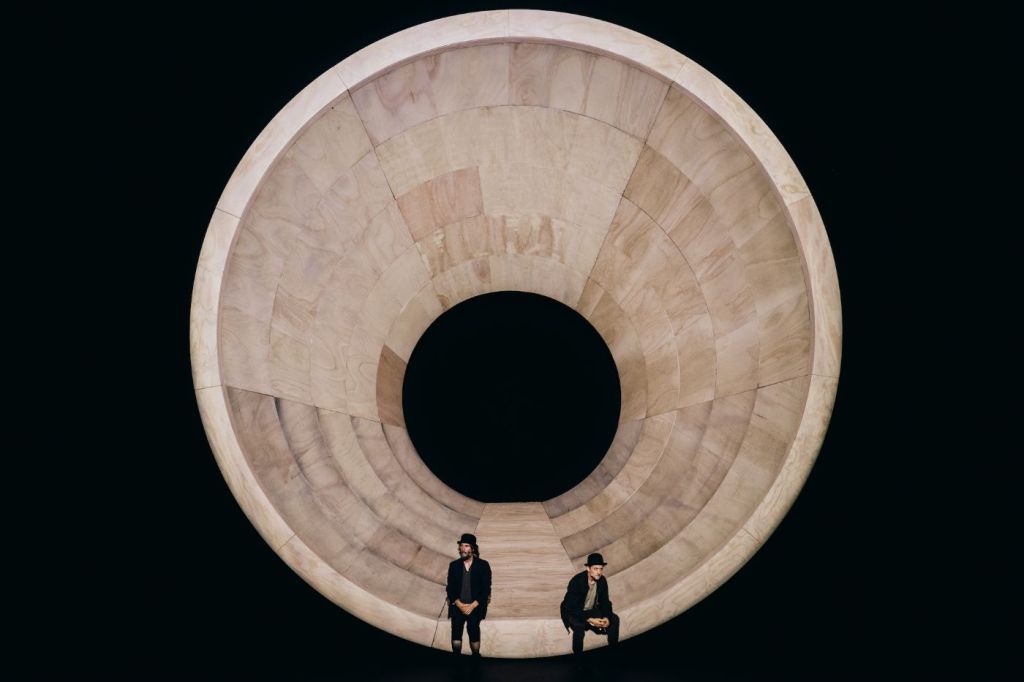
Despite the strangeness of it all, one thing is certain. Bill and Ted are together again for another adventure that promises to be like no other. First, they’ve landed on Broadway, dressed as hobos in bowler hats playing clowns for us, who happily watch and wait for Godot with them. And it doesn’t matter whether they tear it up or tear it down. The excellent novelty of these two appearing live as Didi (Vladimir) and Gogo (Estragon), another dimension of Bill and Ted, illuminates Beckett.
Keanu Reeves’ idea to have another version of their beloved characters confront Samuel Beckett’s tragicomical questions in Waiting for Godot seems an anointed choice. It is the next step for these bros to “party on,” albeit with unsure results. However, they do well fumfering around in this hollowed out world, a setting with no material objects. The director has removed the tree, the whip, or any props. Thus, we concentrate on their words. Between their riffs of despair, melancholy, hopelessness and trauma, they have playful fun, considering the existential value of life. Like all of us, if they knew what circumstances meant in the overall arc of their lives, they wouldn’t be so lost.
Director Jamie Lloyd, unlike previous outings (A Doll’s House, Sunset Boulevard), keeps Beckett’s script without alteration. Why not? Rhythmic, poetic, terse, seemingly repetitive and excessively opaque, in their own right, the spoken words ring out, regardless of who speaks them. That the characters of Bill and Ted are subsumed by Beckett’s Didi and Gogo makes complete sense.
What would they or anyone do if there was no intervention or salvation as occurs fancifully in the Bill and Ted adventure series? They’d be waiting for salvation, foiled and hopeless about the emptiness and uselessness of existence without definition. Indeed, politically isn’t that what some in a nation of unwitting, passively oppressed do? Hope for salvation by a greater “someone,” when the only possibility is self-defined, self-salvation? How long does it take to realize no one is coming to help? Maybe if they help themselves, Godot will join in the work of helping them find their own way out of oblivion. But just like the politically passive who do nothing, the same situation occurs here. Godot is delayed. Didi and Gogo do nothing but play a waiting game.
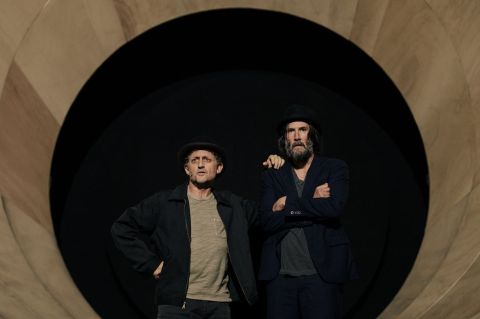
From another perspective eventually unlike political passives they compel themselves to act. And these acts they accomplish with excellent abandon. They have fun.
And so do we watching, listening, wondering and waiting with them. Their feelings within a humorous dynamic unfold in no particular direction with a wide breadth of expression. Sometimes they want to hang themselves to end the frustration. Sometimes, bored, they engage in swordplay with words. Sometimes they rage. Through it all they have each other. And despite wanting to separate and go their own ways, they do find each other comforting. After all, that’s what friends are for in Jamie Lloyd’s anything is probable Waiting for Godot.
In Act I they are tentative, searching their memories for where they are and if they are. Continually, they circle the truth, considering where the one is who said they were coming. However, the situation differs in Act II because the Boy gave them the message about Godot.
In Act II they cut loose: chest bump, run up and down their circular environs like gyrating skateboarders seamlessly navigating curvilinear walls. By then, the oblivion becomes familiar ground. They relax because they can relax, accustomed to the territory. And we spirits out there in the dark, who watch them, become their familiar counterparts, too. Maybe it’s good that Godot isn’t coming, yet. They may as well while away the time. Air guitar anyone? Yes, please. Reality is what we make it. Above all, we shouldn’t take ourselves too seriously. In the second act they don’t. After all, they could turn out like Pozzo and Lucky. So they do have fun while the sun shines, until they don’t and return right back to square one: they wait.
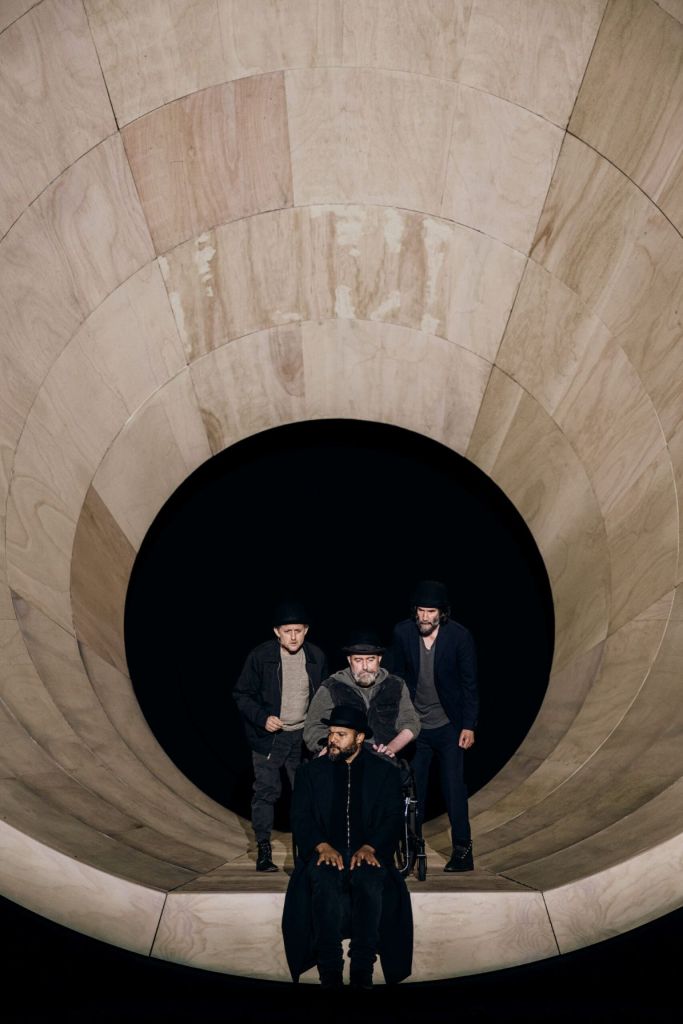
As for Pozzo and Lucky a further decline happens. In Act I Lucky gave a long, unintelligible speech that sounded full of meaning. In Act II Lucky is mute. Pozzo, becomes blind and halt, dependent upon Lucky to move. He reveals his spiritual and physical misery and haplessness by crying out for help. On the one hand, the oppressor caves in on himself via the oppression of his own flesh. On the other hand, he still exploits Lucky whom he leads, however awkwardly. The last shreds of his bellicosity and enslavement of Lucky hang by a thread.
Pozzo has become only a bit less debilitated than Lucky, whereas before, his identity commanded. Fortunately for Pozzo Lucky doesn’t revolt and leave him or stop obeying him. Instead, he takes the role of the passive one, while Pozzo still acts the aggressor, as enfeebled as he is. The condition happened in the twinkling of an eye with no explanation. Ironically, his circumstances have blown most of the bully out of him and reduced him to a pitiable wretch.
Nevertheless, Didi and Gogo acknowledge Pozzo and Lucky’s changes with little more than offhanded comments. What them worry? Their life-giving miracle happened. They have each other. It’s a congenial, permanent arrangement. After that, when the Boy shows up to tell them the “bad” news, that Godot has been delayed, yet again, and maybe will be there tomorrow, it’s OK. There’s no “sound and fury” as there is in Macbeth’s speech about “tomorrows.” We and they know that they will persist and deliver themselves and each other into their next clown show, tomorrow and tomorrow and tomorrow.
If one rejects the comparison of this version of Waiting for Godot with others they may have seen, that wisdom will yield results. To my thinking comparing versions takes the delight out of the work. The genius of Beckett is that his words/dialogue and characters stand on their own, made alive by the personalities of the actors and their choices. I’ve enjoyed actors take up this great work and turn themselves upside down into clown princes. Reeves and Winter have an affinity and humility for this uptake. And Lloyd lets them play, as he damn well should.
In the enjoyment and appreciation of their antics, the themes arrive. I’ve seen greater and lesser lights in these roles. Unfortunately, I allowed their personalities and their gravitas to distract me and take up too much space, crowding out my delight. In allowing Waiting for Godot to settle into fantastic farce, Lloyd and the exceptional cast tease out greater truths. These include the indomitably of friendship; the importance of fun; the tediousness of not being able to get out of one’s own way; the uselessness of self-victimizing complaint; the vitality and empowerment of self-deliverance, and the frustration of certain uncertainty.
Waiting for Godot runs approximately two hours five minutes with one intermission, through Jan. 4 at the Hudson Theatre. godotbroadway.com.
‘Sunset Blvd.’ A Thrilling, Edgy, Mega Spectacle, Starring Nicole Scherzinger

If you have seen A Doll’s House with Jessica Chastain, Cyrano de Bergerac with James McAvoy or Betrayal with Tom Hiddleston, you know that director Jamie Lloyd’s dramatic approach reimagining the classics is to present an unencumbered stage and few or no props. The reason is paramount. He focuses his vision on the actors’ characters, and their steely, maverick interpretation of the playwright’s dialogue. The actors and dialogue are the theatricality of the drama. Why include extraneous distractions? Using this elusively spare almost spiritual approach which is archetypal and happens in what appears to be pure, electrified consciousness, Lloyd is a throwback to ancient Greek theater, which used few if any sets. As such Lloyd’s reimagining of the magnificently performed, uncluttered, cinematically live spectacle, Sunset Blvd., currently at the St. James Theatre in its second Broadway revival, is a marvel to behold.
The original production, with music by Andrew Lloyd Webber and book and lyrics by Don Black and Christoper Hampton, opened in 1993. Lloyd’s reimagining configures the musical on a predominately black “box” stage that appears cavernous. Soutra Gilmour’s black costumes (with white accessories, belts, Joe’s T-shirt), are carried through to the black backdrop whose projection, at times, is white light against which the actors/dancers gyrate and dance as shadow figures. The white mists and clouds of fog ethereally appear white in contrast to the background. There is one stark exception of blinding color (no spoiler, sorry), toward the last scene of the musical.

As a result, David Cullen and Andrew Lloyd Webber’s orchestrations under Alan Williams’ music supervision/direction sonorously played by the 19 piece orchestra are a standout. The gorgeous, memorable music is a character in itself, one of the points of Lloyd’s stunning production. From the overture to the heightened conclusion, the music carries tragedy lushly, operatically in a fascinating accompaniment/contrast to Lloyd’s spare, highly stylized rendering. On stage there are just the actors, their figures, voices and looming faces, which shine or spook shadows, sinister in the dim light. The immense faces of the main four characters in black and white, like the silent film stars, gleam or horrify. The surreal, hallucinatory effect even abides when the actors/dancers stand in the spotlights, or the towers of LED lights, or huddle in a dance circle as the cinematographer films close-ups thanks to Nathan Amzi & Joe Ransom.
The symbolism of the staging and selection of colors is open to many interpretations, including a ghostly haunting of the of the Hollywood era, which still impacts us today, persisting with some of the most duplicitous values, memes, behaviors and abuses. These are connected to the billion dollar weight loss industry, the medical (surgery and big pharma) industry, the fashion and cosmetics industry, and more. The noxious values referenced include ageism, appearance fascism (unreal concepts of beauty and fashion for women that promote pain, chemical dependence and prejudice), voracious, self-annihilating ambitions, sexual youth exploitation, sexual predation and much more. Lloyd’s stark and austere iteration of Sunset Blvd. promotes such themes that the dazzling full bore set design, etc., drains of meaning via distraction and misdirection.
The narrative is the same. Down and out studio writer Joe Gillis (the exceptional, winsome, authentic Tom Francis), to avoid goons sent to repossess his car, escapes onto the grounds of a dilapidated mansion on the famed Sunset Boulevard in Hollywood. In the driveway, manservant Max (an incredible David Thaxton), mistakes him for someone else and invites him inside. There, Joe meets Norma Desmond (the divine hellion Nicole Scherzinger), a faded icon of the silent screen era in the throes of mania. Norma is “lovingly,” stoked by Max into the delusion that thousands of fans want her to return to her glory days in a new film.
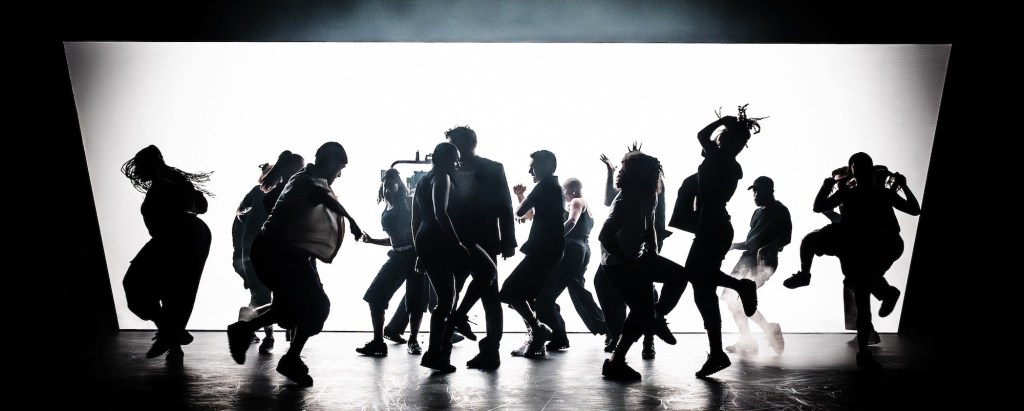
When Norma hears Joe is a screenwriter, like a spider with a fly, she traps him to finish her “come-back” film (she wrote the screenplay). Thus, for champagne, caviar and the thrill of it, he stays, lured by the promise of money, the glamour of old Hollywood and the avoidance of debt collectors. As Norma grows dependent on Joe as her gigolo, he ends up falling for the lovely, unadulterated Betty (the fine, sweet, Grace Hodgett Young). Behind Norma’s back, Joe and Betty collaborate on a script and fall in love. The lies and romance end with the tragic truth.
The seemingly empty stage, tower of lights, spotlights for Norma and live streaming camera closeups projected on the back wall screen, Lloyd is the antithesis of the average director, whose vision focuses on lustrous set design and elaborate costumes and props. In Lloyd’s consciousness-raising universe such gaudy commercialism gaslights away from revealing anything novel or intriguing in the meat of this play’s themes or characterizations, which ultimately excoriate the culture with social commentary.
Soutra Gilmour’s set design and related costumes unmistakenly lay bare the narcissism and twisted values the entertainment industry promotes so that we see the destructive results in the interplay between Max, the indulged Norma and the hapless victim Joe, who tries a scam of his own which fails. Ultimately, all is psychosis, illusions and broken dreams turned into black hallucinations. For a parallel, current example, think of an indulged politician who wears bad make-up that under hot lights makes his face melt like Silly Putty. Again, hallucinations, psychosis, narcissism, egotism that is dangerous and ravenous and never satisfied. Such is the stuff insufferable divas are made of.

In the portrayal of the former Hollywood icon who has faded from the public spotlight and become a recluse, in scene three, when Lloyd presents Gillis meeting Desmond, she is the schizoid goddess and Gorgon radiating her own sunlight via Jack Knowles’ powerful, gleaming spotlights and shimmering lighting design, the only “being” worth looking at against the black background. Throughout, Norma possesses the cavernous space of the stage in surround-view black with white mists jetting out from stage left or right, forming symbolic clouds and fog representing her imagined “divinity” and her confused, fogged-over, abject psychotic hallucinations.
Whenever she “brings forth” from her consciousness “on high,” and empowers her fantasies in song, Lloyd has Knowles bathe her lovingly in a vibrant spotlight. When she emerges from the depths of her bleak mansion of sorrows to sing, “Surrender,” “With One Look,” and later, “As if We Never Said Goodbye,” she brings down the house with a standing ovation. Indeed, Norma Desmond is an immortal. She worships her imagined self at her alter of tribute. Her mammoth consciousness and ethos which Max (Thaxton’s incredible, equally magnificent, hollow-eyed, ghoulish, former husband and current director/keeper of her flaming divinity), perpetuates is key in the tragedy that is her life.
Importantly, Lloyd’s maverick, spare, stripped down approach gives the actors free reign to dig out the core of their characters and materialize their truth. In this musical, the black “empty” stage allows Scherzinger’s Norma to be the primal, raging diva who “will not surrender” to oblivion and death. She is a a god. Like the Gorgon Medusa, she will kill you as soon as look at you. And don’t anyone tell her the truth that she is a “has been.”
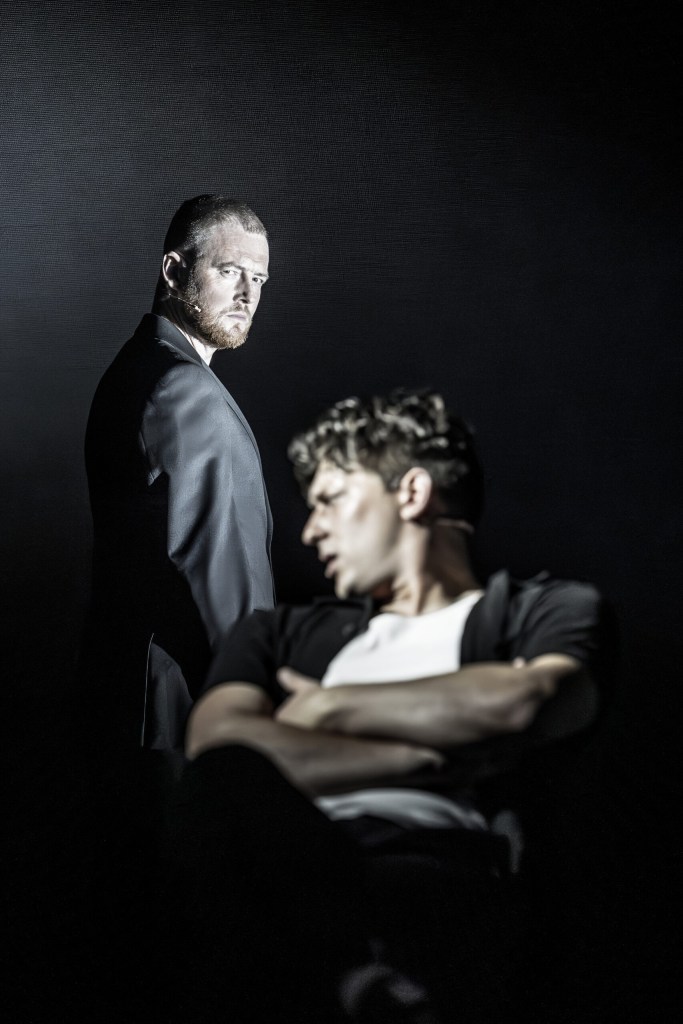
Of course, Joe does this out of a kindness that she refuses to accept. Without the black and white design, and cinematic streaming, a nod to the silent screen, which allows us to focus on faces, performances, magnified gestures and looks, the meanings become unremarkable. The theme-those who speak the truth must die/be killed because the deluded psychotic can’t hear truth-gains preeminence and Lloyd’s archetypal production gives witness to its timelessness. In her most unnuanced form, Norma is a dictator who must be obeyed and worshiped. Such narcissistic sociopaths must be pampered with lies.
Thus, in the last scene, Scherzinger’s Norma stands in bloody regalia as the spiritual devourer who has just annihilated reality and punished Joe. She is permissively allowed to do so by Max, who like a director, encourages her to star in her own tragedy, as he destroys her and himself. As Joe narrates in the flashback from beyond the grave, he expiates his soul’s mistakes with his cleansing confession, as he emphasizes a timeless object lesson.
From a theatrical perspective, the dramatic tension and forward momentum lies with Lloyd’s astute, profound shepherding of the actors in an illusory space. This becomes a fluid field which can shift flexibly each night, revealed when Joe, et. al run in circles and criss-cross the stage wildly. Expressionistic haunting, the foggy mists, the surrounding black stage walls, black costumes, the barefoot diva-hungrily filling up the spotlight-the shadowy figures, all suggest floating cultural nightmares. These the brainwashing “entertainment” industry for decades forces upon its fans to consume their waking moments with fear, the fear of aging, fear of failure, fear of destitution, fear of not being loved, fear of being alone. Many of these fears are conveyed in the songs, and dance numbers in Fabian Aloise’s choreography.

And yet, when the protagonist takes control of the black space of the stage around her, we understand how this happens. She is mesmerizing, hypnotic. Seduced by what we perceive is gorgeousness, we don’t see the terror, panic and mania beneath the shining surface. Instead, we are drawn as if she indomitably, courageously stands at the edge of the universe and asserts her being. In all of her growing insanity, we admire her persistence in driving toward her desire to be remembered and worshiped. Though it may not be in the medium she wishes, her provocations and Max’s love and loyalty help her achieve this dream, albeit, an infamous one, by the conclusion, as gory and macabre as Lloyd ironically makes it. Indeed, by the end her hallucination devours her.
Sunset Blvd is a sardonic send up of old Hollywood’s pernicious cruelty and savagery in how it ground up its employees (“Let’s Have Lunch,” Aloise’s brilliant factory town, conveyor belt choreography, referencing the cynical deadening of Joe’s dreams), and how it made its movie star icons into caricatures that bound their souls in cages of time and youth. Also, it is a drop down into tropes of cinema today in its penchant for horror, psychosis and the macabre, represented by Lloyd’s phenomenal creative team which elucidates this in the color scheme, mists, and starkly hyper-drive, electric atmosphere and movement.

Finally, in one of the most engaging, and exuberantly ironic segments filmed live, right before Act II, when Joe sings Sunset Blvd. with wry, humorous majesty, Tom Francis merges the character with himself as a Broadway/entertainment industry actor. During a live-recorded journey unveiling backstage “reality,” Francis/Joe moves downstairs, inside the bowels of the theater and in the actors’ spaces, so we see the actors’ view, from the stairwell to dressing rooms. Then Francis moves out onto 44th Street, joined by the chorus to eventually move back inside the theater and on stage where they finish singing “Sunset Blvd,” in a thematic parallel of Broadway and Hollywood. Broadway with its wicked inclination to sacrifice art for dollars, truth for commercialism with insane ticket prices, is the same if not worse than Hollywood, until now with AI fueling Amazon, Apple, Google, etc.
However, Broadway came first and spawned the movie industry, which poached actors from “the great white way.” Lloyd clearly makes the connection that the self-destructive dangers of the entertainment industry are the same, whether stage, screen, TV or Tik Tok. The competing themes are fascinating and the lightening strike into the “reality of backstage theater,” refreshes with funny split-second vignettes. For example, Francis peeks into Thaxton’s dressing room. Humorously merging with his character Max, Thaxton ogles a photo of the Pussycat Dolls taped to his mirror. Scherzinger was a former member of the global, best-selling music group (The Pussycat Dolls).

As Lloyd’s most expressionistic pared down, superbly technical extravaganza to date, every thrilling moment holds dynamic feeling, sharply illustrated for maximum impact. As an apotheosis of rage when her gigolo lover speaks the truth that dare not be spoken, Scherzinger’s Desmond becomes primal, a banshee, a Gorgon, a Medea who “refuses to surrender” to the idea that Hollywood, a treasured lover, like Jason, abandoned her for new goddesses.
With cosmic rage Scherzinger releases every, living, fiery nerve of vengeance to destroy the who and what that she can never believe. Meanwhile, Max, her evil twin, with clever prestidigitation, in one final act of loyalty to protect her febrile, mad, entangled imagination, has her get ready for the cameras and close-up, despite Joe’s tell-tale gore on her “black slip,” face and hands, which the media can feed off of like flies. No matter, she sucks up all the spotlight hungrily, clueless she will share a solitary room in a padded sell with no one in a prison for the mentally insane. Perhaps.
This revival should not be missed. Sunset Blvd. with one intermission, two hours 35 minutes is at the St. James Theatre until March 22, 2025 https://sunsetblvdbroadway.com/?gad_source=1
‘A Doll’s House,’ Jessica Chastain’s Nora is Brilliantly Unbound
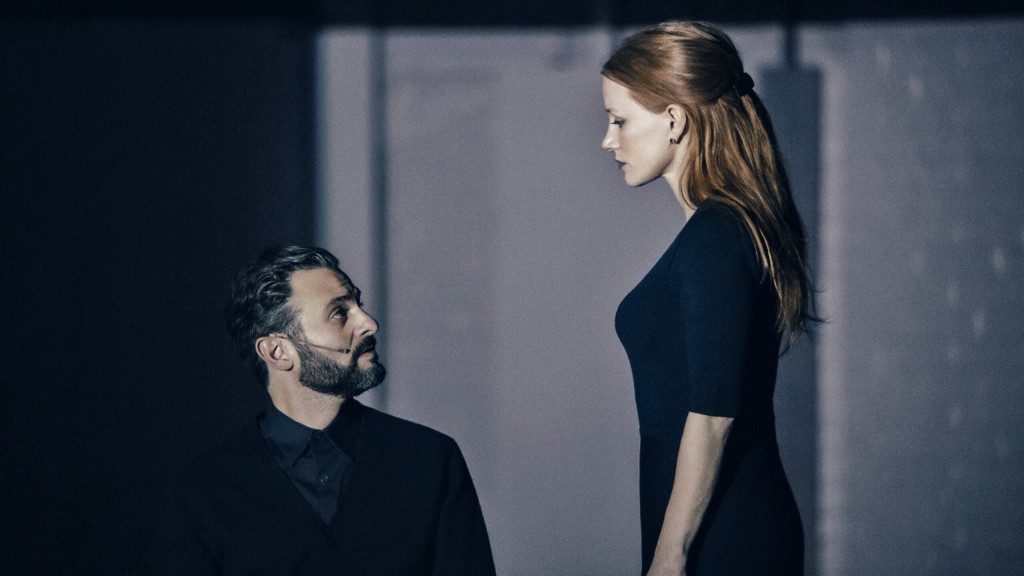
As a masterpiece of modern theater Henrik Ibsen’s A Doll’s House presciently foreshadowed the diminution of a women’s role as homemaker. Ibsen shattered the notion of a woman being a husband’s pet, an obedient robot/doll with no autonomy or identity of her own, who cheerfully accepts the delimitation of traditional folkways. A maverick play at the time, A Doll’s House was considered controversial. Ibsen was forced to rewrite the ending for German audiences so it was acceptable.
What would those audiences have said about Amy Herzog and Jamie Lloyd’s stark, minimalist, conceptually powerful, metaphoric version currently at the Hudson Theatre? It is a version which relies on no distracting accoutrements of theatrical spectacle, i.e. period costumes and plush drapery. Nothing physically tangible assists with the unlacing of “the bodice” of Nora’s interior. With “little more” than cerebral irony, and emotional grist, Nora displays her soul in a genius enactment by the inimitable Jessica Chastain, in the production of A Doll’s House, which runs a spare one hour and forty-five minutes with no intermission.
The plot development, characters and themes are Ibsen’s. Nora, a pampered, babied housewife, to save her husband’s life, unwittingly commits fraud by borrowing money from loan shark Krogstad (Okieriete Onaodowan who in the first scene needed to project his voice so as not to appear a weak character which Krogstad is not). Complications arise when Torvald (an exceptional Arian Moayed), receives a bank promotion. With the additional money, Nora plans to quickly pay back Krogstad. But the loan shark threatens to expose Nora’s secret, unless she can save his job at the bank, where her husband has just become his boss.
Tensions increase when Torvald fires Krogstad and hires Nora’s friend Kristine (Jesmille Darbouze). Nora must confront the situation with Torvald before Krogstad exposes her and destroys Torvald’s reputation and their marriage.
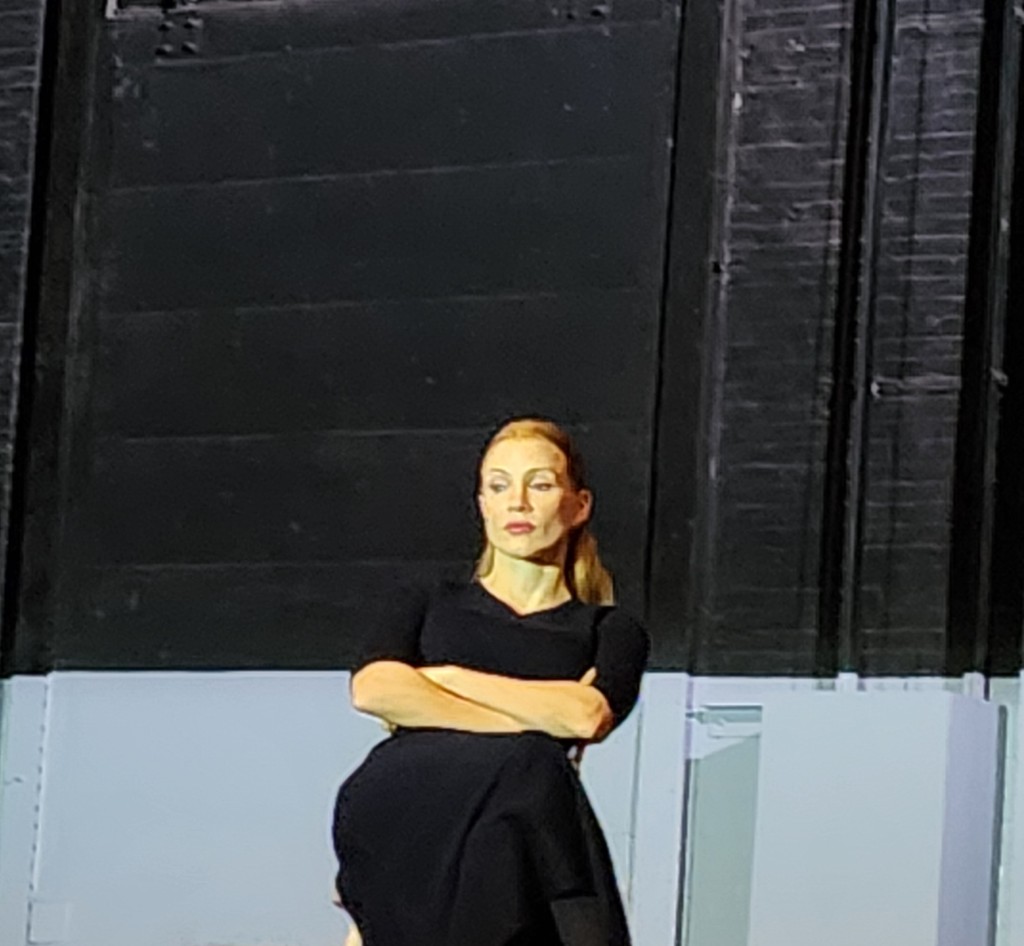
Lloyd and Herzog are a fine meld. Herzog strips extraneous words and phrases, though not the substance of the pared-down dialogue. Her version is striking with a natural, informal, un-stilted speech for concentrated listening. There’s even a “fuck you” which Nora proclaims cheerfully to be bold, though not in Torvald’s hearing. The meat is Ibsen; the forks and knives to devour it are sleek and without ornamentation to distract. The themes and characterizations are bone chillingly articulate, which Herzog and Lloyd excavate with every word and phrase in this acute, breathtaking, ethereal, new version of A Doll’s House.
Lloyd eliminates the comforting, elaborate staging where actors might have moved to and fro amongst luxurious furniture and eye-catching, gloriously-hued dramatic sets that show Torvald’s preferred, lifestyle, which Nora scrimps from her own “allowance” to maintain. Instead, the ensemble’s movements are restrained. They step quietly around Soutra Gilmour’s set. Gilmour has distilled Lloyd’s vision to the back stage wall, top-half painted black, with attendant muted white painted on the bottom half of the wall. The flooring is grey. Predominant are the revolving platform and institutional-looking bland chairs which actors bring in and place on the sometime circling platform, or on its outer edges which don’t revolve.
Chastain appears twenty minutes before the production begins, seated in a chair revolving on the platform (I should have counted the repetitions, but I didn’t.). Sitting, she fascinates. Initially, to me, she was invisible; I was distracted, while she quietly walked on bringing her chair. She was a part of the onstage background, muted, unremarkable. That is perhaps one of the many concepts Lloyd and Herzog suggest with this enlightened version that is memorable because it is metaphysical and conceptual, giving rise to themes about soul interiors and women’s invisibility in the patriarchal culture.
One theme this set design suggests is that we travel in our own orbits, going in circles in our own perspectives, unseen and never truly known as psychically present, spiritual beings. And as Ibsen suggests, it takes an inner cataclysm such as Nora experiences to break from traditional mores and behavioral repetitions into a different consciousness and new way of being. This breakthrough, Nora attempts at the conclusion.
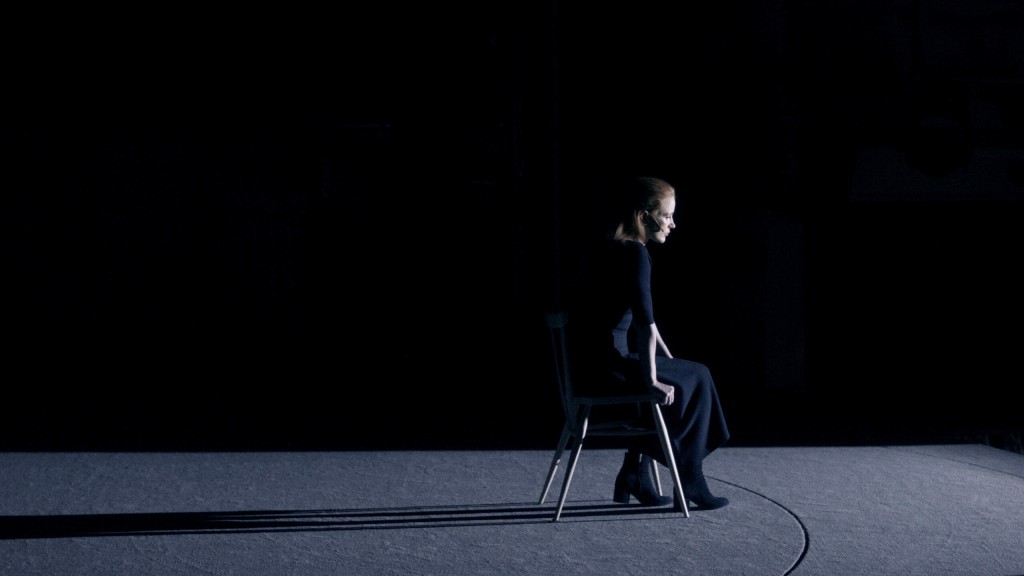
Amy Herzog’s modernized language version of A Doll’s House is one for the ages in focusing Ibsen’s power of developing characterizations. It presents an opportunity for Lloyd’s preferred, stylized, avant-garde staging, similar to what he used in Betrayal (2019) and Cyrano (2022). It requires the audience to listen acutely to every word of the dialogue and scrutinize the actors splendid, nuanced emotions which flicker across their faces. This is especially so of Chastain’s Nora, who is chained and bound symbolically throughout, minimally using gestures or any physicality, as she sits in a chair facing the audience. Predominately. she employs her voice and face to convey the interior-organ manifestation of Nora’s tortured, miserable psyche. For example when the wedding ring is returned, Nora and Torvald do not move; there is no ring. They look at one another, however, the unspoken meaning resonates loudly.
Even the tarantella Nora dances at the costume party, Chastain wrenches from herself sitting in the chair in a frantic nearly psychotic frenzy of shaking and kicking. The earthquake physicality that splits Chastain’s Nora apart is the only broad, physical movement, other than walking out of her stifling, meaningless existence, that Chastain and Lloyd effect with novel irony at the conclusion. The chair-dance is an explosive, rage-filled fit of exasperation, principally done for the purpose of distracting Torvald. Desperate to prevent his discovery of corrupt loan shark Krogstad’s blackmail plot, Nora’s diversion succeeds for a time. However, her fear and inner bleeding wounds only augment, until her behavior is exposed and Torvald unleashes his fury, vowing she must not infect the children with her poisonous corruption. Interestingly, the children ethereally “appear” as voices in voice- over recordings. Nora speaks to them, looking out in the direction of the audience. Hypocritically, Torvald demands she stay away from the children, though she must remain with the family to keep up appearances as his jeweled asset and prize doll.
With Lloyd’s symbolic staging, Chastain’s Nora proves that body, soul and mind are inseparably engulfed in the trauma of a paternalistic culture, represented by males who “love her the most” (her father and husband), and psychically straight-jacket and gaslight her to adopt their thoughts, behaviors and attitudes as right and true. To do this she nullifies her existence as a “human being.” In this production, Herzog, Lloyd, Chastain and the ensemble display this truth. It is undeniably representative of women in 1879, the projected number on the back wall of the stage that appears in the beginning of the production.
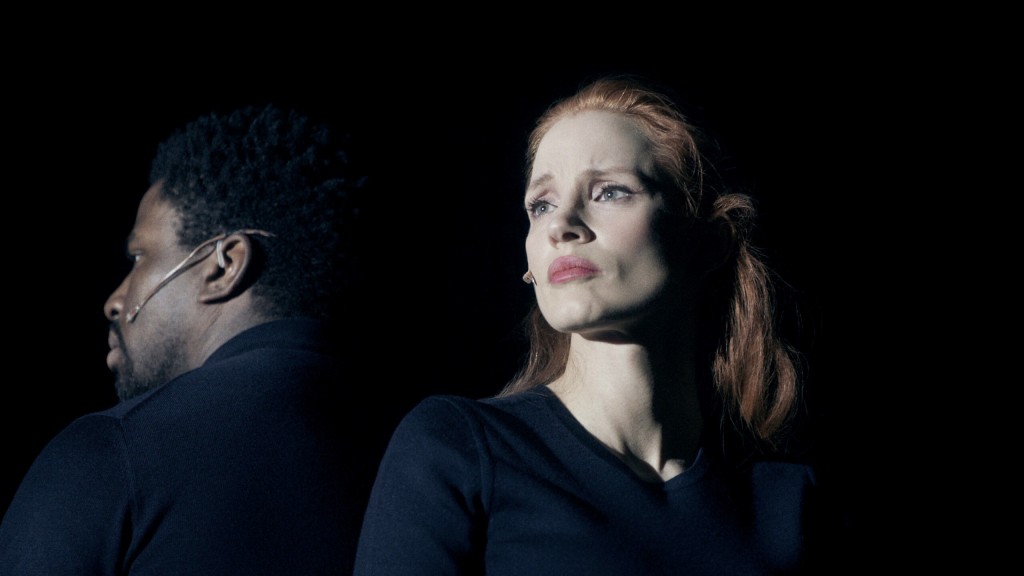
And when the number disappears, we understand that Soutra Gilmour’s black, white, grey set design, and Gilmour and Enver Chakartash’s costume design (modern dress black), function to speed us through 140 + representative years to display the dominant patriarchal attitudes today. These folkways still straight-jacket, demean and traumatize. If one thinks this is fatuous “woke” hyperbole that is finished, one has only to read the one in four statistics of women who are bound in violent relationships with male partners who beat or abuse them, yet cannot leave for fear of being alone or without the means to support themselves or their children. The LGBTQ community is not excepted from this. Humanity has a penchant for violence. If it is not externalized, the violence is psychic and emotional, where not a hand is raised toward a partner, yet the words and silences traumatize. It is the latter psychic trauma that Ibsen/Lloyd explore.
Whether in Ibsen’s historically, visually laden production of A Doll’s House, or in Lloyd’s naked, bleak and blasted version, it is a despotic spirit that demands obeisance, excluding other ways of being to exalt itself by oppressing and choking the life force from “the other,” whether gender-conforming or LGBTQ. That Chastain has the chops to convince us that we are witnessing every stressed fiber of her nerve endings annihilated, as she inhabits one of the most well-crafted characters in drama, is astounding and not to be underestimated, as some have done, implying her Nora “cries too much.”
Suffice to say, those are not female critics, of which there are far too few. However, her performance is emotionally handicapped accessible for those without a hearing ear, who may need to see Jamie Lloyd’s phenomenally sensitive direction a few times to “get it.” And happily many men do get it. They stood, cheered and whooped during the curtain calls when I looked around to see who was standing at Wednesday’s March 14th matinee. More importantly, women also cheered and whooped.
Clearly, husbands/partners, who might be like Torvald, need to see this production, if they suspect they are like him. Chastain’s Nora is an educational experience in how a particular woman suffers to the breaking point in order to be the prototype ideal wife and mother for a man’s “love” and acceptance. When Nora finally realizes she has the tools to free herself from the false and illusory prison of her own making, she throws off a life and role she believed made her happy to search for definitions of her own happiness.
Moayed’s Torvald, who portrays the solipsistic, presumptuous, self-aggrandizing, martinet with likable charm (how he does this is incredible), exposes her to herself. He smashes her fantasies that he is a white knight, who will do the “beautiful thing,” by sacrificing himself for her, as she has done for him.
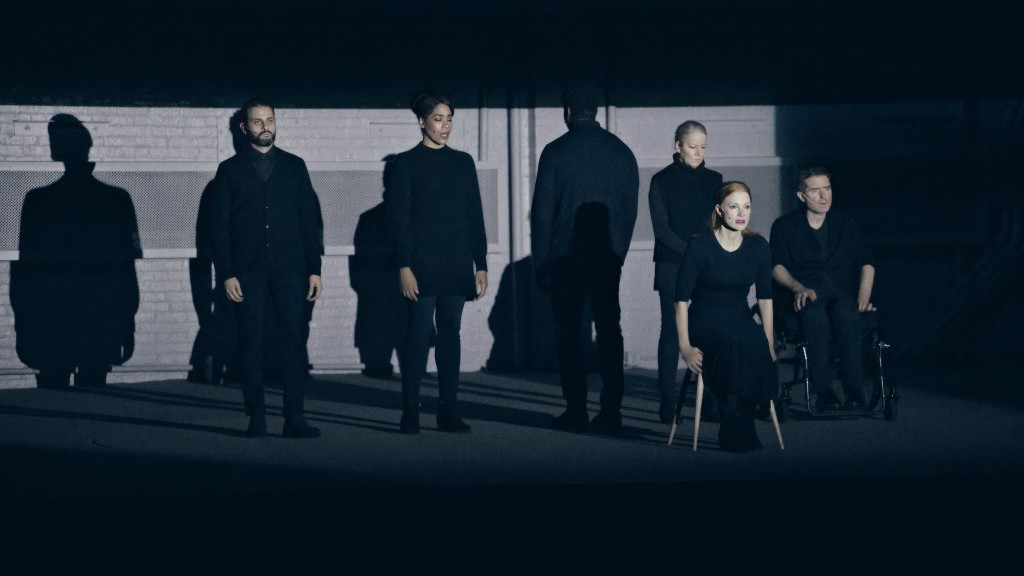
Unfortunately, the only one who would sacrifice himself for her is on his way out of life. Chastain’s scenes with Michael Patrick Thornton’s Dr. Rank, who is the couple’s terminally ill close friend, are touching, warm and human, unlike her scenes with Torvald. They should be together, but she won’t push their light flirtations beyond, loyal to her fantasy of Torvald, until she isn’t.
Interactions between Nora and Torvald are increasingly transparent as they devolve into Torvald’s eventual explosion and hatred directed at Nora after discovering the truth. The scenes between Krogstad and Kristine pointedly contrast and move in the opposite direction. Kristine’s persuasive love of Onaodowan’s Krogstad makes him swallow his “pride” and give up his extortion plan. Truth is at the core of their love. Onaodowan and Darbouze are particularly strong and authentic in their scene together which reveals Kristine and Krogstad’s love has remained over the years. On the other hand Torvald and Nora’s toxic relationship functions in falsehoods. Lies are at its core, and what is presumed to be love is convenience and objectification. Torvald demands Nora be his dream doll and she obeys, though it demoralizes her soul.
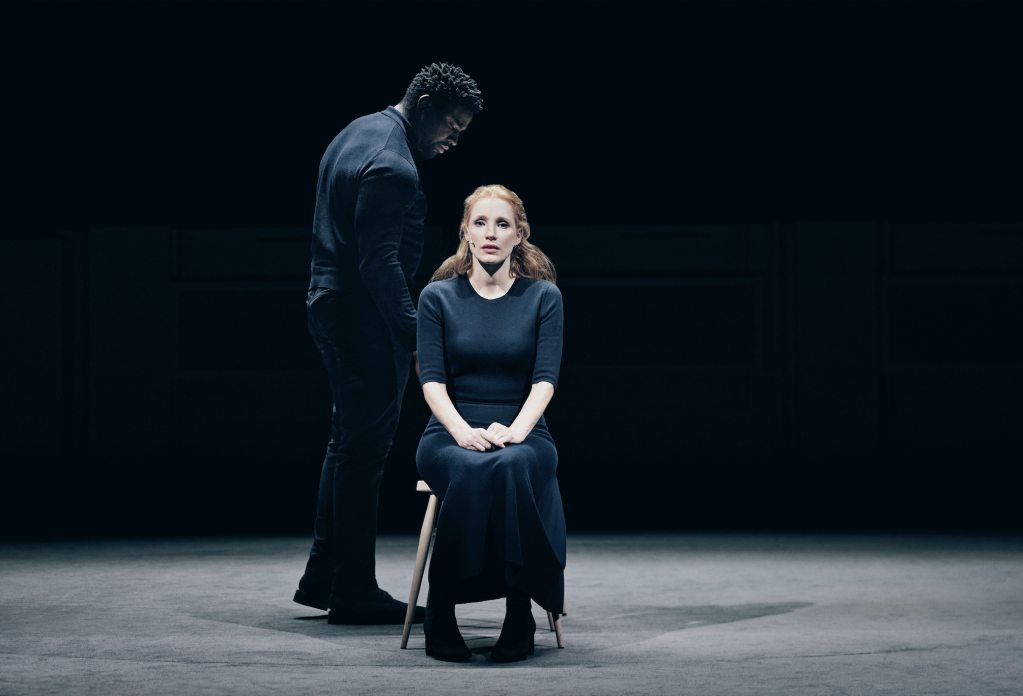
Kristine’s troubled life has brought her to an understanding of herself in an honesty which Krogstad appreciates, for he wants to give up his corrupt way of life. That Lloyd has selected two Black actors to portray these characters reveals an underlying authenticity and exaltation for their love. Krogstad, who is in the shadows when we first meet him, as he sits behind Nora and blackmails her (unfortunately I had to read the script to understand these lines), appears the villain. He is made more villainous by the society’s ill treatment of him, but his love for Kristine redeems him. Torvald’s inability to love Nora damns them both.
Ironically, when her friend’s love is rekindled, Nora’s love ends, as she realizes Torvald’s true nature and relationship to her. Though he apologizes for “going off” in a diatribe superbly delivered by Moayed, Torvald’s narcissism which can’t abide anything hurting the Torvald “brand,” is egregious. His presumption is a delusion, for she saved his life; he wouldn’t exist but for her.
Herzog’s spare dialogue reveals how loathsome Torvald is in the last scene, when Nora tells him she believed him to be her white knight who would take the blame for her mistake. She insists she would have killed herself to stop his sacrifice for her. It is laughable when he says he would do anything for her, but he “won’t do that.” With conviction speaking for the entire tribe, Moayed states, “No man sacrifices his dignity for the person he loves.” Nora counters, “Hundreds of thousands of women have done that.” When Torvald begs her to stay for the children, he is the weak, despicable coward. His concern is pretentious show to make her feel guilty for leaving. Nora can’t be pressured. She knows Torvald will dump the inconsequential children’s care on their Nanny Anne-Marie (Tasha Lawrence).
Nora allows Torvald’s toxic masculinity to forge the chains which she uses to bind herself in the confines of a paternalistic culture that promotes attitudes about “the little wife.” Meanwhile, his little “bird” lacks a being and ethos apart from him. The only freedom, identity and empowerment Chastain’s Nora will ever receive is one she fashions for herself. This, she ironically and joyously enforces at the play’s conclusion.
How are such incredible performances by Chastain, Moayed and the others so beautifully shepherded? Lloyd economizes to the essence of thought in the lines reworked by Herzog. The evocative minimalism heightens the play’s timelessness and draws into crystal clarity the subtle, “loving” oppressive fantasies men and women (or whatever gender relationships), rely on to sustain power dynamics in their coupling. Without underlying truth and honesty to bolster the relationship and weather horrific storms, the illusions become insupportable and the personalities and relationships shatter.
Kudos to all in the creative team I may not have noted previously, including Jon Clark (lighting design), Ben & Max Ringham (sound design), the ominous, haunting music by Ryuichi Sakamoto & Alva Noto, and dance choreography by Jennifer Rias. For tickets to this maverick production, go to their website https://adollshousebroadway.com/
‘Betrayal’ Starring Tom Hiddleston, Zawe Ashton, Charlie Cox in Quintessential Harold Pinter
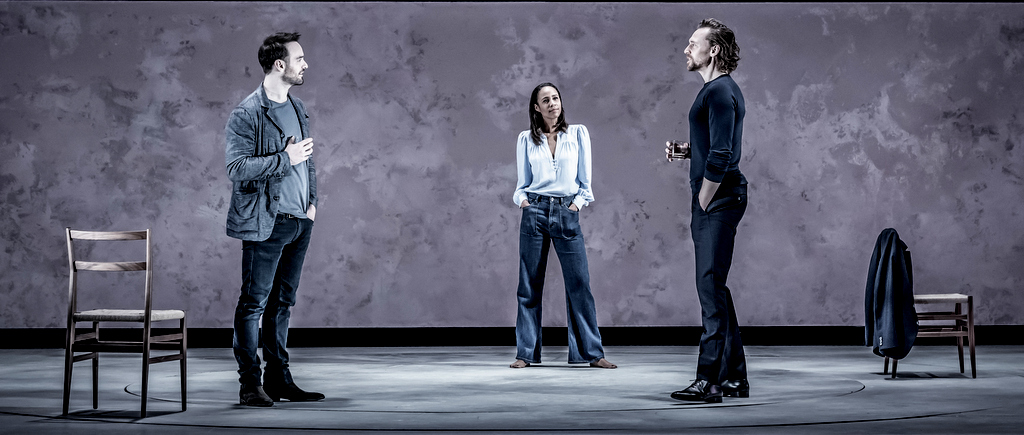
(L to R): Charlie Cox, Zawe Ashton, Charlie Cox in Harold Pinter’s ‘Betrayal,’ directed by Jamie Lloyd (Marc Brenner)
For those who have seen one of the many revivals of Harold Pinter’s brilliant, award winning play Betrayal or its film equivalent (1983), you cannot help but be engaged following the intrigue and duplicity of the triangulated relationship between married couple Emma and Robert, and close friend Jerry. In Betrayal, Pinter raises deceitfulness to a fine art as he memorializes how a convolution of lies evolve into the death of a marriage. The current revival directed with exceptional insight and precision by Jamie Lloyd and acted to perfection by Tom Hiddleston (Robert) Zawe Ashton (Emma) and Charlie Cox (Jerry) at the Bernard B. Jacobs Theatre, vaults Pinter’s work into the heavens.
Though I have not seen every revival, this one most probably exceeds productions that came before it with few exceptions, perhaps the only one being the production in 2013 directed by Mike Nichols starring real-life-couple Daniel Craig and Rachel Weisz. However, I cannot adequately compare for this spectacular production is mind-blowing. It took my breath away.
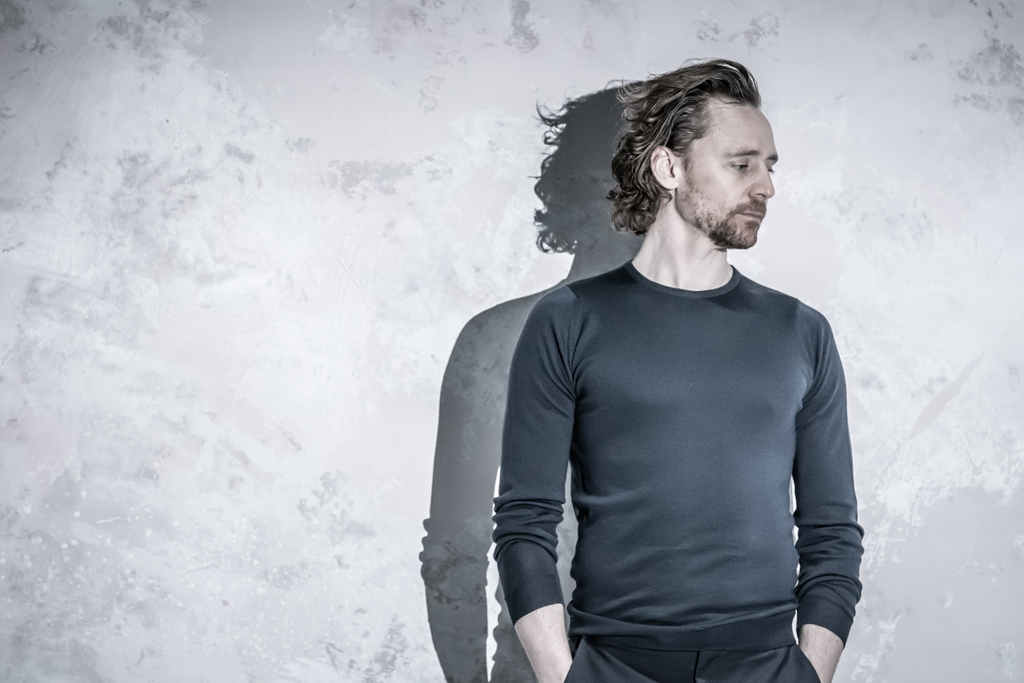
Tom Hiddleston in Harold Pinter’s ‘Betrayal,’ directed by Jamie Lloyd (Marc Brenner)
Director Jamie Lloyd removes any extraneous spectacle of sets, props, costumes. He supplants them with unobtrusive design elements to enhance Pinter’s themes so we focus on the interactions of the three principals and their responses to each other both sub rosa and manifest. Lloyd retains a spare physicality during scene changes employing the use of a revolving platform to spin the characters back into time and flashback where they finally land on the “beginning” event in Emma’s/Robert’s bedroom. It is then in 1968 when Jerry poetically, fervently seduces Emma mentally and plants the seeds of the irrevocable ending of it all in her consciousness. In a reverse chronological order we witness the ending dissolution of the marriage at the top of the play. Pinter reveals in reverse the salient conversations which slide back to the initial thrusts of “love and betrayal” between Jerry and Emma which are integral to their relationship with Robert. who manages to retain control despite their duplicity with a mendacity all his own.
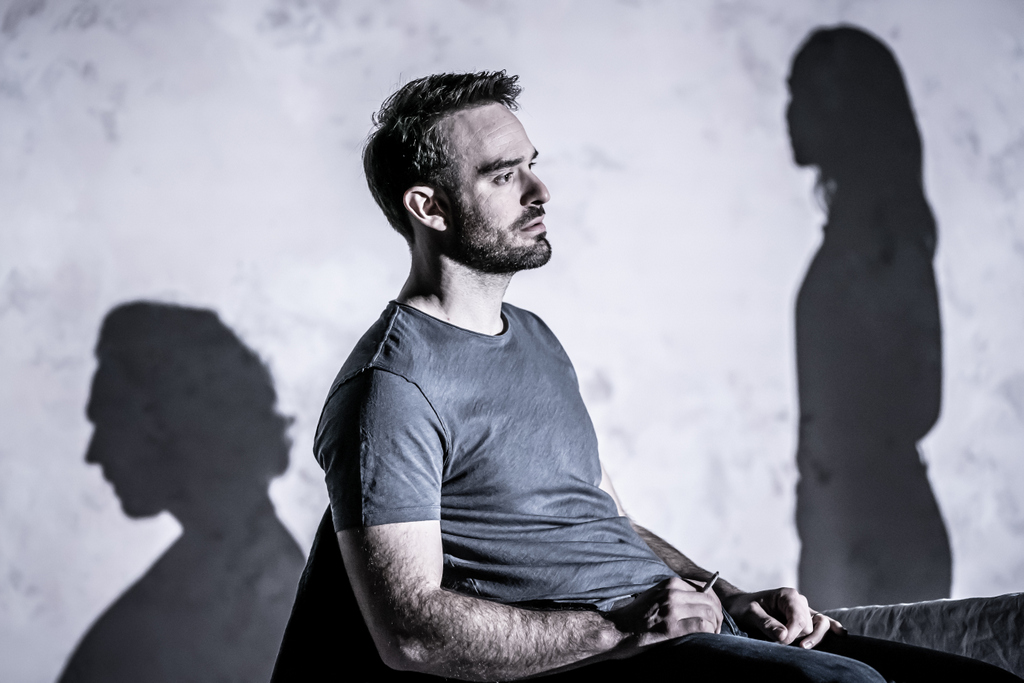
Charlie Cox in Harold Pinter’s ‘Betrayal,’ directed by Jamie Lloyd (Marc Brenner)
To clarify the structure of the seven year affair, Lloyd adds projections of the backward turning years on the wall and the front of the proscenium. Thus, we note in backward evolution events which lead to the primal moment when the canker worm of adultery first nestles on the flower of Robert’s and Emma’s marriage, a worm which we witness from the initial scene and which completely has eaten away Emma’s, Robert’s and Jerry’s well being and peace. However, at the top, like most interactions we ourselves have, we are not sure what we witness until the final revelation of deceit at the play’s conclusion.
For the entire production, Lloyd has constructed as the main set piece, the backdrop of a blandly colored wall at the rear of the stage against which the actor not engaged in a scene stands facing the audience or leaning in profile. Lloyd’s enlightened staging reinforces the nature of the relationship among Robert, Emma and Jerry as if they are one being and entity. It also heightens the notion that the one absent is everpresent in the others’ minds, and that he or she will be the subject of the conversation between the other two.
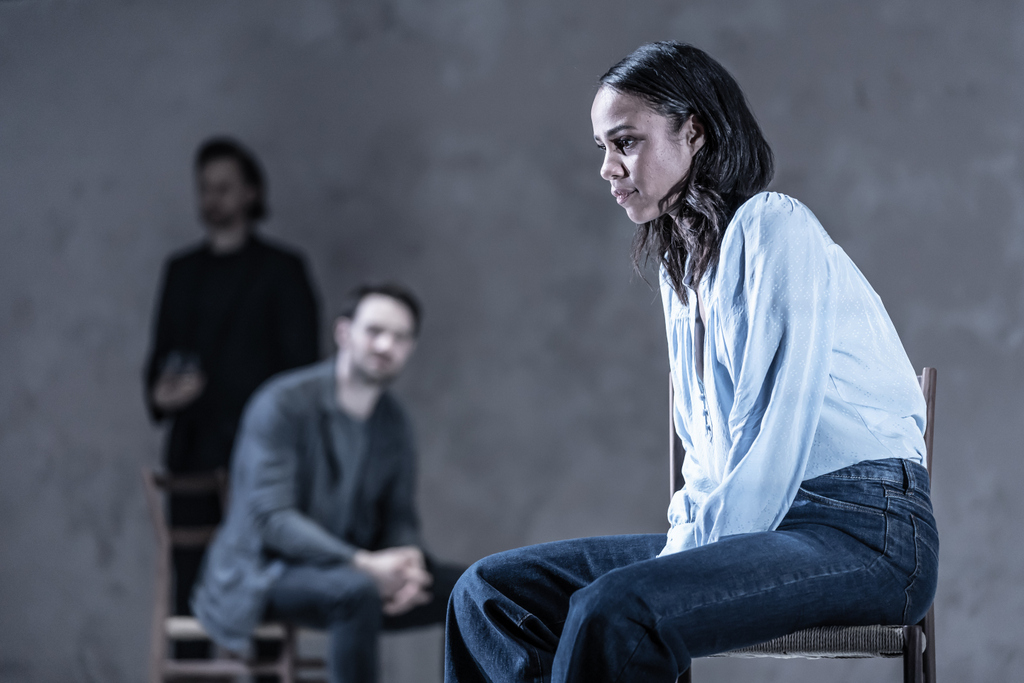
(L to R): Tom Hiddleston, Charlie Cox, Zawe Ashton in Harold Pinter’s ‘Betrayal,’ directed by Jamie Lloyd (Marc Brenner)
Maintaining the presence of all the principals on stage whether they are actively engaged or silently hovering, also elucidates the nature and condition of each. It is as if they enjoy the necessity of being a “threesome” of duplicity, though they are not a “threesome” physically or sexually. Nevertheless, each is seared and entrapped in the consciousness of the other two and never really is far away from “them” when the other two are together cheating “behind his/her back.” The fascinating staging furthers Lloyd’s theme: if there is to be an affair, the three are perhaps most satisfied in being clandestine with each other in a strange egotistical and mental sadomasochism which allows them to continue betraying and misleading each other for years. Thus, the themes of betrayal for each of the characters is nuanced and layered and because Robert, Jerry and Emma cannot confront the truth of their own illness of self-deception, the destruction of their relationships between and among each other grows, despite their willful obliviousness.
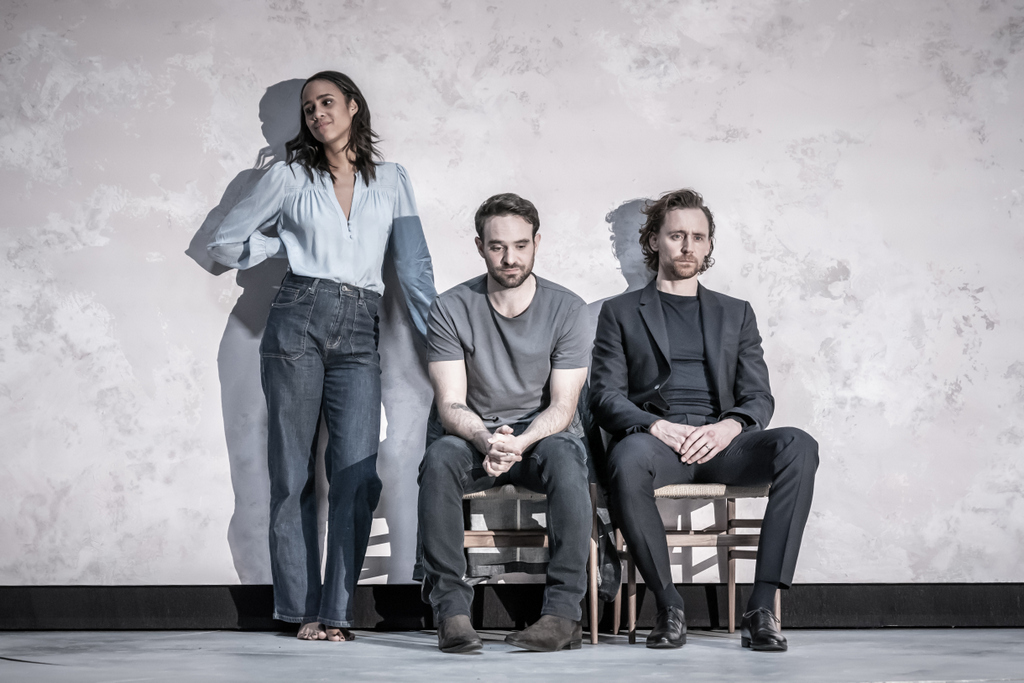
(L to R): Zawe Ashton, Charlie Cox, Tom Hiddleston in Harold Pinter’s ‘Betrayal,’ directed by Jamie Lloyd (Marc Brenner)
Lloyd’s focus on psyche and consciousness rises to great thematic purpose and illustrates why Pinter never includes the presence of Judith, Jerry’s spouse or the others with whom Robert and Emma are having affairs. These others are ancillary to the vitality of the psychic “threesome.” As a result we understand how Emma, Robert and Jerry function together swimming in the medium of lies pulling toward and against each other to an inevitable dissolution of what they once were before the affair between Emma and Jerry began.
For what Lloyd’s staging and incredible direction with the equally scintillating acting by Hiddleston, Ashton and Cox evokes and symbolizes, we experience a production which is thrilling, alive, masterful. For in the hands, minds and instruments of these brilliant talents, Pinter’s Betrayal is a play about consciousness and the emotional and mental agility of ego, impulse, deflection and undercurrent so that we understand each character’s intentions and feelings though these may never be expressed and may hover as the unspoken and insidious. Hiddleston, Ashton and Cox circle smugly around the truth, even to the point of lying about “how they are doing.” All are doing poorly, considering they’ve blown apart love and friendship and have reveled in allowing a cover-up to persist with a sub rosa disdain and rebuke of each other. We witness a tragedy which the characters are loathe to admit. Only the waiter wonderfully portrayed by Eddie Arnold remains cheerful, positive and authentic.
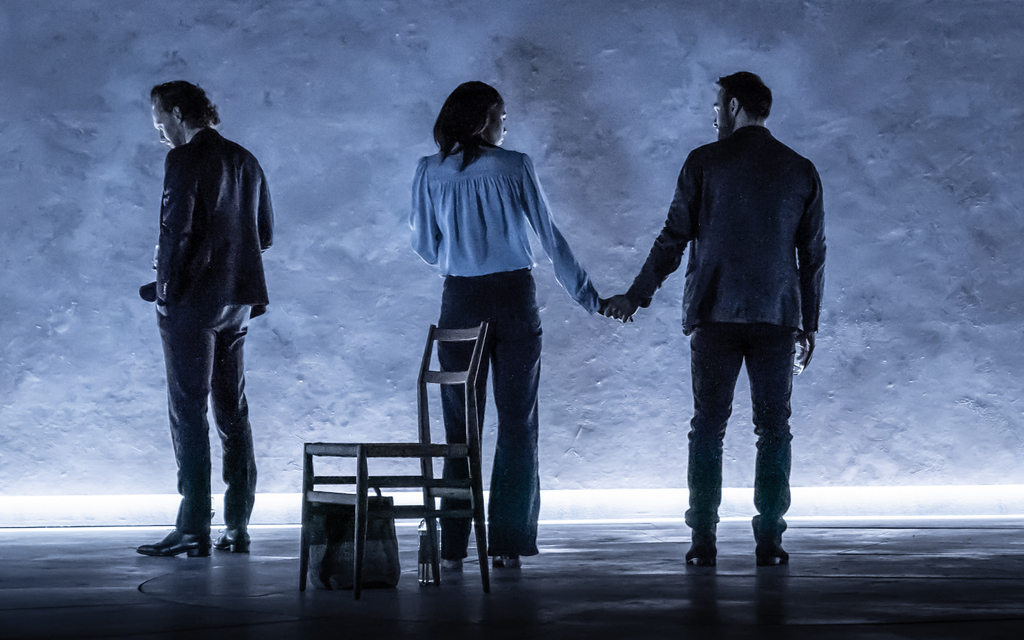
(L to R): Tom Hiddleston, Zawe Ashton, Charlie Cox in Harold Pinter’s ‘Betrayal,’ directed by Jamie Lloyd (Marc Brenner)
Interestingly, when prodded, the characters deflect. Typical of Pinteresque dialogue, a simple “How are you?” and response of “Fine,” becomes weighted with subterranean meaning and import. The individual whether Robert or Emma or Jerry is not fine. Indeed, their souls are in tatters. Though the relationship between and among each was profound (Emma and Robert have two children together, one after she sleeps with Jerry; Robert actually likes Jerry better than Emma) it is not intimate. Each is an isolate, separate and alone, inauthentic, insincere, manipulative. Pinter displays the very core of friendship and love for these three. They lovingly, charmingly, metaphorically stab each other again and again in the back while smiling in each other’s faces. They accomplish their treacheries to preserve ego. Meanwhile, how can their center hold? Eventually, it doesn’t.
Of course this is the human condition: fronting, saving face. God forbid these would admit hurt, pain and torment. God forbid Robert would smash Jerry’s head in for seducing his wife or confront Jerry with the truth. God forbid Emma and Robert would go to therapy. Instead, we discover that Robert becomes “all right” with their affair and doesn’t share his knowledge with Jerry punitively, until Jerry furiously confronts him after the affair is over for two years. Likewise, Emma’s ego is shattered when she discovers Robert punishingly, ironically, has been unfaithful to her for years. Thus, we note how Robert has controlled Jerry and Emma and manipulated them while letting them believe he was the “weakling” and cuckold. That he encourages it and that they are outraged at his behavior and unfaithfulness is the height of irony, humor and cynicism.
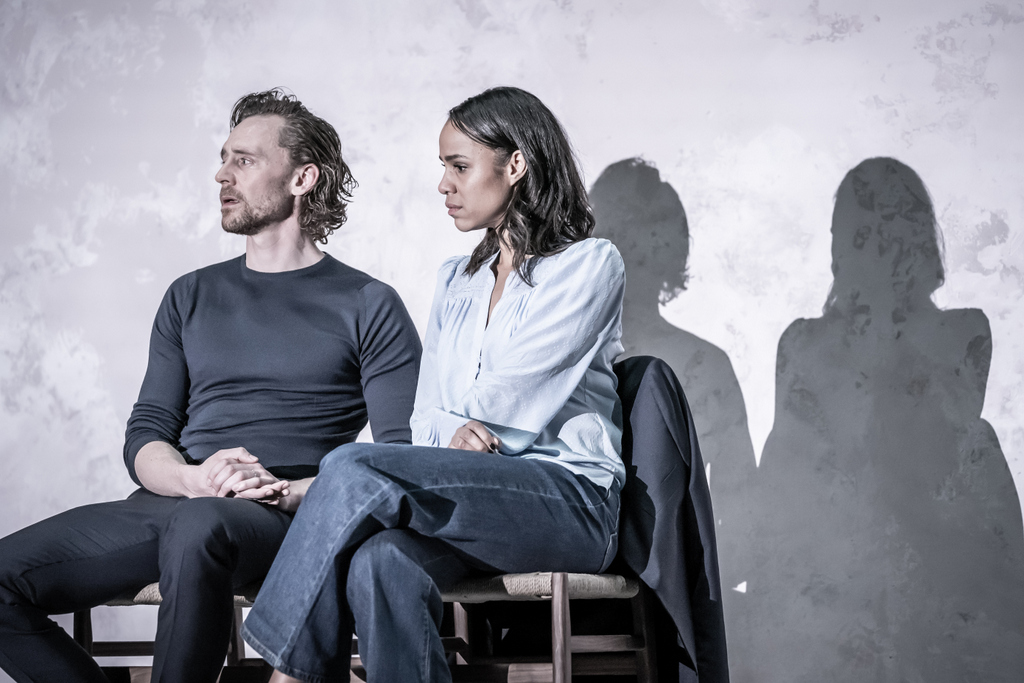
Tom Hiddleston, Zawe Ashton in Harold Pinter’s ‘Betrayal,’ directed by Jamie Lloyd (Marc Brenner)
What particularly enthralled me was the emotional grist of Hiddleston, Zawe and Cox revealed at various times when the truth smashes into them. The actors allow us to see glimpses of the pain the characters are hiding. This occurs, for example: when Hiddleston initially discovers Emma’s letter to Jerry; when Emma discovers her marriage which has been over for years, is finally over; when Jerry discovers with outrage how Robert hid his knowledge of the affair from him for four years without a stir or breath of upset or anger. Each of them plodded on living with their own perfidy and self- deception without feeling the necessity of coming to an end of themselves in truth. Cox, Hiddleston and Zawe are absolutely stunning in their moment-to-moment responses to each other. Theirs is breathtaking ensemble work.
Betrayal is a magnificent production. I didn’t want it to end and the standing ovation wasn’t enough appreciation, surely, for such marvelous work. Kudos to Soutra Gilmour (scenic & costume design) Jon Clark (lighting design) Ben and Max Ringham (sound design and composition) for executing Jamie Lloyd’s vision and in creating a medium in which the actors’ portrayals are encouraged to vibrate with life.
Betrayal runs with no intermission at the Bernard B. Jacobs Theatre (242 West 45th Street) until 8 December. Don’t miss this theatrical event which will surely bring in nominations for the cast and director. For tickets and times CLICK HERE.
 CAROLE DI TOSTI