Blog Archives
‘The Night of the Iguana,’ Theater Review
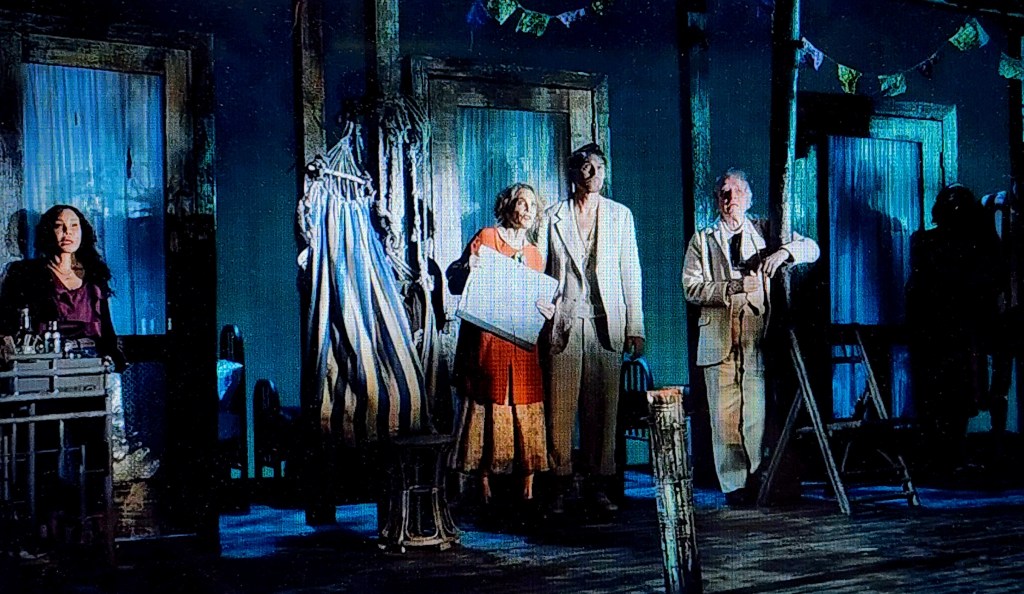
The Night of the Iguana is one of Williams most poetic and lyrical plays with dialogue that touches upon the spiritual and philosophical. On the one hand in Iguana, Williams’ characters are amongst the most broken, isolated and self-destructive of his plays. On the other hand, in their humor, passions and rages, they are among the most identifiable and human. La Femme Theatre Productions’ revival of The Night of the Iguana, directed by Emily Mann, currently at the Pershing Square Signature Center until the 25 of February, expresses many of these elements in a production that is incompletely realized.
The revival, the fourth in 27 years, and sixty-one years after its Broadway premiere, reveals the stickiness of presenting a lengthy, talky play in an age of TikTok, when the average individual’s attention span is about two minutes. Taking that into consideration, Mann tackles Williams’ classic as best as possible with her talented creative team. At times she appears to labor under the task and doesn’t always strike interest with the characters, who otherwise are hell bent on destruction or redemption, and if explored and articulated, are full of dramatic tension and fire.
Beowulf Boritt’s scenic design of the off-kilter, ramshackle inn in the tropical oasis of 1940s Costa Verde, Puerto Barrio, Mexico, and Jeff Croiter’s fine, atmospheric lighting and superbly pageanted sky are the stylized setting where Williams’ broken individuals slide in and out of reality, as they look for respite and a miracle that doesn’t come in the form that they wish. With the period costumes (exception Maxine’s jeans) by Jennifer Von Mayrhauser), we note the best these characters can hope for is a midnight swim in the ocean to distract themselves from their inner turmoil, depression, loneliness, DT’s and brain fever/ The latter are evidence of addiction recoiling, experienced by the play’s anti-hero, “reforming” alcoholic Reverend T. Lawrence Shannon (Tim Daly).

One of the issues in this revival is that the humor, difficult to land with unforced, organic aplomb is missing. At times, the tone is lugubrious. This is so with regard to Tim Daly’s Reverend Shannon, in the scene where he expresses fury with the church in Virginia that locked him out, etc. If done with “righteous indignation,” his rant, with Hannah Jelkes (Jean Lichty), as his “straight person,” could be funny as her response to him elucidates the psychology of what is really going on with the good reverend. It would then be clearer that Shannon is misplaced and just can’t admit he loathes himself and agrees with his congregants who see him as one who despises them and God, an irony. Indeed, is it any wonder they see fit to lock him out of their church?
The ironies, his indignation and Hannah’s droll response are comical and also identify Shannon’s weaknesses and humanity. Unfortunately, the scene loses potency without the balance of humor. Shannon is a fraud to himself and he can’t get out of his own way. Is this a tragedy? If he didn’t realize he was a fraud, it would be. However, he does, thus, Williams’ play should be leading toward a well deserved redemption because of the underlying humor and Shannon’s acceptance that his life is worth saving. In this revival, the redemption merely happens without moment, and the audience remains untouched by it, though impressed that Tim Daly is onstage for most of the play.
The arc of development moves slowly with a few turning points that create the forward momentum toward the conclusion, when Shannon frees an iguana chained at its neck so it won’t be eaten (a metaphor for the wild Shannon that society would destroy). The iguana is released, yet the impact is diminished because the build up is incompletely realized. Little dramatic immediacy occurs between the iguana’s release into freedom and the initial event when Daly’s quaking Reverend Shannon struggles up the walkway of Maxine’s hotel. Daphne Rubin-Vega’s Maxine Faulk and her husband Fred have previously offered escape for Shannon. Now, at the end of nowhere, he goes there to flee the condemnation and oppression meted out by the Texas Baptist ladies he is tour guiding, This slow arc is an obstacle in the play that is difficult to overcome for any director and cast.
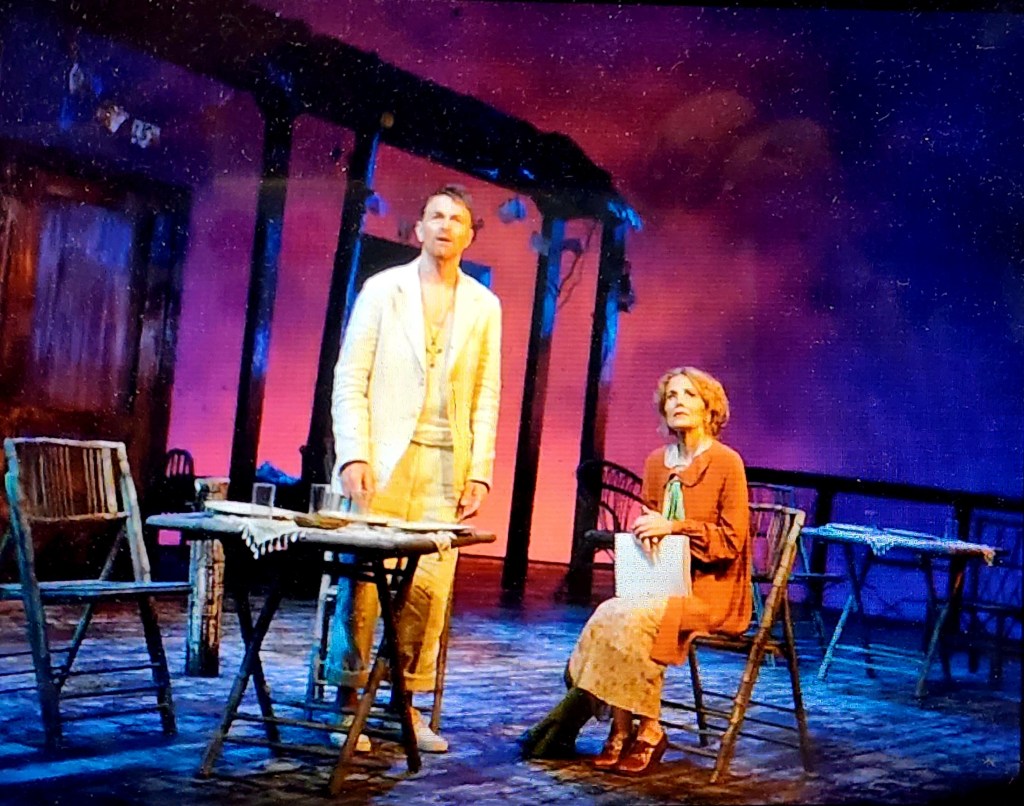
In the Act I exposition, we learn that Shannon’s job of last resort as ersatz tour guide has dead-ended him in a final fall from grace. He is soul wrecked and drained after he succumbs to seventeen-year-old Charlotte Goodall’s sexual advances in a weak moment, while “leading” the ladies through what appears to be paradise (an irony). However, their carping has made the Mexican setting’s loveliness anything but for the withering, white-suited Shannon, who was moved toward dalliances with Carmen Berkeley’s underage nymphet. Whether culturally imposed or self-imposed, prohibition always fails. Ironically, clerical prohibitions (alcoholism, trysts with women), are the spur which lures Shannon to self-destruction.
Already a has-been as a defrocked minister when we meet him, Shannon is hounded by the termagant-in-chief, Miss Judith Fellowes (Lea Delaria), who eventually has him fired. He has no defense for his untoward behavior, nor explanation for his actions, when he diverts the tour, and like a foundering fish gasping for air, flops into the hammock at Maxine’s shabby hotel. There, he discovers that her husband Fred has passed. In her own grieving, desire-driven panic, Rubin-Vega’s Maxine welcomes Shannon as a fine replacement for Fred.
It is an unappealing and frightening offer for Shannon, who views Maxine as a devourer, too sexual a woman, who takes swims in the ocean with her cabana boy servants to cool off the heat of her lusts. Shannon prefers her previous function in her collaboration with Fred, when her protective husband was alive enough to throw Shannon on the wagon, so he could prepare for his next alcoholic fall off of it.
While the appalled Baptist ladies remain offstage, honking the horn on the bus to alert Shannon to leave, and refusing to come up to Maxine’s hotel to refresh themselves, Shannon makes himself comfortable. So do spinster, sketch artist and hustler Hannah (Jean Lichty is less ethereal than the role requires), and her Nonno, the self-proclaimed poet of renown, Jonathan Coffin (Austin Pendleton moves between endearing and sometimes humorous as her 97-year-old grandfather).

Oozing financial desperation from every pore, the genteel pair have been turned away from area hotels. As Hannah gives Maxine their “resume,” the astute owner sniffs out their destitution and is about to show them the door, when the down-and-out Shannon pleads mercy, and Maxine relents. Her kindness earns her chits from Shannon that she will capitalize on in the future. Maxine knows she won’t see a dime from Hannah or her grandfather, whether or not Nonno dramatically discovers the right phrasing and imagery to finish his final poem at her hotel, and earns some money reciting it to pay their bill.
Though the wild and edgy Maxine allows them to stay, she “reads the riot act” to Hannah, suggesting she curtail her designs on the defrocked minister. If Hannah doesn’t go after Shannon, she and her grandfather might stay longer. However, the tension and build up between Maxine and Hannah never fire up to the extent they might have.
To what end does the play develop? Explosions do erupt. Maxine vs. Shannon, and Shannon vs. Miss Judith Fellowes create imbroglios, though they subside like waves on the beach minutes after, as if nothing happened. Only when tour replacement Jake Latta (Keith Randolph Smith), confronts Shannon for the keys to the bus, must Shannon reckon with one who enforces power over him. Neither Maxine, nor her cabana boys, nor Hannah, nor Fellowes can bend Shannon’s will to his knees. Jake Latta’s reality rules the day.

As the bus leaves and his life blows up, Shannon must face himself and end it or begin anew. In the scene between Daly’s Shannon and Lichty’s Hannah after Shannon is tied up in the hammock to keep him from suicide, there is a break through. Daly and Lichty illuminate their characters. Together they create the connection that opens the floodgates of revelation between Shannon and Hannah in the strongest moments of the production. When Nonno finishes his poem and expires, the coda is placed upon the characters who have come to the end of themselves and their self-deceptions. Life goes on, as Shannon has found his place with Maxine who will help him begin again, free as the iguana he set loose. Perhaps.
Williams’ characters are beautifully drawn with pathos, humor, passion and hope. If unrealized theatrically and dramatically, they remain inert, and the audience doesn’t relate or feel the parallels between the universal themes Williams reveals, or the characters’ sub text he presents. Mann’s revival makes a valiant attempt toward that end, but doesn’t quite get there.
For those unfamiliar with the other Iguana revivals or the John Huston film starring Richard Burton and Ava Gardner, this production should be given a look see to become acquainted with this classic. In this revival, there are standouts like Daphne Rubin-Vega as the edgy, sirenesque Maxine, and Pendleton’s Nonno, who manages to be funny when he forgets himself and asks about “the take” that Hannah collected. Lea Delaria is LOL when she is not pushing for humor. So are the German Nazi guests (Michael Leigh Cook, Alena Acker), when they are not looking for laughs or attempting to arouse disgust. That Williams includes such characters hints at the danger of fascist strictures and beliefs, that like the Baptist ladies follow, threaten free thinking beings (iguanas) everywhere.
Humor is everpresent in The Night of the Iguana‘s sub text. However, it is elusive in this revival which siphons out that humanity, sometimes tone deaf to the inherent love with which Williams has drawn these characters. Jean Lichty’s Hannah, periodically one-note, misses the character’s irony in the subtle thrust and parry with Tim Daly’s humorless, angry and complaining Reverend T. Lawrence Shannon. Daly’s panic and shakiness work when he attempts to hide the effects of his alcoholic withdrawal. Both Lichty and Daly are in and out, not quite clearly rendering Williams’ lyricism so that it is palpable, heartfelt and shattering in its build-up to the significance of Shannon’s symbolically freeing himself and the iguana.
The Night of the Iguana with one intermission at The Pershing Square Signature Center on 42nd Street between 9th and 10th until February 25th. https://iguanaplaynyc.com/
Theater Review (NYC): ‘A Lovely Sunday For Creve Coeur,’ by Tennessee Williams, Starring Kristine Nielsen, Annette O’Toole, Jean Lichty
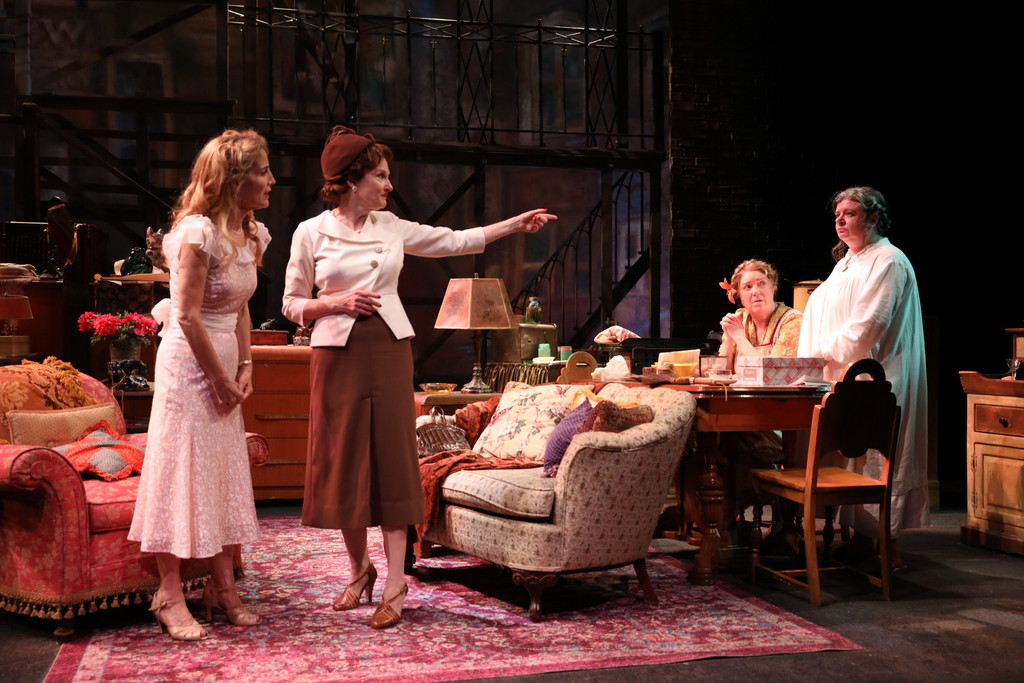
(L to R): Jean Lichty, Annette O’Toole, Kristine Nielsen, Polly McKie in ‘A Lovely Sunday For Creve Coeur,’ directed by Austin Pendleton (Joan Marcus)
Tennessee Williams dramatized women’s quiet lives of desperation. Indeed, his characterizations ping from the haunting, tragic-comedic melodies of emotion he experienced with his family growing up in St. Louis, Missouri. In A Lovely Sunday For Creve Coeur, directed with measured grace by Austin Pendleton, one of Williams’ last plays receives a sterling, masterful presentation. Assuredly, the excellent ensemble of actors provides the poignant atmospheric intensity.
Currently running at Theatre at St. Clement’s, the production deserves a visit for its adroit performances and direction. Pendleton’s nuanced and gradual unfolding of Williams’ dramatic climax at once captivates with its beauty, delicacy, and plaintiveness. Delivered with a less astute balance in shepherding the actors’ portrayals than Pendleton’s, Williams’ complicated play would not deliver the power and heart-break that this production evokes at the conclusion.

(L to R): Kristine Nielsen, Jean Lichty, ‘A Lovely Sunday For Creve Couer,’ Tennessee Williams, directed by Austin Pendleton (Joan Marcus)
Throughout the play we witness three single women’s wants and desires. A fourth, who becomes a foil for the other three, provides the background theme which motivates them to desperation. Each longs for happiness away from her current day to day lower class existence in depression era St. Louis, Missouri. In order to achieve this happiness, they place their hopes in others to deliver it. Ultimately, the women deceive themselves. Clearly, they set themselves up for disappointment after disappointment.
At the opening we note that maternal, nurturing Bodey (Kristine Nielsen in a superb, layered, and profound rendering), chides Dorothea. With precision Jean Lichty portrays the teacher, a fading Southern belle from Tennessee. Lichty’s somewhat frivolous Dorothea spends her entire morning waiting upon Mr. Ralph Ellis’s phone call. Because Bodey is “deaf” and didn’t hear the phone ring when it did, we become persuaded by Dorothea’s view. Initially we believe her relationship with Ralph remains solidly founded. Meanwhile, Bodey prepares food for a lovely outing at Creve Coeur with her twin brother Buddy, anticipating that Dorothea will join them. She insists she will not, for Ralph Ellis has important information to tell her about their lives together.
Strikingly, we see that neither women really listens to the other as each drives forward to achieve their own goals. Dorothea yearns for Ralph, a principal who associates with the country club set. Because of her recent tryst with him, she anticipates that her charms have overwhelmed him romantically as she has been overwhelmed. The inevitability remains clear for her, though Bodey warns her against these notions.
Bodey’s reaction to Dotty’s relationship with Ellis appears questionable. We wonder at Bodey’s potential jealousy of “their love.” The feminine, sweet, pretty Dorothea surely will leave her and get married, a frightening prospect for Bodey. Indeed, Dotty believes that eventually, Ralph will spirit her into a well positioned marriage away from the squalid, spare lifestyle she leads teaching, and renting from Bodey. For her part Bodey, a spinster devoted to caring for others, least of all herself, has given up on her own prospects of marriage. Instead, she believes that her overweight, reliable, unromantic, hearty twin Buddy would be perfect for Dorothea. And if they married, she would be the dependable aunt who would raise their brood and have a vital purpose in their family life.
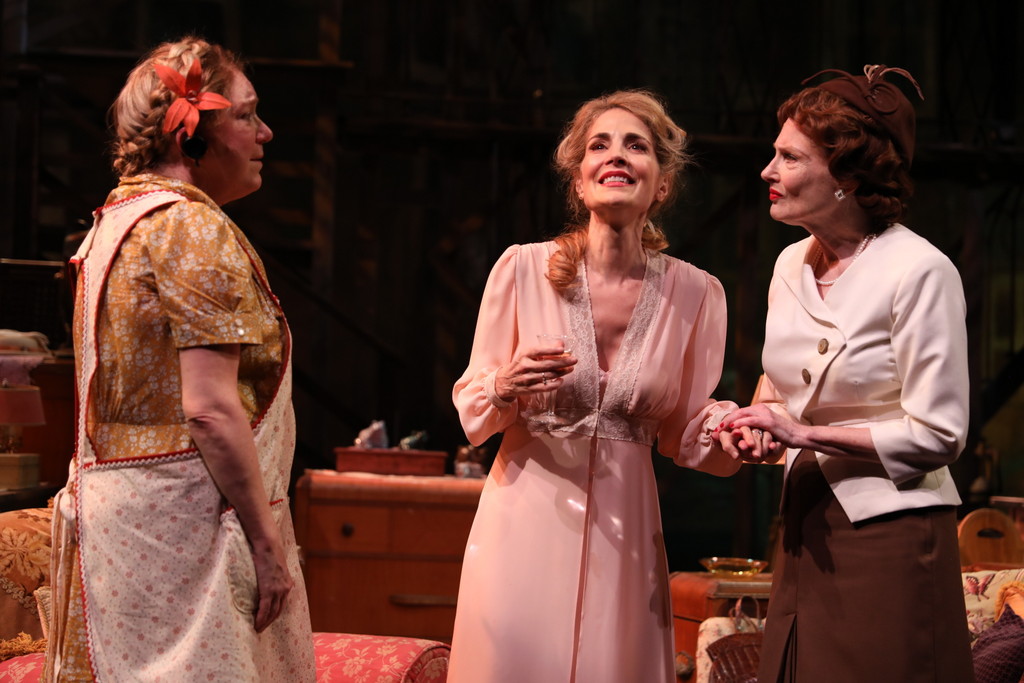
(L to R): Jean Lichty, Annette O’Toole, Kristine Nielsen in ‘A Lovely Sunday For Creve Coeur,’ directed by Austin Pendleton (Joan Marcus)
During the course of the play, two other spinsters join into this group of women who appear unloved and unwanted. Miss Gluck, a German neighbor who has lost her mother and who grieves incessantly. Most probably not only does she grieve the close relationship loss. But she probably grieves that she will be alone. Thus, she must give herself her own solace daily. Indeed, how much can Miss Gluck rely on the friendship of her neighbor Bodey with whom she communicates only in German? Polly McKie as the mournful Miss Gluck is humorous and believable. Thematically, the character portends what happens to women who do not marry well economically or congenially, or whose husbands abandon them to loneliness and despair.
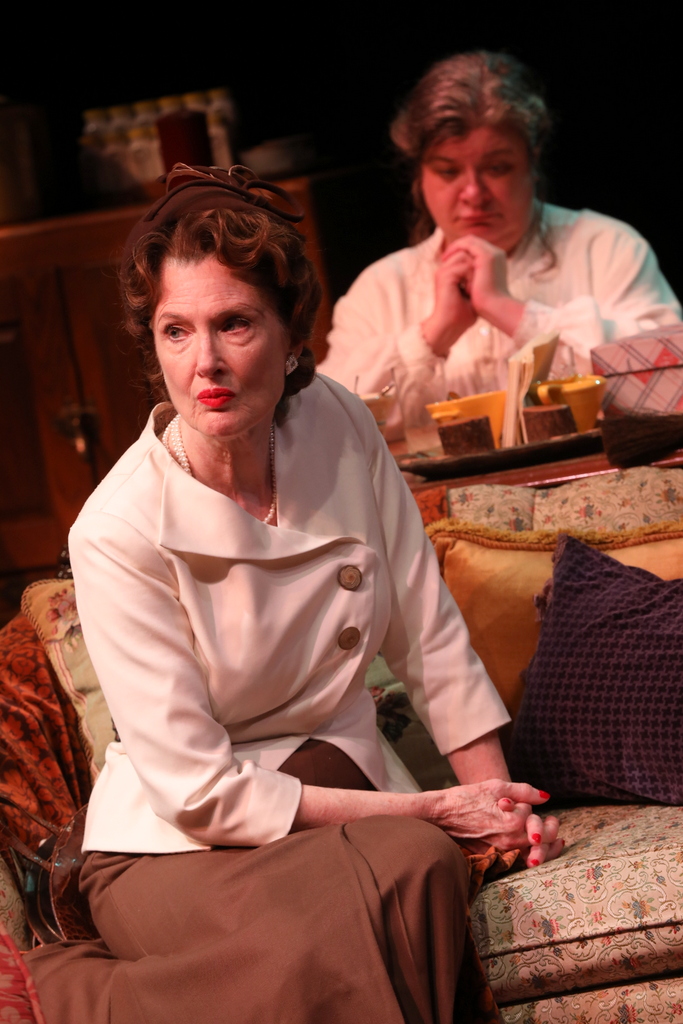
Annette O’Toole and Polly McKie in ‘A Lovely Sunday For Creve Coeur,’ directed by Austin Pendleton, written by Tennessee Williams, La Femme Theatre Productions (Joan Marcus)
Helena is the fourth spinster who intrudes into the lives of Bodey and Dotty. During the course of her visit, she suggests the monstrous end which awaits the unfortunate Miss Gluck. Incisively portrayed by Annette O’Toole, Helena represents the cruel and bitter archetype of the most miserable of the spinsters. These yearn to escape themselves and falling short, grow venomous and predatory toward other women. Arrogant, acerbic, biting she manipulates with sarcasm. And she bullies and demeans Bodey and Dotty with female cultural mores and the pretense of good breeding. In irony she implies that unless Dotty takes actions to lift herself into an upscale arrangement with her, she will fall into the same despair as Bodey. And with finality, poor Dotty will eventually become a social anathema, the greying, unwanted, depressive Miss Gluck.
As the day unfolds, we learn Helena, too, has wants. A fellow teacher in the same school, she intends for Dotty to be her roommate and share the expensive rent and utilities. Her concern for Dotty’s life path concludes with self-dealing. Her own. She covets the monthly expenses Dotty will hand to her. And she intends Dotty to partner up at their bridge games twice a week for companionship. When Dotty inquires whether the bridge will be mixed, we see the fullness of Dotty’s fear anguish of discouragement.
For Dotty, there is no hope without a man. She cannot define herself in any other terms. Nor can she settle for a kind of contentment or resignation as Bodey, Helena and even Miss Gluck have. For her it’s a man, or it’s the abyss. That her designs fall upon Ralph Ellis and certainly not the overweight, unappealing Buddy, who accompanies his sister to Creve Coeur, is her tragic misfortune.
Tennessee Williams’ ironies and humor seek a fine level in this satisfying and heartfelt production. Notably, the Rolling Stones anthem to humanity rings out loudly in this play’s themes of disappointment and finding one’s courage to move past despair. No, “You Can’t Always Get What You Want!” However, for some of the characters, especially the ones who nurture and look out for each other, they do “get what they need.” Perhaps. Indeed, they may even enjoy a lovely Sunday at Creve Coeur.
Kudos to the artistic team Harry Feiner (Scenic & Lighting Design), Beth Goldenberg (Costumes), Ryan Rumery (Sound Design & Original Music), and the other artists.
A Lovely Sunday For Creve Coeur presented by La Femme Theatre Productions runs without an intermission at Theatre at St. Clement’s (423 West 46th St) until 21 October. Interestingly, the theater was founded by Tennessee William’s cousin Reverend Sidney Lanier. You may purchase tickets at LaFemmeTheatreProductions.org.
 CAROLE DI TOSTI