Blog Archives
‘Jaja’s African Hair Braiding,’ Hysterical, Fun, Profound
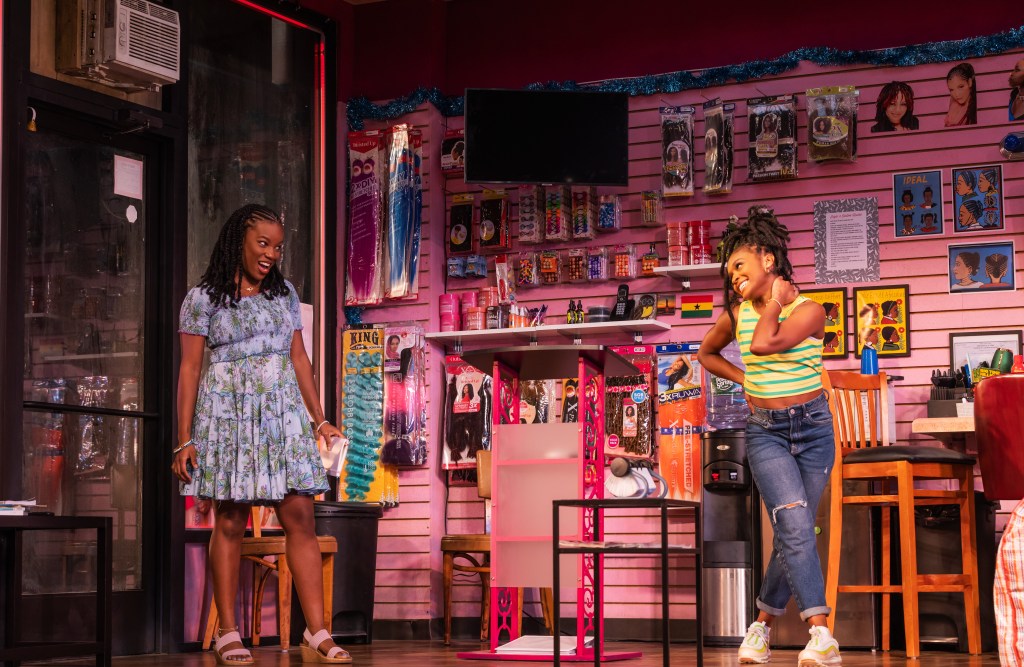
Jaja’s African Hair Braiding by Jocelyn Bioh in its world premiere at the Manhattan Theatre Club (Samuel J. Friedman Theatre), is a rollicking comedy with an underlying twist that, by the conclusion, turns as serious as a heart attack. Bioah’s characters are humorous, quick studies that deliver the laughs effortlessly because of Bioah’s crisp, dialogue and organic, raw themes about relationships, community, female resilience and the symbolism of hair braiding which brings it all together.
The setting is in Harlem, at Jaja’s Hair Salon where African hair braiding and the latest styles are offered. For those white gals and guys who envy the look of long lovely extensions but are too afraid to don them, it is understandable. You have to have a beautiful face to sustain the amazing, freeing look of long braided tresses that you can fling with a gentle or wild toss, evoking any kind of emotion you wish.
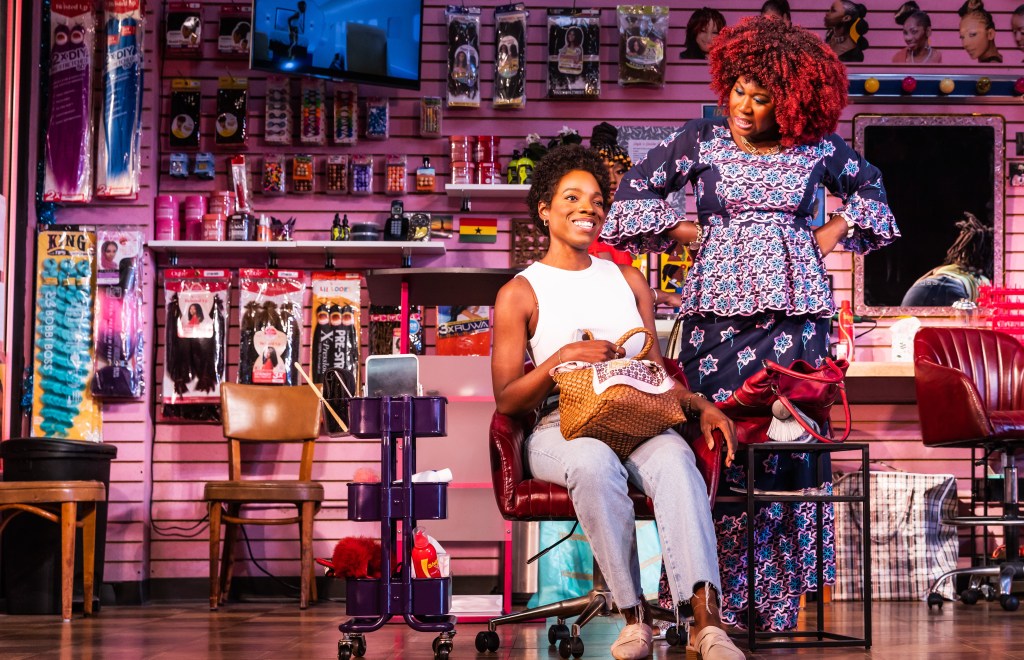
During the course of the play, we watch fascinated at the seamless ease with which the actors work their magic, transforming otherwise unremarkable women into jaunty, confident and powerful owners of their own dynamic presentation. While we are distracted by the interplay of jokes and mild insults and gossip, the fabulous shamans weave and work it.
In one instance, Miriam (the fine Brittany Adebumola) takes the entire day to metamorphose her client Jennifer (the exceptional Rachel Christopher). Jennifer comes into the shop appearing staid, conservative and reserved with short cropped hair that does nothing for her. But once in Miriam’s chair, something happens beyond a simple hairdo change.
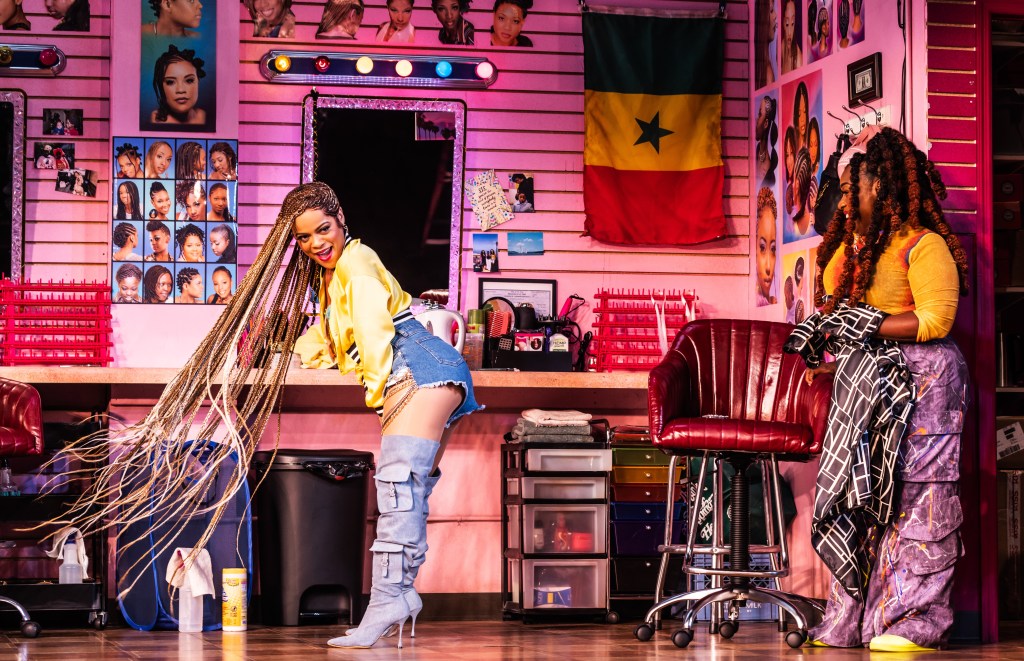
After MIriam is finished discussing her life back in Sierra Leone, which includes the story of her impotent, lazy husband, her surprise pregnancy and birth of her daughter by a gorgeous and potential future husband, and her divorce from the “good-for-nothing”, paternalistic former one, Jennifer is no longer. Miriam has effected the miraculous during her talk. Jennifer has become her unique self with her lovely new look. As she tosses her head back, we note Jennifer’s posture difference, as she steps into the power of how good she looks. Additionally, because of Miriam’s artistry, Jennifer is the proud receptor of a new understanding and encouragement. She has witnessed Miriam’s courage to be open about her life. If Miriam can be courageous, so can she.
Jennifer leaves more confident than before having taken part in the community of caring women who watch each other’s backs and hair, which by now has taken on additional symbolic meaning. Incredibly, Miriam works on Jennifer’s braids the entire play. However, what Jennifer has gained will go with her forever. The dynamic created between the storyteller, Miriam, and the listener, Jennifer, is superb and engages the audience to listen and glean every word they share with each other.
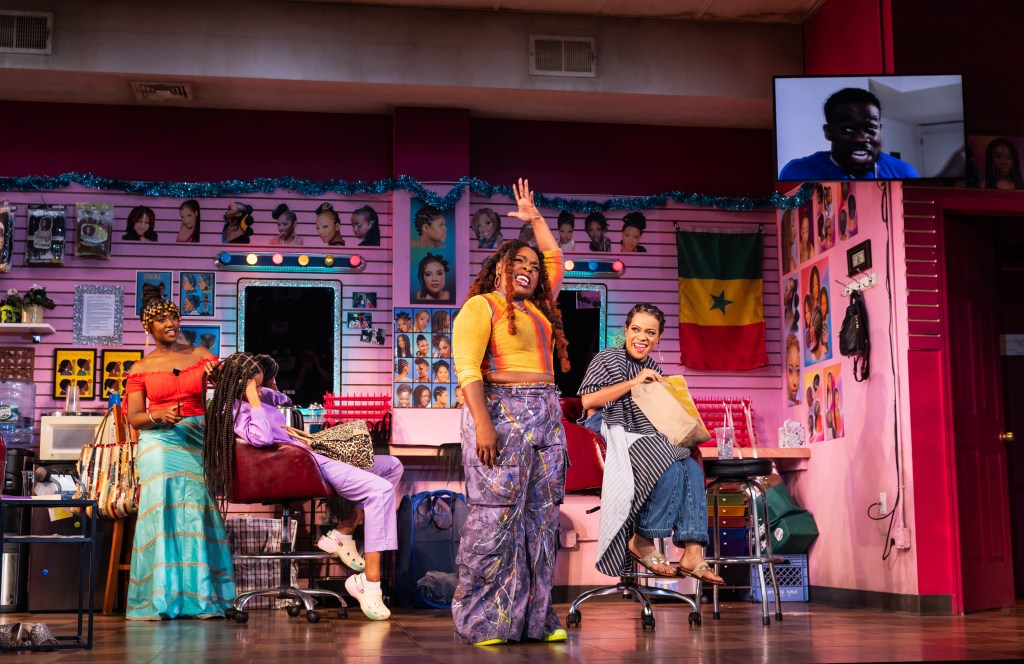
On one level, a good part of the fun and surprise of the production rests with Bioh’s gossipy, earthy, forthright characters, who don’t hold back about various trials they are going through involving men, who exploit them. Nor do they remain reticent if they think one of their braiding colleagues has been surreptitiously stealing their clients, as Bea accuses Ndidi of doing in a hysterical rant
Another aspect of the humor deals with the various clients who come in. Kalyne Coleman and Lakisha May each play three roles as six different clients. They are nearly unrecognizable for their differences in appearances. They change voices, gestures, clothing, mien, carriage and more. For each of these different individuals, they come in with one look and attitude and leave more confident, happier and lovelier than before.
Portraying three vendors and James, Michael Oloyede is hysterically current. Onye Eme-Akwari and Morgan Scott are the actors in the funny Nollywood Film Clip that Ndidi imitates.
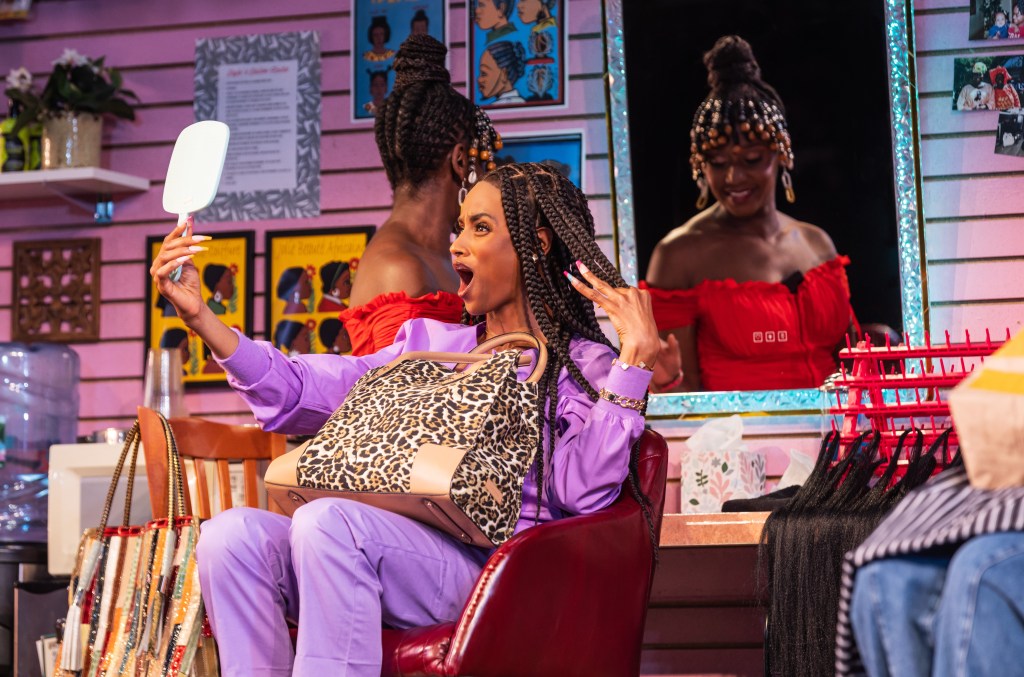
For women, hair is key. Bad hair days are not just a bad joke, they are a catastrophe. Bioh capitalizes on this embedded social, cultural more. Presenting its glories, she reveals the symbolism of “extensions,” and “new appearances” as they relate to uplifting the spirit and soul of women who are required to look gorgeous.
Above all, Bioh elevates the artists whose gifted hands enliven, regenerate, encourage and empower their clients. Along with Miriam (Brittany Adebumola), these include Ndidi (Maechi Aharanwa), Aminata (Nana Mensah) and Bea (Zenzi Williams). Sitting in their chairs, under their protection, trusting their skills at beautification, we recognize the splendid results, not only physically in some instances but emotionally and psychically.
The only one who isn’t an African braiding artist is Marie (Dominique Thorne). She is helping out her mother Jaja (Somi Kakoma), who owns the salon and who is getting married that day, so she can get her green card for herself and Marie. Jaja who appears briefly in wedding garb to share her excitement and happiness with the women who are her friends, then goes to the civil judge to be married. However, Marie can’t be happy for her mother. Likewise, neither can old friend Bea, who has told the others the man Jaja is marrying is not to be trusted.
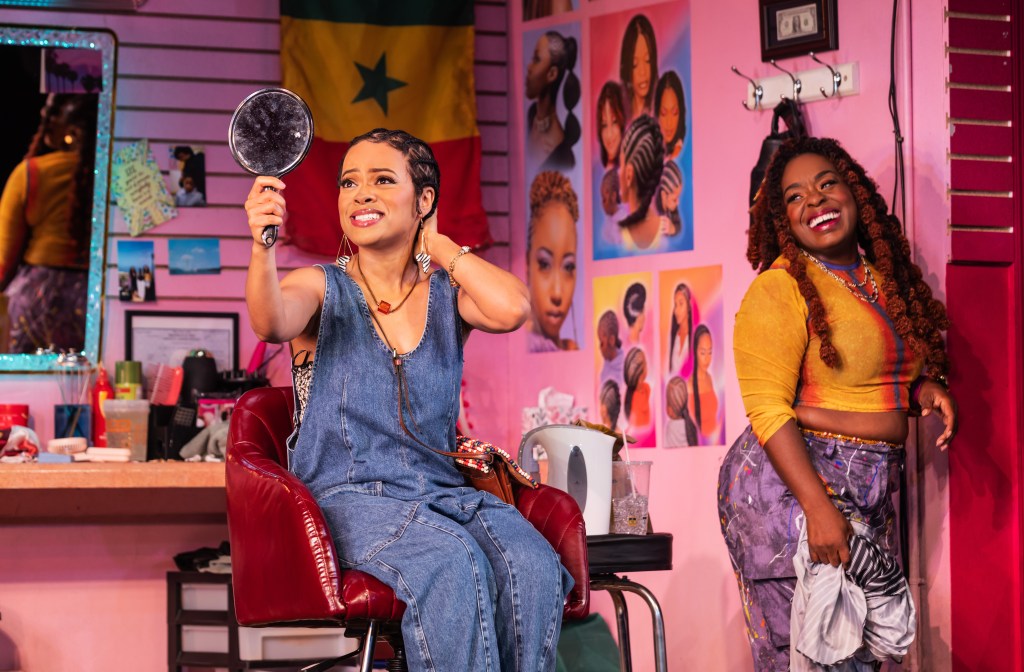
Nevertheless, the point is clear. Within the shop there are artists who are working their way toward citizenship. And Miriam is saving money to bring her daughter to the US. Though Bioh doesn’t belabor the immigration issues, but instead, lets us fall in love with her warm, wonderful characters, it is a huge problem for the brilliant Marie, who has been rejected from attending some of the best colleges. Her immigration status is in limbo as a “Dreamer.”
And like other immigrants, she is living her life on hold in a waiting game that is nullifying as well as demeaning because, as Jaja points out repeatedly to her, she can be a doctor or anything she wants. Her daughter, Marie, is brilliant, ambitious and hard working. Taking over the African hair braiding salon is not good enough. She can do exploits. But without a green card, she can do nothing.
Directed by Whitney White whose vision for the play manifests the sensitivity of a fine tuned violin, the play soars and gives us pause by the conclusion. The technical, artistic elements cohere with the overall themes that show the hair salon is a place of refuge for women to commiserate, dig deep and express their outrage and jealousies, then be forgiven and accepted, after a time. It is a happy, busy, brightly hued and sunny environment to grow and seek comfort in.
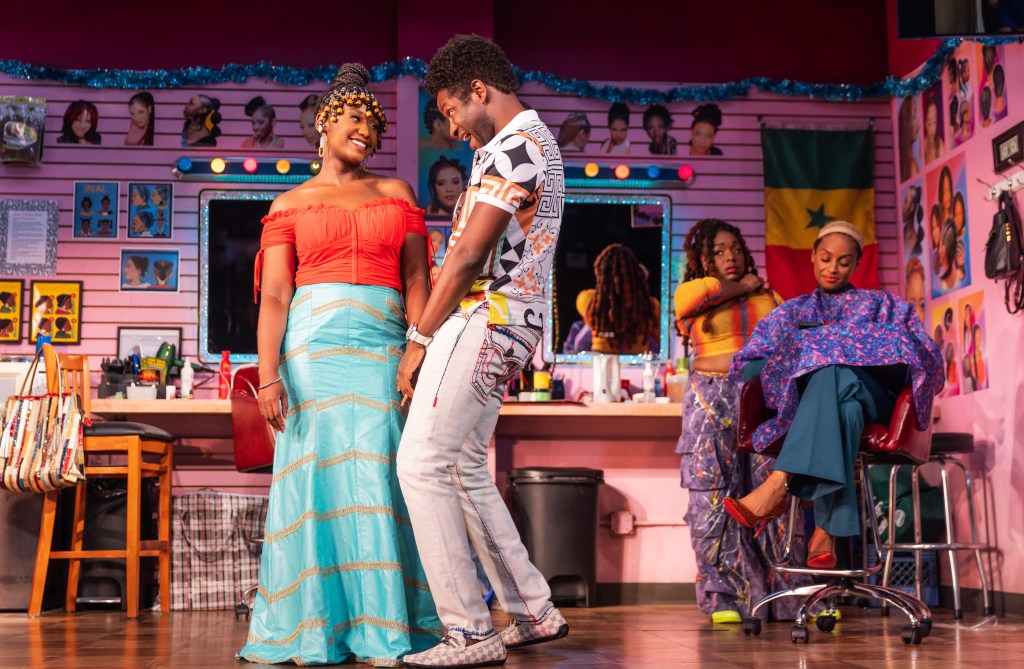
David Zinn’s colorful, specific scenic design helps to place this production on the map of the memorable, original and real. This salon is where one enjoys being, even though some of the characters snipe and roll their eyes at each other. Likewise, Dede Ayite’s costume design beautifully manifests the characters and represents their inner workings and outer “brandings.” From her costumes, one picks up cues as to the possibilities of what’s coming next, which isn’t easy as the production’s arc of development is full of surprises.
Importantly, Nikiya Mathis’ hair & wig design is the star of the production. How the braiding is done cleverly with wigs so that it appears that the process takes hours (it does) is perfect. Of course the styles are fabulous.
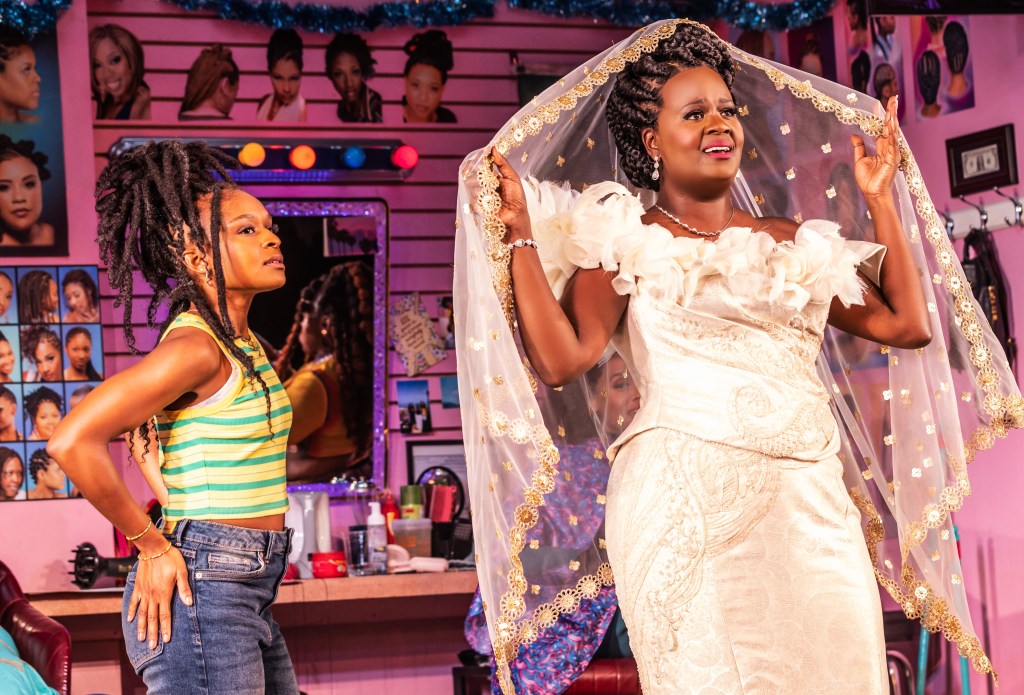
Kudos to the rest of the creative team which includes Jiyoun Chang (lighting design), Justin Ellington (original music & sound design), Stefania Bulbarella (video design), Dawn-Elin Fraser (dialect & vocal coach).
This is one to see for its acting, direction, themes and its profound conclusion which is unapologetic and searingly current. Bioah has hit Jaja’s African Hair Braiding out of the park. She has given Whitney White, the actors and the creatives a blank slate where they can enjoy manifesting their talents in bringing this wonderful show to life. It is 90 minutes with no intermission and the pacing is perfect. The actors don’t race through the dialogue but allow it to unfold naturally and with precision, humor and grace.
For tickets go to the Box Office on 47th Street between 7th and 8th Avenues or their website https://www.manhattantheatreclub.com/shows/2023-24-season/jajas-african-hair-braiding/?utm_source=google&utm_medium=cpc&gclid=CjwKCAjwvfmoBhAwEiwAG2tqzDaZkpYxm9EVbEs9yQ0hCPDF5gTyx9a8iy4yFCkwZxfd3skrmdD8oxoCAfgQAvD_BwE
‘Nollywood Dreams’ a Comedic Farce With Intriguing Undertones

Jocelyn Bioh (School Girls; or, The African Mean Girls Play), and director Saheem Ali her frequent collaborator (Merry Wives of Windsor), once again work comedic magic in Nollywood Dreams, a farce that twits burgeoning Nigerian Cinema in the 1990s, yet makes a statement about dreaming, and dreamers influenced by countries with jaded, hypocritical values.
The production makes the most of the Newman Mills Theater’s intimacy with heightened, particular and detailed scenic design by Arnulfo Maldonado,, that cleverly enhances Bioh’s characters, set changes, story arc and thematic focus. Dede Ayite’s appealing and over-the top costume design and Nikiya Mathis’ hair and wig design encourage the actors to pull out all the stops. These production elements especially enhance the actors’ characterizations and encourage their freedom to humorously tear up Bioh’s witty celebrity inferences with grace and humor, that moves the production along at a well-paced clip.
If Bioh’s characterizations are superb, even greater is the cast that inhabits the recognizable celebrity types and their acolytes with definition, depth and unique authenticity. The humor is organic and situational, and part of the laugh riot comes at witnessing how other countries, i.e. Nigeria, emulate some of the worst of American, to wit “Hollywood” culture through a lens brightly. Thus, Bioh’s farce not only humorously underscores and gently ridicules Nollywood cinema, but it also satirically rocks the most shallow and nauseating American entertainment transference, save the send up of Oprah in the TV hostess Adenikeh by the fabulous Abena. Interestingly, Nollywood cinema has grown by leaps and bounds to be one of the most productive engines globally.

The plot is as simplistic as the Hollywood pie that actors refuse to eat for fear of going over their 18 BMI. Ayamma Okafor (the lovely Sandra Okuboyejo), dreams of being an actress, as she and her older sister Dede (the jealous, know-it-all humorously portrayed by Nana Mensah), run their parents’ travel agency. They intend to move up in the world beyond their middle class status, of course, influenced by the US and other capitalist countries. The siblings are well drawn with the older Dede continually chiding Ayamma, dumping the work on her and generally being a scutch. Then events break for the sweet but down-to-earth Ayamma and she becomes Dede’s rival for the man in their dreams (for different reasons), the gorgeous star Wale (the sweet and adorable Ade Otukoya).
In all the gossip magazines that Dede reads, confirmed by the guests on Adenikeh’s TV show, we learn the backstory and the stakes for the characters. The gobsmacking Wale is slated to be in the next film from director and all-around big producer who learned the ropes in America, Gbenga Ezie (Charlie Hudson, III has the energetic, compromised Hollywood director/schmoozer down perfectly). However, to spur interest, cleverly, the big man announces a nationwide open audition for the part of the female lead in his next film, “The Comfort Zone” (how Bioh introduces the title and the name of the lead character is hysterical). For Ayamma, this is the opportunity she has dreamed about, to be able to raise herself up into stardom as an actress. Meanwhile, Dede will just settle as second best to marry Wale.
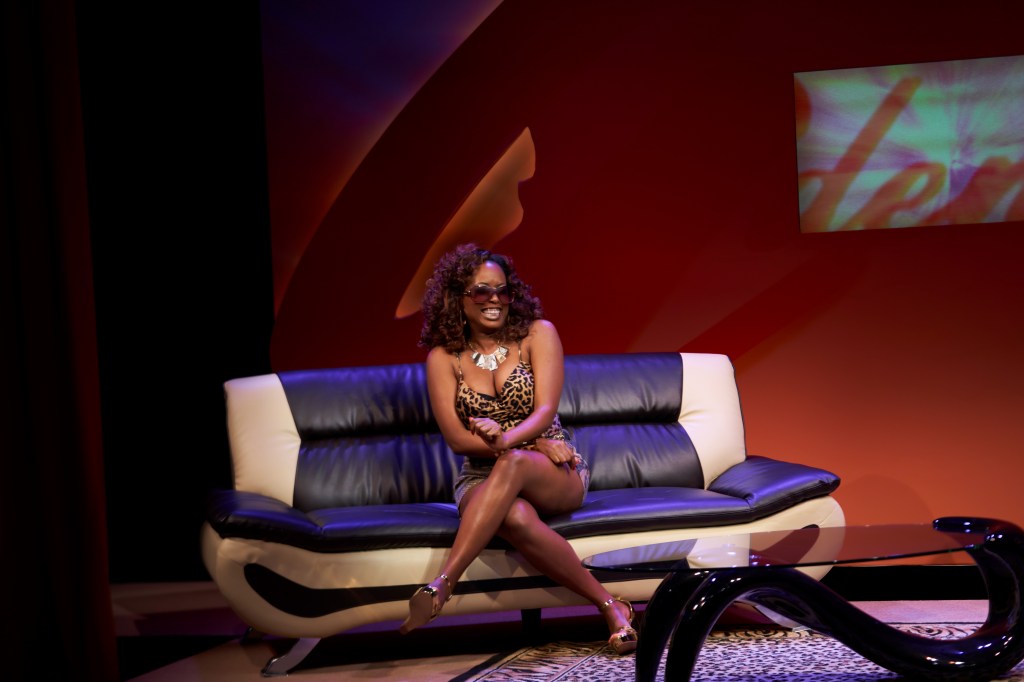
Bioh ratchets up the sibling rivalry when Ayamma asserts herself and visits Gbenga’s offices to get the part and play against Wale to prove she is a great actress and can make something of herself. In Gbenga’s office, we see the allure of possible future starlet vs. potentially predatory director. Enjoying the visit of the lovely Ayamma, an ingenue of innocence, we note that Gbenga never misses an opportunity with the ladies. Gbenga allows her to read with the actress and his former partner Fayola (the Nollywood “Hallie Berry with the Tina Turner legs”). The “fix is in.” He will most likely cast Fayola in the part to prevent her spilling the dirt on him which would put him in jail.
Emana Rachelle portrays the wild and dramatic Fayola with vibrance, humor and sheer joy. Ayite and Mathis’ costumes, shoes, wigs give even more umph and fabulousness to Emana’s Fayola, whose gestures and movements, like Abena’s, celebrate those they imitate and gently ridicule. The women are in conflict against each other for the part of Comfort; the sisters are in conflict for Wale, and Adenikeh wants in and will use her leverage in whatever way possible to be with Wale and Gbenga. Interestingly, Hudson III’s king manipulator Gbenga keeps them all allured. Meanwhile, Ade’s Wale, with quiet confidence oozing sensitivity, the honey which every woman loves, sits back and is himself.
The actors are having a blast as is the audience. And we even get to see a clip of The Comfort Zone which is a LOL overacting extravaganza at its best. Special kudos to David Weiner’s and Jiyoun Chang’s lighting design, Palmer Hefferan’s sound design, Alex Basco Koch’s projection design. It’s a shame that the run of Nollywood Dreams isn’t longer. It’s a wonderful romp with depth, for it exposes the broken promises and seductions which are the dark side of the predatory entertainment industry. Thanks to the creative team, Saheem Ali-director, Bioh and especially the ensemble who are seminal performers. It is clear they listen to each other to remain “in-the-moment” authentic. All make this production memorable.
To see Nollywood Dreams, you must act fast. It is over November 28th. For tickets and times go to the MCC website and CLICK HERE.
 CAROLE DI TOSTI