Blog Archives
‘Purpose’ Brandon Jacobs-Jenkins’ Riotous Play, Directed by Phylicia Rashad

In Purpose, Brandon Jacobs-Jenkins’ satiric family expose directed by Phylicia Rashad, we meet a patriarchal Black American civil rights icon, Solomon “Sonny Jasper (Harry Lennix), who is forced to confront his disappointments and foibles as his family gathers to celebrate the homecoming of his eldest son and namesake, Solomon “Junior” Jasper (Glenn Davis). Navigating the audience through treacherous familial waters with asides and intermittent, pointed narration, the youngest son Nazareth “Naz” Jasper (Jon Michael Hill), explores his family’s complicated legacy as he attempts to confront issues about his own identity and future.
Currently running at the Hayes Theater until July 6th, this ferocious, edgy and sardonic send up of Black American political and religious hypocrisy resonates with dramatic power. Its superlative performances and Rashad’s fine direction, make it a must-see. Importantly, in typical Brandon Jacobs-Jenkins style, the tour de force with jokes-a-plenty raises questions. It prompts us to reflect upon our own life intentions, as we examine the Jasper family’s dynamic through the acute perspective of the endearing, sensitive, vulnerable and authentic Naz. Hill is just terrific in a role which requires heavy lifting throughout.

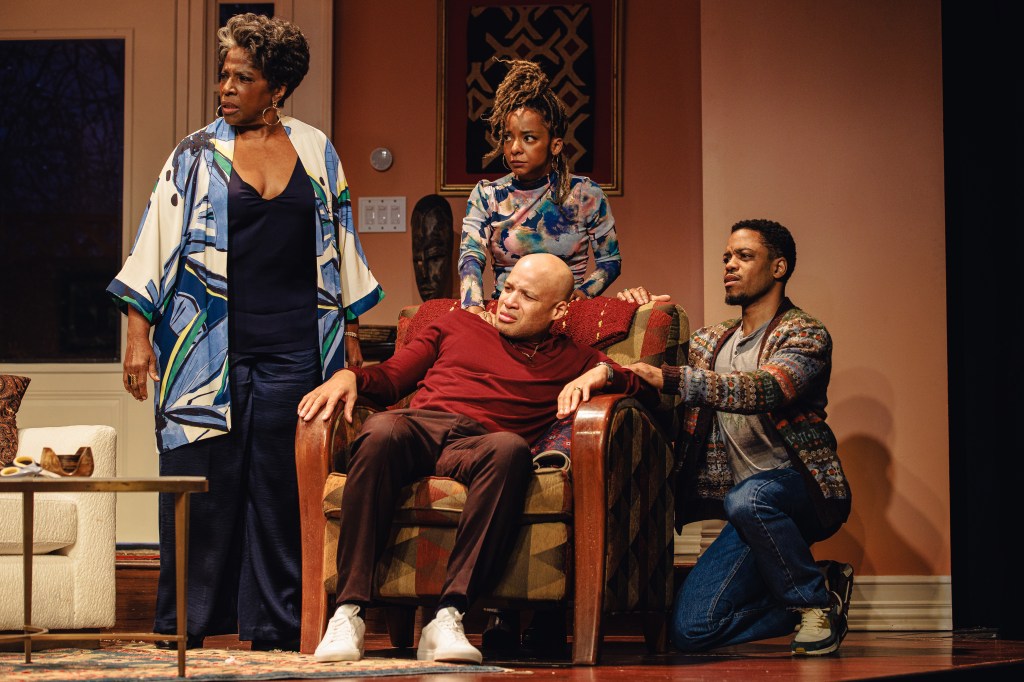
As the play opens we note the subject matter and foundation upon which Jacobs-Jenkins’ moralistically satiric drama rests, namely the Jaspers (think along the lines of Jesse Jackson), whose heritage boasts of leaders in civil rights, congress and the protestant church. Todd Rosenthal’s lovely, well-appointed, Jasper family home represents prosperity, upward mobility and the success of the celebrated Black political elite. Solomon Jasper was Martin Luther King, Jr.’s heir apparent in the civil rights movement.
However, among other questions the play asks is, what happened to the substance and efficacy of the movement, considering the current “state of the union” under MAGA Party president Donald Trump, whose cabinet has no Black American member? What are the legacies of the Jasper’s faith? What is the heritage of their former Black radicalism, which Naz calls into question throughout the play, as the evening explodes into tragicomedy in front of unintended witness Aziza Houston (Kara Young)? As a result of the evening with the Jaspes, Aziza is horrified to see her civil rights icons, Solomon and Claudine, smashing her respect for them to smithereens during the family imbroglio in Act I.

Via an intriguing flashback/flashpresent device, Naz exposes and illustrates how the family’s shining history becomes obliterated by circumstances in the present “state of the family union,” which has not lived up to their patriarch’s illustrious expectations. Ultimately, Solomon Jasper, too, may be counted as not living up to his own personal expectations, a fact revealed by the conclusion of the second act, which further adds to his hypocrisy for giving Naz a hard time about his sexually, abstemious, personal choices..
With increasing intensity, the upheavals occur by the end of the first act and augment into further revelations and complications well into the second, until the wounds exposed are too great to ignore. Naz’s final synopsis and soulful, poignant comments solidify at the conclusion bringing this family retrospective together. His questioning wisdom leaves us as he is left, wondering what is the trajectory of this once august Jasper legacy, which Naz has chosen not to perpetuate. Not going into politics or the church, Naz selected a career in photography where he communes with nature’s beauty and peace.

Jacobs-Jenkins’ work is filled with contrasts: truth and lies, health and sickness, moral uprightness and moral turpitude. In fact the contrast of the outer image of the Jasper calm and sanctity versus the inner corruption and turmoil becomes evident with Jacobs-Jenkins’ character interactions throughout, heightened by Naz’s confidential asides.
Additionally, this contrast of superficial versus soul depth is superbly factored in by Rashad and Todd Rosenthal’s collaboration on set design. Initially, all is peaceful in their gorgeous home set up by matriarch Claudine Jasper (the excellent Latanya Richardson Jackson). The home’s beauty belies any roiling undercurrents beneath the family’s solid, upright probity. Perfection is their manufactured brand, which Aziza has bought hook, line and sinker as a Jasper fan.
To continue with the Jaspers’ “brand,” the inviting great room boasts a comfortable and lovely open layout-living room and dining room-backed by a curved staircase to the second level of bedrooms off the landing. The dark peach-colored walls are beautifully emphasized with white trim molding. The cherry wood furniture and cream colored sofa color-coordinate with the walls. The sofa is accented with appropriate pillows. Interspersed among furniture pieces are obvious antique heirlooms. Indeed, all is perfect with matching table runners and dining room tablecloth and napkins and dinnerware tastefully selected for its enhancing effect.

Prominently featured is the Jasper family heritage and legacy, a large portrait of Dr. Martin Luther King, Jr. proudly displayed on the first level, and a lesser portrait of political/cultural heir apparent, Solomon “Sonny” Jasper on the second floor landing. Surrounding the Sonny Jasper portrait are framed photos chronicling the civil rights warriors and family, shining their historical significance. When Aziza first arrives and is welcomed desperately by Claudine who fears Naz’s not bringing any woman home means he is gay, Aziza is gobsmacked by the house. Seeing the portraits and Solomon Jasper, she realizes who Naz really is. She is over the moon slathering blandishments to Sonny. Thrilled, she can’t help but take selfies with the Jaspers to send to her mom, a mutual fan. Naz is beyond humiliated and surreptitiously pleads with her to leave.
What does Naz know about his family that he fears Aziza will discover? If Aziza doesn’t leave quickly, his mother’s hospitality to divine who Aziza is will make sure she stays. Indeed, Jackson’s Claudine never fails in her intentions.
Against the storied backdrop of their illustrious past that Aziza worships, the garish present unfolds at dinner. It is the celebration of Junior’s homecoming and reunion with the family since his thirty month prison stay for embezzling campaign funds. Junior’s behavior is one of the gravest disappointments that Sonny holds against his son. For him it is unforgivable that his namesake who was to take his place has tarnished the Jasper name with corruption.

Thus, when Junior presents a birthday gift to Claudine, of the letters she wrote to him in prison in a lovely book, Sonny scoffs, especially after reading a particularly mundane letter. (Lennix’s reading of a sample letter is hysterical). Then, Sonny questions Junior who wants to exploit their family name and go on tour with the book of Claudine’s letters, and Claudine, lifting up the hellishness of his imprisonment like a martyr.
Ironically, bitterly, humorously, Sonny airs his disgust that Junior would present himself as a Nelson Mandella, as if Junior’s prison experience was in any way equivalent to the horrors of imprisonment used as a tool of oppression and racism throughout US history. Sonny is especially livid because Junior’s crimes ripped off his father and Blacks who supported him. Additionally, the time Junior did was easy because Sonny used his influence to get Junior into “a minimum security playground.” Though it is revealed that Junior has bi-polar disorder, (the scene when Glenn Davis manifests this is superb), Sonny lacks empathy for Junior. He dismisses his illness and says he got caught where other politicians don’t get caught because Junior is stupid.
At dinner the dour Morgan (Alana Arenas), Junior’s wife, sits quietly at first. After Junior uplifts Claudine, Morgan claims neither he nor the Jaspers helped her through Junior’s mental breakdown. Nor does he acknowledge her visiting him through the prison experience with a present. Morgan rips into him and the family. They are “hucksters,” who don’t care about her and “have no sense of responsibility or remorse.” Listening to the Jasper’s accountants, Morgan signed their joint tax returns that implicated her in tax fraud with Junior. She has lost her career and will have to do time in prison for an error that she was ignorant about, trusting the family to not mislead her.
Thus, the artifice gradually peels away, shaped by the characters’ ever increasing digs at each other and Naz’s humorous perspective. To top it off, despite her promise to Naz that she will keep quiet, Aziza reveals how she trusts Naz to be the sperm donor for their child. This piece of information is a stick of dynamite for this religious family who chaffs at unmarried young people sleeping together. Then, when Claudine and Morgan go head to head and Morgan calls the family’s “honesty” into question and accuses Sonny of having “his fiftyleven other kids scattered all over this damn country,” Claudine loses it and gets violent.
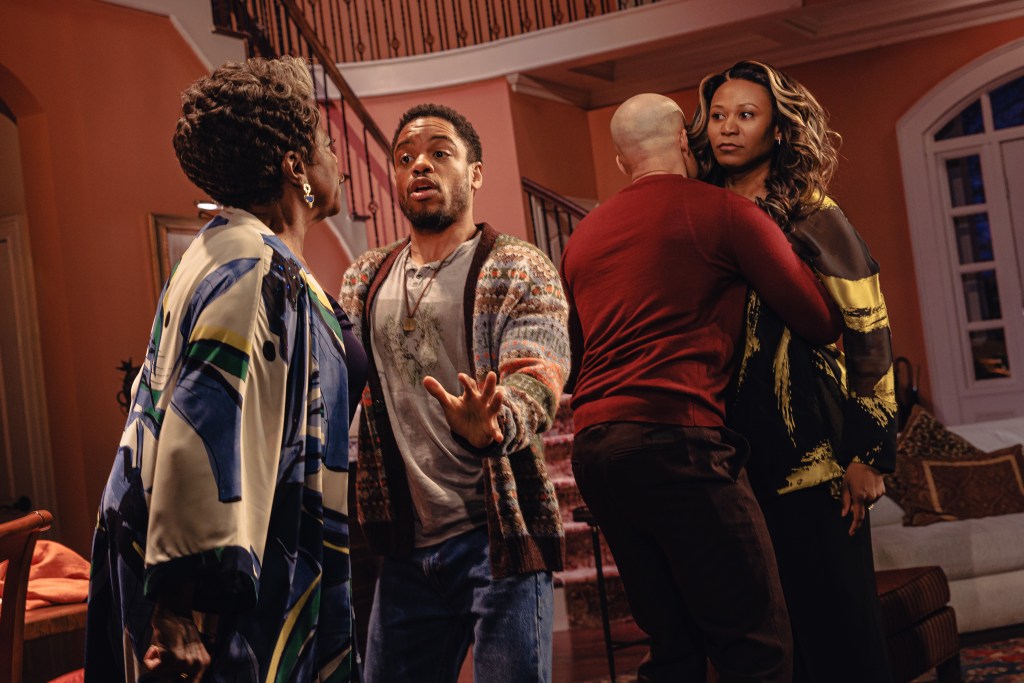
Ironically, the act ends with the patriarch blaming Claudine, “I have let you build this house on a foundation of self-deceit.” Sonny loudly declares the time is now for “redemption” and a “new era in this family – a new era of truth! Truth!”
Act II indicates how that “truth” is to come about, as Naz and Aziza argue about why she broke her promise to him. Abashedly, Naz disavows the violence that spilled out between his mother and Morgan. Meanwhile, the verbal and emotional violence has always been an undercurrent in the family that has never confronted their issues. In other words, the dissembling, the lies and the deceit have augmented until “enough is enough.” Aziza, caught up in the fray rethinks what she has seen and no longer has any wish to have Naz’s child from their “illustrious” DNA. Additionally, she has learned not to lionize any other civil rights icon or celebrity easily, again. Celebrities, like the Jaspers, are not saviors or worthy to be made into icons. They have clay feet if you see them up close and personal.

Though the first act sails smoothly, the second act digresses in part with Naz’s extensive dialogue and explanations, which might have been slimmed down. Nevertheless, as we learn about each family member’s complications, the intensity shifts. Though there is less humor, there is incredible poignancy and each of the actors have their moments to shine. Not only do we note the profound aspects of character complexity, we understand the difficulty of attempting to maintain an oversized legacy of greatness when one is an imperfect human being. Indeed, the one who comes out best appears to be Naz, until the conclusion. It is then we understand how the family has impacted him and in response, he has sent himself spinning into his own chaos, which he will have to unravel for himself. So do we all as we deal with our own legacy, heritage and family dysfunction.
Purpose is brilliant, if a tad unwieldy. However, the ensemble cracks sharply like lightening. Rashad has a deep understanding of Jacobs-Jenkins’ themes, dynamic characters, prickly relationships and the sub rosa levels of meaning in the interactions. The pace is lively despite the playwright’s wordiness and keeps the audience engaged.
Kudos to the creative team including those not already mentioned: Dede Ayite (costume design), Amith Chandrashaker (lighting design), Nikiya Mathis (hair & wig design), and Bob Milburn & Michael Bodeen (sound design). Purpose runs two hours fifty minutes with one intermission at the Helen Hayes Theater on 44th between 7th and 8th. https://purposeonbroadway.com/
‘Pass Over’ at the August Wilson Theatre is Glorious
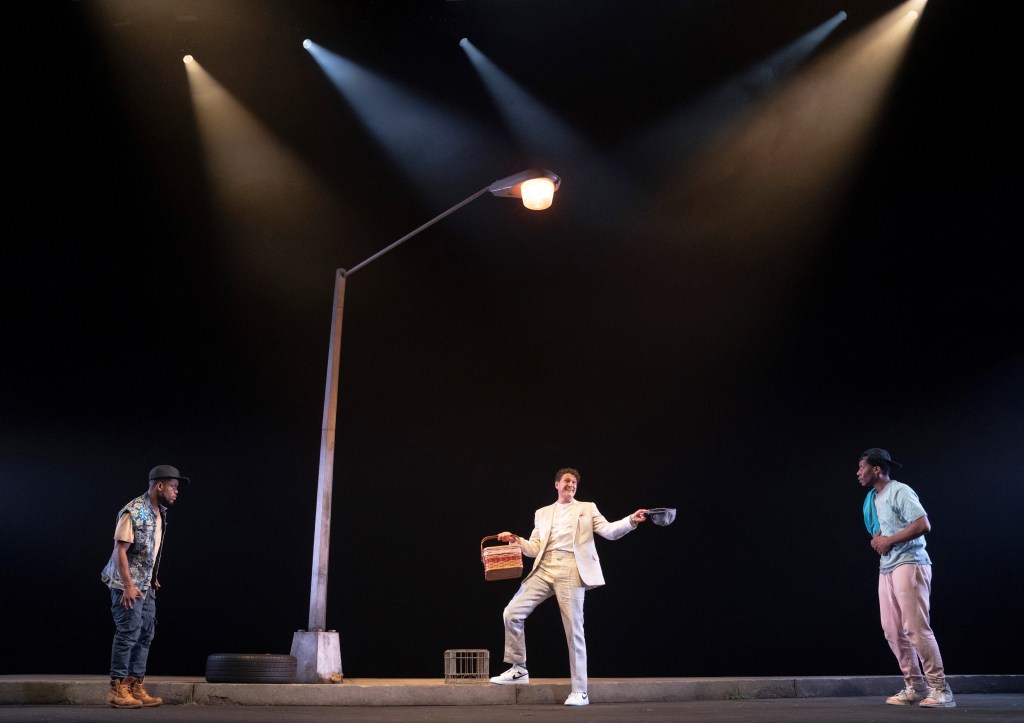
Two men standing on a desolate street corner with a lamppost shining on a blasted, deserted, space save for a garbage can, a patch of weeds, a tire, a wire milk carton. Such is the material/empirical setting reminiscent in its isolation and abstract loneliness of Samuel Beckett’s setting in ‘Waiting For Godot.’ Likewise the comedic and clown-like Moses (the brilliant Jon Michael Hill) and his Homie, clowning sidekick Kitch (the brilliant Namir Smallwood) appear similar to Vladimir and Estragon. However, they are not. They are black. And where Vladimir and Estragon “wait,” unafraid, bored, wiling away the hours, Moses and Kitch exist in a hellish landscape afraid of death at the hands of the “PoPos,” shorthand for police.
Whether one has seen Beckett’s Godot or not, doesn’t matter. The isolation of these two individuals and their express desires to leave this heartless existence that holds the terror of black men dying by a simulated “justice” which is tantamount to the injustice of lynching is conveyed with empathy and poignancy by the creative team of actors and director Danya Taymor. With acute care, emotional grist, comedic genius and dynamic drama, they bring to stark, felt life, Antoinette Chinonye Nwandu’s haunting, memorable dialogue in Pass Over, currently running at the August Wilson Theatre in a cool, streamlined no intermission production.

When we first meet the likable Moses and Kitch, we understand their camaraderie and support for one another, as well as the similarity of their desires, fantasizing about the finer things of a luxurious, material, elite lifestyle. Though Moses is the leader and Kitch is his follower and admirer, their synchronicity and dependency is clear, for they wish to “pass over,” to get to the “promised land,” the “land of milk and honey” represented by the “American Dream.”
And whether we have eaten lobster or drank Crystal, like they wish to, we, too, have craved the finer things of life and may even feel a sense of superiority that we have experienced them, where these impoverished of the ghetto block can only entertain themselves and each other by dreaming about such extravagances in a humorous and ironic game which has become a way of bonding between them.
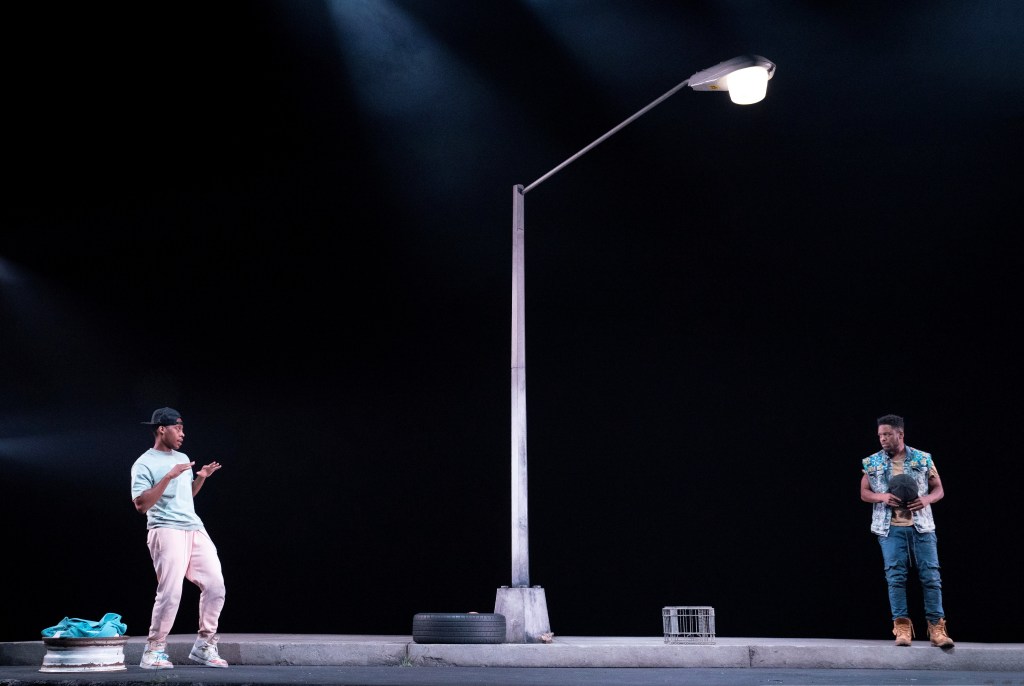
Fifteen minutes in to the thrust and parry of humor, the gaming is interrupted by a Pavlovian signal that has brainwashed them to fear: the stage floods momentarily with a steely light and a dull, blaring warning sound. (It reminded me of Steven Spielberg’s 2005 film War of the Worlds, when there sounds a far-reaching alarm announcing the aliens’ presence.) We learn later that Moses and Kitch recognize this alarm as the sound of death; that another black friend or acquaintance in their neighborhood has been killed by police. They cower and crouch in fear until the light and sound normalizes to the stasis of desolation, and once again they return to humor and the grace of planning to escape and go somewhere where they can live free from fear in a greater abundance of prosperity than their current existence.
However, there are two caveats. They must elude the PoPos, as Moses led the Israelites to elude the angel of death which “passed over” the the First Born if the blood of the lamb was on the doorposts of the Israelites’ homes. Secondly, the PoPos expect them to remain on the block to never escape their oppression and misery. Thus, they are free only in their games, humor and imagination, while their physical bodies are subject to the reality of their dire existence with the threat of death hanging over their lives. Will they be able to “pass over” and escape death? The symbolism is spiritual with possibilities for escaping all of what the playwright infers elements of the death state is in this life.

Into their ghetto corner (which the playwright suggests symbolizes as historical oppression and redemption-a river’s edge, a plantation, a desert city built by slaves and a new world on the horizon) comes Mister who slips up and calls himself Master (the wonderful Gabriel Ebert). Taymor has him ironically dressed in a white suit and vest, such as gentlemen of the Old South used to wear on or off the plantation. Mister, intending to visit his ill mother with a picnic basket of food, inexplicably gets lost and arrives with his bounty to the ghetto block.
At first Moses, whom his religion teacher encouraged to live up to his namesake, the Biblical Moses, proudly eschews Mister’s offer of food charity, though both he and Kitch are hungry. However, sociable, “good-natured” Mister cajoles and tempts them. And after he massages their egos with charm and humility, he shares some of the delicious food in his basket with Moses and Kitch in a wonderfully humorous staged scene.

We note the roles between the individuals and hints of seduction and exploitation, expecting some catastrophe, however, Nwandu has tricks up her sleeve and the situation with Mister is as it appears. Mister worms his way into their hearts and they become friendly. And for a fascinating moment they forget about “getting off the block,” and being all they can be, lulled by the food. Intriguingly, Mister chides them for abusing their use of the “N” word which he cannot use, because as Moses suggests, he doesn’t own that word.
It is an ironic gesture since it is perhaps the only “thing” Mister doesn’t “own,” as a representative of the dominant oppressor race. Though Mister doesn’t “own” their black identity which they have accepted as their own, is it something which is good for them or is it another trick of oppression? After Mister leaves, Moses and Kitch realize that adopting that identity is a trick of the white culture and the PoPos, for by inference, the “N” label associates with low-down and/or slovenly criminal behavior, regardless of whether they are deserving of such labels or not. Ironically, they have proudly accepted that term as their identity, but it has resulted in black male deaths at the hands of the police.
Deciding to cover for themselves, using Mister’s gentile manners, they avoid trouble, when Ossifer (a police officer played by Gabriel Ebert who is the different side of the same coin as Mister) shows up. Moses and Kitch become “gentlemen” in word and action, imitating Mister. It works. Ossifer leaves them alone and protects them as culturally “white” until Kitch slips up and uses the “N” word triggering the brutality of the police officer who confronts them as their oppressor to control, belittle and demean. Under these circumstances we feel the depressive desolation of the historical and current inferior “slave.” And Ossifer terrorizes them reminding them that their lives are only useful for living in fear and misery as “the controlled.” The only respite Moses and Kitch have is the humor and hope Kitch and Moses stir up within themselves and share with each other to make existence bearable until they can “pass over.”

In an amazing turning point, Nwandu clarifies a new meaning for the term Moses references from the Bible, “pass over.” It is a spiritual one that Moses convinces Kitch they must now seek, no longer wanting to deal with the despair and long trial of a desolate existence.
Taymor, shepherding Hill, Smallwood and Ebert creates extreme tension throughout. Especially when Ebert as Mister and Ossifer shows up. The atmosphere is that of a pressure cooker sizzling until it seethes into an explosion which does occur. We, like Moses and Kitch, expect the blast after every joke, around every game they play, especially when the alarm sounds and lights flare up that the PoPos have killed another black man. Nwandu cleverly distorts the thrust of the heat and danger providing extraordinary twists in the turn of evolving events. These become revelatory, magical and lead to the unexpected and heartfelt.
The beauty of the conclusion is in its realization of a return to an ideal which isn’t actually some pie in the sky fantasy, but is present and real. In the production it occurs with the help of and extraordinary supernatural intervention as happened to the Biblical Moses. Taking one step forward after another, Moses, Kitch and Ossifer (a reborn Christopher) are released and the imagined consciousness comes into being. However, the lure of what’s past beckons. One must not turn around to be enticed, or everything will be lost in the material plane where the human race has crashed and burned for millennia.
Pass Over is a must see for its fantastic performances, its uniqueness, its joy, despair, thematic truths and its wonderful faith and hope in human nature. I could not help but be gratified that there were no female characters. Their absence is lyrically pointed. The production is mesmerizing and I have nothing but praise for how the playwright, director and actors connected with the truth of what we face as a multifaceted and diverse society that is desperately crying out for healing and redemption. But as Nwandu suggests, the promised land is already here. We must look to our own inner strengths and step out to cross that “river”and never turn back.
Kudos to the creative team that made this production fly and whose effects helped to send chills down my spine and tears down my face. They include Wilson Chin (scenic design) Sarafina Bush (costume design) Marcus Doshi (lighting design) and Justin Ellington (sound design). Pass Over runs until the 10th of October. This is one you cannot miss. For tickets and times go to the Pass Over website by clicking HERE.
 CAROLE DI TOSTI