Blog Archives
Daniel Radcliffe Smashes it in ‘Every Brilliant Thing’

Every Brilliant Thing starring the inimitable Daniel Radcliffe in a solo, interactive performance as The Narrator succeeds on many levels. The show has become a global phenomenon and has been performed for over a decade. Presented Off Broadway at the Barrow Street Theatre in 2014, it finally landed in its Broadway Premiere at the Hudson Theatre. The joyous, hybrid comedy/drama runs through May 24, 2026.
Written by British playwright Duncan Macmillan as an initial 15-minute monologue the play evolved into a longer work with Jonny Donahoe. Over the years culturally diverse cities and theater companies around the world performed the piece with male and female “Narrators,” tailoring the particularities of the list to various cultures, which playwrights included in the notes. These provide a fascinating and humorous read.
The usually triggering subjects of suicide and depression swallow easily because Radcliffe’s Narrator introduces the topic from the innocent perspective of a seven-year old. The production becomes an extended flashback of The Narrator’s life with delightful, often humorous audience participation seamlessly woven into his storytelling. Not understanding his mom’s profound desolation, The Narrator relates how he tries to joggle her out of depression during her initial hospitalization. He attempts this by giving her his “list of life’s brilliant things,” the first being “ice cream.”

The Narrator flashes back to key turning points related to his mom’s first act to take her own life. These parallel the expansion of “the list” which develops a life of its own. While eventually enumerating hundreds of thousands of great things, ironically, the narrator is no closer to understanding his mom’s mental state. Additionally, he is in denial about his own depressed, isolating behaviors and ignores his beloved partner when they try to alert him to go for help. However, recognition is the dawn of his enlightenment. With both sorrow and joy he confronts the devastating and untenable impact of his mom’s condition upon his and his father’s lives as the play ends.
What makes this production so special is its humanity, love and the encouragement conveyed by Radcliffe as he elicits enthusiasm from participating audience members. Because they’re thrilled to be a part of this experience on Broadway, the show manifests a unique, communal vibe. It begins when the first audience member shouts out in response to Radcliffe’s “#1,” their response, “ice cream.” They do this from the balcony, or the back row, or audience left, or wherever the person is who has the paper with #1 written on it.
Amazingly, Radcliffe sentience is tuned like a seismograph to audience members’ locations and responses and discomforts, if any. Prepared for the unpredictable with “in the moment” spontaneity, Radcliffe’s performance can’t be quantified. It’s breathtaking, ineffable, divine genius.
In addition to Radcliffe’s numbered shout-outs, he guides the participation of lucky folks who help him tell the segments of The Narrator’s life. These include a vet, a librarian, an old couple, his dad, his partner, his college professor that Radcliffe selects. Interestingly, The Narrator’s mother never appears. The enigmatic mom cannot be known, nor does anyone ever portray her.
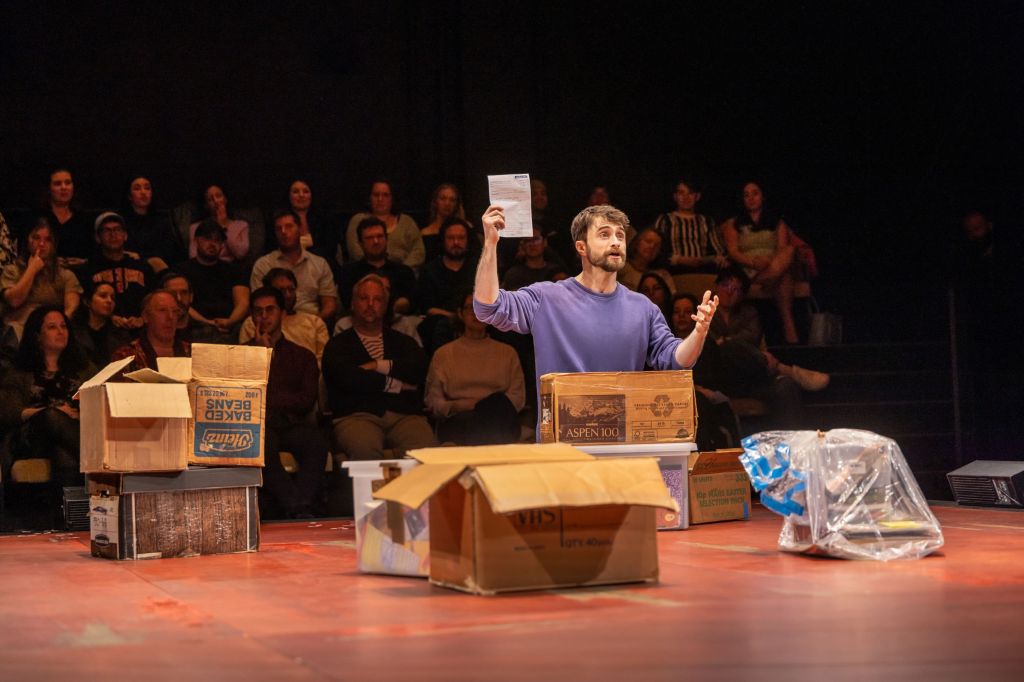
The key players in his life circle around Radcliffe’s Narrator on stage. To their surprise Radcliffe sits next to a few of them or asks them to perform at crucial moments. In one example the vet gives his suffering dog a shot (a pen was used the night I saw it), to ease him out of the world. These electrifying moments happen magically as audience members anticipate being ready for anything as they stand before Radcliffe, who demonstrates great good will. They pay attention and listen acutely, taking their lead from him. What results brings humor, uplift and surprise. What happens comes at the whim of the audience members who Radcliffe entrusts to trust him in whatever they do together.
Directors Jeremy Herrin and Duncan Macmillan shepherd Radcliffe to prepare by selecting audience members as they arrive. Some might be visiting actors though there are no plants. The audience members’ parts scripted by the playwrights leave the freedom for ad libs, jokes and funny or somber retorts. Some of the unique responses even tickle Radcliffe. As he moves through The Narrator’s stages of development from teenager to adult, the list becomes an afterthought that he unearths unwittingly or others (his partner) give him. In reflection about his “childish” perspective, Radcliffe’s Narrator questions the list ‘s efficacy. Did it help to mitigate his mother’s extreme ups and downs? Did it startle his unemotional, undemonstrative father into a more responsive relationship with his family?
Clearly, the list’s intended result fails. But what does succeed are the positive unintended results of the list as a light that shines for however long because others he meets and befriends keep it going as an uplifting fulfillment of hope. For example the list even has a Facebook page that you might add to if invited.

One of the high-points of Every Brilliant Thing occurs when the Narrator meets his partner. In rehearsals, Radcliffe and the directors considered every contingency for the segment which moves The Narrator’s relationship from the first date, to a wedding, to a marriage to a split. The night I saw it, the lovely audience member he selected as his partner glowed. And Radcliffe’s energy played back the enthusiasm and transmitted it to the audience. The Narrator achieves a high not experienced before as his parents show their love and acceptance happily dancing at his wedding.
Another fun moment occurs when Radcliffe’s Narrator runs around the audience, attempting to “high five” everyone. However, his “manic” peak immediately craters into the downward spiral of a depressive state. Even the Narrator’s list in the hundreds of thousands of brilliant things can’t stop his “peaks and valleys” from happening like they happened to his mom.
The play must not be underestimated because of its elements of easy enjoyment. Powerful and understated themes of silence, and the inability of the sufferer and those impacted to connect, help or effectively confront the crisis, gently thread throughout. The fun comes with the audience’s effervescence. Yet, the playwrights take pauses identifying convenient truths and salient information tucked in by The Narrator when the audience takes a breath between laughs. What is known of the mind that takes its own life? The Narrator leaves many unanswered questions. Evident underneath is the pain which clarifies when no specific information about his mom, his parent’s relationship and The Narrator’s emotions ever comes.
Every Brilliant Thing runs 1 hour 10 minutes with no intermission, through May 24, 2026 at the Hudson Theater. everybrilliantthing.com.
 CAROLE DI TOSTI