Blog Archives
‘Kyoto,’ Climate Science vs. Oil Billionaires’ Profits as the Planet Crisps, Theater Review

Based on events beginning in 1989 leading up to the 1997 United Nations Climate Change Conference in Kyoto, Japan, Joe Murphy and Joe Robrtson’s Kyoto explores the momentous occasion when nations agree to confront climate change. The two-act political thriller is in its US Premiere at the Lincoln Center Theater at the Mitzi E. Newhouse until November 30th. Compressing extensive detail, the playwrights reveal how representatives from 160 nations negotiated the Kyoto Protocol. The Protocol committed first world and emerging nations to limit/reduce greenhouse gasses after setting targets and timetables.
Stephen Daldry and Justin Martin co-direct Kyoto, which enjoyed its world premiere at the Swan Theatre, Stratford-upon-Avon. Due to its continued success, it transferred to London’s West End before debuting to American audiences, who don’t always relate to the ironies and humor in the play (directed at the US). Indeed, the US representative (Kate Burton), and American oil lobbyist Don Pearlman (Stephen Kunken) and the representative of Saudi Arabia (Dariush Kashani) become the objects of humor and frustration. They continually oppose any movement to pin down emissions’ timetables or support decreasing oil production.
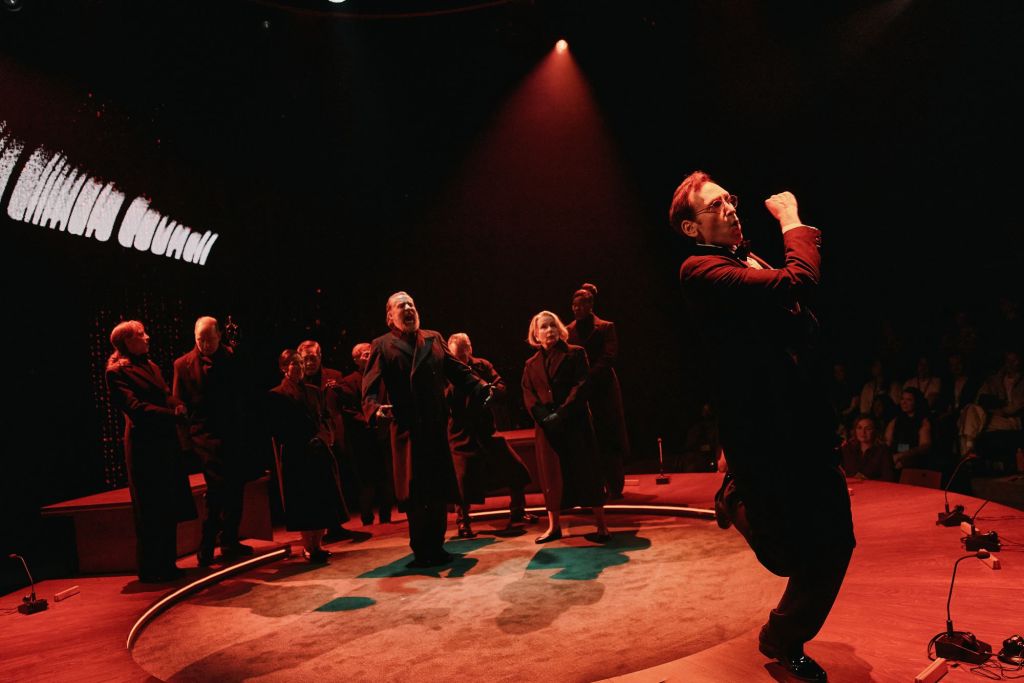
The set is a circular conference table where members sit and sometimes interact with the audience. The table serves also as a raised platform for Don Pearlman, placing him above the fray. In its design by Miriam Buether, Pearlman stands at its center and addresses the audience. Variably it becomes a private meeting area where Pearlman speaks with those opposed to any “progress” on emissions. It becomes a setting in his home, and several hotel rooms where he converses with his wife Shirley (Natalie Gold) and others. The co-directors keep the play in the realm of ideas, not material places. In one instance Shirley and Don join Raul Estrada (Jorge Bosch), the Argentinian representative for China, in a rain forest. The fluid, minimal set design forces the audience to keep up with the dialogue cues which indicate setting changes.
The playwrights have chosen the “well-meaning,” slippery lawyer Don Pearlman, as their spokesperson to reveal what happened from 1989 through1997, when nations finally achieved consensus in Kyoto. At the outset Kunken’s disarming oil lobbyist begins by discussing how the Seven Sisters (big oil, i.e, Exxon, Shell, BP) appoint him as their agent provocateur to stall and delay any UN agreement about greenhouse gas emissions.
Like Iago in Othello, Pearlman instructs the audience in his nefarious plans. Though the events happen at lightning speed, Kunken’s Pearlman slow walks us with his wise words and commentary about how to derail progress among the nations.

We become mesmerized as we note how he thwarts the representative countries who have different agendas than big oil conglomerates. Also, by extension we understand why little has been done to effectively curtail global warming. Without particular malice or a sinister tone, Kunken’s Pearlman humanely portrays a man who justifies his mission to support American’s “freedoms” to have a first world economy delivered by fossil fuels. Any change disrupting the oil supply, decreasing fossil fuels and harming profits must be stopped. Truly, Pearlman believes in his job and he believes in doing it well. This makes him and the Big Sisters utterly terrifying and wicked when one stops to consider the consequences.
As we follow along with the various conferences and summits beginning with the 1990 World Climate Conference in Geneva, through the Rio Earth summit, the many rounds of talks with scientists among countries, to 1995 Berlin, the First Conference of the Parties, COP-1, we see Kunken’s Pearlman enact the strategies and philosophies he first discussed with us and his wife Shirley. Without glee, with more than a soupcon of irony, Pearlman, ever the oil lobbyist, proves his genius standing up to various representatives with his knowledge about the process of negotiation, as well as his breadth of knowledge about the subject matter.

He, Burton’s US representative, Kashani’s Saudi Arabian representative for OPEC, and others dismiss the gravitas of what climate scientists have presented about global warming. However, Pearlman’s and others’ delinquence in acknowledging the looming disaster for representatives of low-lying coastal nation states comes to a screeching halt. The representative from Kiribati (Taiana Tully) joins forces with 39 other coastal nations to create a powerful negotiating bloc, The Alliance of Small Island States. They make it clear they will not allow the first world nations to marginalize and destroy them. For it is the first world nations’ oversized pollution that predominately contributes to the polar ice caps melting, and that puts the coastal nations at grave risk.
Thus, the conflict begins in earnest as the first world nations strain against the emerging nations, China having joined the coastal states. Few if any concessions are made for any collective unity as they delay for years, sea levels rise, and time runs out. However, a turning point occurs with the new appointment of Raul Estrada. Bosch’s Estrada eventually bans Pearlman from conferences, despite his being the CEO of the NGO, Climate Council (a blind to get him on the inside). Estrada knows Pearlman’s intent, and Pearlman shows no inclination to change his mission. Their war proceeds as representatives criss-cross the world in jets and add to the increasing emissions they seek to control.

Importantly, the play’s dynamism, pacing and urgency are conveyed by Kunken and Bosch’s performances and the co-directors’ staging and directed momentum. The lead actors who reprise their roles from the London production, have settled into their portrayals. As in real life, the oil lobbyist vs. the Argentinian representative to China smile and joke while warring against each other in a deadly “game” to stop big oil from holding the planet hostage.
Interestingly, the playwrights use the character of Shirley as a foil to soften and humanize Pearlman. However, when she finds out that the Seven Sisters knew about the consequences of global warming since 1959 and have kept this research under wraps, she realizes the wickedness of what her husband attempts. If she gives this information to him will it change his approach to his handlers? How can he live with himself and continue to support big oil knowing what the conglomerates have intentionally done for decades to keep profits flowing while endangering life on the planet?
At its strongest and most profound Kyoto dramatizes the tense political and scientific life and death battles that eventually result in the world’s first legally binding agreement to limit greenhouse gas emissions. That such Sturm und Drang resulted in so little is disappointing. However, in light of today’s international global divisions, to arrive at such a consensus seems miraculous and gives us pause.
Kyoto runs 2 hours 40 minutes with one intermission until Nov. 30 at the Mitzi E. Newhouse Theater, lct.org.
‘Prima Facie,’ Jodie Comer’s Tour de Force is a Must-See

One receives a stunning, thematic walk-away from Suzie Miller’s Prima Facie, directed by Justin Martin, currently at the Golden Theatre for a limited engagement. Prima Facie (the Latin legal term means on the face of it), stars the inimitable Jodie Comer in a well-heeled, solo performance. She won the U.K.’s Olivier Award for her portrayal of the assertive, successful, high-powered barrister, Tessa Ensler, who adores the rules of the law with an almost religious fervor. How Comer, the director and Miller effect Tessa’s roller-coaster ride toward hell, engaging the audience so you can hear a pin drop, reveals their prodigious talents. In Prima Facie, they’ve created a thematically complex production of theatricality and moment.
Though there are gaps in the play, Cormer’s performance bestrides them and raises numbing, thematic, rhetorical questions. Initially, the answers escape us, as we become involved in Tessa’s journey toward personal revelation. The strength of the play is in the slow arc of character development, which Cormer senses in her bones and conveys with power and flexibility, as she draws us in to Tessa’s plight. Her vocal and emotional breadth are superb and wide-ranging. Comer’s near-flawless expose, starkly pinpoints Tessa’s confession and admission of repeated self-betrayal and unwise decision-making. How Tessa is prompted to self-destruction by the patriarchal culture’s influence, confounds us. However, the audience cycles through the nullifying events she experiences and gradually becomes enlightened to her devastation.
From the top of the play, through to Miller’s characterization and Cormer’s sometimes breezy, dualistic, self-satisfied and impassioned recounting of her success as a defense barrister, we note she plays to win against the tricks of the police and the tactics of the prosecution. Her metaphoric descriptions are humorous. She is a winner at the law, always up for social justice, jumping into challenging cases against the prosecution. We learn many of the cases are for sexual assault, which she defends her clients against to “get the criminals off,” as her mother suggests. Blindly, with her own rational justifications, Tessa has greedily internalized the patriarchy’s folkways and legal mores. She believes herself immune as a barrister in a justice system, which she thrillingly and ferociously advocates. It is a game to her. She humorously pegs herself as a thoroughbred in a race, during which she expertly uses her strategies to anger, lure and upend the prosecution’s witnesses, who can’t “see her coming.”
Believing herself to be in control, she succeeds in becoming a star defense barrister, who wins her cases for her male clients. That she is a dupe, and a puppet female that the legal system has cultivated to perpetuate its entrenched hierarchy and male-informed justice, she only awakens to when she herself falls prey to assault. Too late, she becomes like the female victims she shreds, victimizes and makes look guilty on the witness stand to benefit her male clients. As Cormer and Miller subtly reveal, Tessa has been riven asunder by her desires to best the upper class barristers she competes against. To do this, she must take on their most obnoxious of attributes and suppress her true identity as the attractive, vulnerable, learned, emotional woman, who desires love and a relationship with a guy.
Thus, like most women in the patriarchal culture, she must negotiate two selves and protect both from each other. Importantly, she must not allow the predominance of one over the other in a blood sacrifice to “rise to the top,” or be the handmaiden of a partner, supporting him financially, if he is a slacker. Worse, she must not couple up with another barrister as ferocious as herself in a competitive, combative relationship. Nor must she throw down her career to wrap herself in the “lesser roles” of housewife, mother, wife, while her partner enjoys the power and amenities (sexual peccadilloes) his career may offer. However, as Cormer and Miller portray Tessa, the “feminine” side is not tended to, so it erupts when a guy lures her away from her career identity.
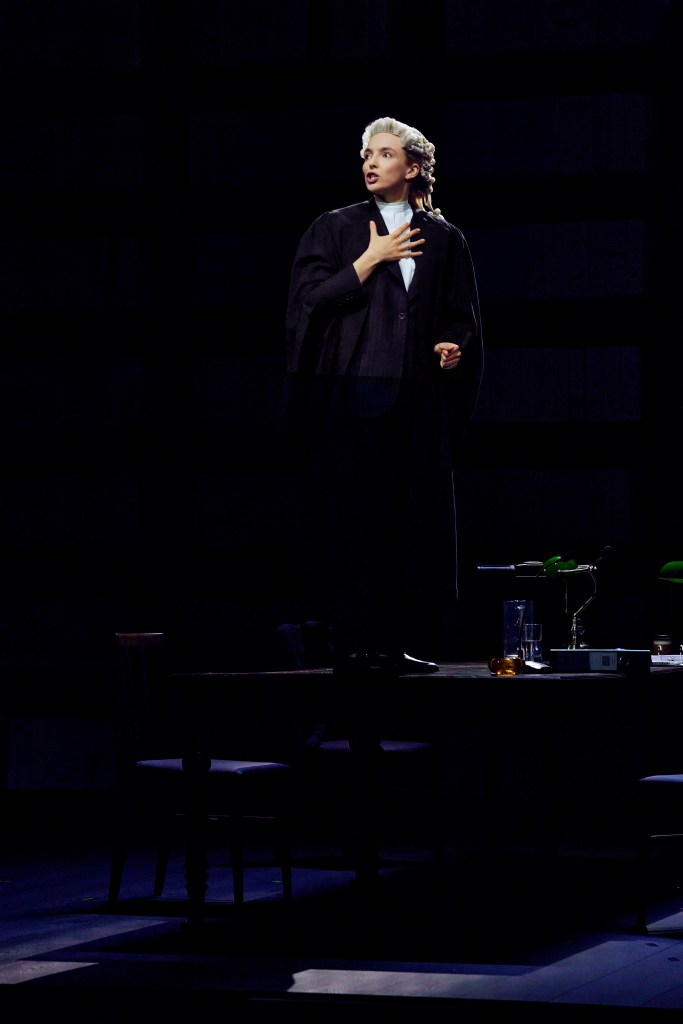
Interestingly, to convey the mystery of this inner conflict, which Tessa ignores, Miller sanitizes Tessa’s descriptions and removes gender references, when discussing her cases as “the barrister.” She doesn’t use names. Instead, she employs legal terms. Objectification and impersonalization are paramount. Cormier’s Tessa internalizes the abusive male folkways and embraces them because she is in a position of power. She doesn’t realize that she is a dehumanized robot, exploited by the patriarchy precisely because she is a woman defending men (a supreme irony). Just like the guys she competes with, she is all about the legal game and winning the race. We understand that the police predominately are males, and she bests them and her male barrister colleagues. One she excels against is Julian, who ruefully comments on her repeated success.
Occasionally, a clue is given. Her upper class friend, who started law school with her, drops out and becomes an actress. Tessa is the one in three, who makes it because of her persistence, brilliance and aggressiveness against all comers. Indeed, the very attributes that are rewarded in the legal profession are more masculine than feminine. That she has chosen to defend males against females in a crass exploitation of her skills is pointed out by a female colleague, who questions her.
Though her colleague intends to bring Tessa to enlightenment, Tessa describes how she conveniently ignores the question which hits us over the head with its answer. Apparently, Tessa doesn’t mind that her position is being undermined by defending men in cases against women. Nose to the grindstone, she aggressively succeeds, and all should get out of her way. The undaunted barrister personality proves she is the best and “fits right in.” However, there is the suppressed side of her personality, where she can’t compete with “all comers,” and she will never fit in. She can’t compete with males in their gender antics. She can’t behave like men sexually because the standards are different for men and women. Such traditions and double standards die hard.

There’s the rub. Women are still oppressed by the ancient folkways that manifest in sub rosa male and female attitudes. These egregiously include the notions that men are not “whores,” they’re just good ole boys, having fun. After all, boys will be boys. On the other hand, women are referred to as “sluttish” according to double standards. Thus, a woman’s response to sexual assault can be easily confounded by the legal questioning in a system that “doesn’t get how females respond and freeze,” when they are sexually assaulted. The legal interrogation system that allows for only one word answers is oriented toward the masculine. If there is fuzzy thinking and confusion on the stand, it means intentional obfuscation and guilt. The legal system’s foundation is historically entrenched in preeminent male beliefs, behaviors and attitudes, integral to its structure of obtaining justice for the accused. This is especially so when the charge is a gender crime against women.
The event that turns Tessa’s world upside down and opens her understanding is her non-consensual rape by a colleague with whom she previously was intimate. The legal parameters of justice indicate that non-consensual sex is the red line beyond which no partner can go, because it involves force and pushing oneself on the autonomy of another. Tessa ends up in a situation with barrister Julian making one bad decision after another that she knows will make her appear guilty. In effect, she is making herself the victim, but can’t stop herself. In applying the law to her own behavior, she realizes her mistakes, however, she decides to press charges against Julian. Despite knowing she should wait for a female officer, who will understand from a female perspective, she relates what happened to a male officer in charge. She knows what to do, but does the opposite, time again during this experience with Julian to seek justice.
We follow Tessa’s story from one sequence of events after another, during Tessa’s two year waiting period to eventually get into the courtroom and testify on her own behalf. As she faces Julian and the defense barrister colleague realizing what’s coming, she is shocked. The entire courtroom of officials is filled with men. She is the only woman. And it is there that the tactics she strategically, confidently, aggressively used against females to defend her male clients, now are employed against her. She becomes her own victim. By her own barrister standards, she realizes she is guilty. However, she is not on trial, Julian is.
In her final self-betrayal, the internalized patriarchy of justice must release Julian as an innocent. There is one guilty person, the woman, who somehow is lying and magically fabricating that a non-consensual rape occurred. Because of her fuzzy and at times confused, frozen responses, she raises doubt that a rape occurred. Thus, victimizing herself, she turns the barrister Tessa against her female identity, and is guilty. The prosecution loses the case to Julian, who she victimized with her accusation.

In an interesting turn, Tessa is able to express her feelings. She addresses the court absent the jury and finds her voice. Cormer rises to the occasion during the courtroom scenes she effects. She is especially powerful in her indictment of a patriarchal legal system established for the betterment of males, particularly those who have money and are in the upper class.
In her concluding salvo to the audience, tears streaming down her face, Comer’s Tessa adjures wistfully that “something must change.” Though we agree, after her revelations, the self-absorbed, anti-climactic assertion rings hollow. Indeed! She must change. She must stop internalizing “the perfection” of male folkways, which historically have destroyed women. She must resign from her position of defending men in sexual assault cases. She must negotiate the balance in her personality. She must not allow “the barrister” to predominate and harm the feminine Tessa, mistakenly applying male double standards to her personal life. She must not forget her gender places upon her an unforgiving female ideal of perfection and purity, she must adhere to. Ironically, there is no move to understand that she must transform herself to bring about the change that she seeks. This irony needed to be emphasized in the staging, which at times is lacking in pointing up the dualism in her character.
However, Cormer’s plaintive cry reveals her regret, which is a self-betrayal and utter confusion at finding herself where she is in her life. She has backed herself into a corner. If she leaves the profession after losing the case, the patriarchy will have won. If she stays and continues to defend men, as she has done before to “put the terrible events behind her,” the patriarchy will have won. If she moves to the prosecution side, she will no longer be “the star” at the top of the ladder. She is left broken and crying at her self-entrapment in the stunning irony as the stage lights dim. The effect is numbing. What did we just see? Her generalized cry for change lacks impact and force. However, her tearful regrets are the first step in a long process of self-correction, which may lead to social reform.
Miller’s thematic “call to arms” is clear. Every woman in the audience must change internally. They must uproot every internalized desire of the patriarchy which defines them and denies them. They must define themselves. They must not believe the lie they can compete with men as Tessa attempted to compete and allowed herself to be duped and exploited. Sadly, in the attempt to compete women internalize folkways that necessitate their own co-optation that leads to self-harm.
Miller’s point about the judicial system concerning rape and sexual abuse is thought-provoking. Only with protests might the legal system be reformed to accommodate the female perspective about rape to use a different form of questioning that drives to the truth. But the underlying folkways that have been seething for millennia and are global in scope must be dealt with. If not, men will continue to conquer, divide and co-opt to undermine women. They are incredibly practiced at it. This is especially so with regard to institutional misogyny that is subverted/invisible because it is inherent in the structures men have created to maintain privilege and power.
Kudos to Miriam Buether (set & costume designer), Natasha Chivers (lighting designer), Ben & Max Ringham (sound designers), Rebecca Lucy Taylor (composer), Willie Williams (video). Prima Facie is not to be underestimated and labeled as a “feminist” treatise that is against men, so those who wish to ignore what Miller’s themes are conveying can easily dismiss them. The production is complex in a time when #metoo often has been misunderstood, politically abused and misapplied. The insert with the program is a reminder of the catastrophic consequences of rape as a crime of gender annihilation. One statistic stands out. Approximately 70 women commit suicide every day in the US, following an act of sexual violence.
The point is not that sexual violence is sexual. It is that gender/sex is used to annihilate psychically, and render the “other” silent. Prima Facie investigates this on a more profound level than one expects. For that reason, it is a must see. And Jodie Comer is just terrific. For tickets and times to this play with no intermission, go to their website https://primafacieplay.com/
 CAROLE DI TOSTI