Blog Archives
‘Kyoto,’ Climate Science vs. Oil Billionaires’ Profits as the Planet Crisps, Theater Review
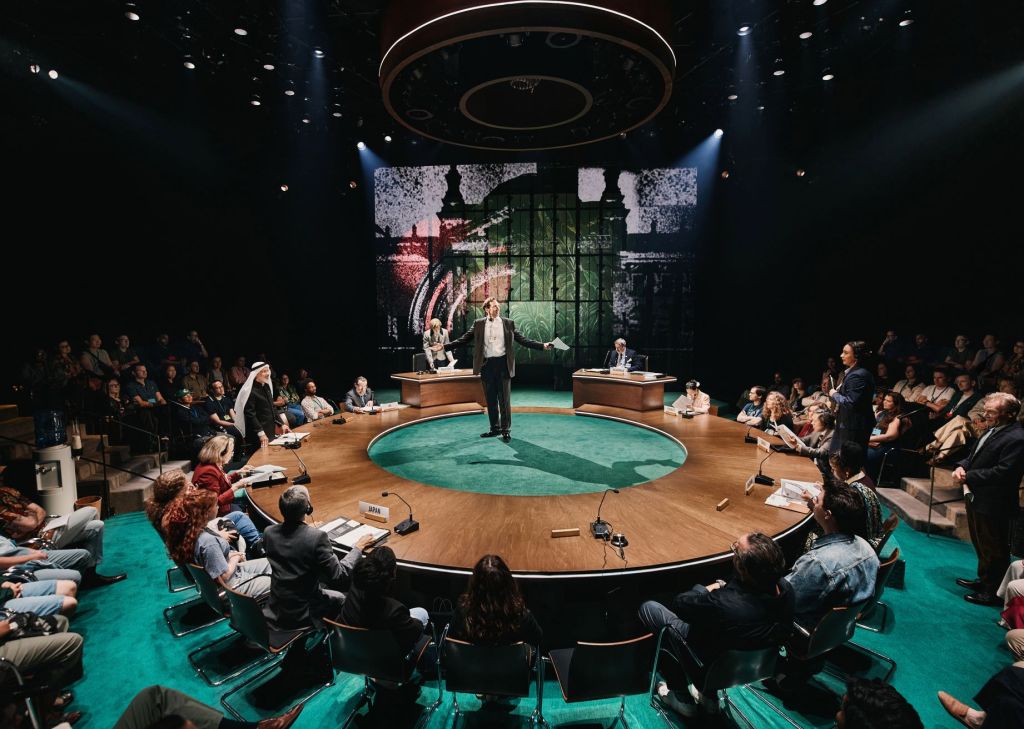
Based on events beginning in 1989 leading up to the 1997 United Nations Climate Change Conference in Kyoto, Japan, Joe Murphy and Joe Robrtson’s Kyoto explores the momentous occasion when nations agree to confront climate change. The two-act political thriller is in its US Premiere at the Lincoln Center Theater at the Mitzi E. Newhouse until November 30th. Compressing extensive detail, the playwrights reveal how representatives from 160 nations negotiated the Kyoto Protocol. The Protocol committed first world and emerging nations to limit/reduce greenhouse gasses after setting targets and timetables.
Stephen Daldry and Justin Martin co-direct Kyoto, which enjoyed its world premiere at the Swan Theatre, Stratford-upon-Avon. Due to its continued success, it transferred to London’s West End before debuting to American audiences, who don’t always relate to the ironies and humor in the play (directed at the US). Indeed, the US representative (Kate Burton), and American oil lobbyist Don Pearlman (Stephen Kunken) and the representative of Saudi Arabia (Dariush Kashani) become the objects of humor and frustration. They continually oppose any movement to pin down emissions’ timetables or support decreasing oil production.
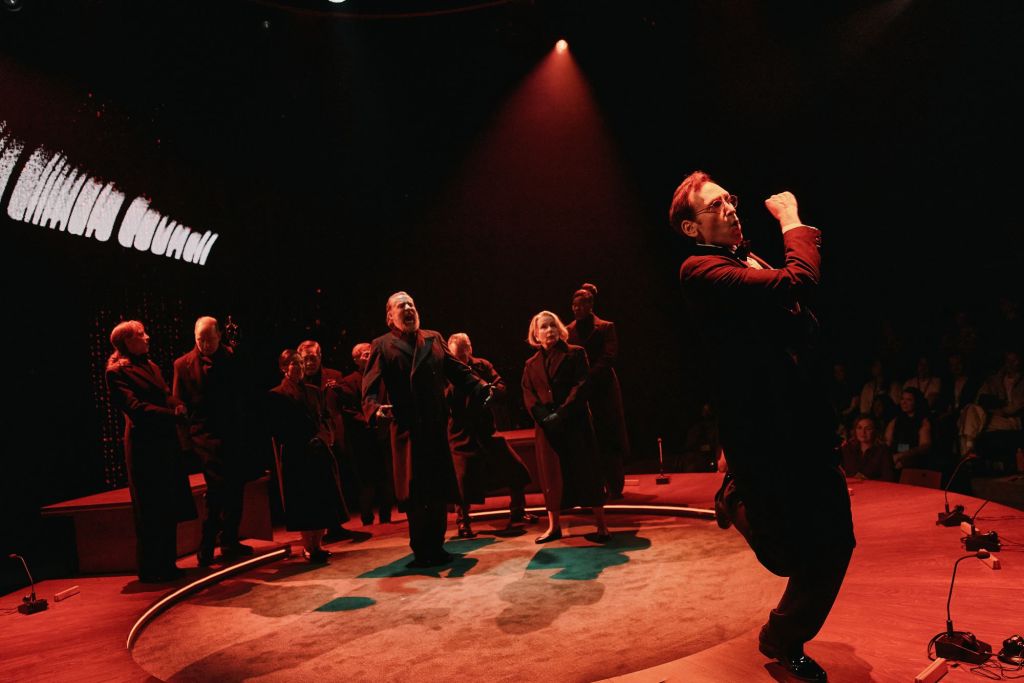
The set is a circular conference table where members sit and sometimes interact with the audience. The table serves also as a raised platform for Don Pearlman, placing him above the fray. In its design by Miriam Buether, Pearlman stands at its center and addresses the audience. Variably it becomes a private meeting area where Pearlman speaks with those opposed to any “progress” on emissions. It becomes a setting in his home, and several hotel rooms where he converses with his wife Shirley (Natalie Gold) and others. The co-directors keep the play in the realm of ideas, not material places. In one instance Shirley and Don join Raul Estrada (Jorge Bosch), the Argentinian representative for China, in a rain forest. The fluid, minimal set design forces the audience to keep up with the dialogue cues which indicate setting changes.
The playwrights have chosen the “well-meaning,” slippery lawyer Don Pearlman, as their spokesperson to reveal what happened from 1989 through1997, when nations finally achieved consensus in Kyoto. At the outset Kunken’s disarming oil lobbyist begins by discussing how the Seven Sisters (big oil, i.e, Exxon, Shell, BP) appoint him as their agent provocateur to stall and delay any UN agreement about greenhouse gas emissions.
Like Iago in Othello, Pearlman instructs the audience in his nefarious plans. Though the events happen at lightning speed, Kunken’s Pearlman slow walks us with his wise words and commentary about how to derail progress among the nations.
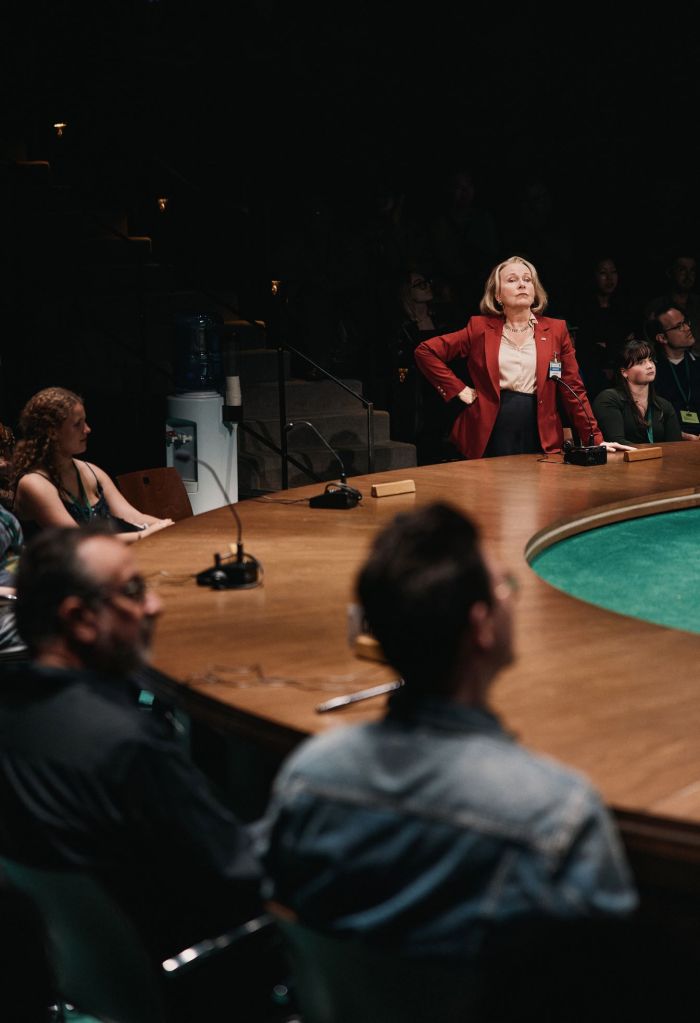
We become mesmerized as we note how he thwarts the representative countries who have different agendas than big oil conglomerates. Also, by extension we understand why little has been done to effectively curtail global warming. Without particular malice or a sinister tone, Kunken’s Pearlman humanely portrays a man who justifies his mission to support American’s “freedoms” to have a first world economy delivered by fossil fuels. Any change disrupting the oil supply, decreasing fossil fuels and harming profits must be stopped. Truly, Pearlman believes in his job and he believes in doing it well. This makes him and the Big Sisters utterly terrifying and wicked when one stops to consider the consequences.
As we follow along with the various conferences and summits beginning with the 1990 World Climate Conference in Geneva, through the Rio Earth summit, the many rounds of talks with scientists among countries, to 1995 Berlin, the First Conference of the Parties, COP-1, we see Kunken’s Pearlman enact the strategies and philosophies he first discussed with us and his wife Shirley. Without glee, with more than a soupcon of irony, Pearlman, ever the oil lobbyist, proves his genius standing up to various representatives with his knowledge about the process of negotiation, as well as his breadth of knowledge about the subject matter.
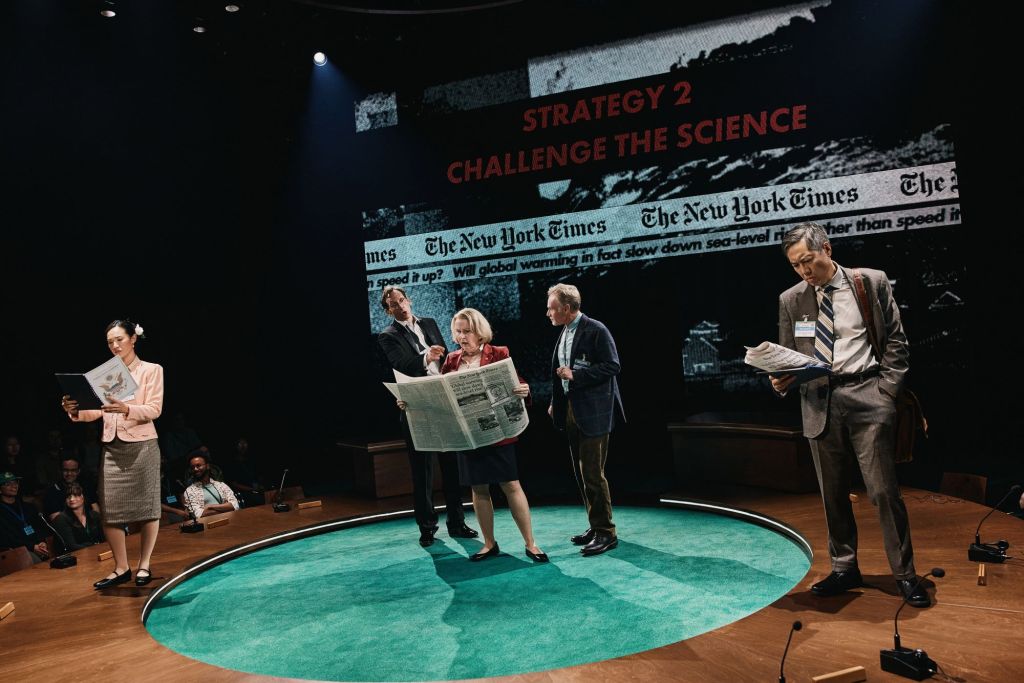
He, Burton’s US representative, Kashani’s Saudi Arabian representative for OPEC, and others dismiss the gravitas of what climate scientists have presented about global warming. However, Pearlman’s and others’ delinquence in acknowledging the looming disaster for representatives of low-lying coastal nation states comes to a screeching halt. The representative from Kiribati (Taiana Tully) joins forces with 39 other coastal nations to create a powerful negotiating bloc, The Alliance of Small Island States. They make it clear they will not allow the first world nations to marginalize and destroy them. For it is the first world nations’ oversized pollution that predominately contributes to the polar ice caps melting, and that puts the coastal nations at grave risk.
Thus, the conflict begins in earnest as the first world nations strain against the emerging nations, China having joined the coastal states. Few if any concessions are made for any collective unity as they delay for years, sea levels rise, and time runs out. However, a turning point occurs with the new appointment of Raul Estrada. Bosch’s Estrada eventually bans Pearlman from conferences, despite his being the CEO of the NGO, Climate Council (a blind to get him on the inside). Estrada knows Pearlman’s intent, and Pearlman shows no inclination to change his mission. Their war proceeds as representatives criss-cross the world in jets and add to the increasing emissions they seek to control.

Importantly, the play’s dynamism, pacing and urgency are conveyed by Kunken and Bosch’s performances and the co-directors’ staging and directed momentum. The lead actors who reprise their roles from the London production, have settled into their portrayals. As in real life, the oil lobbyist vs. the Argentinian representative to China smile and joke while warring against each other in a deadly “game” to stop big oil from holding the planet hostage.
Interestingly, the playwrights use the character of Shirley as a foil to soften and humanize Pearlman. However, when she finds out that the Seven Sisters knew about the consequences of global warming since 1959 and have kept this research under wraps, she realizes the wickedness of what her husband attempts. If she gives this information to him will it change his approach to his handlers? How can he live with himself and continue to support big oil knowing what the conglomerates have intentionally done for decades to keep profits flowing while endangering life on the planet?
At its strongest and most profound Kyoto dramatizes the tense political and scientific life and death battles that eventually result in the world’s first legally binding agreement to limit greenhouse gas emissions. That such Sturm und Drang resulted in so little is disappointing. However, in light of today’s international global divisions, to arrive at such a consensus seems miraculous and gives us pause.
Kyoto runs 2 hours 40 minutes with one intermission until Nov. 30 at the Mitzi E. Newhouse Theater, lct.org.
‘Irishtown,’ a Rip-Roaring Farce Starring Kate Burton

Irishtown
In the hilarious, briskly paced Irishtown, written by Ciara Elizabeth Smyth, and directed for maximum laughs by Nicola Murphy Dubey, the audience is treated to the antics of the successful Dublin-based theatre company, Irishtown Plasyers, as they prepare for their upcoming Broadway opening. According to director Nicola Murphy Dubey, the play “deals with the commodification of culture, consent and the growing pains that come with change.”
Irishhtown is also a send up of theatre-making and how “political correctness” constrains it, as it satirizes the sexual relationships that occur without restraint, in spite of it. This LOL production twits itself and raises some vital questions about theater processes. Presented as a world premiere at Irish Repertory Theatre, Irishtown runs until May 25, 2025. Because it is that good, and a must-see, it should receive an extension.
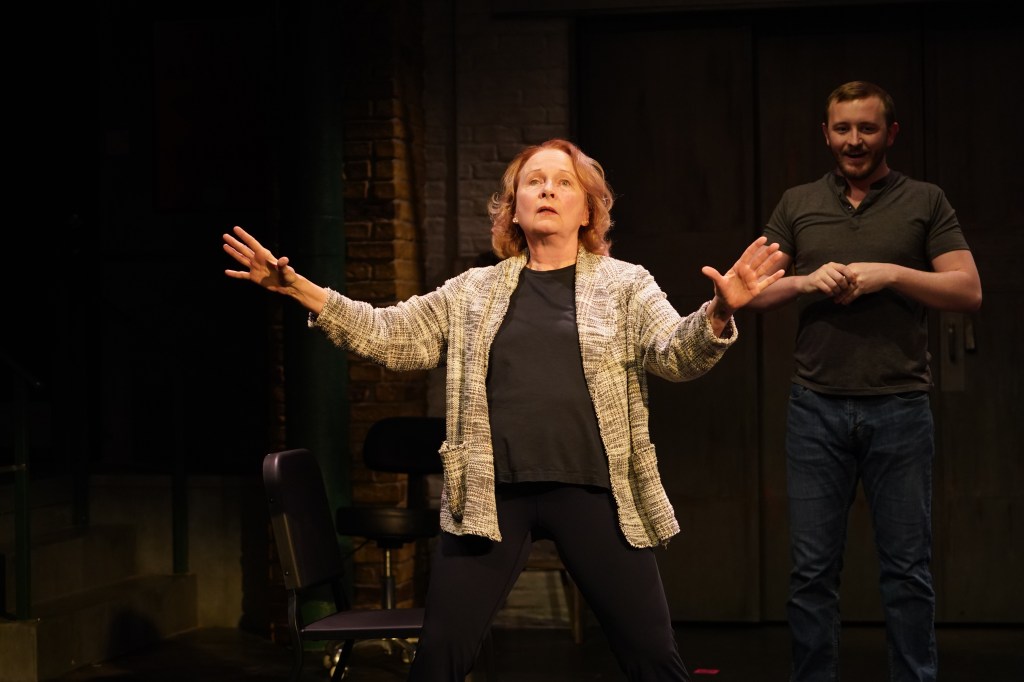
The luminous Kate Burton heads up the cast
Tony and Emmy-nominated Kate Burton heads up the cast as Constance. Burton is luminous and funny as the understated diva, who has years of experience and knows the inside gossip about the play’s director, Poppy (the excellent Angela Reed). Apparently, Poppy was banned from the Royal Shakespeare Company for untoward sexual behavior with actors. Burton, who is smashing throughout, has some of the funniest lines which she delivers in a spot-on, authentic, full throttle performance. She is particularly riotous when Constance takes umbrage with Poppy, who in one instance, addresses the cast as “lads,” trying to corral her actors to “be quiet” and return to the business of writing a play.
What? Since when do actors write their own play days before their New York City debut? Since they have no choice but to soldier on and just do it.

The Irishtown Players become upended by roiling undercurrents among the cast, the playwright, and director. Sexual liaisons have formed. Political correctness didn’t stop the nervous, stressed-out playwright Aisling (the versatile Brenda Meaney), from sexually partnering up with beautiful lead actress Síofra (the excellent Saoirse-Monica Jackson). We learn about this intrigue when Síofra guiltily defends her relationship with the playwright, bragging to Constance about her acting chops. As the actor with the most experience about how these “things” work in the industry, Constance ironically assures Síofra that she obviously is a good actress and was selected for that reason alone and not for her willingness to have an affair with Aisling.
Eventually, the truth clarifies and the situation worsens
Eventually, the whole truth clarifies. The rehearsals become prickly as the actors discuss whether Aisling’s play needs rewrites, something which Quin (the fine Kevin Oliver Lynch), encourages, especially after Aisling says the play’s setting is Hertfordshire. As the tensions increase between Quinn and Aisling over the incongruities of how an Irish play can take place in England, Constance stumbles upon another sexual intrigue when no one is supposed to be in the rehearsal room. Constance witnesses Síofra’s “acting chops,” as she lustily makes out with Poppy. This unwanted complication of Síofra cheating on Aisling eventually explodes into an imbroglio. To save face from Síofra’s betrayal and remove herself from the cast’s issues with the play’s questionable “Irishness,” Aisling quits.

Enraged, the playwright tells Síofra to find other living arrangements. Then, she tells the cast and director she is pulling the play from the performance schedule. This is an acute problem because the producers expect the play to go on in two weeks. The company’s hotel accommodation has been arranged, and they are scheduled to leave on their flight to New York City in one week. They’re screwed. Aisling is not receptive to apologies.
What is in a typical Irish play: dead babies? incest? ghosts?
Ingeniously, the actors try to solve the problem of performing no play by writing their own. Meanwhile, Poppy answers phone calls from American producer McCabe (voice over by Roger Clark). Poppy cheerily strings along McCabe, affirming that Aisling’s play rehearsals are going well. Play? With “stream of consciousness” discussions and a white board to write down their ideas, they attempt to create a play to substitute for Aisling’s, a pure, Irish play, based on all the elements found in Irish plays from time immemorial to the present. As a playwright twitting herself about her own play, Smyth’s concept is riotous.
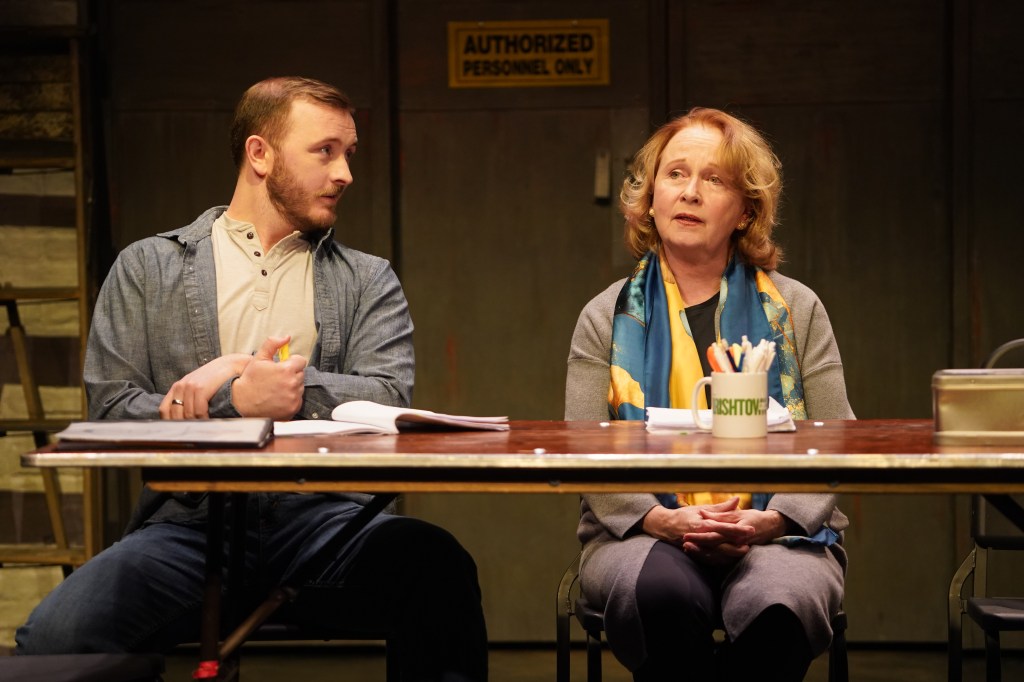
The actors discover writing an Irish play is easier said than done. They are not playwrights. Regardless of how exceptional a playwright may be, it’s impossible to write a winning play in two days. And there’s another conundrum. Typical Irish plays have no happy endings. Unfortunately, the producers like Aisling’s play because it has a happy ending. What to do?
Perfect Irish storylines
In some of the most hilarious dialogue and direction of the play, we enjoy how Constance, Síofra and Quin devise their “perfect Irish storylines,” beginning with initial stock characters and dialogue, adding costumes and props taken from the back room. Their three attempts allude to other plays they’ve done. One hysterical attempt uses the flour scene from Dancing at Lughnasa. Each attempt turns into funny scenes that are near parodies of moments in the plays referenced. However, they fail because in one particular aspect, their plots touch upon the subject of Aisling’s play. This could result in an accusation of plagiarism. But without a play, they will have to renege on the contract they signed, leaving them liable to refund the advance of $250,000.

As their problems augment, the wild-eyed Aisling returns to attempt violence and revenge. During the chaotic upheaval, a mystery becomes exposed that explains the antipathy and rivalry between Quin and Aisling. The revelation is ironic, and surprising with an exceptional twist.
Irishtown is not to be missed
Irishtown is a breath of fresh air with laughs galore. It reveals the other side of theater, and shows how producing original, new work is “darn difficult,” especially when commercial risks must be borne with a grin and a grimace. As director Nicola Murphy Dubey suggests, “Creative processes can be fragile spaces.” With humor the playwright champions this concept throughout her funny, dark, ironic comedy that also is profound.
Kudos to the cracker-jack ensemble work of the actors. Praise goes to the creatives Colm McNally (scenic & lighting design), Orla Long (costume design), Caroline Eng (sound design).
Irishtown runs 90 minutes with no intermission at Irish Repertory Theatre, 132 West 22nd St. It closes May 25, 2025. https://irishrep.org/tickets/
‘Coriolanus’ by William Shakespeare, Pride Without Humility Breeds Self-Destruction
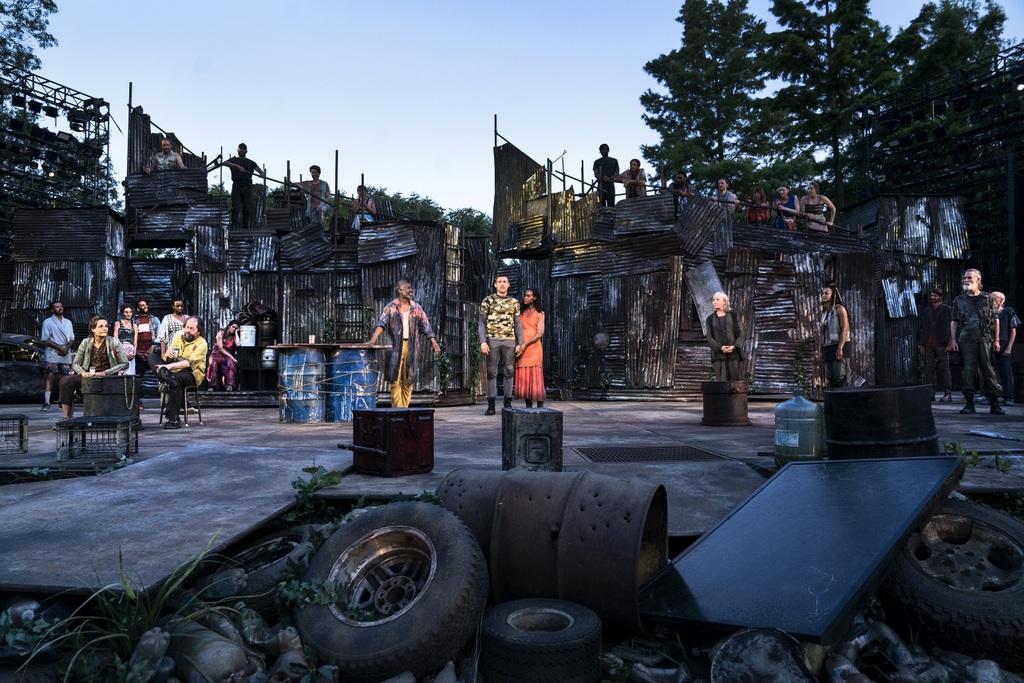
‘Coriolanus,’ by William Shakespeare, directed by Daniel Sullivan with Justin P. Armstrong (Ensemble), Teagle F. Bougere (Menenius Agrippa), Kate Burton (Volumnia), Jonathan Cake (Caius Martius Coriolanus), Louis Cancelmi (Tullus Aufidius), Katharine Chin (Ensemble), Gregory Connors (Ensemble), Darryl Gene Daughtry, Jr. (Ensemble), Biko Eisen-Martin (Ensemble), Bree Elrod (Ensemble), Nayib Felix (Ensemble), Josiah Gaffney (Ensemble), Chris Ghaffari (Titus Lartius), Enid Graham (Junius Brutus), Christopher Ryan Grant (Ensemble), Emeka Guindo (Young Martius), Jonathan Hadary (Sicinius Velutus), Suzannah Herschkowitz (Ensemble), Gemma Josephine (Ensemble), Thomas Kopache (First Senator), Tyler La Marr (Ensemble), L’Oreál Lampley (Ensemble), Jack LeGoff (Ensemble), Alejandra Mangini (Ensemble), Louis Reyes McWilliams (Ensemble), Max Gordon Moore (First Citizen), Tom Nelis (Cominius), Nneka Okafor (Virgilia), Donovan Price (Ensemble), Sebastian Roy (Ensemble), Ali Skamangas (Ensemble), Jason Paul Tate (Ensemble), and Amelia Workman (Valeria), (Joan Marcus
Coriolanus, Shakespeare’s apotheosis about a war monger who fires up for battle and yawns with boredom when he must live peaceably in the community brings to mind a ravaged soldier whose PTSD has so overcome him that he prefers living on the edge of death to energize himself to life. If he must choose between bloodshed, battle and calm, give Coriolanus carnage that he delivers, the gorier the better.
What does one do with such a Roman in a time of scarce resources on a planet ravaged by the doomsday scenario of global warming? Make him a politician to organize and straighten out issues in a time of great unrest in the most dire of conditions? Indeed, then watch him self destruct. For politicians must schmooze, flatter, promise, swallow crow, apologize and act with humanity and forbearance. Coriolanus is fit for battle, not for compromise, leader of his own personal autocracy which cannot be countermanded. Politics requires equanimity or the appearance of it. Of this he is incapable.
Shakespeare’s protagonist has a bit of the hero of The Hurt Locker (Kathryn Bigelow’s 2008 award winning film) without Jeremy Renner’s heartfelt agony and recognition of the mammoth loss of his former self before he signed up for war. Indeed, Coriolanus as portrayed by Jonathan Cake has much of the robotic machine killer with whom one has a devil of a time empathizing, especially as he rants and raves against those not born to a privileged background, from no fault of their own. Cake’s Coriolanus lacks interest, love or concern for others, except his wife (Nneka Okafor) son (Emeka Guindo) and mother (the wonderful Kate Burton). For his patrician friends he shows equal measure and latitude, for example Menenius Agrippa (Teagle F. Bougere) Cominius (Tom Nelis) and Titus Lartius (Chris Ghaffari) who advise him and fight with him. For his marvelously bellicose foes like Tullus Aufidius (Louis Canelmi) he bestows his complete veneration and worship.

(L to R): Christopher Ryan Grant, Louis Cancelmi in ‘Coriolanus,’ directed by Daniel Sullivan, Delacorte Theater (Joan Marcus)
As for the hurting, starving crowds clamoring for grain while the patricians’ storehouses flow with plenty? Let them eat each other in a zombie apocalypse. Coriolanus will none of it. Indeed, at the outset of the production, director Daniel Sullivan has placed a locked up barrel holding water downstage which the plebeians attempt to break into. But only Coriolanus holds the key to the lock and only he has access as he gives water to his son and denies his thirsty underlings. Charity stops first and last with self and family in a time of crisis such as that which confronts this deteriorating Rome, evocatively represented with a Mad Max scenic design by Beowulf Boritt of scattershot, burned out piles of garbage, remnants of the past, rather like Bob Ewell’s (To Kill a Mockingbird) scrummy playland hovel next to a massive town dump.
Because the rabble are deprived, there is civil unrest against the elites which if not quelled will threaten the security of the state, making it vulnerable to Rome’s enemies. However, Coriolanus answers the plebeians’ complaints with epithet and insult (they are curs and scabs) and argues that if he had the opportunity, he would slaughter them and create a mountain with their carcasses.

(L to R): Jonathan Cake, Biko Eisen-Martin, and Teagle F. Bougere in the Free Shakespeare in the Park production of Coriolanus, directed by Daniel Sullivan (Joan Marcus)
Some explanation is given for his wrath against the fickle, unreliable lower classes. His is an elitist patrician nature roiled by his aggressive, assertive mother. When he was a child she encouraged him to abusive dominance exemplified when he attacked the most beautiful and delicate of nature’s creatures by chomping off the wings of butterflies. Being so schooled against softness and generosity, he has no tolerance for the lazy, cowardly plebeians whose unmeritorious behaviors deserve no handouts. He states this to their faces in the opening scenes and we divine that his rancor is most grievous when he rails that he has provided the security of Rome while these poor and unfit do nothing to help him, but quailing in fear, flee even the thought of battle.
The situation is certainly egregious with the Volsces who come to attack. To get the corn they need to stem Rome’s hunger and murmurings, Coriolanus like a Titan hero single-handedly in “Incredible Hulk” fashion goes against these foes and delivers the goods without the help of the commons who slow him down. He emerges victorious from Beowulf Boritt’s ramshackle tin gates set, bloody and triumphant, but arrogant to the point of caricature!

(L to R): Kate Burton (downstage) Tom Nelis, Teagle F. Bougere, and Nneka Okafor in the Free Shakespeare in the Park production of ‘Coriolanus,’ directed by Daniel Sullivan (Joan Marcus)
Was ever there such a raging hero hewn from the trials of confronting daily doom as the populace struggles against diminishing resources in Sullivan’s fascinating, ominously foreboding vision? Never. And Shakespeare forges from his hyperbolic character the tragic flaw that caves in Coriolanus’ life, legacy and career: his overweening pride, and his fearsomeness in not being shy to express his superiority to those lowlife “deplorables” who hate him.
Coriolanus certainly is reminiscent of other leaders we know whose arrogance and inability to apologize runs before them. However, Coriolanus is intrepid, mighty and uber skilled in battle. In this he is admirable. The current arrogant and boastful who lead are 100% image and 0% substance, bullying, cowardly and shallow like those whom they represent. That both Coriolanus and the resident of the White House are unfit for politics is their only similarity. Coriolanus’ pride is based in fact and follows an important logic that is downright Puritan in a time of destitution. If one doesn’t contribute to the good of the society, then one is not worthy of the grain that others have supplied. Freeloaders are not welcome!

(L to R): Emeka Guindo, Jonathan Cake, Nneka Okafor in Free Shakespeare in the Park,’Coriolanus,’ directed by Daniel Sullivan (Joan Marcus)
Shakespeare’s tragedy revolves around his protagonist being lured into the political sphere which he hates for he is not social. He is too “in your face” real to grovel in flowery phrases, alluring promises and imaginative disingenuousness to please the masses. He is direct, frank and authentic and cannot apologize or “fake it” to front those he despises.
However, he suppresses his best judgment and accepts a position which is offered to him. The conspiracy against him blows up when the Tribunes who despise him Sicinius (the excellent Jonathan Hadary) and Junius Brutus (the equal of the pair Enid Graham) incite the plebeians to revoke the offer of the position. This is upon condition that Coriolanus does not “bow” to the voice of the people. This untenable situation requires Coriolanus to be humble and compromising; this is an impossibility which results in his banishment by the Tribunes. Coriolanus counters with the statement that he banishes Rome from his presence and stature. With solemnity, he suggests that there is a place for him, away from Rome.

(L to R): Jonathan Cake, Kate Burton in ‘Coriolanus,’ directed by Daniel Sullivan (Joan Marcus)
But there is not. Though he joins Rome’s former enemy Tullus Aufidius of the Volsces intending to avenge his disgrace and dishonor of banishment by destroying Rome, it is a rush to judgment. The momentous decision means that he will destroy his mother, wife, son and friends who have not joined the Volsces. In the most insightful and powerful scene in the production (thanks to Kate Burton and Jonathan Cake’s whining “but mother” which reveals his enslavement to her dominance) Voluminia persuades him to betray Aufidius and fight for Rome not Volsces. It is Coriolanus’ act of sacrificial, stoic death. Aufidius will certainly kill him for his betrayal. That Voluminia has raised her son to war so that he can ultimately die to save her is unnatural and wicked for a mother. Doesn’t Voluminia and his family have other options? But their relationship as Cake and Burton portray it is fraught with issues of power dominance and abuse as the brute Coriolanus is reduced to a mewling weakling by his mother. He accedes to her wishes.
The production’s emphasis works at times and at other times is spotty. The rag-tag Costume Design by Kaye Voyce, Scenic Design by Beowulf Boritt, the Lighting Design by Japhy Weideman (strongest at the conclusion) the Soudd Design by Jessica Paz, the Composer Dan Moses Schreier’s music all convey Sullivan’s vision and themes soundly to resonate for us today. What happens to the haves and have nots when the law of diminishing returns lets loose annihilation because of the willful negligence and stupifying greed of previous generations’ corporate elites? Sullivan’s answering backdrop for the play is acute and frightening.
On the other hand, the empathy that we could feel for the plight of Coriolanus struggling against his own character wobbles perhaps because his character portrayal is one-note, at times cartoonish and lacking in depth. In the scenes with Burton’s Voluminia the depth of Cake’s Coriolanus shines, however. Shakespeare’s characterization reveals a character caught by his own ego between a rock and a hard place. He is betrayed by the Tribunes (his mother’s rant in their faces is largely ineffective) who capitalize on his arrogant weak character, lure him then back him into a humble pie corner from which he implodes.
And when he decides to punish Rome by depriving the society of the one way he has greatly benefited it by delivering death to its door? Once again he is thwarted, this time by his mother. And yet, there is no solace, nor sorrow nor identification at the conclusion that one might feel with Cake’s portrayal of a man who has undone himself. This is a weakness of the production which in all else especially Sullivan’s vision of the future is pointed.
Coriolanus is enjoying its last presentation today, 11 August. Performances have been sold out. However, there may be seats released if you are lucky and able to get to the Delacorte Theater well before curtain time at 8:00 pm.
 CAROLE DI TOSTI