Blog Archives
‘The Saviour,’ a Tour de Force at the Irish Repertory Theatre
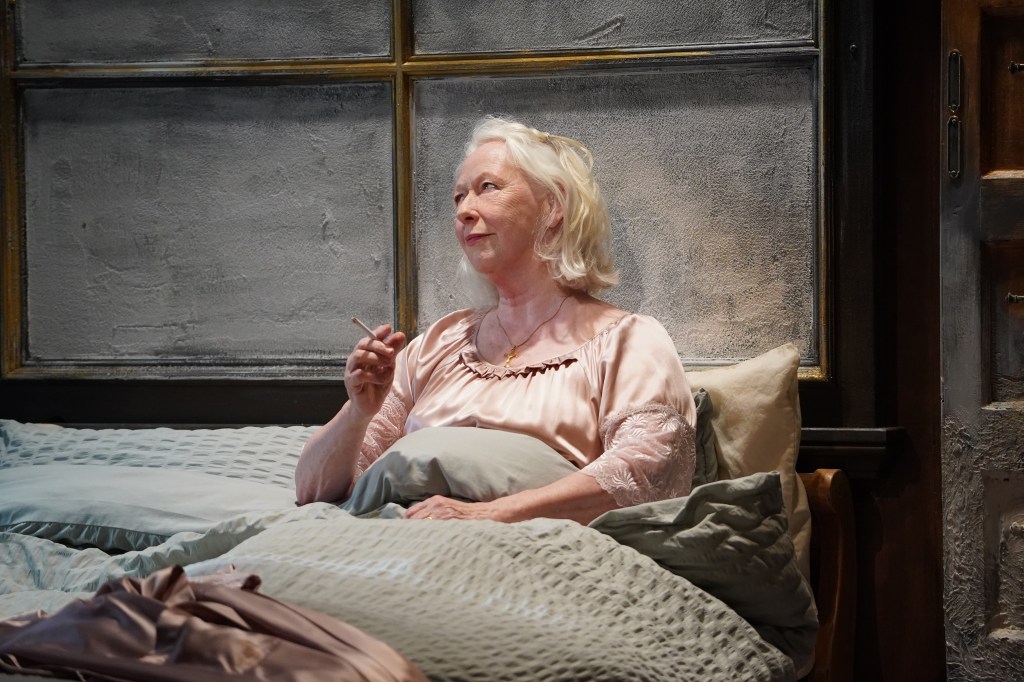
The Saviour, a powerful, ironic character expose, written by Deirdre Kinahan and directed by Louise Lowe, presents the wonderful Marie Mullen in a performance which strikes at the heart of Catholicism, paternalistic culture and hypocrisy. The World Premiere by Landmark Production is being performed on the Francis J. Greenburger Mainstage at the Irish Repertory Theatre until August 13.
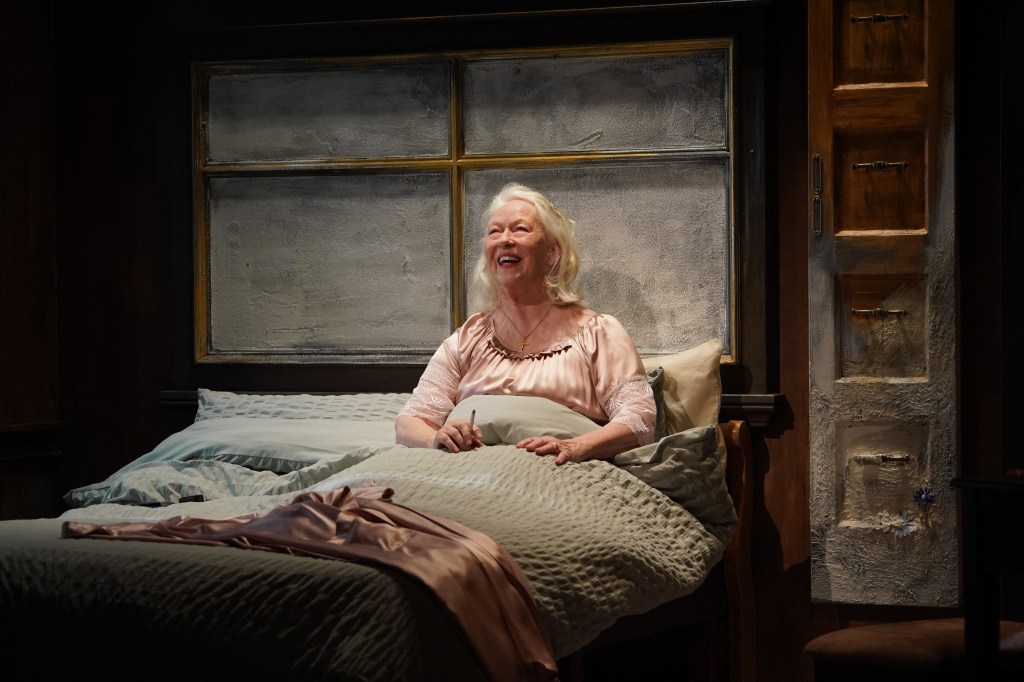
Kinahan begins her 70 minute play as Marie Mullen’s Máire resides in bed enjoying a “fag” (cigarette) and laughing to herself at what has just transpired with Martin. She expresses her enthusiasm and joy to her great confidante Jesus, whom she addresses for half of the play.
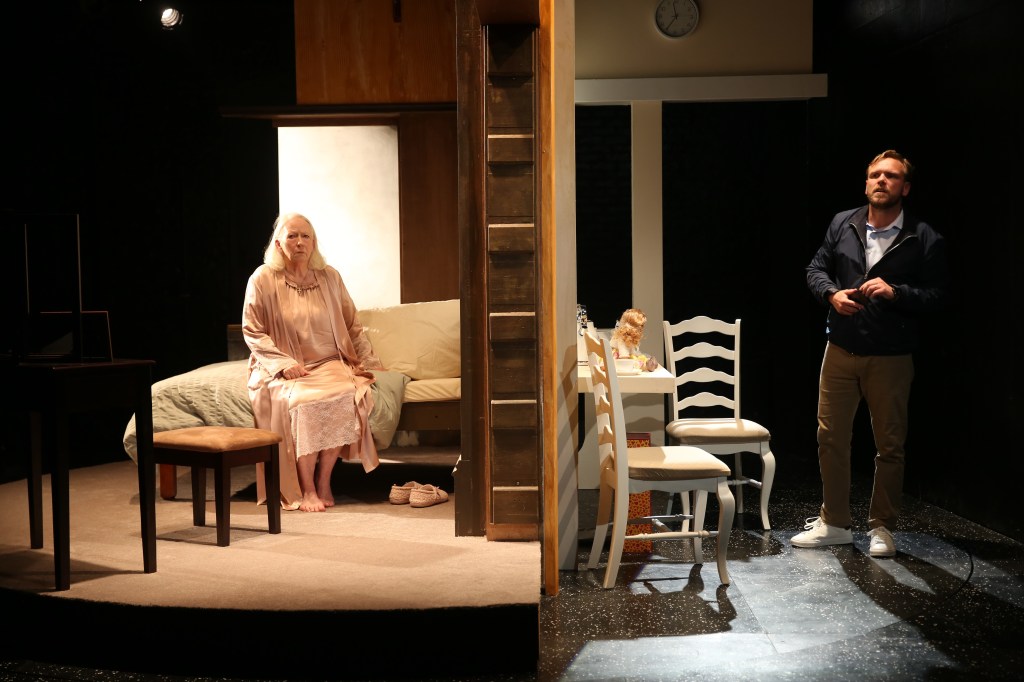
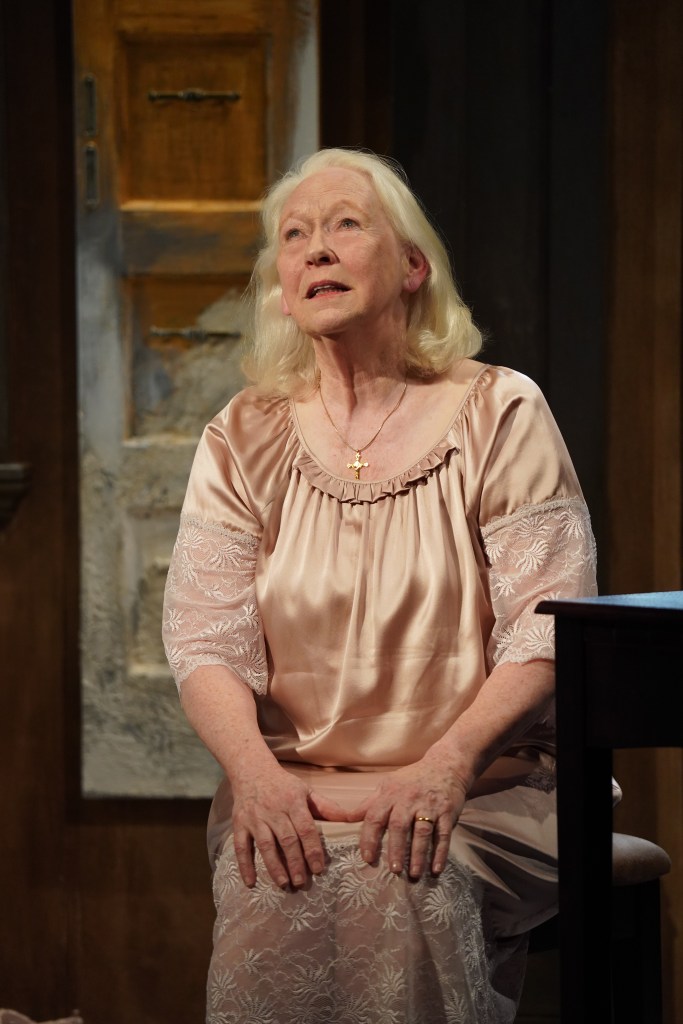
The audience is shocked into laughter at the unexpected subject matter of her descriptions. Máire (thanks to Joan O’Clery’ costume design), is the opposite of a woman that others might describe as a “dolled-up floozy,” generous with her affections and body. The protagonist is a senior citizen. Her environs and bedroom are neither opulent nor well-appointed thanks to Ciarán Bagnall’s scenic and lighting design. The sets on a revolving platform of bedroom and kitchen are a clue to her financial situation.
In other words, Máire is not the type to be taken advantage of for her money or what she has which looks to be the stylized bare minimum of possessions. Thus, she must be taken at her word, or she is completely fantasizing the circumstance with Martin, who, like Jesus, remains invisible. She is an unreliable narrator, so we are left guessing about the truth of the present circumstance she describes.
Louise Lowe’s acute direction shepherds’ Mullen’s fabulous performance as Máire to lead the audience in wonder, enthralled in the grip of hearing about Máire’s relationship with Martin as she discusses it with Jesus.
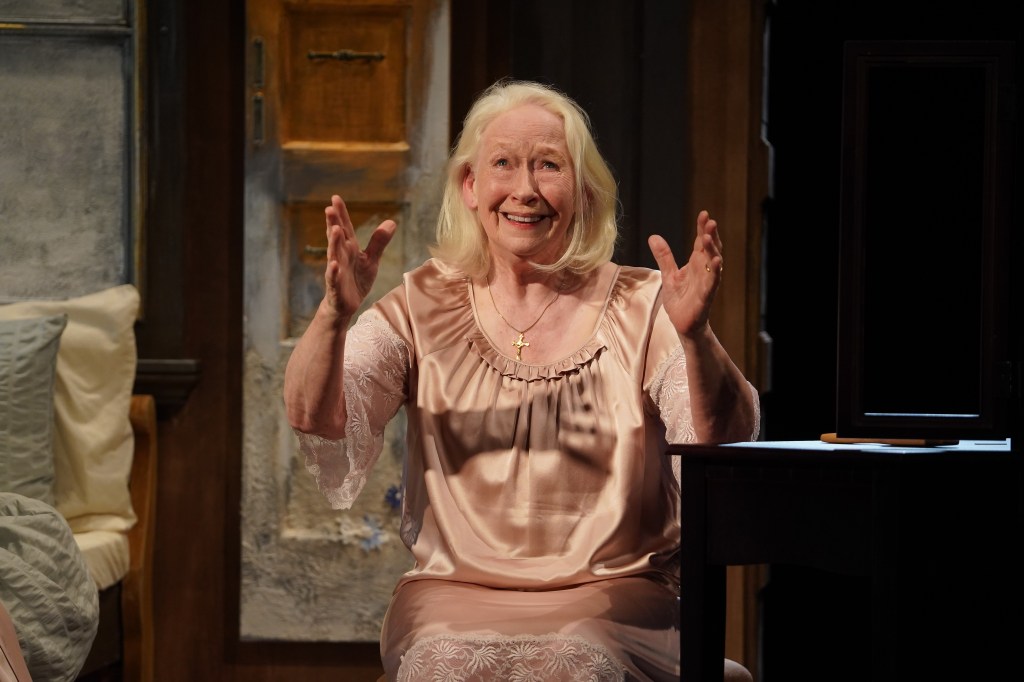
As Máire waits for Martin to come upstairs with her coffee, she glories that it is her birthday and she celebrated a wonderful evening with Martin who shopped and cooked for her and appreciates her more than her husband who died years before. Indeed, Martin even appreciates her more than her children, who are now grown and have children of their own. She reviews the circumstances of her life with Jesus in light of her relationship with Martin. She believes that her relationship with “the saviour” is somehow in concert with her Godly interactions with Martin, because he prays, believes in God, goes to church and wouldn’t be with her if Jesus didn’t accept him.
Kinahan’s characterization of Máire, effected through Mullen’s interpretation, is completely believable, especially when she speaks to Jesus as if He is her “all in all.”
As the monologue continues, we question the reality of what Máire shares with Jesus with regard to Martin who is shadowy and mysterious. Is it true or isn’t it? However, we do accept her discussion with Jesus about her devastating upbringing. This includes the death of her mother, and her father’s abandonment. He left her with the nuns where she is abused and made to work in the oppressive, hot “laundry.”
The reference is perhaps to the Magdalene Laundries in Ireland, run by the nuns and Roman Catholic orders to give shelter to “fallen women” from poor backgrounds. To punish them with proper penance and hide their shame, parents sent them to these asylums which were secretive and oppressive. Exploiting the girls’ labor, they offered little emotional respite from condemnation. Sadly, the babies born out of wedlock were taken away from their birth mothers and adopted out by the nuns for donations.
As in the case of Máire, orphaned girls were placed there so they could be properly raised by the goodly nuns. However, as Máire indicates, her situation was equally terrible, not because she “sinned,” but because poverty relegated her to a life of misery of hellish toil and fear with the nuns at a young age.
It is during this discussion of the laundry, whose atmosphere and terror is effected by Aoife Kavanagh’s crushing sound design (as Máire recalls her past), that she reveals her only salvation was her faith in Jesus. She refers to “her loving Jesus” as not the “nuns’, Jesus.” Her Jesus helps her survive the nuns’ cruelty, condemnation and judgment until she manages to free herself with a job. And it is then she meets her husband with whom she has a loving relationship and family.
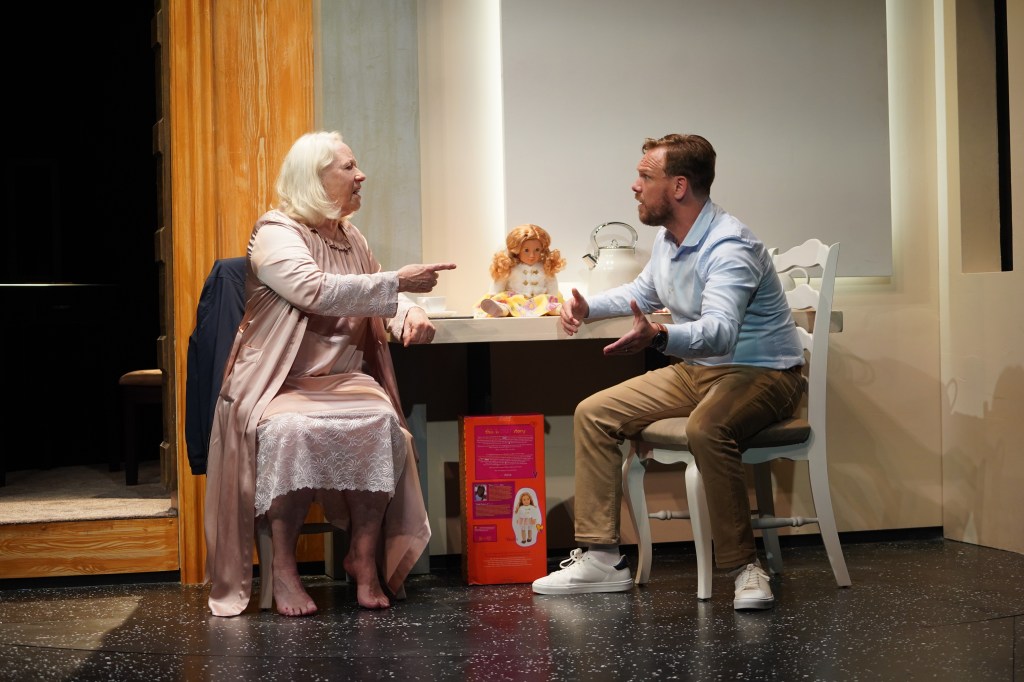
Marie Mullen’s is absolutely terrific in animating Máire and establishing Jesus as a “living” being with whom she shares the most intimate of secrets. Mullen’s authenticity is spot-on. We accept how Jesus affirms Máire’s life to receive this new beginning in her relationship with Martin. Though there doesn’t appear to be a conflict, the dramatic dynamic unfolds in earnest when son Mel (the superb Jamie O’Neill) appears. He brings her a present (a doll which has symbolic significance), to celebrate her birthday.
Her relationship with Mel seems loving enough, until Máire’s behavior references Martin’s visit. It is then that they make statements which explode with revelation and meaning in a myriad of emotions including anger, torment and hate. Both mother and son hurt one another. Their comments are severe. No apologies can be made to salve the wounds. We question where is forgiveness? Where is Jesus? Where is love? All appears to be confusion, fear and obfuscation.
Kinahan’s dialogue cleverly builds as Mel and Máire turn to the undercurrents of the past. Clearly, we understand the impact the church has had upon them. After Mel leaves, Máire must grapple with what the truths may be and either confront and accept them, or reject them finding justifications. Ironically, this leaves the audience in uncertainty with more questions which are never answered.
Kinahan’s suspenseful events beautifully build toward the high point at the conclusion. The mesmerizing play is directed and acted to perfection. Thematically, the characters’ acceptance of lies as truth and their ability to be duped by “isms,” philosophies and trends is incredibly current. Mel uses the truth to bludgeon his mother which appears vengeful. On the other hand, Máire selects which truths to believe and which to reject, hypocritically.
Both son and mother are flawed. Both need redemption and love from each other. Both have been caught in a web of religion, either rejecting/rebelling against it, or embracing it but not in the fullness of its meaning. As a result, caught up in their own agendas, they cannot communicate to use the very tenets of faith that are supposed to heal, bring peace and redeem. This is a terrible, magnificent irony where Jesus is called upon, but never arrives to heal and mend the differences. Additional work must be done for that to occur.
Unfortunately, this is a story visited again and again in religious households. It is thematically universal. Kinahan, Lowe, the actors and creatives have expressively highlighted the conundrums of faith, hypocrisy, forgiveness, spiritual truth and condemnation in this amazing and unforgettable production. It is a must-see.
For tickets and times go to their website https://irishrep.org/show/2022-2023-season/the-saviour/
 CAROLE DI TOSTI