Blog Archives
‘After the Hunt’ Featuring Julia Roberts, Andrew Garfield @63rd NYFF
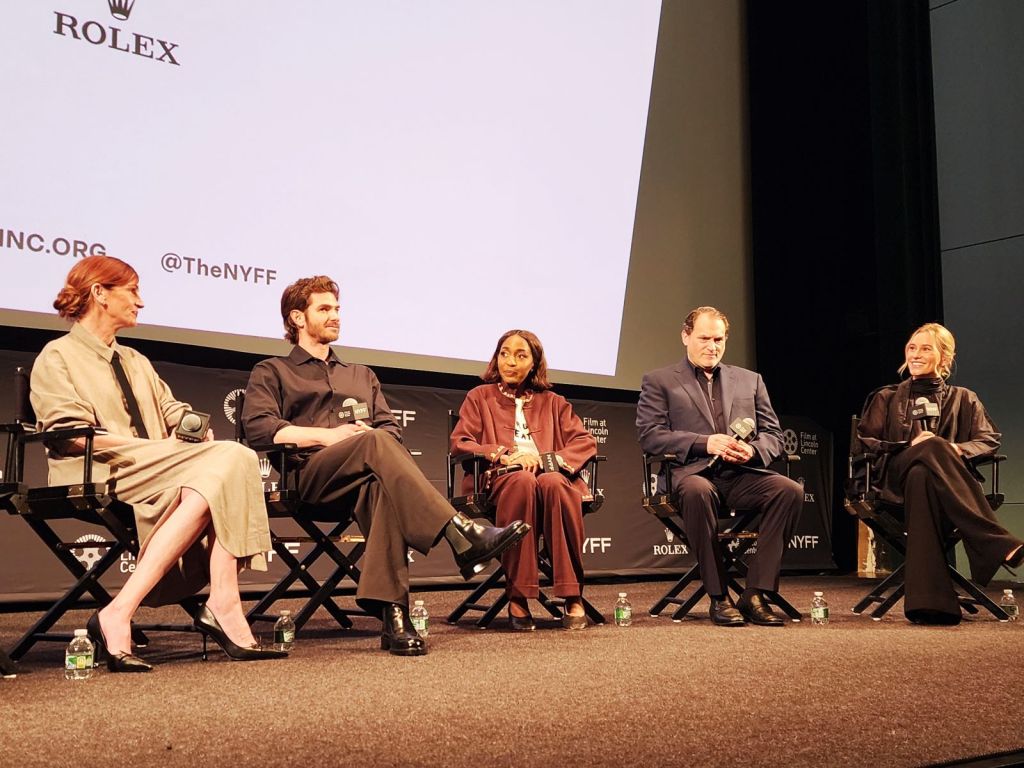
After the Hunt
Directed by Luca Guadagnino and written by Nora Garrett, After the Hunt is a complex, psychological, mystery drama with comedic/ironic flourishes that turn culture wars on their heads. Pointedly, its entangling themes never resolve into a satisfying resolution. Reflective about current social issues involving sexual abuse, gender identity, race, power dynamics, ethics and women’s career ascendance against the backdrop of Yale University in New Haven Connecticut, Guadagnino and Garrett tackle some of the themes credibly. Others they leave swinging in the winds of uncertainty.
Thanks to the incisive performances of principals Julia Roberts, Michael Stuhlbarg, Andrew Garfield and Ayo Edebiri, the film’s central mystery whether sexual abuse did or didn’t occur and why it occurred holds our interest.
However, the subtle nuances and motivations each character reveals become convoluted and incoherent at times. Is this in the service of the notion that human beings are layered, self-destructive, self-betrayers driven by their own nihilistic impulses? In a further irony, the philosophy professors Alma (Roberts) and Hank (Garfield), and their Ph.D. student Maggie (Ayo) are adept at weaponizing philosophy as a defense they use to promote their personal agendas. As a perfect foil, the most well-drawn character of rationality, Alma’s husband psychiatrist Frederick (Stuhlbarg), receives the prize for being the authentic adult in the room. Stuhlbarg’s Frederick is a perfect delight to watch and a welcome relief from the others’ Sturm and Drang.
Main Slate Section of the NYFF
Having its world premiere at the 2025 Venice International Film Festival, After the Hunt in its North American premiere opened the New York Film Festival in the Main Slate section. Interestingly, though the film takes place at Yale University in New Haven, Connecticut, Guadagnino filmed it in England. The superb set design provides the ambience for the 2020 setting and final epilogue in 2025.
In the opening scene, Guadagnino shares his first clue with a title message stating that the event happened at Yale. However, many events occur at the party Alma holds at her home for her students, colleagues and friends. First, we learn about Hank, Alma and Maggie, those closest to Alma, who briefly discuss Maggie’s dissertation on why she selected her topic, “the resurgence of virtue ethics.” Additionally, we learn that Alma and Hank compete for a tenured line professorship. Frederick asks both how they would respond if the other wins it? Do we take them at their word or do they lie?
Finally, Maggie goes to the bathroom. In searching for toilet paper, she finds a “hidden” envelope taped to the interior top of a cabinet. When Maggie opens the envelope she sees it contains an article and pictures. Maggie takes the article which we don’t see in close-up. So much for Maggie’s ethics and respect for her beloved professor’s privacy. Immediately, we note an immoral aspect of her character. We also have an indication of Alma’s character in placing an envelope with secret information where it can be found.
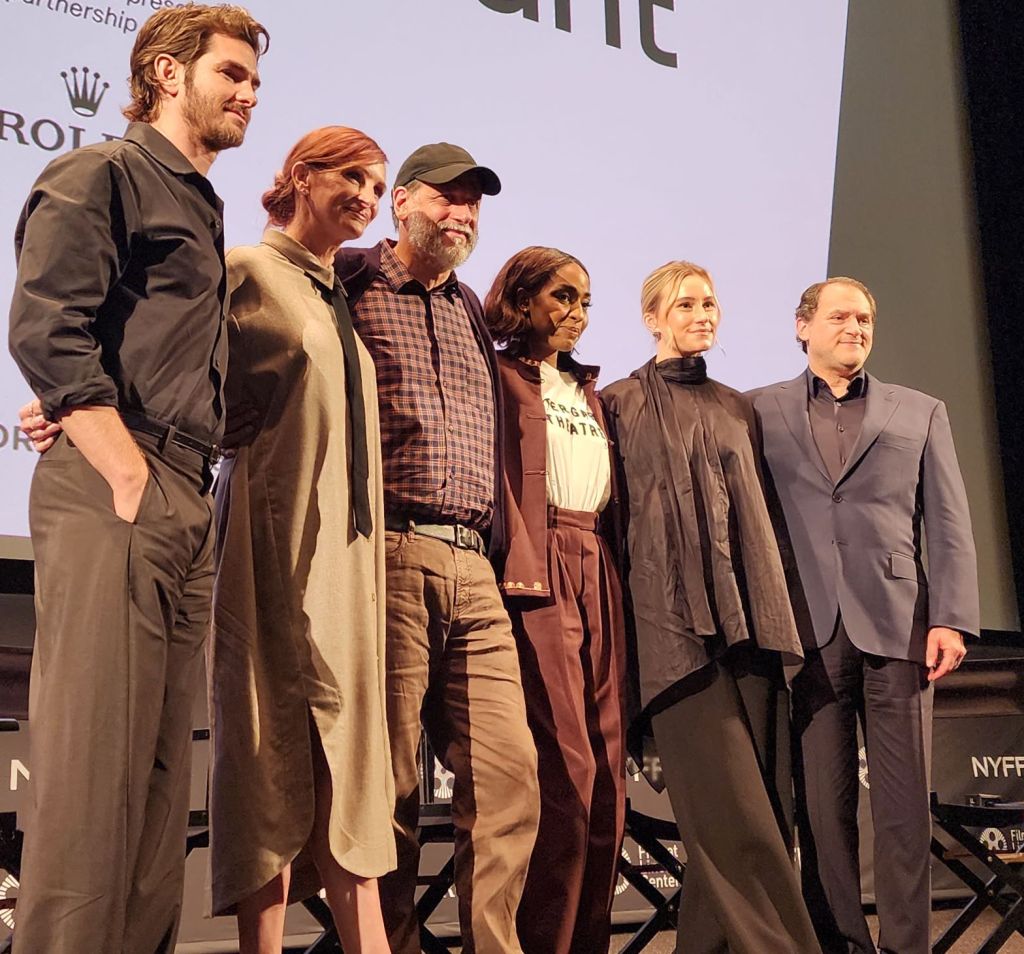
Initial incidents we see, a hidden incident occurs we don’t see
These initial incidents that we see, eyes wide open, take place in Alma and Frederick’s house. However, another incident that happens after the party, we don’t see. We hear about it from the victim, Maggie, who returns the next day to Alma’s. Dripping wet, bedraggled and forlorn, a waif to sorrow over, Maggie tells Alma that Hank sexually attacked her. Maggie admits she shouldn’t have allowed Hank to come over after the party where they had been drinking. Of course, he didn’t stop after she kissed him, though she said, “No.”
Somewhere in the emotional grist of this event that Alma doesn’t initially respond to with care and concern, we consider Maggie’s highly leveraging position at Yale, the antithesis of a conservative, “Red State” university. She is a Black, gay student whose wealthy parents donate heavily to Yale. Close to her professors Hank and Alma, who taught Hank, she goes to Alma for support. Maggie suggests Alma’s background will help her understand what Maggie feels. This comment short circuits Alma. Manipulatively, Maggie brings Alma into the situation and makes it personal to her. In other words, whatever Maggie read in the article she uses as leverage to manipulate Alma to help her. Confused, Alma wonders what Maggie knows about her.
Questioning Maggie’s motives
Thus, we question the wisdom of Maggie’s manipulation and wonder what information the hidden article about Alma held. Also, we question the extent to which the article influenced Maggie to invite Hank to her apartment where she kissed him and then tried to back off his advances. Did this event even occur? What underlying motives does Maggie have if It didn’t? By this point we have forgotten the ironic import of Maggie’s dissertation topic (the resurgence of virtue ethics). If virtue ethics gives weight to practical wisdom and the pursuit of a flourishing life through moral excellence, Maggie appears a hypocrite to even deal with such a topic. Taking the article about Alma doesn’t exemplify moral excellence. Neither does manipulating her with it.
Nevertheless, Maggie’s potentially heart-wrenching emotional experience of sexual assault by a close professor becomes occluded by many factors. Perhaps because of Alma’s cool response, we don’t feel sorry for Maggie or believe her. Her moral ambiguity taking the secret article also makes us question her veracity. Indeed, in the discussion of the “rape” by Alma, Hank and others, then in subsequent compelling scenes more information about the three philosophers unfolds. Against Alma’s suggestions, Maggie presses charges against Hank a surefire way to end his career at Yale.

Spiders spinning webs
As Garrett and Guadagnino spool out clues to interconnecting spider webs spun by three clever spiders with conflicting agendas and motivations, we remember Frederick’s unction about Maggie. He implies that Maggie is a mediocre student. This gives credence to Hank’s assertions that Maggie plagiarized parts of her dissertation. Apparently, her abilities falter, she can’t do the research and resorts to plagiarism. In fact Maggie’s plagiarism will disqualify her Ph.D., and possibly get her evicted from Yale, if either Hank or Alma hold her to account. How should Hank handle Maggie’s plagiarism? Does Alma, an expert in her field qualifying for tenure know Maggie plagiarized? Why don’t Alma and Hank report or correct Maggie?
To what extent do repercussions from Maggie’s wealthy donating family shut Hank and Alma’s mouths about the plagiarism? Shouldn’t they take the moral high ground and have her change her dissertation instead of ignoring it? To what extent does Maggie use the race card to her advantage? Doesn’t she understand that her behaviors play into the stereotypes about wealth, class and race? Does she even care?
Clearly, everyone’s careers are at stake, especially after Maggie accuses Hank of sexual assault. By this point morality, ethics and philosophy don’t help these philosophy professors and would-be philosophy professor. Governed by their own impulses of fight, flight, desire, need beyond intellectual thought, they founder in their own moral morass. Indeed, the irony becomes who is preying on whom? And “after the hunt,” who will be left standing and what will the carcasses look like?
Extreme complications
During the course of the film the complications become extreme when we learn that Alma and Hank had an affair which ends, perhaps prompted by Maggie’s accusation. Additionally, we learn that Maggie emulates Alma obsessively and loves her beyond a teacher student relationship. Also, we learn that Frederick knows about Hank and Alma, and understands the affair’s necessity and impermanence. Finally, we learn that Alma has some disease or pain that requires her to take pain killers or medicine that Frederick leaves on her table stand each morning. However, doctor and colleague Dr. Kim Sayers (Chloë Sevigny) also helps her out with medication.
How many more webs can Garrett and Guadagnino have their spiders spin? Well, Alma’s secrets have yet to be exposed. To what extent should truths be uncovered sooner rather than later to free individuals from wounds that govern their lives? Guadagnino and Garrett do have much to suggest about this through Alma’s revelations and Frederick’s wise love and counseling. Truly, as she says, “she doesn’t deserve him” and is fortunate that he loves her.
As an important point, this film could never take place in a part of the country that is governed by “red state” politics. Ironically, Connecticut, a blue state prides itself on listening to anyone coming forth with accusations. Safe to say that such events occur most probably in universities and colleges around the country. That the screenwriter and director set it in an Ivy League School that takes such issues seriously adds to the gravitas of the film.
In the Q and A after the film, Guadagnino admitted he is a provocateur, but more for entertainment purposes in a positive way. Perhaps, as an iconoclastic clown, he attempts to nudge his audiences to think after unsettling them and providing no easy answers. Indeed, the main tenor of After the Hunt appears to be his wish to provoke discussion more than to present a dialectic and conclusion. Considering his cavalier voice over “cut,” then blackout to end the over two hour film, Guadagnino suggests that the characters he set in motion will continue their duplicity and self-betrayal long after it’s “lights out.”
After the Hunt will open October 10th at select theaters. For screening information for the 63rd NYFF, go to https://www.filmlinc.org/nyff/films/after-the-hunt/
Talking With Ralph Fiennes About ‘A Bigger Splash’
The irrepressible Ralph Fiennes press day NYC for ‘A Bigger Splash.’ Photo by Carole Di tosti
Ralph Fiennes was at the NYC press day held at the Park Hyatt to discuss A Bigger Splash. In the film which also stars Tilda Swinton, Matthias Schoenaerts and Dakota Johnson, Fiennes gives an energetic, profound, and spot-on portrayal as Harry Hawkes, music producer who seeks out his former love Marianne (Tilda Swinton), a rock star who is recuperating from voice surgery. Marianne and Paul (Matthias Schoenaerts), are luxuriating on sultry, wind-wily Pantelleria, the island between Italy and Africa. Pantelleria plays an intriguing and unpredictable character in the film, especially as a contrasting presence to the main characters who are well off and revel in their high-end getaway.
Fiennes’ Harry is an amazing personality. He is frenetic, electric, exciting with shades of irrepressible abandon. He is an admixture of winds, like those on the island: he is incapable of drawing lines of propriety when it comes to restoring his love with Marianne; yet he combines his desires for salvation by her with an acute and keen sense of authenticity and blunt truthfulness that is admirable. The character of Harry is quite unlike his film portrayal of Gustav, the honorable, reserved, always impeccable and soulfully noble concierge of The Grand Budapest Hotel. Fiennes’ virtuoso acting skills which are also legion on the stage, allow him to pull out all the stops in his complex, exceptional portrayal of Harry. He discussed Harry and entertained six of us with his effervescent story telling skills during the roundtable. The versatile stage and film actor is also a director and at the end of the interview, Fiennes shared his latest multiple endeavors.
Last time we saw you was in The Grand Budapest Hotel. You were wonderful. I was hoping that the film would receive the Academy Award. It was a phenomenal film.
(Ralph Fiennes shyly smiles.) Good, good. Thank you.

Tilda Swinton is Marianne Lane in ‘A Bigger Splash.’ At NYC press day. Photo by Carole Di Tosti
Great contrast in portrayals from The Grand Budapest to A Bigger Splash. It was an inspiration to see you move from that character to Harry Hawkes. Could you feel physically, the difference between these two characters?
Oh, Yes. Very much. In The Grand Budagest, there’s a sort of upright postural thing going on which I think I identified early on as I remember. And of course Harry moves completely differently.
They are like night and day.
It seems to me that they are. Everything about Gustav from his costume to his upright posture is different from Harry. Harry is a rock and roller. (Ralph smiles)
Could you talk about the shoot on Pantelleria as an intriguing location which created its own dynamic?
Yeah, Pantelleria. I didn’t know what I was going to encounter there. I had a sense of some place sunny in the Mediterranean. It’s quite an odd place because there is no other island near it, and it’s volcanic. It must be that it’s sort of on a massive finger of rock that sticks up because the water encircling it is very deep. There are no beaches. And it’s very windy. And it doesn’t feel like Italy. It’s closer to Africa, I think. Odd place, odd because it’s quite rugged even though there is this August summer holiday-like thing happening. But that’s only in August.
It’s quite an eccentric place and the winds are unsettling. They sort of nag at you. They tug at you. It’s not that restful. When the winds stop and you feel the heat, it can be very calm. But the winds change direction all the time. Constantly. Because there are no beaches, you’re conscious of there being these homes. Dammusi is the name. And a single house is a dammuso. And lots of wealthy Italians have their holiday homes there. Armani is famous for being there and has a house there and he’s there precisely for the whole of August.

Ralph Fiennes, NYC press day at the Park Hyatt. He plays Harry Hawkes in ‘A Bigger Splash,’ directed by Luca Guadagnino. Photo, Carole Di Tosti
I remember a couple of times I went out with this local fisherman called Mimo in his little boat composed of flakey wood. Mimo’s a classic local fisherman with his little bottle of wine, offering up some olives and bread. And we jumped over the side into the water with our masks and the boat would chug, chug, chug along quite slowly.
Once we anchored in a little lagoon. Then suddenly I heard this sort of low throb of an engine. And there was this long, long, sleek, state of the art motor boat that drifted into view. There in the back was…gray hair…sunglasses…Giorgio. And there were all of these beautiful people, men and women, all sort of draped around the boat. And there they sat in the water (Ralph makes a purring noise of the boat engines…smiling at the humor of the incident). And Mimo said, (in Ralph’s best Italian accent), “Hey Gorgio.” And they sat and watched us, with me and a couple of friends looking a bit messy. They sat and hovered in the water (thrummmm), and went away again. Very funny to see all these sunglasses switching to a view in one direction. (we laugh at Ralph’s acutely humorous visual description and innate story telling skills)
Your character is not really likable. But he is charming and witty and is intelligent about a myriad of different subjects, but he’s so self-centered and narcissistic. What was it like reading him in a script and then portraying him on the screen? Do you like him?
I do like him. I like him for all the reasons you said. There’s an honesty about him. I think you can take the view that these four people are privileged people and are sitting in their own dysfunction. For Harry…there is something malign and something benign. He’s a sort of devil figure, like a satyr. He’s there to provoke people into self-recognition. He’s got his own demons. And I agree he is narcissistic to some extent. But I like the things he says. I love the lines where he says, “The men have had their chances. It’s the women’s chance to run the world now.” There’s another great line that he says, “We’re all obscene, but we love each other anyway.”
I think he wants no bullshit connection with people. But he’s also a muddled man. The best of Harry is someone who is very direct and doesn’t bullshit. He’s mercilessly honest. And though the film doesn’t show this, I believe he’s a very, very good music producer. Actually, in the room with an artist, he’s brilliant. He really knows his stuff. But he’s a bit of a lost soul. For all his verbosity and provocative antics, underneath, he’s actually a lost person. That’s why he wants Marianne to give him some kind of anchoring.
In the evolution of his character…how you evolved him through the film, when he first goes to the island, does he sense that there’s any impulse to destroy himself?
Good question. I think it might be unconscious (Ralph contemplates), unconscious. Because I think that it is quite a provocative thing to do. To push yourself in on someone’s private holiday. You have to really willfully ignore all the norms. I wonder what a psychotherapist would say about that sort of behavior? It strikes me that it’s unconsciously self-destructive.
You mention about how important it is that he’s a brilliant music producer. A music producer has a different role from a producer in a film. A music producer takes what’s buried in the music and takes what’s best about the musician and, not imposing his will, the producer gets the musician to channel the best performance
He’s brilliant at that.
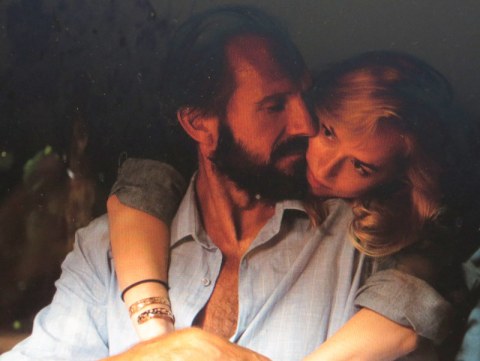
Ralph Fiennes and Dakota Johnson in ‘A Bigger Splash.’ Photo by Jack Engish, Twentieth Century Fox and Fox Searchlight.
Could you talk about what you might have learned from the role. If you met some music producers now, what questions would you ask as a result of the film?
My brother’s a music producer. I sat with him in recording studios and I’ve worked with music producers on films I’ve directed. I’ve seen music producers guide musicians with a language I don’t know, but I can see how they are shaping musicians. And when I was directing these two films, I was able to say, though I’ve not much musical or technical knowledge, I would be able to say, “Can it be more like this?” And they would understand what I was trying to say and they would have the skills to say, “No we need to do this or play that on a lower key, and don’t come in too quick on that.”
So I sort of got a sense of what that would involve. And I was reading these books about The Rolling Stones that were helpful background reading. One was about Keith Richards’ life and the other was a book called The True Stories of The Rolling Stones by an American journalist on the Altamont Tour. He was present at the Muscle Shoals’ recording of “Sticky Fingers” and he was there to hear “Wild Horses” being recorded and put down. That was very useful to connect my own little, tiny experience being in recording studios to understand, you know, how musicians go on and on and on playing, and have breaks, have a row and suddenly the magic is there. Or the producer says, “Try doing this,” or “Try playing in that key.” And I thought that’s what Harry’s really good at. Sadly, the film doesn’t show this. But it helped me to know it (Ralph laughs).
Did you collaborate with Mick Jagger?
No, no I didn’t. I understood that the material was sent to them, meaning their representatives. And they knew about it and we got notes on the story. And they were happy for us to, as it were, incorporate the story for Harry. But it was based on a true story of a producer’s. The name I can’t remember right now, but it is a true story. This producer did say, “Try playing the percussion on the trash can in the recording in Dublin for Voodoo Lounge.”

Poster of ‘A Bigger Splash,’ courtesy of the film. Photo by Carole Di Tosti, taken NYC press day at the Park Hyatt.
Did you and Tilda work out the characters’ history? It’s such a long and toxic tumultuous relationship.
We talked about it a bit. But I don’t remember talking about it at huge length. We would share our own sense of what our backstory was. But it was quite clear from the script what it was. I think we did talk about it, but it just fell into place quite quickly. All four of us quite quickly seemed to be playing who we are. Luca is not one, and I think he would agree with me, he’s not one given to exhaustive analysis and discussion. There are directors who will pick away in detail at the backstory. I think Luca just got his cast and wants to let the energy unfold between them and doesn’t want to interfere too much.
How do you see your relationship with Penelope? Is he using her to get back on Marianne? There is a lot of ambiguity between them but at the same time there is a good dynamic also.
He believes, as I imagined it, that this is his daughter as a result of an affair or a fling he had 18 years before. I’m not sure whether Harry knows her real age. I imagine the daughter said to her mother, “I want to meet my father.” She had been a model or whatever…Penelope/Dakota had her backstory. Anyway, the mother rings up, we have a daughter of 18 years, or maybe he knows about the daughter but he’s never met her. It moves to “Our daughter wants to meet you.” So he says, “Cool. Fine. Let’s meet.” He’s been with Penelope the last month or so traveling around Italy. And I think he’s enjoying the experience. Harry is someone who’s open to what that experience will be and who she is. He hasn’t pushed her away or closed her off. And I think he’s gotten to like her, finds her interesting. She challenges him and he says in a scene…of course she’s sexy, a young, sexy girl and he can deal with that.
I don’t think he’s tried anything transgressive or incestuous with her, but I think because they’ve never experienced each other as a child or baby or young adolescent, I think they enjoy this slightly flirty vibe that they have. But I don’t think it’s fucked up in any way. I think, as you say, it’s ambivalent. Dakota and I seemed to find it quickly whatever this thing is. She’ll sing “Unforgettable” with him and she’ll enjoy the vibe of sort of flirtatious proximity. I don’t think that Harry’s trying to get into bed with her. Not at all. Not remotely. In fact I think he likes to feel that energy, but he will never cross that line. I think he’s actually quite protective of her.
Any more directing for you?
Yeah. I’m developing some screenplays to direct, but it won’t be for a while.
Any chance you’ll come to Broadway? I’ve seen everything you’ve done there and loved it.
Well, I was hoping to come to Broadway this autumn with The Masterbuilder.
Great.
But actually the producers…well, it’s a sellout in London.
Of course. I’ve read that it is.
I don’t know. I think it will come here in the next couple of years.
I hope so.
This article first appeared on Blogcritics.
 CAROLE DI TOSTI