Blog Archives
‘The Saviour,’ a Tour de Force at the Irish Repertory Theatre
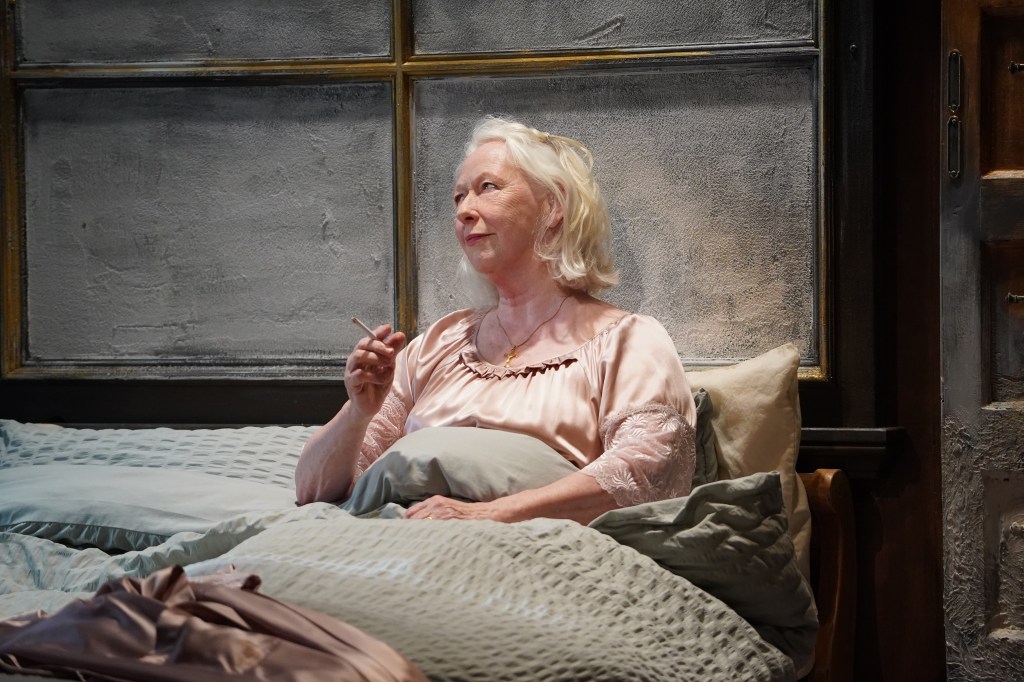
The Saviour, a powerful, ironic character expose, written by Deirdre Kinahan and directed by Louise Lowe, presents the wonderful Marie Mullen in a performance which strikes at the heart of Catholicism, paternalistic culture and hypocrisy. The World Premiere by Landmark Production is being performed on the Francis J. Greenburger Mainstage at the Irish Repertory Theatre until August 13.
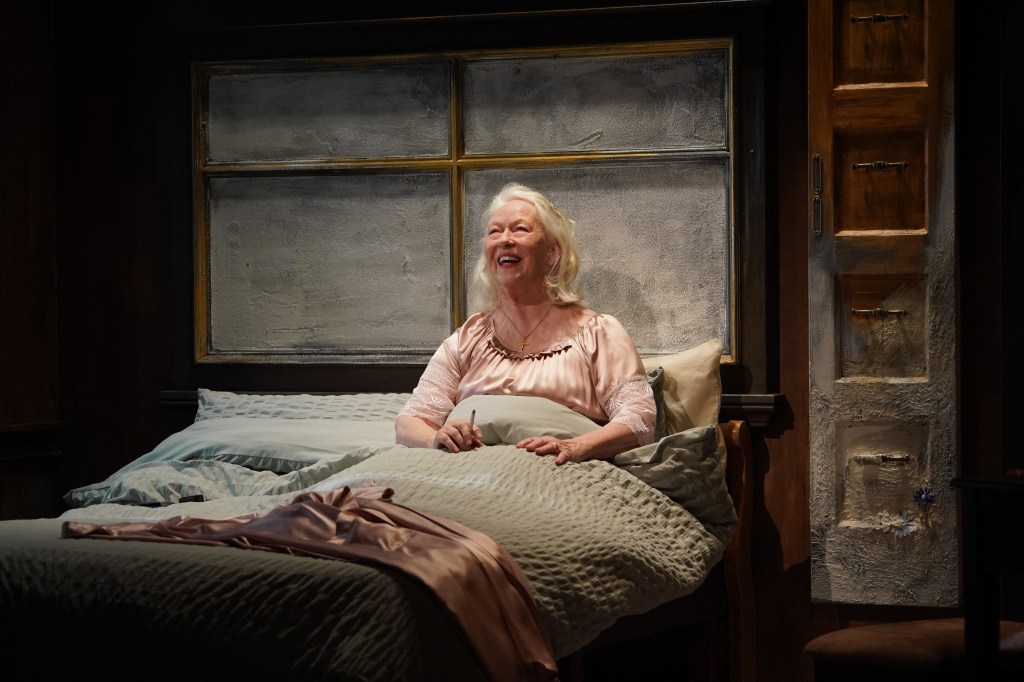
Kinahan begins her 70 minute play as Marie Mullen’s Máire resides in bed enjoying a “fag” (cigarette) and laughing to herself at what has just transpired with Martin. She expresses her enthusiasm and joy to her great confidante Jesus, whom she addresses for half of the play.
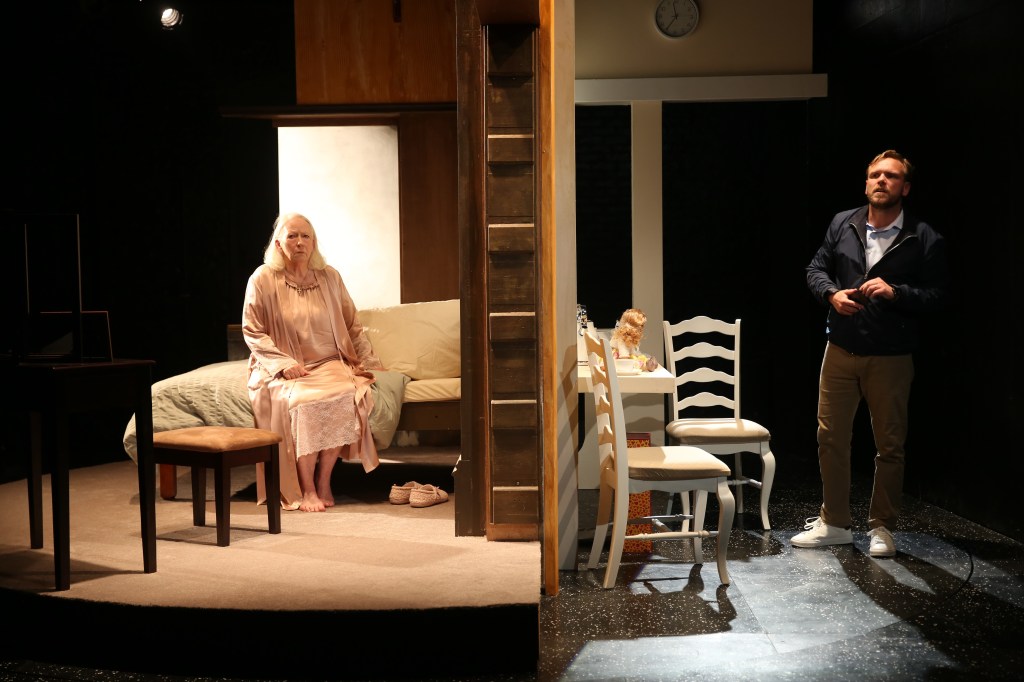
The audience is shocked into laughter at the unexpected subject matter of her descriptions. Máire (thanks to Joan O’Clery’ costume design), is the opposite of a woman that others might describe as a “dolled-up floozy,” generous with her affections and body. The protagonist is a senior citizen. Her environs and bedroom are neither opulent nor well-appointed thanks to Ciarán Bagnall’s scenic and lighting design. The sets on a revolving platform of bedroom and kitchen are a clue to her financial situation.
In other words, Máire is not the type to be taken advantage of for her money or what she has which looks to be the stylized bare minimum of possessions. Thus, she must be taken at her word, or she is completely fantasizing the circumstance with Martin, who, like Jesus, remains invisible. She is an unreliable narrator, so we are left guessing about the truth of the present circumstance she describes.
Louise Lowe’s acute direction shepherds’ Mullen’s fabulous performance as Máire to lead the audience in wonder, enthralled in the grip of hearing about Máire’s relationship with Martin as she discusses it with Jesus.
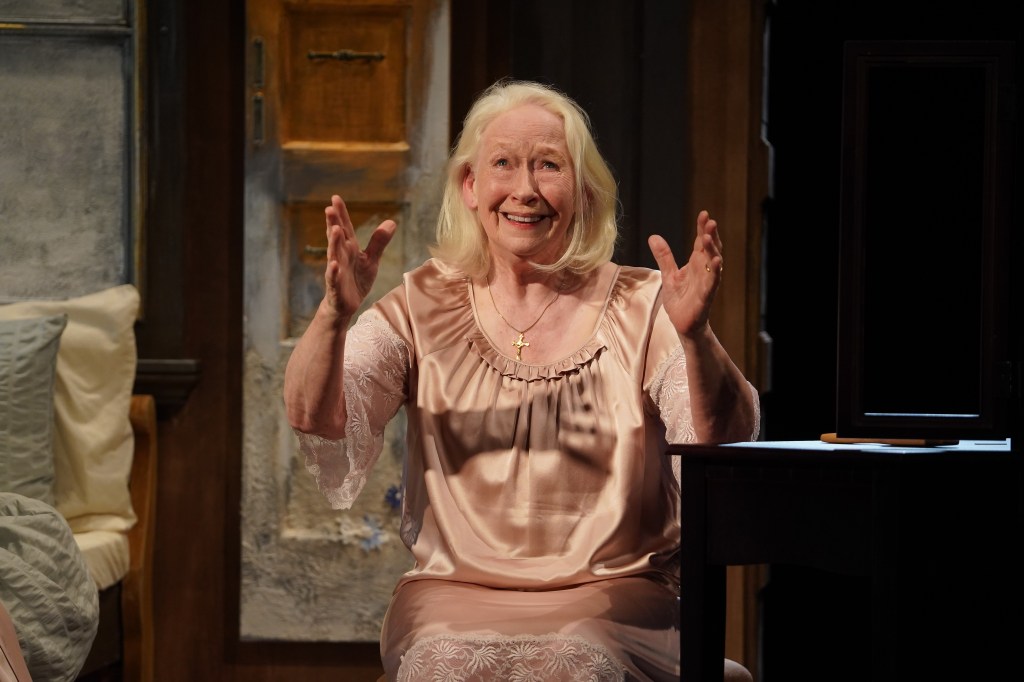
As Máire waits for Martin to come upstairs with her coffee, she glories that it is her birthday and she celebrated a wonderful evening with Martin who shopped and cooked for her and appreciates her more than her husband who died years before. Indeed, Martin even appreciates her more than her children, who are now grown and have children of their own. She reviews the circumstances of her life with Jesus in light of her relationship with Martin. She believes that her relationship with “the saviour” is somehow in concert with her Godly interactions with Martin, because he prays, believes in God, goes to church and wouldn’t be with her if Jesus didn’t accept him.
Kinahan’s characterization of Máire, effected through Mullen’s interpretation, is completely believable, especially when she speaks to Jesus as if He is her “all in all.”
As the monologue continues, we question the reality of what Máire shares with Jesus with regard to Martin who is shadowy and mysterious. Is it true or isn’t it? However, we do accept her discussion with Jesus about her devastating upbringing. This includes the death of her mother, and her father’s abandonment. He left her with the nuns where she is abused and made to work in the oppressive, hot “laundry.”
The reference is perhaps to the Magdalene Laundries in Ireland, run by the nuns and Roman Catholic orders to give shelter to “fallen women” from poor backgrounds. To punish them with proper penance and hide their shame, parents sent them to these asylums which were secretive and oppressive. Exploiting the girls’ labor, they offered little emotional respite from condemnation. Sadly, the babies born out of wedlock were taken away from their birth mothers and adopted out by the nuns for donations.
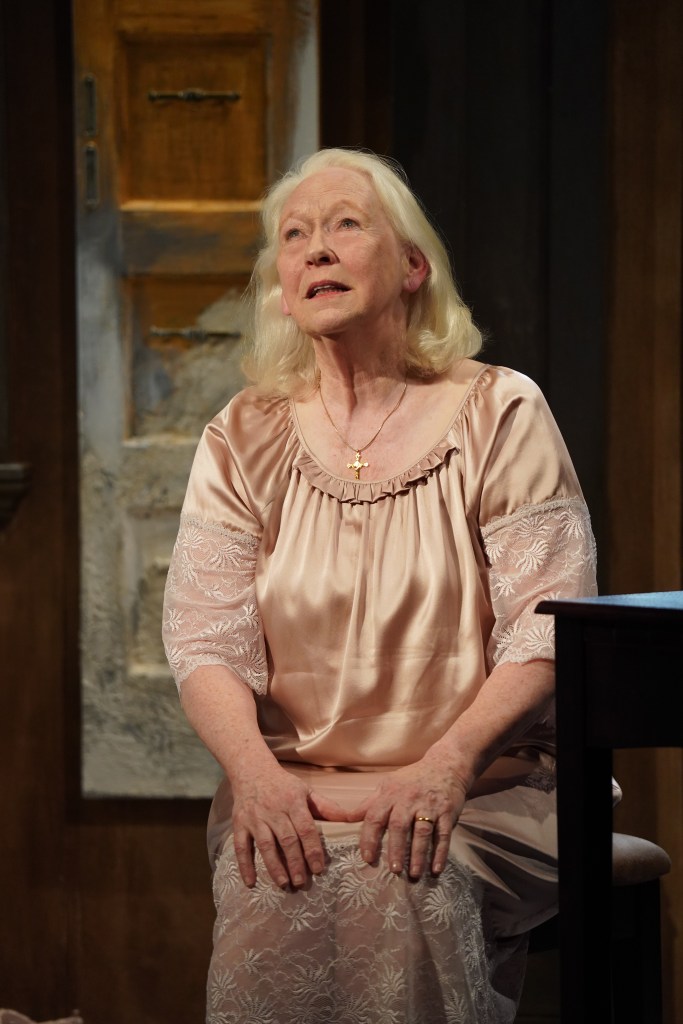
As in the case of Máire, orphaned girls were placed there so they could be properly raised by the goodly nuns. However, as Máire indicates, her situation was equally terrible, not because she “sinned,” but because poverty relegated her to a life of misery of hellish toil and fear with the nuns at a young age.
It is during this discussion of the laundry, whose atmosphere and terror is effected by Aoife Kavanagh’s crushing sound design (as Máire recalls her past), that she reveals her only salvation was her faith in Jesus. She refers to “her loving Jesus” as not the “nuns’, Jesus.” Her Jesus helps her survive the nuns’ cruelty, condemnation and judgment until she manages to free herself with a job. And it is then she meets her husband with whom she has a loving relationship and family.
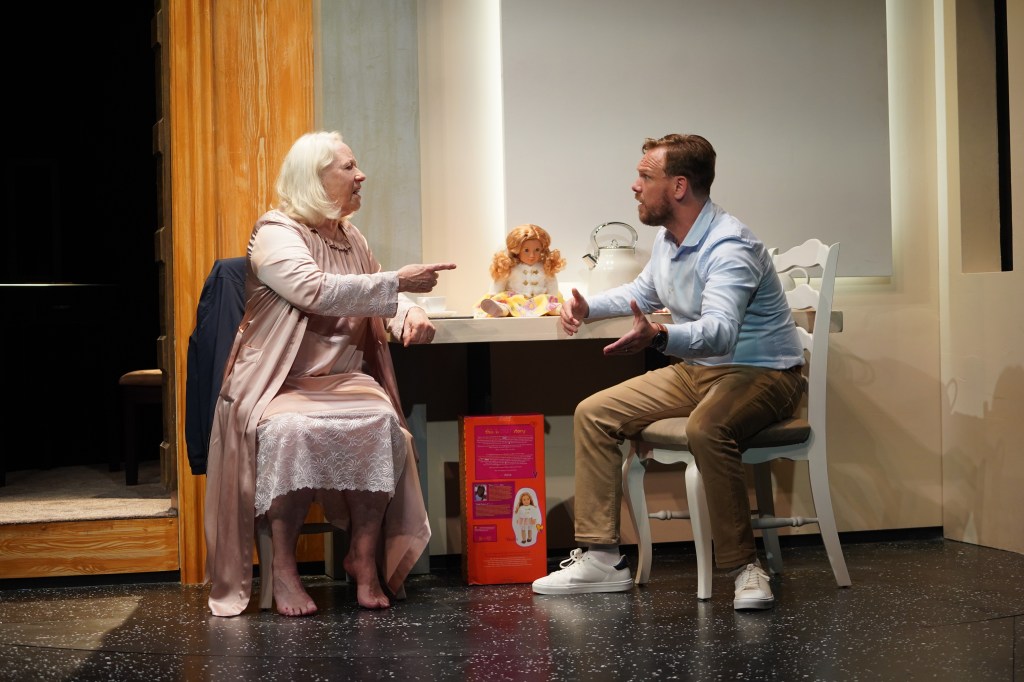
Marie Mullen’s is absolutely terrific in animating Máire and establishing Jesus as a “living” being with whom she shares the most intimate of secrets. Mullen’s authenticity is spot-on. We accept how Jesus affirms Máire’s life to receive this new beginning in her relationship with Martin. Though there doesn’t appear to be a conflict, the dramatic dynamic unfolds in earnest when son Mel (the superb Jamie O’Neill) appears. He brings her a present (a doll which has symbolic significance), to celebrate her birthday.
Her relationship with Mel seems loving enough, until Máire’s behavior references Martin’s visit. It is then that they make statements which explode with revelation and meaning in a myriad of emotions including anger, torment and hate. Both mother and son hurt one another. Their comments are severe. No apologies can be made to salve the wounds. We question where is forgiveness? Where is Jesus? Where is love? All appears to be confusion, fear and obfuscation.
Kinahan’s dialogue cleverly builds as Mel and Máire turn to the undercurrents of the past. Clearly, we understand the impact the church has had upon them. After Mel leaves, Máire must grapple with what the truths may be and either confront and accept them, or reject them finding justifications. Ironically, this leaves the audience in uncertainty with more questions which are never answered.
Kinahan’s suspenseful events beautifully build toward the high point at the conclusion. The mesmerizing play is directed and acted to perfection. Thematically, the characters’ acceptance of lies as truth and their ability to be duped by “isms,” philosophies and trends is incredibly current. Mel uses the truth to bludgeon his mother which appears vengeful. On the other hand, Máire selects which truths to believe and which to reject, hypocritically.
Both son and mother are flawed. Both need redemption and love from each other. Both have been caught in a web of religion, either rejecting/rebelling against it, or embracing it but not in the fullness of its meaning. As a result, caught up in their own agendas, they cannot communicate to use the very tenets of faith that are supposed to heal, bring peace and redeem. This is a terrible, magnificent irony where Jesus is called upon, but never arrives to heal and mend the differences. Additional work must be done for that to occur.
Unfortunately, this is a story visited again and again in religious households. It is thematically universal. Kinahan, Lowe, the actors and creatives have expressively highlighted the conundrums of faith, hypocrisy, forgiveness, spiritual truth and condemnation in this amazing and unforgettable production. It is a must-see.
For tickets and times go to their website https://irishrep.org/show/2022-2023-season/the-saviour/
Hugh Jackman’s Indelible, Winning Con in ‘The Music Man,’ Just Unbeatable!’
Historically, America is the land of con artists and showmen. Do you know the difference? As a relatable example there is David Hannum who in the 1850s bought the “Cardiff Giant,” a stone statue he unwittingly believed to be real (the giant fake was made in Iowa). As did its previous owner, Hannum charged admission for viewings. When P.T. Barnum (Hugh Jackman portrayed Barnum in The Greatest Showman) couldn’t purchase the Cardiff Giant for $50,000, he made his own plaster statue, called Hannum’s statue the fake, and charged more money, advertising his as the “real” one. Hannum sued Barnum and referring to Barnum’s patrons said, “There’s a sucker born every minute,” not realizing he, too, had been duped. The suit failed when the originator of the hoax “came clean.” Interestingly, all three entrepreneurs probably kept the money “they earned” providing a thrilling show. In keeping with the great cons of America, history is silent about whether patrons got their money back.
This exploration of that type of con is at the core of Meredith Willson’s The Music Man, which I’ve come to appreciate on another level with this revival at the Wintergarden Theatre, starring Hugh Jackman and Sutton Foster. Along with these romantic leads are Shuler Hensley, Jefferson Mays, Jayne Houdyshell and Marie Mullen. All are Tony Award winners. All give humorous, memorable performances in this fanciful, exuberant, profoundly conceived production (directed by Jerry Zaks and choreographed by Warren Carlyle), about small town America, its bucolic, “nothing is happening here” townsfolk, and the burgeoning love between two needy, flawed individuals, who grasp at hope in each other.
With book, music and lyrics by Meredith Willson and story by Meredith Willson and Franklin Lacey, the great con is spun by a magic-making, uber-talented, artiste extraordinaire that all fall in love with by the conclusion (including the audience). That is all except non-believer, malcontent salesman Charlie Cowell (the excellent, hyper-caustic Remy Auberjonois who was in Death of a Salesman). He’s the “villain” who seeks vengeance to expose Hill as a wicked, flim-flam man.
Hugh Jackman is spot-on in his modern interpretation of the Professor Henry Hill “brand” of “music man.” He and Zaks really get this character, so that Jackman makes it his own, as he exudes the energy-packed, brilliant, larger-than-life, loving individual that you want to stay with, wherever he takes you. After seeing his performance, I believe in pied pipers, who don’t need music to make you theirs.
The criticism that he is not edgy is questionable. If Jackman’s Hill were sinister, few would believe his sincerity in a small town that prides itself on suspicion and being “Iowa Stubborn.” Would the women be so taken with his graceful, smooth, charmingly flirtatious manner? He is a swan among the ungainly, quacking mallards and especially his nemesis, the punchy, exasperated, malaproping Mayor Shinn (the always hysterical and exceptional Jefferson Mays), who gaslights the town with his own con. That this genius craftsman of BS has an irresistible delivery reveals Jackman enjoying expanding the graceful Professor in pure entertainment, with every precious breath and every savvy movement he expends, as he inhabits his refreshing version of Professor Harold Hill for the ages.

Hill’s seductive, adorable, spirited demeanor is dangerously addictive. The happy-go-lucky showman is all about getting others to believe in and enjoy themselves. From that elixir, there is no safe return and the crash, if there is one, is emotionally devastating. How Zaks, Jackman, the cast and creative team spin this rendering is solid and logical throughout, giving this extraordinary revival a different feel, understanding and vision, that should not be underestimated or ignored.
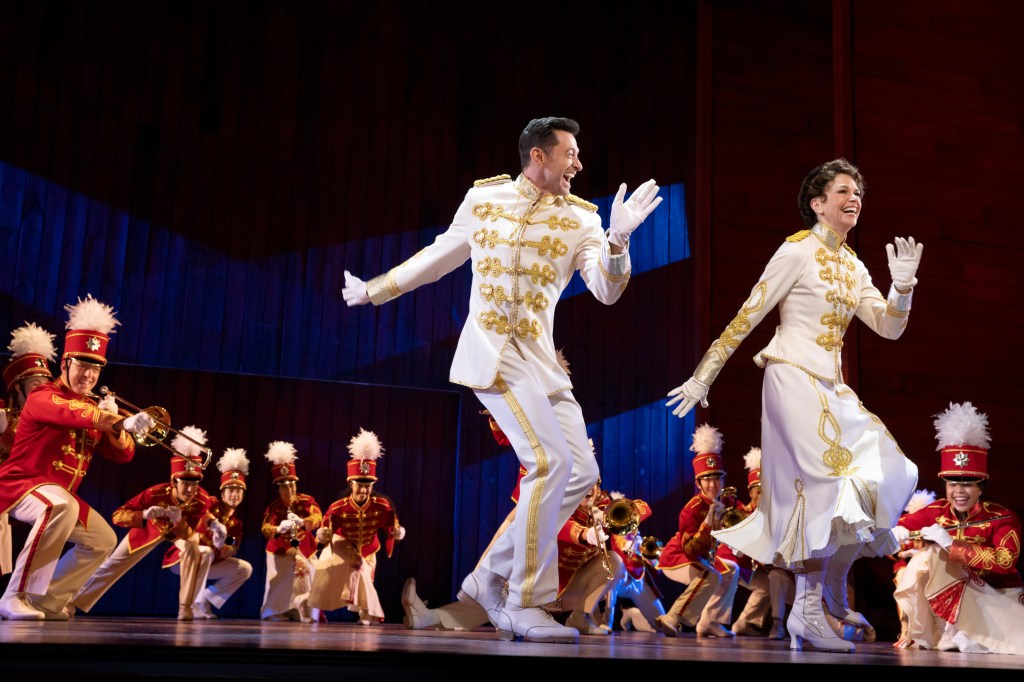
Throughout the dance numbers, which are beautifully conceived with wit and substance, Jackman’s lead is ebullient, light, lithe. This is especially so during his convincing, playful seduction in the number “Marian the Librarian” (Warrent Carlyle’s ballet in soft shoe tempo is just great). Jackman’s sensual, boyish suppleness contrasted with Sutton Foster’s stiff reticence in Marian counterpoint are superb together.
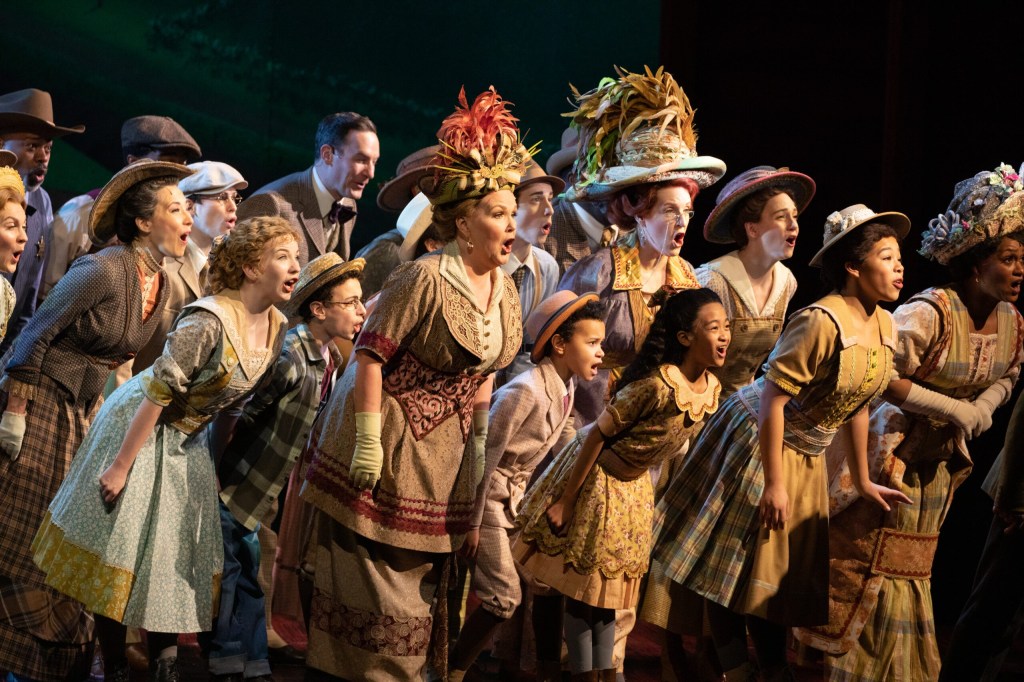
For the song identifying the Iowan’s walled stronghold against strangers (“Iowa Stubborn”), Hill’s great challenge, Zaks stages River City citizens huddled together in a circular clump with stern looks and unsmiling determination. Initially, with Hill they pride themselves on being cold steel like Marian, who is even more icy remote than they are. However, because of Charlie Cowell’s challenge, that Iowa territory is impossible for salesmen, Hill takes the bait and rises to the occasion. He plies his delightful winsomeness with enough sincerity and great good will to surreptitiously penetrate their pride.
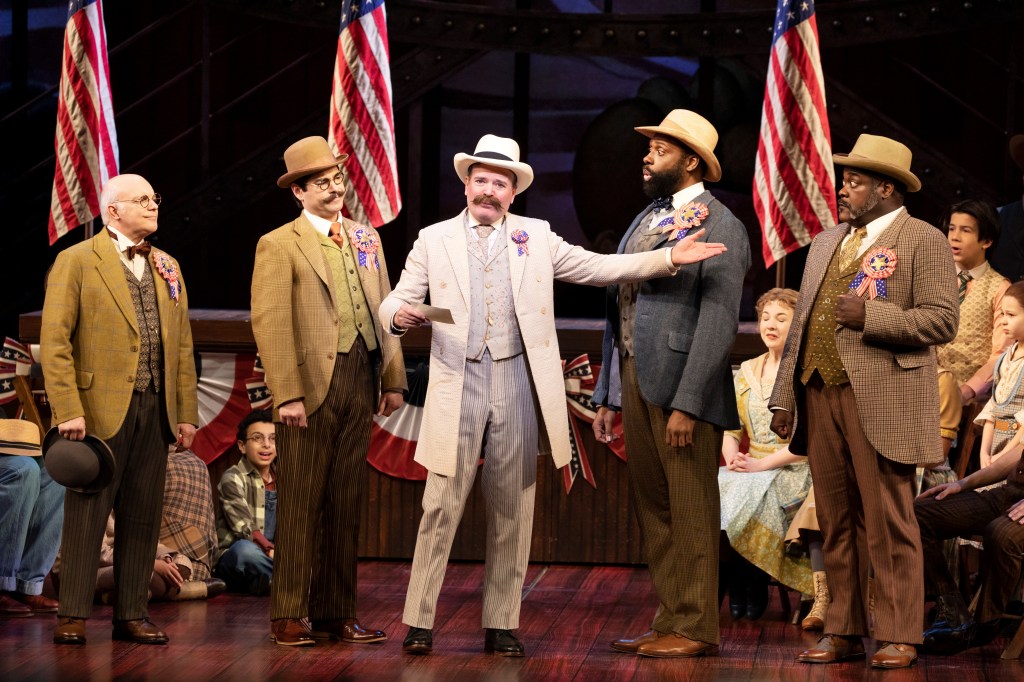
Not only are the townsfolk splintered from their stubborn resolve because of his contagious enthusiasm, his youthfulness retains a sociability that is able to connect with young and old. Indeed, Hill offers them something that no one else who has come to their town has ever offered: happiness, hope, fantasy, the power to believe; to think something is so and it becomes so (the “Think System” re-framed from “the power of positive thinking”). Jackman’s Hill is a practiced master at human nature-buffeted by life’s heart-breaks, that create the foundation in the soul, that hungers to believe in something or someone. Of course, he is a master at this, because he, first and foremost, is starving, a clue to this Hill portrayal, upon which turns the arc of development and all the character interactions. It is also the theme of “Sadder But Wiser Girl,” that he sings in knowing “wisdom” with buddy Marcellus Washburn (the excellent Shuler Hensley).
The brilliance of this production is that Hill’s charismatic delivery of the dangerous idea is palpable, adorable and expansive. As apparently unrealistic as Hill’s disarming positivity is, it is like manna from heaven for these homely folks, who cannot resist just a taste. And Jackman’s Hill enjoys spoon feeding it to them like sugar, until they are hooked. Interestingly, he also is hooked…on their joyous response to him.
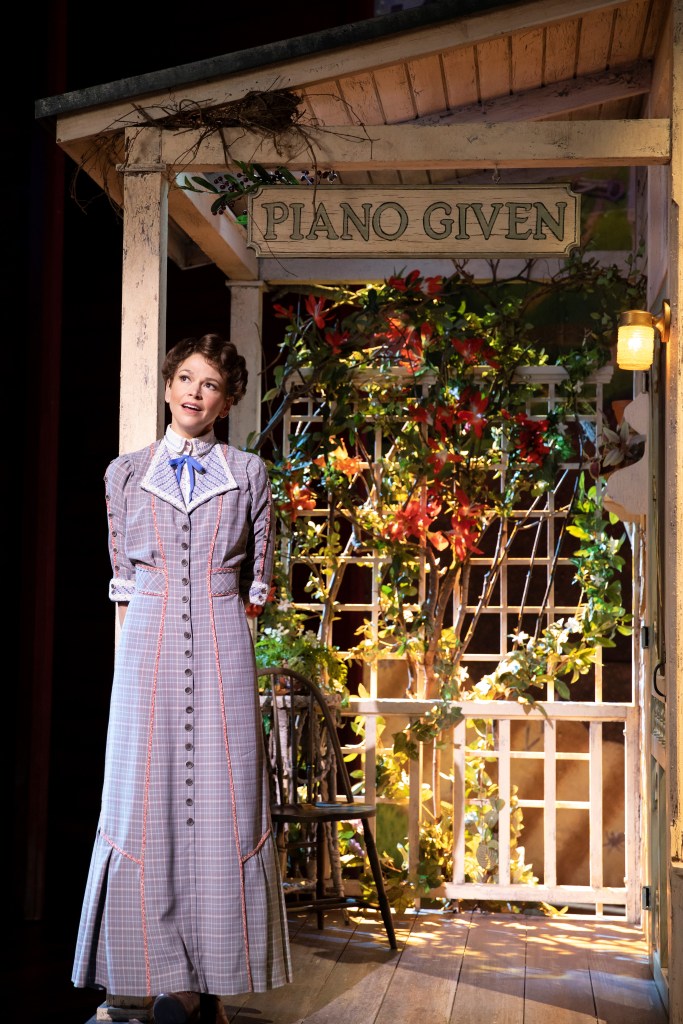
In his backdoor discussions with his comrade in arms, the affable and in love Marcellus, the winning Professor Hill has no disdain or ridicule for those he mesmerizes. He enjoys the challenge (more in the style of 110 in the Shade’s rainmaker Bill Starbuck), of instilling confidence in others and, in return, receiving what he needs, enjoyment, fun, affirmation. He is the antithesis of the bombastic, arrogant traveling salesman loudmouths like Charlie Cowell and the others in the rhythmically pounding opening train number “Rock Island.” (another superb staging by Zaks, et. al.)
Willson reveals the vital difference between them and Hill, as they ride the rails and complain about how hard their job is because of encroaching progress. What an incredible opening scene that gives the set up (costumes, staging, sets, music, sound, tone, tenor). Challenged by their comments that Iowa is an impossible territory, Hill shows himself up to the task, gets off the train, turns to the audience and presents Professor Harold Hill. Just looking at Jackman’s unabashed, open smile and shining spirit, we believe as Mrs. Paroo does, that he can do nearly anything, even if it is getting her very shy son Winthrop to speak, which he does, as Winthrop flows forth in a burst of excitement and emotion that never stops afterward in “Wells Fargo Wagon.”

His product, unlike Charley Cowell’s and the others, is intangible. Thus, taking folks’ money is done quickly, painlessly for much more is being given, including a loving manner and wish to spread joy. In this version of Hill it is his endearing vulnerability to love that Jackman makes believable in his deepening interactions with Marian, whose loving support he has, before the two of them realize it. Jackman and Foster construct this surprising discovery beautifully in the Footbridge scene (“Till There Was You,” and the melding of the relationship as they conjoin their singing of the double reprise “Goodnight My Someone” and “Seventy-Six Trombones”).
The town’s seduction is inevitable after “Ya Got Trouble” and “Seventy-Six Trombones,” an incredible dance number (and pantomimed instrumentation), that Jackman and the cast just kill. River City has “swallowed his line” (the fishing metaphor is used throughout), as does young Winthrop (Benjamin Pajak in a show stealing performance), who is thrilled when his mother, like the other townspeople, signs on for instruments, uniforms and instruction books to form the showy band Hill promises for the absolute thrill of it. That they must learn to play is subtly whisked off until “later,” the “will-o-the-wisp” magic Jackman’s Hill seamlessly performs.

Hill is gloriously, attractively spell-binding. He draws the town to him bringing togetherness and good will, that goes a long way to diffuse the backbiting of the women against Marian’s standoffishness (“Pick-a-Little, Talk-a-Little”). He helps to mend the ladies’ divisiveness, which further draws Marian to them and himself. Humorously, he unifies feuding officials in the exquisite harmony of a barbershop quartet, that they can’t seem to get enough of, once he starts them off on the right chords (“Sincere,” “Goodnight Ladies,” “Lida Rose”). One by one each potentially thorny group falls under Hill’s flirtatious, delectable, gentle power and inspirational artistic encouragement. Talk about soft power flying under the radar, he hits folks’ hearts for a bullseye every time.
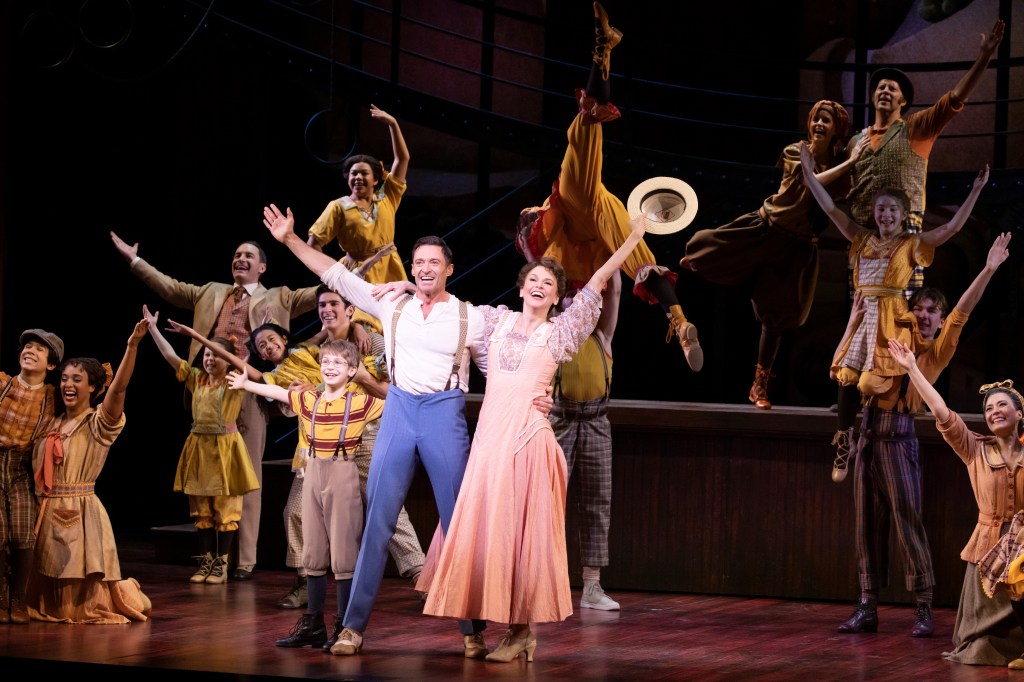
In beautifully staged moments by Zaks, we see Hill’s influence on the Mayor’s wife, Eulalie Shinn and her friends, who create dance numbers and other entertainments. Jayne Houdyshell as Shinn is marvelous and LOL in her dancing and primping poses, after Hill’s maximum attentions. The costuming for these scenes is exceptional. Throughout, the costumes are a take-off of 1912 fashion but with the variety of patterns, in some scenes earthen tones, other scenes fun hats, shoes and accoutrements, thanks to Santo Loquasto, who also did the scenic design.
Marian’s costumes are straight-laced without frills by comparison; her hair (Luc Verschueren for Campbell Young Associates), like the other ladies is in fashion, an up-sweep like her mother’s, Mrs. Paroo (the wonderful Maureen Mullen). Attention in this detailed crafting reveals Marian’s restraint, her career and character, providing the subtext and interesting contrast to the other open-handed, more extravagantly dressed woman. Eulalie and her hens are encouraged to believe in themselves in Hill’s sincere admiration as they ooze his charm back at him and titter. In the case of Marian’s response to Hill’s starlight, she moves from grimace to smile to grin.

Importantly, the women are drawn into Hill’s net, however, it’s mutual. Jackman’s Hill is having a rollicking time becoming enamored of them. This portrayal makes complete sense. Because he is lured by their, acceptance and trust in mutual feeling, he is unable to escape when the love net closes around him. Jackman and Zaks have broadened that net to include the townspeople’s acceptance and love as well as Marian’s, her mother’s and Winthrop’s. Zaks shepherds the actors to forge that budding love and trust with specificity and feeling each time they share a scene (i.e. the fishing scene with Hill and Winthrop).
Fear has no place in Hill’s magical world. So when it attempts to enter in the form of Mayor Shinn’s grave doubts about Hill (though Shinn’s motives are financially suspect), he is misled by Marian and his officials, who by this point in time, understand Hill is bringing new life to the community. Thus, they allow themselves to be distracted away from Shinn’s mission to verify Hill’s identity. It’s apparent that with the exception of Mayor Shinn, whose agenda Hill upends by dunning his new pool table, the town’s spirited happiness is heartfelt. One wonders what their lives were like before his enchantments blinded them? Or did he give them a new way of seeing? And what was Hill’s life like traveling one step ahead of the sheriff before he hit River City, an unintentional stop on his route to anywhere U.S.A.?
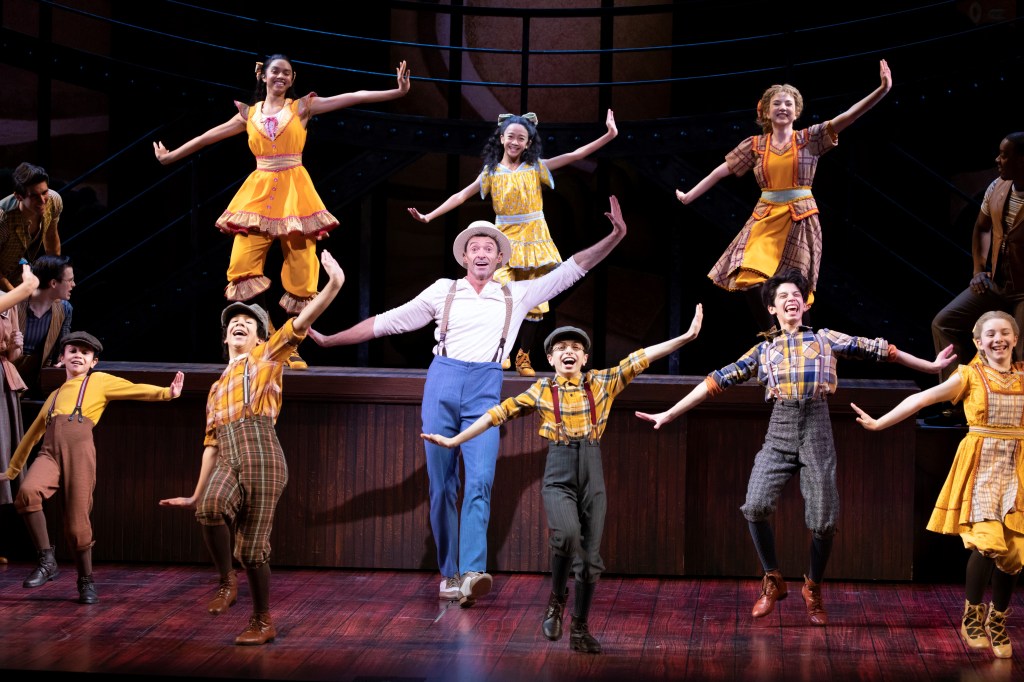
Clues are revealed in the large set backdrops of the Grant Wood style paintings (Regionalism, note the painting “American Gothic”), that are at once simplistic and complicated in their being two-dimensional, brimming with sub-text. These brilliantly reveal the time, place and characters with details of tone, tenor and color. This is especially so against the green rolling hills Grant Wood backdrop, where the tiny, animated, red, Wells Fargo Wagon races down a hill in the distance as it approaches River City. The audience gasped in awe at the ingenious contrivance. Then, they gasped even louder as the “larger-than-life” Wells Fargo Wagon materialized on stage. Pulled by a well-groomed, shiny-coated, smallish-looking “Clydesdale,” Hill beamed atop the wagon as it stopped, the cast sang “The Wells Fargo Wagon” exuberantly, and Jackman rhythmically tossed out the brown, paper wrapped “instruments.” Poignantly, Pajak’s Winthrop sings, lisp and all, completing the effect. Pure dynamite!
This is the show’s “Singing in the Rain,” moment. It is the still point in time that clarifies and represents the whole; action, event, music, symbolism, lighting and spectacle reveal the theme and its significance to the characters and audience. It is here that we understand the treasure that Hill brings, the heightened glory he coalesces in a happening that the townspeople and a now confident Winthrop, (whom we fall in love with along with Hill), will never forget. And for that reason, Marian destroys the evidence that can sink Hill. It’s a stirring, fabulous end to Act I.

By the beginning of Act II, Hill’s invested emotional interest in Marian is revealed in “Shipoopi,” the silly-grand singing and dance number with the entire cast, and colorful, striking costumes, led by Marcellus, who reveals his contentment with his wife. As friend and confidante Marcellus is also Hill’s foil. Living a fulfilled life in a small town, his life contrasts with the emptiness of Hill’s tired wanderings. This is underscored through Hill’s previous interactions with Marcellus, in their fine duet “The Sadder But Wiser Girl,” and brief discussion of his former inability to settle down which Marcellus encourages him to do in River City because he can introduce him to a lovely girl. However, Hill has already met a lovely girl, who rejects him, but as we note at the top of the musical, Hill enjoys a challenge. Jackman nails Hill’s bravado with class, nuance and balance, never over-doing it. He will have Marian and she will have him.
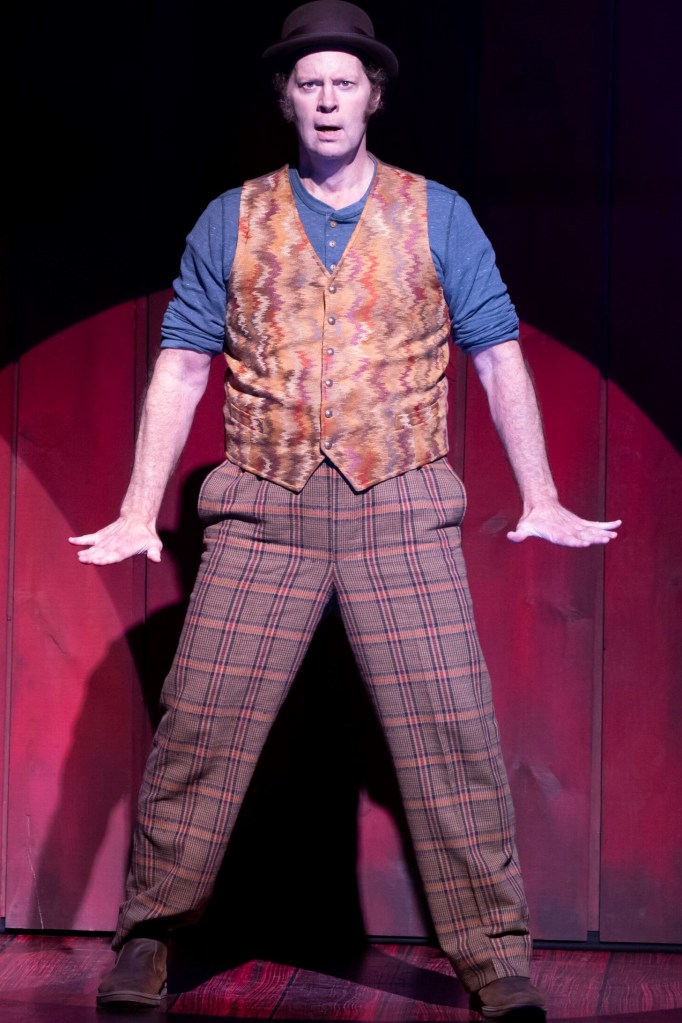
Sutton Foster’s Marian is the challenge Hill finds stimulating. She falls in love, her hard-heart melting in attenuating stages: after Mother Paroo’s pressure in “If You don’t Mind My Saying So,” her own internal pressure in “Goodnight, My Someone” and “My White Knight,” in Hill’s sweetly, gorgeous “bad-boy” pestering in, “Marian the Librarian,” and most importantly, after she sees Hill’s beloved influence on Winthrop (“Wells Fargo Wagon,” the fishing scene, “Gary Indiana”). As Marian, Foster’s change of heart toward Hill is superbly wrought by degrees; her stance and body gradually relaxing as they dance in “Shipoopi.” And the relationship Foster and Jackman forge in its progressive development toward love is believable and touching. By the time the scene with the kiss arrives, their bond is manifest; the long kiss, wistfully enjoyed by Jackman fans, brought faint and not so faint audience gasps; the longing and hunger in the characters dangerously apparent.
For love’s reality is an obstacle to his “safety” that Hill acknowledges (“Till There Was You” reprise). Charlie Cowell intends to provoke the town to scourge Hill with a “tar and feathering.” It is at this point that Marcellus’ injunction that Marian is doing the conning and Hill has to leave or be damned, resonates. But he can’t leave; he must face the music or rather, lack of it.
Foster shines as she attempts to gaslight sexual predator Auberjonois’ Cowell with flirting and a kiss. And in the realistic fight scene (one punch is always sufficient), between Cowell and Hill, the professor vindicates Marian’s reputation that Cowell besmirches. I love how Foster sexually presents herself to Cowell, breaking the third wall and eliciting the audience’s encouragement; she twits the scene for all its worth.
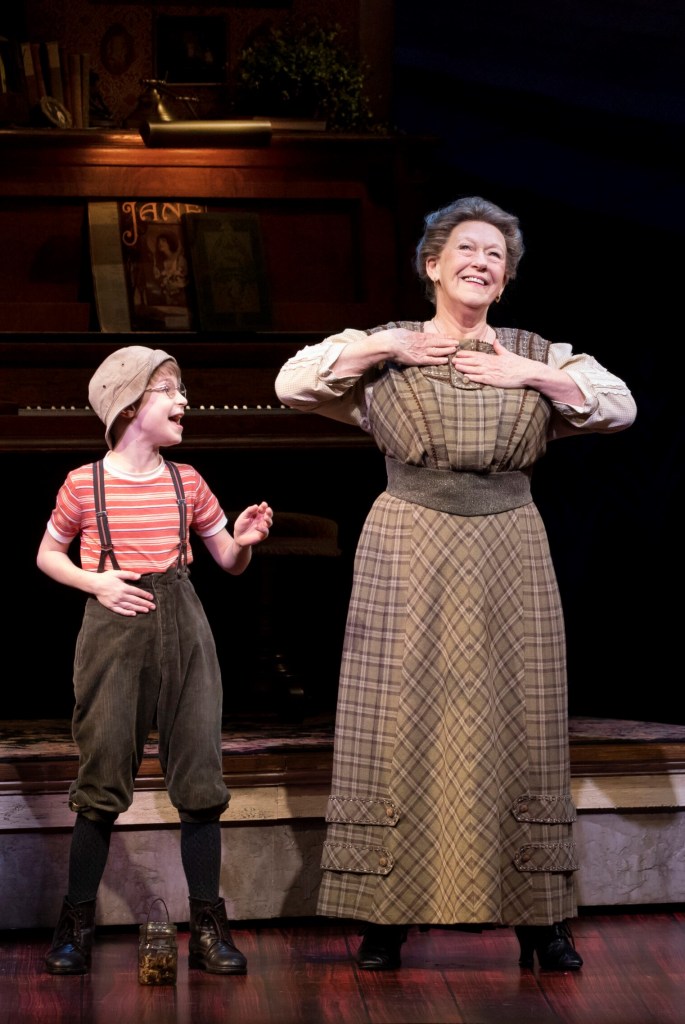
But the con is over. Humorously and ironically, Hill is a victim of Mother Paroo’s use of his “Think System.” And of course, his own need to be loved traps him. Thus, he admits the truth to an upset Winthrop, who forgives him as does Marian. Brother and sister encourage Hill to quickly escape, not realizing the music man wants to stay despite the jeopardy. The sacrifice of the three for each other is perfection. When Hill is arrested, Jackman’s emotional response in the scene is smashing, as is the drama created by Pajak, Auberjonois, Foster and the other cast members. The question remains. Will the town forgive Hill, as Marian and Winthrop have? Will they acknowledge that he has given them something more priceless than a boy’s band? Perception is everything.
In this revival the intentionally “un-dangerous,” genius, entrepreneur professor, like those entrepreneurs of the Cardiff Giant, created a daily thrill. Specifically, Hill’s music man encourages the town to launch out on a new road. It turns into their own growth and ultimate benefit in merging community, good will and love. In exchange for instruments and uniforms, he has bestowed the citizens with an ineffable gift (that Marian and Eulalie Shinn encourage the others to stand for). As Mayor Shin sees their unity and hears his son play, Hill’s “Think System” catches communal fire. The joy and warmth that Hill gave is returned; he is loved and forgiven. And Charlie Cowen leaves a sadder and unrepentant man.

In the end scene as the perception of the townsfolk moves from what is to what each parent thinks/imagines Hill’s orchestral direction to be with love, the miraculous occurs. Hill is redeemed as the band emerges in sound and sensory vision. Announcing the Finale, Winthrop/Pajak blows a vibrant, bold horn. The cast emerges in full band regalia, sings, plays and dances, with Foster and Jackman front and center, leading the charge. Dazzling fun, profoundly realized.
The Music Man is a spectacle that is incredibly rich with visual movement and vibrancy, striking hues and emotional musical grist brought together with sterling performances that are divine brush strokes. The story is a faceted jewel, the characters inhabited by these multi-talented acting greats are uniquely American. The sound/music delivery-technical and vocal is as fine as can be. I heard every word, the glorious harmonies, spun out rhythms and witty lyrics in the compelling choral numbers (“Rock Island,” “Ya Got Trouble,” Shipoopi,” “Pick-a-Little, Talk-a-Little,” “Marian the Librarian,” Seventy-Six Trombones”). What a pleasure, especially in the large musical numbers; this has not always been the case on Broadway (post-pandemic and certainly not pre-pandemic).
The Smithsonian Institution ranks The Music Man as one of the “great glories of American popular culture.” When it premiered on December 19, 1957, it was a smash hit that ran 1375 performances. It won five Tony Awards including Best Musical. The original cast album held the number one position on the
Billboard charts and stayed on the album charts for 245 weeks. The recording won the first-ever Grammy Award for Best Original Cast Album.
In this amazing revival all of the main actors are Tony Award winners. Sutton Foster is a two-time Tony Award winner. Hugh Jackman is a two-time Tony Award, Grammy Award, and Emmy Award-winning star. Director Jerry Zaks is a four-time Tony Award winner and Choreographer Warren Carlyle is a Tony Award winner. The creative team is equally sterling and award studded. It includes four-time Tony Award winner Santo Loquasto (Scenic & Costume Design), five-time Tony Award winner Brian MacDevitt (Lighting Design), Tony Award winner Scott Lehrer (Sound Design), Luc Verschueren for Campbell Young and Associates (Hair, Wigs, & Makeup Design), Tony Award winner Jonathan Tunick (Orchestrations), David Chase (Vocal and Dance Arrangements), and Patrick Vaccariello (Musical Director).
This production with this cast, director, choreographer and technical team will never happen again in your lifetime. Considering what the cast, crew and production team went through to present The Music Man opening night this February 10th, 2022, it has been a labor of love that underscores every dance step, every note played, every trill, every laugh by the actors, the musicians, everyone. It is a one-of-a-kind revival that is breathtaking. Do what you can to see it. I will go again if I can get tickets. Here is their website for arrangements. https://musicmanonbroadway.com/
 CAROLE DI TOSTI