Blog Archives
‘Ulster American’ Matthew Broderick Leads the Bang on Ensemble at Irish Repertory Theatre

With sardonic wit and dark farcical elements David Ireland’s Ulster American sends up the differences among Irish-American, left-wing British, and Northern Ireland’s Unionists’ views about identity politics. David Ireland also ridicules the hypocrisy of those who adhere to political correctness and equanimity when it serves their purpose, but when push comes to shove and the stakes are raised, they easily throw overboard their posturing to reveal ugly, ingrained prejudices not yet reconciled.
The play’s humor lands sometimes with subtly, other times with uproarious riot and full throttled mayhem in this wonderful production acutely, specifically directed by Ciaran O’Reilly. Ulster American runs at Irish Repertory Theatre through May 10, 2026.
Using theater as the medium to express his themes, Ireland begins with a simple “meeting of the minds,” among an actor, director and playwright. They join up to discuss the play which has been scheduled for its first rehearsal the following day. The individuals include Jim Conway, the lead actor (Matthew Broderick) of Irish ancestry from America. Conway has been cast for his talents and star power. The play’s British director (Max Baker), runs his own theater company that produces the play. Most importantly, the director has chosen a Northern Ireland female playwright (Geraldine Hughes) because her play is exceptional. He will present the play in London which is also where the director’s home conveniently is. Scenic designer Charlie Corcoran provides the comfortable environs where the characters discuss the play and where their true emotions explode.
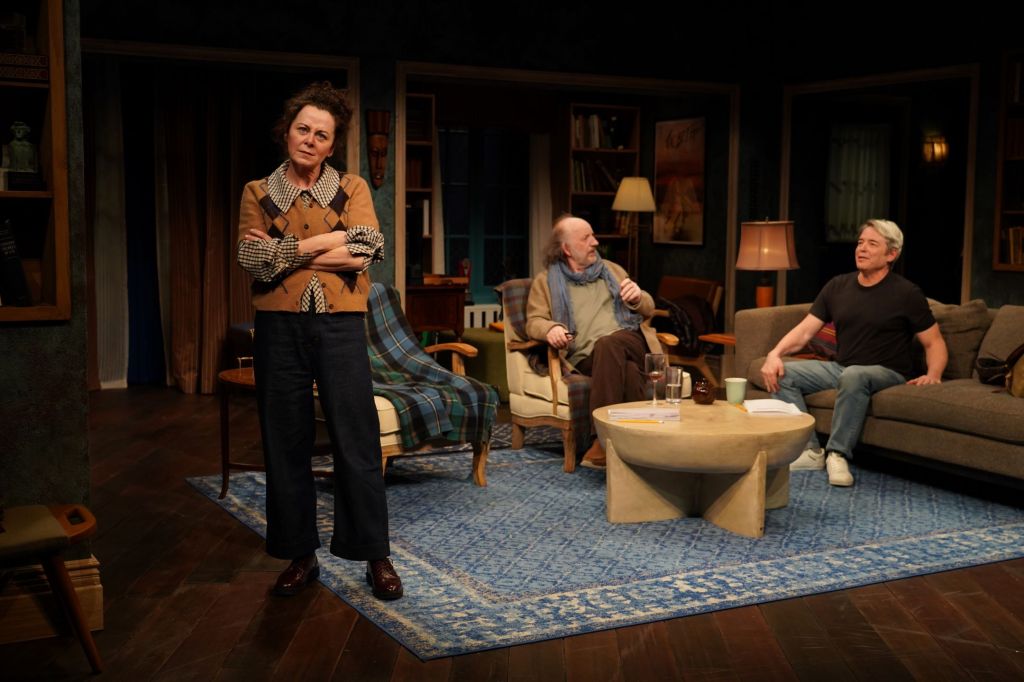
But what can go wrong among these artists who pride themselves on their craft and their humanity as creatives? Indeed! The diverse ethnic combination in itself indicates a potential powder keg for those in the know about the history of the Republic of Ireland, England, Northern Ireland, and America’s roots in all three. However, the beauty of David Ireland’s play and the talents of the dynamic cast manifest in the gradual reveal. Discovering who these people are and what each assumes about the others is the order of the day. If they achieve a consensus and understanding of the play, then they hope it will be a smash that takes them to Broadway and eventually to a friend of the actor’s doorstep, filmmaker Quentin Tarentino.
The fun is in watching the characters’ assumptions about each other and “their” play go up in flames, and seeing their shock when they realiz who everyone is as the smoke clears. How Ireland turns everything on its head after the opening scene is terrific theater. The actors deliver, hitting every bullseye Ireland sets up.
Matthew Broderick’s Irish American Jay Conway reveals the underlying pomposity of an Oscar-winning film star who attempts to evolve into a better person as he conquers his alcoholism with the help of his priest sponsor. Deft with the character’s initial humility, decency and humanity Broderick pings these notes with earnestness. Conway and amenable theater director Leigh Carver (Max Baker) become better acquainted discussing topics ranging from the use of the “N” word, to the importance of “women’s voices crying out,” to Irish history, and being of the patriarchy only as a necessary evil, though it demeans them.
Ironically, both disavow the patriarchy and uplift themselves as feminists. Though they dismiss the inherent power and status they’ve received from being males at the top of their game, in due season, the worm turns. We watch delighting in their hypocrisy as they riotously try to exert power over playwright Ruth Davenport by changing her play among other actions. Under the right conditions everyone’s truth emerges and deeper unconscious impulses explode to the surface.
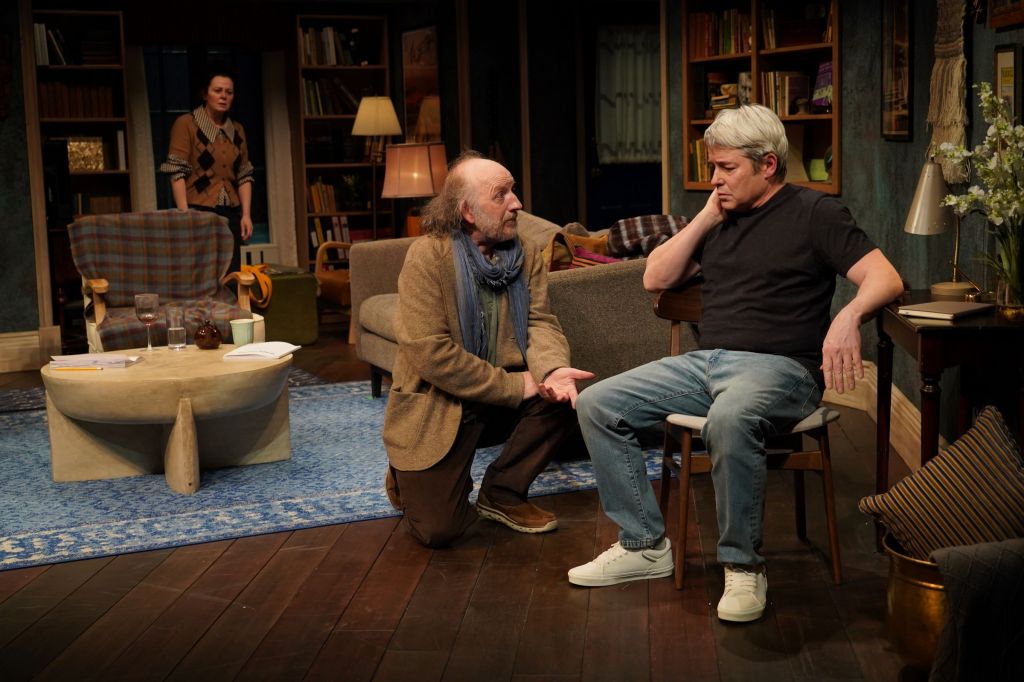
The men’s discussion topics conclude with a scene in a film early in Conway’s career which involved Jay’s character raping a woman at the direction of a terrorist who would bomb Minneapolis with a nuclear bomb if he didn’t do the deed. The studio cut the scene from the script because the women at the studio felt it was objectionable. However, Conway considered the scene thought provoking and thought about who he would rape to save the city, as hideous as it was.
Why Conway brings each of the topics up, especially the latter one, he ascribes to nervousness and being overly talkative. Perhaps, it is an attempt to deepen the feelings and get on solid footing with his director in a relationship which he believes should be close, intimate, like family. Nevertheless the question Conway innocently poses to the reticent, Brit Leigh alienates the director. Not only does he lie and pretends it’s OK when Conway confronts him, but he is so upset he spills to Hughes’ Ruth, though Conway told him in confidence. Eventually, this causes havoc for the actor, director and playwright, who swore that being true to oneself and being honest were paramount.
David Ireland has peppered the scene between the two men with platitudes and their agreed upon myths about themselves and each other which he gradually topples on the proving ground of working with Ruth after she arrives. She is late because of a car crash which lands her mother in hospital. After pleasantries and compliments the artists get to the “nitty gritty,” what the play is about.
We learn interesting bits of information along with Conway who asks what and why Ulster. The questions about Irish vs. British identity arise and unsettle Conway who expected something else. Ruth calls him on his misunderstanding. Did he really read and “get” what her characters were about? Does Conway really mean it is the best play he read in a decade and that it’s like Chekhov? And does Leigh mean the play is better than Harold Pinter? If one knows Pinter’s attitude about his own work, Leigh’s compliment that even Pinter would say her play is better than his is particularly ironic.
Of all of them Ruth holds her own and finds ways to fight back, using their own admissions against them. Remembering how they patted themselves on the back for their feminism, we note that white knights become black knights as they attempt to change the play and save their egos. For her part Ruth cleverly makes her demands and uses impeccable leverage to get what her play needs.
The specific details about how these webs are woven to catch the self-duplicitous are entertaining and surprising. The actors move from moment to moment and give nothing away, least of all the last five minutes until lights out. Great stuff.
Ulster American runs 1 hour 30 minutes with no intermission at Irish Repertory Theatre until May 10, 2026. https://irishrep.org/whats-on/ulster-american
‘Love Letters,’ by A.R. Gurney, Starring Matthew Broderick & Laura Benanti, The Conclusion of Irish Rep’s Letters Series.

The intimacy of listening to the voices of individuals’ emotional grist, concern and vibrance through letters written to a secret confidante is delicious and stirring in this time of 140 characters where “brevity is often not the soul of wit.” Irish Repertory Theatre’s “Letters Series” portrays the profound, intimate relationship between two individuals not “visible” to the naked eye of friends and relatives, and sometimes not gleaned by the characters themselves until it is too late.
The first series, now ended, starred Melissa Errico and David Staller in Jerome Kilty’s play Dear Liar. Kilty reconfigured his play from the decades-long epistolary relationship between George Bernard Shaw and the actress, Mrs. Patrick Campbell. The second part of the series highlights Matthew Broderick and Laura Benanti in A.R. Gurney’s (Pulitzer Prize finalist for Drama) Love Letters, directed by Ciarán O’Reilly. The staged reading of the drama with prodigious comedic elements runs with one intermission on the Irish Repertory Theatre’s Francis J. Greenburger Mainstage and concludes on the 9th of June.
Gurney’s two-act play explores the arc of the decades long relationship between friends and eventual lovers, Andrew Makepeace Ladd III (played by the inimitable Matthew Broderick) and Melissa Gardner (Laura Benanti is fresh, witty, humorous). These individuals write letters to each other over a span of decades (1937-1985), beginning in the second grade when Mrs. Gardner sends Andy an invitation to Melissa’s birthday party, and Andy responds to Melissa accepting the invitation.

From then on the the individuals share a profound written correspondence, though Melissa tells Andy to stop writing to her initially and at various times during their lives. At first, it is because she prefers pictures to words. Afterwards, it is because the words are so heartfelt and searingly directed to her, they are breathtaking to process and conflict with her estimation of Andy when they meet in person.
Oftentimes, reverse psychology is at work in Gurney’s pla,y where subtext and undercurrent in the dialogue between the characters takes precedence. The characters are confessional, argumentative, challenging, and interested in each other as friends, though there is always the sense that their concern for each other, authenticity and the bond formed through words reveal theirs is not an ordinary friendship, but one of the most sincere, transcendent and special that love might bring, even though it is not formalized in marriage.

Gurney intimates the possibility that their feelings have the potential for intimacy with their child-like innocent abandon (in 2nd grade), when Andy asks if Melissa will be his valentine, and Melissa agrees that she will, if she doesn’t have to kiss Andy. The verbal affection continues when we learn that Andy repeatedly asks Melissa to marry him. She gets him to stop, by telling him she will go with him to get the milk and cookies for the class, if he stops proposing to her. When Melissa employs her skills drawing, which she enjoys doing, she draws pictures of them without their bathing suits on, asks if he knows which one he is, then importunes him not to tell anyone about her drawing. She concludes by telling him she loves him.
This thrust and parry structurally mirrors the pattern of their relationship. Andy initiates his desire to be close to her. Melissa avoids responding, then eventually comes around to agree with him. Then, something intervenes and prevents them from actually becoming boyfriend and girlfriend or partners. When they finally try to extend their relationship beyond the intimacy of their writings and meet “live” for a weekend at the Harvard/Yale game, their date, including sexual coupling explodes in their faces. There is more “aliveness” in their writing, than in their ability to regain the soulfulness of their correspondence face to face. It will take other circumstances to transpire in Act II before any meaningful physical coupling occurs.

Ironically, despite their union and knowledge of each other that they’ve gleaned over the years and expressed in writing in the comfort of their surroundings, confronting each other in their “real” identities is problematic. Or perhaps the mental/spiritual connection through letters is their real identity.
Their written consciousness is a mystery. As Andy attempts to rationalize why their intimacy backfired when they met in person, Melissa blames the letter writing and suggests Andy phone her. However, this doesn’t work out and Melissa becomes infuriated with Andy when she hears he is writing letters to someone else, because he has fallen in love with the words coming out of his soul. Through their correspondence, he has discovered that he is compelled to write letters to “someone” to better know himself.
Andy’s love of writing and expressing himself to Melissa who listens and responds to him throughout elementary school, high school, college, the Navy and their travel to various places on the globe manifests in his career as a lawyer. Melissa’s drawing talents, that she initially felt comfortable to share with Andy, burgeon into a full-blown career as a professional artist who exhibits in New York City. Their epistolary relationship reveals a love, honesty and encouragement unlike that found in their other relationships. However, whether Melissa can bear continuing the writing when she dislikes it and believes it is keeping them apart physically gives both of them pause. Andy suggests that he hopes they can work it out and keep writing.

The suspense whether or not they will ever “get together” in a lasting marriage carries into Act II. However, by then, both end up with other individuals. Again, something intervenes to keep their love distant and unfulfilled. Every time Andy asks if Melissa is OK, she provides a “stiff up lip” response that she is “fine,” though we know she is not. Likewise, Andy never goes beyond his father’s folkways (family country, himself) which Melissa proclaimed was stifling him when they were teenagers. Following his father’s dictum, Andy fulfills his obligations to his family, country and himself sacrificially.
Though he and Melissa fulfill their love which blossoms, unlike that which they experience with others, Andy eventually falls back on his father’s belief, uplifting the traditional sacrifice of his own happiness. His choice to put his own desires last has disastrous consequences for both of them, only realized too late.
Broderick and Benanti bring their own unique talents and personalities portraying Andy and Melissa. Shepherded by O’Reilly, they strike the right tonal notes and pacing to engage us. We become involved in these two individuals to care about them and take the journey of life through elementary school, private high schools, college, careers and marriages to other individuals, all the while reading the sub rosa signs that they mean so much to each other and missed their destiny by never marrying and having children. Thus, the tragedy of the ending is all the more greater.

Throughout, Gurney’s clever dialogue, wit and fervor crafts individuals that Broderick and Benanti solidly inhabit to make them believable to us. From halting, shy children who are obligated by their parents to write birthday thank yous to hardened adults who have veered off their truth and empowerment, we accept all, even the abrupt conclusion which belies their soulful devastation leaving Andy to pick up the pieces.
The importance of this two-hander’s themes about human nature, love, cultural influences and the power of intimacy in correspondence lies in Gurney’s characters as they age. Andy and Melissa perceive each other’s identities and ethos first as innocent, frank children. As the corrupted environments harden them, they push each other away. The irony is that they are the only individuals that truly matter to each other in their lives as adults.
That Gurney has selected individuals who are upper middle class and are white, Protestant and privileged is telling. To a large extent it is their background folkways and traditions that Melissa rebels against and Andy adheres to that walls them off from each other. In their heart of hearts they are soul mates which Andy expresses and Melissa acknowledges, though they are incapable of taking the plunge to overthrow the strictures that bind them.
That Gurney in his notes wisely instructs the minimalism of sets (a table and two chairs facing out to the audience), simple lighting and reduced theatricality enhances the dialogue and focuses our attention on realizing the humanity of these two lovers traveling their destiny together in written words.
Broderick portrays Andy with unaffecting humor which allows Gurney’s ironies to be revealed all the more quickly. Benanti is sardonic and edgy with rebellion that is balanced just enough so as not to be curdling or understated. Both hit the mark to tease out their characters with a poignancy and grace that reminds us that love requited but not fulfilled is its own tragedy. In this staged reading we understand Gurney’s emphasis on the power of expression in a truthful exploration of relationships and love under the guidance and wisdom of director Ciarán O’Reilly.
For tickets to this fine staged reading with superb actors see below.
Tribeca FF 2018, Hamptons FF 2018 Review: ‘To Dust,’ Starring Matthew Broderick

(L to R): Matthew Broderick, Géza Röhrig in ‘To Dust,’ directed by Shawn Snyder (photo courtesy of the film)
For atheists death is a macabre subject if they fear oblivion. For the religious death is an inevitable part of life and nothing to fear because there is something beyond. Those of various religious persuasions believe that as the mortal body turns “to dust,” the immortal spirit is in the loving embrace of a God of light, forgiveness and joy. The conundrum occurs for the religious who have a crisis of faith: 1)in a loving God; 2)in a spiritual dimension beyond the physical plane. When that siege of doubt appears and embraces the coffin of a loved one as a cemetery caretaker lowers it into the ground, depending upon the ability of the individual to “bury” fears and doubts, death and the mourning process can be catastrophic. In the instance of the Hasidic Cantor, Shmuel, (played by the wonderful Géza Röhrig of the Oscar winning Son of Saul), death turns him inside out and upside down. And it is his “turning” that creates the wonderful comedic situation of To Dust.

(L to R): Shawn Snyder, Jason Begue, Matthew Broderick, Géza Röhrig, ‘To Dust,’ Tribeca Film Festival 2018 Q & A (Carole Di Tosti)
Part of the charm of To Dust, written by Jason Begue and Shawn Snyder and directed by Snyder lies in the superb casting of Röhrig and Matthew Broderick. as research buddies getting a handle on the rate of body decomposition after death. Röhrig has the right measure of intensity and frenzy as he attempts to confront the stark and unsettling images of what has happened to his wife’s soul and body. She died suddenly and unexpectedly leaving him with two young children. Broderick is his perfect foil. He portrays the dead pan, unassuming, steady, science professor (Community College, upstate New York), who Shmuel seeks out for information about the progress of his dead wife’s physical decomposition. Clearly, Shmuel cannot confront the emotional impact of his wife’s absence so he obsesses about her burial underground. He worries that she must suffer for a long the time until she finally turns “to dust,” an injunction of the scripture. In his own logic Shmuel imagines when her body arrives at its final “dust” phase, she will have arrived at peace.
There is no reasoning with him that the contrary might be true, that at the point of death, she entered realms of joy. And though Broderick attempts to shake Shmuel from his obsession, there is no stopping a man addicted to tormenting himself with emotional devastation handily submerged by a preoccupation with precise facts about decomposition. There is only the opportunity to extend one’s kindness, befriend the tormented one and help him relieve his misery going down the path of least resistance. And that is what Broderick does.

(L to R): Matthew Broderick, Géza Röhrig, ‘To Dust,’ Tribeca Film Festival, Hamptons International Film Festival (photo courtesy of the film)
Cleverly, the writers and the director quickly pass over the logic of the circumstance that anyone but Albert would dump Shmuel, ignore him, or call the police on him. However, the haunted Shmuel is a wandering ghost who does not know that his “deadness” outside covers up his raw bleeding wounds inside. Thus, if Broderick doesn’t help him with this scientific experiment, Shmuel’s state is such he will be haunted forever. Who knows what he might do? Thus, the kind teacher/helper, gradually allows himself to be persuaded to partner with Shumel on this secret adventure. Their friendship and rapport becomes the humanity and beauty of To Dust and the emotional payoff in satisfaction points is huge.
Broderick’s impeccable comedic timing and his fabulous intuition for what can get a laugh comes from his extensive experience acting on Broadway and Off Broadway. It is this pacing garnered from years of sensing audiences that he translates humor flawlessly to the screen. The comedy of the situation bounces back and forth on Shmuel’s and Albert’s journey of discovery. Broderick’s Albert becomes hooked out of curiosity, compassion and the fact that he has nothing much else going on in his life. And besides. He’s an open-minded stoner, not an uptight evangelical Christian.

Géza Röhrig in Tribeca FF Q and A after the screening of ‘To Dust,’ directed by Shawn Snyder, written by Shawn Snyder and Jason Begue (Carole Di Tosti)

Matthew Broderick at the Tribeca FF Q and A for ‘To Dust,’ directed by Shawn Snyder, written by Shawn Snyder and Jason Begue (Carole Di Tosti)
The adventures they encounter involve grave robbing, but for a good purpose, research, and a visit down South to a “Body Farm” and other experiences. Many of the scenes at the grave or woods dealing with the wife’s shrouded body are hilarious and the ironies abound. The scenes with the pig are hysterical. The very idea that they would experiment and even touch the animal considered filthy among the Jewish orthodox who do not eat pork indicates the extent to which Shmuel is beside himself in horror at her death. His shuddering torment is worse than touching the porker a 5000+ year-old tradition of banning the cloven-hoofed from the Jewish Orthodox diets and presence. How Broderick and Shmuel deal with the unclean or ” trade” — האַנדל (טמא — is beyond the pale riotous.
Also, there is the apprehension that they could be stopped and questioned by the police for their secret deeds. How would they answer for themselves? Making rational sense of what they are doing with Shmuel’s wife’s body to the legal authorities conjures all sorts possibilities. This alone is priceless sardonic humor.
The dialogue is exceptional because these actors are so authentic in their attempts to deal with the absurdity of death from their perspective as citizens of life. The concept of death taken to its existential extreme is one we all must confront. What happens to us after our hearts stop and our brain function completely ceases? Does consideration of what is beyond and of what we will look like 10 years after death terrify? Certainly, we identify and empathize with Shumel. So does Albert. We have to because we are mortal. And how fast do we decompose if we are not embalmed? The Jewish tradition stipulates burial before sundown of the day of death.

Géza Röhrig in ‘To Dust,’ directed by Shawn Snyder, Tribeca FF, Hamptons FF 2018 (photo courtesy of the film)
If the actors and the situation created by Snyder and Begue weren’t so humorous, we would be as frightened as this husband is every time his imagination resurrects his wife. She torments him with the only thing left of her, her body. If not for the situational absurdity and humor, we would be saddened for this husband’s emotional debility in not being able to get over her loss.
That would be a different film. As a result, there is not even an affirmation that there is a life after death or that she resides in another dimension, or has achieved a God consciousness. In all that these Orthodox Jews have sacrificed in their lives to uphold their religious culture and folksways, one would think that there would be much consideration and comfort available to the living as they mourn the passing of their beloved. However, introducing the concept of the sweet hereafter would throw in an inappropriate twist based upon religious tradition. And it would change the tone of this film. Its richness in moving between surprise, comedy and sardonic jokes forces us to shift on a dime and follow along. The fact that the director and writer have engaged us in this very dark subject, then made us laugh about it is sheer perfection.
Also, another irony is not lost on us as aa truism in life: those who readily help others cannot easily help themselves. Here is a religious cantor who sings at funerals and helps others grieve by stemming their sorrow with his beautiful, anointed voice. In his own life he is incompetent at helping himself grieve and mourn. Indeed, the religion to which he has devoted his life and purpose is insufficient until he confronts his loss in real time and doesn’t disassociate from it. Albert’s friendship and camaraderie is crucial for Shmuel. And then occurs a brief intervention by his young children which forces him into the realization that he and his wife are in different mediums. One way to engage with her is to be present for his children and shake off the concept that she experiences soul torment based on a material/empirical time constraint.
To Dust works on many levels. It captivates, entertains and enthralls us with unanswerable questions that we will never answer in our bodies. And that’s the rub of it. Thankfully, laughter, too is a part of the mourning process. To Dust reminds us of this with bucketfuls of humor. For that and the adroit way the writers and directors negotiated this particular and inventive story with grace, humanity and love makes it a must-see.
This film screened at the 2018 Tribeca Film Festival and 2018 Hamptons International Film Festival. It won the audience award at the Tribeca Film Festival. It opens on 8 February 2019.
 CAROLE DI TOSTI